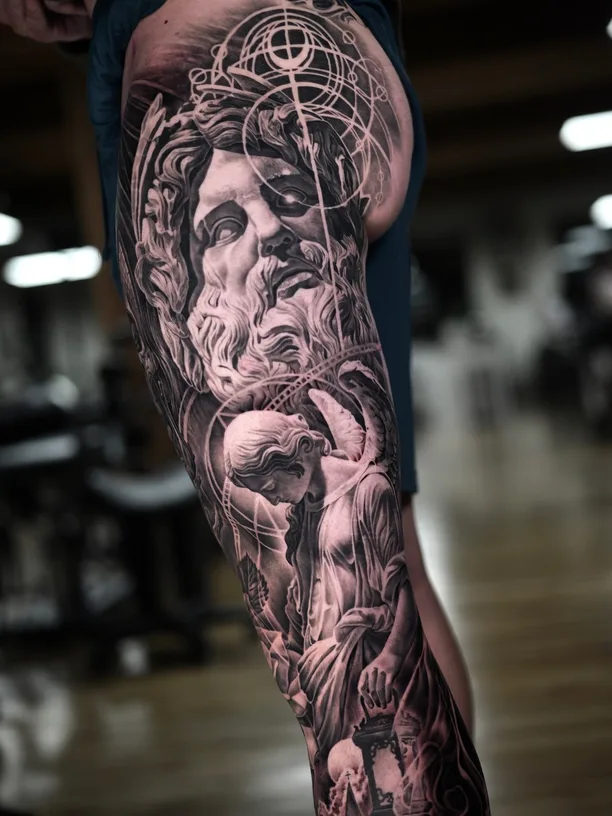
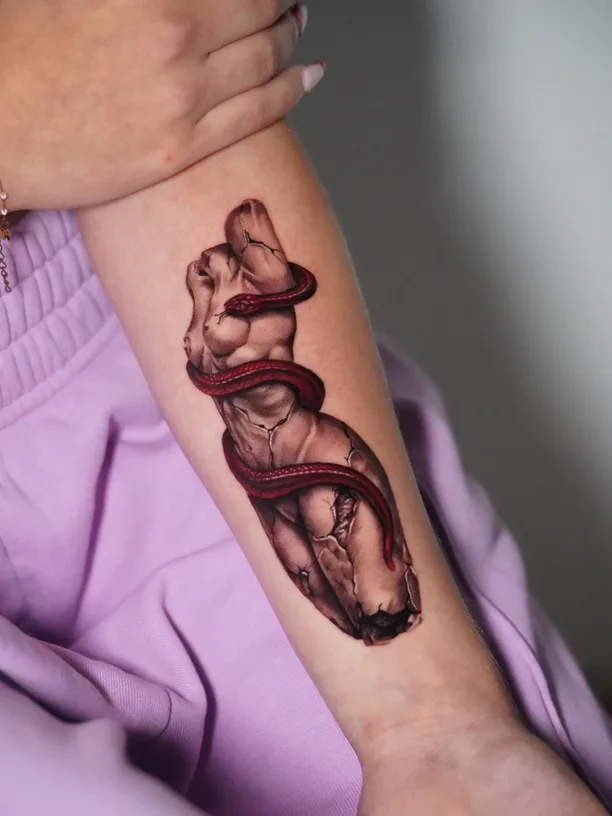
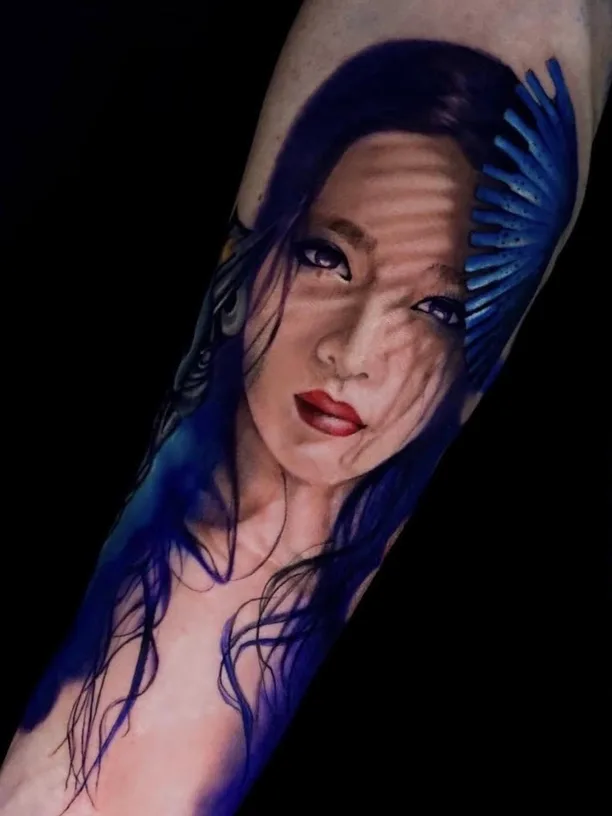
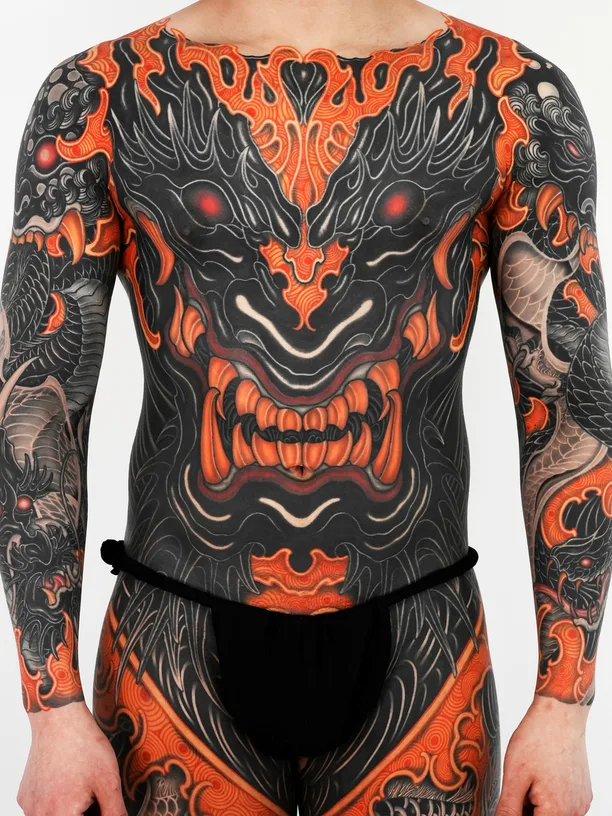
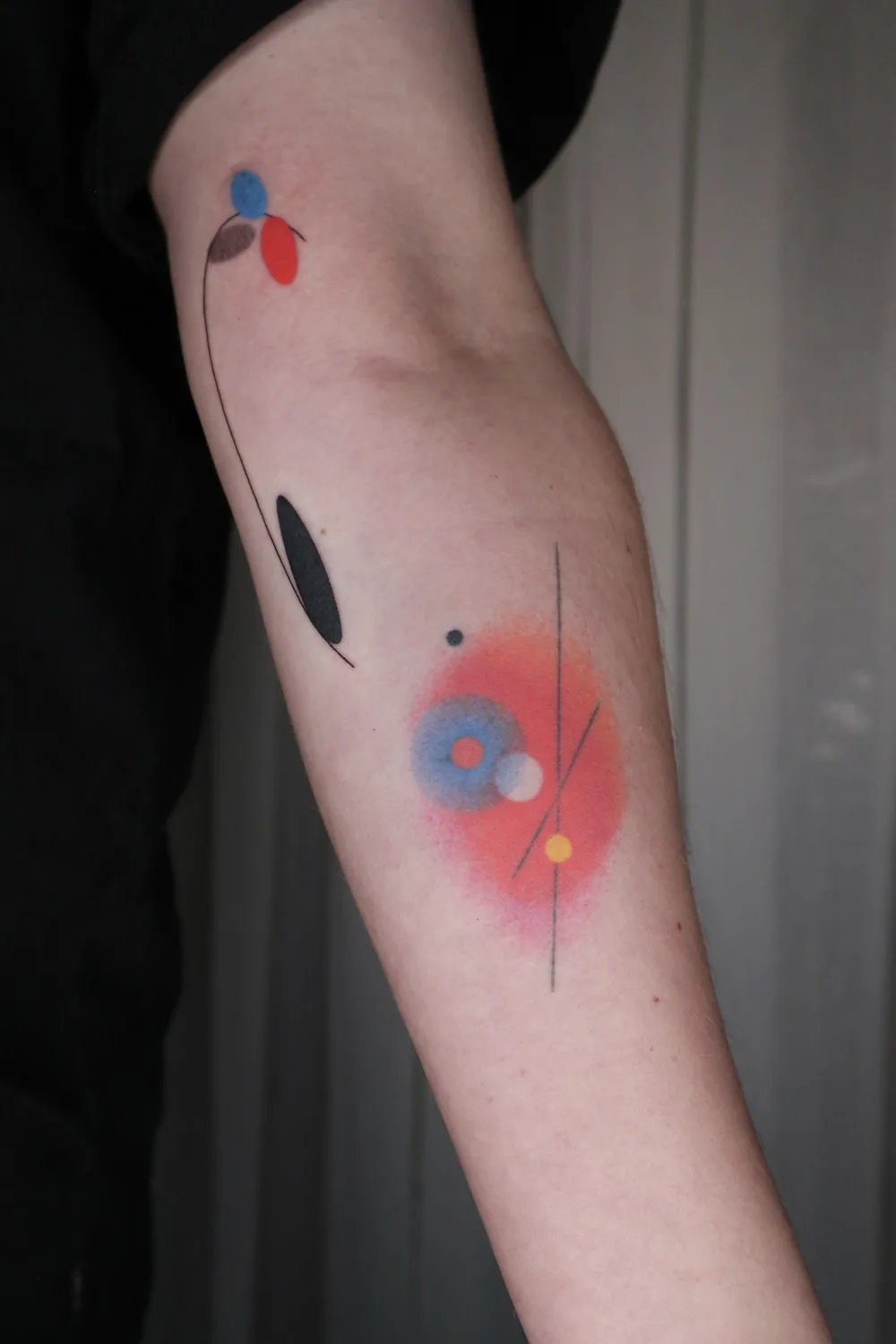
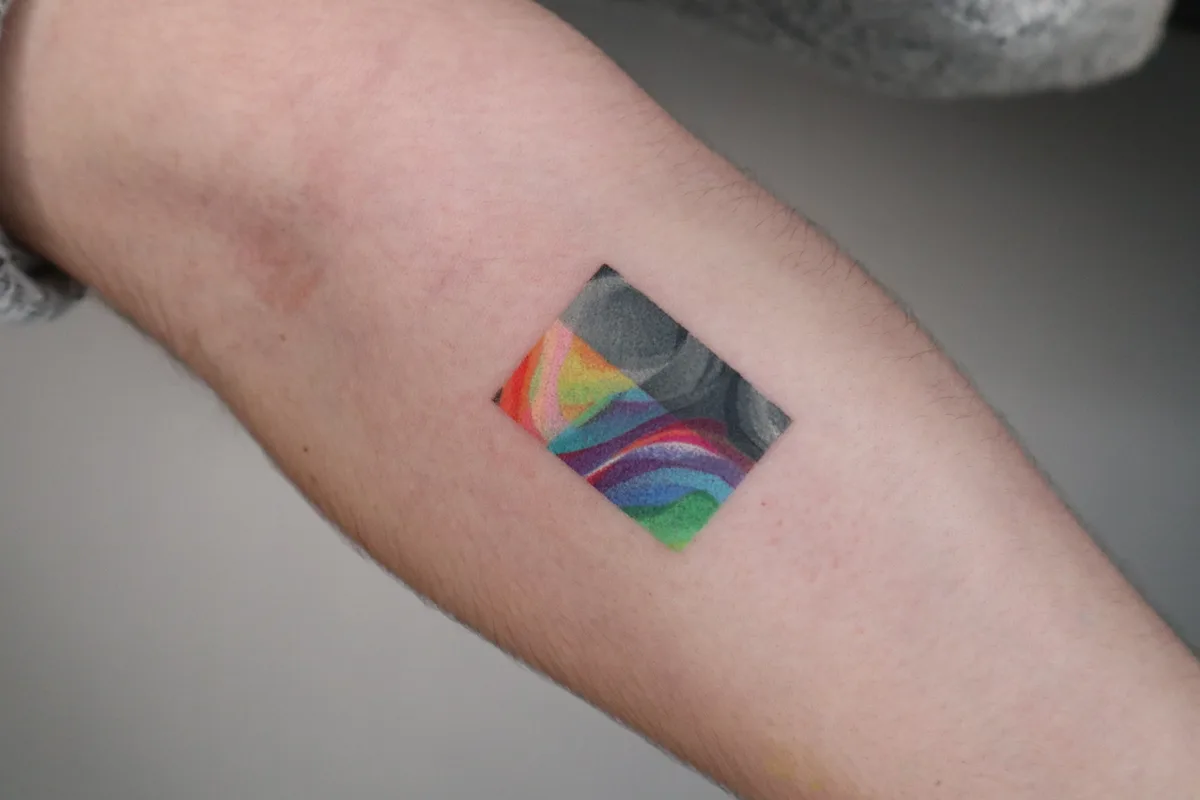
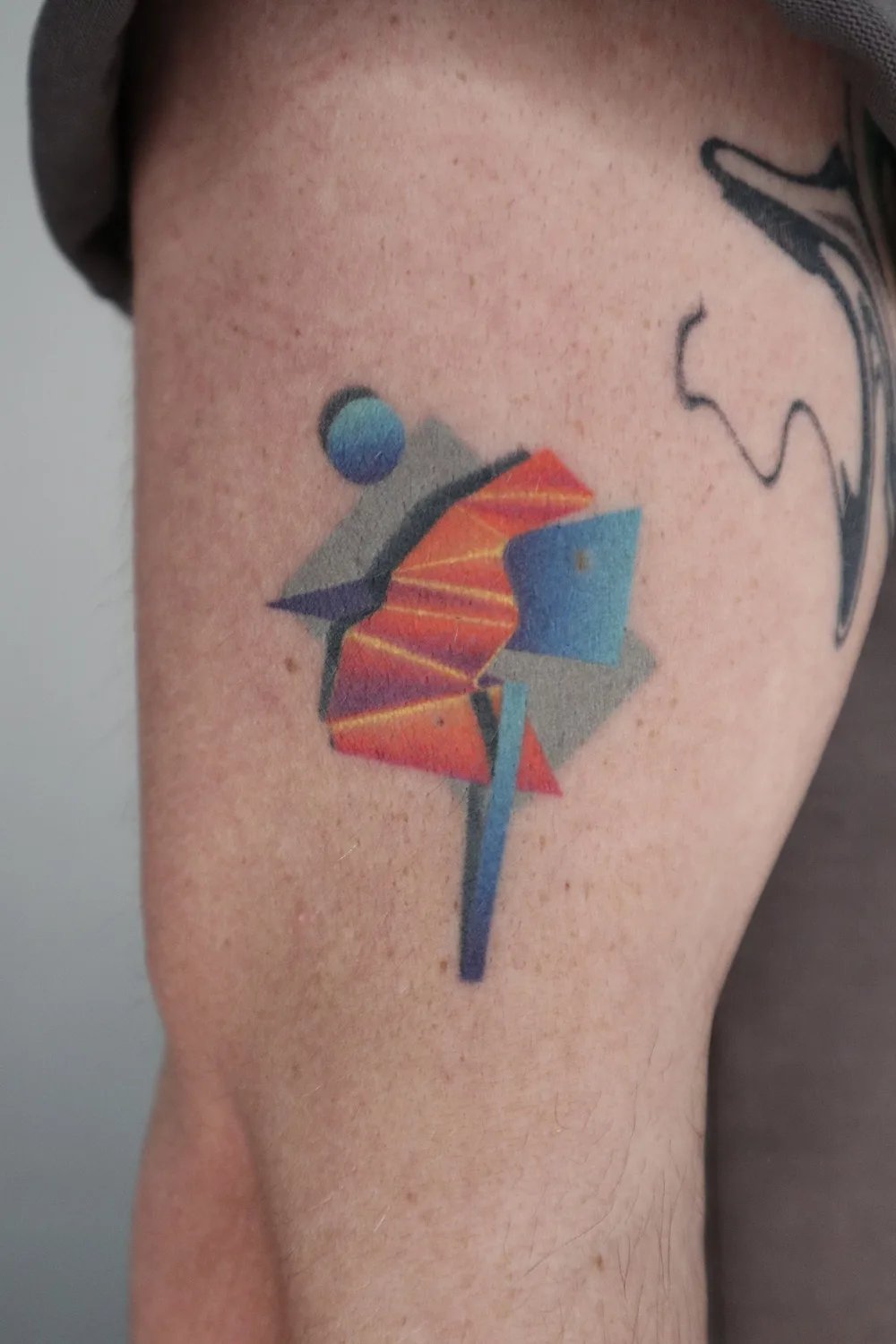
Macarena, also known as Maca or Blekanddots, is a tattoo artist from Chile working in Santiago. Her style is built on a combination of abstraction, graphic thinking, and a delicate painterly approach to color. Through geometric forms, soft tonal transitions, and color, she creates tattoos that feel thoughtfully composed both as images and as forms integrated into the body.
This way of thinking is directly connected to her artistic foundation. In this conversation, Macarena reflects on the role of color theory, composition, and knowledge of materials in the making of a tattoo artist.
She does not separate theory and practice into two different worlds, but sees them as inseparable parts of the same process — one that shapes not only how an artist learns, but also how they grow, solve technical challenges, and achieve results that stand the test of time.
— Tell us a bit about yourself. Where are you originally from, and where do you currently live and work?
— Hello! I'm from Chile, born and raised here, and I'm still based here. I've been working in a couple of studios the last 7 years in Santiago, but currently I have my own and private space.
— You describe yourself as a multidisciplinary artist. Which forms of art did you start with before tattooing?
— If my childhood counts, I experienced and learned many things from a very young age.
I was a very curious child, contemplating and observing everything around me, asking countless questions, and my mother was always willing to teach me what she knew whenever I asked, “How do you do that?”, because I wanted to understand how things were done. She taught me to read and write from the age of four because of my fascination with words, to weave on a loom, to embroider, to crochet, and to paint on my clothes. I learned to weave with glass beads simply by watching my father, who did it as a casual hobby.
I drew and painted all the time for as long as I can remember, and during elementary school, I learned to sew and knit with needles. I think that back then, and probably until high school, I didn’t feel that all of this was very relevant or serious in my life. I saw it as a simple hobby because it was something very normal in my daily routine, and I was wrong.
I studied Fine Arts, where I specialized in Color Theory and Photography. My university program was very comprehensive, and for the first two years I had to learn all the techniques: drawing, painting, printmaking, digital and analog photography, video, mixed media, ceramics, sculpture, arc welding, etc. It was mandatory. This helped keep my curiosity alive, which later led me to wonder, “How different can it be to paint on skin with needles?”
As soon as I graduated, I worked primarily with oil painting, photography, and paper models until I started tattooing.
— As far as we know, you have an academic background in art. How did your studies influence your approach to tattooing?
— I believe my studies prepared me for a very different relationship with, and perspective on, materials and tools, and on the creative process in general. They also gave me the desire to turn tattooing into painting, to forget that they are separate things. I made them one in my mind, so I started doing the same thing I would do with oil paint, but through tattooing.
I have studied my color palette deeply for years and continue to do so: the quality of pigments, how stable they are after the healing process, and so on. I have modified my palette over time, experimenting with many colors and different brands to see whether they are similar or not. Sometimes, due to lack of stock, I would run out of my favorite colors, so I discovered their equivalents in other brands for emergencies. My knowledge of pigments also comes from my specific studies in Painting, in addition to my own reading and research after graduating.
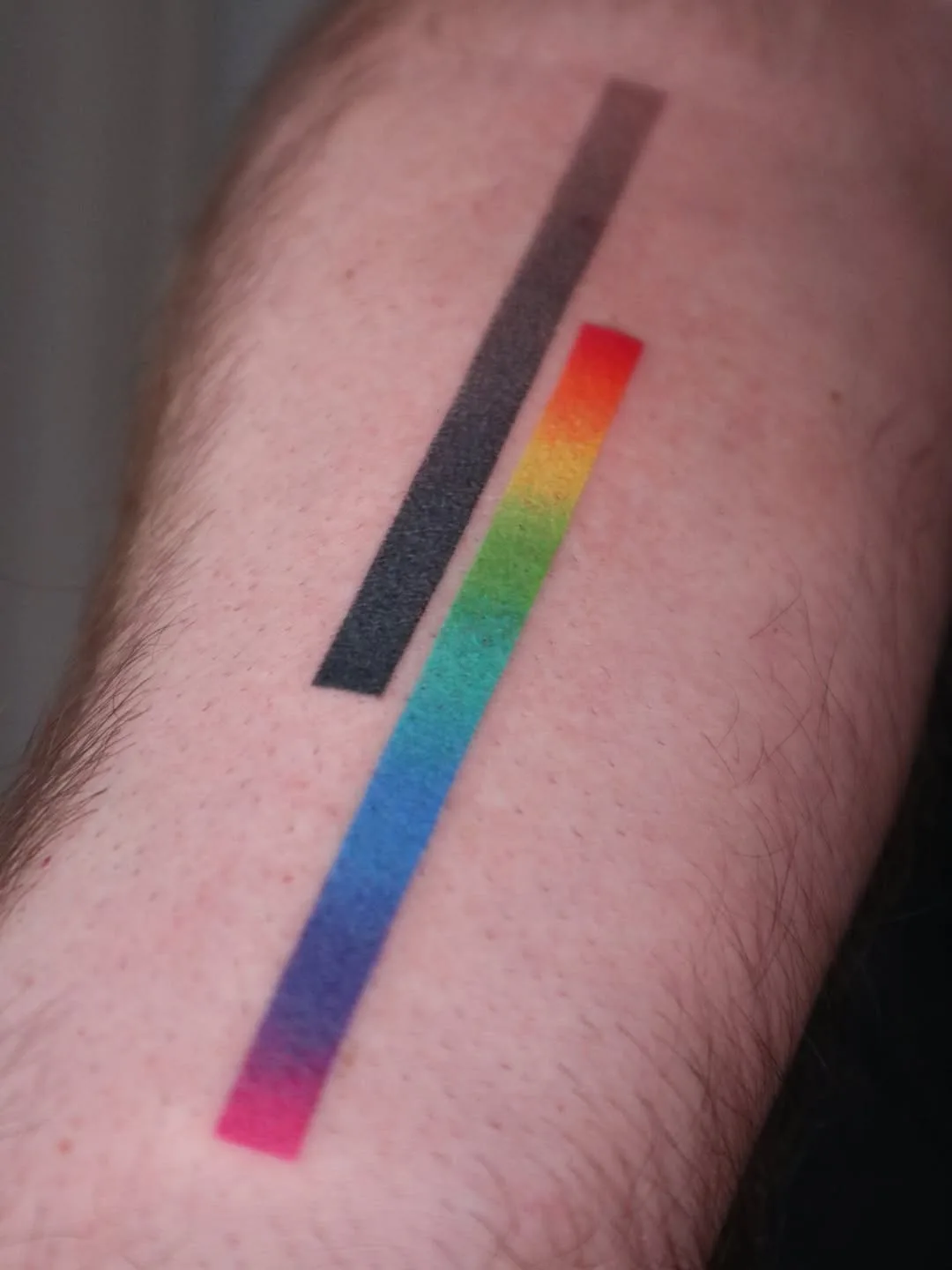
I think painting is where the characteristics and properties of color, and all of its theory, are explored most deeply, from both a physical and chemical perspective. Today, all of that knowledge helps me make better decisions to guarantee the results my clients expect, as well as teach and communicate why one result would be better than another, and how colors interact with each other or with their skin tones.
My academic background also made me see everything as colors and shapes within a space. It helped me abstract not only from an aesthetic perspective, but also from the process itself—the way I see, think, and apply or modify methodologies in any technique. All of this allows me to achieve results more efficiently.
— At what moment did tattooing become your profession? Tell us when and how this transition happened.
— A year after graduating from university, I apprenticed full-time at a tattoo studio during my summer vacation in 2015. This allowed me to practice everything from setting up the table to assembling and disassembling my coil machine. I learned to tattoo with a machine first.
After starting to practice tattooing with and without a machine, I focused more on becoming independent from my parents, so I stopped practicing regularly and looked for a stable job. At the beginning of 2016, I worked for a month as a photographer at a jewelry store, and the following month I was hired as an Art Director at an advertising agency, where my job involved creating paper models, producing stop-motion animations, DIY videos, food styling, and other tasks. I worked there for a year and a half.
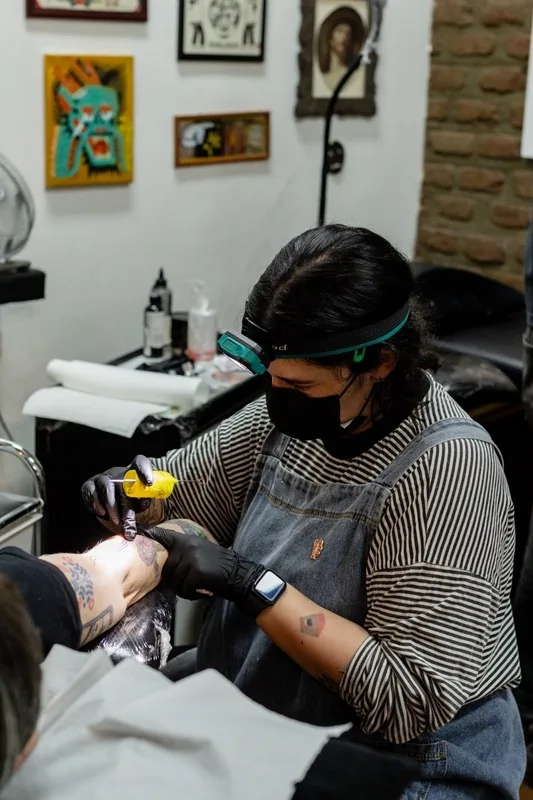
During that year and a half, I occasionally tattooed a family member or friend, until one day one of my teammates discovered I could tattoo and asked me to tattoo him. That was the first step that changed everything, and honestly, I never would have imagined it, because I also chose to tattoo him without a machine, which meant reconnecting with handpoke, something I had practiced the least at the time.
The next day, word got around, and little by little I started receiving new commissions, so I decided to tattoo on my days off. In just a couple of months, I realized that I really enjoyed tattooing, that I missed it, and the truth is, I hadn’t been enjoying my work for a while. I felt a bit stuck at the agency, very limited in my creative development. I remember constantly walking home thinking, “What’s the point of having studied art if I’m not practicing it? I didn’t study this just not to do it. I’m wasting it. None of this makes sense.”
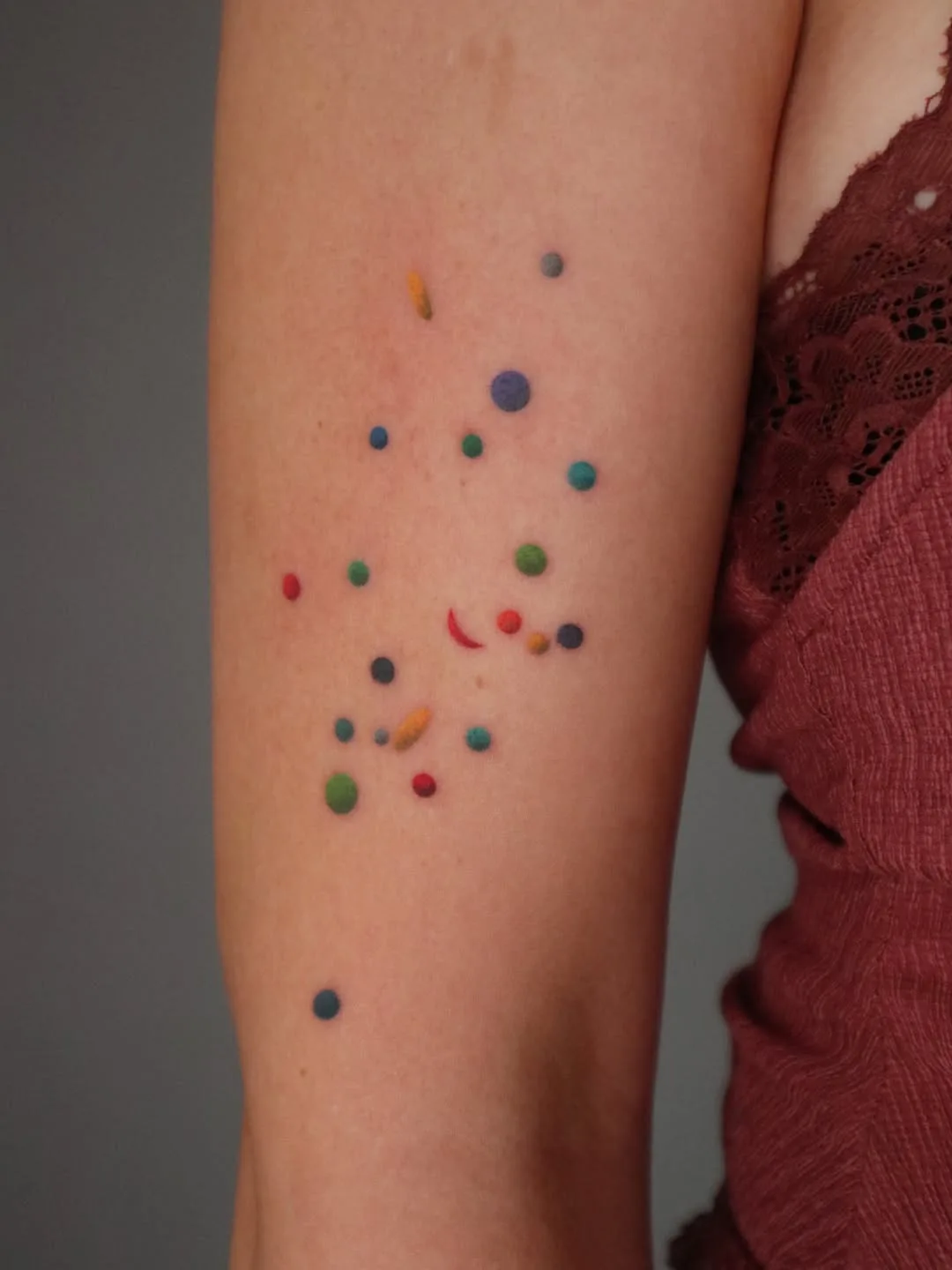
I thought about it for another month, almost convinced to quit. I talked it over first with my inner circle—my best friends, one of my brothers, and my mom. My brother told me, “Imagine the ideal scenario for your current job, with exciting ideas, more freedom, and a much higher salary. Would you be happy?” I said no. Then he said, “And if you were paid ten times your salary, would that be enough to make you happy?” For me, the answer was always no.
I quit my job in August 2017, with no savings, nothing. Just my desire to paint on every possible surface and make a living from art. It was all worth it, and here we are.
— Many artists say that tattooing is learned mostly through practice. In your opinion, how important is theoretical knowledge—such as color theory, composition, and art fundamentals—for a tattoo artist?
— Although I completely agree with that statement, I believe there’s also a less explored, or perhaps less discussed, aspect based on traditional stereotypes about how a technique—not just tattooing—should be learned. I think certain stereotypes are sometimes romanticized, which prevents a complete perspective on things and their possibilities. For some reason, which bothers me, despite how ancient the art of tattooing is, it isn’t recognized as a formal discipline. This has been perpetuated for centuries.
For a while, I myself kept my mind compartmentalized, as if everything I studied had nothing to do with tattooing, and I felt very foolish and ashamed later, because it has everything to do with it. Tattooing is pictorial, it’s illustrative, and it could even be considered sculptural to me—working with a two-dimensional design on a three-dimensional surface. It’s a complete discipline, and the moment I stopped compartmentalizing my mind and applied all the theory and technicalities to this discipline, my process changed and my entire work changed.
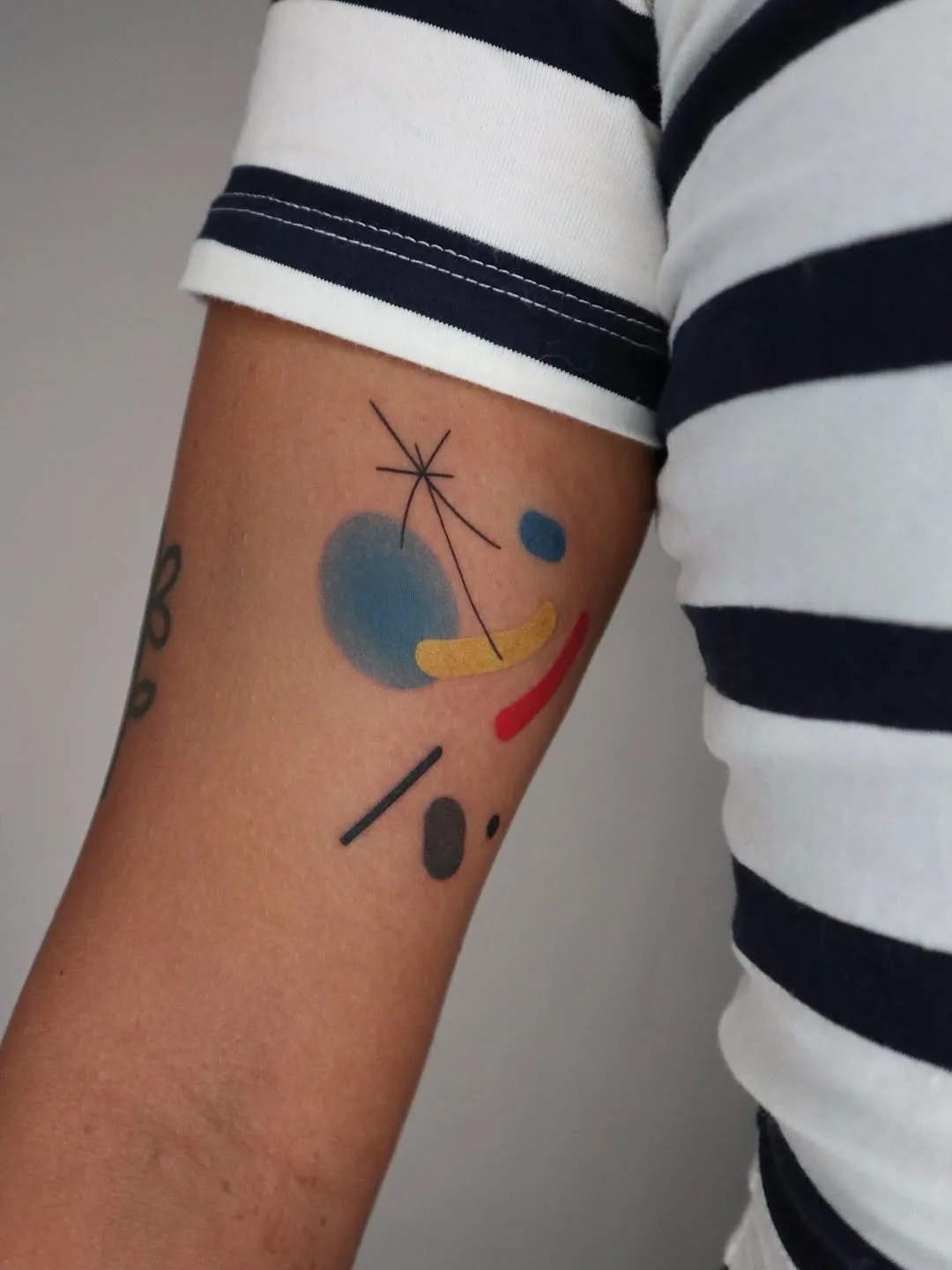
Personally, I believe that having technical and theoretical knowledge of a discipline is immensely important and makes your entire process more efficient. You make more intentional and conscious decisions, and less is left to chance.
I think many artists intuitively apply theory and technique, and that doesn’t make their knowledge any less valid, but knowing why you do what you do can even change the way you observe and how you propose or develop your ideas.
Practice is a crucial part of the process — practice makes perfect, right? — but theory is also essential, and they shouldn’t be considered separately. Definitely both are fundamental to our development.
Sometimes I also think that perhaps there is just a misconception of what theory is and what it isn’t, and that maybe we’re talking about the same thing, just with a different name. Understanding how things work and what they’re made of — machines, needles, inks, skin — is pure theory.
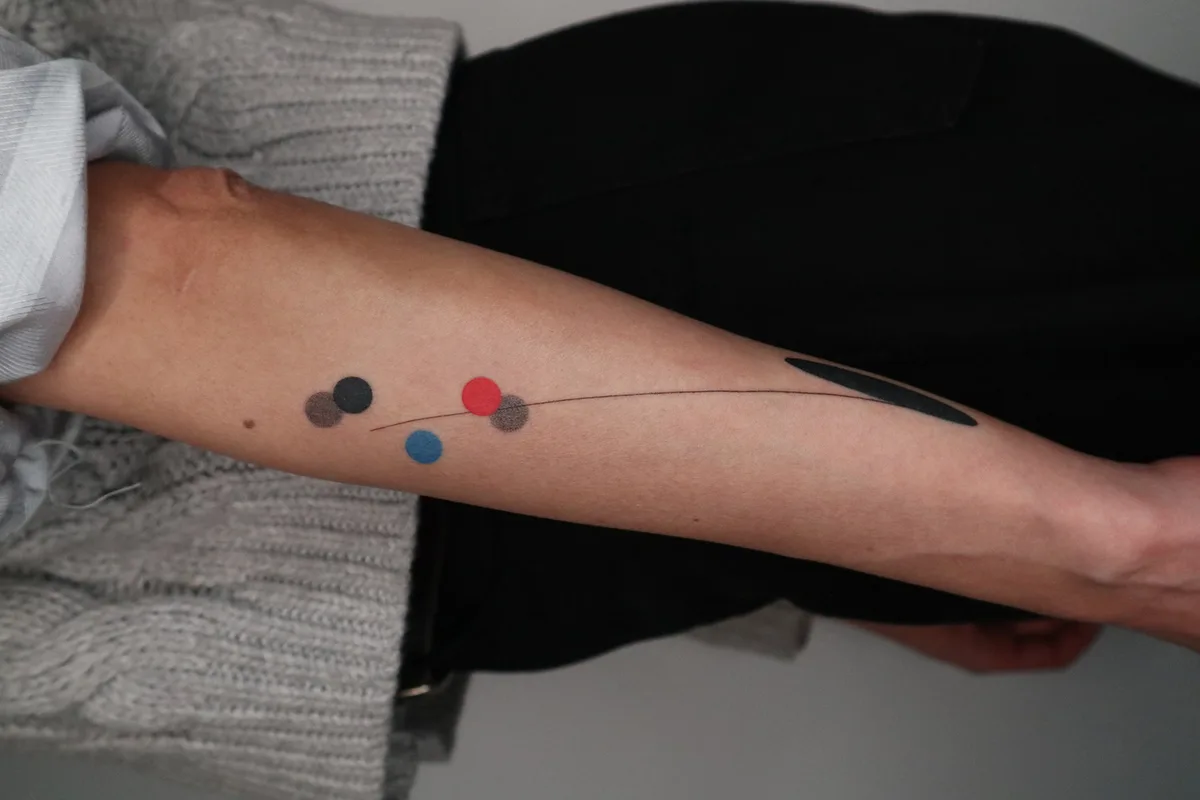
— How does your understanding of color theory influence the way you design tattoos and choose palettes for different skin tones?
— It is basically one of the backbones of my work, regardless of the style or elements I want to compose with, whether in color or in grayscale.
I believe it accounts for 50% of my work. I use it from beginning to end; it’s not even something I have to think about or decide anymore. It’s as natural as breathing or blinking; it simply exists as an extension of me. But I do have steps to follow.
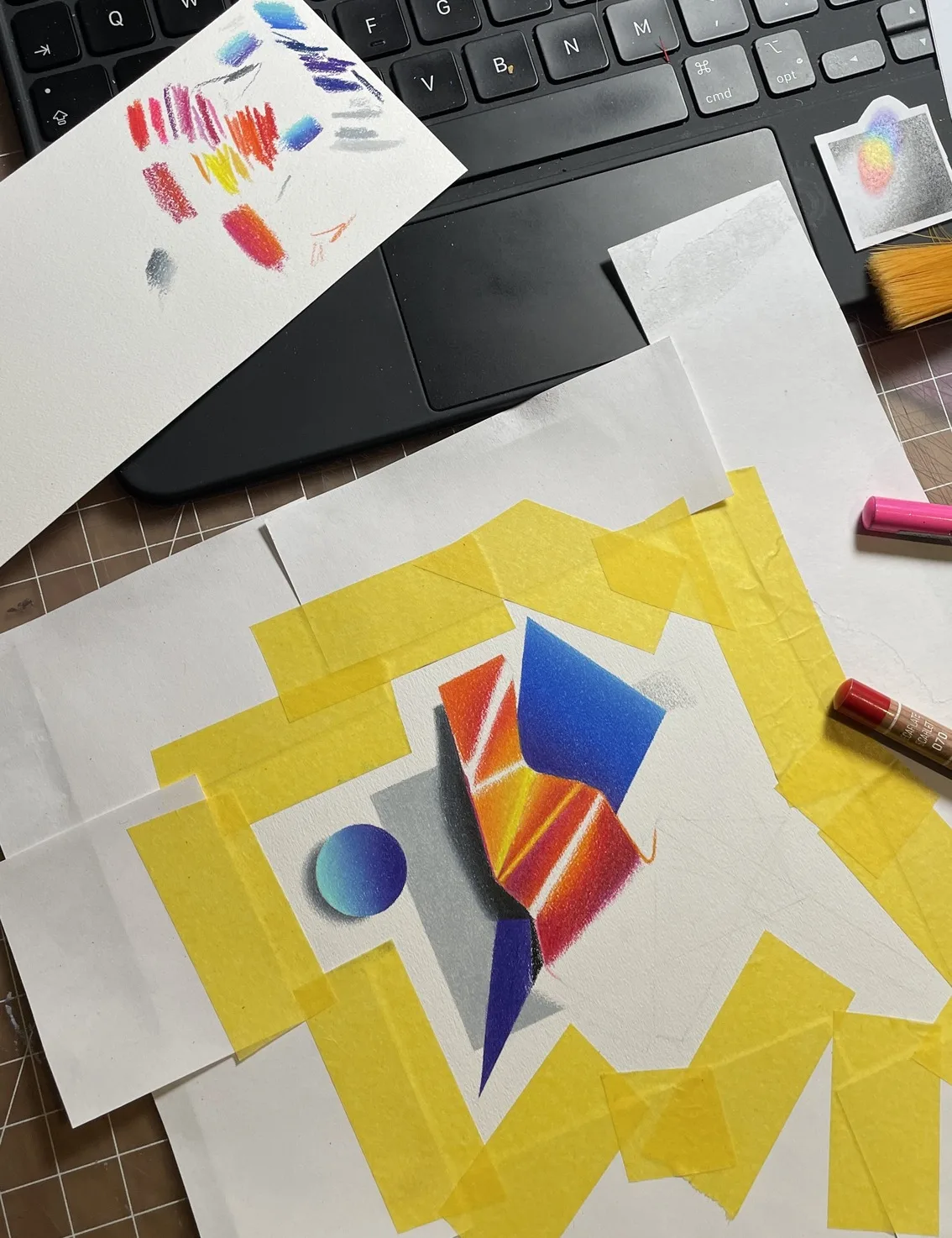
To minimize the margin of error in custom projects, I send my clients a color palette with reference tones so they can determine where their skin tone falls. Their response doesn’t exclude them, nor is the color exact, because the screen projects light and the skin absorbs it, but it helps me understand the range of light I can work with when developing a design, make technical decisions accordingly, and, depending on the case, explain why we should change some colors to achieve what they’re looking for.
Of course, if I receive requests for colors that aren’t viable for their skin tones, I won’t lie to them, and I’ll explain that it’s not a good idea, that it won’t stand out, etc., so they also understand how the theory works in reality, or often to debunk myths about color in tattoos or skin tones.
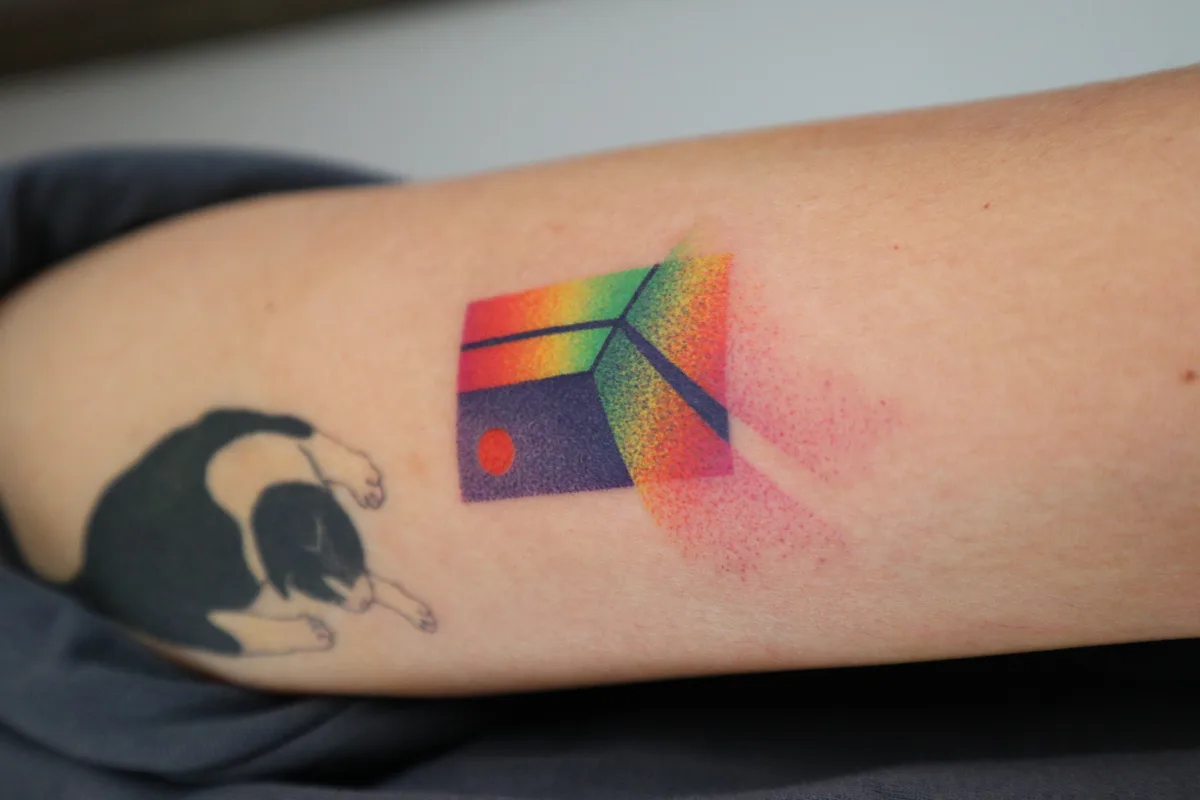
Composition plays a crucial role in painting and illustration. How do you apply compositional principles when working with the human body as a canvas?
— I compose twice: first in the design, and then on the body.
I follow the basic principles of composition — unity and balance — in addition to the objective of each design: whether there will be dynamism or not, movement, rhythm, virtuality, statics, etc., and how to maintain the same feeling when incorporating it onto the body. The curves and volumes of the body influence the design; I consider the movements of the muscles and, of course, if there are other tattoos in that area, how all the factors interact with each other in complete harmony.
Each time I compose a design and place it on the body, my goal is for it to work alongside what is already there, but also separately. I want the pieces to complement each other and for none to detract from the others, so that when observing the “canvas,” the visual reading is homogeneous, as if it were all a single composition on the body.
Depending on the design, I sometimes work in a “collage” mode, where I have different stenciled elements — lines, shapes — that I then place separately to make them fit the space perfectly. And if the project requires it, I also do a mix of stencil and freehand.
Knowing and being able to use the technical principles of composition also allows you, conversely, to create designs with specific points of interest if you want to break the balance. It’s all a lot of fun.
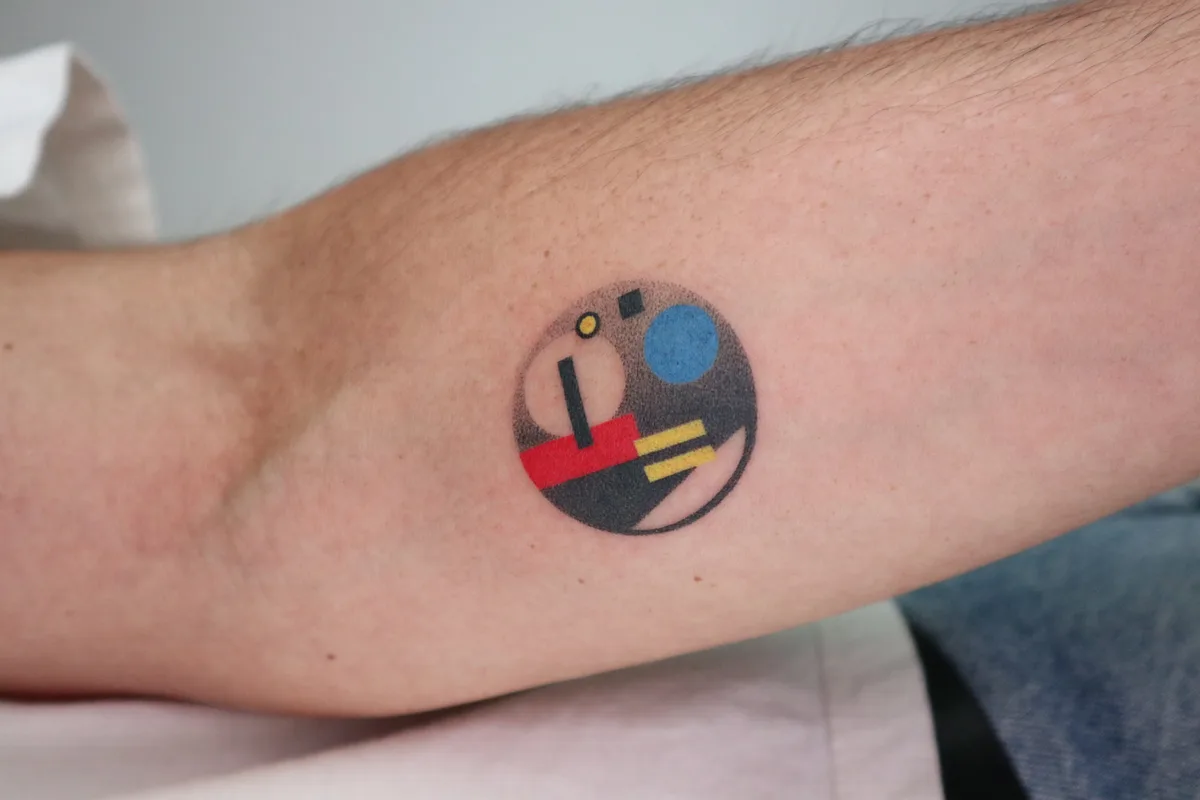
— Tattooing also requires deep knowledge of materials and tools. What technical aspects of the craft do you think young tattoo artists often underestimate?
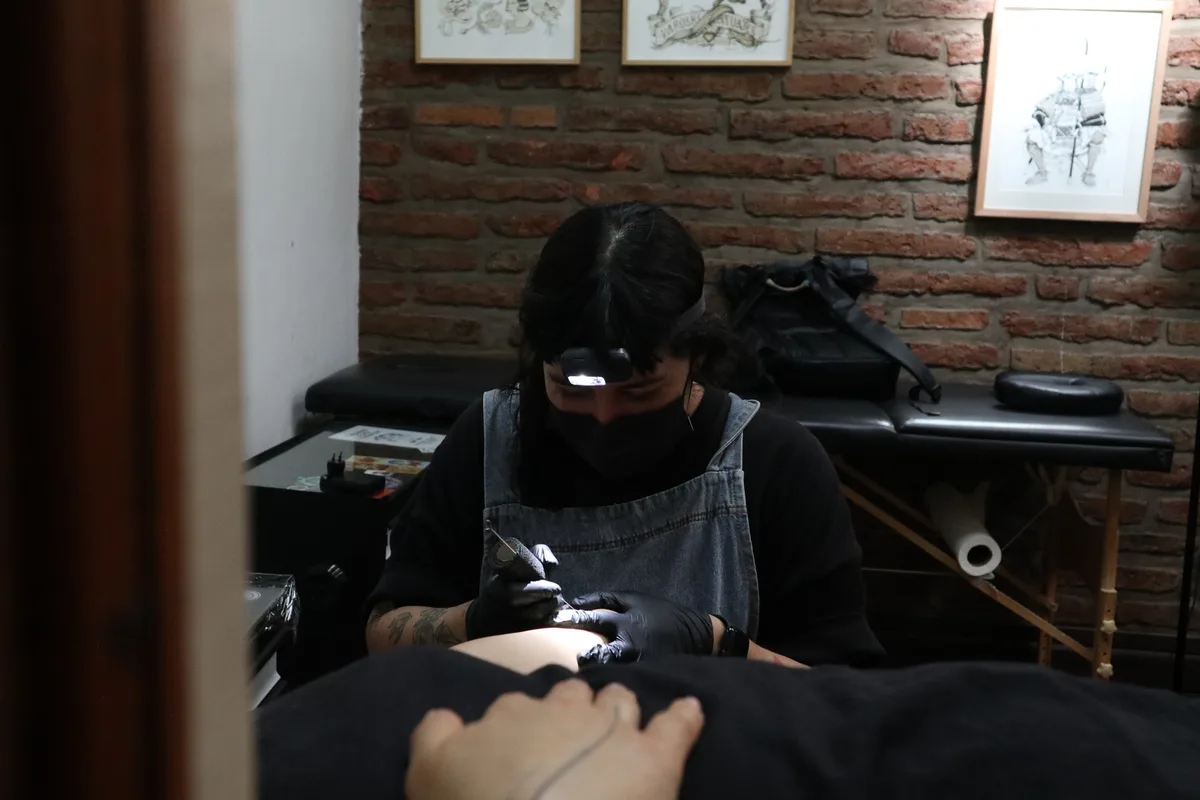
— This is a hard one. I would say the stencil, and the quality of the materials, and how they influence the result.
I never forgot a phrase from my mentor: “Your stencil must be perfect, otherwise knowing how to tattoo is useless.” And yes, I kept that advice in mind forever.
If your stencil isn’t well done and then isn’t properly applied to the skin, it can negatively affect the result.
Years of experience can always give you the advantage of being able to improvise when something is erased, or to correct the stencil by hand, or even to adjust the application or transition of different tones within the drawn areas, but it’s not something we should attempt at the beginning if we don’t have a firm grasp of all aspects of this technique.
Also, over time, depending on your style, you learn to create your own ways of differentiating areas with shading, filling, or texture, and you understand your own language of guidelines in your stencil.
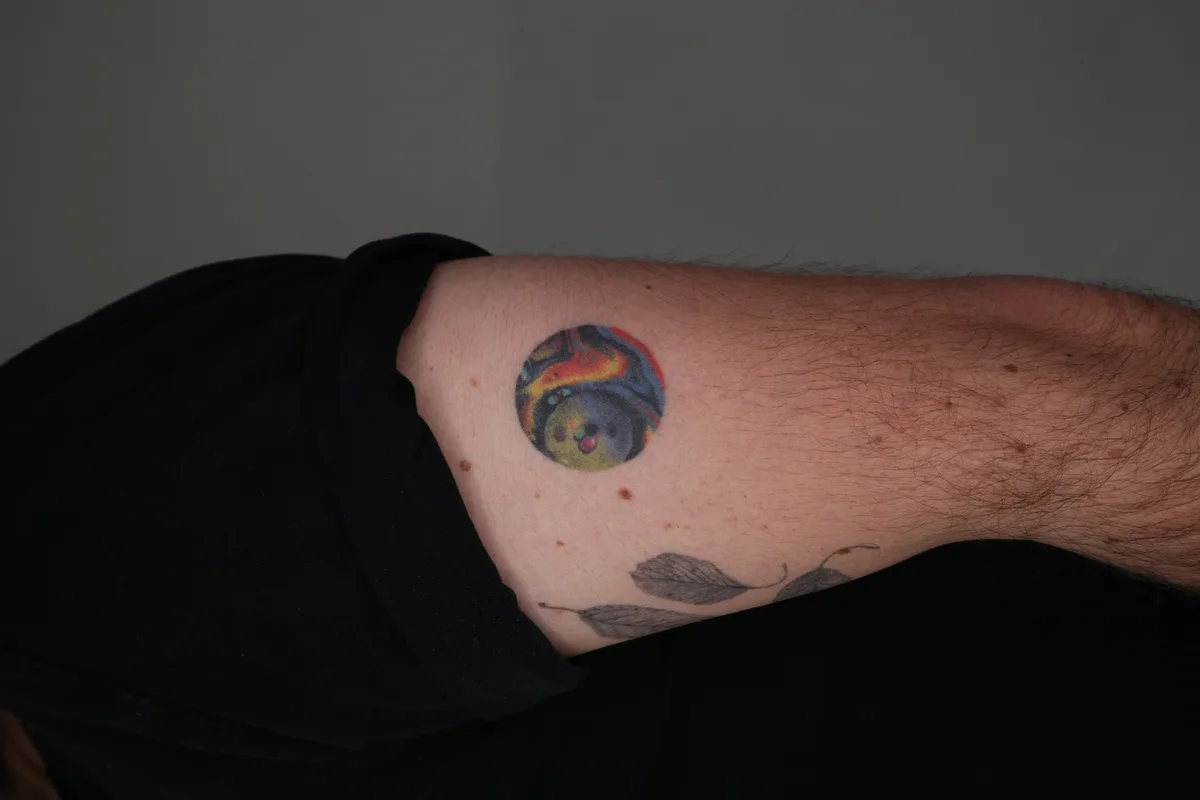
And about materials, I know from personal experience that at the beginning it isn’t always affordable to get better tools or inks based on their quality, because they aren’t cheap when you’re learning as an apprentice.
But it’s worth investing, and in the long run, when you have more financial stability, skimping on expenses instead of investing in your materials shouldn’t be negotiable.
For me, the most noticeable difference lies in the needles and inks: in the quality of the pigment, the color opacity, its flow, or whether it loses saturation during the healing process. Does the color change while I’m tattooing? Does the color change after the healing process? How fast does it change, and how? Does it become warmer? Less bright? Etc.
And with the needles, there’s the resistance and strength they have depending on what I need to do with them, and the sharpness as well. How consistent is the size of my needle? Are they all 90–99% similar, or are some wider than others? Do I need to push the needle harder when I’m using this brand? How often do I need to change it because it no longer injects the ink the same way? Does this needle damage the skin more than another one of the same size? How consistent is my line? How smooth is the dot?
Of course, the same applies to the machines: their stroke, weight, and power.
— Do you believe that stronger theoretical training can accelerate an artist’s progress in tattooing? In what ways?
— Absolutely. It’s like a kind of shortcut — not because you skip steps in the tattooing process, but because the approach is different, less overwhelming maybe.
I feel that understanding the laws of drawing, composition, the arrangement of forms in space, and the use of color both theoretically and practically allows you to apply all that knowledge to any two-dimensional or three-dimensional surface, regardless of material, technique, or style.
It becomes a bit easier to adapt to surface changes and the inconsistencies of different materials.
All that theoretical and technical preparation helps you resolve the challenges of the process more quickly, so to speak.
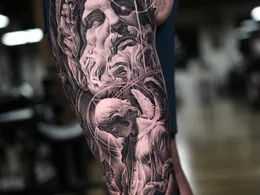
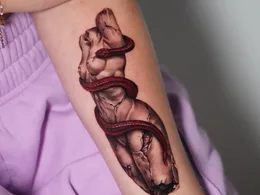
But of course, it’s not a perfect formula or the only way, because skin isn’t paper or fabric, and you only learn that by tattooing, practicing, and learning from people with more years of experience than you, asking questions and exchanging information, which for me is precisely the theory of tattooing.
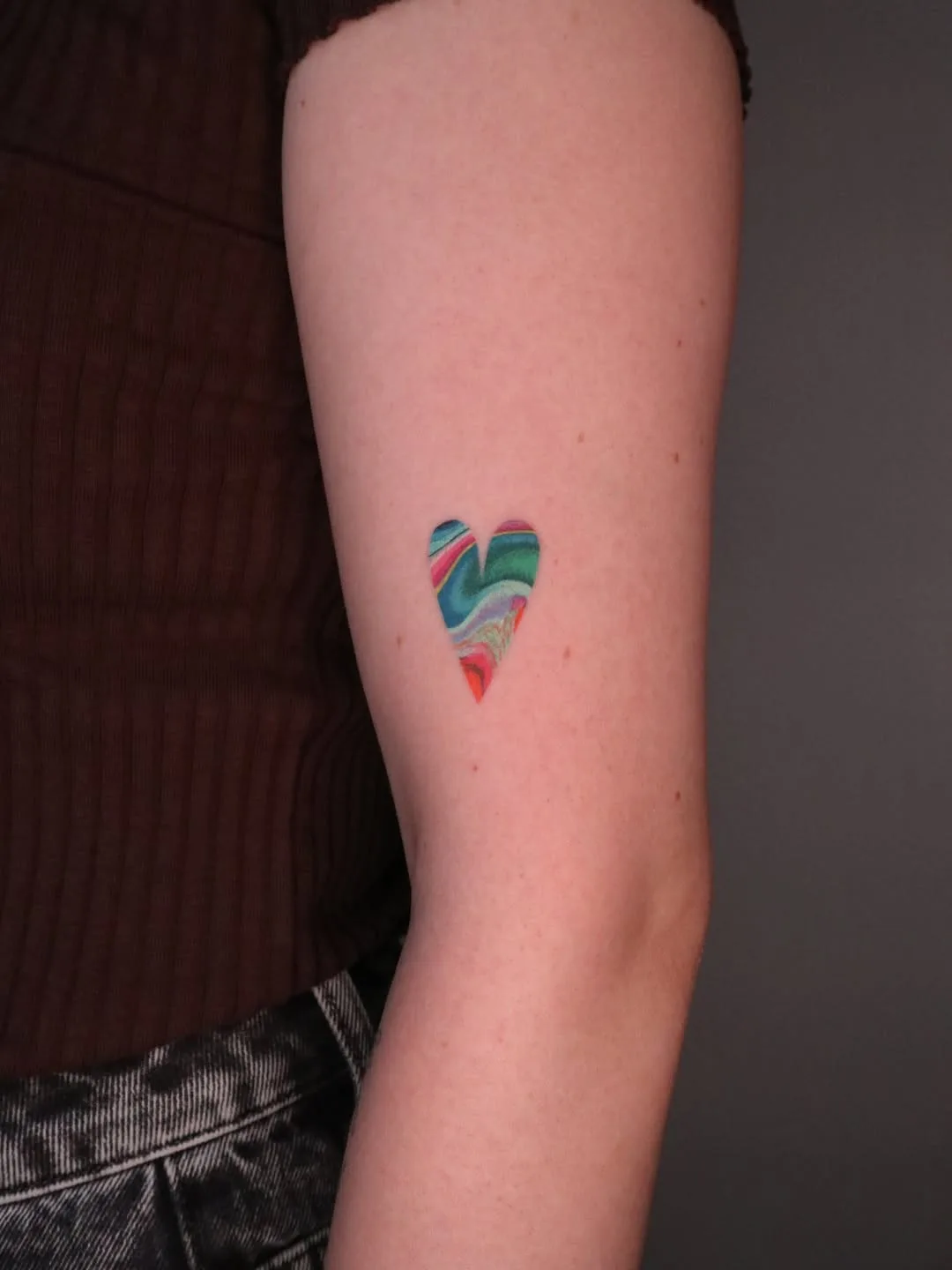
— Your tattoos are known for their vibrant colors and graphic approach. How did your visual style develop over the years?
— I think my fear of showing what I really wanted to work on gradually shifted, and my confidence in what I actually knew about color and painting also changed.
When I decided to put all of that on the table and trust blindly in what I did know, I began to pay closer attention to, and study, what I didn’t know or understand: how color behaves on the skin, its reaction and interaction. I focused so much on that that the visual aspect developed organically.
Painting became vital to me; light was already the most important element of my work, and all that remained was to find a way to use all the elements in a fun, symbolic, and often intimate way.
I revisited my university thesis from 2013–2014, which dealt with the creative process, the use of memory, recollections, the senses, time, and how to translate that into a visual language. The thesis itself reminded me of Kandinsky’s writings on composition and color, which I had used in my research.
Representing ideas abstractly feels like visual poetry to me; in some way, it’s about using metaphors all the time. A color or a shape can represent a place, a moment, a feeling, or a person.
Kandinsky was by far the best inspiration to spur the search I was afraid to begin, but so eager to explore. That’s one of the reasons why my work became more graphic.
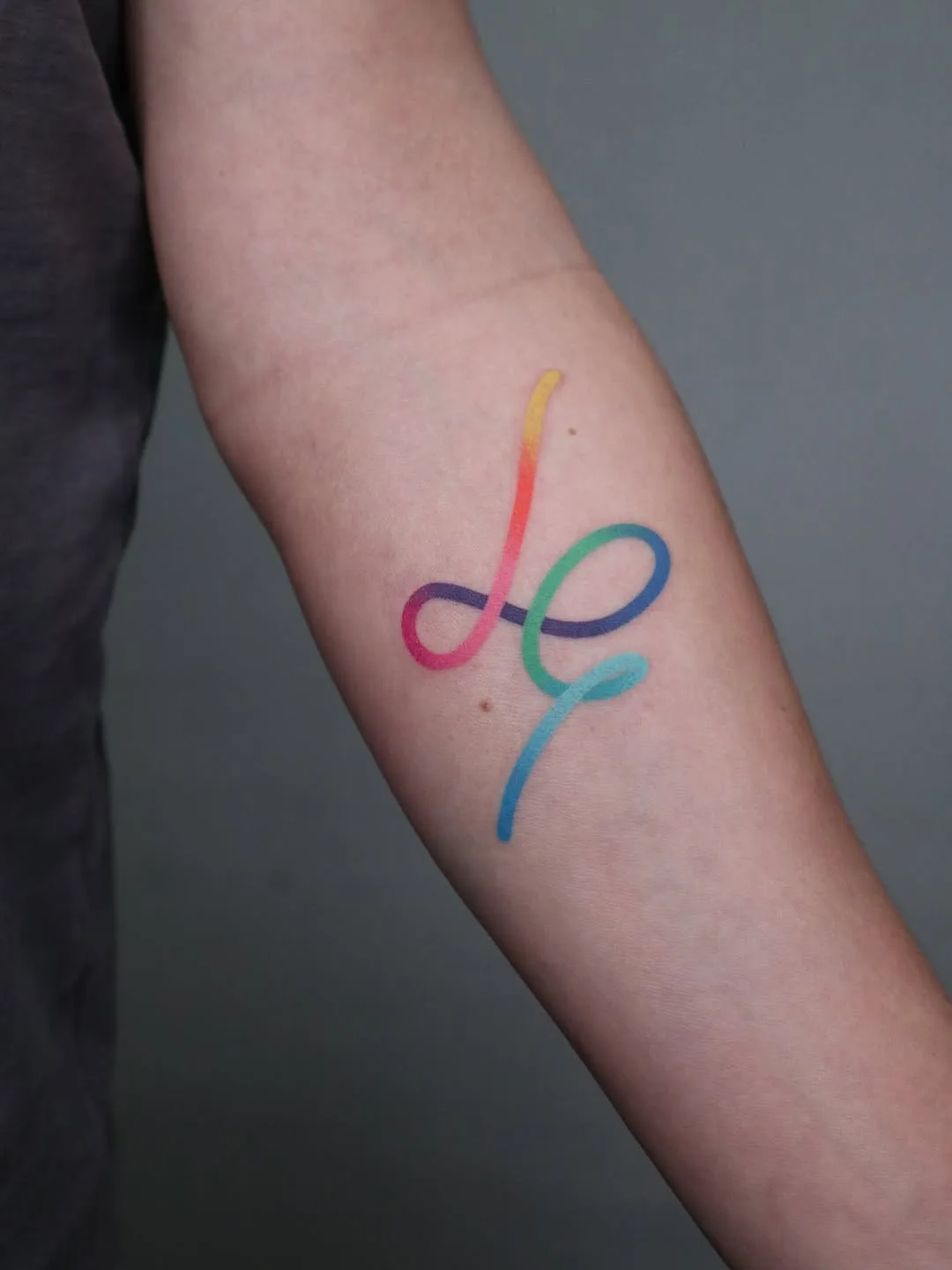
— How has your style evolved throughout your career? Were there any turning points that significantly changed your artistic direction?
— I think it was something like a “silent presence” of my current style. I’ve always been a big fan of Claudio Bravo, the Bauhaus, Kandinsky, Yayoi Kusama, Edward Hopper, Monet, among others. What I liked most about them was their use of light, the balance of their compositions, and their color palettes.
In 2013, when I wasn’t even planning on learning to tattoo, I got my first tattoo, and I wanted it to be a marbled paint triangle, without outlines, just color. The tattoo artist told me that everything I was asking for was impossible to do because it had too many details, and that it wasn’t normal to do tattoos without outlines, that my idea wasn’t feasible.
After negotiating for a while, he agreed to outline it with the lightest color and simplify it “a little.” Of course, I didn’t get anything like what I wanted, hahaha, although it’s not terrible.
And well, I didn’t know anything about tattoos, so I believed him. And it’s crazy because, fun fact, six or seven years later I was tattooing that marbled effect that was supposedly impossible.
Since I’ve always painted and drawn in realism and hyperrealism, that predominated in my work for a long time, but there has also always been a tendency to work with geometry, color theory, minimalism, and architecture.
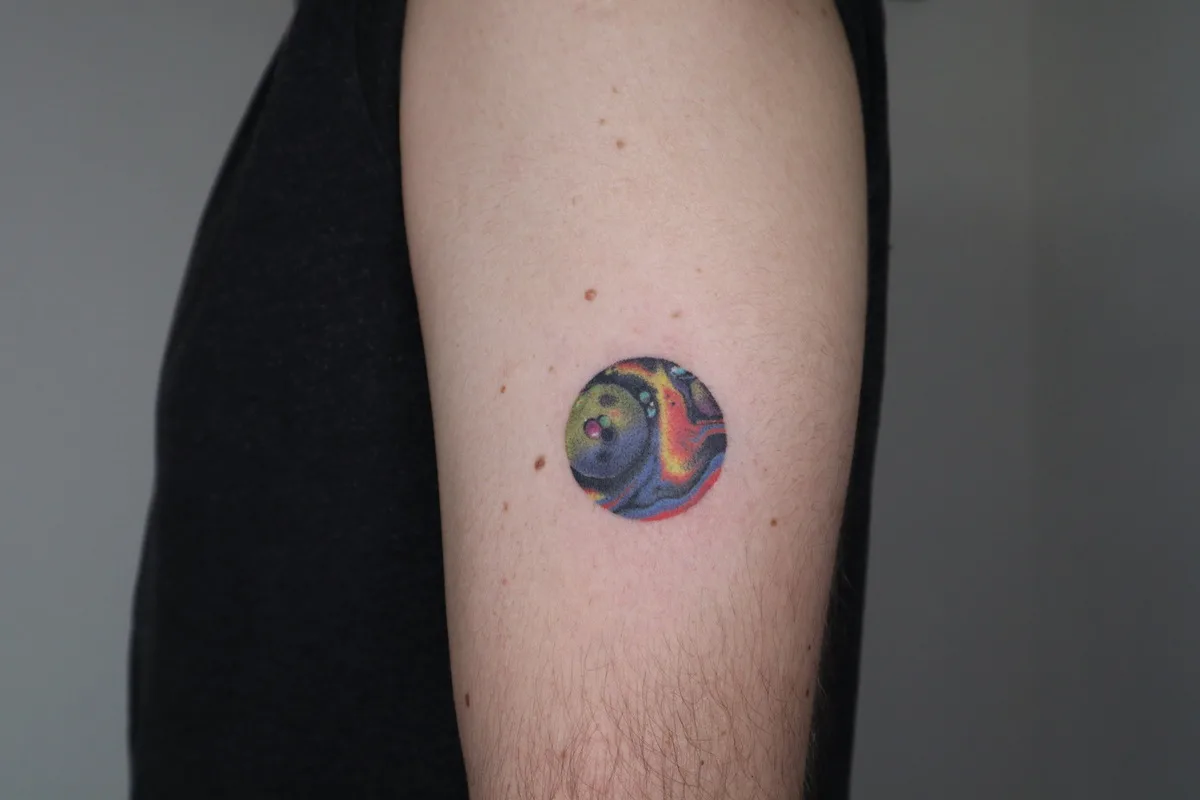
Since I learned to tattoo, I’ve designed and worked in all kinds of styles because I learned the old-school way, where you’re supposed to learn to do everything well, perfectly. But despite trying to offer my more minimalistic, abstract, or geometric proposals at the beginning, they never took off. I only had the opportunity to work with my own ideas or designs very briefly, until 2018 or early 2019. At that moment, gradients were the most abstract and popular thing in my portfolio.
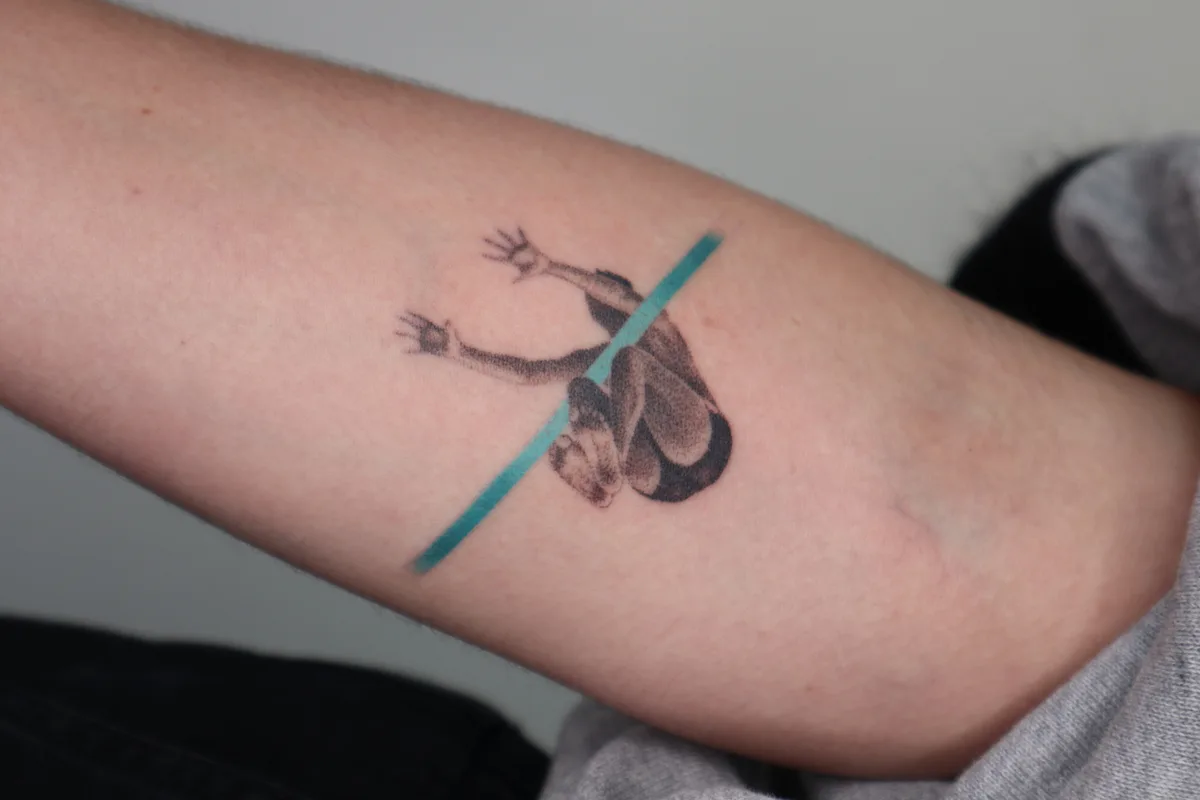
Despite wanting to find new ways to express my art, I’ve always had this duality of wanting to work between the figurative and the abstract. I love hyperrealism, I can’t help it, but I also immensely love abstract art, and I was determined to dedicate more space to abstraction because it had been waiting a long time, wanting to surface.
During the 2020 quarantine, I had the opportunity to spend a lot of time in my studio — a room I converted in my apartment for painting—and I focused on developing ideas and sketches that had accumulated in my mind and in sketchbooks. I also had plenty of time to review my archives, and in my photographs, which I’ve been taking daily since I was 17, I found a pattern: my everyday photographs capture abstract details of the world, minimalist compositions where sometimes color takes center stage, along with angles and light. Everything clicked, because one way or another, no matter what I’m working with, certain common threads remain in my work.
Silently, without fear or shame, I began to paint my ideas in oil. I felt I had to bring them to life, so I started sharing them on my Instagram profile, explaining what the compositions were about, how I interpreted each element, and that really helped the people who followed my work understand the abstraction in my designs. From then on, I decided to give space and priority to that perspective. People joined me and embraced my proposals each time they requested a custom project, and little by little, the figurative style faded away.
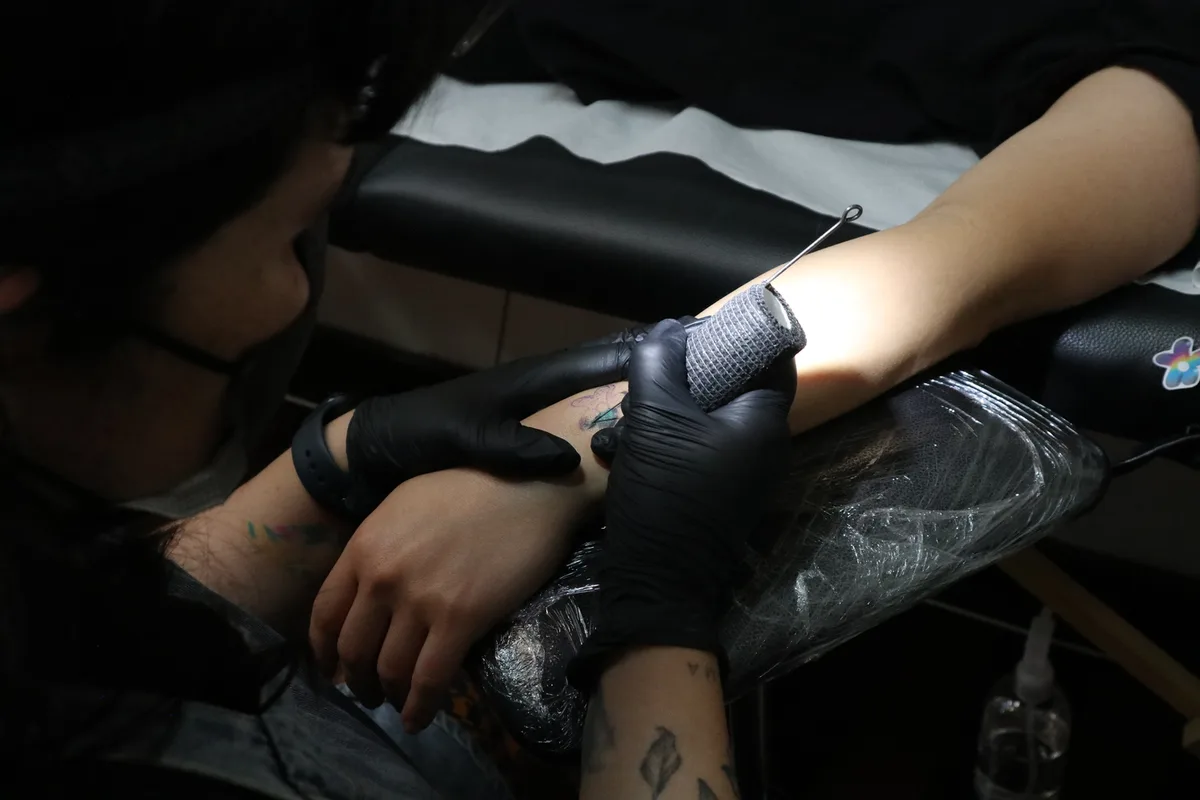
Most of those ideas began in grayscale. Then I started incorporating details of color, but that palette kept changing and growing. Color naturally became the protagonist, also at the request of my clients, because they began to see the results, to see work that had healed over the years, and that increased their confidence in my work.
Without a doubt, the work of other artists also inspired me to want to find my own path. Every time I encountered an artist doing something unconventional in the tattoo world, I took notes, studied, and admired their processes, regardless of their style or technique.
I remember that in my early days, around 2015–2016, the work of @baka.tat, @chenjie.newtattoo, @ida.minimal, @mariusztrubisz, @tattooist_doy, @evakrbdk, and @dzo_lama blew my mind. They were all doing something different, taking designs and concepts beyond the boundaries of each style or technique.
I am very grateful to all the artists who paved a more flexible path for experimentation.
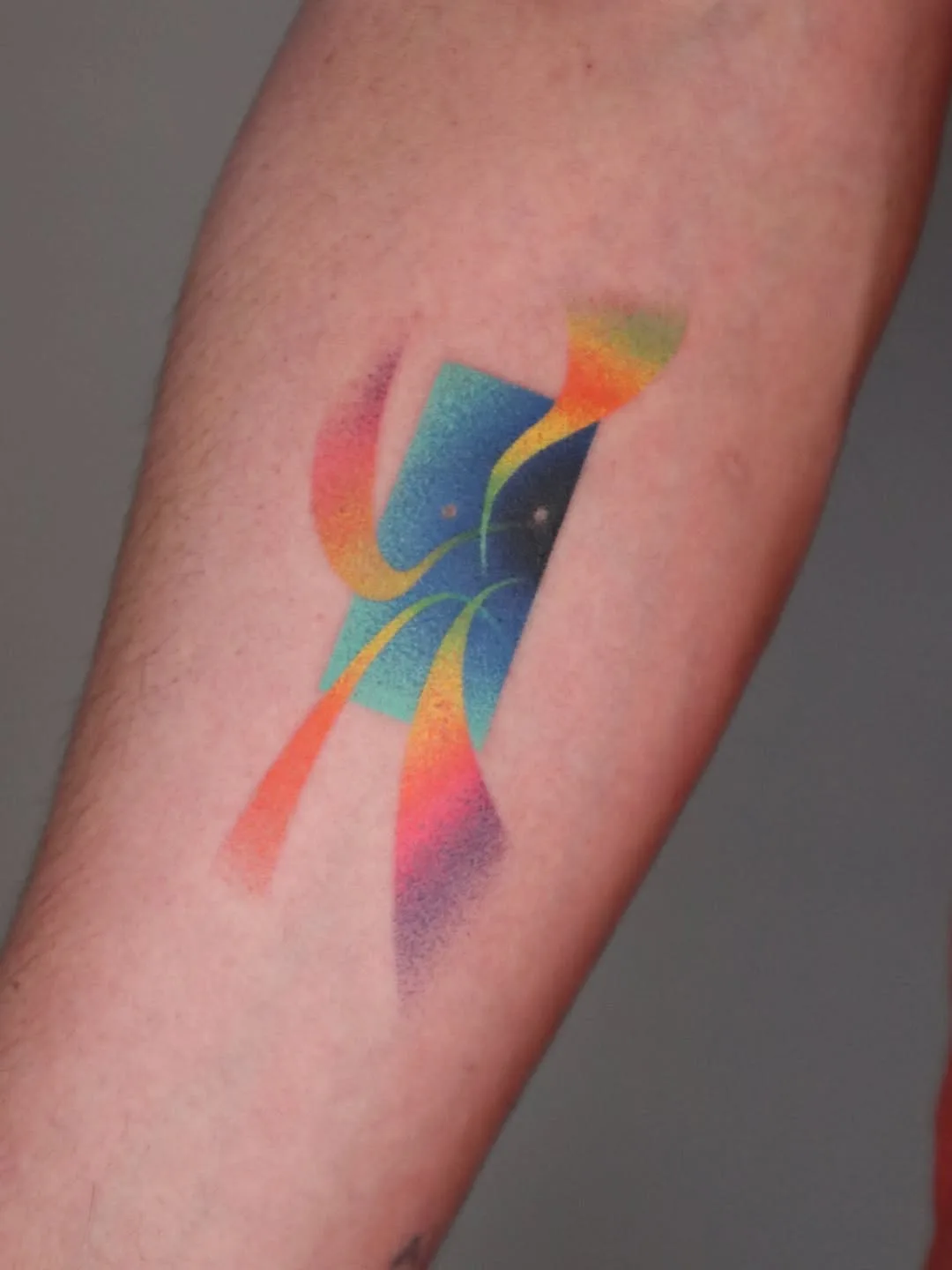
— Which projects or tattoos do you consider the most technically or artistically important in your portfolio?
— Probably “open compositions,” because they have the characteristic of working in any orientation without losing unity and balance, easily adapting to different body contexts or surrounding tattoos.
It’s something you won’t really notice unless you get a tattoo from me or I tell you, hahaha, but when I show these designs to my clients on the day of their appointment, I explain them, and we don’t always tattoo them in the original orientation in which I drew them.
Creating these pieces helps me trust my understanding of forms within a space, and the adaptability and versatility of a well-composed design.
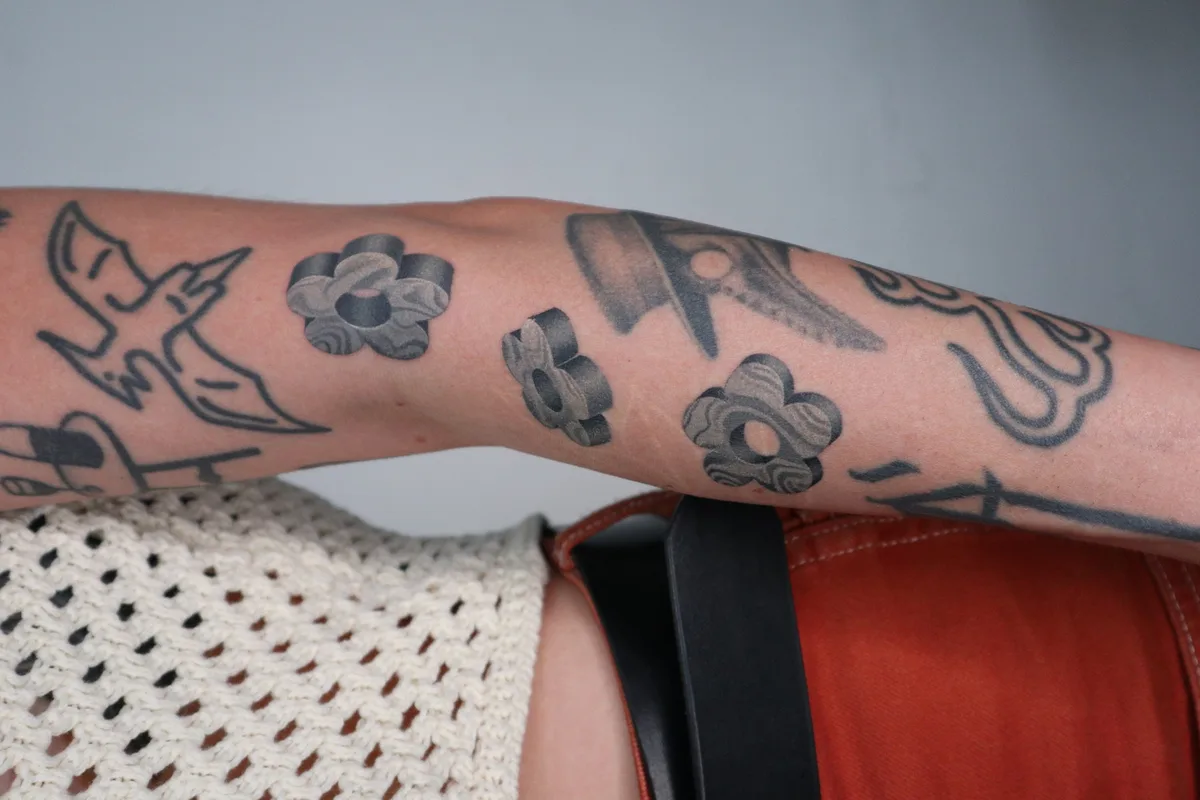
— Do you travel a lot as a tattoo artist? In which countries or studios have you had the opportunity to work?
— Kind of. I try to travel at least once a year if it’s a long trip.
Four years ago, I had the opportunity to study for a year in Barcelona, which allowed me to be a resident artist at 19:28 Tattoo Parlour, as well as visit several countries around Europe in a short time.
Since that experience, I’ve tried to maintain a consistent schedule each year.
I’ve had the privilege and opportunity to visit Cucu Studio in Buenos Aires, Rayon Noir in Paris, Akurat Studio in Berlin, Blanco Roto in Barcelona, New Tattoo Studio in Beijing, Sasha Tattooing in Paris, among others.
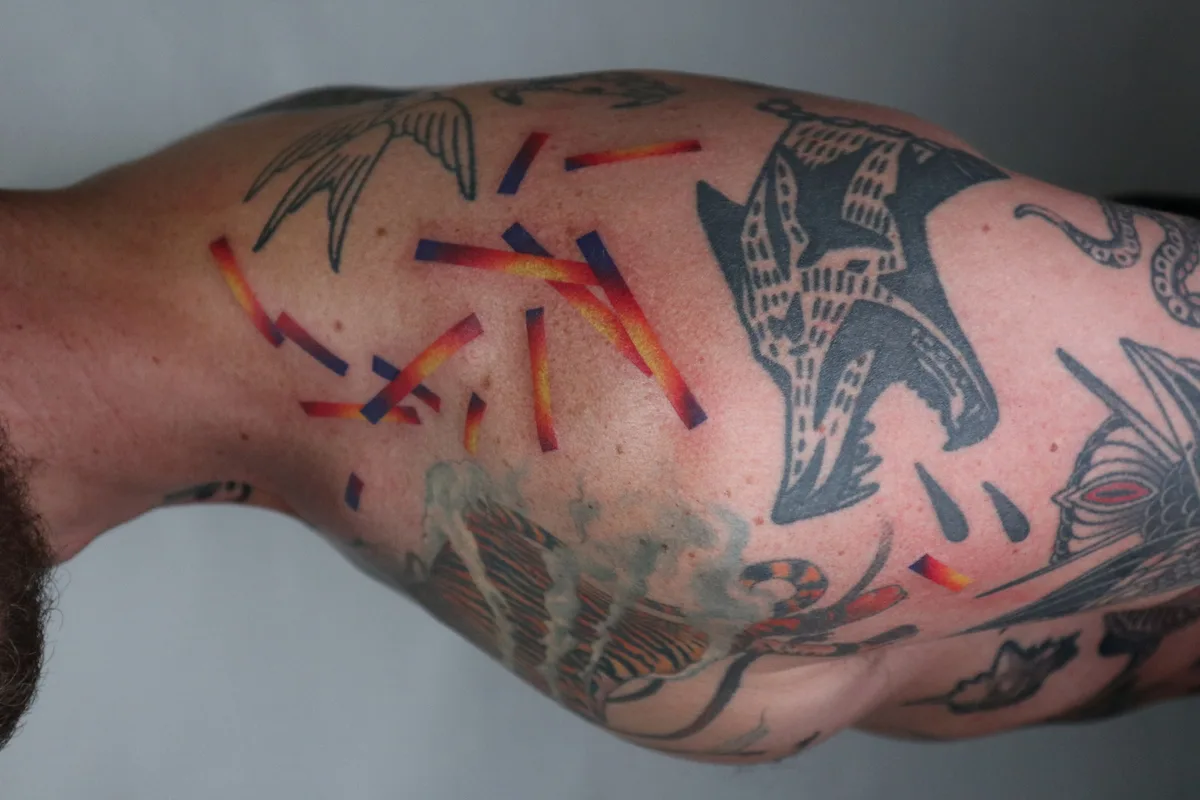
— Have you participated in tattoo conventions? If so, which ones were the most memorable for you?
— Yes. Throughout my career, I’ve participated in three conventions — Reñaca Ink 2019, Comic Ink 2019, and Summer Ink 2024—but I’ve only competed in one, and I think I can take away something memorable from more than one experience for different reasons.
Reñaca Ink was my first convention experience, where I participated “accidentally.” I used a friend’s spot because she couldn’t attend at the last minute, @marialeontattoo. So officially I wasn’t part of the artist line-up, but I had the opportunity to meet some great Chilean artists whom I admire a lot and who welcomed me warmly as part of their team. I have a lot of affection for the Nomade Tattoo Studio team from Viña del Mar, Chile.
And Summer Ink was my first time participating in a competition. I was very nervous, but also very excited to be able to showcase the handpoke technique at such an important convention, and I won 2nd place in the Tiny Tattoo category. It was an incredible experience!
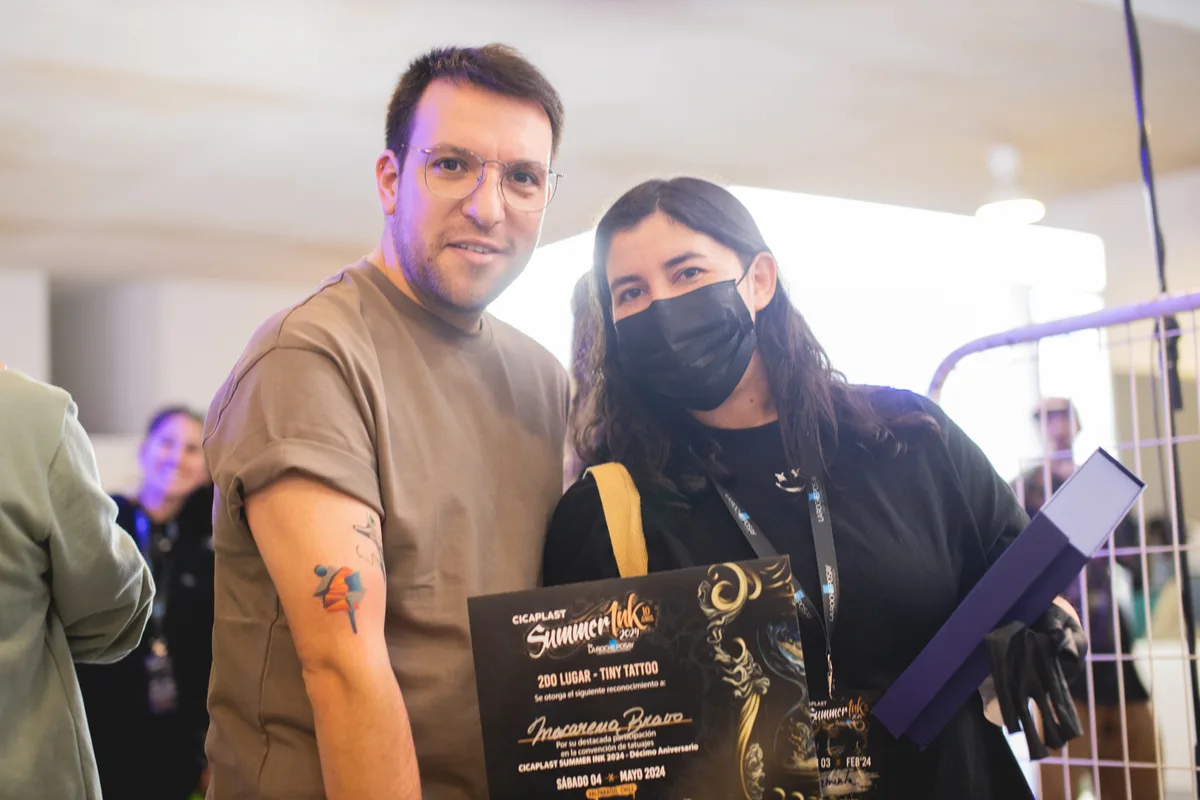
— Finally, what are you currently working on, and what are your plans for the near future?
— Ummm... Well, I feel that my work is generally in a constant state of progress. I’m always researching, studying, imagining, and every day I think, “What do I do now?”, “What comes next?”, “How can I do it differently?” But I think what stands out most right now is that I’m looking to work on larger pieces and more complex areas of the body that I’m not used to working on, and for that reason I’ve started posting larger and more complex compositions for myself.
And plans? For the moment, I’d like to visit Asia again, hopefully return to Europe, and maybe add some new destinations this year, but we’re taking it one step at a time.