Few animals carry as much weight in tattoo culture as the bear. It shows up across almost every tradition, from Pacific Northwest tribal art to Russian folk imagery, from Norse mythology to Japanese mountain legends. And yet, despite being one of the most popular animal tattoos out there, the bear remains surprisingly layered in what it can represent.
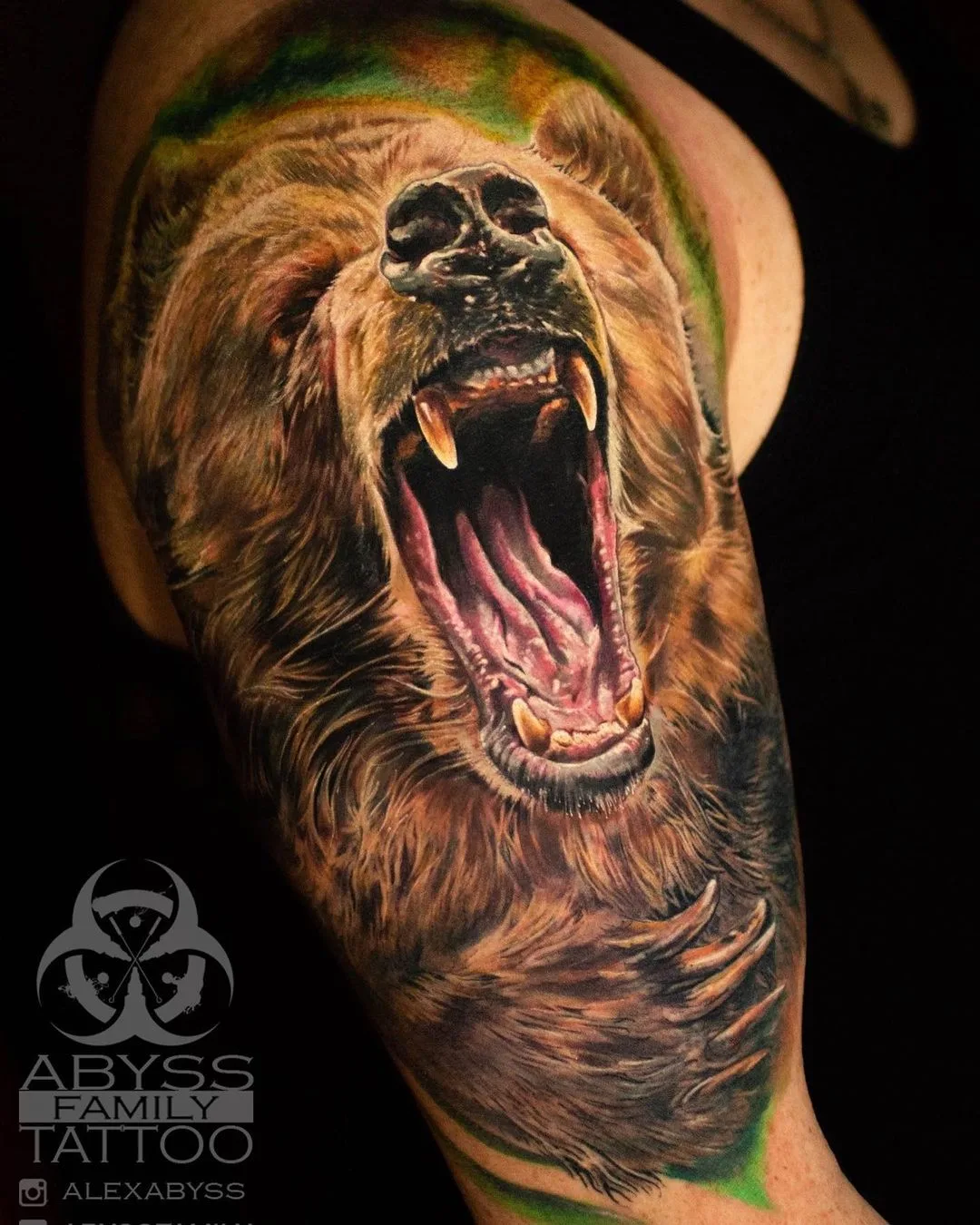
A bear tattoo is never just a bear tattoo. It can speak to raw physical power, or it can be about something quieter, protection, patience, the ability to endure. Some people get one to honor their family. Others are drawn to the solitary nature of the animal. The meaning shifts depending on the species, the style, and maybe even the placement on your body.
Core Symbolism of Bear Tattoos
At its most basic level, a bear represents strength. That part is obvious. But there are several other threads woven into bear symbolism that are worth pulling apart.
Strength and Courage
Bears are apex predators in nearly every ecosystem they inhabit. A grizzly can weigh over 600 pounds. That kind of physical dominance translates naturally into tattoo symbolism, the idea of being unshakable, of standing your ground. People who have overcome serious challenges in their lives often gravitate toward bear tattoos for exactly this reason. It is, perhaps, one of the most direct ways to carry a reminder of your own resilience on your skin.
Protection
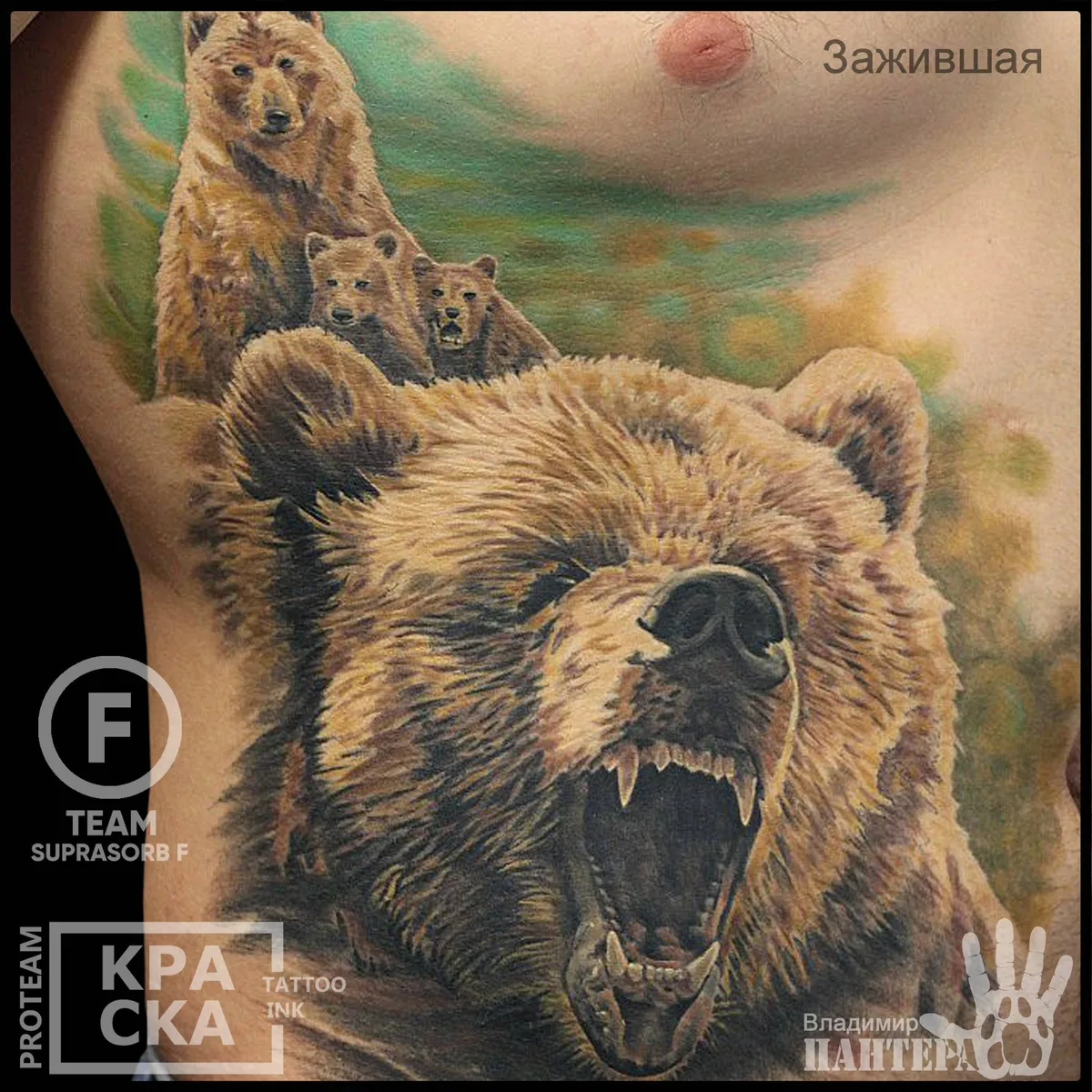
This one runs deep. Bears, especially mother bears, are famously protective. The phrase "mama bear" exists for a reason. A sow with cubs will charge animals ten times her speed without hesitation. In tattoo art, this protective instinct gets referenced constantly. Parents get bear tattoos for their children. Siblings get them for each other. Actually, protection might be the single most common reason people cite when choosing a bear design.
Solitude and Introspection
Bears are largely solitary creatures. Outside of mating season and the mother-cub bond, they spend most of their time alone. For some people, a bear tattoo is about valuing that kind of independence, the ability to be comfortable on your own, to not need a crowd. There is something appealing about an animal that walks through the forest without needing company.
Hibernation and Renewal
The hibernation cycle adds another dimension. Bears retreat into darkness for months, slow their heartbeat to nearly nothing, and then emerge in spring. It is hard not to see the metaphor there. People who have been through periods of depression, recovery, or personal transformation sometimes choose a bear tattoo to mark that process of going inward and coming back out stronger. Or rather, coming back out different.
Native American Bear Medicine
In many Native American traditions, the bear holds a position of deep spiritual significance. It is considered a healer and a guide. Bear medicine, the spiritual power associated with the animal, connects to introspection, strength, and the ability to heal both physical and emotional wounds.
The bear is one of the most prominent clan animals across multiple tribes, including the Pueblo, Navajo, and various Northwest Coast peoples. Bear paw prints, in particular, carry strong meaning. They represent good luck, stability, and a connection to the earth. Some tribal traditions also associate the bear with the west direction and the autumn season.
Worth noting. If you are not Native American and you want a bear tattoo inspired by these traditions, it is worth doing your homework. Some designs carry specific ceremonial or clan-based meaning, and borrowing them without understanding can be disrespectful. A good tattoo artist will help you find a way to honor the symbolism without crossing that line.
Celtic Bear Warriors
The Celts had their own relationship with bears. The word "art" in old Celtic languages actually means "bear", and yes, that is probably where the name Arthur comes from. King Arthur, the bear king. The connection between bears and warrior culture ran deep through Celtic and early British societies.
Celtic bear tattoos tend to feature knotwork patterns, interlocking lines that create the shape of the animal without depicting it literally. These designs emphasize the bear as a symbol of nobility and warrior spirit. The goddess Artio, worshipped in what is now Switzerland, was a bear deity associated with wildlife and abundance. Her imagery sometimes appears in Celtic-inspired bear tattoo designs.
Norse Berserkers
Then there are the berserkers. The word itself comes from "bear shirt", berserkr in Old Norse. These warriors reportedly entered battle wearing bear skins, working themselves into a trance-like fury that made them nearly unstoppable. Whether the berserker rage was chemically induced or purely psychological is still debated. Probably a bit of both.
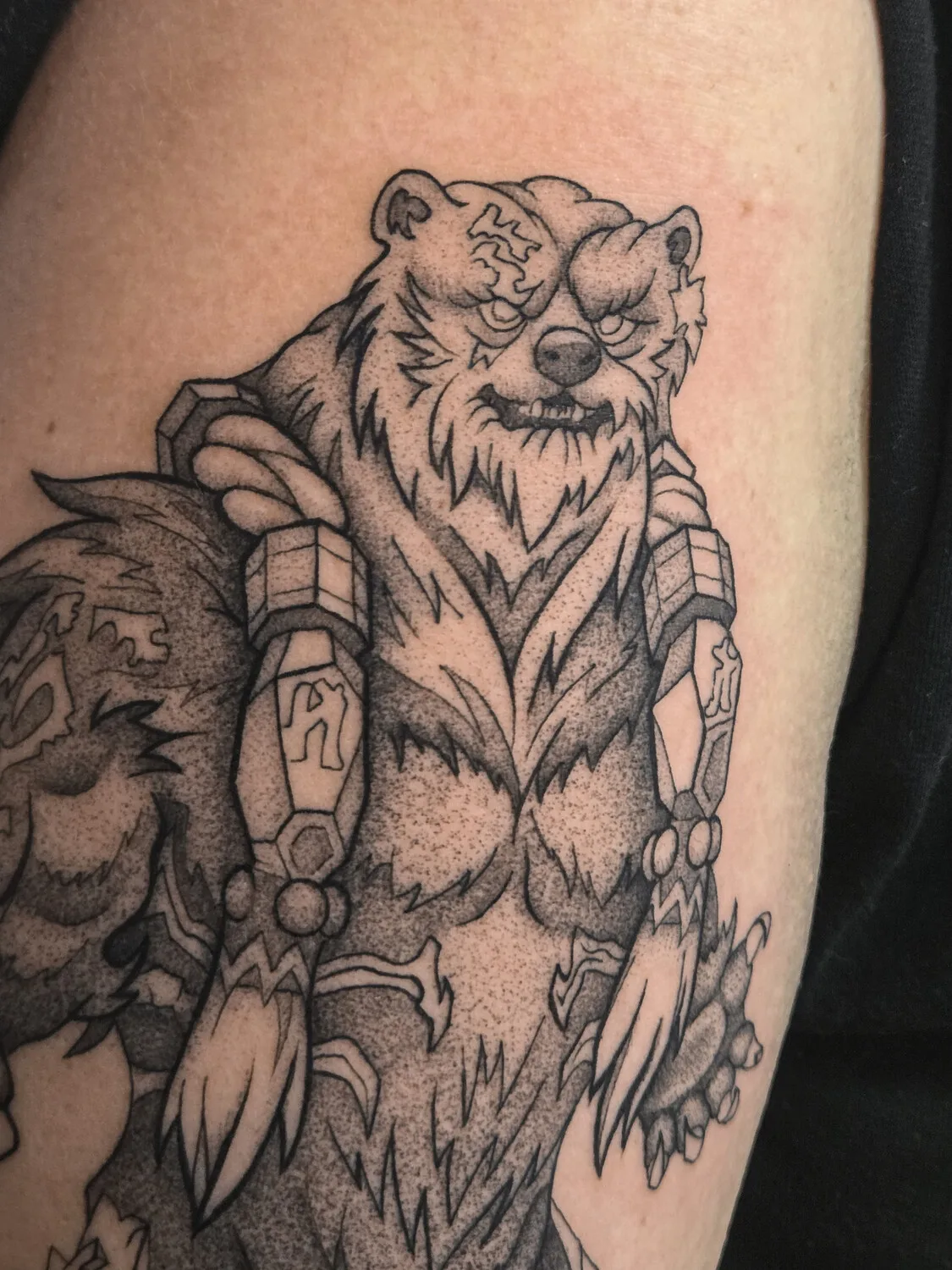
Norse bear tattoos often incorporate runes, Viking knotwork, or the valknut symbol. They tend to be aggressive in tone, snarling bears, open jaws, heavy black shading. This style appeals to people who connect with Norse mythology or who see the bear as an embodiment of controlled aggression. The idea that you can be calm and measured most of the time, but capable of absolute ferocity when it matters.
Slavic Bear Traditions
The Russian word for bear - "medved" - literally means "honey eater" and was used as a euphemism because the original Slavic word for bear was considered too sacred to speak aloud. People believed saying the bear's true name could summon it.
Russia and the bear. It is maybe the most famous national animal association in the world. But the connection goes back much further than modern stereotypes. In pre-Christian Slavic religion, the bear was considered the master of the forest, a sacred creature connected to the god Veles, who ruled the underworld, cattle, and earthly wealth.
The actual name of the bear in Russian, medved, means "honey eater," which is itself a euphemism. The original Slavic word for bear was considered too sacred to say out loud. People believed that speaking the bear's true name could summon it. That level of reverence tells you something about how seriously the animal was taken.
Slavic-style bear tattoos sometimes incorporate folk art patterns, birch trees, or Orthodox iconographic elements. They work well in blackwork or woodcut-inspired styles.
Japanese Bear Symbolism
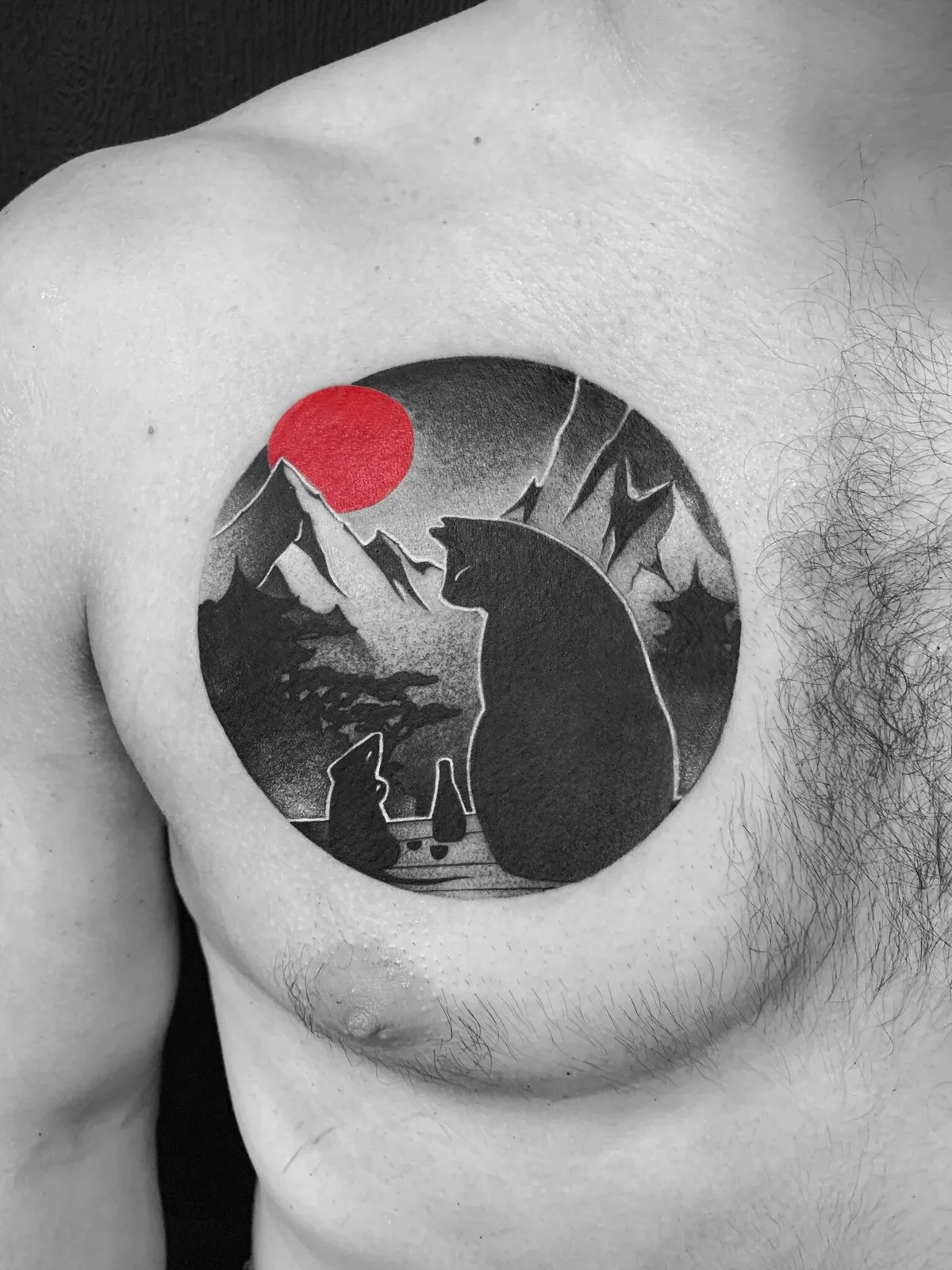
In Japan, the bear holds a different kind of significance. The Ainu people of Hokkaido considered the bear, particularly the brown bear, or higuma, to be a divine being. The Iyomante ceremony, a bear-sending ritual, was one of the most important Ainu spiritual practices. It treated the bear as a visiting god who had taken animal form.
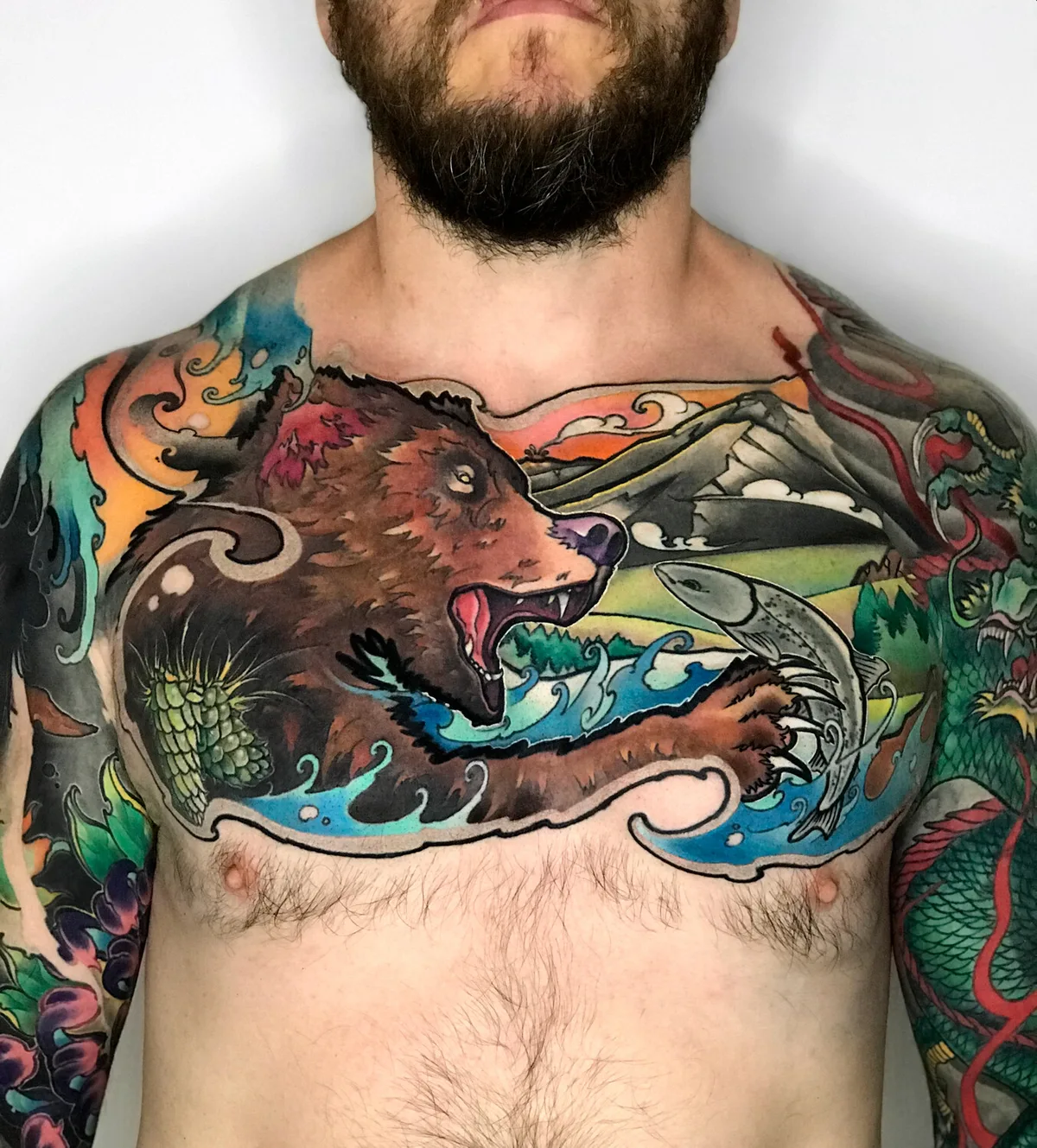
Japanese-style bear tattoos might incorporate elements like mountains, pine forests, or flowing water. They tend to be less about aggression and more about the bear's connection to the natural world. The moon bear, native to parts of Honshu, also appears in Japanese tattoo art, though less commonly than dragons or koi.
Mama Bear and Family Meaning
This deserves its own section because it has become one of the most popular bear tattoo themes in the last decade. The mama bear concept, fierce, unconditional protection of your children, translates beautifully into tattoo art.
Common approaches include a mother bear with one or more cubs, sometimes with the number of cubs matching the number of the wearer's children. Bear family scenes, walking through a forest, crossing a stream, create narrative compositions that can be both tender and powerful. Some parents add a cub each time they have a new child.
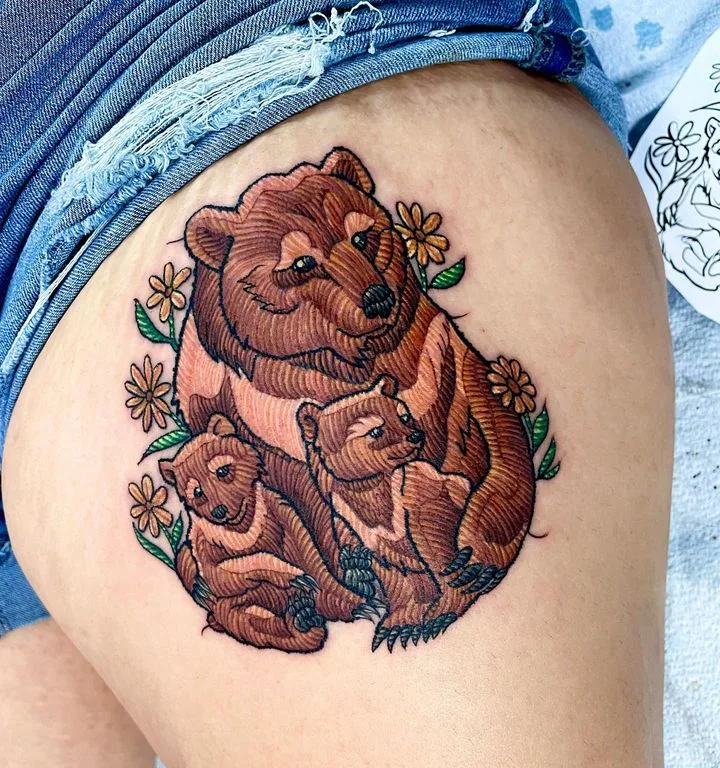
It is not limited to mothers, either. Fathers get bear family tattoos too, sometimes featuring a large bear sheltering smaller ones. The meaning stays the same. Family first. Always.
| Cultural Tradition | Primary Symbolism | Common Design Elements |
|---|---|---|
| Native American | Healing, spiritual guidance, earth connection | Bear paw prints, tribal patterns, natural settings |
| Celtic | Warrior nobility, leadership | Knotwork patterns, interlocking lines |
| Norse | Berserker fury, controlled aggression | Runes, Viking knotwork, valknut symbols |
| Slavic | Forest mastery, sacred reverence | Folk art patterns, birch trees, Orthodox elements |
| Japanese | Divine nature connection, mountain spirits | Mountains, pine forests, flowing water |
Popular Bear Tattoo Styles
The style you choose for a bear tattoo changes its character completely. Here is how the major approaches play out.

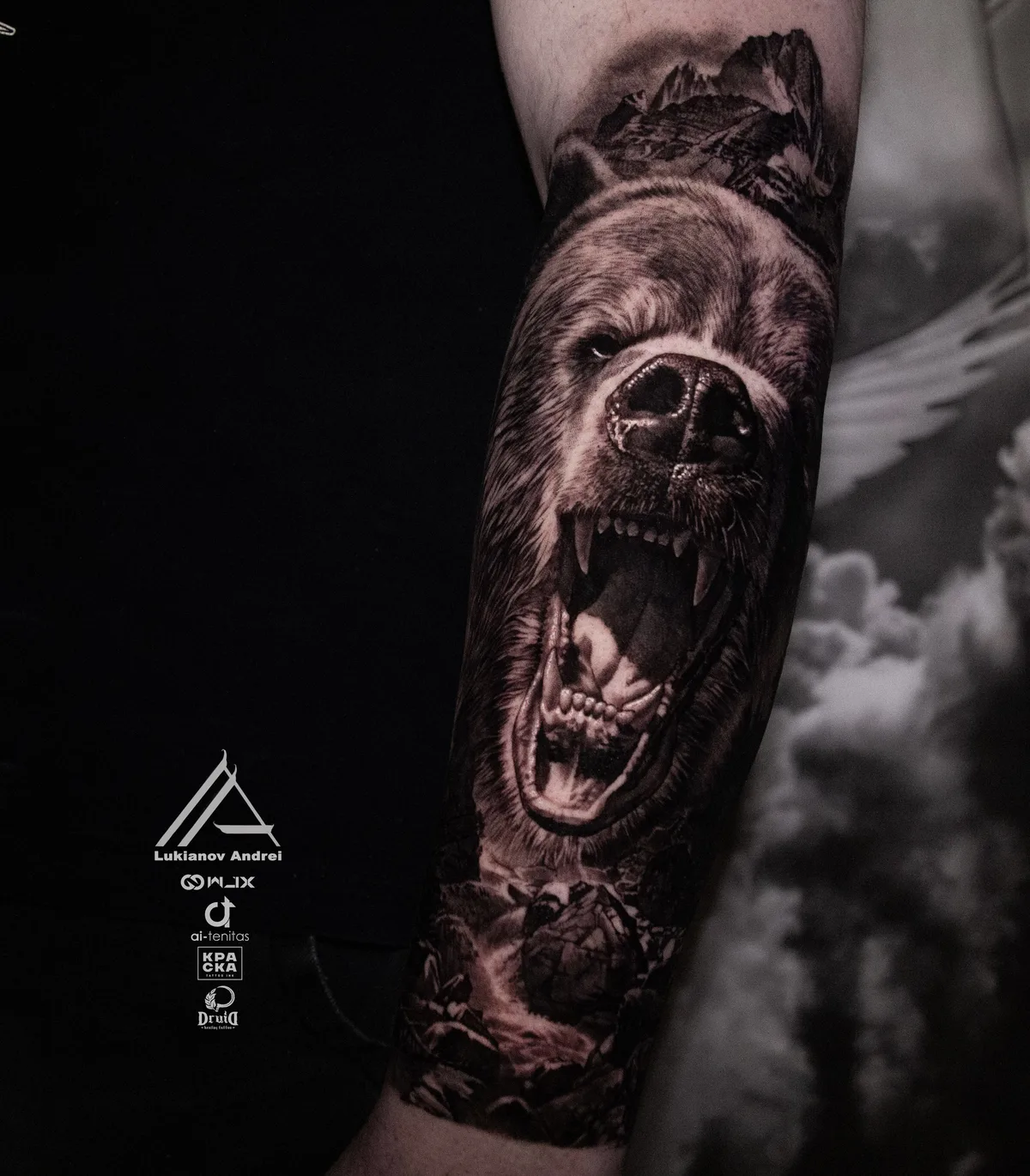
Lukianov Andrei, black and grey realism

Black and grey bear shoulder tattoo
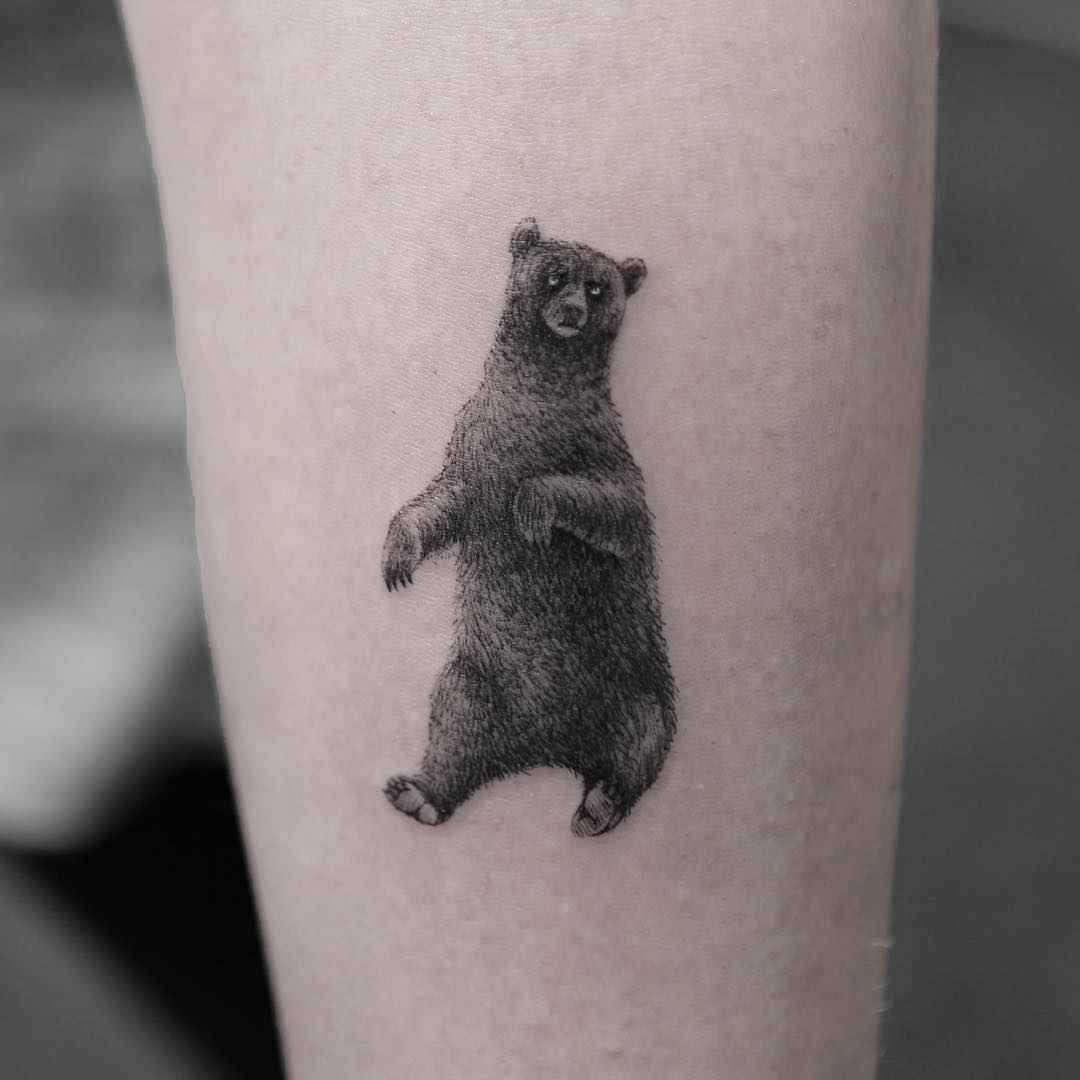
Realistic black and grey bear

Black and grey realism bear
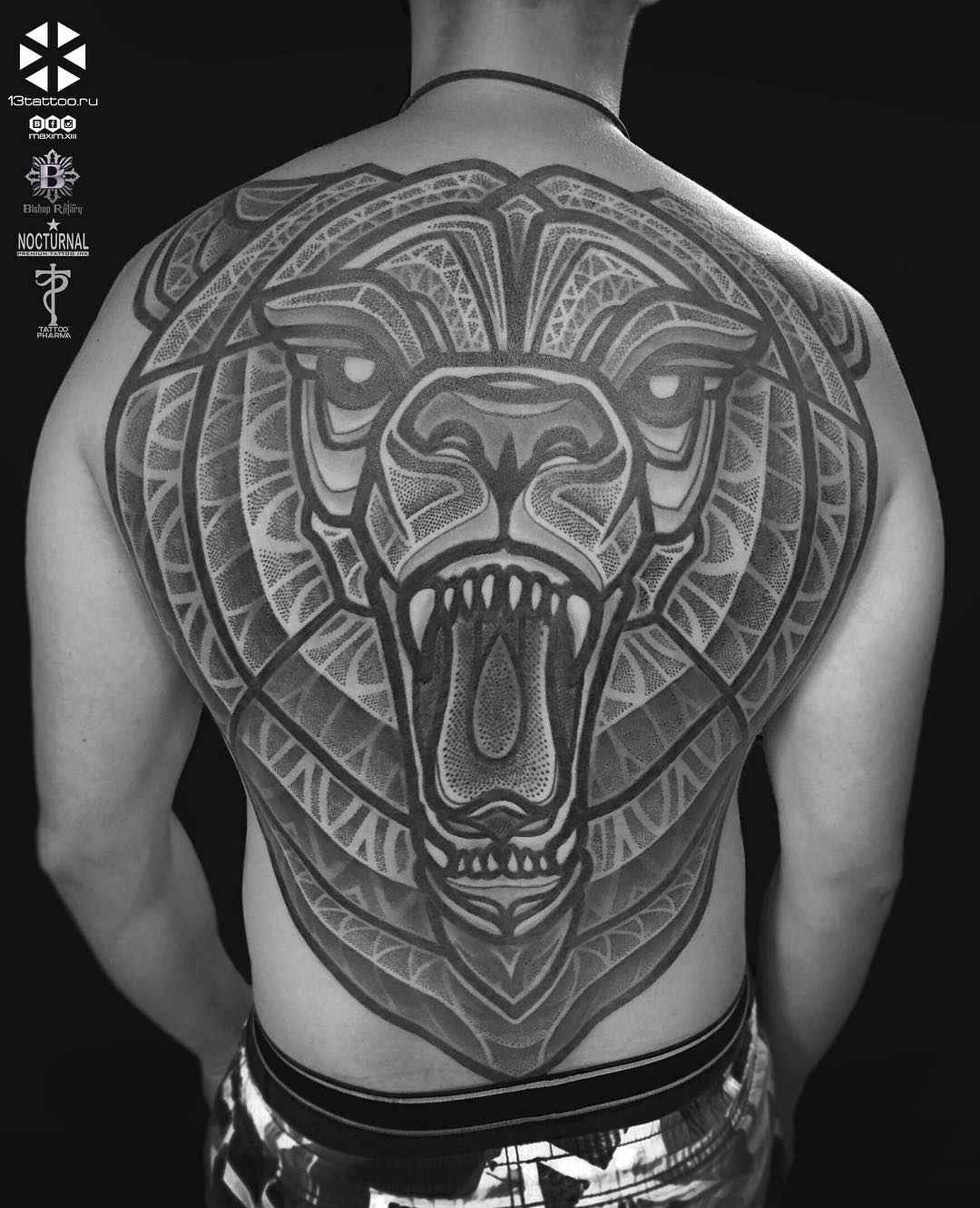
Geometric bear, dotwork and linework

Stylised bear, black and grey linework and dotwork
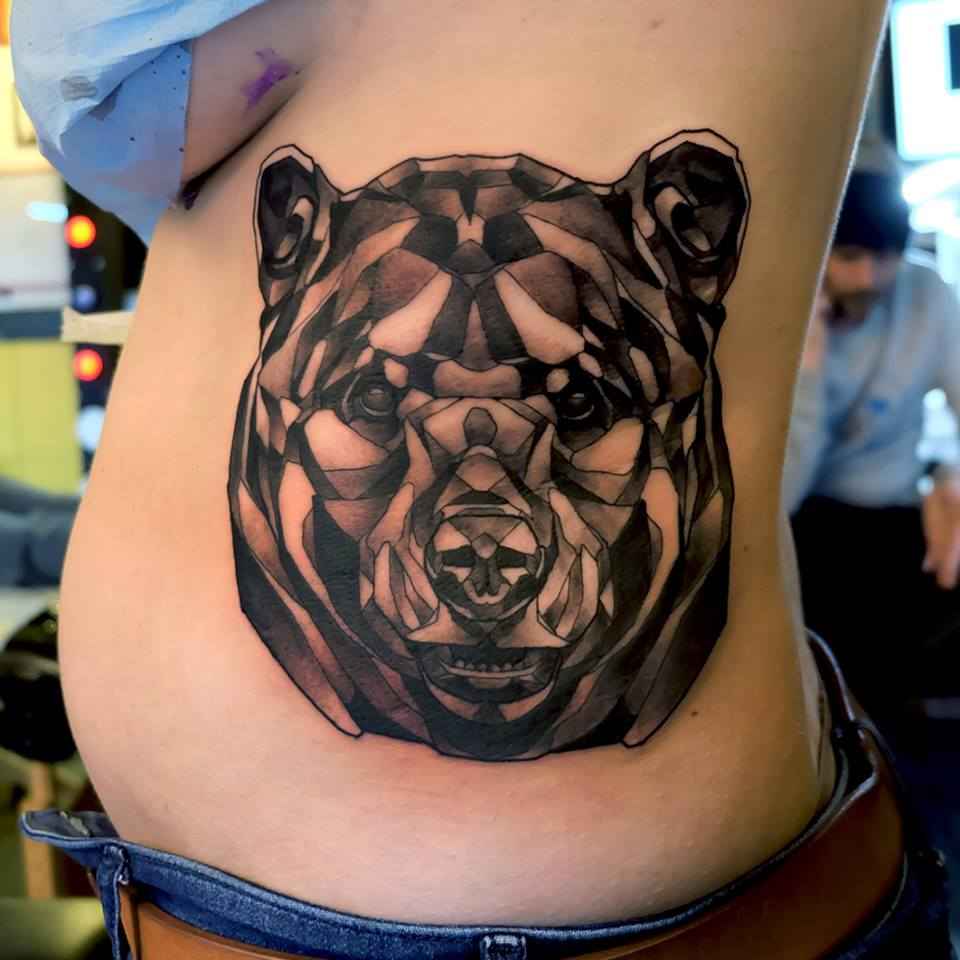
Geometric bear head tattoo
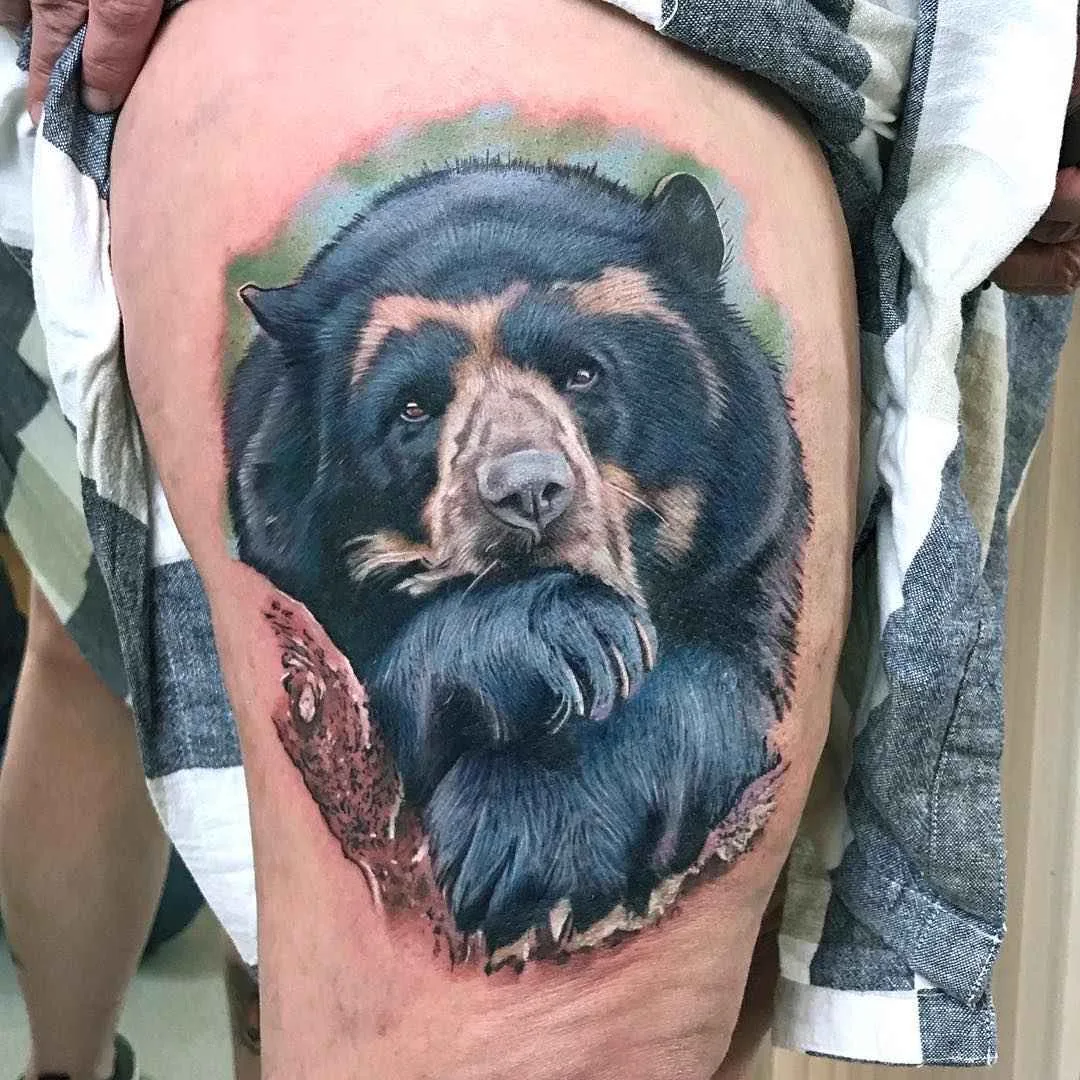
Realistic
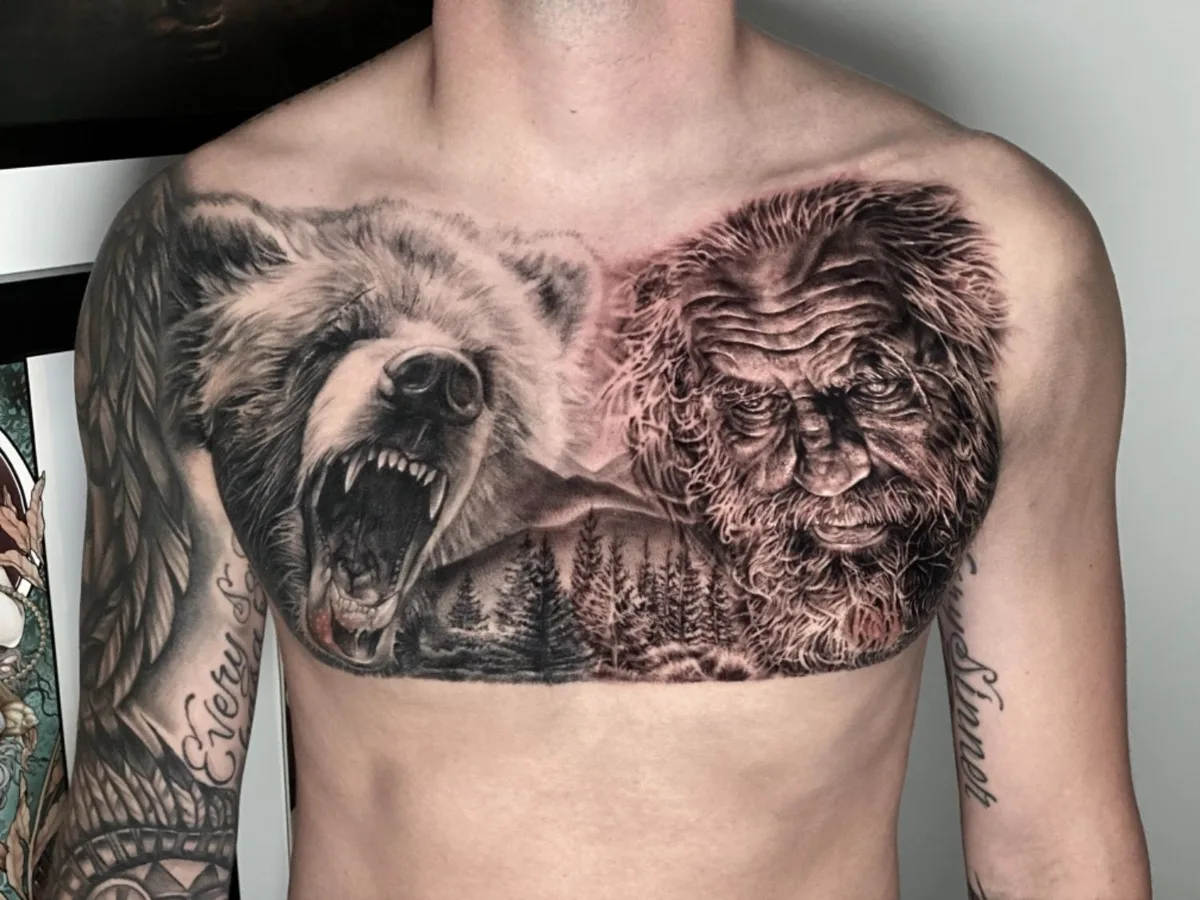
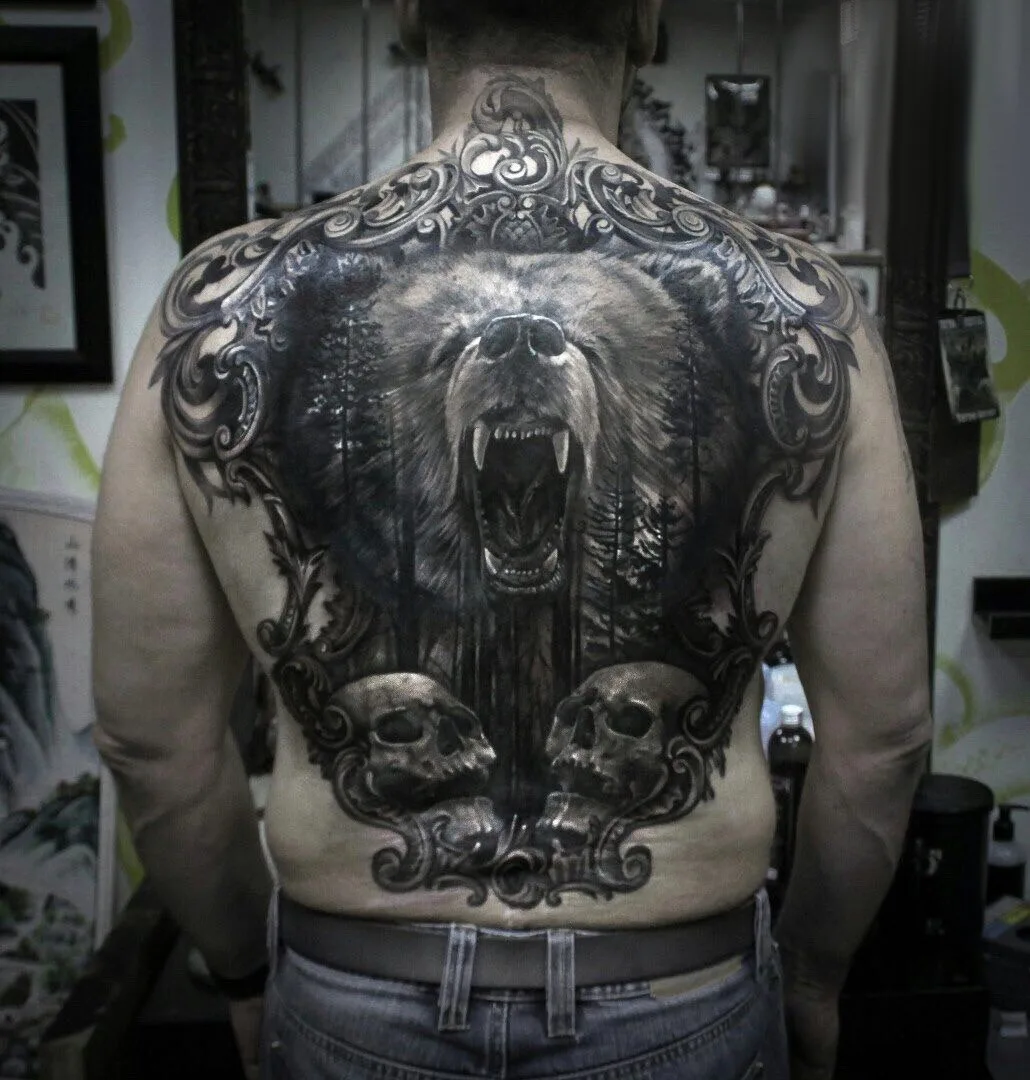
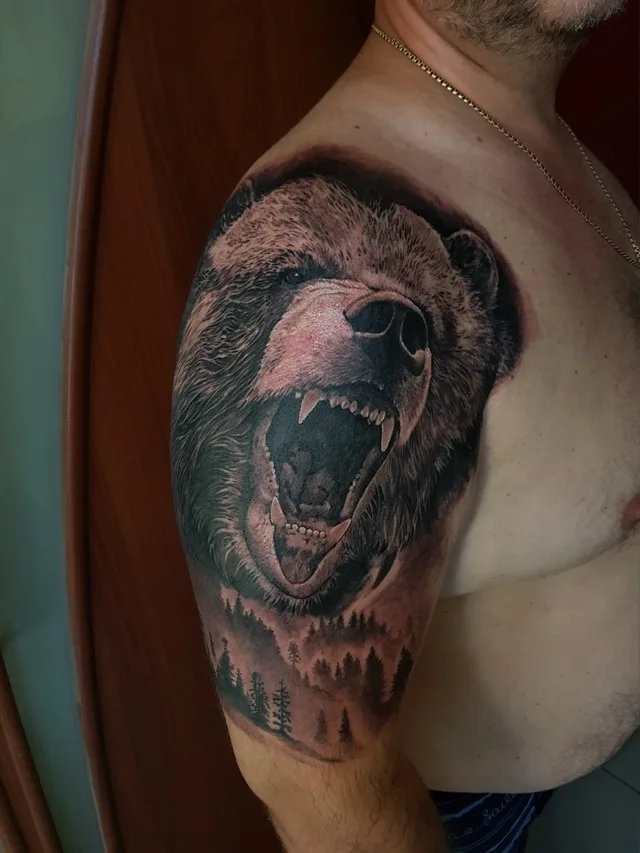
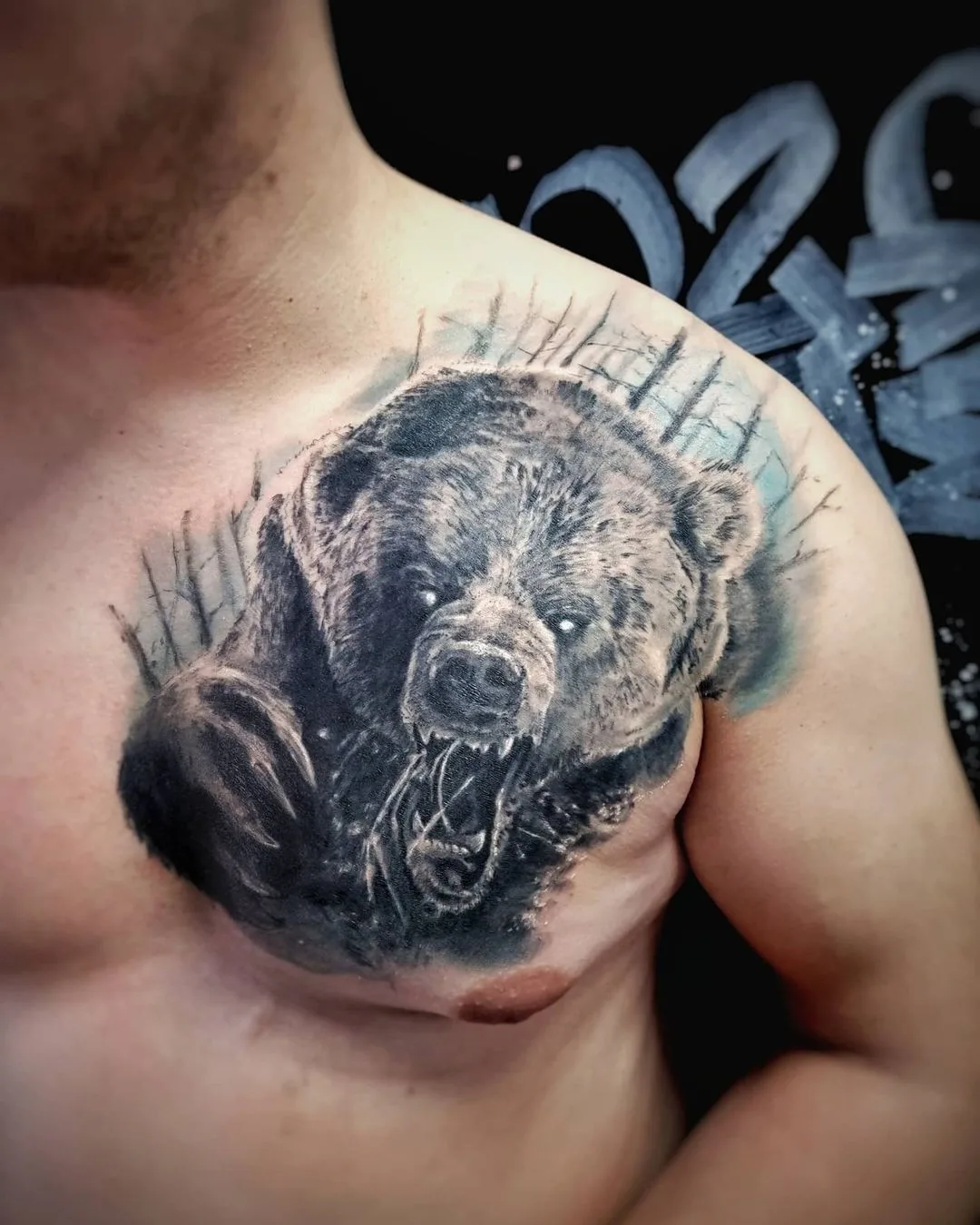
Photo-realistic bear portraits demand serious technical skill. When done well, they are breathtaking, every hair rendered, light and shadow captured perfectly. These work best at larger scales (full sleeve, back piece, thigh) where the artist has room to build detail. A realistic bear tattoo says you respect the animal as it actually is, no embellishment needed.
Geometric
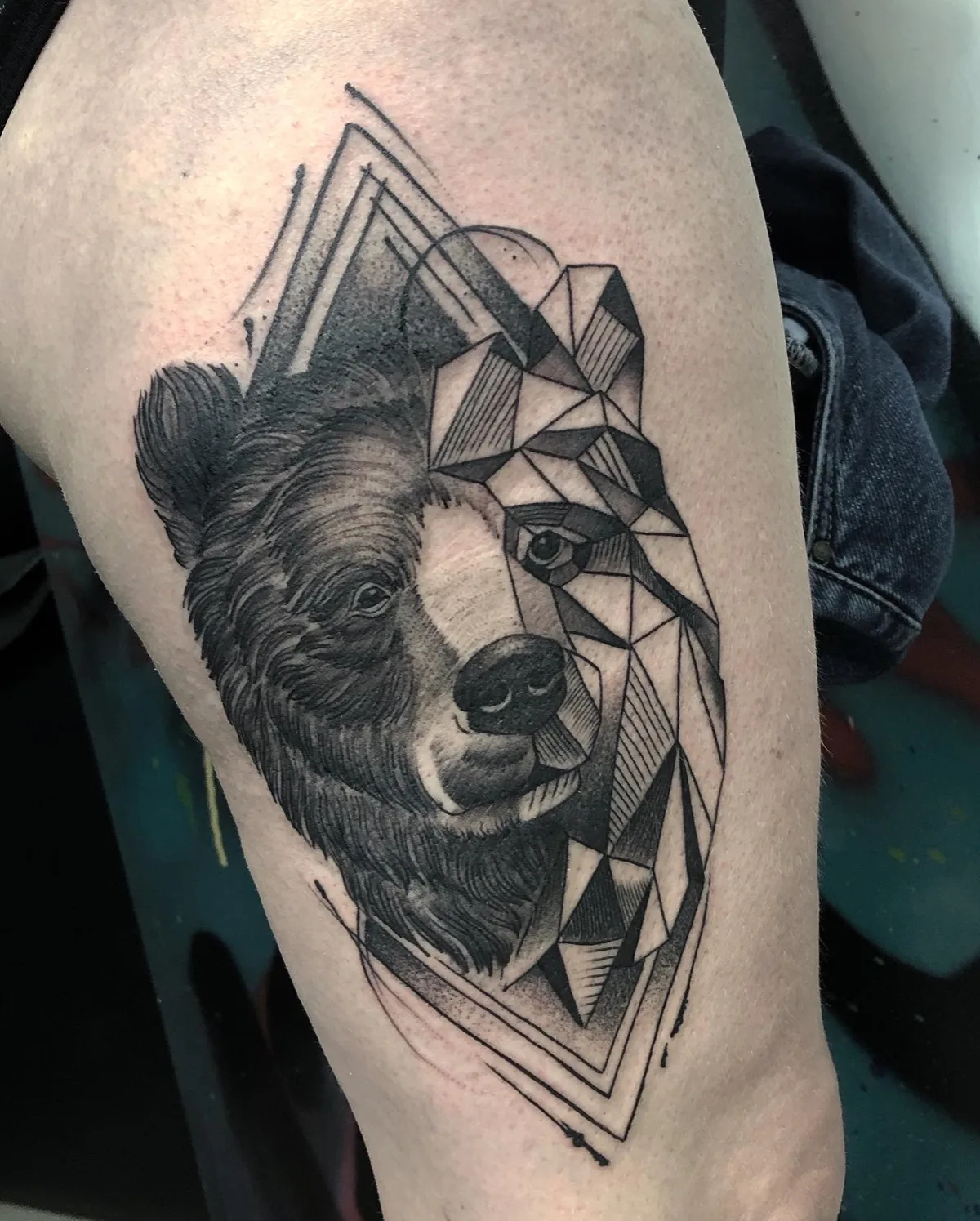
Geometric bear tattoos break the animal's form into triangles, hexagons, and clean lines. Sometimes half the bear is realistic and the other half dissolves into geometry. This style has exploded in popularity over the past few years. It adds a modern, almost architectural quality to the design. Works surprisingly well at medium sizes.
Traditional (American)
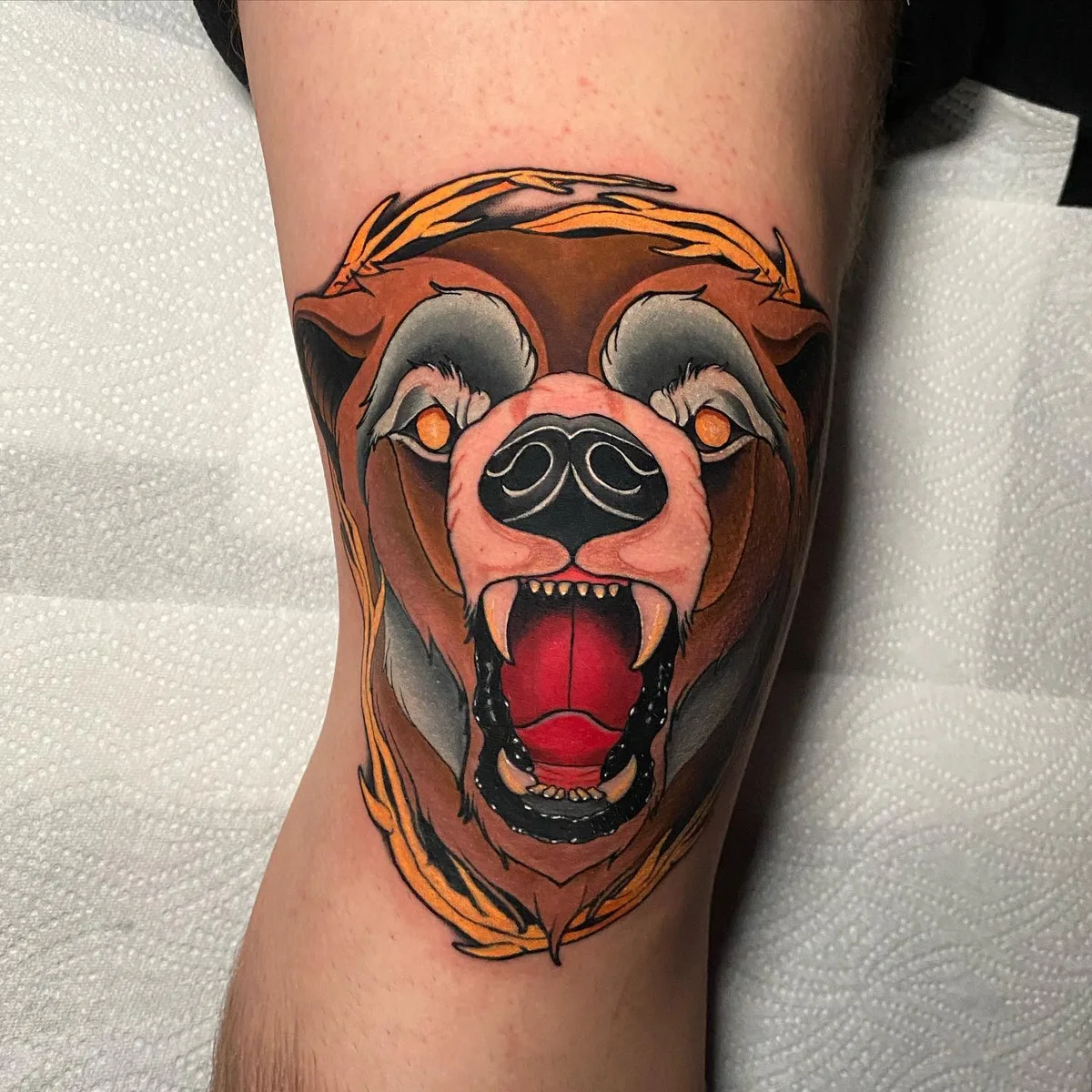
Bold outlines, limited color palette, strong composition. Traditional bear tattoos have a timeless quality. The bear is usually shown head-on or in profile, often snarling, with heavy black outlines and flat color fills. These age well and read clearly from a distance. Old school, but never outdated.
Blackwork
Pure black ink, heavy saturation, dramatic contrast. Blackwork bear tattoos can range from delicate dotwork to solid black silhouettes. This approach strips away color entirely and relies on composition and contrast. It suits the bear's natural gravitas. There is something about a bear rendered in nothing but black that feels honest.
Neo-Traditional
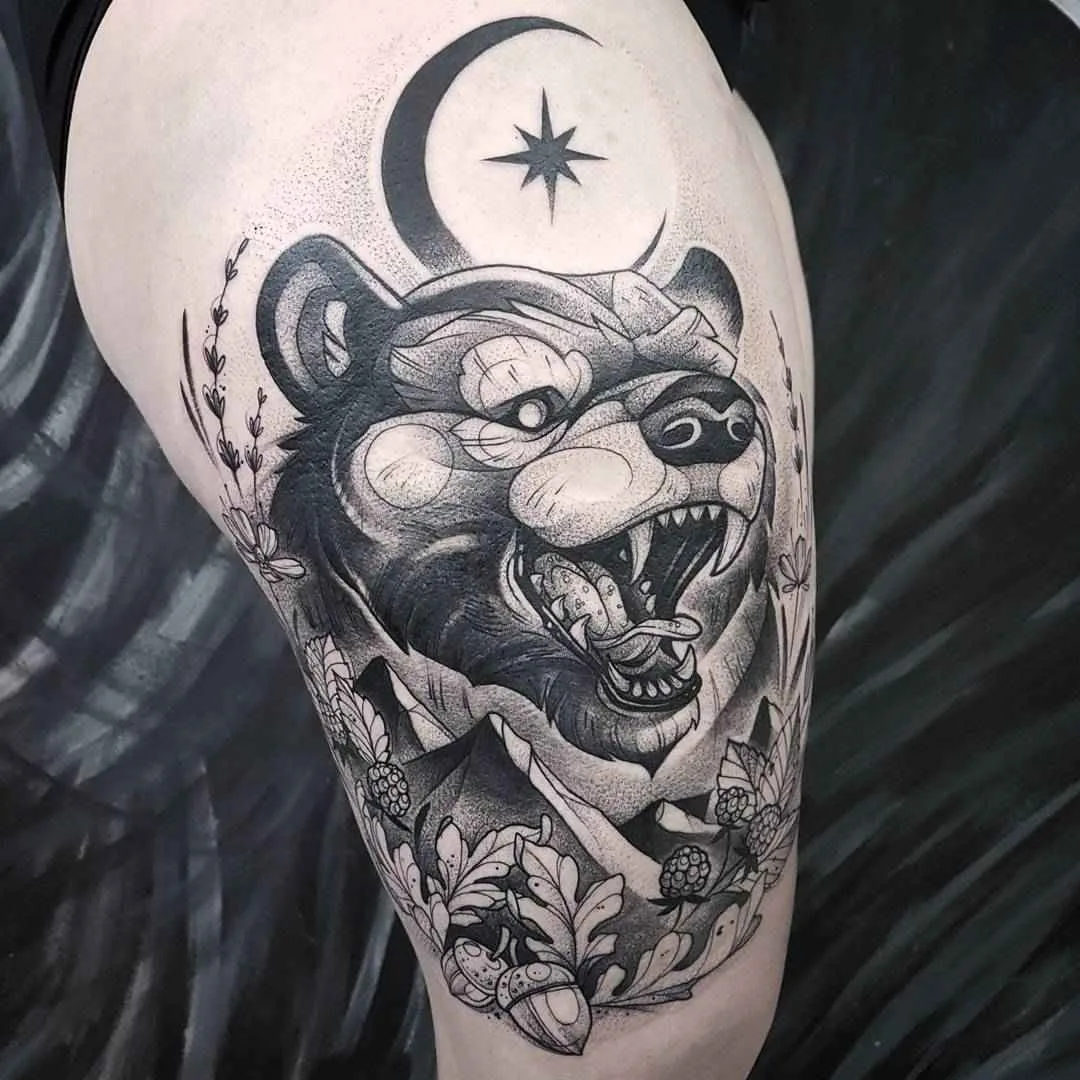
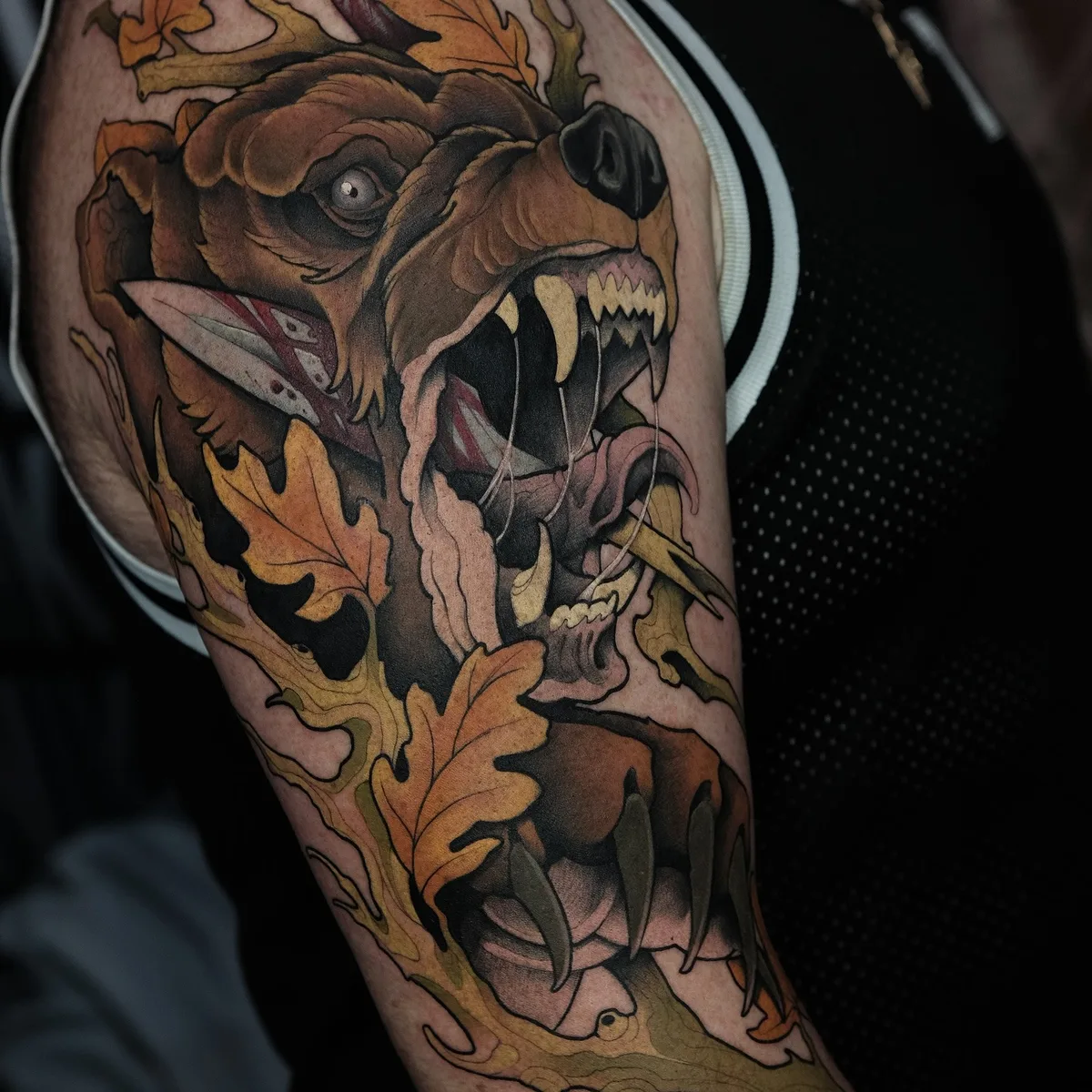
Take the structure of traditional tattooing, then push the color palette wider and the details finer. Neo-traditional bear tattoos allow for more expression, more personality. Jewel tones, decorative framing elements, stylized fur textures. This style bridges the gap between classic and contemporary.
Watercolor
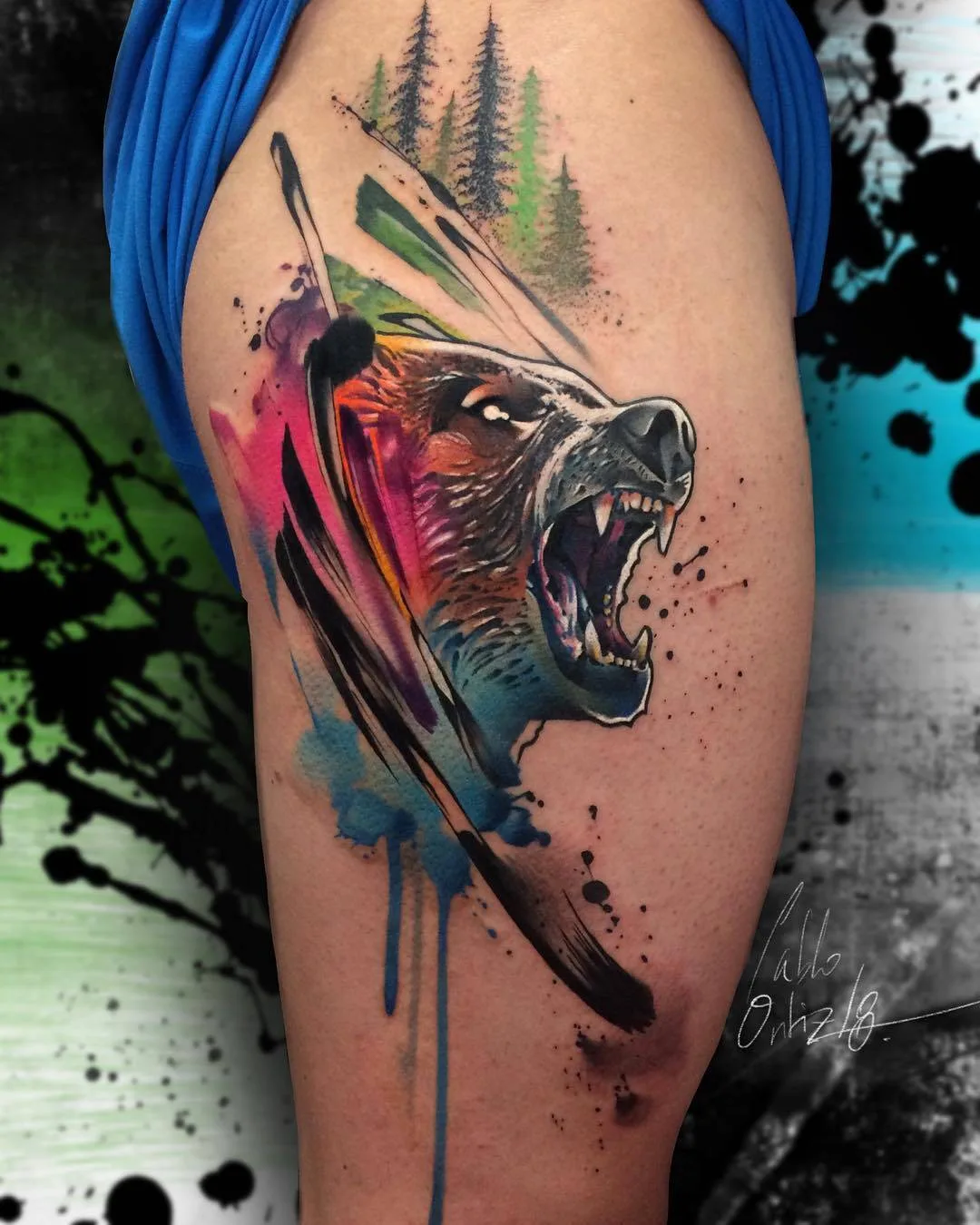
Watercolor bear tattoos use splashes of color that bleed beyond the outlines, creating a painterly effect. They look stunning when fresh. However, and this is worth mentioning, they can be harder to maintain over time. The soft edges that make watercolor tattoos appealing are also the first elements to blur as the tattoo ages.
Bear Species and Their Meanings
The species of bear you choose matters. Each one carries its own connotations.
Grizzly Bear
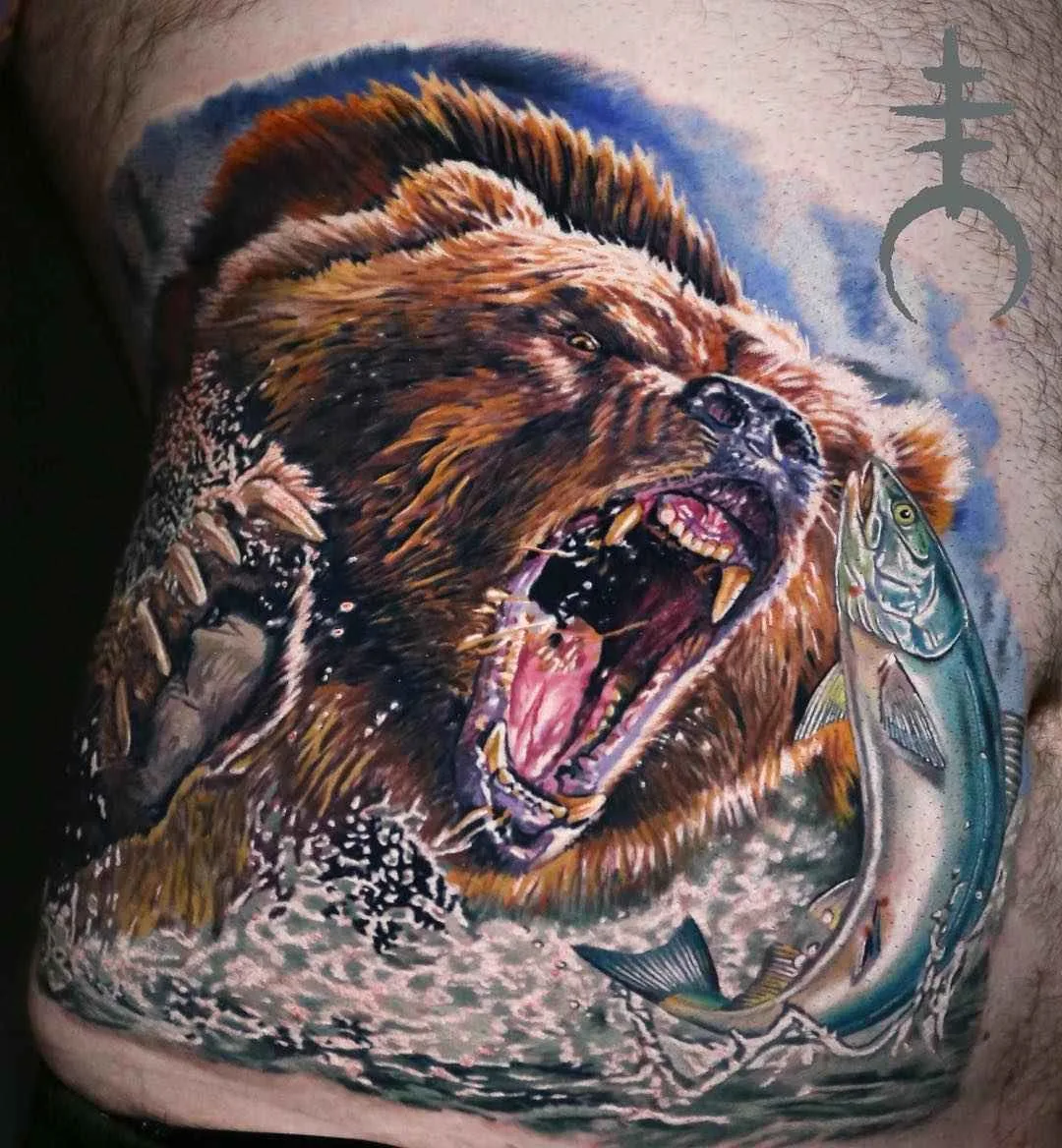
Raw power, wilderness, North American identity. The grizzly is probably the default bear in most people's minds when they think of bear tattoos. It is imposing, aggressive when provoked, and deeply connected to mountain and forest landscapes. Grizzly tattoos tend to lean toward realism or traditional styles.
Polar Bear
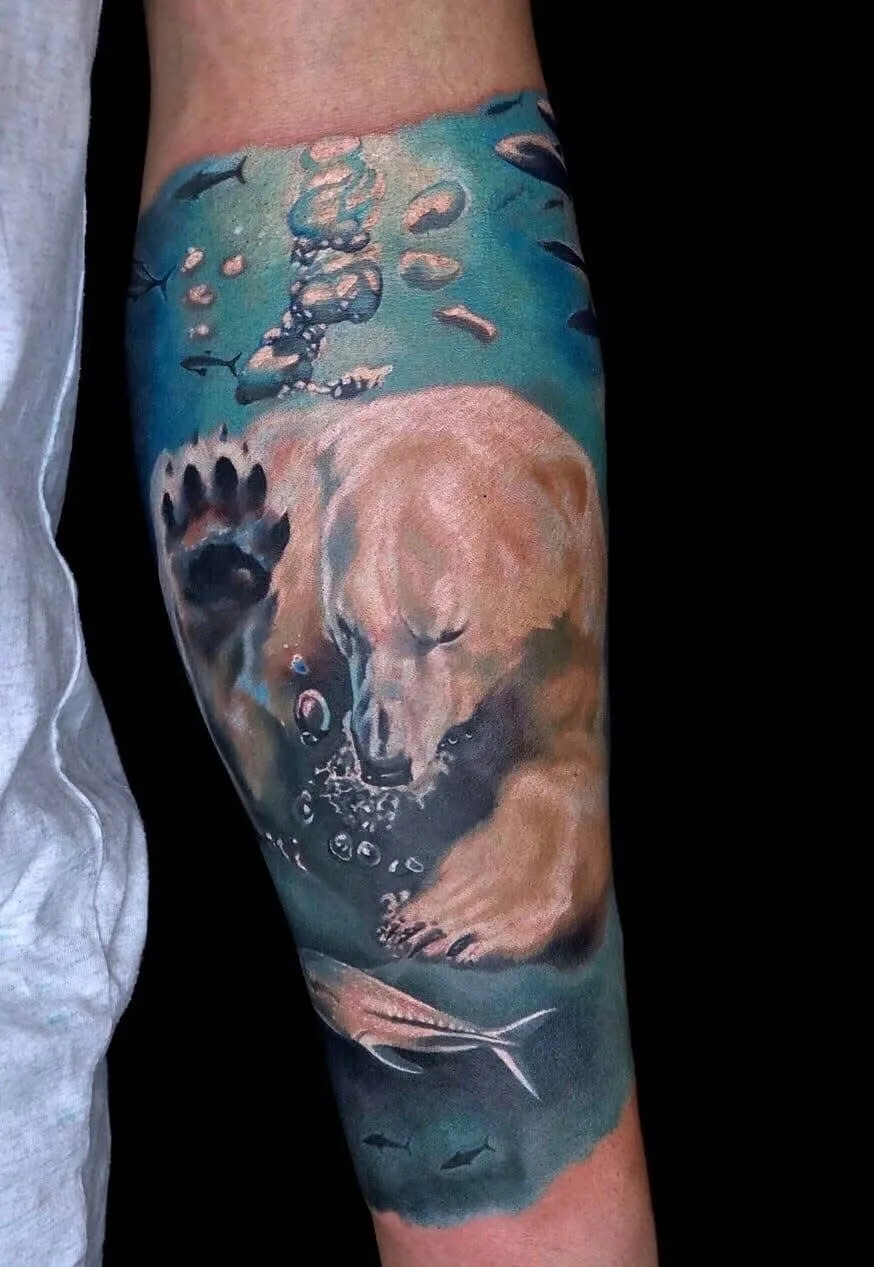
Endurance, survival, adaptability. Polar bears live in one of the harshest environments on earth. A polar bear tattoo can symbolize the ability to thrive in difficult conditions, or it might reflect environmental awareness. The stark white-on-blue color palette of polar bear tattoos creates striking visual compositions. Some people also connect them to themes of isolation, not loneliness, but self-sufficiency.
Black Bear
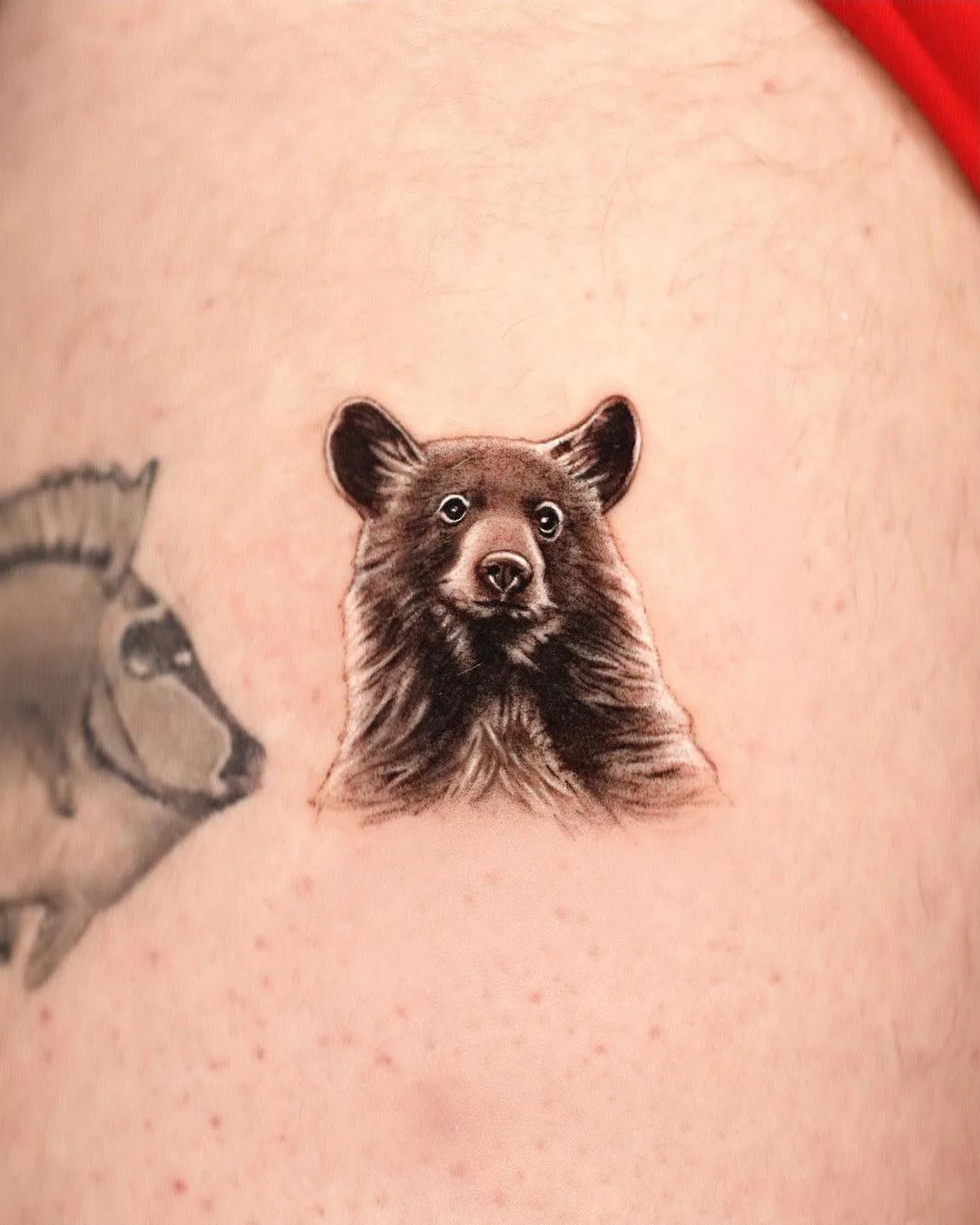
More approachable than the grizzly. Black bears are actually quite shy and tend to avoid confrontation. A black bear tattoo might represent quiet strength, intelligence, or adaptability. They are also the most common bear in North America, so there is a 'local wildlife' connection for many people.
Panda
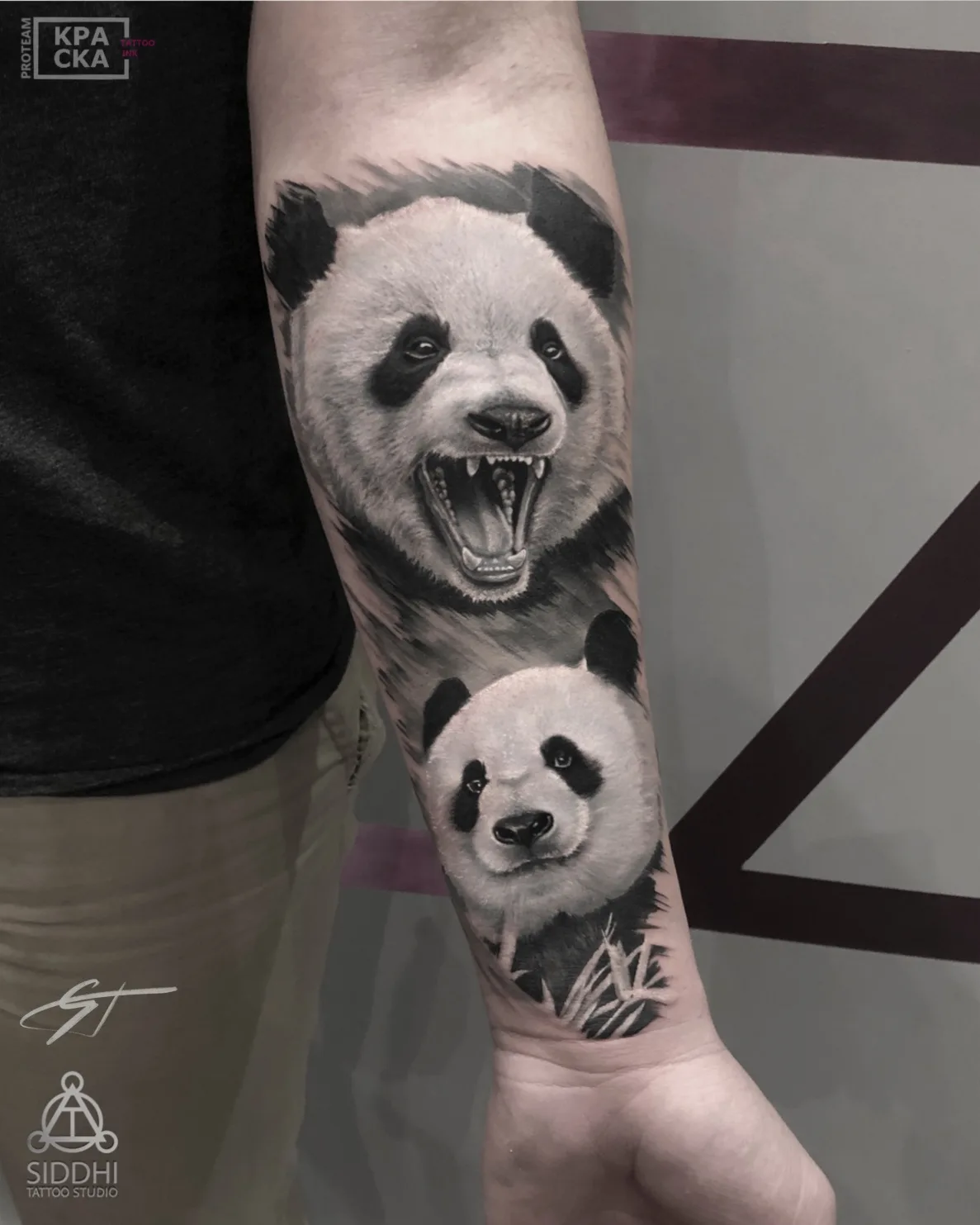
Gentleness, peace, balance. The panda is technically a bear, and as a tattoo it carries very different energy than its more aggressive relatives. Panda tattoos often reference yin-yang balance (the black and white coloring makes that almost unavoidable), playfulness, or conservation awareness. They can be done in virtually any style, from hyper-realistic to cartoon.
Sun Bear and Moon Bear
Less common but increasingly popular. Sun bears, with their distinctive chest patches, represent uniqueness and tropical energy. Moon bears carry associations with mystery and the night. Both make for distinctive tattoo choices if you want something that stands apart from the typical grizzly design.
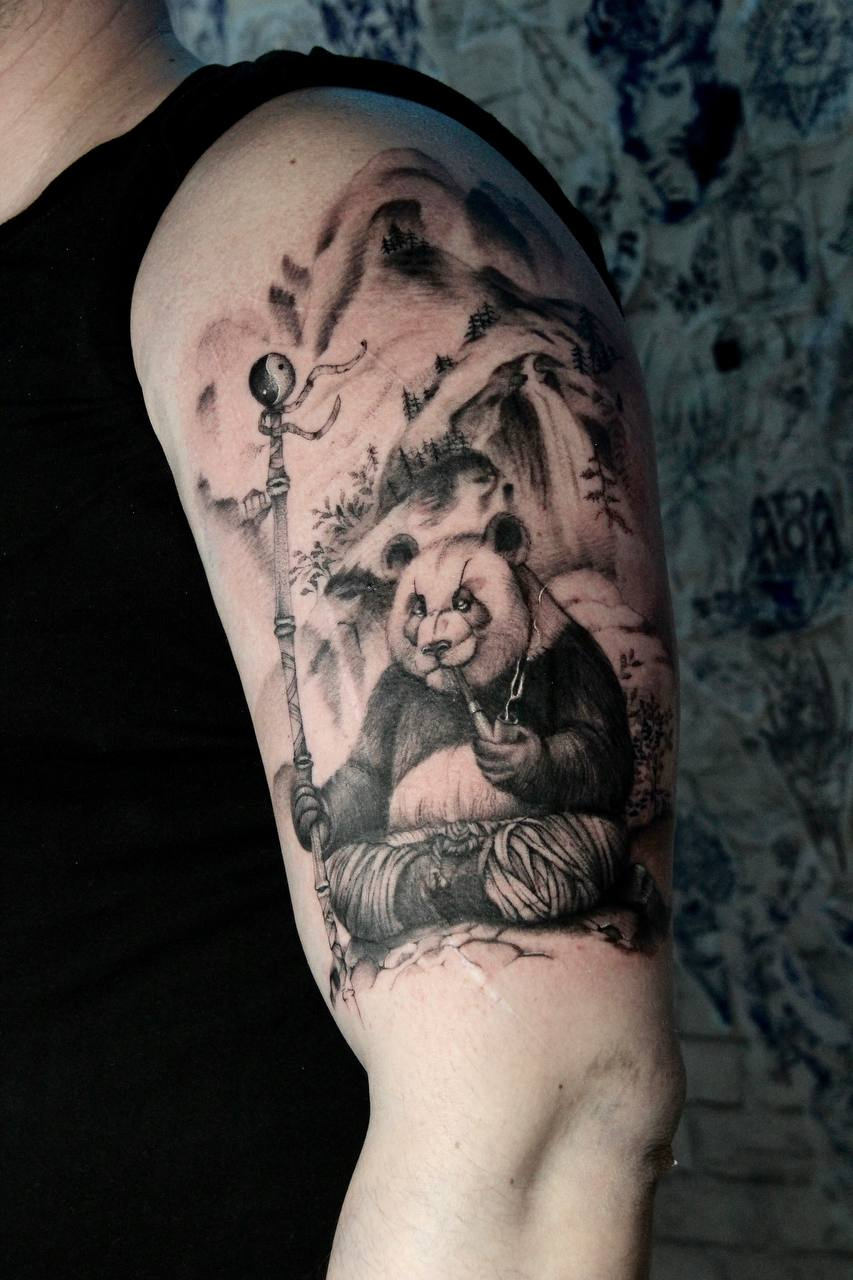
Panda with pipe, black and grey
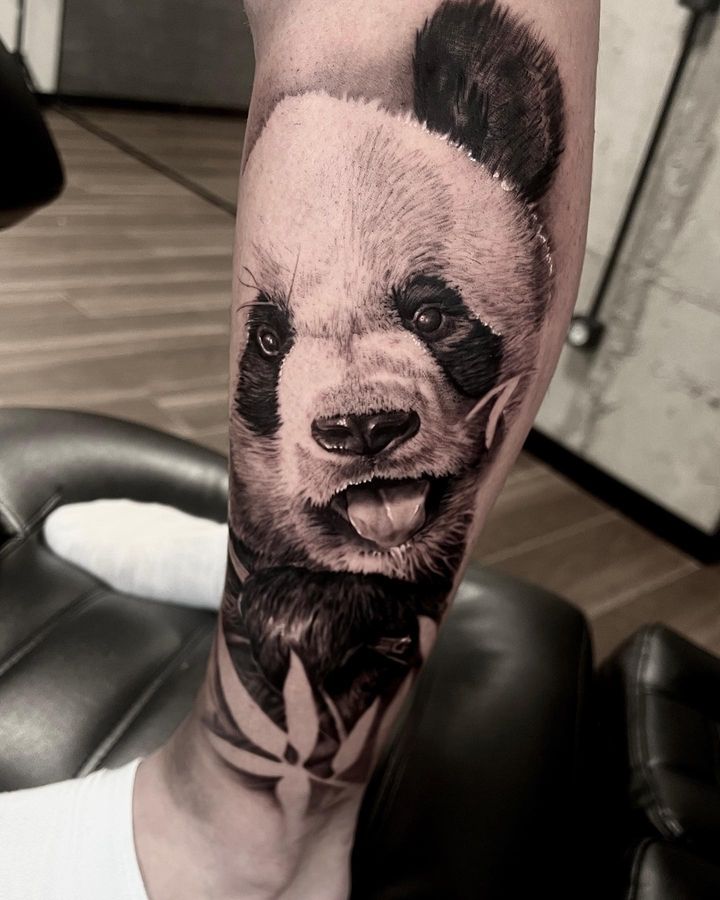
Realistic black and grey panda
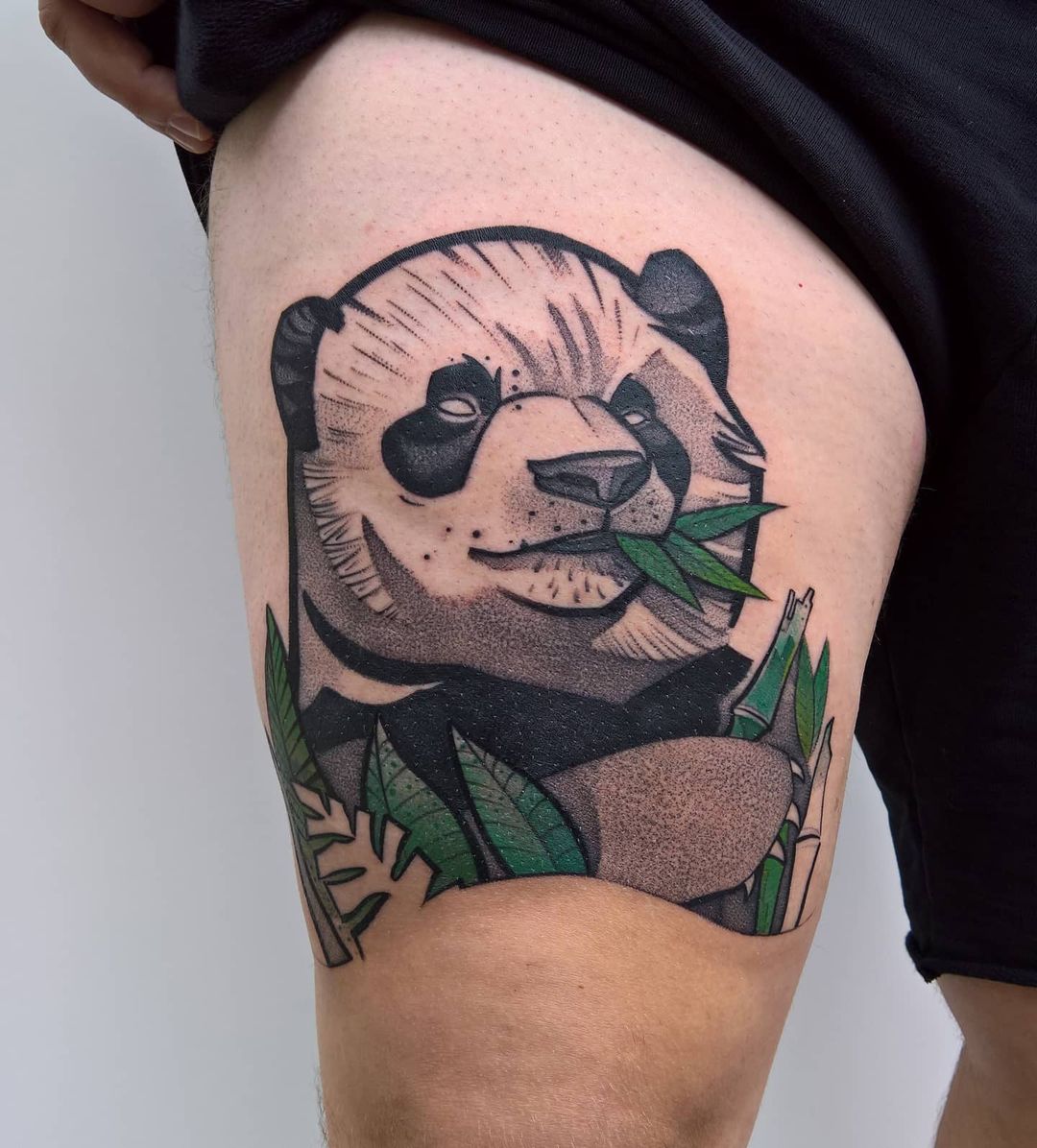
Black and grey panda on thigh
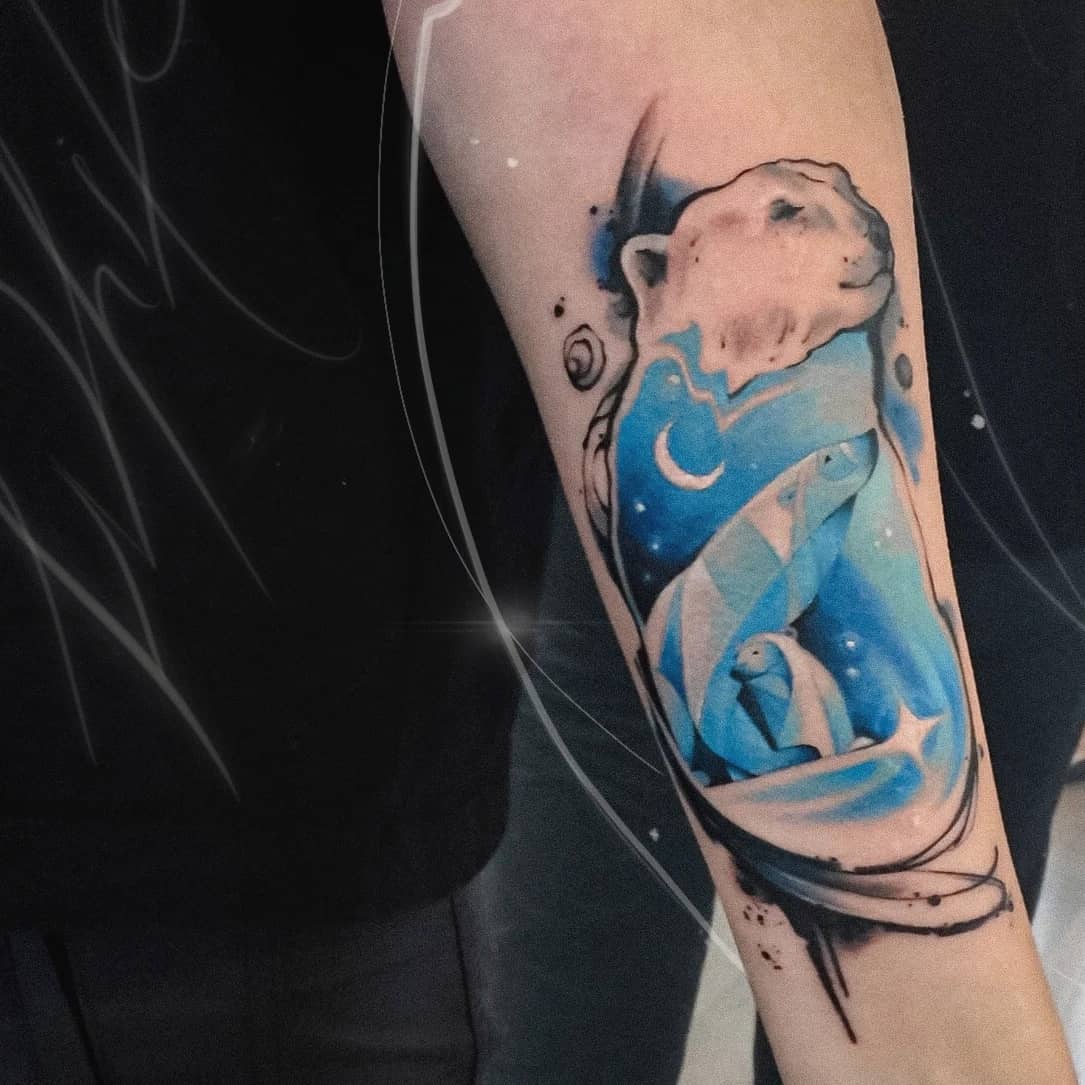
Watercolour polar bear family tattoo
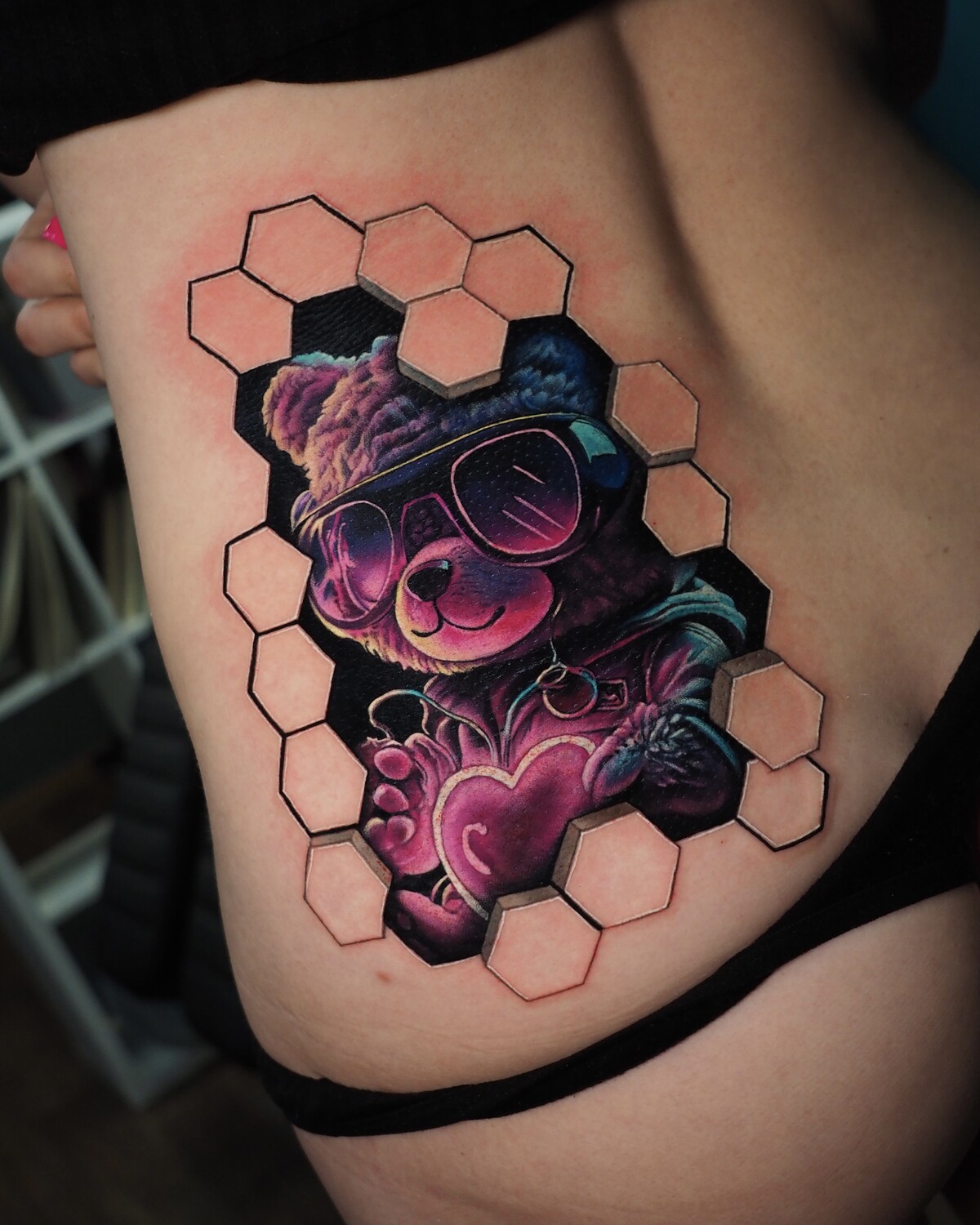
Neo-traditional bear with honeycomb frame
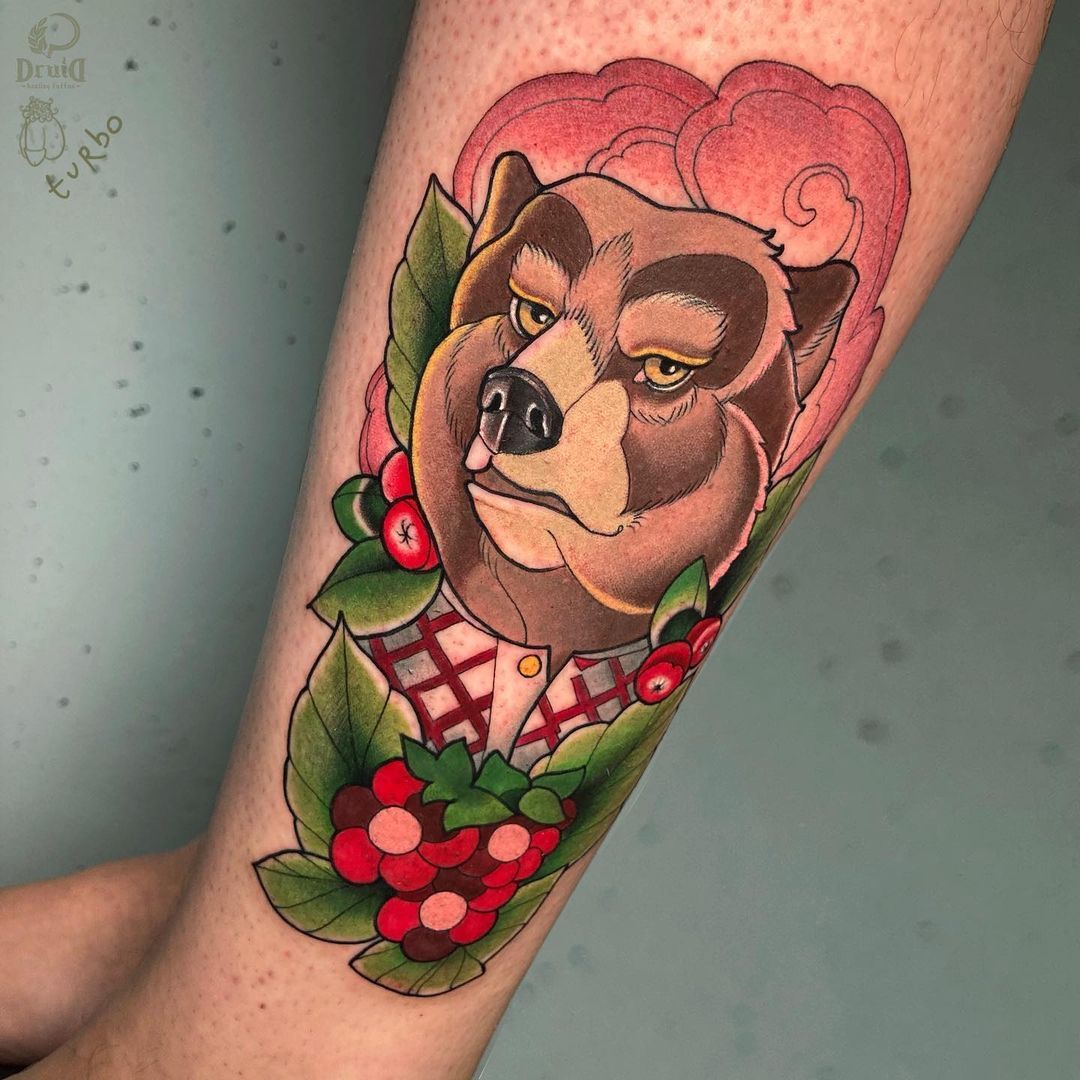
Neo-traditional bear with berries
Placement Guide
Where you put a bear tattoo affects both the visual impact and, arguably, the meaning.
Upper arm and shoulder: The most popular placement. The rounded muscle of the deltoid suits the bear's head shape naturally. Good for portraits and medium-sized designs.
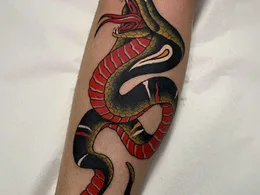
Forearm: Highly visible. Works well for geometric or blackwork bears. You will see this tattoo every day, so the personal significance should be strong.
Back: Full back pieces allow for complete scenes, a bear in its habitat, surrounded by forest or mountains. This is where realistic bear tattoos really shine. The canvas is large enough for genuine detail work.
Chest: Powerful placement. A bear on the chest sits close to the heart, which amplifies the protective symbolism. Common for mama/papa bear designs.
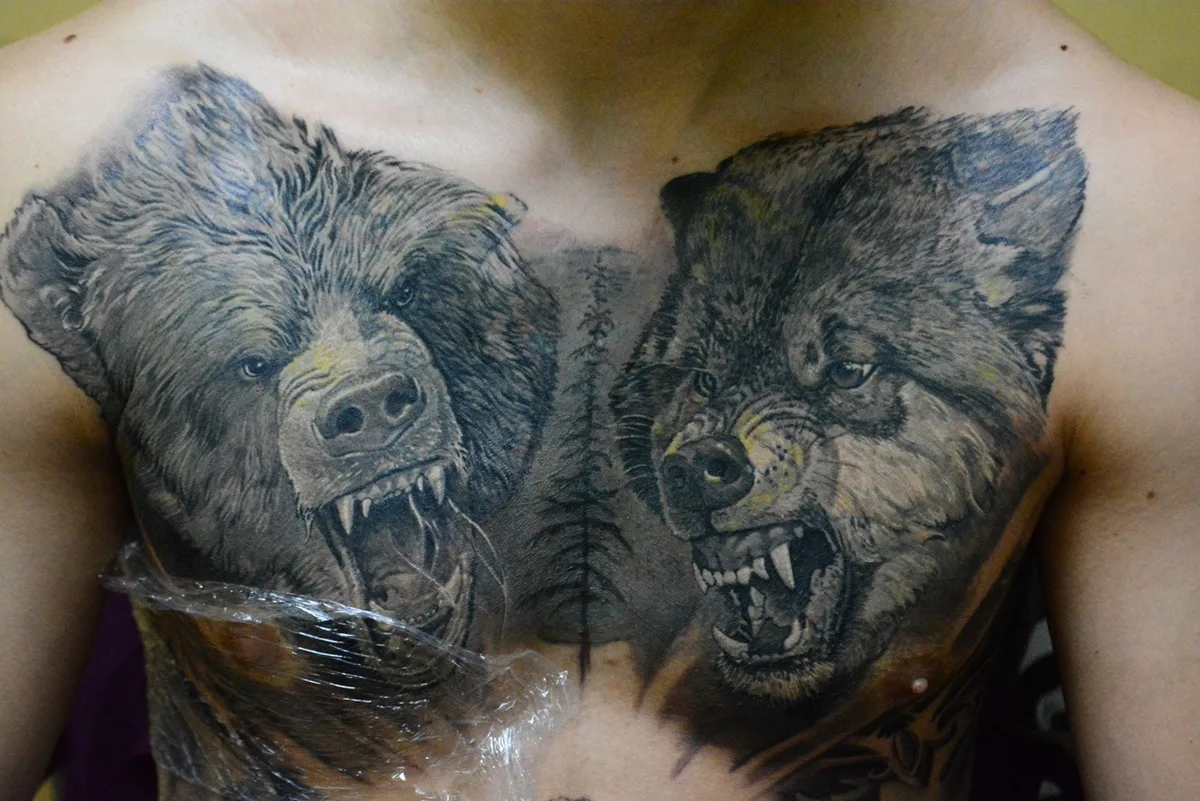
Thigh: Increasingly popular, especially for larger pieces. The thigh offers a flat, wide surface that works well for both horizontal compositions and vertical portrait formats. Also easy to conceal for professional settings.
Calf: Good for standalone bear designs. The natural curve of the calf muscle can add dimensionality to the tattoo.
Color Symbolism in Bear Tattoos
Color choices are not arbitrary. They shift the meaning.
Black and grey keeps things serious, timeless. It emphasizes form over flash. Brown tones add warmth and a naturalistic quality, this is the bear as it actually appears in the wild. Red accents can represent aggression, passion, or blood ties (family). Blue tones, while unusual for bears, create a surreal, dreamlike quality that works well in watercolor or neo-traditional styles.
Gold and amber tones sometimes appear in bear tattoos connected to honey, autumn, or solar symbolism. And then there is full black saturation, no grey, no shading, just solid black, which creates a totemic, almost spiritual quality. It strips the bear down to pure symbol.
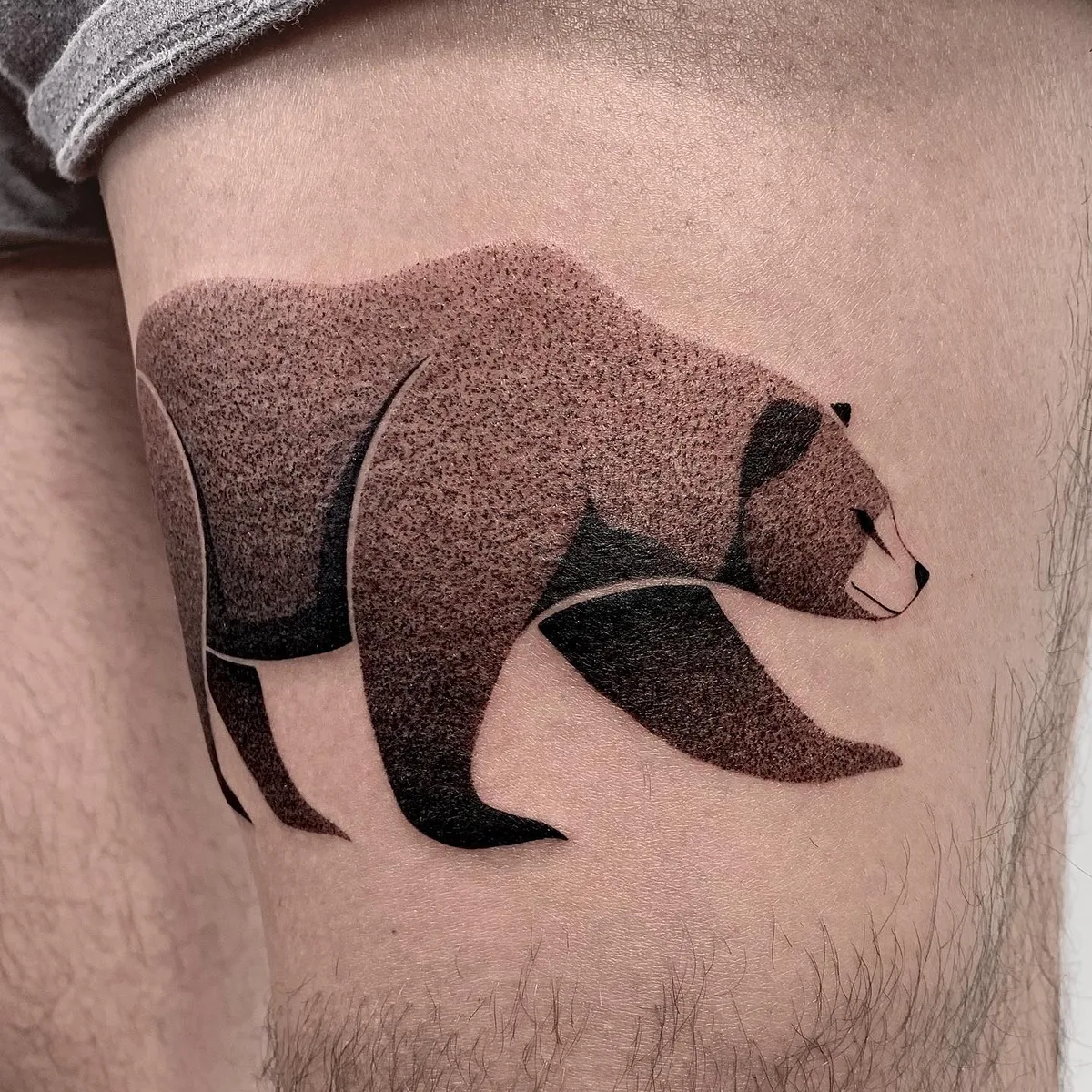
Common Bear Tattoo Combinations
Bears pair well with certain elements that extend or refine their meaning.
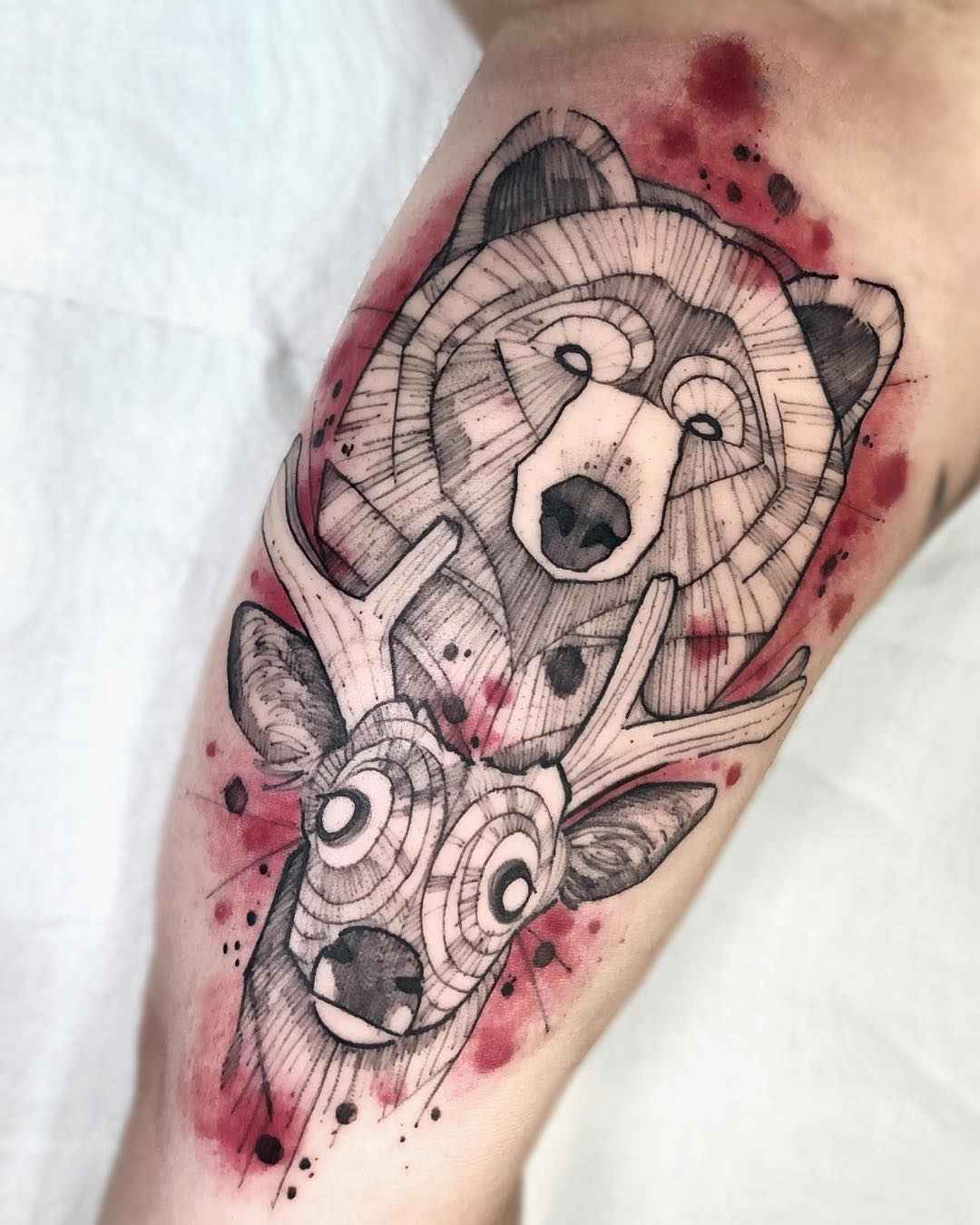
Bear and deer, black and grey illustrative
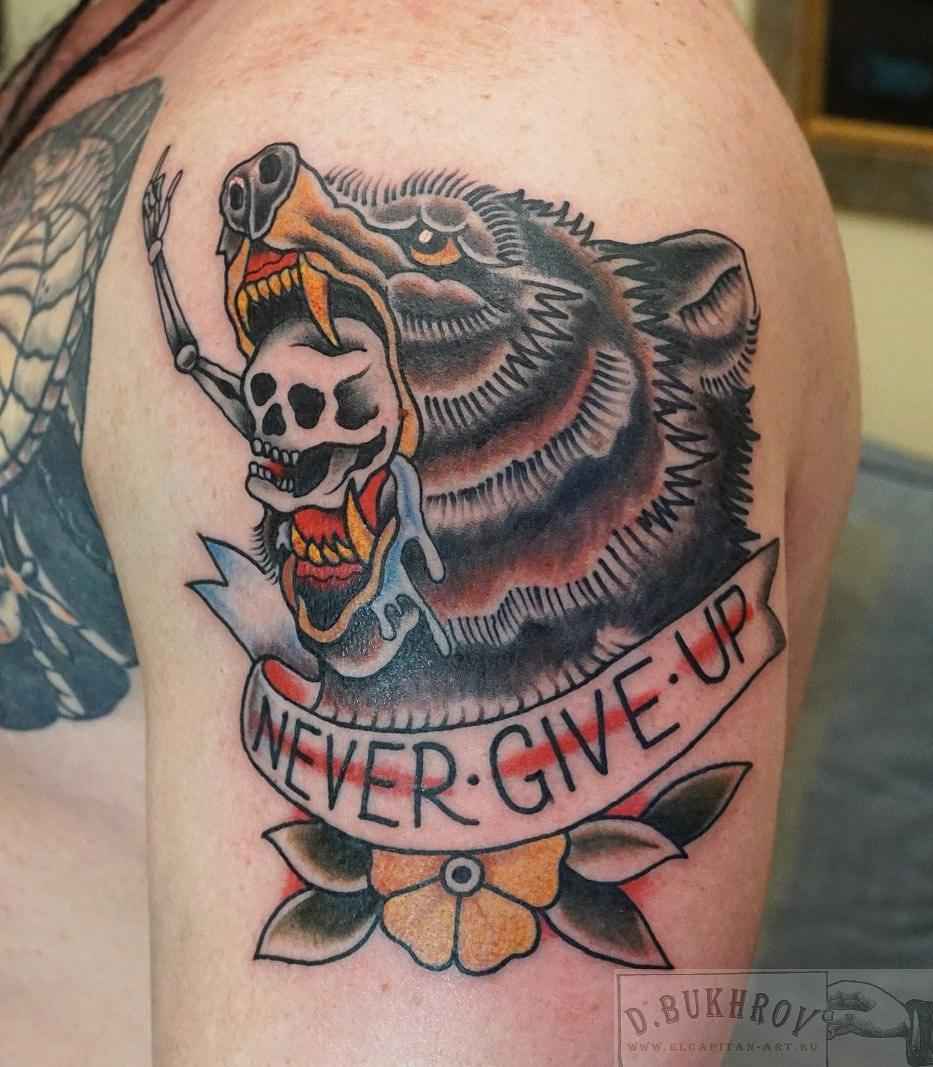
Traditional bear with skull and 'Never Give Up'
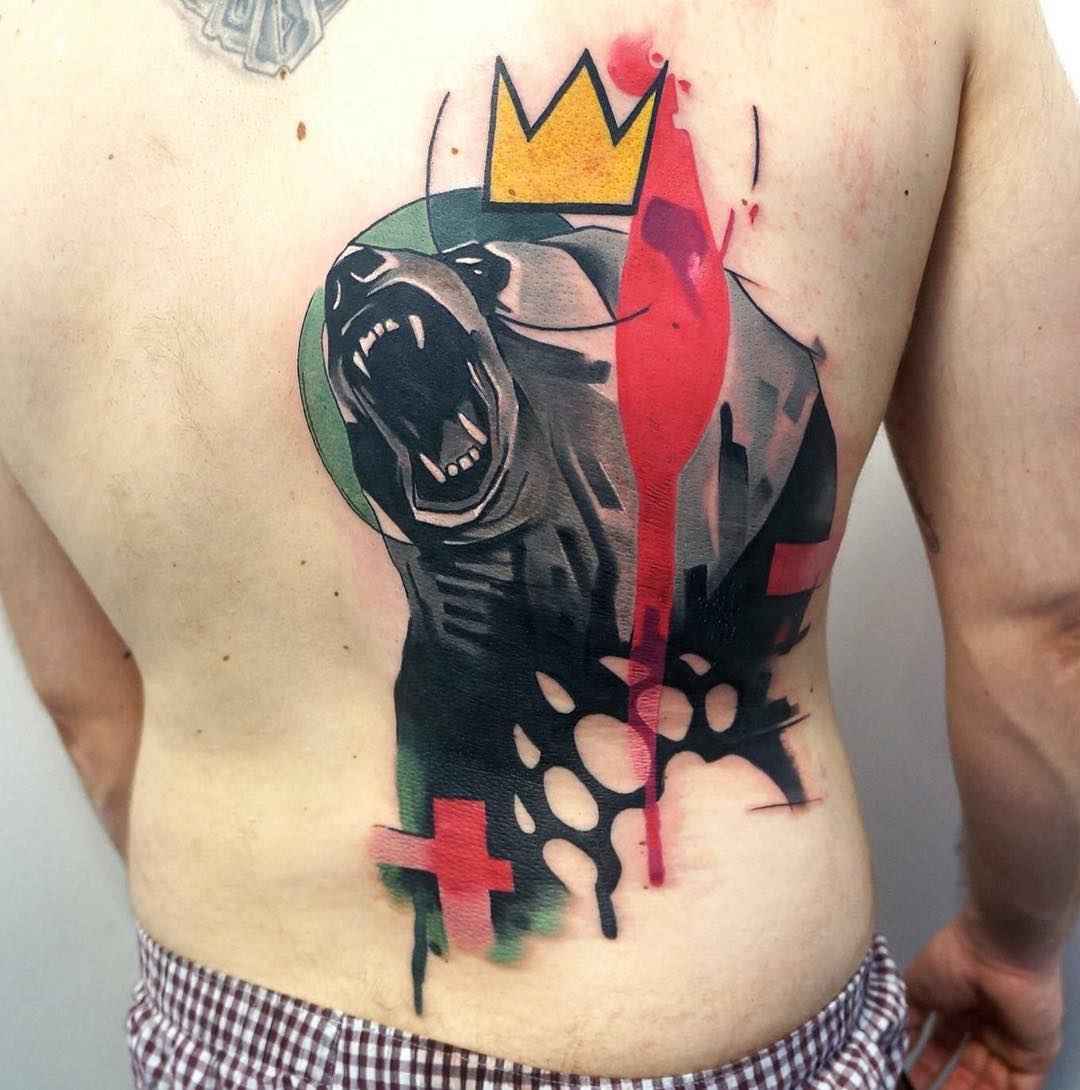
Trash polka bear with crown
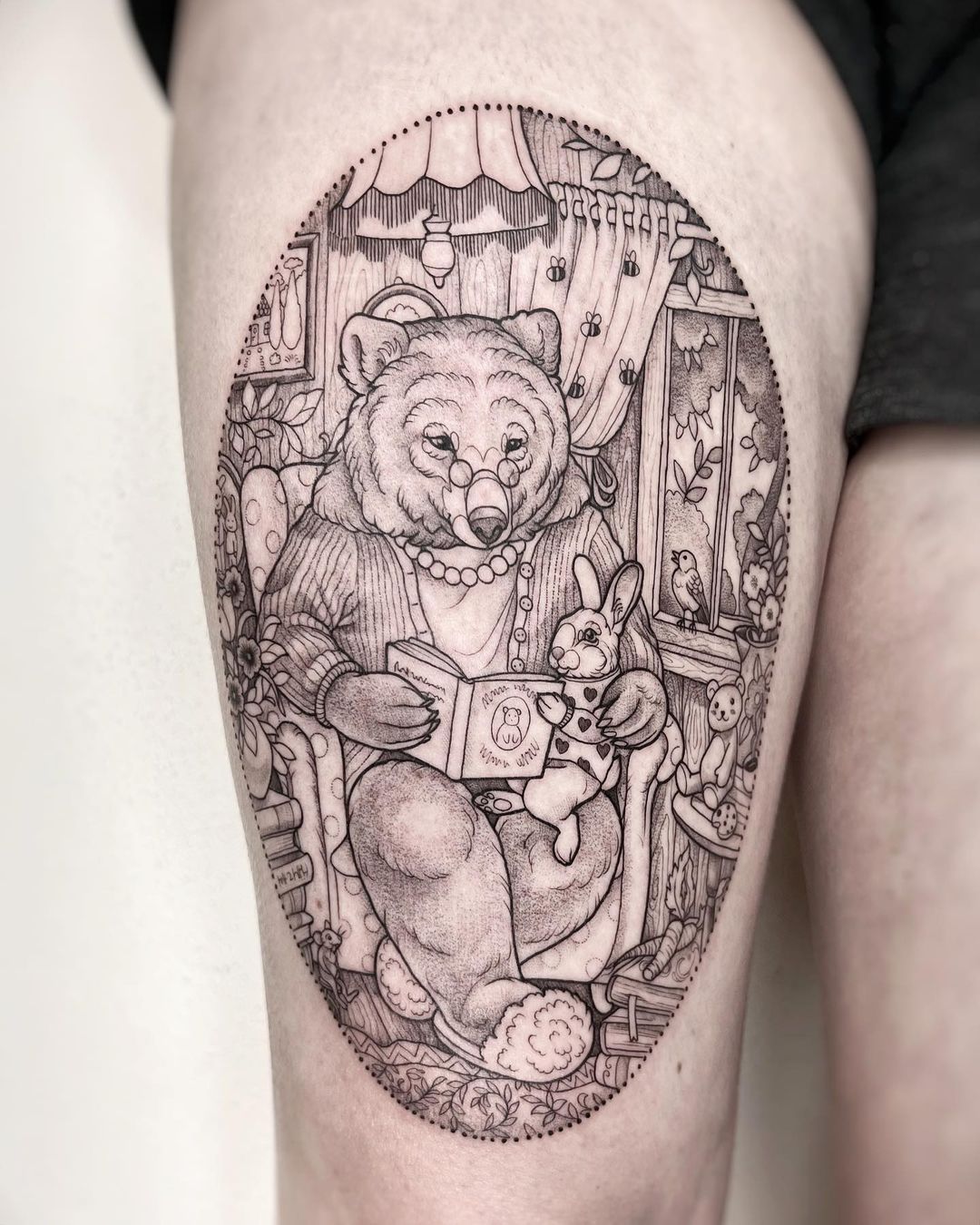
Bear reading to rabbit, black and grey linework
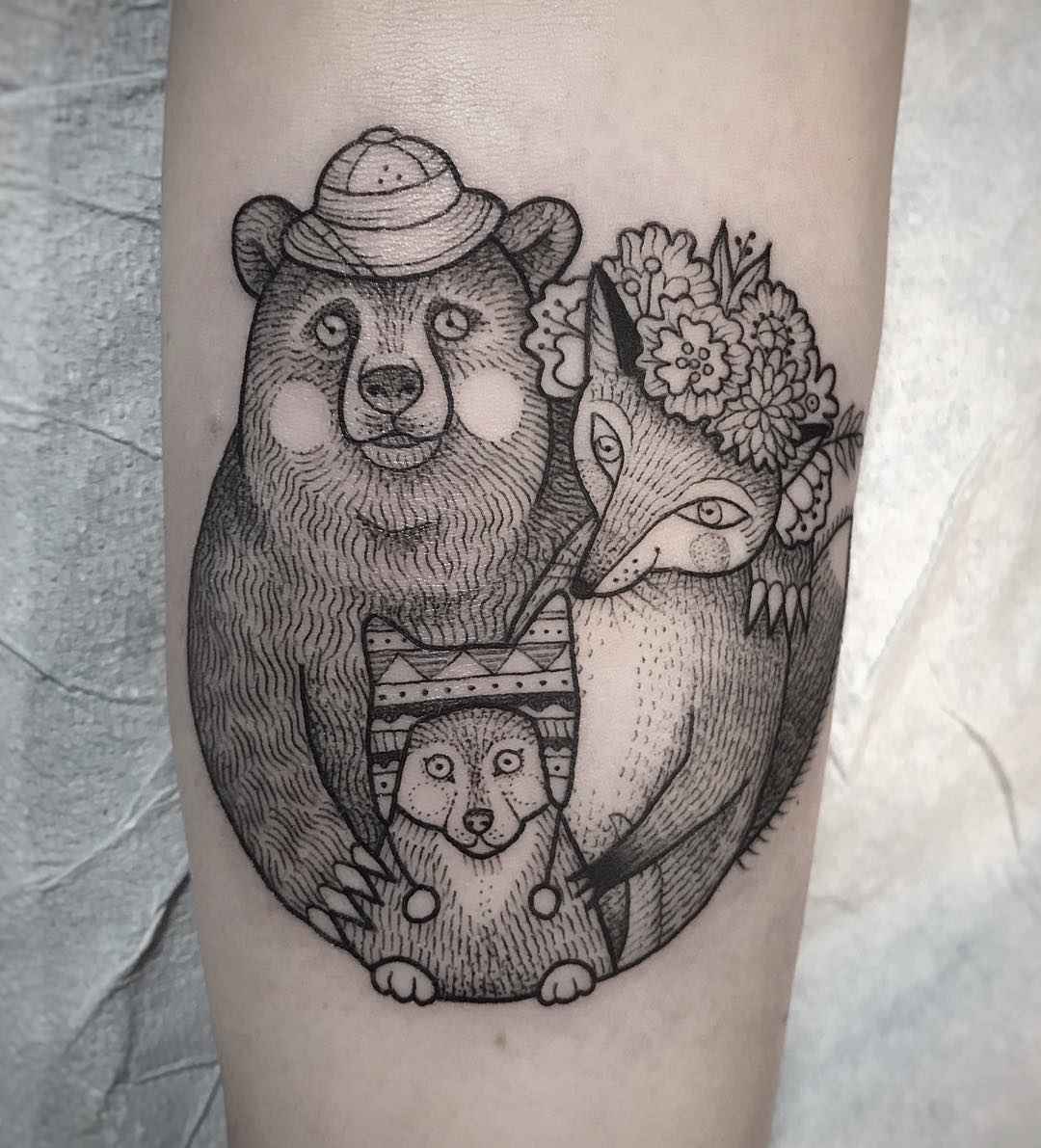
Bear, fox and dog embracing
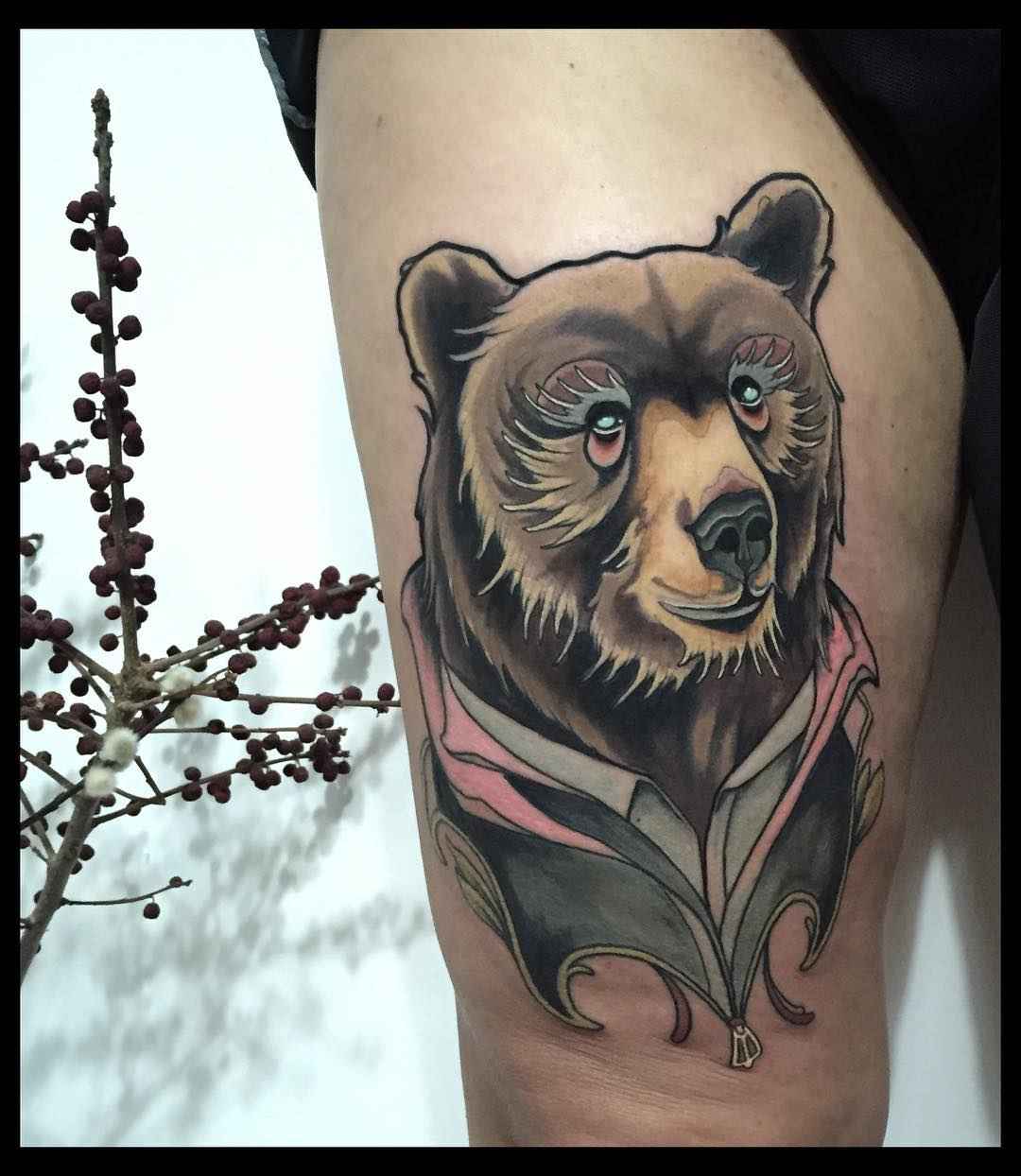
Neo-traditional bear in suit
Mountains and forest: The most natural combination. It places the bear in its habitat and adds themes of wilderness, adventure, and freedom. These compositions work particularly well as half-sleeves or back pieces.
Compass or map elements: Adds a navigation theme, finding your way, staying oriented through difficulty. Popular with people who love outdoor activities or who have been through significant life transitions.
Paw prints: Can trail along the body or accompany the main bear design. Paw prints alone are sometimes chosen as a subtler alternative to a full bear tattoo. They carry much of the same symbolism in a smaller, more discreet package.
If you're not Native American and want a bear tattoo inspired by tribal traditions, research thoroughly first. Some designs carry specific ceremonial or clan-based meanings, and using them without understanding can be culturally disrespectful. Work with a knowledgeable artist to honor the symbolism appropriately.
Dreamcatcher: Bridges bear and Native American symbolism. A bear within or alongside a dreamcatcher references spiritual protection and guidance. Again, be thoughtful about cultural context here.
Geometric frames: Placing a realistic bear inside a diamond, triangle, or circle creates visual tension between organic and structured forms. This combination has become very popular in contemporary tattoo design.
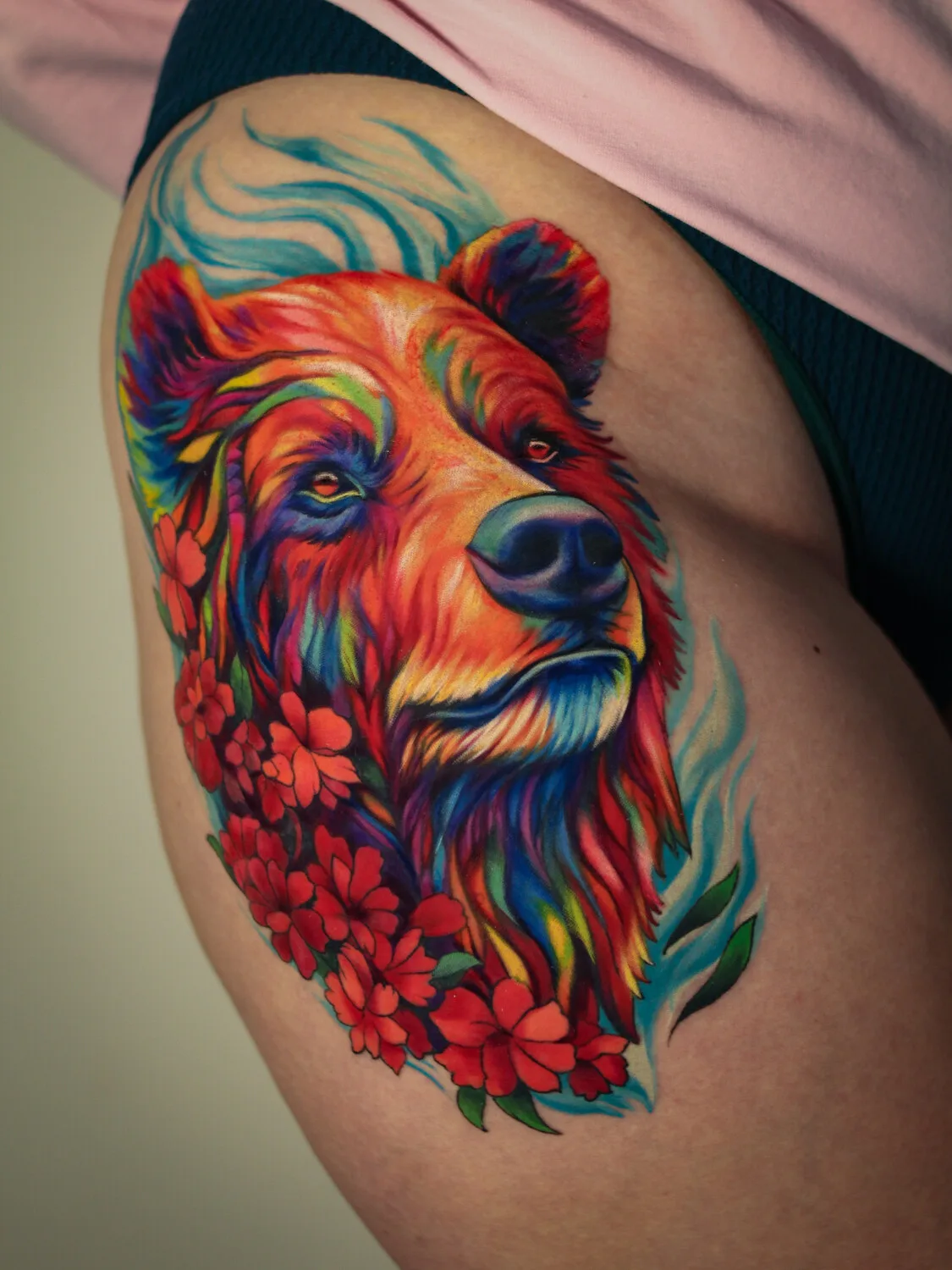
Flowers: Might seem contradictory, but flowers soften the bear's intensity without eliminating it. Roses, wildflowers, or cherry blossoms paired with a bear create a balance between power and beauty. This combination shows up frequently in neo-traditional work.
- Bear tattoos represent strength, protection, solitude, and renewal through hibernation cycles
- Cultural meanings vary dramatically - from Native American healing medicine to Norse berserker warriors
- Mama bear designs have become increasingly popular for representing fierce family protection
- Style choice (realistic, traditional, geometric) completely transforms the tattoo's character and message
- Placement and color choices add additional layers of symbolism to bear tattoo meanings
Frequently Asked Questions
What does a bear tattoo symbolize?
A bear tattoo primarily symbolizes strength, protection, and courage. Beyond that, it can represent family bonds (especially parental protection), resilience through difficult times, independence, and spiritual connection. The specific meaning depends on the style, species, and cultural context you choose. A mama bear with cubs is about family. A Norse berserker bear is about warrior spirit. The symbolism is flexible enough to be deeply personal.
Is a bear tattoo only for men?
Not at all. Bear tattoos are popular across all genders. The mama bear theme is one of the most requested designs among women, and geometric or watercolor bear styles have broad appeal regardless of gender. The bear's symbolism, protection, strength, resilience, is universal. There is nothing inherently masculine about wanting to represent those qualities.
Some parents add a new cub to their mama bear tattoo each time they have another child, creating an evolving family portrait that grows with their family. This approach works especially well with designs that have space for expansion.
How much does a bear tattoo cost?
Cost varies significantly based on size, style, detail level, and the artist's rate. A small geometric bear on the forearm might run $200-400. A realistic half-sleeve with a bear and forest scene could be $1,500-3,000 or more. Full back pieces with heavy detail work can reach $5,000+. Most artists charge by the hour ($100-250/hour depending on location and experience), and a detailed bear tattoo typically requires multiple sessions.
Where is the best placement for a bear tattoo?
The upper arm and shoulder are the most popular placements, the muscle shape complements the bear's head naturally. However, the "best" placement really depends on the size and style you want. Realistic pieces need larger canvas areas like the back, thigh, or full sleeve. Geometric or minimalist bears can work well on the forearm or calf. Chest placement adds emotional weight, especially for family-themed designs.
Do bear tattoos age well?
Generally, yes, especially in traditional, neo-traditional, and blackwork styles. Bold lines and solid fills hold up over time. Realistic bear tattoos with fine detail may need touch-ups after 5-10 years as subtle gradients can soften. Watercolor bear tattoos are probably the most maintenance-intensive, since the soft color bleeds tend to blur. Regardless of style, proper aftercare and sun protection will keep any bear tattoo looking sharp for decades.