Cindy You is an illustrator and tattoo artist based in Brooklyn, New York. Her work has been exhibited at the Society of Illustrators in New York, including the institution's The Art of the Folio show; recognized by American Illustration, Illustration West, and the 3x3 Illustration Competition; published and commissioned by The New Republic, Zócalo Magazine, and Shenzhen Press Group Publishing House. Her practice has been profiled by Communication Arts Magazine, Creative Boom, and Al-Tiba9 Contemporary.
In tattooing, she is building a visual language at the intersection of classical Chinese painting, botanical form, and the New York fine line tradition — a synthesis that currently has no direct equivalent in contemporary tattoo practice.
Cindy You came up through two distinct academic traditions. Her formal training began with classical fine art in Beijing, a system known for its discipline of observation, brushwork, and compositional restraint. She then moved to New York and earned a BFA in Illustration from the School of Visual Arts. SVA added a layer the Beijing curriculum did not address: "It pushed me to think more about voice and intention, why I make images, not just how."
For the tattoo industry, this is a rare profile — an artist with dual academic grounding, Western and Eastern, who arrived at her practice with an articulated artistic position before she ever picked up a tattoo machine.
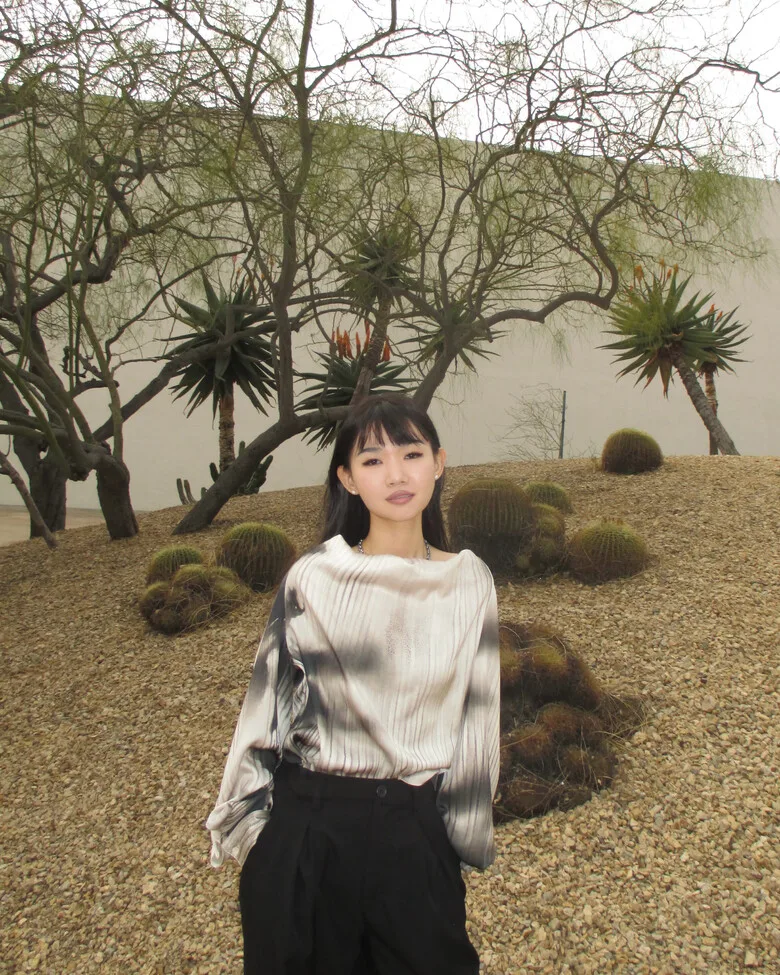
She entered tattooing through an apprenticeship at one of New York's fine line studios — a sub-scene that has shaped the global standard for thin, precise tattooing over the past decade. The move grew out of proximity rather than ambition: "I was especially drawn to how their work could exist on someone's skin in such a permanent and personal way. That experience made me realize tattooing could be a natural extension of my illustration practice." Today she runs both disciplines in parallel — tattoo sessions out of Brooklyn and editorial illustration commissions for major publications.
.jpg)
Cindy You, fine line snake
.jpg)
Cindy You, fine line bird
.jpg)
Cindy You, Asian-inspired fine line
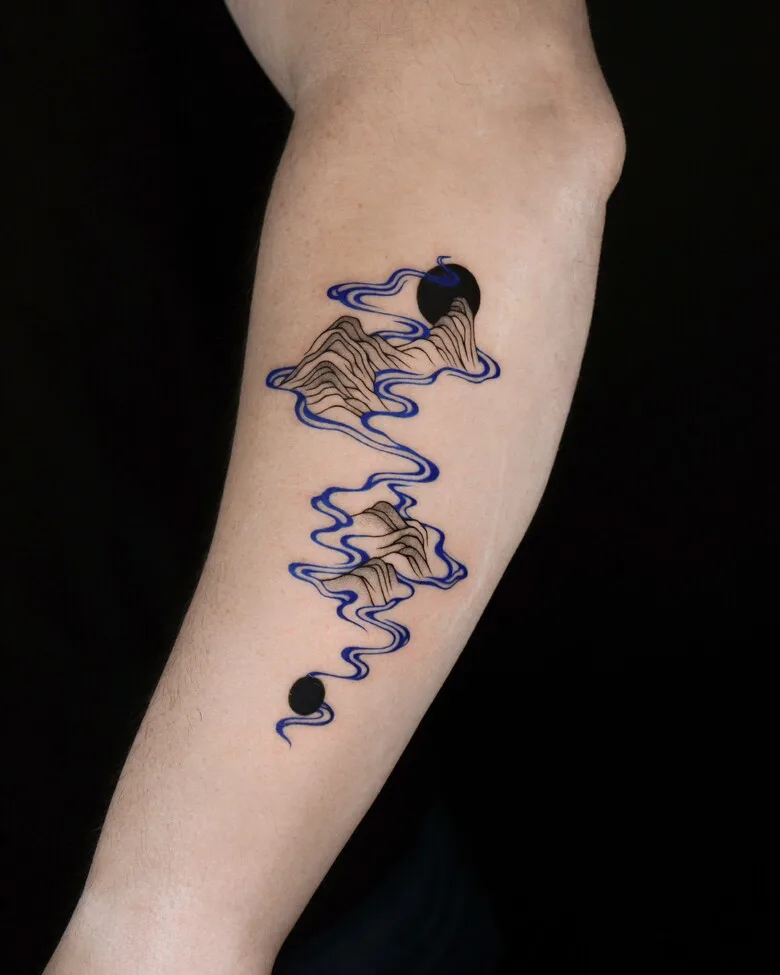
Her tattooing rests on a principle that runs counter to the dominant fine line aesthetic. The category, in its New York form, has been refining itself toward photographic micro-realism and tight ornamental work. Cindy You uses the same toolset to produce something the category was not built to produce: atmosphere, mood, ambiguity.
"Unlike traditional Western aesthetics, which often emphasize light and shadow, perspective, exact geometry and form, I'm more drawn to a sense of softness and ambiguity."
The reference is specific. She draws from the mountains-and-rivers tradition in Chinese painting, where line carries movement and energy and where negative space is treated as primary content rather than background.
This is a meaningful position to take in contemporary tattooing. Most artists working with Asian aesthetic vocabulary in tattoo cite Japanese irezumi — large-scale, densely saturated, narrative compositions. Cindy You works from a different Asian tradition: the Chinese graphic and ink-painting lineage.
.jpg)
Cindy You, fine line geometric
.jpg)
Cindy You, fine line botanical
.jpg)
Cindy You, fine line, Asian flow
Botanical forms run consistently through her portfolio. The connection to plants is direct and observational: she keeps many of them in her apartment and studies their structure as she works. Plants resolve a tension specific to body art — they expand, wrap, and adapt to a curved, moving surface, which most static designs do not.
"In a way, they allow me to translate something living and evolving into a visual language that can flow with the body."
Her palette is deliberately narrow. Cindy deliberately avoids using many colors, choosing instead the restraint of black. When red ink does appear in her tattoos, it is always a conscious decision rather than a client’s whim. Red functions almost like a subtle accent or intervention, drawing attention to specific areas without disturbing the overall balance.
.JPG)
Cindy You, fine-line botanical
.JPG)
Cindy You fine-line flash designs
.JPG)
Cindy You, abstract floral, fine line
Clients come to Cindy for both flash designs and custom projects. In the latter case, she first tries to understand what the person is drawn to — a specific reference or a certain feeling. For custom pieces, she photographs the body, creates a digital sketch, discusses it with the client, and continues making adjustments during the stencil placement directly on the skin.
"With flash tattoos, the client chooses from pre-made designs, but I still adapt them to the body through placement and minor tweaks, sometimes adding freehand elements."
.jpg)
.jpg)
Cover-up tattoos occupy a distinct place in her practice and demand a different kind of judgment. Working with an existing tattoo means accounting for its shape, density, and how it has aged — variables that constrain the new design before it begins. She approaches these projects as problem-solving, finding ways to integrate or redirect what is already there. There is also an emotional dimension she takes seriously: clients arriving for cover-ups often carry unresolved frustration with their previous work, and the act of restoring their relationship to their own skin is part of the craft she names as one of the more meaningful aspects of the job.
"Being able to help them transform that into something they feel connected to again is very meaningful to me."
Her credentials in illustration are extensive and institutional. She has exhibited at the Society of Illustrators in New York, including the museum's The Art of the Folio show — a recognition reserved for illustrators whose work meets the institution's curatorial standard. She has been included in American Illustration, the Society of Illustrators of Los Angeles' Illustration West annual, and the 3x3 Illustration Competition — three of the most consequential juried recognitions in the contemporary illustration field.
Her editorial publication record extends across cultural and political publications in the United States and abroad. The New Republic and Zócalo Magazine have published or commissioned her work, placing her in the editorial illustration tradition associated with major American magazines. Shenzhen Press Group Publishing House has commissioned her in China, giving her cross-Pacific publication reach that is uncommon for tattoo artists. Her practice has been profiled by Communication Arts Magazine — the discipline's most established trade publication — as well as by Creative Boom and Al-Tiba9 Contemporary, which together represent meaningful coverage from the international illustration and contemporary art press.
Two personal projects represent the more conceptual side of her practice: Pressure Beneath the Skin and The Quiet Bloom of Otherworlds. Both use domestic and everyday imagery to investigate emotional and psychological states, and both occupy a register closer to her tattooing than to commercial illustration. Pressure Beneath the Skin, in particular, names directly the territory her tattoo practice operates in: the surface of the body as a site where private experience becomes visible.
.jpg)
Cindy You, fine-line geometric portrait
.jpg)
Cindy You, fine line style
.jpg)
Cindy You fine-line pop-art portrait
A turning point in her tattoo career came through a shift in how clients approached her. There was a period when people stopped choosing from a portfolio and started seeking out her vision specifically: "It made me realize that I was no longer just executing ideas, but actually building my own visual language and being recognized for it." That recognition — quiet and accumulating, rather than sudden — is the marker she identifies as the most meaningful development in her career so far. It also reflects the broader pattern in the contemporary tattoo industry, where the most established artists are those whose authorship clients actively seek.
Looking ahead, Cindy You is moving toward larger-scale work — designs that wrap more fully around the body and develop a deeper relationship with form and movement. She has also been traveling more frequently for guest spots, which is establishing her work in tattoo communities outside New York and broadening her client base internationally. The longer-term direction is toward a closer integration of her tattooing and her illustration: ideas moving between paper and skin, each medium informing the other. For an artist whose practice has always been built on the meeting point between disciplines, that direction reads as a continuation of the work she has been doing all along.