An elephant tattoo means family memory and protection: the animal that remembers its dead, walks its calves between its legs and does not leave the herd. Wisdom and patience follow from that. In Hindu and Buddhist countries the elephant is also a religious image with rules attached, and those rules reach the tattoo chair. Which reading you are wearing depends on the design: a matriarch with her calf says one thing, Ganesha on an upper arm says another, a white elephant says a third, and a Thai elephant in full regalia says something none of the others do.
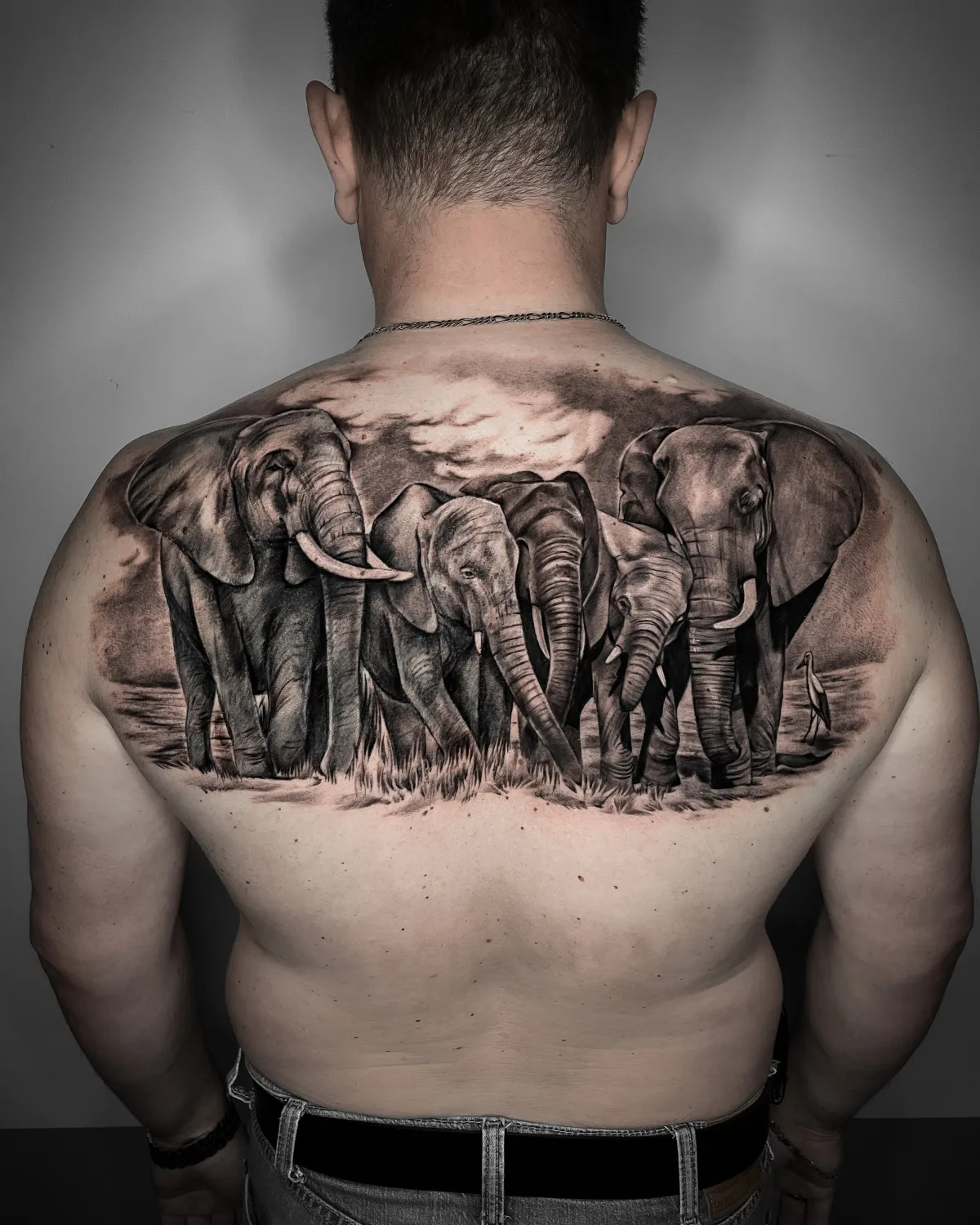
- The family reading comes from real herd behaviour: matriarchs carry the memory that gets calves through a drought, and elephants mourn their dead.
- Ganesha is a living god, not a decoration. Keep him above the waist: legs, feet and hips are ritually unclean in Hindu practice.
- A white elephant is the safe way to wear Buddhist meaning; the restrictions in Sri Lanka and Thailand attach to the Buddha's image, not the animal.
- Species matters for the drawing: African ears for the matriarch and mother-and-calf, Asian ears for Ganesha, Māyā's dream and the Thai royal elephant.
- Realism needs at least eight centimetres of head to hold skin texture; below that, go for outline, blackwork or traditional lines.
What an elephant tattoo means
The memory part is not folklore. The Amboseli Elephant Research Project in Kenya has followed the same families since 1972, and in 2001 its researchers published a study in Science showing that families led by the oldest matriarchs were far better at telling the calls of strangers from the calls of friends. The matriarch is the herd's social memory: she knows who is who, and where the water was in the last bad year. During the 1993 drought in Tanzania's Tarangire, the families that left the park and lost the fewest calves were the ones whose matriarchs had been alive during the drought of 1958 to 1961.
Mourning is documented too, and it is the reason so many elephant tattoos are memorials. Elephants stop at the bones of their own kind, touch them with the trunk and foot, and stand over a dying animal long after there is anything to be done. In 2003 in Kenya's Samburu reserve, researchers watched a matriarch named Eleanor collapse and a female from an unrelated family try repeatedly to lift her back to her feet.
Protection is the third meaning, and it is visible in any wild herd: the calves walk in the middle, the adults on the outside, and when something threatens them the family turns to face it in a ring. That is the strength people mean when they choose the animal: not the sheer weight, but the willingness to put the body between danger and the young. A lion tattoo is force that explodes. An elephant tattoo is force that stands its ground.
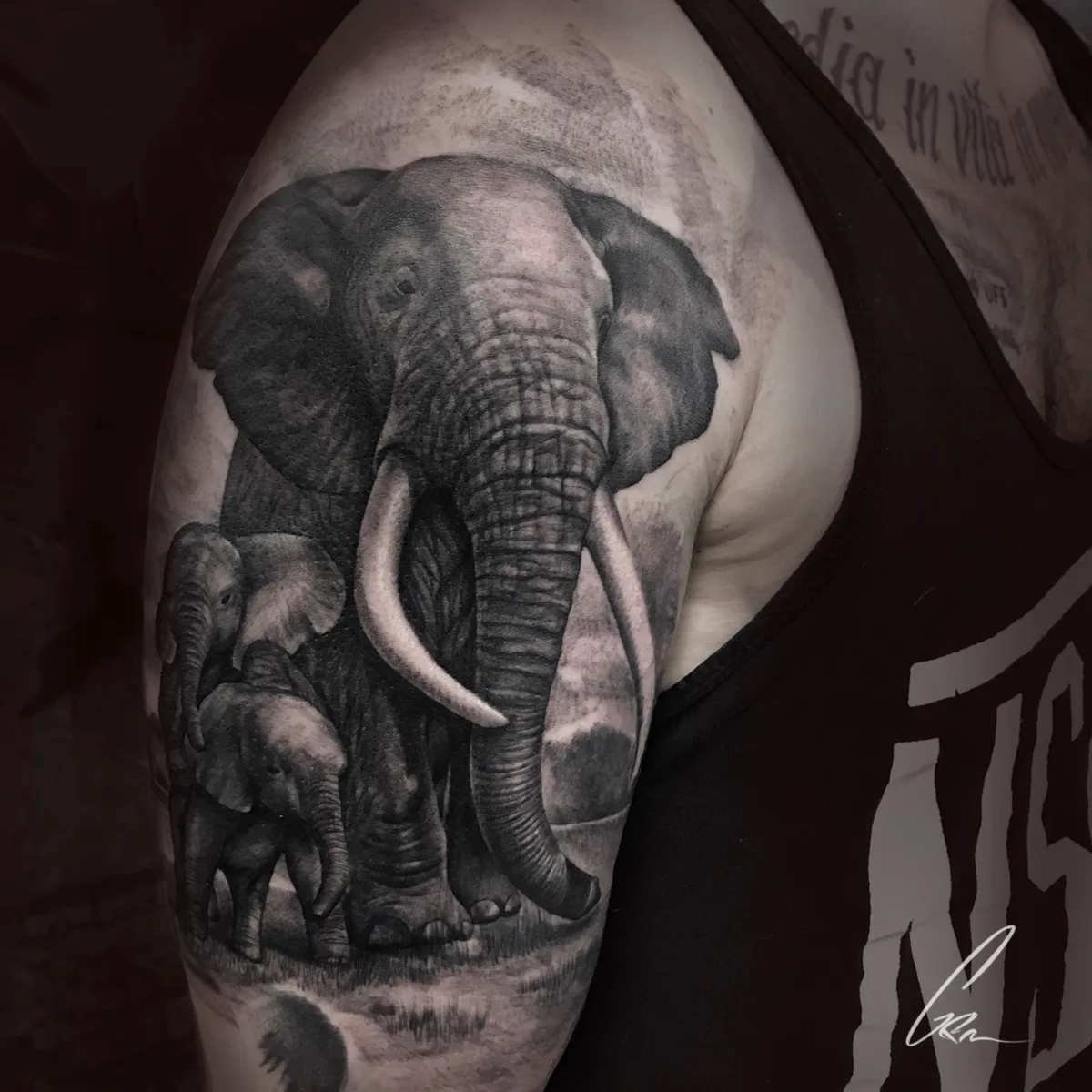
Most commissions fall into three broad groups. Memorial and family pieces: a parent who has died, a child who was born, a line of generations. New-beginning pieces, often Ganesha, wanted for a recovery, a business or a move. Protection and luck pieces, which are where the trunk-up convention and the Thai heraldic elephant come from. It is also the one family animal in tattooing that carries a living religion, which is why the next four sections matter.
Hindu mythology: Ganesha, remover of obstacles
Ganesha is the son of Shiva and Parvati, and he got the elephant head after his father cut off his human one: Parvati had made the boy from clay to guard her door, Shiva did not know him, and the replacement head came from the first animal that passed. He is Vighnaharta, the remover of obstacles, and Hindus invoke him before anything begins, whether a wedding, a journey or the first page of a new account book.
The broken tusk has its own story. When the sage Vyasa dictated the Mahabharata, Ganesha agreed to write it down on condition that Vyasa never paused. When the pen broke, Ganesha snapped off his own tusk and kept writing. As a tattoo the broken tusk means finishing what you started at whatever cost, and it is the detail most often drawn wrong: the right tusk is the missing one in most iconography, and he usually holds the broken piece in a lower hand.
Now the etiquette, because clients ask and most articles skip it. In Hindu practice, the feet and anything below the waist are ritually unclean: you remove shoes at a temple door and never point your feet at a shrine. Hindu advocacy groups have complained publicly about Ganesha printed on socks, shoes and doormats for exactly this reason, and a tattoo on a calf, thigh, foot or hip reads the same way to them. The placements practising Hindus usually choose for themselves are the upper arm, the chest and the back. So this is not a neutral decorative choice. If you are wearing a deity who is worshipped today, give the image the care his devotees give it: above the waist, and kept out of irreverent settings.
Buddhist tradition: the white elephant and Māyā's dream
Queen Māyā of the Shakya clan, asleep at Kapilavastu, dreamed that a white elephant with six tusks came down from the Tusita heaven holding a white lotus in its trunk, walked around her three times and entered her right side. The brahmins called to read the dream said the child would be either a universal monarch or a Buddha. The scene is carved on the railing at Bharhut in central India, from the second century BCE, one of the oldest images in Buddhist art: the elephant hovering above the sleeping queen.
The six tusks point to an older story. In the Chaddanta Jātaka, the Buddha in a previous life is an elephant king with six tusks. A former wife, reborn as a human queen, sends a hunter to kill him for them. Hit by the arrow, the elephant asks why, then saws off his own tusks and hands them over: generosity carried to the point of self-destruction. White stands for purity in the same tradition, and for the mind after training. Tibetan murals of the nine stages of calm abiding show a monk chasing an elephant that turns from black to white as the mind settles.
For a tattoo, a white or negative-space elephant is the direct reference to all of this, and it is the safer way to wear Buddhist meaning. Sri Lanka deported a British tourist in 2014 for a Buddha tattoo on her arm; Thailand's Culture Ministry has campaigned against Buddha images on skin since 2011. The objections concern images of the Buddha himself, not the animal.
Thailand: the elephant as national animal
Thailand's word for elephant is chang, and the animal is on the beer and the naval ensign. White elephants (chang pheuak, pale-skinned animals judged by a formal list of physical marks) belong to the king by law, and tradition measures a reign partly by how many are found during it. King Mongkut founded the Order of the White Elephant in 1861, still one of the country's highest decorations.
From 1855 until 1917, Siam flew a white elephant on a red field: plain at first, later dressed in royal regalia. King Vajiravudh replaced it with the red, white and blue tricolour in 1917; the story told in Thailand is that he saw the elephant flag flown upside-down in a flooded town and wanted a flag that could not be hung wrong. The elephant survived on the naval ensign, where it still is.
Two more Thai elephants show up in tattooing. Erawan is the Thai name for Airavata, the three-headed elephant that carries the god Indra. And the war elephant: in 1593 King Naresuan of Ayutthaya killed the Burmese crown prince in single combat from elephant-back, a duel Thailand still commemorates on Royal Thai Armed Forces Day. In the sak yant tradition of sacred tattooing, Ganesha appears as Phra Phikanet, and the same below-the-waist etiquette generally applies. The Thai elephant in a tattoo is heraldic, head-on, ears spread and caparisoned, the animal as a crest rather than a creature.
African traditions: the matriarch and ancestral memory
An African elephant family is three or four generations of females and their young, led by the oldest. Males leave at twelve to fifteen and live apart. The matriarch decides when the family moves, where it drinks and how it responds to a threat, and in the 2011 follow-up to the Amboseli work, families with the oldest matriarchs were the ones that correctly treated a male lion's roar as more dangerous than a female's. This is the reading behind most family-themed elephant tattoos even when the wearer has never heard the word matriarch: a grandmother who holds the knowledge, and a family that survives because it follows her.
The human traditions build on the same animal. Among the Akan of Ghana the elephant, esono, is the emblem of chieftaincy, and the proverb runs "follow the elephant and the dew will not wet you": walk behind real power and the path is cleared for you. In the kingdom of Benin the Oba's ancestral altars carried carved ivory tusks, each one recording the deeds of a reign, which is ancestral memory in the most literal form, cut into the animal's own tooth.
One practical consequence for the drawing: the family elephant is African, Loxodonta, with ears shaped like the continent and two fingers at the tip of the trunk. Ganesha, Māyā's elephant and the Thai royal animal are Asian: small ears, a twin-domed forehead, one finger on the trunk. Artists mix these up constantly, and a mother-and-calf piece drawn with Asian ears is quoting a tradition the client did not ask for.
Tattoo styles that suit the elephant
Realism. The most requested approach, and the elephant rewards it more than most animals because the skin is a landscape: folds, cracks, the fine wrinkles around the eye, the thin hair on the forehead of a calf. Black and grey suits it naturally, since the animal is grey to begin with. The risk is the same as with any fine texture: at conversational distance an elephant rendered entirely in wrinkles turns into a soft grey oval.

Elephant head and lily tattoo, full arm by @evild4n
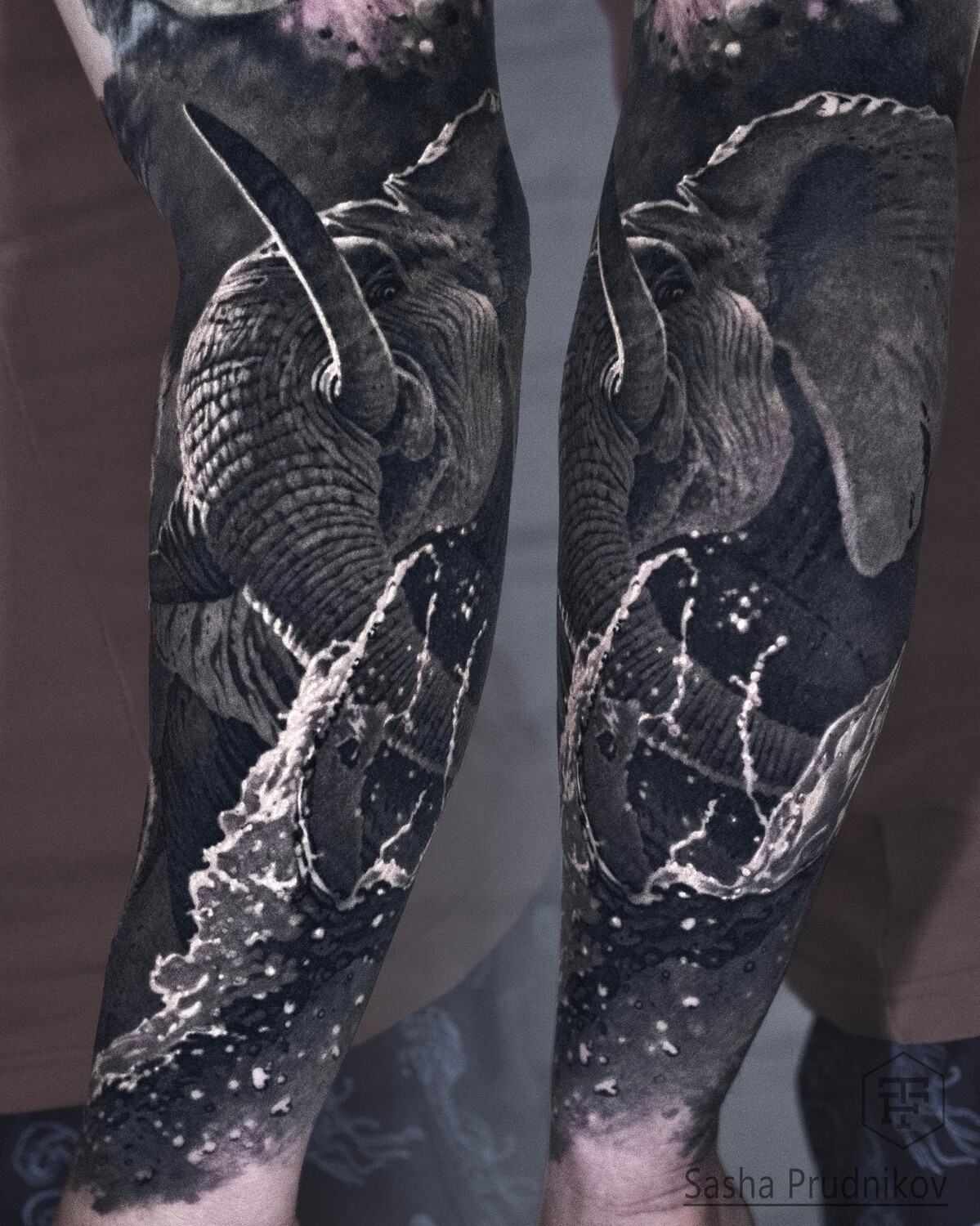
Elephant in water sleeve tattoo by @sasha.prudnikov.tattoo

Black and grey elephant portrait tattoo by @danielbedoyaart

Elephant with trees tattoo by @marceltattooartist

Elephant walking tattoo on blue sky by @gavsta2

Elephant face tattoo with savanna by @Suvorov
Blackwork and dotwork. The elephant's outline is one of the most recognisable shapes in nature, so it survives being reduced to a solid silhouette when a wolf or a horse would not. Dotwork lives in the folds of the skin and in the ears.
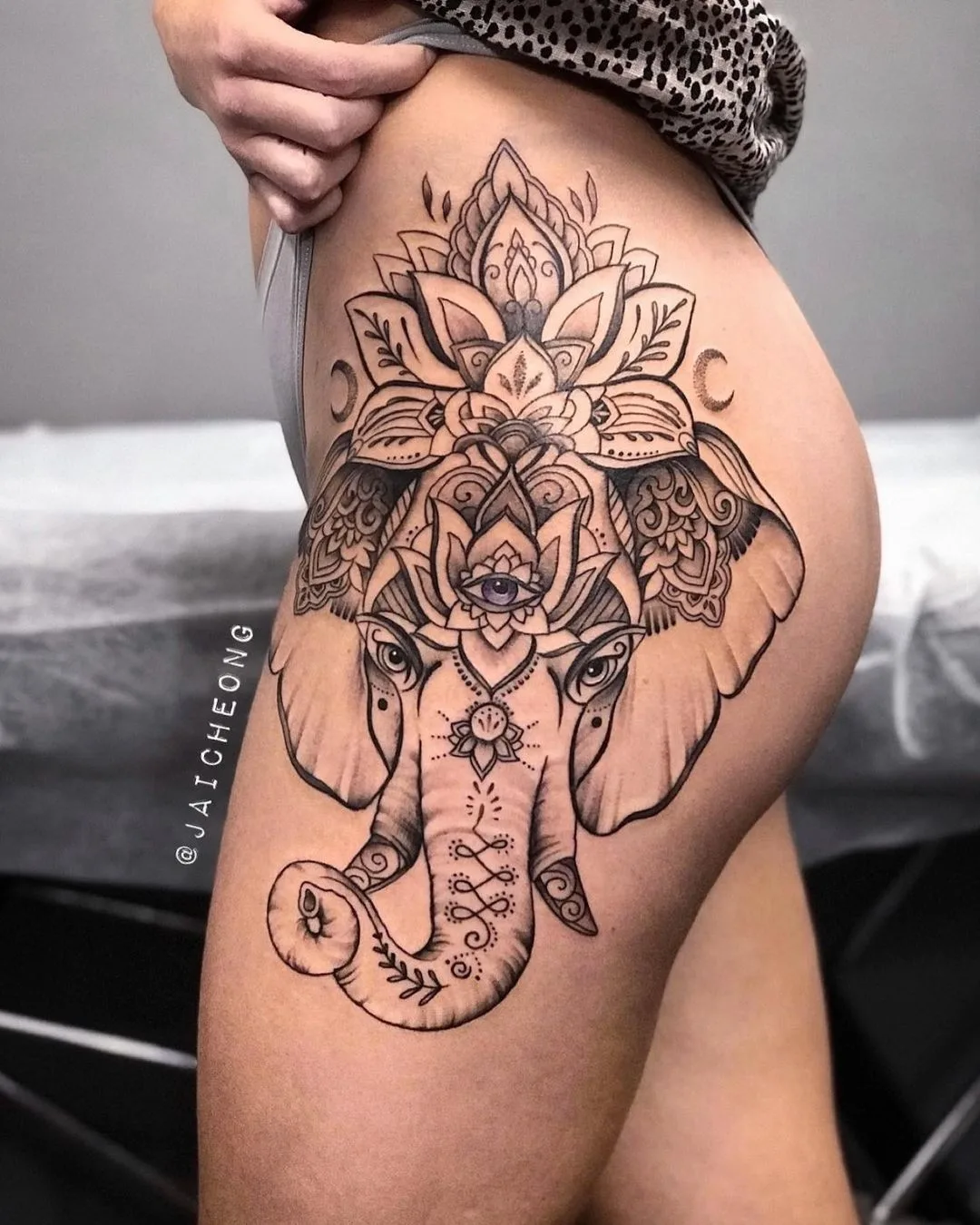
Ornamental and mandala. Temple elephants in Kerala and Thailand wear a decorated cloth called a caparison and a gilded head-plate, and most ornamental elephant tattoos are a stylised version of that costume: paisley, lotus and geometric borders on the head and back. A mandala placed inside the head references the Buddhist mind-elephant whether or not the wearer knows it. It is overwhelmingly the choice for thigh and sternum pieces, and it ages well as long as the pattern stays coarse enough to survive.
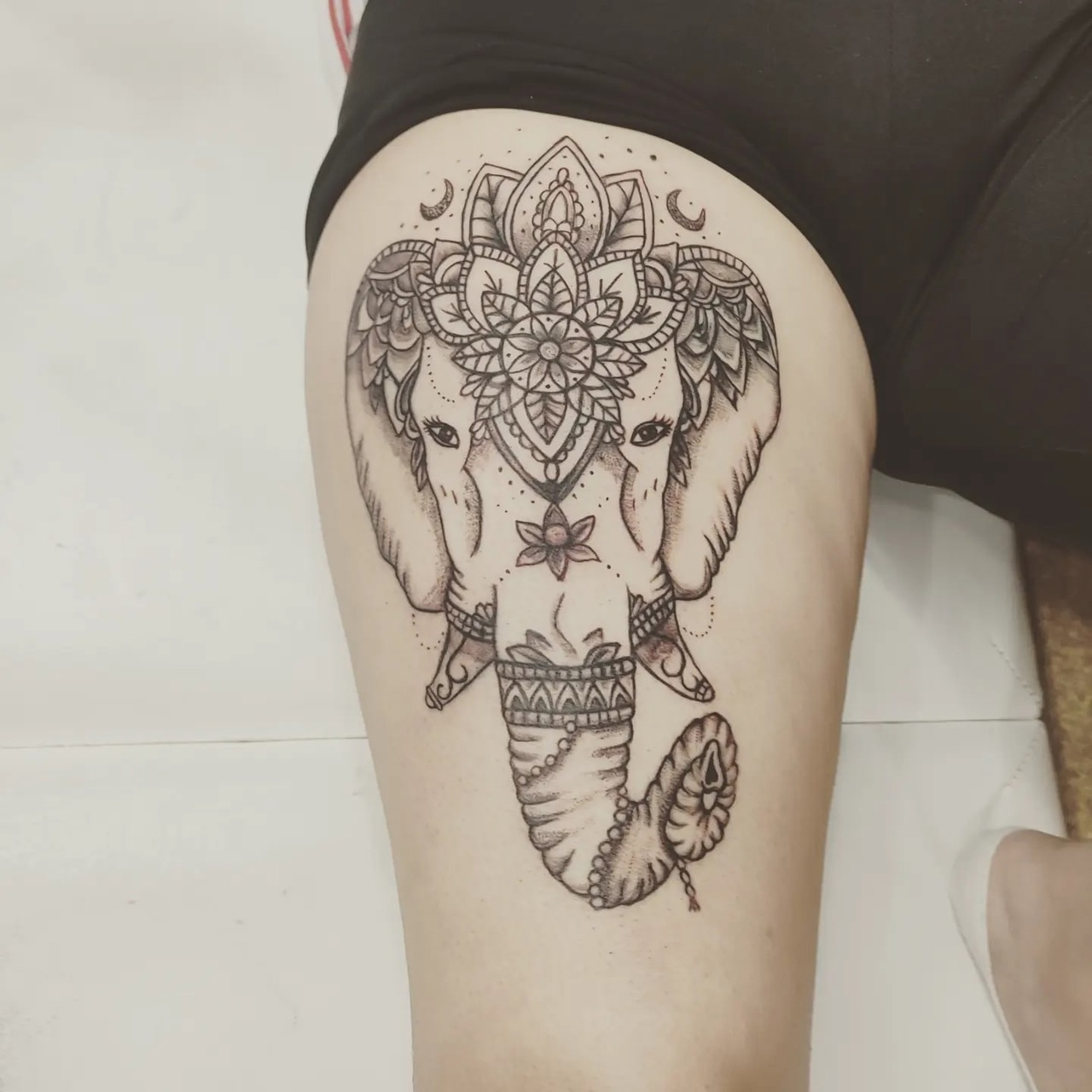
Blackwork elephant tattoo with mandala by @Vikigashe

Elephant mandala tattoo on upper back by @kingaewelina_ink

Elephant tattoo with blue and gold florals by @Sangreblauw

Ornamental elephant tattoo with caparison by @saaremaa_

Elephant tattoo with lotus and geometry by @kathepla
Geometric. Half the animal realistic, half broken into triangles. The style has been done to death on social media, and the fair criticism is that the geometry rarely means anything. It works when the polygons follow the skull and the ear cartilage rather than being scattered for effect.

Geometric sketch-overlay elephant tattoo by @Ascetictattoo
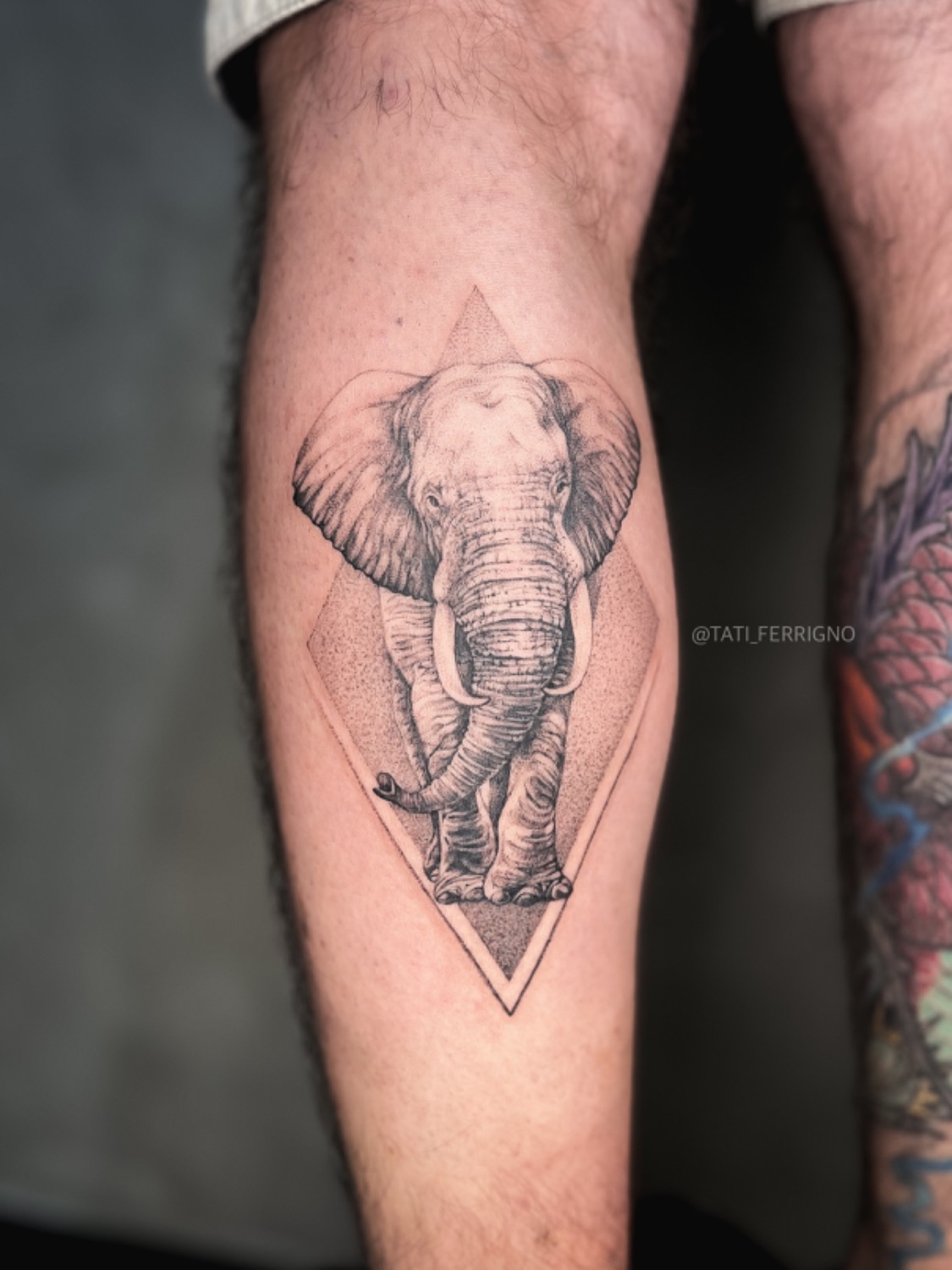
Elephant tattoo in a diamond shape by @Tatiferrigno

Elephant tattoo in triangle with mountains by @michzhenia

Geometric elephant tattoo with landscape by @hurjaesae

Blackwork elephant head tattoo by @D.art.tattoo

Forearm elephant tattoo in geometric frame by @linguadeprata
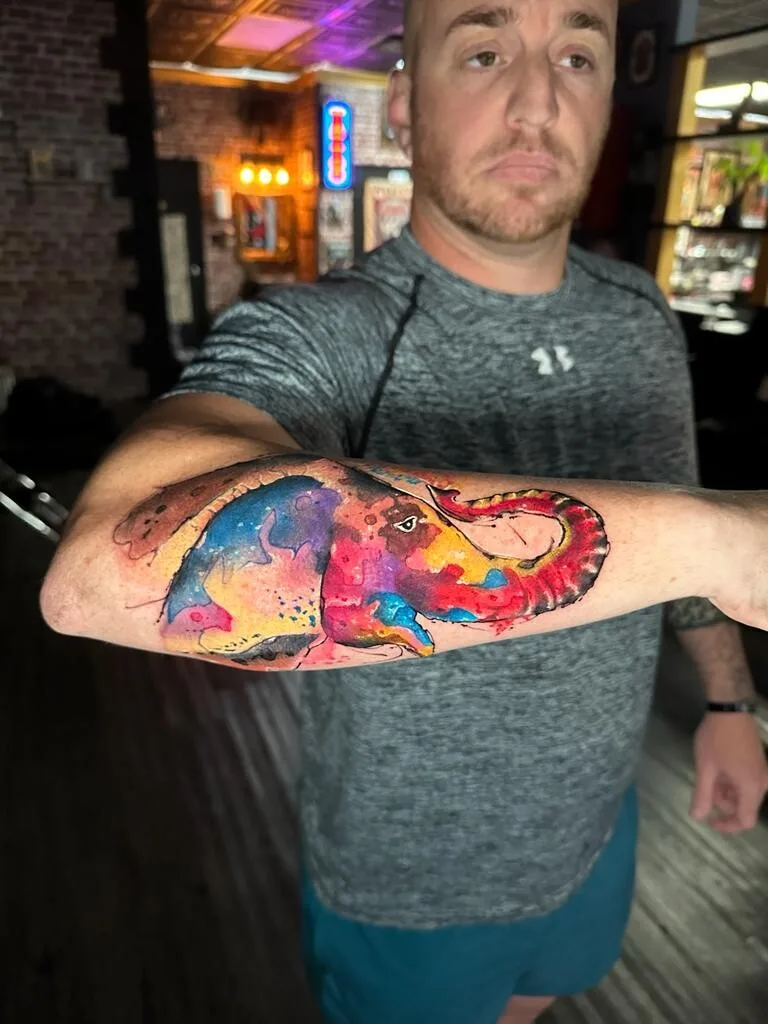
Watercolour. Colour bleeding out from a grey animal, usually on the forearm. The pieces that last have a solid black skeleton under the colour.
Traditional and neo-traditional. Bold outlines, flat colour, a slightly heraldic pose. American traditional flash has long included circus elephants, and the animal's mass suits the style's graphic weight. These age better than anything else on this list. Neo-traditional adds the caparison, the lotus and a wider palette without losing the line discipline.
Thai and Japanese-influenced work. The elephant is not in the Japanese canon except as a Buddhist figure, but the sak yant line (thin, symmetrical, script-heavy) gives the Thai heraldic elephant a register Western styles do not have. To see how these approaches look side by side across real work, the elephant motif page collects pieces by style and placement.
Placement and scale
The elephant is a mass, and the first placement decision is whether you are drawing it in profile or head-on. A profile (trunk forward, one ear, the line of the back) is long and horizontal, and it fits the forearm, the calf and the ribs. A head-on view with both ears spread is nearly as wide as it is tall, and it needs a flat area to match: the chest, the thigh, the shoulder blade or the back. Squeezed onto a forearm, a head-on elephant loses its ears and starts to look like a hippo.
The forearm is the default for medium pieces, realistic or ornamental, and the inner forearm has become the standard spot for a mother and calf. The upper arm and shoulder buy room for Ganesha and for realistic portraits, and the deltoid's curve suits a head-on face. The chest is where memorial pieces go: over the heart, larger and more detailed, often a single elephant walking toward the viewer. The thigh has taken over for mandala and ornamental work and for family groups, with one caveat already covered: not for Ganesha, and not for any design that quotes him.
The ribcage and side body take elongated compositions: a procession of three or four animals trunk-to-tail is the obvious one. The back gives a full scene, a herd at a waterhole, a matriarch under a baobab, Erawan with all three heads. Those are multi-session projects. At the small end, the wrist, the ankle and the spot behind the ear take a single-line elephant a few centimetres long, and that is often a first tattoo.
Scale decides what the style can be. A realistic elephant head under about eight centimetres cannot hold the skin texture; the wrinkles merge within a few years and the animal becomes a grey shape with tusks. Below that size the honest options are a clean outline, a blackwork silhouette or a traditional design with heavy lines. Ornamental work has a similar floor: a mandala smaller than a palm loses its pattern first.
Design variations and what they change
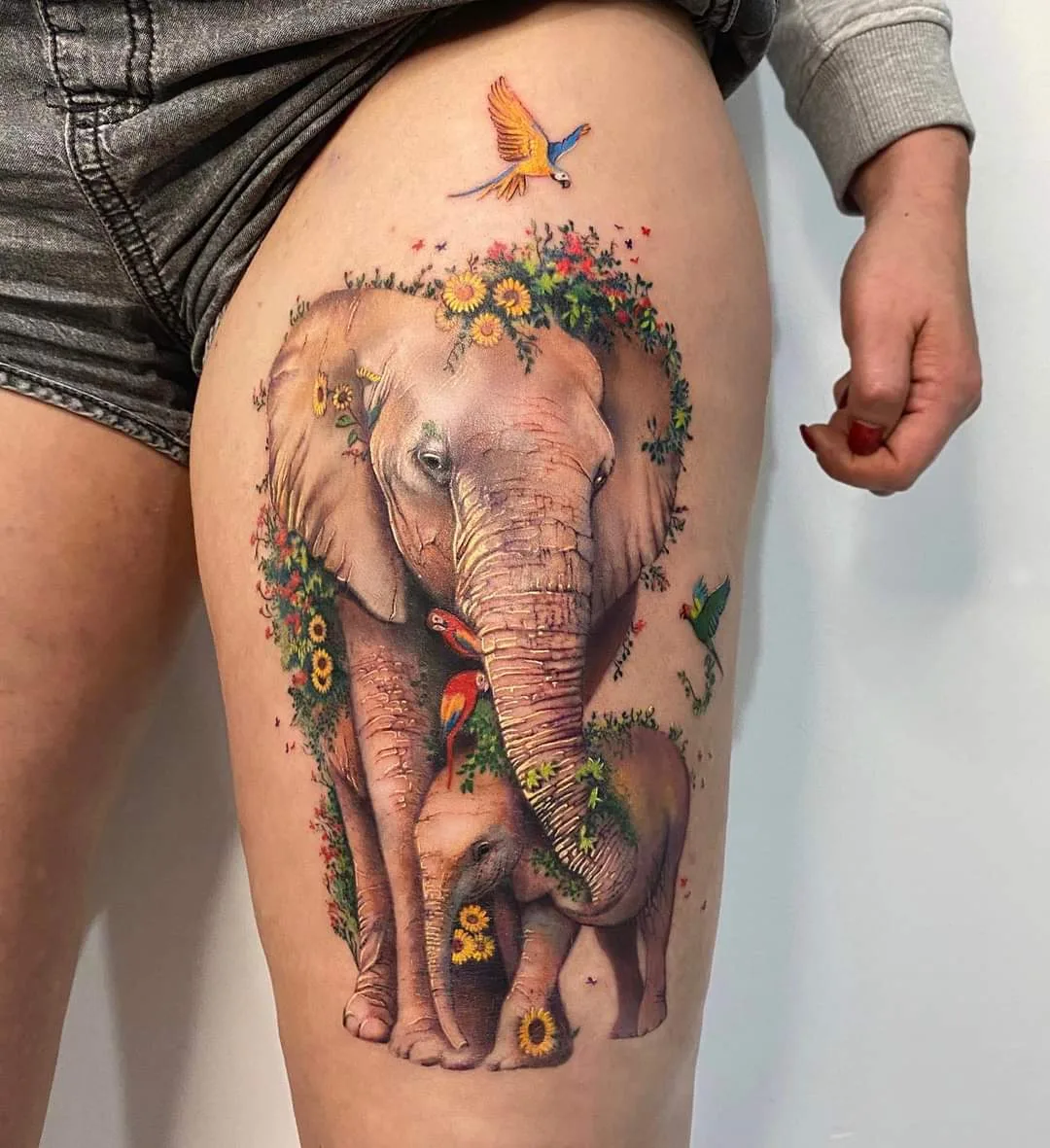
Mother and calf. The most requested elephant design in tattooing. It reads as the parent–child bond, worn by mothers for their children, by children for their mothers, and as a memorial for either. Trunks touching is the standard version; the calf walking underneath the mother's body is the wild version and reads more strongly as protection.
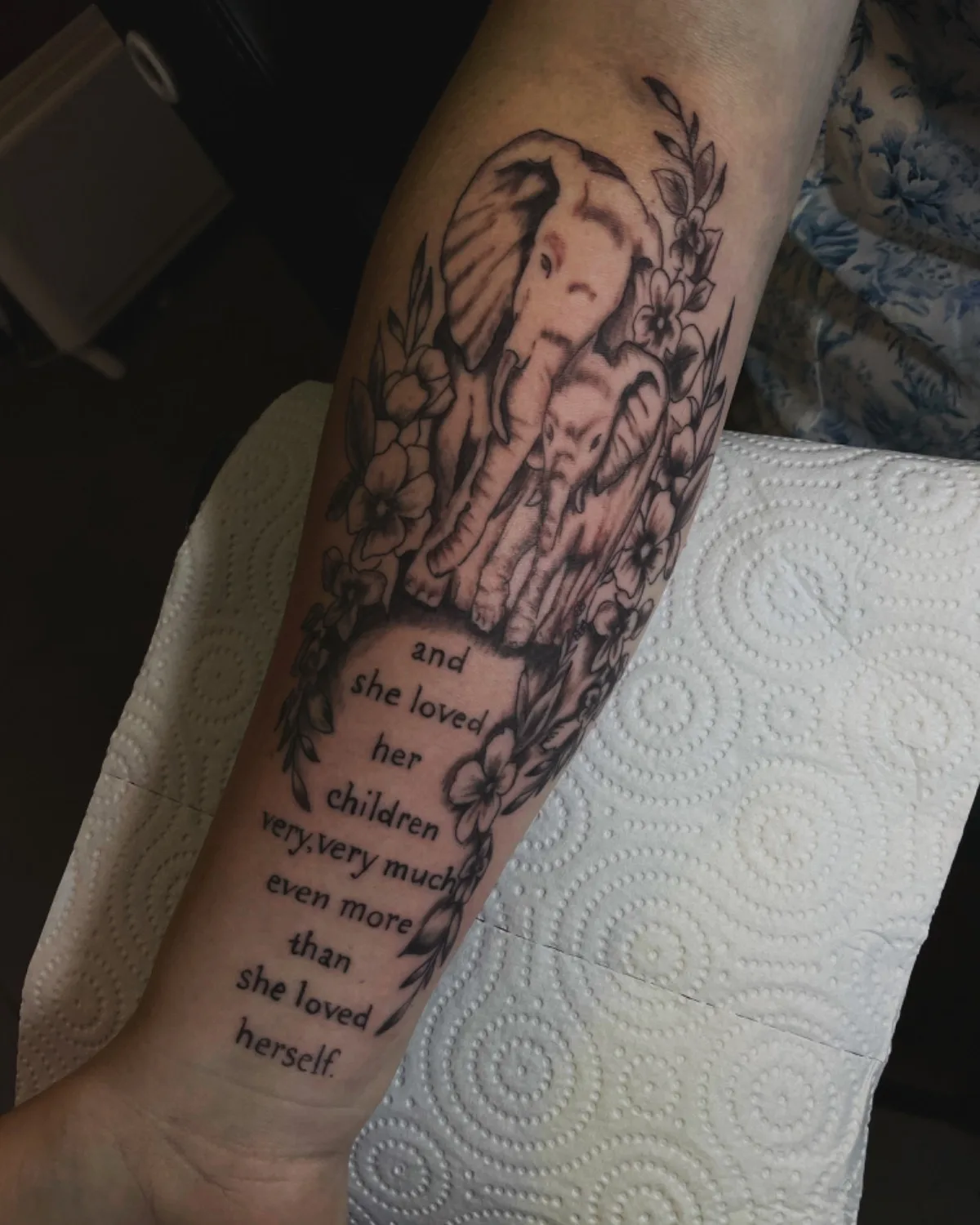
The procession. Three to five elephants trunk-to-tail, each smaller than the last, meaning a family across generations.
Trunk up or trunk down. The trunk-up-for-luck rule comes from feng shui and Western good-luck charms, not from Hinduism, where it carries no such rule. Up reads as luck and celebration, down as calm and groundedness. Neither is negative, and paired elephants with one of each are a common couples' piece.
Ganesha. Four arms is the standard: a noose, an axe, a sweet called a modak, and the broken tusk or a raised palm of blessing. His mount, a mouse called Mushika, usually sits at his feet. Count the arms and check what each hand holds before the stencil goes on.
Airavata and Erawan. Indra's mount in Hindu myth, drawn with three heads in Thai art, where it is also a royal emblem. This is a large piece by necessity, a back or a full sleeve, and reads as sovereignty rather than family.
The white elephant. Negative space or a pale wash instead of grey, referencing Māyā's dream and the trained mind. It is the quietest way to wear Buddhist meaning and the only one without an etiquette problem.
Elephant and lotus. In Hindu art, Gaja-Lakshmi shows two elephants pouring water over the goddess Lakshmi, and the pairing means prosperity. In the Buddhist reading the lotus is the one in the dream-elephant's trunk.
Tusks. A tusked adult reads as strength and age. A tuskless elephant is a newer statement: in Mozambique's Gorongosa, a 2021 study in Science showed that decades of ivory poaching had selected for females born without tusks, so a tuskless elephant now reads as conservation and survival.
Fragmented and dissolving. An elephant breaking into birds, dust or geometry says transition rather than presence, and it has a practical benefit: less flat grey to blur over twenty years.
Choosing an artist for an elephant tattoo
The elephant punishes two kinds of artist: the realist who has not solved skin texture, and anyone who has not looked at the species. Ask for healed photographs, not fresh ones: fresh elephant realism photographs beautifully and tells you nothing about whether the folds survived. Ask for elephants specifically in the portfolio; the ears are where it shows. And check the ears against the tradition you want: African for the family reading, Asian for Ganesha, Māyā and Thailand.
If the design is Ganesha or any other deity, add a third check: an artist who knows the iconography, or is willing to learn it from a temple image rather than from other tattoos. And if the piece is a memorial, say so in the first conversation; it changes the expression the artist gives the animal, and the pose.
The style should match the artist, not the other way around. You can filter by style, country and city in our tattoo artist directory, and it helps to see how differently the same animal is handled. Stefano Alcantara pairs a realistic elephant with a child's portrait on a calf, so the animal becomes part of a family story rather than a subject on its own; Yomico Moreno puts a single realistic elephant across the chest, where the head-on view has the width it needs; Coen Mitchell builds the head out of mandala and ornament on a forearm, so it reads as pattern first and animal second; Chris Bint does the same idea in dense blackwork on a thigh, where the scale lets the dotwork breathe. Four approaches to one motif, and the choice between them decides more than size or placement will.
Aftercare and how an elephant tattoo ages
Standard aftercare applies: keep it clean, moisturise without smothering it, leave the scabs alone, and stay out of pools and direct sun until it has healed, two to three weeks for the surface and a few months for the deeper layers.
The elephant has one specific ageing problem, and it is the opposite of the wolf's. Where fur blurs, the elephant's large flat grey areas flatten: the mid-tones that separate the ear from the head and the leg from the body drift toward each other, and a piece that relied on subtle shading loses its form. The fix is structural: a clear silhouette, strong contrast between the animal and the background, and wrinkle texture that supports the shape instead of carrying it. Ornamental and mandala elephants age on a different rule: fine dotwork on a forearm exposed to sun closes up within a decade, while the same pattern on a thigh lasts much longer.
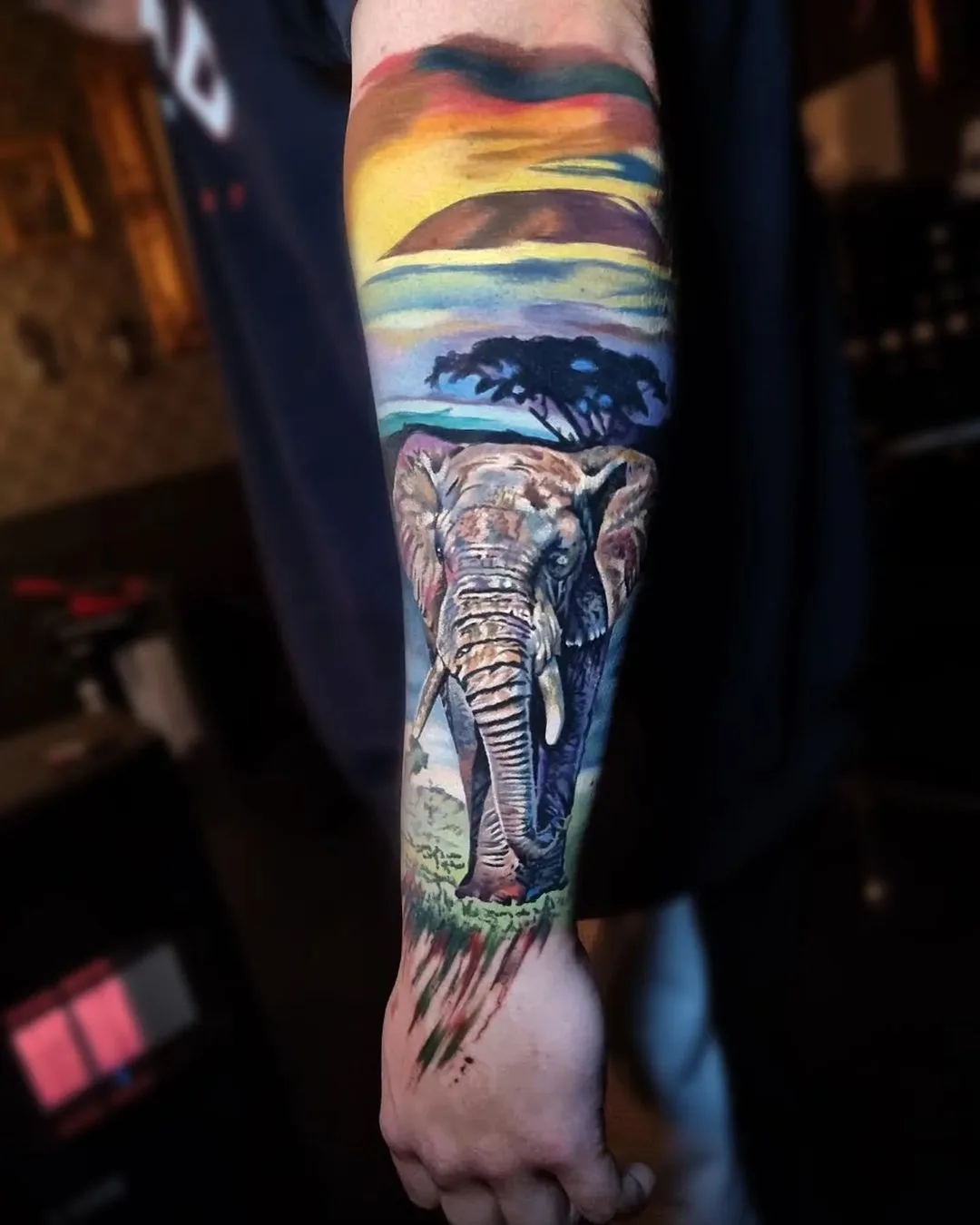
Colour fades unevenly. Watercolour washes and the warm tones of a savanna sunset go first, so an elephant that started under an orange sky can end up under a grey one. Sunscreen on an exposed forearm does more for the twenty-year life of the piece than any product sold for tattoos. Expect one touch-up in the first year for anything with fine linework or dotwork, and budget for it as part of the piece.
Frequently asked questions
What does an elephant tattoo symbolize?
Family, memory, protection and patient strength. The animal remembers its dead and its routes, the herd is led by the oldest female, and adults put themselves between danger and the calves. Add wisdom in Hindu and Buddhist readings and royalty in Thailand.
Is it disrespectful to get a Ganesha tattoo?
Opinions among Hindus differ, but on placement there is broad agreement: keep it above the waist. Feet, legs and hips are ritually unclean in Hindu practice, and a god there offends people who would otherwise be glad to see him. Upper arm, chest and back are the placements Hindus choose themselves. If you are not Hindu, learn what each hand holds before you wear him.
What does an elephant with its trunk up mean?
Luck, celebration and good fortune, a reading that comes from feng shui and Western charms rather than from any Asian religion. Trunk down means calm and stability. Neither is unlucky, whatever the shop owner told you, and paired elephants with one of each are a common couples' design.
What does an elephant tattoo mean for a woman?
Usually the matriarch: wild elephant families are led by the oldest female, and the design is chosen as a statement about motherhood, grandmothers and leadership that comes from care rather than dominance. Mother-and-calf and mandala elephants on the thigh are the most common versions.
What does a mother and baby elephant tattoo mean?
The parent–child bond, worn in both directions: by parents for their children and by children for a parent, living or not. A calf alone can be a memorial for a child.
How much does an elephant tattoo cost?
Size and style set it. A small linework elephant is one short session; a realistic forearm piece with skin texture is usually two; a back scene or an Erawan is a project measured in months. Ask for a quote on the whole piece rather than an hourly rate, and be suspicious of a very low price for detailed realism.