A hummingbird tattoo means a life lived at full speed, and, far more often than the design lets on, a life that has ended. Across the Americas, the only part of the world where the bird exists, it was a returning soul before it was a symbol of joy: a fallen warrior in Aztec belief, a dead relative in Arawak belief, a messenger between the living and whatever comes next. The cheerful reading is real, but it is the younger one.
- The hummingbird is a memorial motif before it is a decorative one: Aztec warriors returned as hummingbirds, and Arawak peoples called it the god bird because it carried the dead.
- The joy, energy and resilience readings come straight from the biology: a three-gram bird that feeds every fifteen minutes, crosses the Gulf of Mexico non-stop, and appears to die each cold night and revive at dawn.
- Sharp wings, black and grey, or a name worked into a flower stem signal a memorial; blurred wings and full colour signal vitality. The same silhouette carries both.
- A life-size hummingbird is eight or nine centimetres, which is why the wrist and inner forearm fit it exactly; under five centimetres only fine line or a solid silhouette survives healing.
- Neo-traditional and black-and-grey versions age best; watercolour, the most requested style, is the least durable and should not go small.
What a hummingbird tattoo means
Start with the animal, because the symbolism follows the biology. A ruby-throated hummingbird weighs about three grams. Its heart runs above a thousand beats a minute in flight, and hummingbird wings beat roughly fifty to eighty times a second, which is why every tattoo of the bird has to decide whether to draw the wings sharp or blurred. It can hover, fly backwards and fly straight up, and no other bird manages all three so well. Every autumn many ruby-throats cross the Gulf of Mexico in one non-stop flight of some eight hundred kilometres.
Two facts matter most for the tattoo. The first is the metabolism: a hummingbird has to feed every ten or fifteen minutes, and without food it can starve within hours. That is where the readings of energy, urgency and appetite for life come from: a creature that cannot afford to stop. The second is torpor. On cold nights the bird drops its body temperature and heart rate to a fraction of the daytime figures and hangs motionless, apparently dead, until the sun warms it. Sixteenth-century observers in Mexico recorded exactly this and drew the obvious conclusion: the bird dies and comes back.
From those two facts the modern meanings fan out. Joy and lightness are the most common request, usually from people marking a recovery. Resilience follows from the migration: something absurdly small doing something absurdly hard. Love is older than it looks: the pairing of hummingbird and flower is a courtship image across the Caribbean and Brazil.
And then there is the reading that fills more consultation books than the others put together: memorial. In Mexico, Central America, the Caribbean and well beyond, a hummingbird that hovers at a window is understood as a visit from someone who has died. The belief has pre-Columbian roots, traced in the next four sections, and it survived conversion, colonisation and emigration intact. Artists who take a lot of hummingbird work say that a large share of clients arrive with a name or a date in mind, even when the final design carries no text. The same silhouette carries vitality and loss, and only the details tell them apart.
Aztec mythology: Huitzilopochtli and the reborn warrior
The Mexica, the people usually called Aztecs, put a hummingbird at the top of their pantheon. Huitzilopochtli, god of the sun and of war, carries a name built from huitzilin, hummingbird, and opochtli, left; because the Mexica placed the south on the sun's left hand, it is usually translated "Hummingbird of the South". He led the Mexica from the mythical Aztlán to the lake where they founded Tenochtitlan in 1325.
His birth is a war story. On Coatepec, Snake Mountain, the goddess Coatlicue was made pregnant by a ball of feathers; her daughter Coyolxauhqui and four hundred sons marched to kill her, and Huitzilopochtli was born fully armed, killed his sister and threw her body down the mountain. When workers in Mexico City struck a carved stone in 1978, it turned out to be Coyolxauhqui, dismembered, at the foot of the Templo Mayor stairs, exactly where the myth put her.
What matters for tattooing is what happened to the dead. According to the Florentine Codex, Bernardino de Sahagún's record of Mexica belief, warriors who fell in battle or on the sacrificial stone went to the House of the Sun, escorted the sun for four years, and then returned to earth as hummingbirds and butterflies to drink nectar for the rest of time. The bravest men in the empire came back as the smallest birds in it. That is why the hummingbird is a memorial motif before it is a decorative one, and why a hummingbird for a soldier, a fighter or anyone who died hard is closer to the original meaning than any flower-and-sparkle design.
Taíno and the Caribbean: the sun's messenger
The Taíno, the Arawakan people who held the Greater Antilles when Columbus arrived, lived among hummingbirds; the word colibrí itself is often, though not securely, traced to a Caribbean language. Their farming depended on pollinated crops, and the bird that spent its day carrying pollen from flower to flower was read as the sun's own agent, taking the sun's warmth down into the plants and bringing the fruit up. It was a bringer of life, and killing one was said to bring misfortune.
Puerto Rico keeps the best-known Taíno story. Alida, a cacique's daughter, loved Taroo, a young man from the enemy Carib people. Her father promised her to another man; she asked the gods to be released, and they turned her into a red flower. Taroo, not knowing, asked the same gods for help, and they made him a hummingbird so that he could visit every red flower on the island until he found her. It gives a story to the hummingbird-and-red-flower design so many people choose for love, often without knowing they are quoting a Puerto Rican legend.
The memorial thread runs here too. In Jamaica the Arawak name for the red-billed streamertail, now the national bird, translated as "god bird", because the people believed hummingbirds were the souls of the dead returned. Trinidad's old Amerindian name, Iere, is usually rendered as "land of the hummingbird", and two of the birds appear on the shield of the national coat of arms. Anyone with Caribbean roots has a specific claim on the bird: this is family iconography, not borrowed exotica.
The Andes: the Nazca hummingbird
On the Pampa de Jumana in southern Peru, between roughly 100 BC and AD 500, the Nazca scraped away the dark desert pebbles to expose the pale ground beneath and drew, among a monkey, a spider, a condor and dozens of straight lines, a hummingbird about ninety-three metres long. It is a single unbroken line, legible only from the air or the foothills. Paul Kosok began studying the lines around 1940, Maria Reiche spent fifty years surveying the lines, and UNESCO listed them in 1994.
Nobody has a settled answer for why. The main theories connect the figures to water rituals (the Nazca lived on the edge of one of the driest places on earth and built underground aqueducts, the puquios, to survive) and to processions walked along the lines. The bird's standing is not in doubt: of all the animals they could have drawn at that scale, they chose this one.
There is a twist. In 2019 a team led by the ornithologist Masaki Eda re-examined the bird geoglyphs feature by feature and concluded that one of the "hummingbird" figures, with its long pointed tail, is specifically a hermit, a group of hummingbirds from the forests on the Amazonian side of the Andes, not the coastal desert where the drawing sits. The Nazca were depicting a bird that did not live in their desert. In Quechua the hummingbird is q'inti, and the bird also turns up on Nazca pottery: a stylised motif already two thousand years ago.
Native American traditions: messenger between worlds
North of Mexico the hummingbird keeps the messenger role but loses the war. Among the Hopi of northern Arizona it is a rain-bringer. The story told to children has a boy and a girl left alone during a famine who carve a hummingbird from a sunflower stalk; it comes to life, flies down to the god of germination, Muy'ingwa, and persuades him to send rain. The Hopi hummingbird katsina, Tocha, dances in the spring ceremonies with the same purpose, and Zuni rain priests tied hummingbird feathers to prayer sticks for the same reason: the bird could carry a request to the beings who controlled water, and fast.
For the Diné, the Navajo, the hummingbird is often said to carry prayers upward and return with answers. The Cherokee tell how the geese stole the people's tobacco and the hummingbird, too small to be noticed, got it back. In a Mojave story often retold, the hummingbird found the way out of the dark underworld and led the first people up into daylight.
The common thread is a creature that moves between levels, sky and earth, the living and the powers that decide whether they eat. It is the same idea the Aztecs and the Arawaks held, and it is why the tattoo can carry a spiritual reading without any particular religion attached. The usual caution applies: the general qualities are open to anyone, while katsina imagery, ceremonial designs and clan symbols belong to the nations that hold them.
Tattoo styles that suit the hummingbird

Watercolour hummingbird forearm tattoo by @mazalovatattoo

Watercolour hummingbird tattoo with colour splashes by @evg_e_sha

Watercolour hummingbird floral tattoo by @lenalunatattoo

Watercolour hummingbird tattoo on the side by @vsemtatoo

Blue watercolour hummingbird tattoo on the neck by @Sangreblauw

Pink and blue hummingbird splash tattoo by @vamptattoo
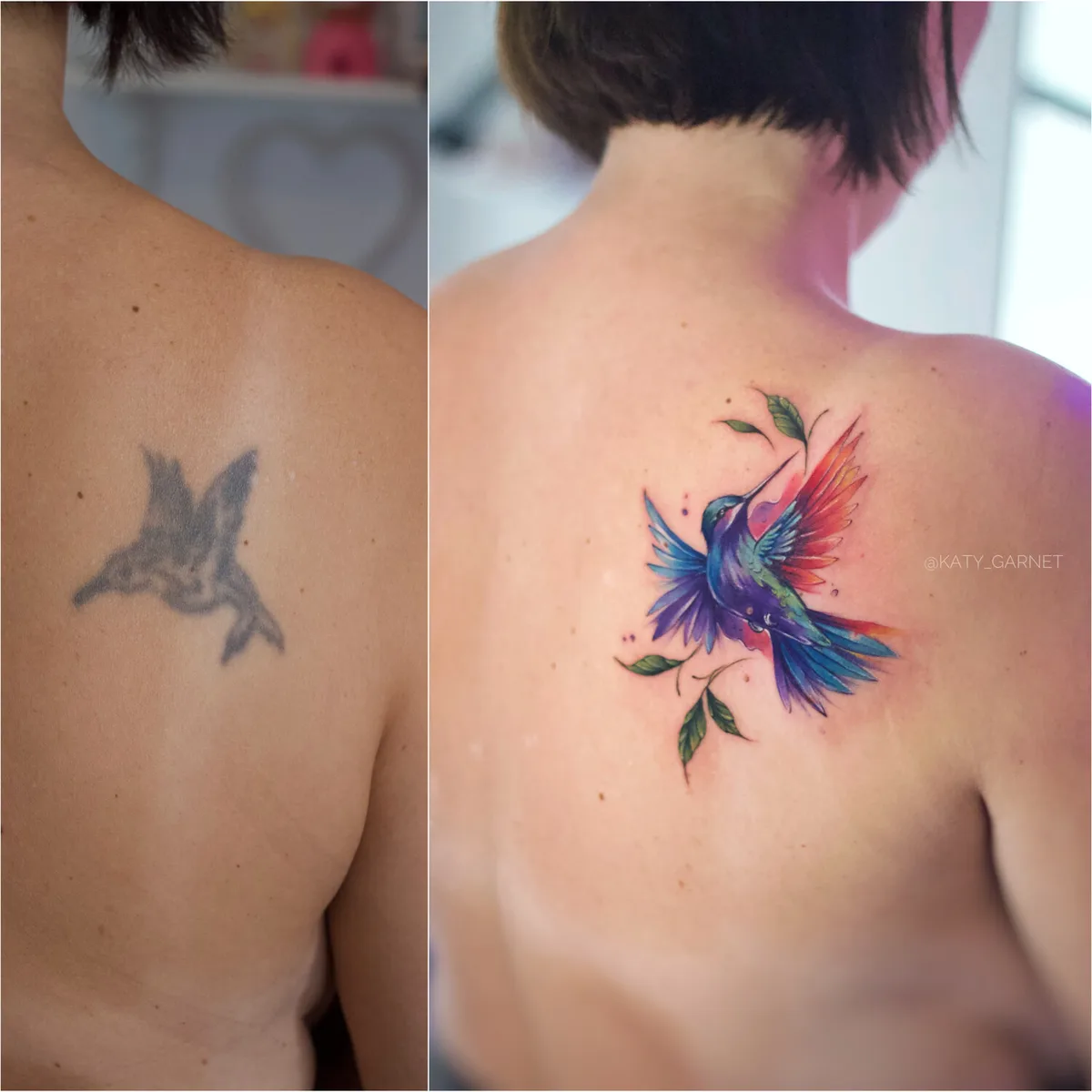
Watercolour. The most requested style for this bird, and the fashion is justified. Hummingbird plumage is structural colour (light interfering in the feather barbules, not pigment), so the bird changes colour as it turns, and a wash bleeding from green into violet imitates that better than any flat fill. The trade-off is longevity: a wash without a line skeleton fades faster than any other technique, and a watercolour hummingbird under six or seven centimetres turns into a coloured smudge within a few years.
Realism. The hardest version to do well. The difficulty is the iridescence: a convincing gorget, the throat patch, needs saturated colour beside near-black, laid in with a sense of where the light comes from, and a needle-thin beak that stays needle-thin after healing. Realism artists who do birds regularly solve the wings one of two ways, frozen sharp as if by a fast shutter or blurred into a soft fan. Ask which the artist prefers and why.
Fine line. The outline is so distinctive (long beak, compact body, forked or fanned tail) that a few lines carry it. This is the style for wrists, ribs and behind the ear, and for anyone who wants the memorial reading without an announcement. The risk is thinness: single-needle lines soften over ten years and a very small bird can lose the beak entirely, so a little more weight in the line than the reference suggests is usually right.
Neo-traditional. Bold outline, saturated colour, stylised feather patterning. It gives the bird a graphic authority the delicate versions lack, holds a flower composition together without the flowers taking over, and ages better than anything else here because the outline does the structural work.
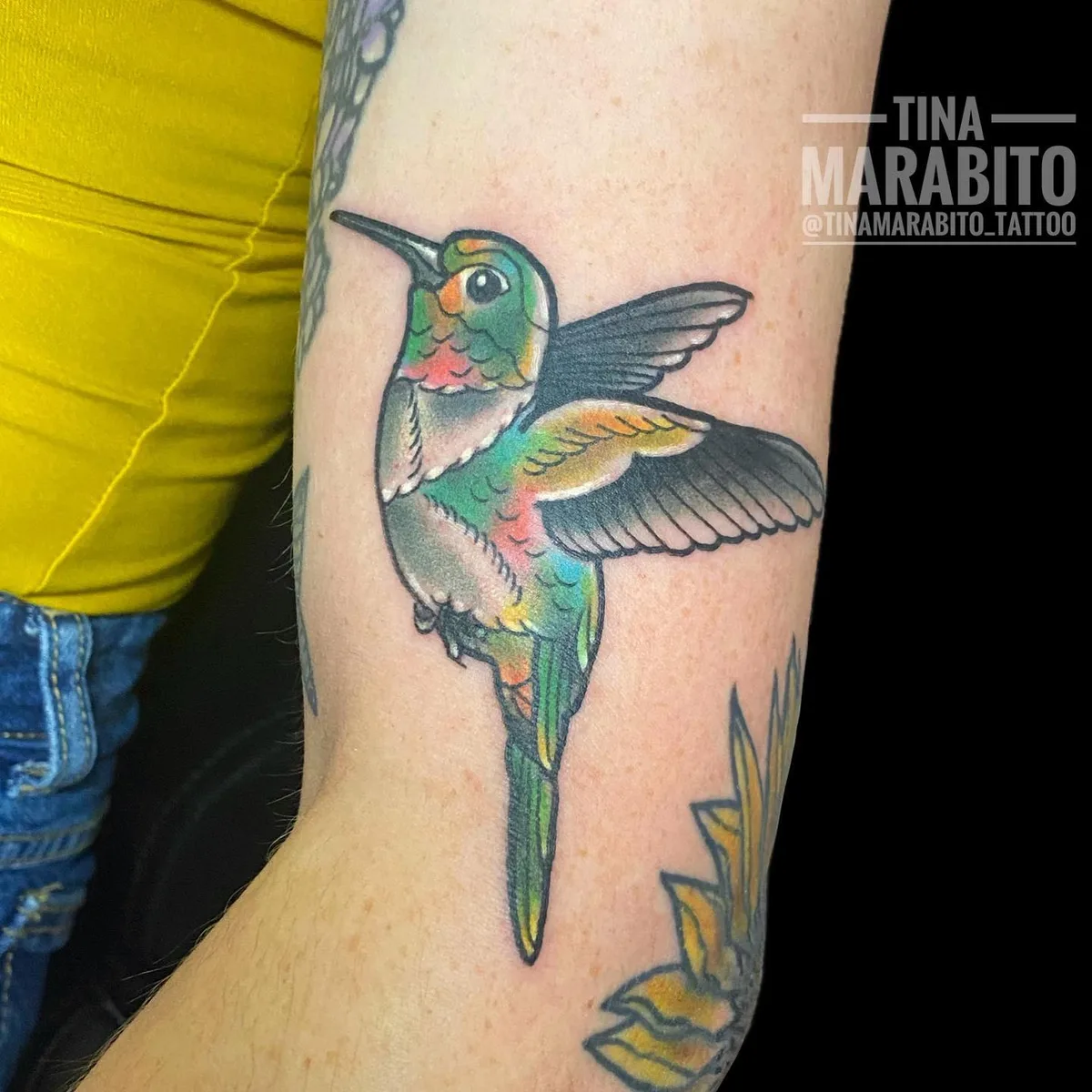
Illustrative and botanical. A large share of current hummingbird work sits here: a bird drawn with a light, sketch-like line among botanically specific flowers (fuchsia, trumpet vine, hibiscus, honeysuckle), with restrained colour or none. It takes the meaning towards growth and renewal.
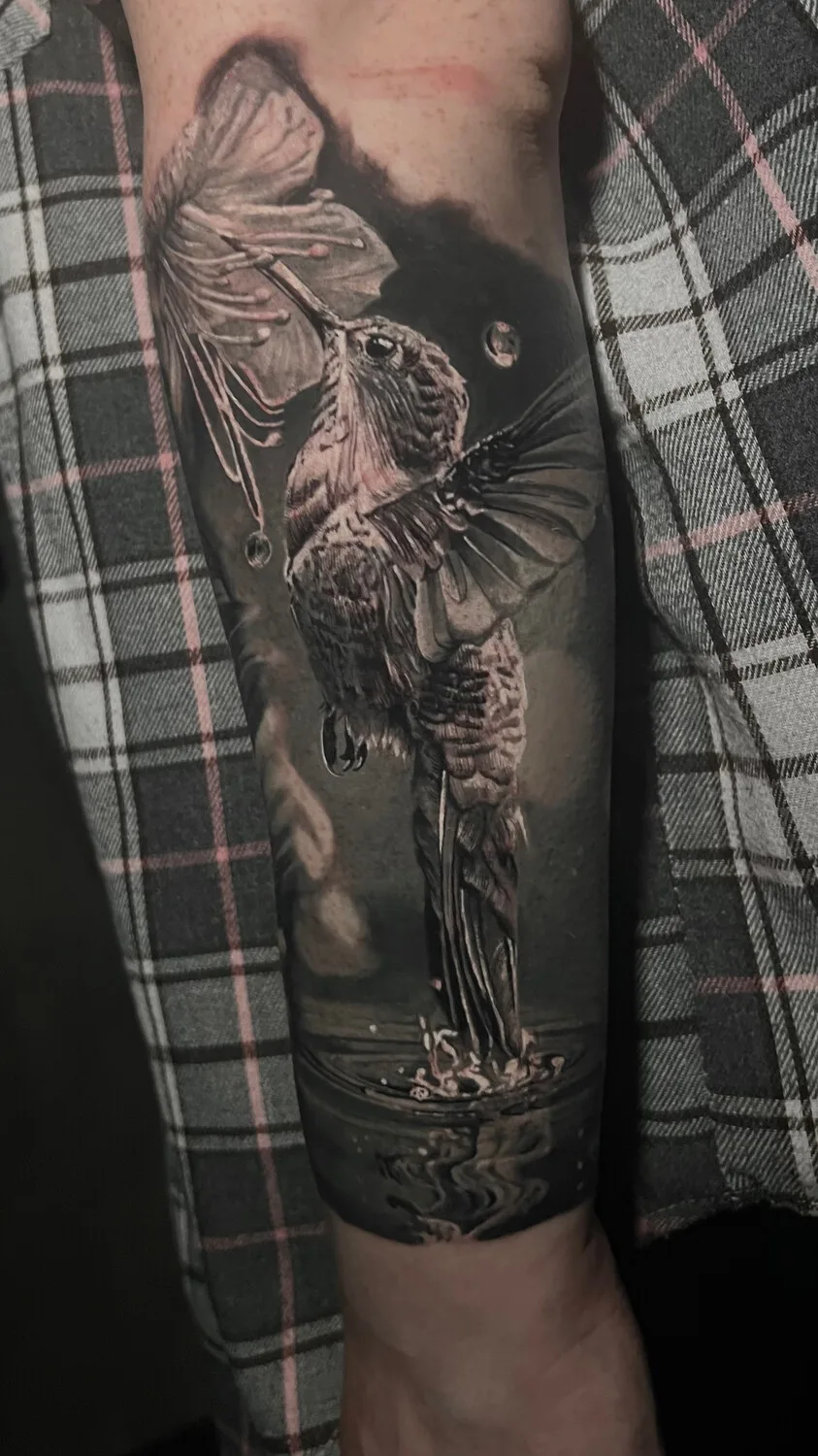
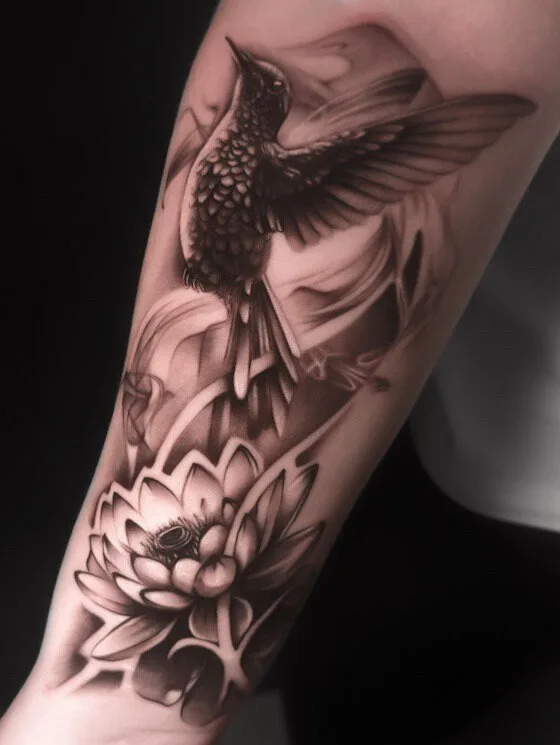
Black and grey. Removing colour from a bird defined by colour sounds perverse, and that is why it works. A black-and-grey hummingbird strips away the joy reading and leaves resilience, form and memory. It is the version most often chosen for a memorial. To see how differently these six approaches handle the same three grams of bird, the hummingbird motif page gathers the work by style and placement.
Placement and scale
The hummingbird is the rare motif whose natural size already fits the body. A life-size ruby-throat is eight or nine centimetres from beak to tail; a bee hummingbird is five. A wolf on a wrist is a miniature; a hummingbird on a wrist is the real thing, which is a large part of why the bird ends up on small placements so often.
The inner forearm and the wrist are the default: the proportions suit them, the pain is moderate, and you see the tattoo yourself all day. A hummingbird on the inner wrist hovering towards the hand is the single most common composition in the motif, and it looks it. Turning the bird to fly up the arm, or moving it to the outer forearm with a flower spray, gets away from the template.
Behind the ear takes the smallest versions, usually fine line, three to five centimetres: discreet, personal, and with a quiet joke in it, since the bird is named for the sound of its wings.
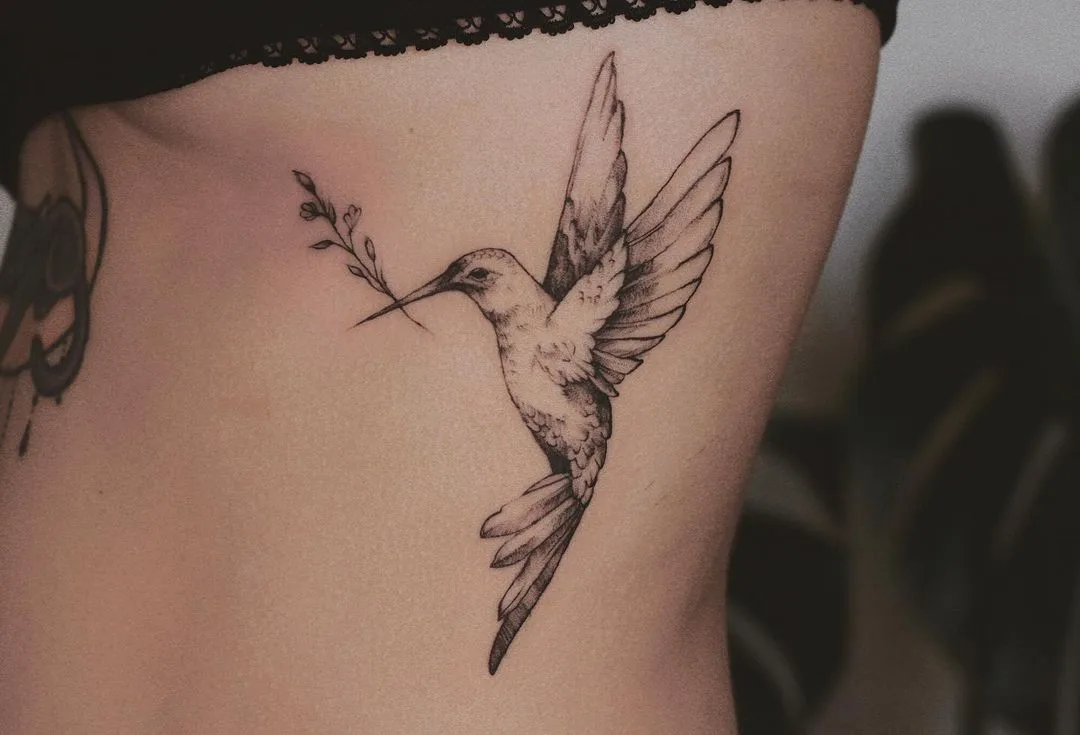
The shoulder and upper arm buy room for context: the bird among flowers, a watercolour bloom behind it, a pair of birds. The shoulder blade suits a hovering bird because the curve of the bone gives the composition a direction. The ribcage takes the largest realistic and watercolour pieces, with the usual warning: it is one of the more painful spots on the body. The thigh has been gaining fast: a good surface, hidden or shown on demand, and the placement for a bird-and-flowers composition that might grow over several years.
Scale deserves a separate decision. Below about five centimetres the beak becomes a single line and the gorget a dot; only fine line or a solid silhouette survives. Between six and ten centimetres, roughly life size, realism, neo-traditional and watercolour all work. Above that the bird is larger than life, fine in a stylised treatment and slightly uncanny in realism, which is why big realistic hummingbirds are usually built into scenes.

Floral hummingbird shoulder tattoo by @tattoo_black_zone

Floral upper-arm hummingbird tattoo by @Essenceinkk
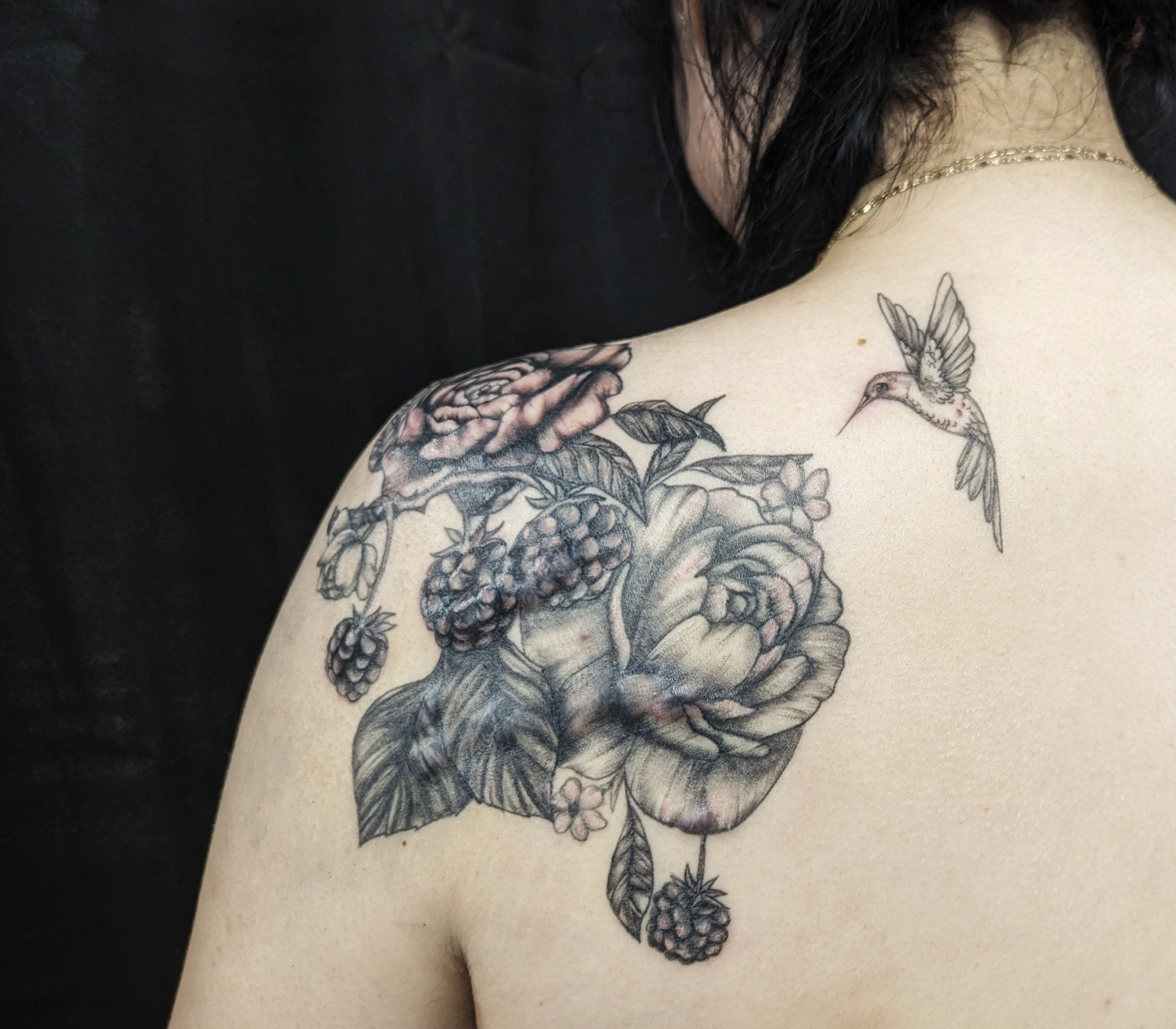
Roses, berries and hummingbird shoulder tattoo by @Essenceinkk

Full-arm sleeve tattoo with hummingbird and florals by @flora.la.moon

Peony and hummingbird hip tattoo by @blondietattooing

Fine-line hummingbird forearm tattoo by @mr.j.fineline
Design variations and what they change
Wings: sharp or blurred. The detail that moves the meaning most. Blurred wings say motion, urgency, a bird that will not stay; sharp wings say a moment held still. Memorial pieces tend towards the sharp wing (the person has stopped), vitality pieces towards the blur. A perched bird, rare enough to be a statement in itself, reads as rest after effort.
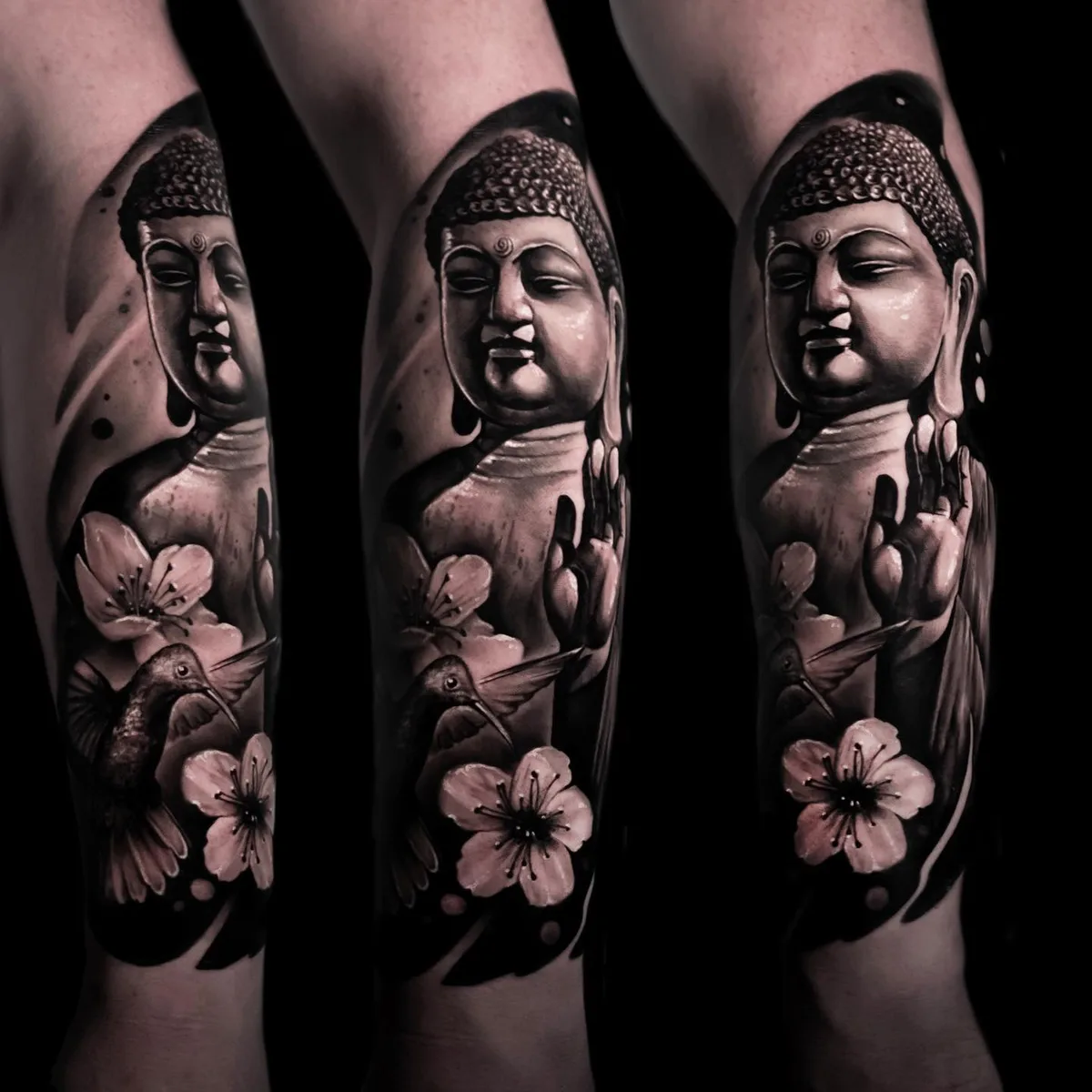
The flower, and which one. Hibiscus, fuchsia, trumpet vine and honeysuckle are flowers the bird actually feeds from, and an artist who knows that will pose it correctly at the bloom. Roses, cherry blossom and lotus are common too, and each imports its own meaning. A rose turns the piece towards romantic love, a lotus towards rebirth, and a red tropical flower quotes the Taíno story whether you intend it or not.
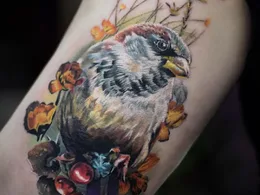
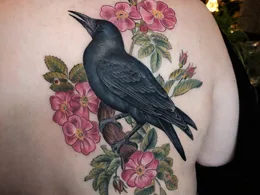
Colour. The ruby-throat's red gorget and green back is the default and reads as passion and vitality. An all-green bird leans towards growth and healing; violet and purple birds, which exist in nature, towards spirit and transformation; black and grey keeps only resilience and memory. If the tattoo is for a specific person, their favourite colour on the gorget is a common private choice.
Names, dates and script. The plainest memorial marker, and the one that most needs integrating. A date worked into a flower stem or script following the flight path reads as part of the design; a name floating under the bird reads as a caption. A line in the person's own handwriting beats any quotation.
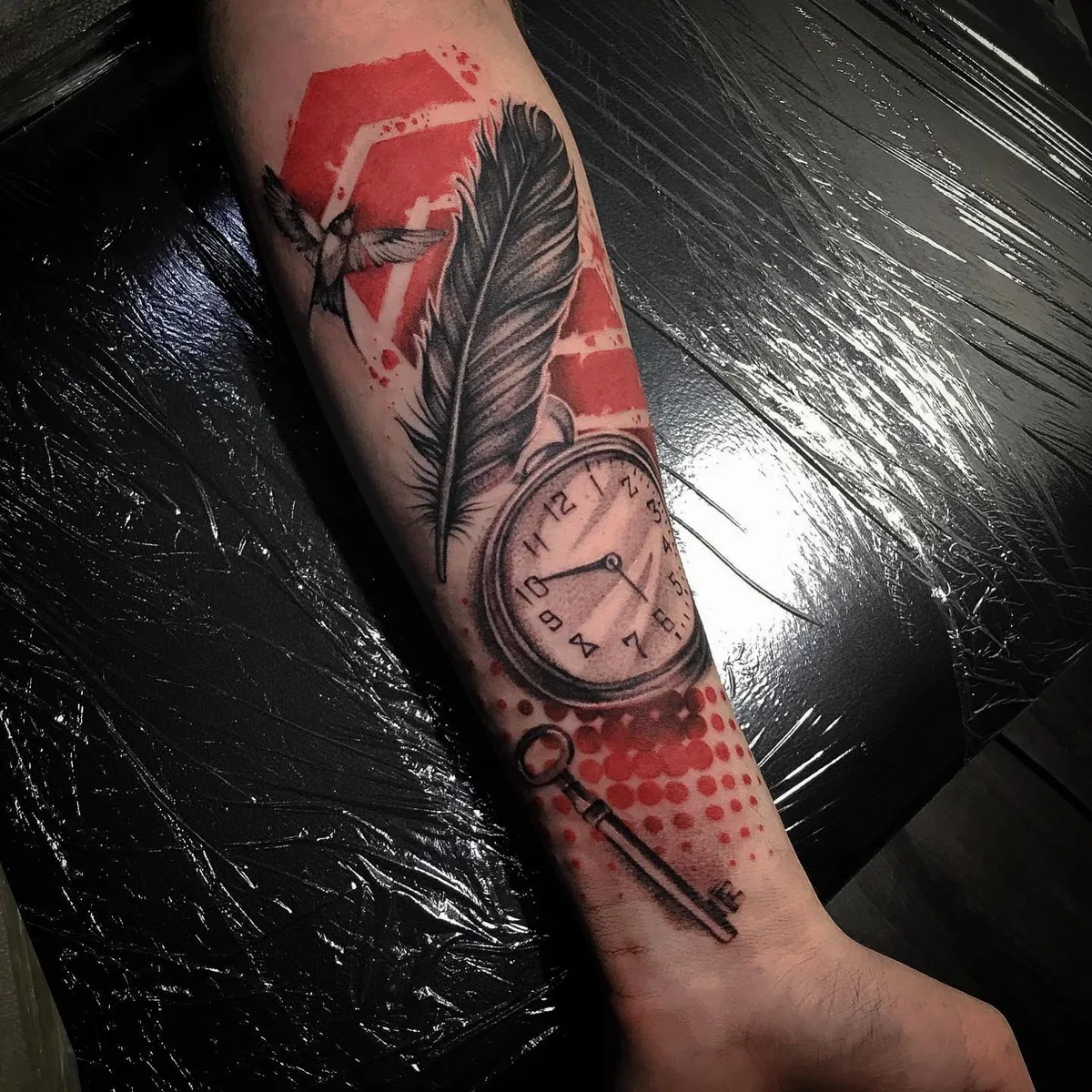
Infinity loops, clocks, hourglasses. The flight path drawn as an infinity symbol is a well-worn memorial device that still works when the loop is the path. A hummingbird beside a clock or an hourglass sets a creature that lives entirely in the present against a machine for measuring time.
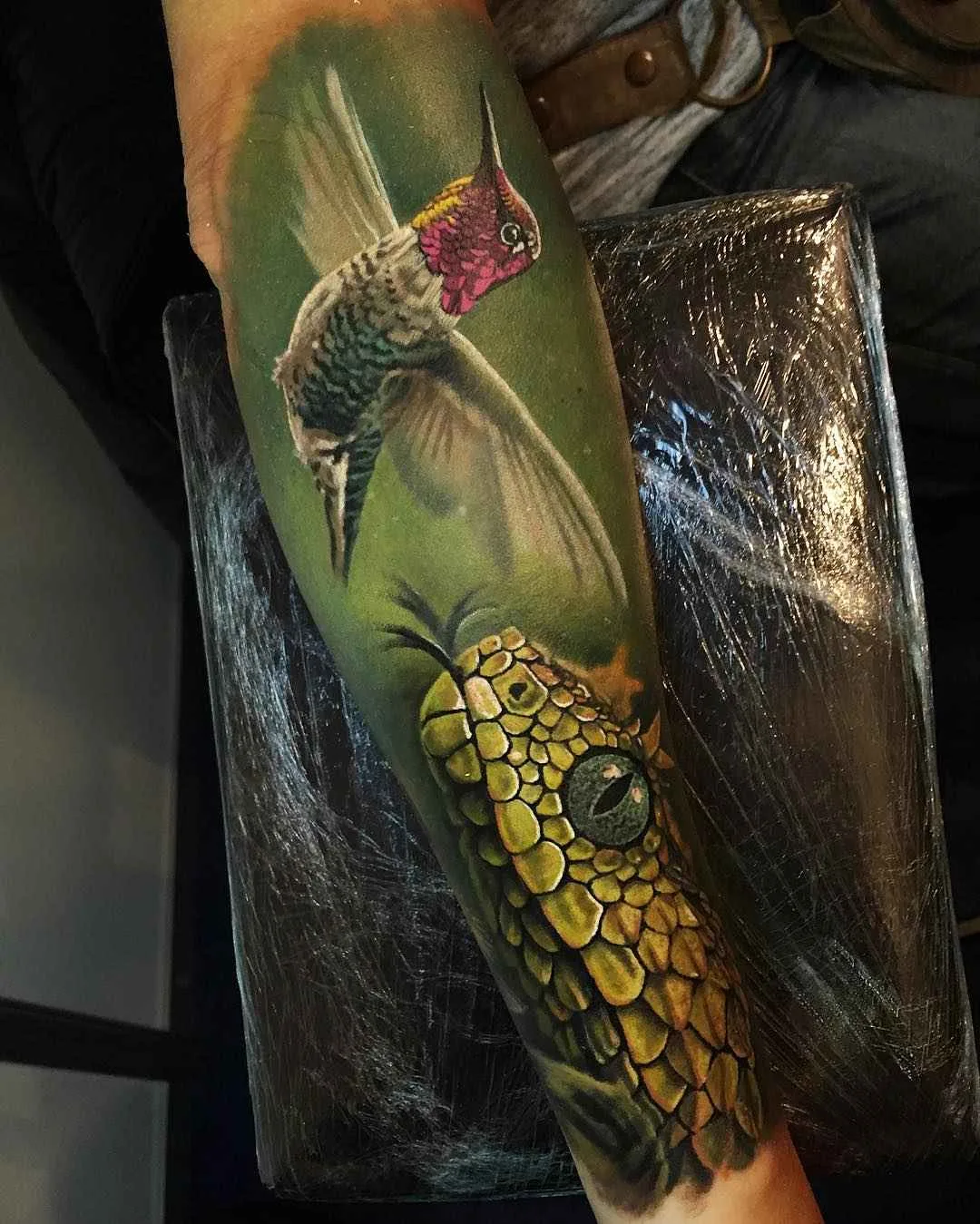
Two birds, or bird with predator. A pair reads as partnership or as two people lost, and because the birds are small, two fit where one large animal would not. A hummingbird beside a snake, a skull or a cat inverts the motif: the fragile thing next to the thing that could end it. It carries the Aztec reading, the warrior in the small body, most directly, and needs black and grey or full realism to hold its nerve.
Choosing an artist for a hummingbird tattoo
The bird punishes two kinds of artist: the one who cannot lay colour beside black without muddying it, and the one whose thin lines are not thin enough. Both faults are invisible in a fresh photograph and obvious in a healed one, so the first check is healed work, a year or more old: look at the beak and the gorget rather than the flowers.
Second, look for hummingbirds specifically. Swallows are not the same technical problem; the iridescence, the wing blur and the beak are unique to this bird, and an artist who has done ten of them has already made the decisions you face. Third, match the style to the artist: a fine-line artist asked for saturated watercolour, or a realism artist asked for a five-centimetre wrist piece, will produce a competent version of somebody else's speciality.
Bring photographs of the actual bird, not screenshots of other tattoos: a photograph gives the artist the animal to solve, a screenshot gives them someone else's solution to copy. Say which reading you want, vitality or memorial, before the sketch, because it changes the wing, the pose and the palette. Style, country and city filters in our tattoo artist directory narrow the field; run the healed-work check on whoever comes out of it.
The motif page shows how much the choice decides. Steve Butcher renders the bird in full-colour realism and pairs it with a snake on the forearm, so the piece is a confrontation rather than a decoration; Josie Sexton builds it in watercolour with flowers on the upper arm, where the colour has room to bleed; MR.K reduces it to fine line on the shoulder, the version that survives the smallest placements; and Tina Marabito goes neo-traditional on the forearm, with the outline doing the work that colour alone cannot. Four artists, one bird, four different tattoos.
Aftercare and how a hummingbird tattoo ages
The basics are the basics: keep it clean and lightly moisturised, leave the scabs alone, no swimming and no direct sun until it has closed. Two to three weeks for the surface, a couple of months for the deeper layers.
The hummingbird has two specific weaknesses. The first is colour. Its palette is built on greens, magentas and violets, and magenta and the warmer purples are among the pigments that fade fastest in sunlight; a gorget that started as a glowing red can drift towards a dull pink inside a decade on an exposed forearm. The second is fine detail. The beak, the eye, the feather edges and any blurred-wing effect are the marks that soften first, and a piece that relies on them loses its bird-ness before it loses its colour.
The fixes are structural rather than cosmetic. A firm outline, or at least a firm silhouette, keeps the bird legible when the fine work goes. Black beside the colour (a dark eye, a shadowed underside) gives the iridescence something to shine against and holds the contrast as the pigments settle. Neo-traditional and black-and-grey versions age most predictably; watercolour least. Sunscreen on an exposed placement does more for the twenty-year life of a colour hummingbird than any dedicated tattoo product, and one touch-up in the first year or two is part of the piece, not a failure.
Frequently asked questions
What does a hummingbird tattoo symbolize?
Energy, resilience, joy and freedom in the modern reading; a returning soul in the older one. Aztec warriors came back as hummingbirds, Arawak peoples called it the god bird because it carried the dead, and across Latin America a hummingbird at the window is a visit from someone who has died.
Is a hummingbird tattoo a good memorial design?
One of the best, and one of the most common. The memorial meaning is the oldest one the bird has, it is small enough to keep private, and it takes a name, a date or a flower without becoming a headstone. Sharp wings, black and grey, or the person's favourite colour on the throat are the usual quiet signals, and none of them needs explaining to anyone who asks.
Is a hummingbird tattoo only for women?
No, although the fine-line wrist version skews that way. The Aztecs made the bird their war god, and a black-and-grey or realistic hummingbird beside a snake or a skull has no softness in it at all. The motif is gendered by style, not by the bird.
What does a hummingbird and flower tattoo mean?
Love and pursuit, mostly. The Taíno story of Taroo, turned into a hummingbird to search every red flower for the woman he lost, is the root of the pairing, and Brazilian folklore keeps the bird as a love charm. The flower adds its own layer: rose for romance, lotus for rebirth, hibiscus or fuchsia for botanical accuracy.
Which style ages best for a hummingbird tattoo?
Neo-traditional first, then black and grey, because in both the outline carries the image after the fine detail softens. Realism holds if the artist builds strong black beside the colour. Watercolour is the most popular and the least durable: plan for a touch-up, keep it out of the sun, and do not go small with it.