From Priestess to Monster: The Myth Behind the Tattoo
In Ovid’s telling, Medusa is punished for a crime committed against her; in a modern reading, her gaze turns the person who harms her to stone. That reversal is at the heart of the Medusa tattoo meaning many survivors see in her face. The eyes that once made her a figure to fear become the part of the design you meet first.
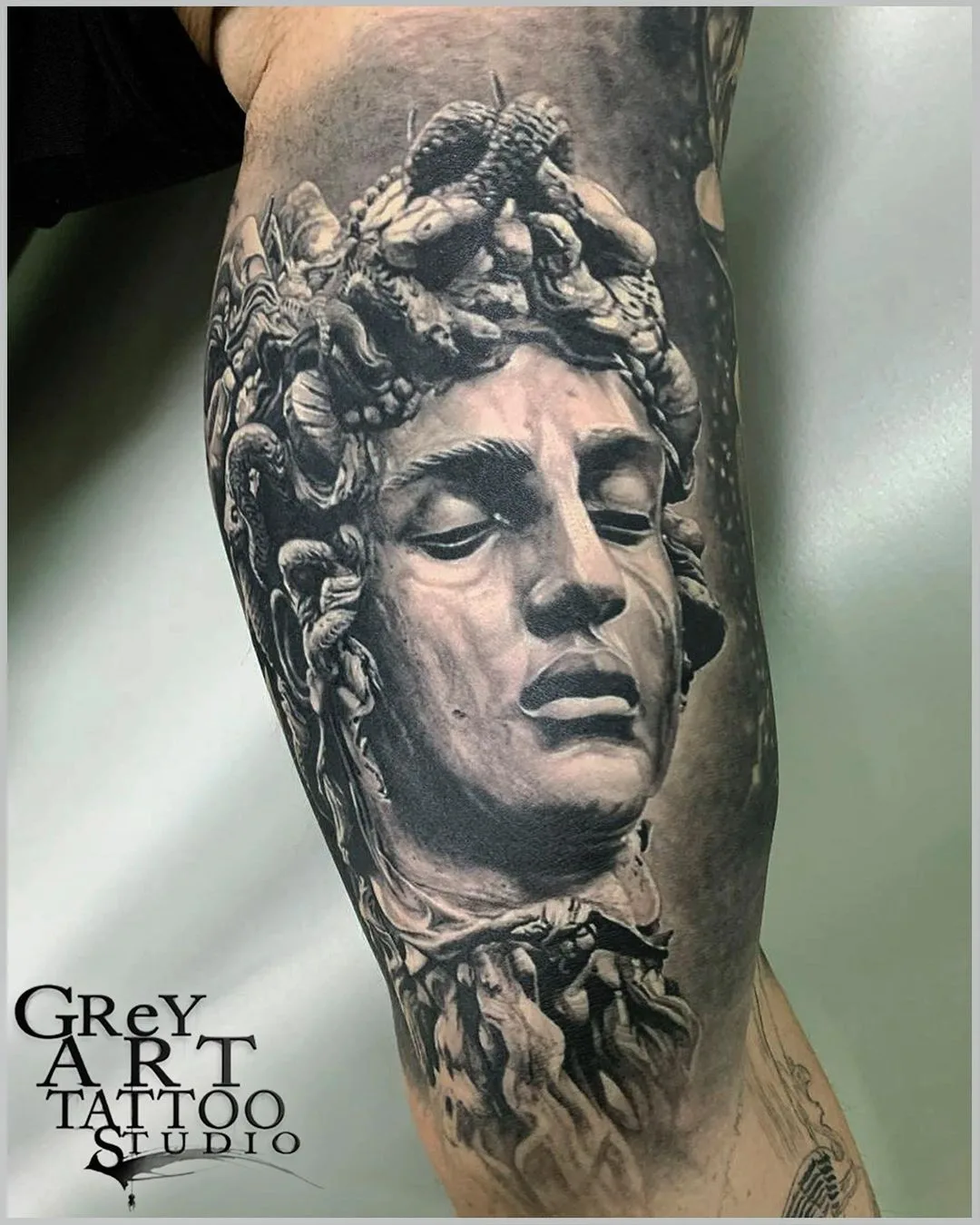
The familiar retelling casts Medusa as a priestess. In Book IV of Metamorphoses, Ovid describes a young woman admired for her hair and places the assault in Minerva’s temple. Minerva covers her eyes with her aegis, then changes Medusa’s hair into snakes. The temple is in Ovid’s account; the role of priestess belongs to the popular retelling.
Hesiod tells a different story in the Theogony. Medusa is the sole mortal among three Gorgon sisters, alongside Stheno and Euryale. Hesiod sets her encounter with Poseidon in a soft meadow among spring flowers, then moves to her death at the hands of Perseus, when Pegasus and Chrysaor spring from her. His account leaves out the temple and the punishment that Ovid supplies.
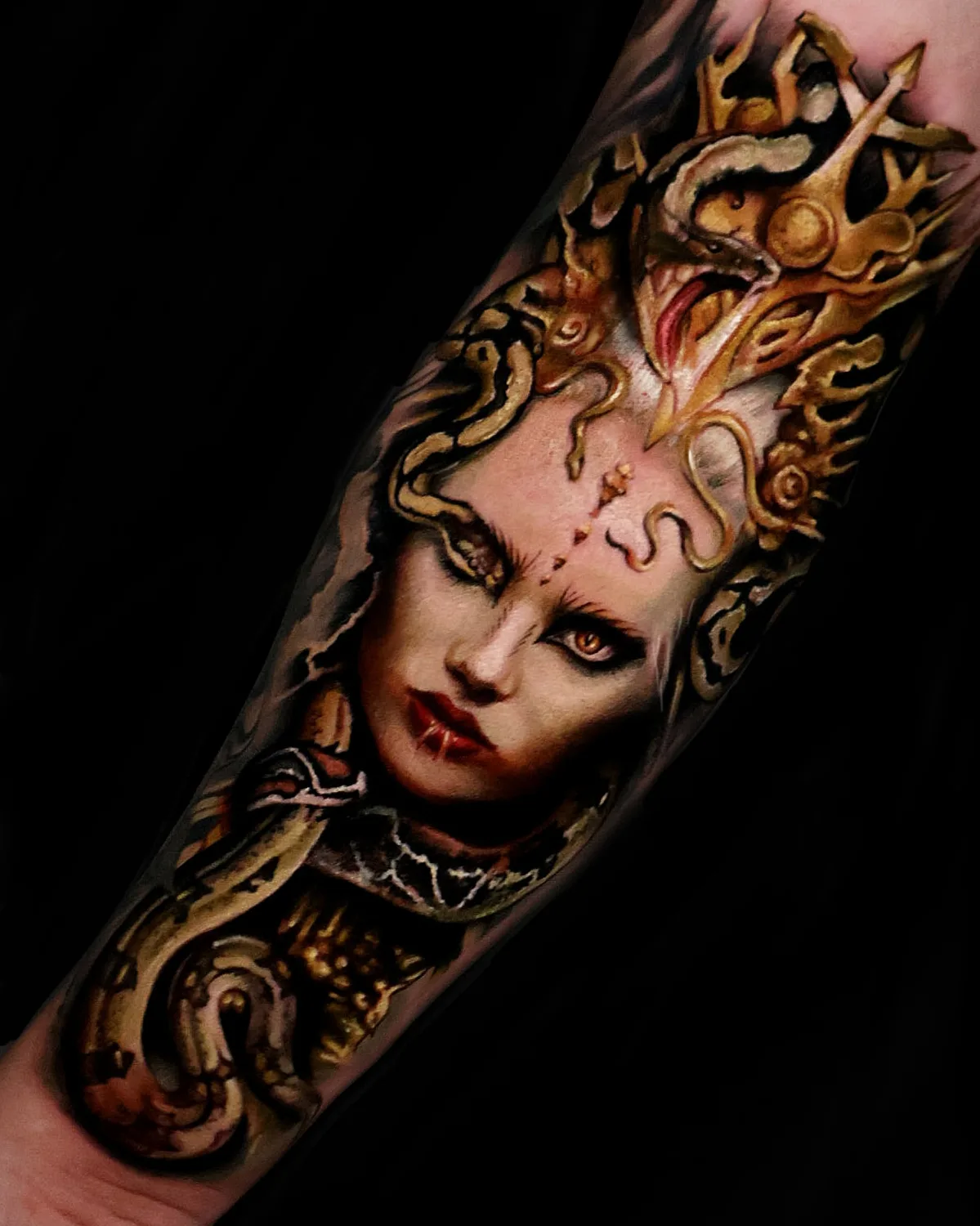
Perseus approaches Medusa by watching her reflection in a polished bronze shield; in many retellings, Athena, the Greek counterpart of Minerva, supplies it. That way he avoids the gaze that turns anyone who meets it directly to stone. That detail gives you a choice when planning a portrait: a face turned toward the viewer feels like a confrontation, while a profile gives the impression that something just outside the frame has caught her eye.
Medusa as a Survivor Symbol
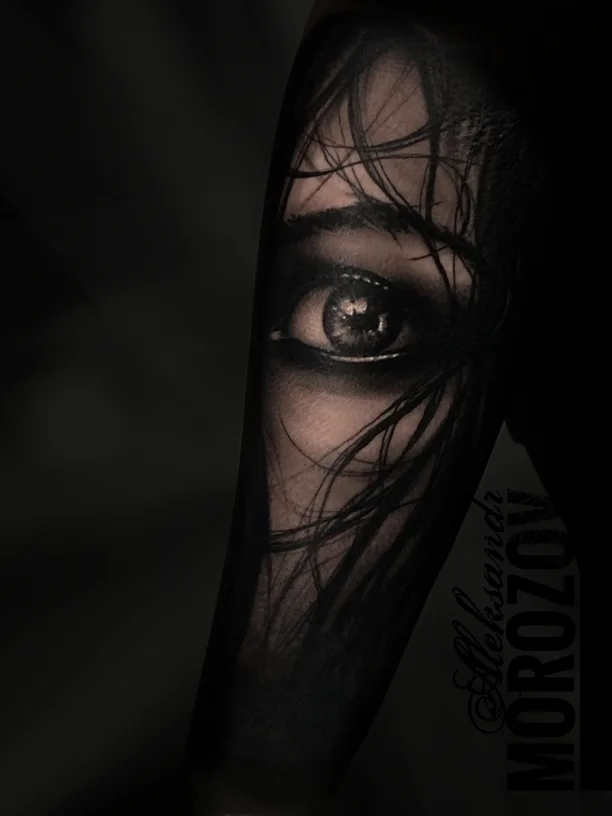
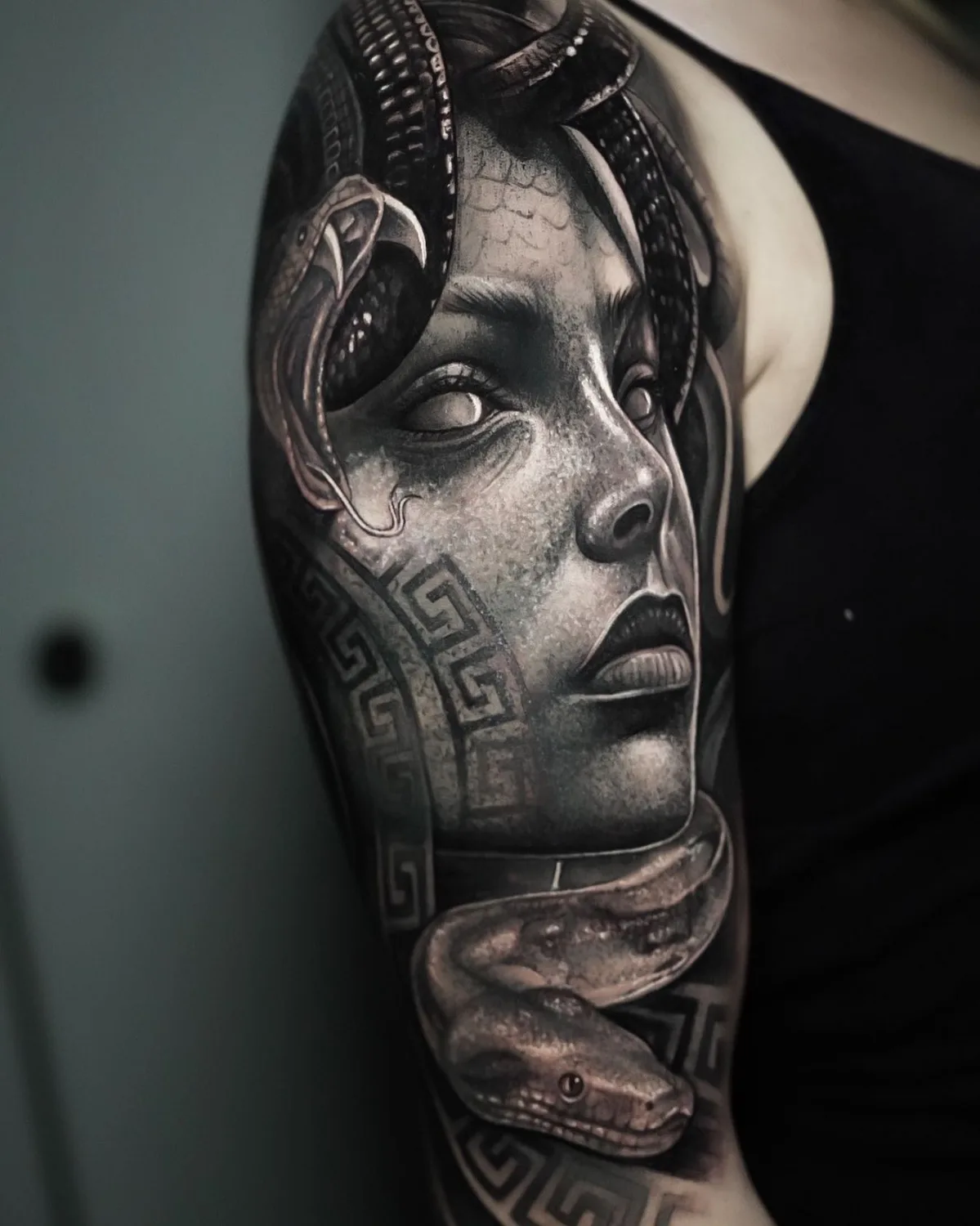
In the modern survivor reading, the gaze gives Medusa the power to stop harm. Ovid gives readers a woman who bears the consequences of someone else’s actions; the tattoo can give her the last word. A level stare can carry that idea quietly. If you want the face to feel composed, you might ask your tattoo artist to keep the mouth relaxed and let the eyes hold the viewer’s attention.
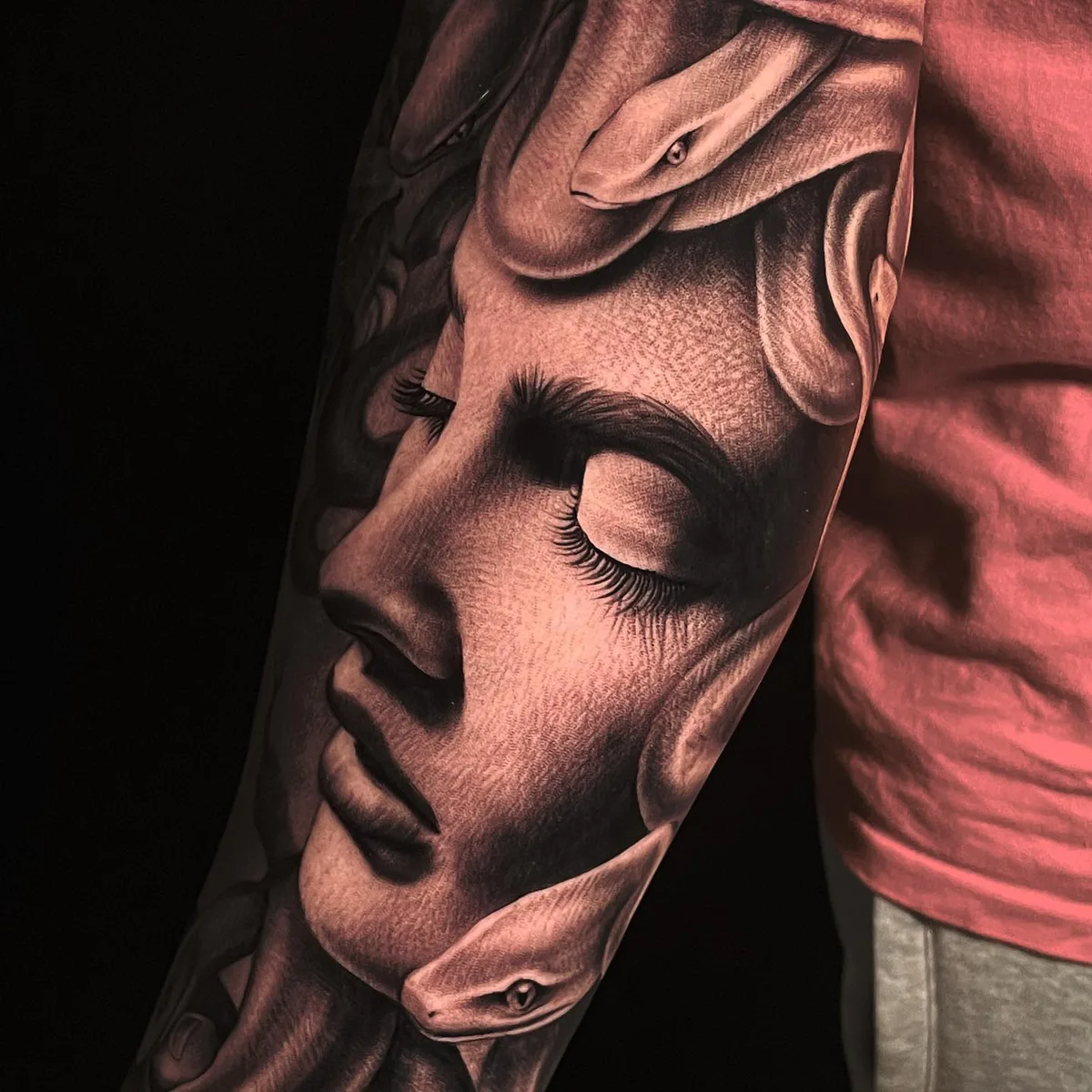
This reading also has a parallel in public art. In 2020, Luciano Garbati’s sculpture Medusa With the Head of Perseus was installed opposite the Manhattan criminal courthouse, and The New York Times described how it had become #MeToo art. The sculpture reverses the familiar scene by putting Perseus’s head in Medusa’s hand. In recent years, people have shared their reasons for the tattoo on social media, which helped spread its association with surviving sexual violence.
If you’re getting the tattoo for this reason, the portrait might mark a change in how you think about your body or a point when setting a boundary began to feel possible. You can tell your tattoo artist what you want the face to express and keep the reason for it private. “I want her to look straight ahead, with a calm expression” gives the artist something concrete to draw. If someone asks what the finished piece means, “I liked her expression” can be the whole conversation.
If this story brings up something you want to talk through, RAINN’s National Sexual Assault Hotline is available in the US at 800-656-4673. Outside the US, a local rape crisis center can offer the same kind of support.
The Gorgoneion: Medusa as a Protective Charm
Gorgoneion is the Greek name for the Gorgon-head emblem. Its purpose was apotropaic: it was there to ward off evil. The head faces outward so that its fearsome expression confronts whatever is coming toward it. In Book V of the Iliad, the Gorgon’s head already appears on Athena’s aegis. In later versions of the myth, Perseus gives Medusa’s head to Athena, who sets it on her aegis or shield.
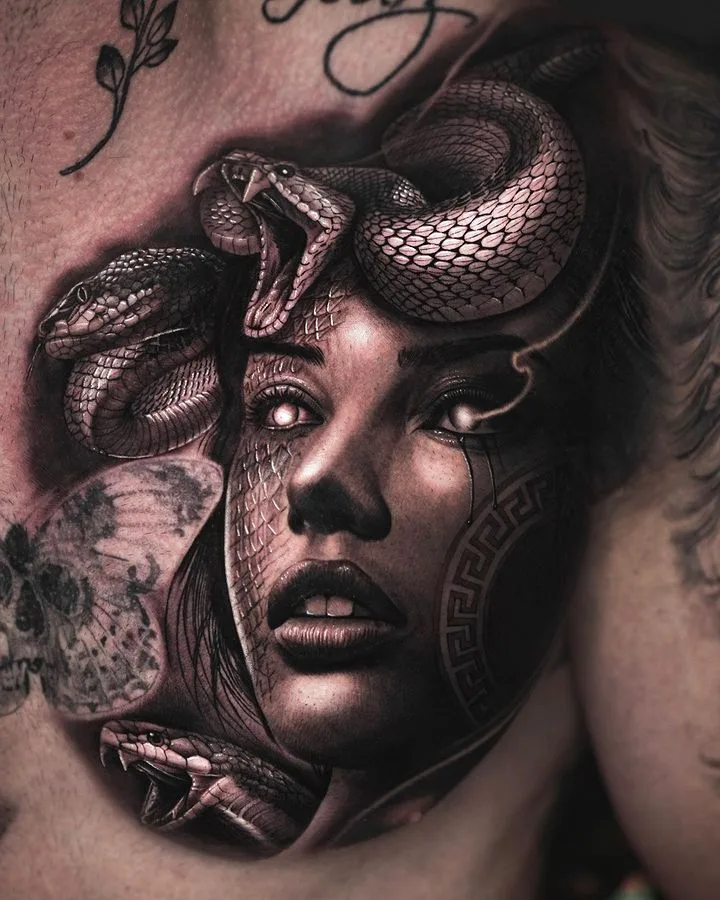
Museum collections and accounts of Greek art document the face on armor, coins, and temple pediments, including the pediment of the Temple of Artemis on Corfu. The motif also appears in Roman floor mosaics. It works at very different scales: you could encounter it underfoot in a room or see it high on the front of a temple. In each setting, the face meets the person approaching it.
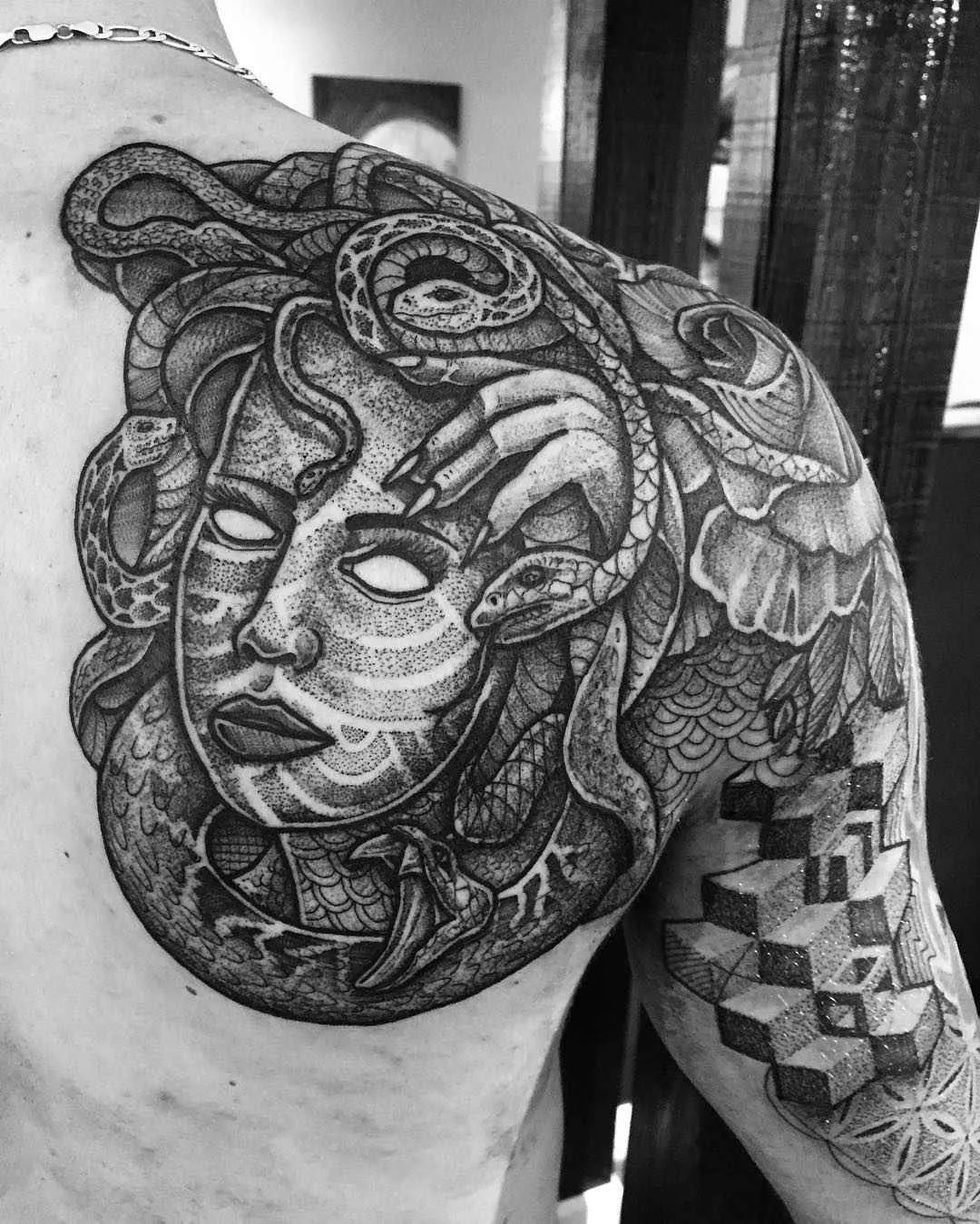
For a tattoo with that protective feel, try sketching the head straight on and looking at it from across the room. A strong brow and a distinct outline around the snakes can make it read as an emblem before you see the individual scales. An oval or shield-shaped border can reinforce that effect, especially if you want a compact piece with a clear edge.
Snakes, Stone and the Severed Head: Reading the Details
Ovid’s transformation begins with the feature Medusa was admired for: her hair. In a tattoo, the snakes can follow the sweep of a hairstyle or break away from it in sharp bends. Browse snake tattoos to see how artists use coils to frame a face or fill the space around a shoulder. Our guide to snake symbolism in tattoos explores the association between shedding skin and renewal, a separate idea you can bring into the design.
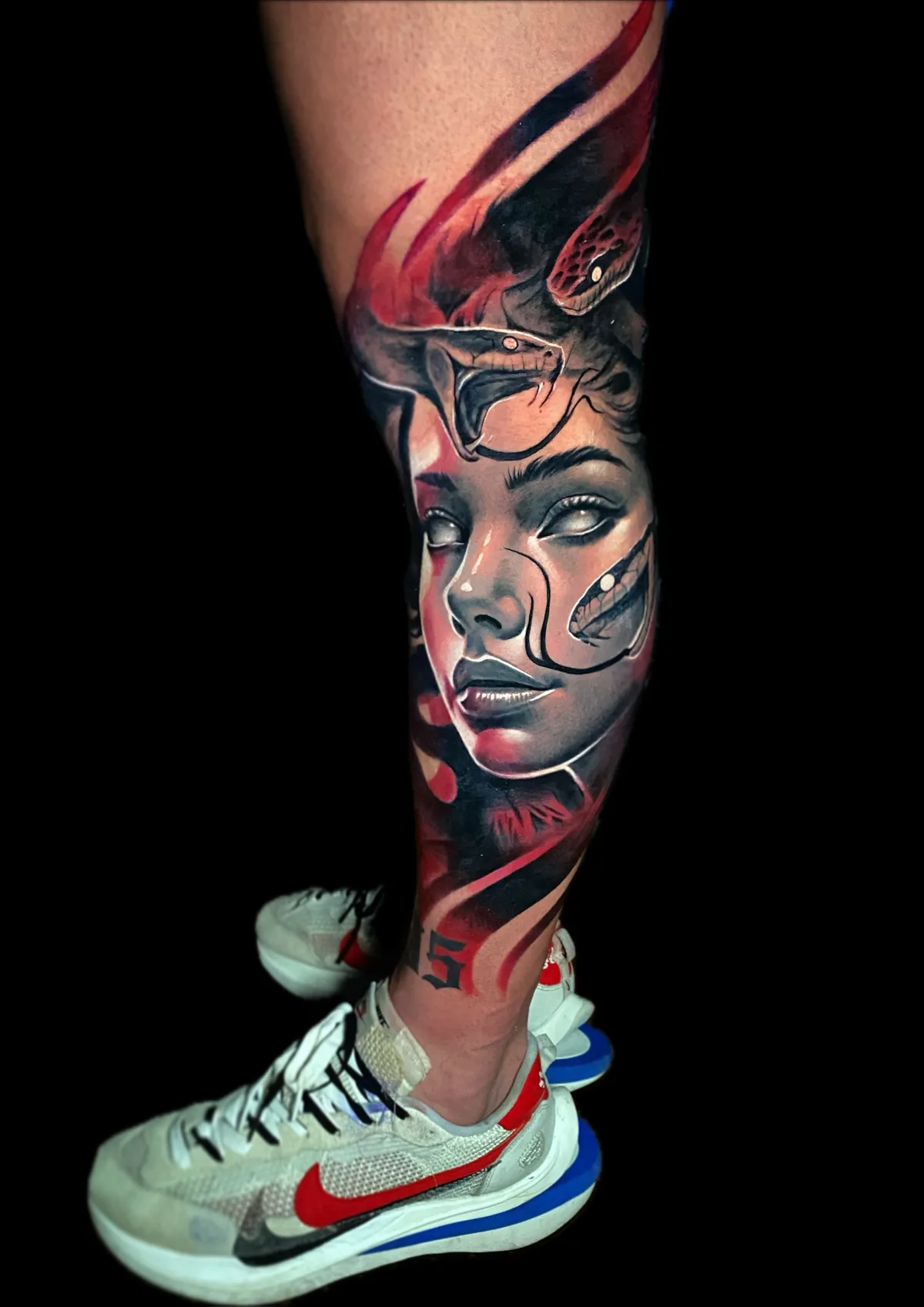
Stone can show up in the portrait itself. Pale eyes, a chipped edge, or a patch of marble texture can suggest that the face belongs to the world its gaze creates. For a calm expression, look at the Medusa Rondanini in Munich’s Glyptothek: the composed face leaves the snakes to identify her.
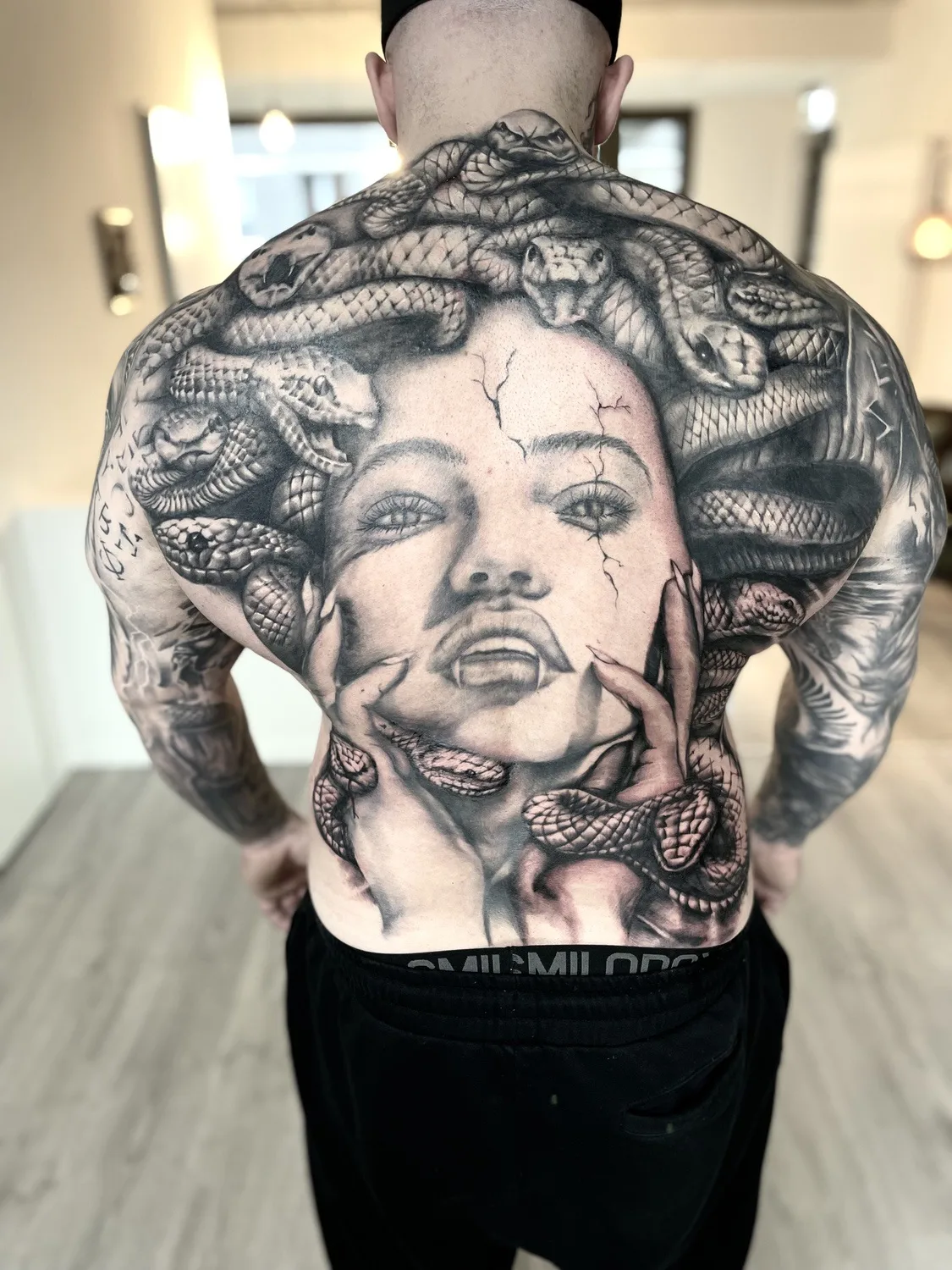
The severed head offers another visual choice. In Cellini’s bronze in Florence’s Loggia dei Lanzi, Perseus holds the head aloft, placing Medusa inside the story of his victory. Caravaggio’s painted shield in the Uffizi fills the space with Medusa’s face. If you’re deciding what to crop out of a sketch, notice how much the scene changes when the face is the only thing you have to look at.
Styles and Placement
A fine-line profile can give the design an intimate scale, especially if you limit the snakes to a few distinct curves around the forehead and neck. Blackwork gives you a bolder silhouette: try leaving open skin around the eyes and between the coils. Black-and-gray realism suits a statue-like face, with soft shadows giving the cheek and brow their shape. In color neo-traditional work, you can use a different hue for the snakes to separate them from the face at a glance.
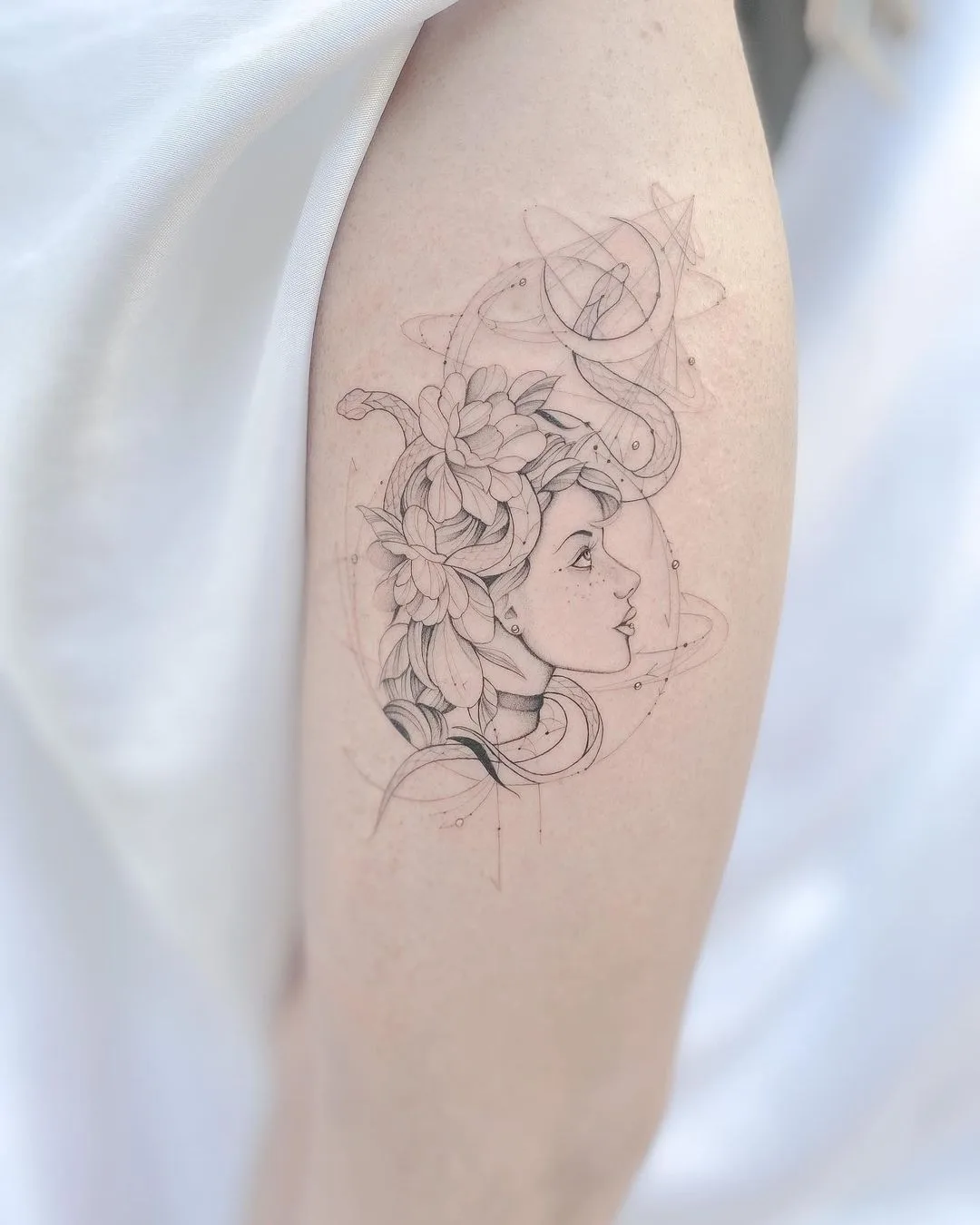
On the forearm, check the orientation with your arm relaxed as well as with your palm up. If you want to meet her eyes yourself, say so when you and your artist position the stencil. The thigh or back gives the snakes room to spread sideways, while a sleeve lets them wrap around the arm. For a sleeve, decide which part of the portrait you want visible from the front; that can help you place the eyes before the rest of the design takes shape.
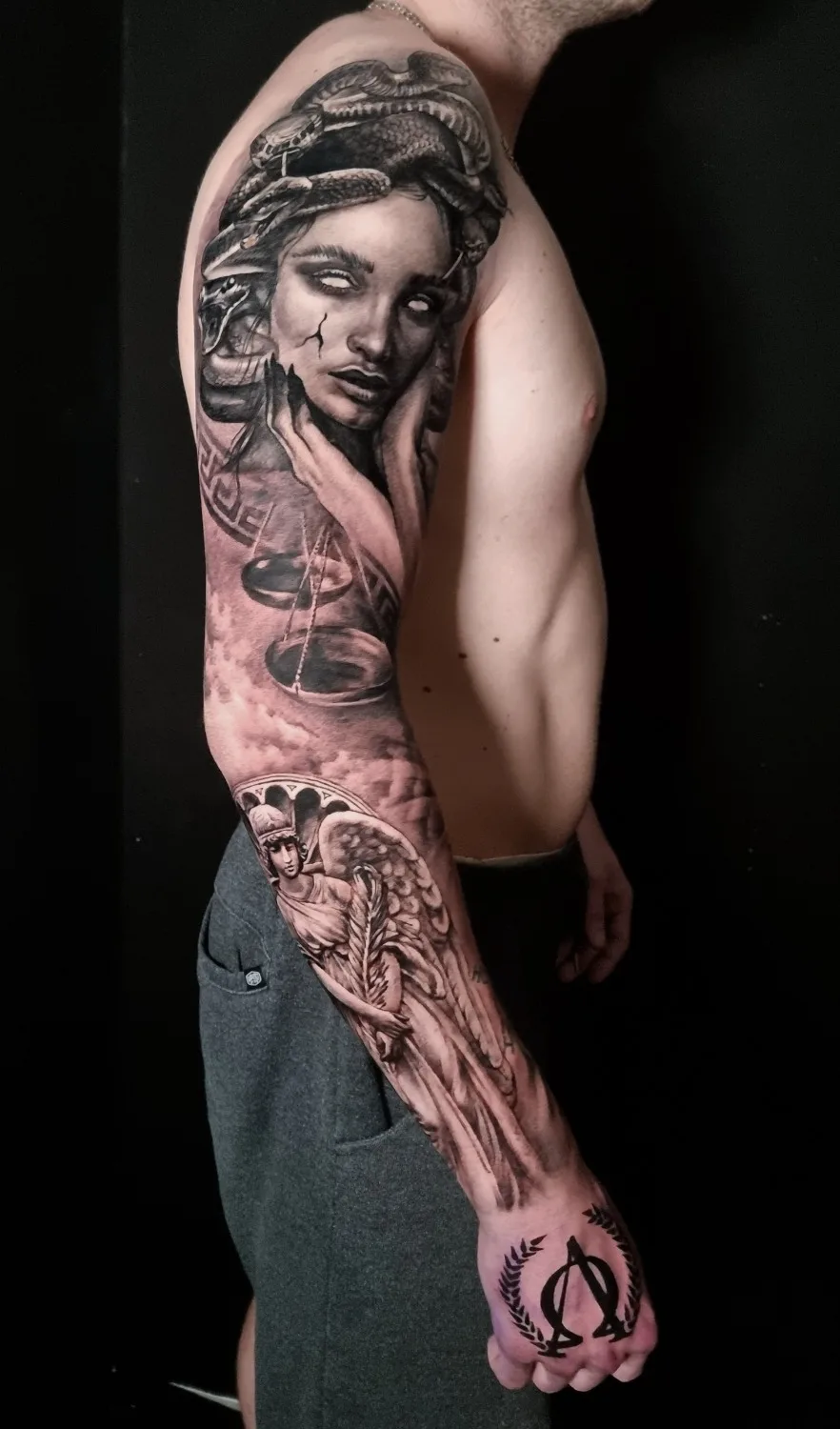
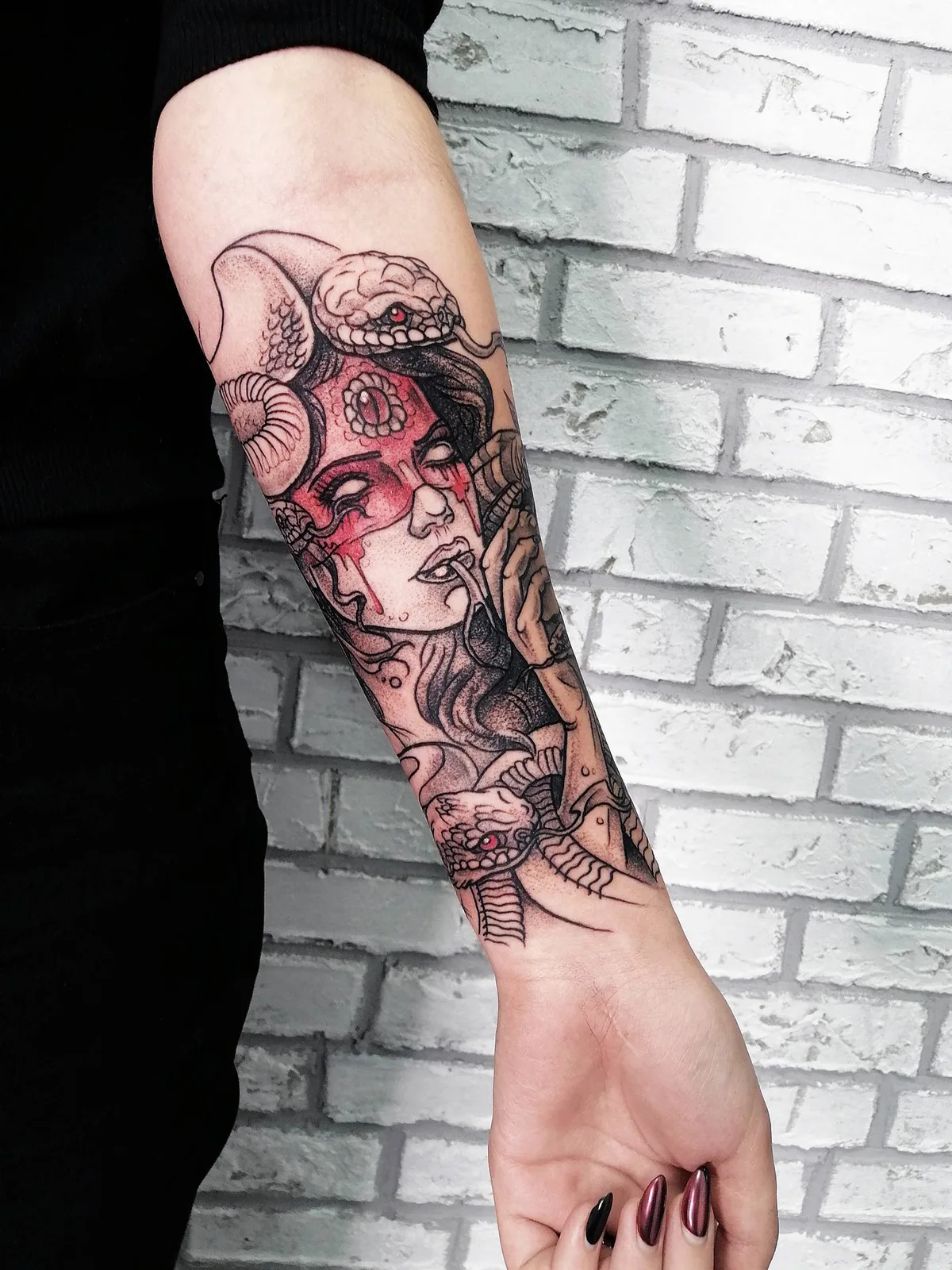
You can also conceal the portrait under clothing or let the face emerge gradually from overlapping lines. In the second approach, ask your artist to make one feature easy to find, such as the curve of the nose. A viewer can pick it out first and then discover the snakes around it. The decision to make someone look twice can be as personal as the choice of placement.
Medusa or Jellyfish?
In Spanish, Italian, and Portuguese, medusa is a word for jellyfish. French has méduse, and Russian uses a form of the same name. In zoology, a medusa is the free-swimming, bell-shaped stage of certain cnidarians. The name comes from the resemblance between trailing tentacles and the Gorgon’s snake hair.
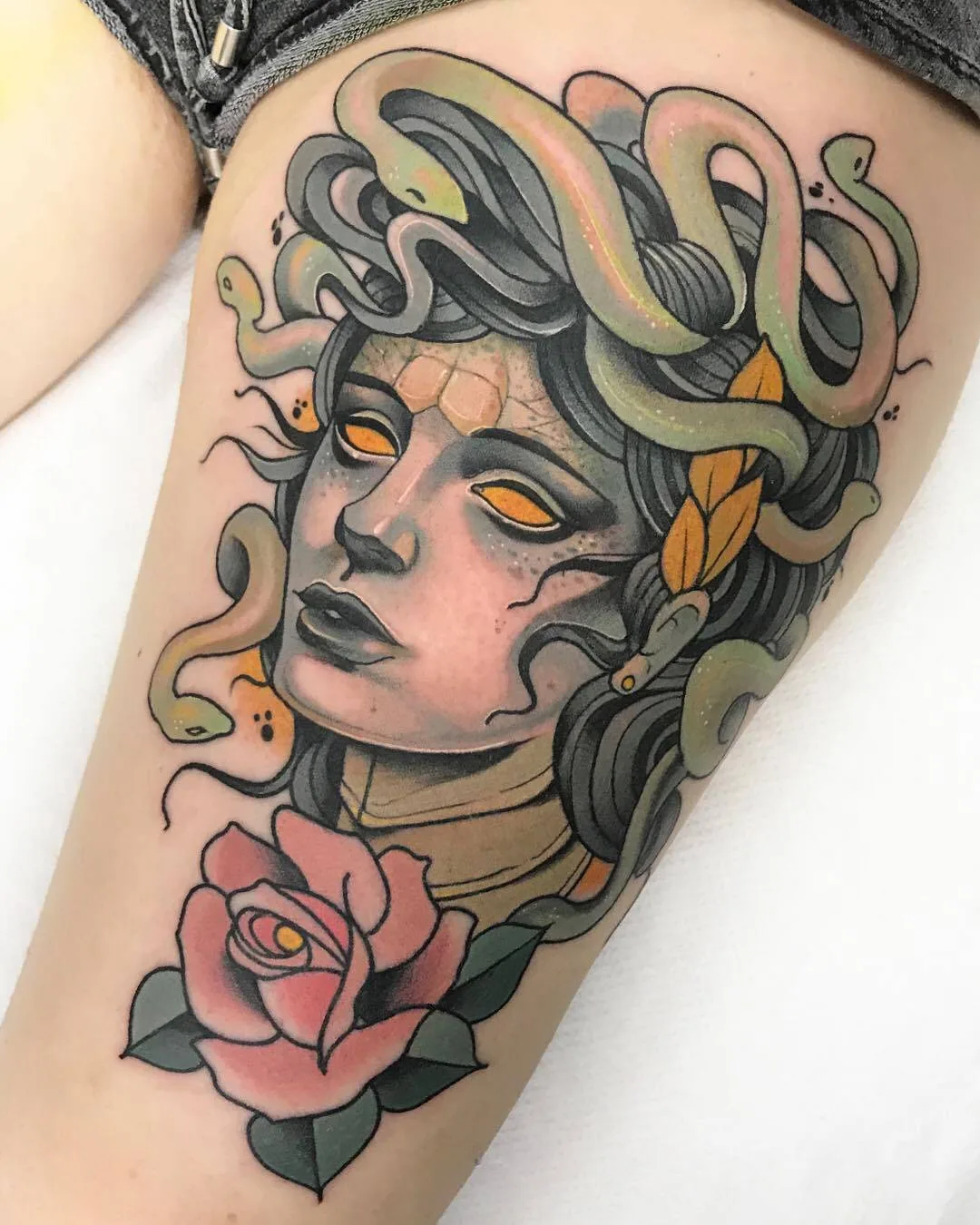
If a search mixes the two subjects, look for the feature you want your artist to draw: a human face with snakes or a bell with tentacles. The Medusa tattoo gallery collects Gorgon designs, so you can compare how different artists handle the face, the eyes, and the shape of the hair.
FAQ

What does a Medusa tattoo mean on a woman?
A woman might choose Medusa to mark survival, express a sense of power, or wear an image she finds beautiful. If you’re asking about someone else’s tattoo, let her decide whether to tell you what drew her to the design.
Is a Medusa tattoo only for survivors?
Anyone can choose Medusa. You might love Greek mythology, want a protective emblem, or be drawn to the look of a classical portrait framed by snakes. Each gives you a different starting point for the sketch.
What does a hidden Medusa tattoo mean?
A hidden Medusa keeps the meaning on your terms: you decide who sees the image and when. You can place it where clothing usually covers it or tuck the face inside a larger design so it appears only on a closer look.
Where do people usually place a Medusa tattoo?
The forearm, thigh, and back are useful options to discuss with your artist. Try the forearm for a portrait you can see easily, or the thigh or back if you want to give the snakes more room. A sleeve lets you carry the coils around the arm.
Is a Medusa tattoo bad luck?
The ancient record points the other way. The Gorgon head served as a protective sign: people displayed its frightening face to ward off harm.