A snake tattoo means renewal: the animal that sheds its skin and comes out whole, and so stands for a person who has left an old self behind. Around that core sit healing, protection and wisdom, depending on which tradition the design is drawn from. Temptation, the reading most Westerners reach for first, is a local exception rather than the default, and the rest of this article explains why.
What a snake tattoo means
Start with the biology, because every culture that made the snake a symbol was looking at the same animal. A snake grows continuously and its skin does not, so several times a year it crawls out of the old layer: in one piece, inside out, starting at the lips. For a few days beforehand its eyes cloud over blue and it goes half-blind; then the skin splits and the animal emerges brighter than before. Going dark, being vulnerable, coming out new: that sequence is why the snake means renewal almost everywhere it appears, from Egyptian coffin texts to Japanese shrines.
It is also the meaning most people bring to a studio. Recovery from addiction, the end of a marriage, a body that survived something: the snake fits all of these because it does not destroy its old skin, it outgrows it, and leaves the shell behind as a transparent ghost of what it used to be. That is a gentler picture of change than the phoenix burning itself down.
The other meanings grow out of the same observation. If a body can renew itself, the snake can heal. That is the Greek line, and the reason a serpent is still on the side of ambulances. If it moves like water, lives in the ground and appears without warning, it guards what is hidden (money, springs, temples), and that is the Japanese, Hindu and Mesoamerican line. If it kills silently, it is danger, and a coiled rattlesnake on a forearm needs no mythology to be understood.
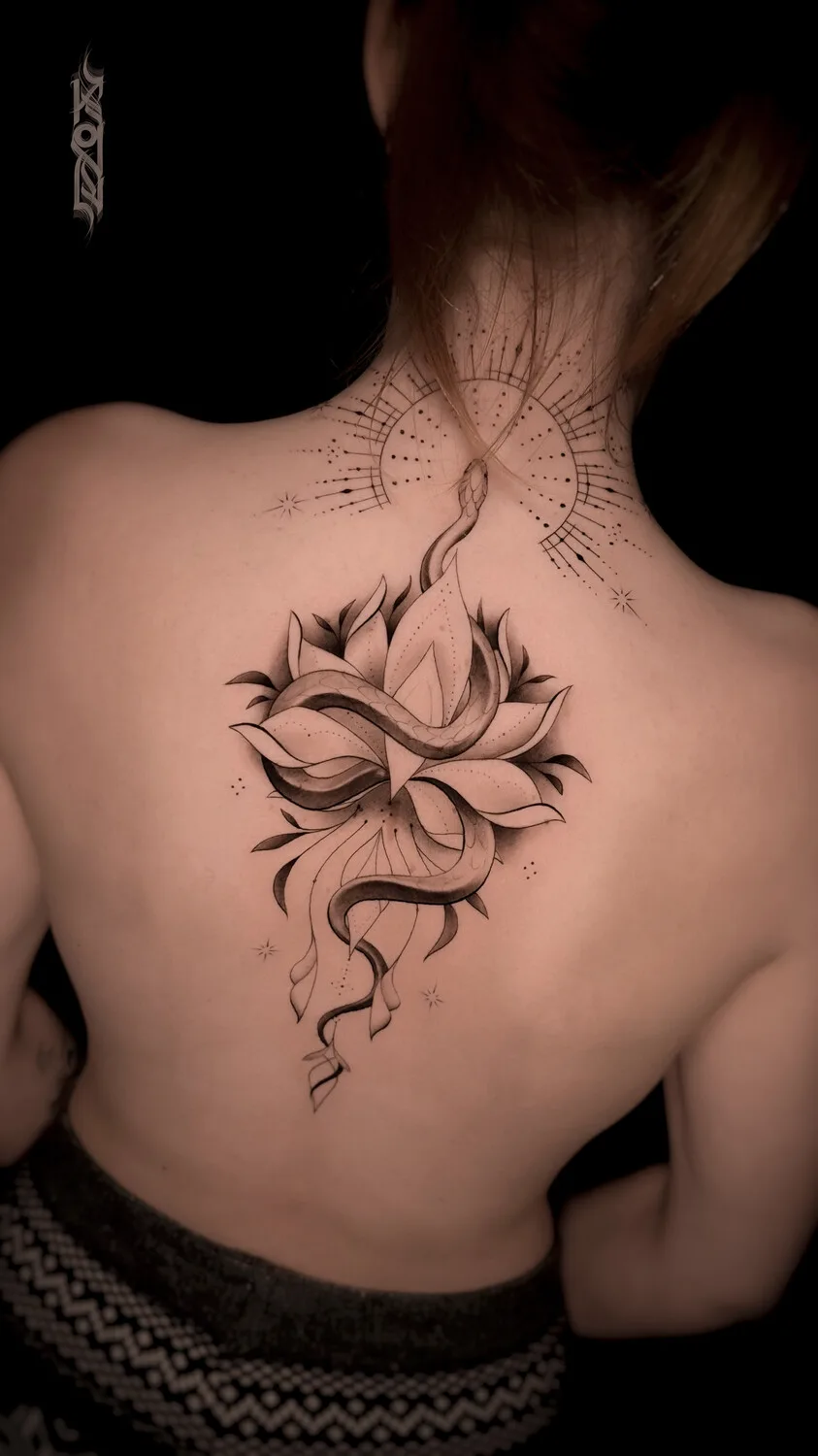
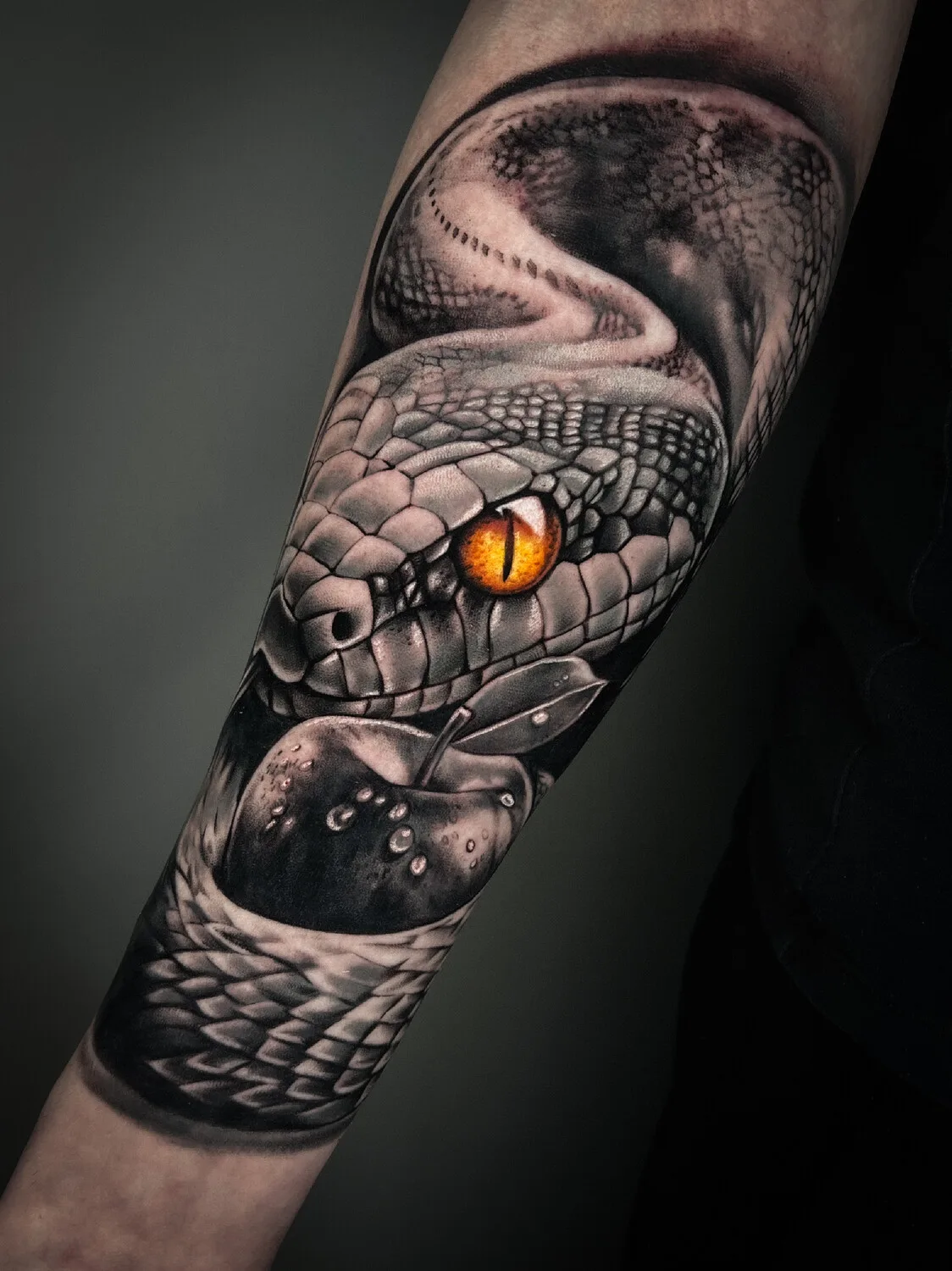
One tradition reversed the sign. In Genesis the serpent talks a woman into eating from a forbidden tree, and Christianity has read the animal as a deceiver ever since. Because Western tattooing grew up inside that culture, temptation became the meaning people assume. Set against everything below, it is the odd one out. The tattoo you are wearing belongs to the larger group unless you deliberately put an apple in its mouth.
Greek mythology: Asclepius and the ouroboros
Asclepius, son of Apollo and the Greek god of medicine, carried a staff with a single snake wound around it. His sanctuaries, the largest at Epidaurus, kept live snakes of a harmless species that still bears his name, the Aesculapian snake, and patients sleeping there for a cure reported the animals moving over them at night. When Rome imported the cult in 293 BCE, a snake is said to have left the ship and chosen Tiber Island, where a hospital still stands.
The confusion is worth a sentence. The rod of Asclepius has one snake and no wings. The caduceus has two snakes and wings and belongs to Hermes, god of trade and thieves. The US Army Medical Department adopted the caduceus in 1902, a choice most historians put down to confusion between the two symbols, and many American medical organisations followed. If you are a nurse or a patient who came through something, the piece you want has one snake.
The ouroboros, a snake eating its own tail, is Greek by name and Egyptian by origin: the earliest known one is painted on a shrine in Tutankhamun's tomb, and Greek alchemists later drew it around the words "the all is one". Infinity is the usual gloss, and too vague to be useful. The image is a cycle: death feeding life feeding death, a process with no outside. As a tattoo it makes a self-contained ring that reads the same in every language.
Japanese tradition: hebi as luck, money and protection
In Japan the snake, hebi, is a messenger rather than a monster. Its goddess is Benzaiten, one of the Seven Lucky Gods, who arrived from India as the river goddess Sarasvati; in medieval Japan she was merged with Ugajin, a local snake kami, and the serpents became hers. At Enoshima, southwest of Tokyo in Sagami Bay, she is worshipped in a sea cave, and in her older form as Uga Benzaiten she wears a small coiled snake with a human head on her crown. White snakes are her messengers; to meet one is a sign of money on the way.
That belief has a physical address. Iwakuni, in Yamaguchi Prefecture, has a population of albino Japanese rat snakes that has bred true for centuries, protected as a Natural Monument since 1924 and given a shrine of their own. The older folk custom is smaller: a piece of shed snakeskin in the wallet, so the money in it renews the way the skin does.
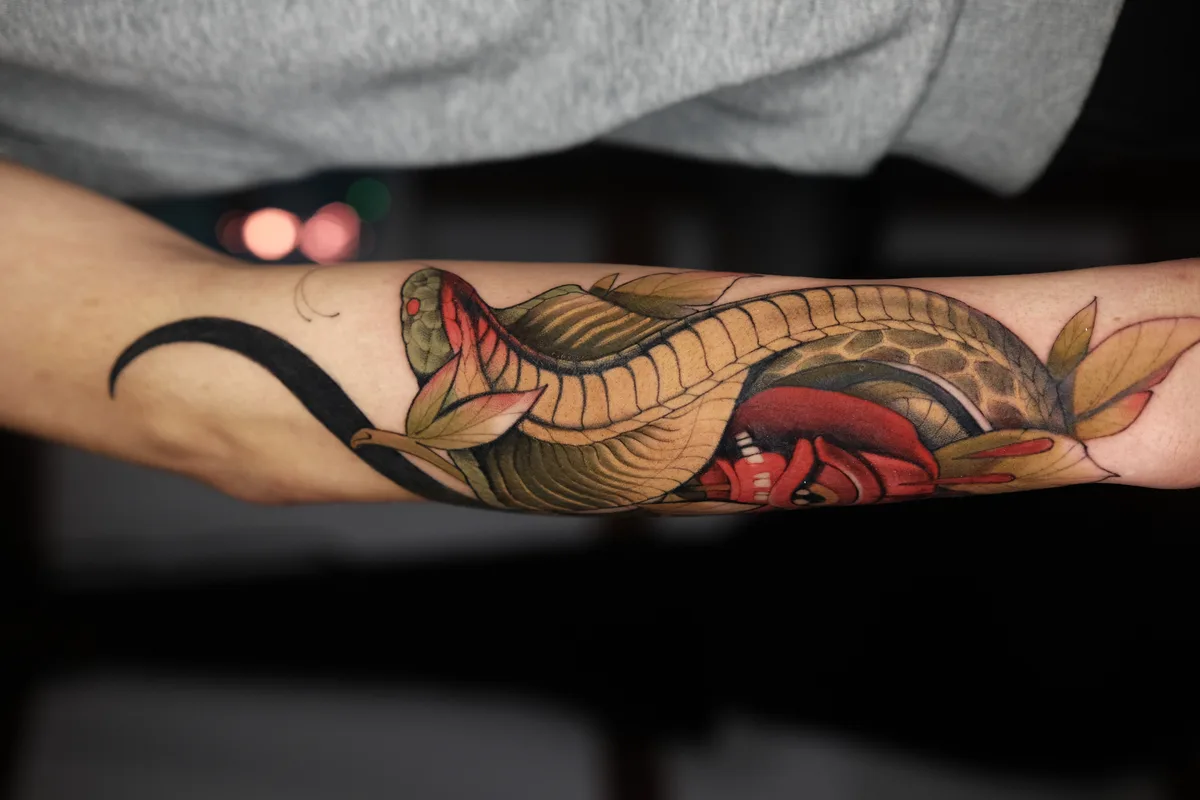
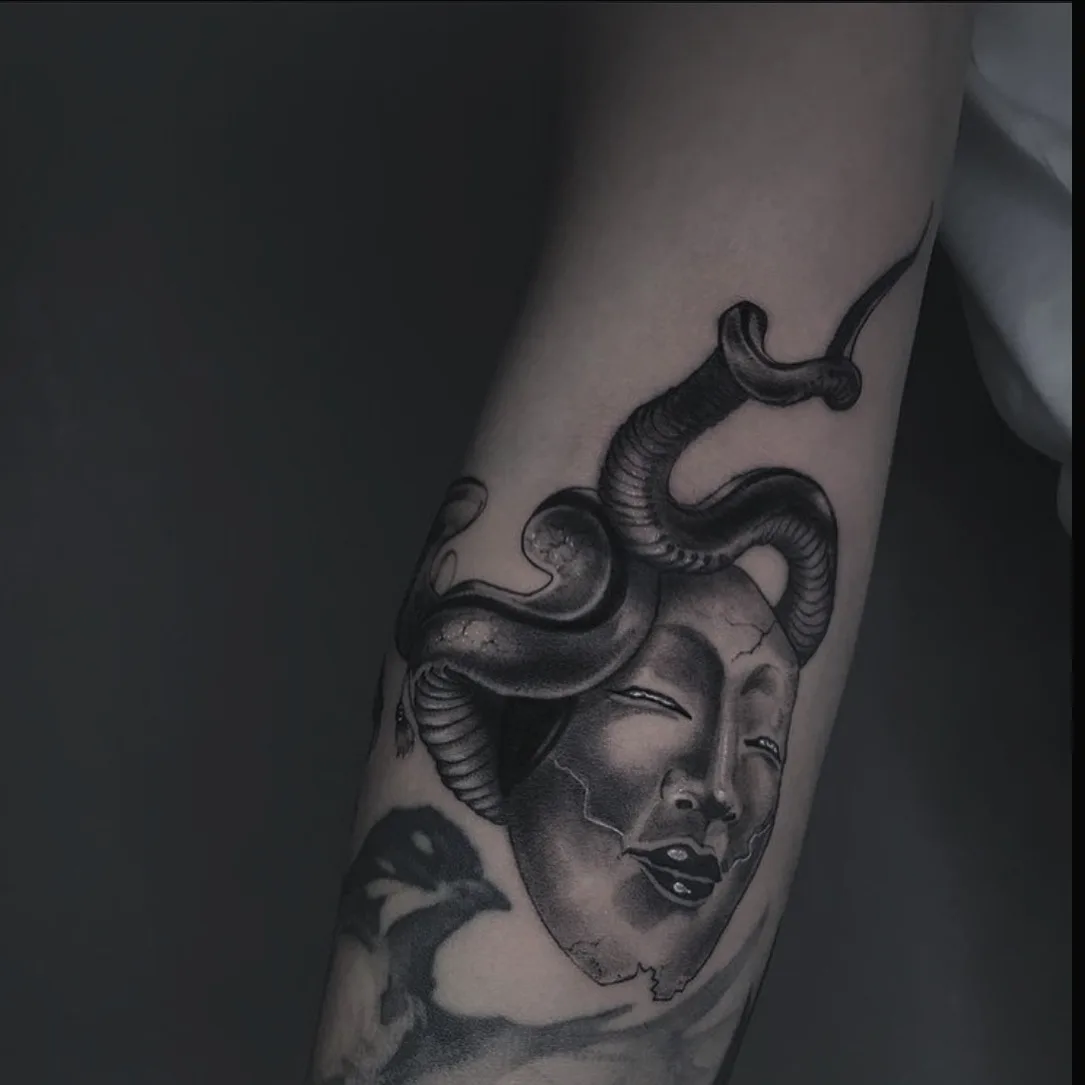
The link to health comes from the same shedding. The snake is often read in irezumi as protective. In irezumi the snake is almost always shown coiling through something (peonies, chrysanthemums, waves, sometimes a skull) and is protective. The folklore has a darker side, snake-women in Noh theatre and jealousy that takes serpent form, but in tattooing it rarely appears.
Hindu mythology: nagas and kundalini
Nagas are serpent beings, sometimes all snake and sometimes half human, and in Hindu belief they guard water: wells, springs, rivers, the rain itself. Every year on Nag Panchami, in the monsoon month of Shravana, milk is offered to living cobras and to their images. The greatest of them are named. Shesha, on whose coils Vishnu sleeps between cycles of the universe. Vasuki, who wears himself around Shiva's neck and served as the rope when gods and demons churned the ocean for the nectar of immortality. In the Buddhist branch, the naga king Mucalinda spread his hood over the meditating Buddha to keep the rain off; that image, the Buddha seated on the naga's coils under its hood, is one of the most common Buddha statues in Thailand and Cambodia.
Kundalini belongs to the same family of ideas but sits in the body. The Sanskrit word means "the coiled one": a serpent of energy asleep at the base of the spine, which yoga practice is meant to wake and lead upward through the chakras to the crown of the head. This is the one snake reading that dictates its own placement. A kundalini piece runs up the spine, tail at the sacrum, head between the shoulder blades or at the nape, because the myth is literally a map of where the animal lives. Put it on a forearm and the reference disappears.
Mesoamerican mythology: Quetzalcoatl, the feathered serpent
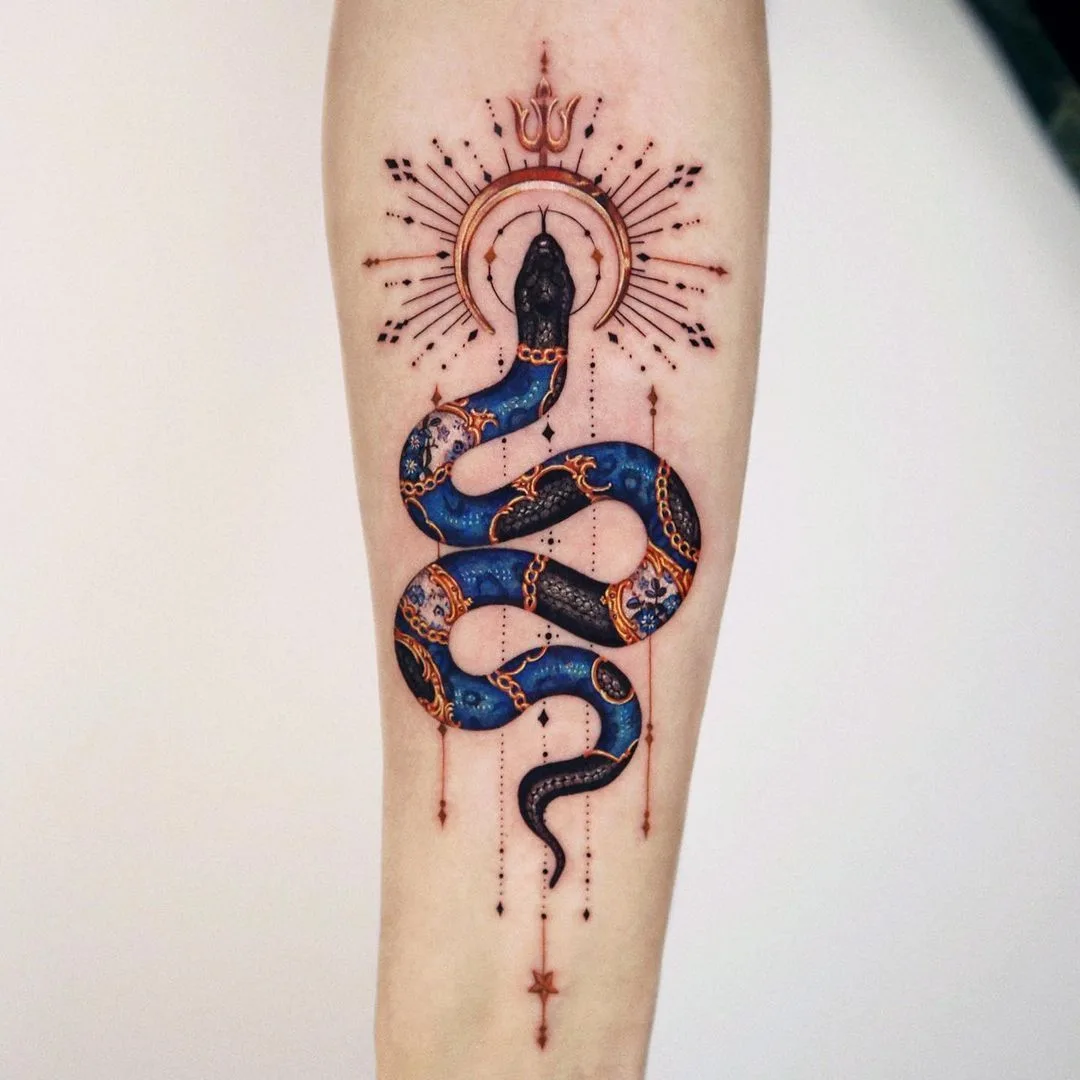
The feathered serpent joins sky and earth in one animal: the long green tail feathers of the quetzal bird along the body of a snake. The image is older than the peoples usually credited with it: the Temple of the Feathered Serpent at Teotihuacan was built around 200 CE.
The Aztec and Maya readings differ, and both belong. To the Aztecs Quetzalcoatl was a creator: the god of wind under the name Ehecatl, the morning star, patron of priests and learning, who went down to the underworld to bring back the bones of the last world's people and bled on them to make the present human race. To the Maya the same being was Kukulkan in Yucatan and Q'uq'umatz among the K'iche'. At Chichen Itza, on the equinox, the afternoon sun throws a chain of triangular shadows down the north staircase of the pyramid until it meets the stone serpent head at the bottom. Maya carvings also show the Vision Serpent, from whose open jaws an ancestor emerges during a bloodletting rite; Lintel 25 from Yaxchilan (early 8th century, now in the British Museum) shows Lady Xook facing one.
For a tattoo the feathered serpent means the union of opposites (wind and ground, bird and reptile, knowledge and the underworld), and it carries heritage for people with roots in Mexico and Central America.
The Eden reading and why it is the minority one
Genesis 3 says the serpent was "more crafty than any beast of the field" (in Hebrew a pun on the word for "naked" a verse earlier) and that it persuaded Eve to eat the fruit. The text never calls it Satan. That identification arrives centuries later, in Revelation's "that ancient serpent", and Christian art built the picture from there.
Even inside the Bible the animal is split. In the Book of Numbers, Moses raises a bronze serpent on a pole so that anyone bitten who looks at it will live: a healing snake, and the one Jesus compares himself to in the Gospel of John. So the deceiver reading is a choice one tradition made, not a fact about the animal.
Set it beside the rest of the world. Greece made the snake a healer, Japan a guardian of health and money, India a god of water, Mesoamerica a creator, Egypt the cobra on the pharaoh's brow. Temptation is the reading of one book, and it became the Western default because tattooing in Europe and America grew up in a Christian culture. Wear the Eden snake if that is your story; the apple and the tree signal it. But do not assume that is what a snake tattoo means. Worldwide, it is the exception.
Tattoo styles that suit the snake
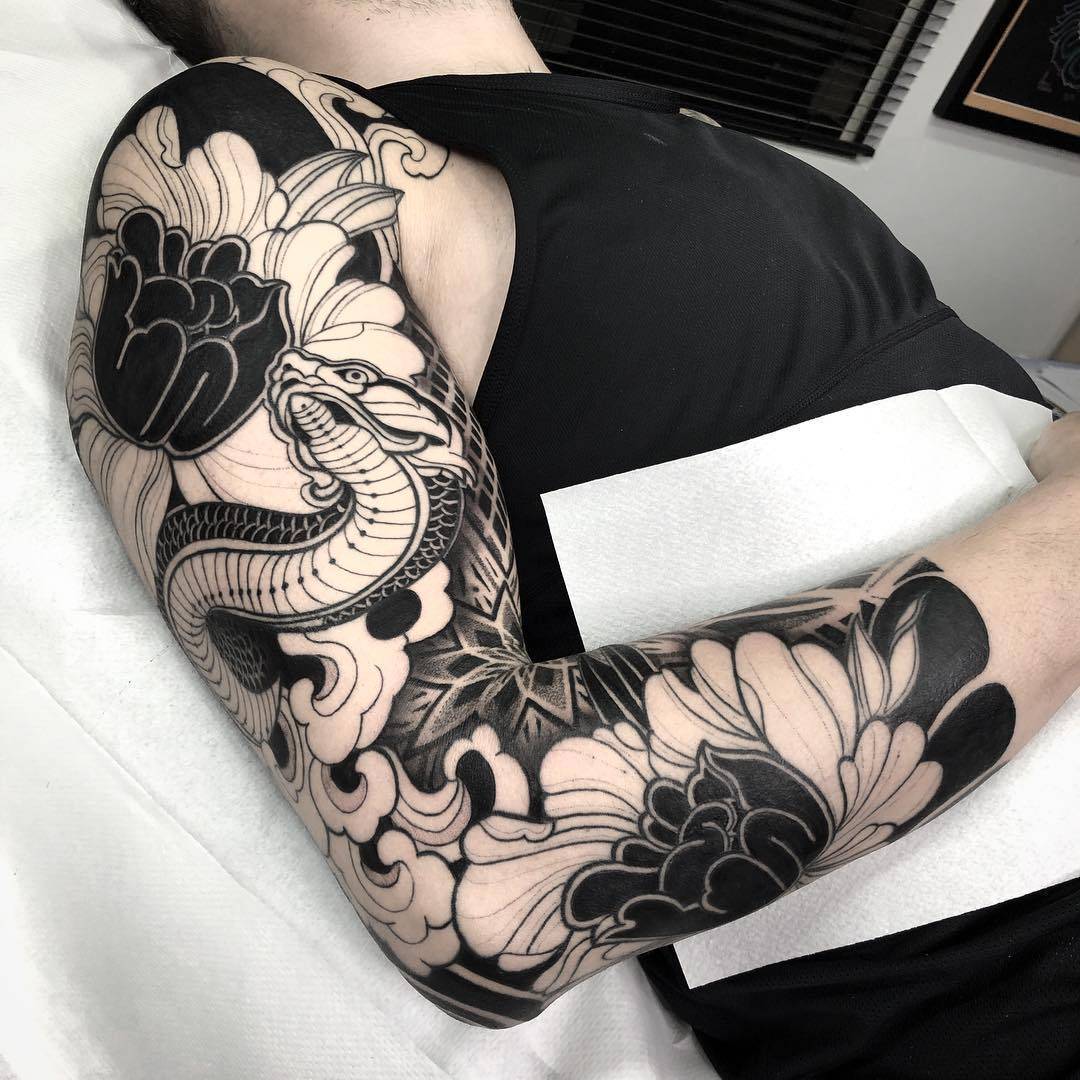
Full-sleeve blackwork snake with flowers by @melowperez
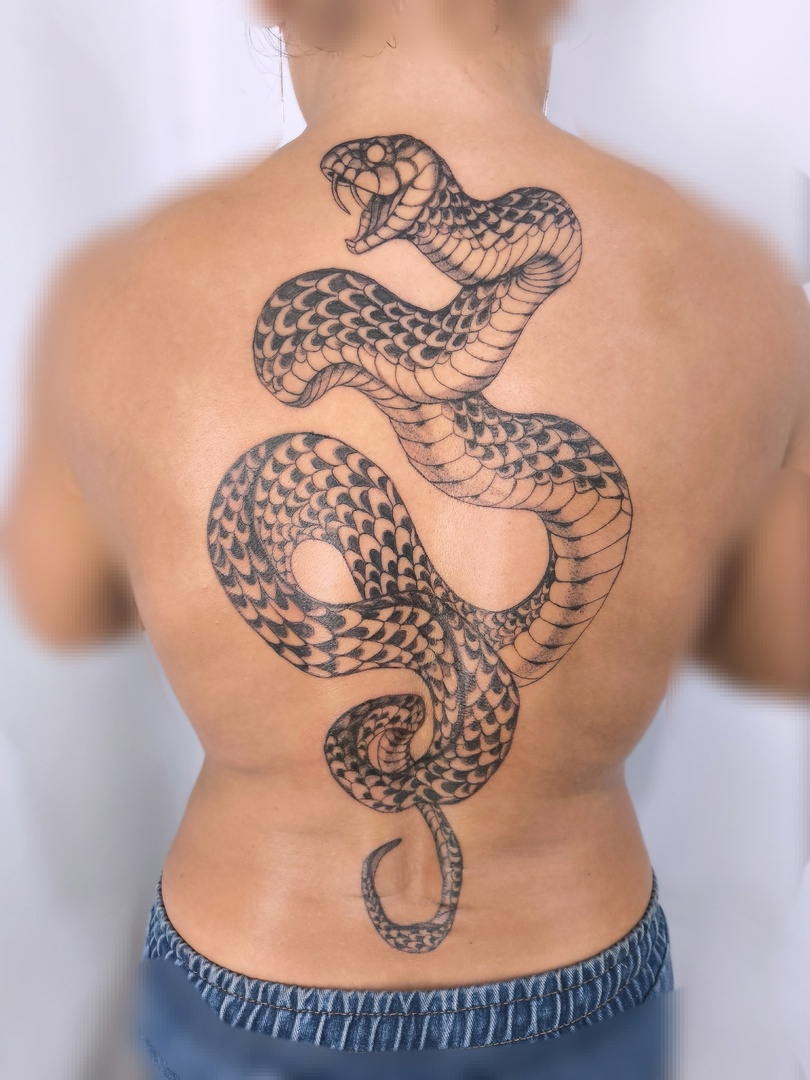
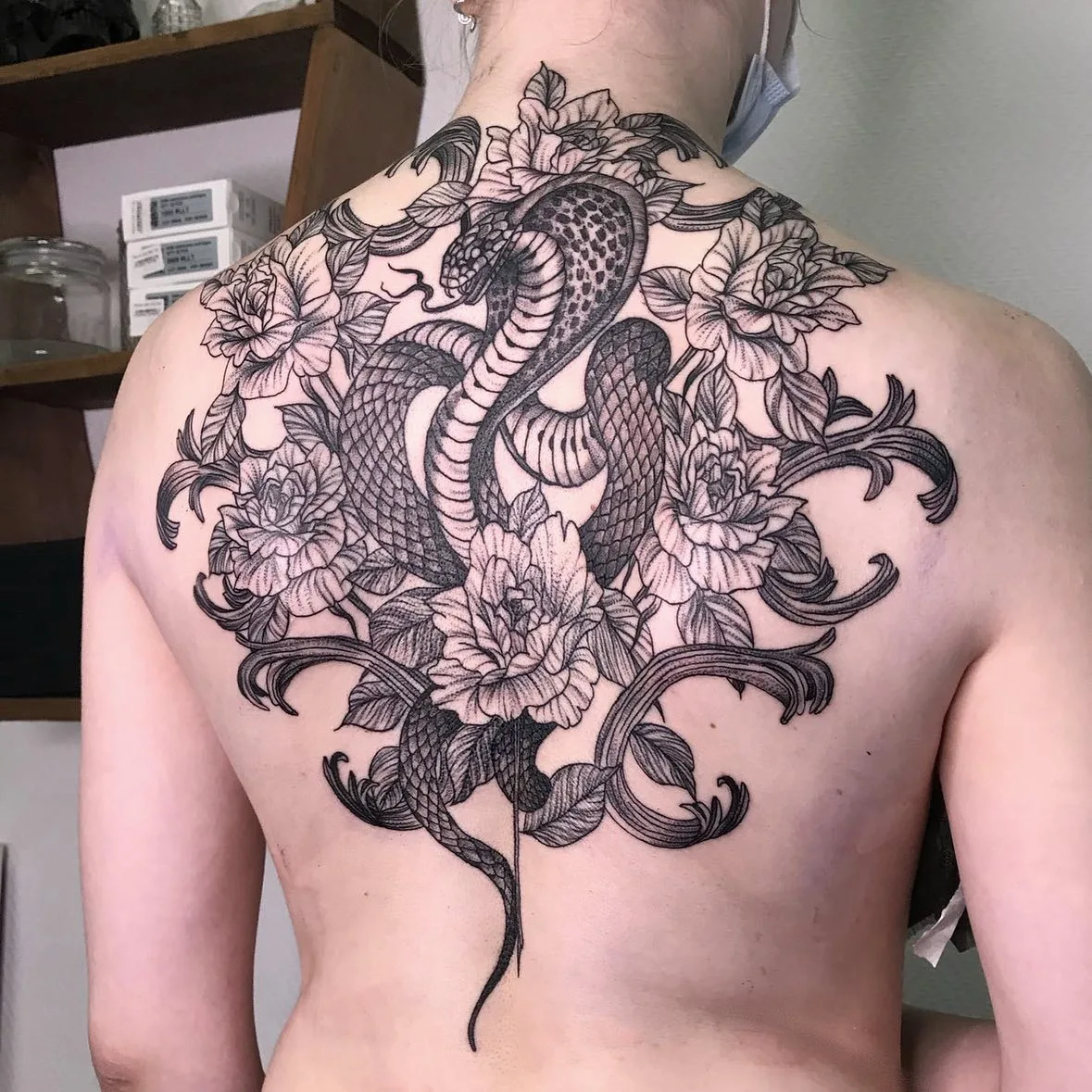
Blackwork snake coiled on the upper back by @Vikigashe
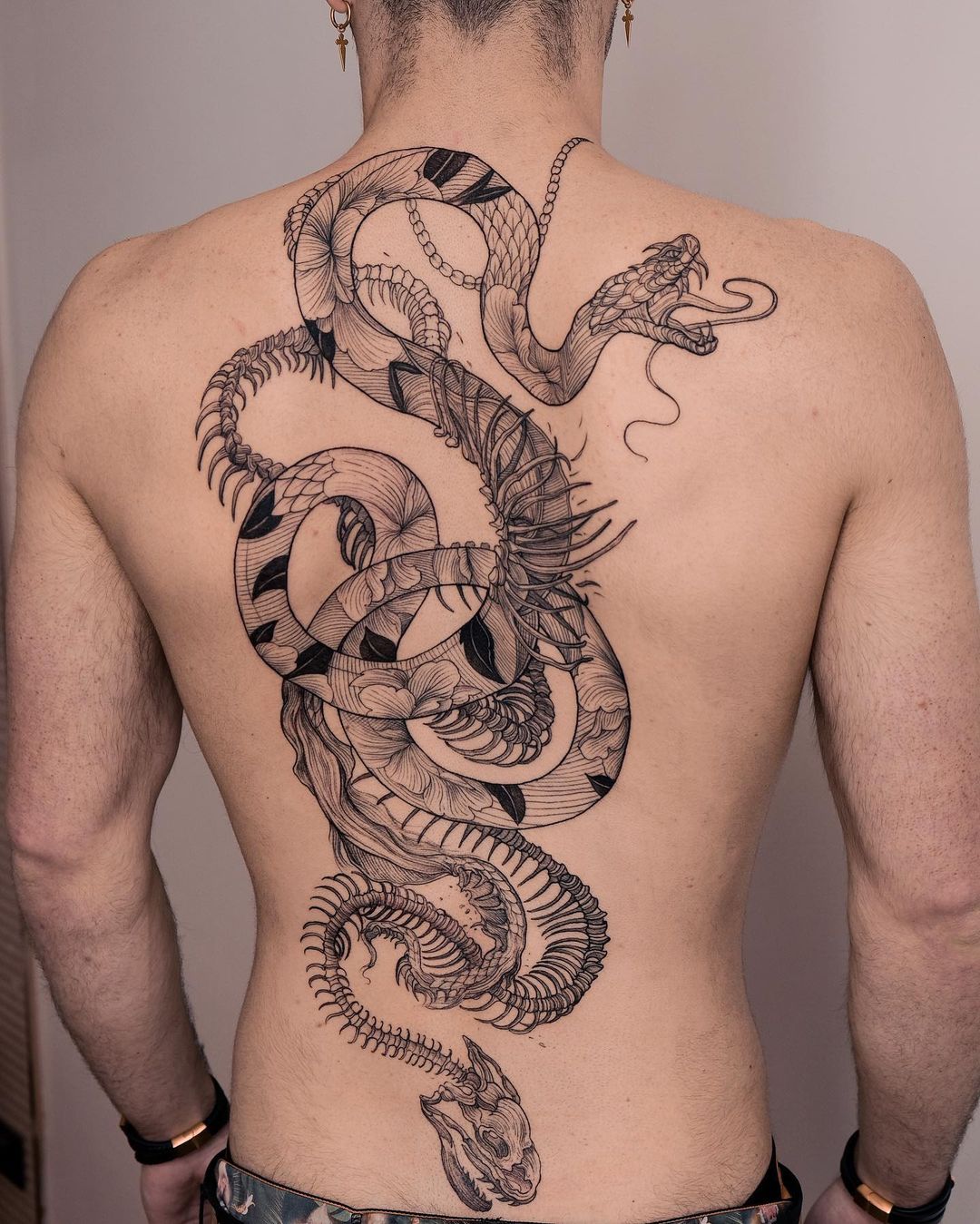
Skeletal snake tattoo covering the full back by @lescrowtattoo
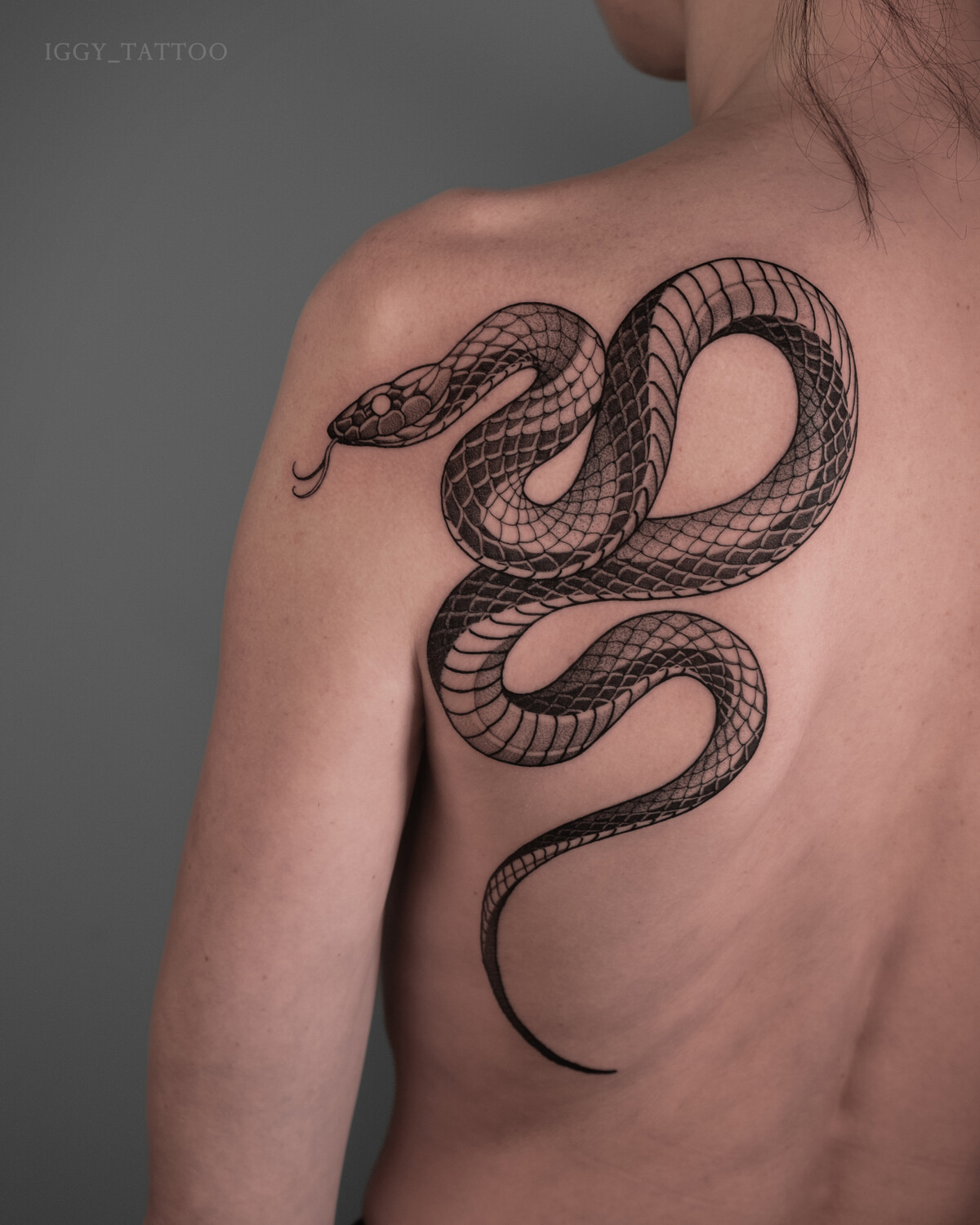
Blackwork snake coiled on the shoulder blade by @iggy_tattoo
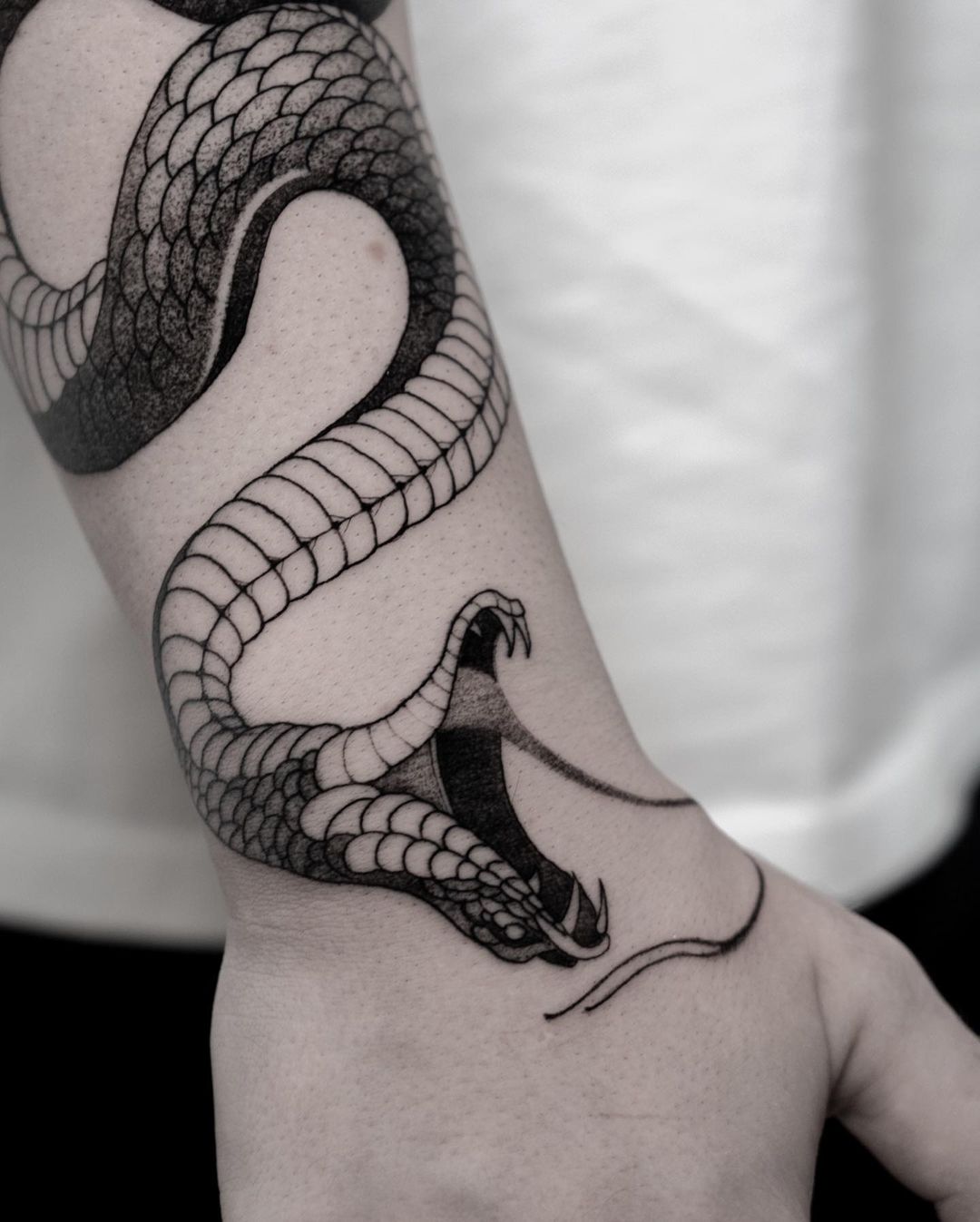
Blackwork open-mouth snake on the forearm by @niko_inky
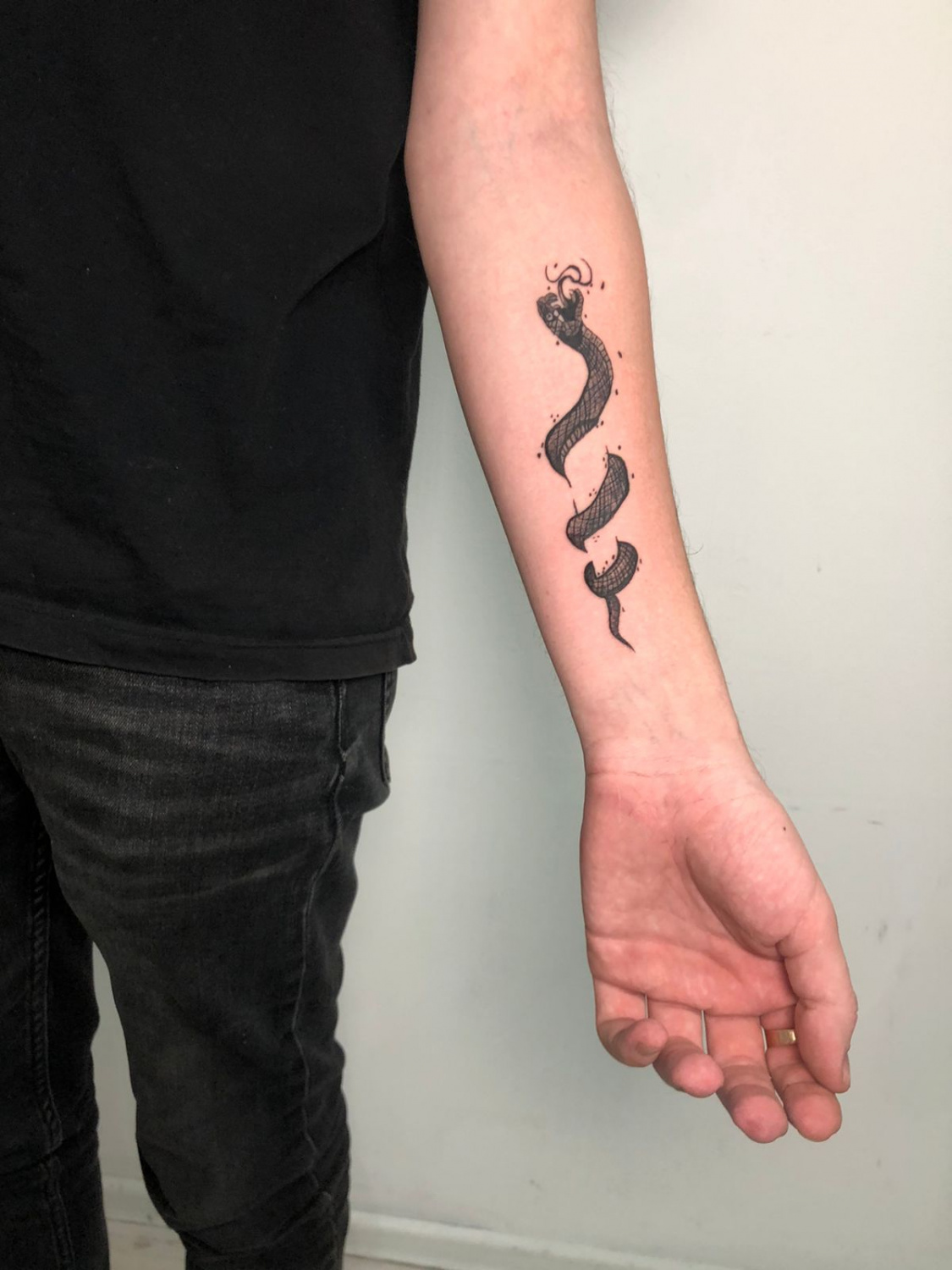
Sketchy blackwork snake down the forearm by @Svetvokne
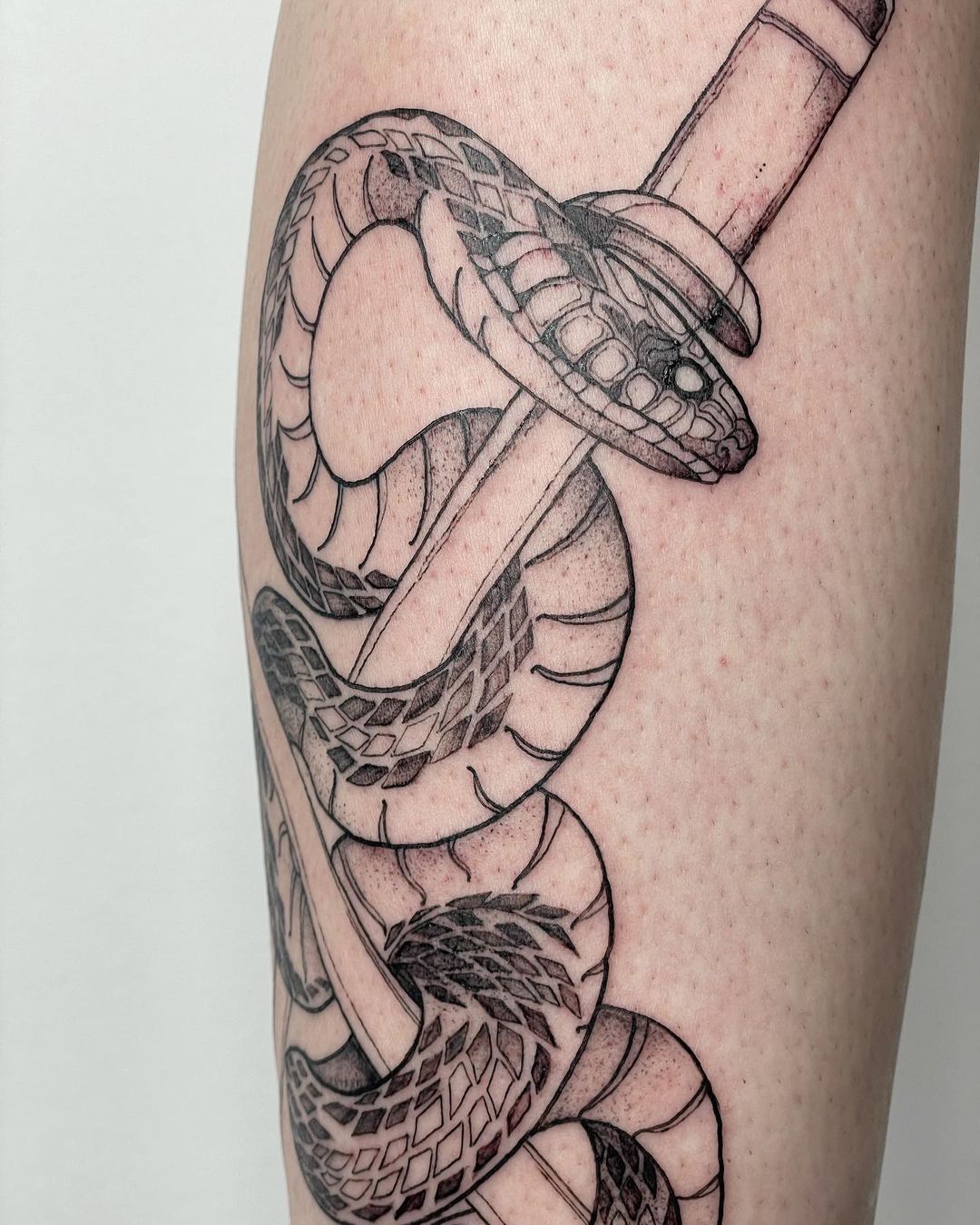
Blackwork snake and sword tattoo by @mlvtsktattoo
Few animals move between styles as easily as this one, because the body is a line and a line can be drawn any way at all.
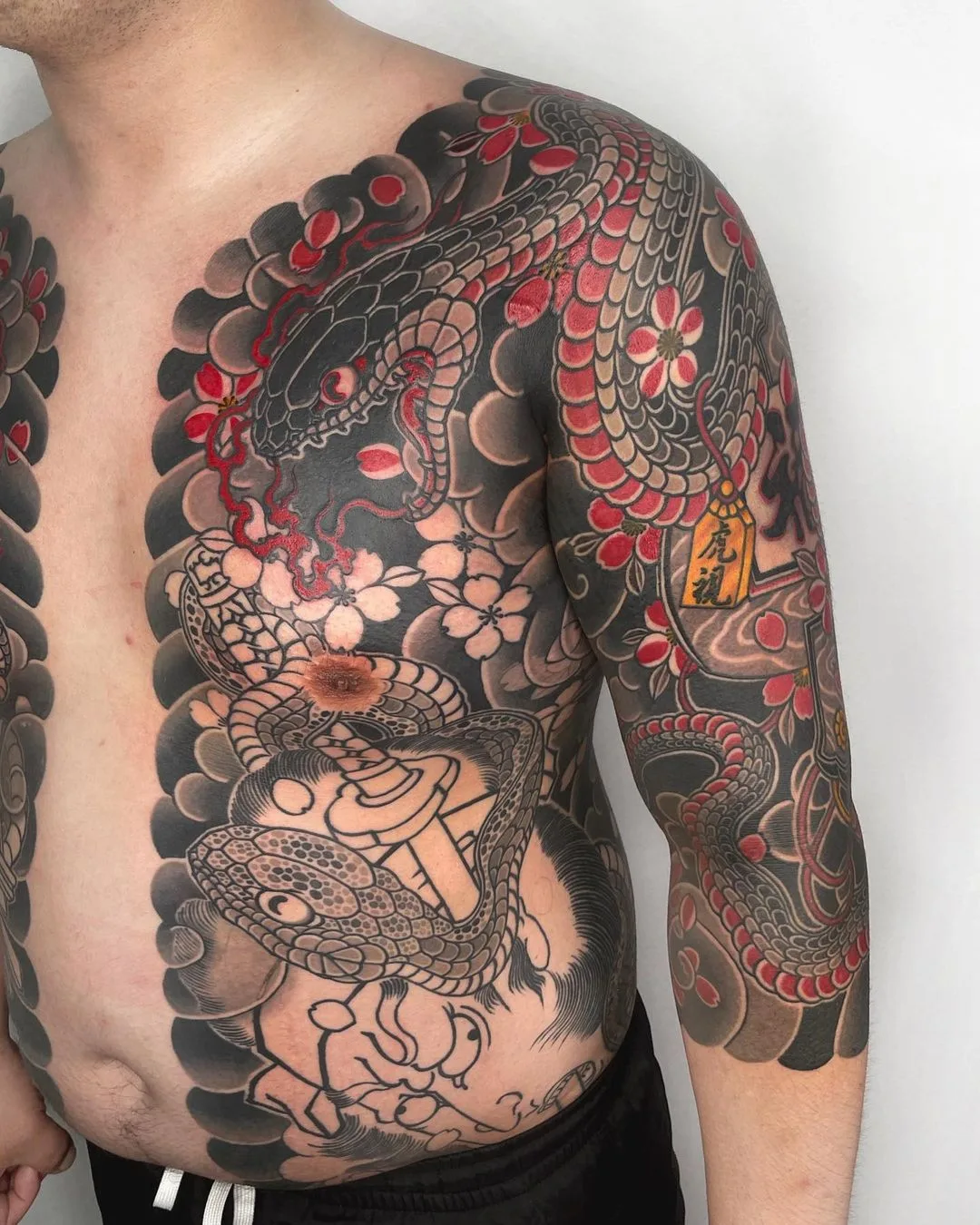
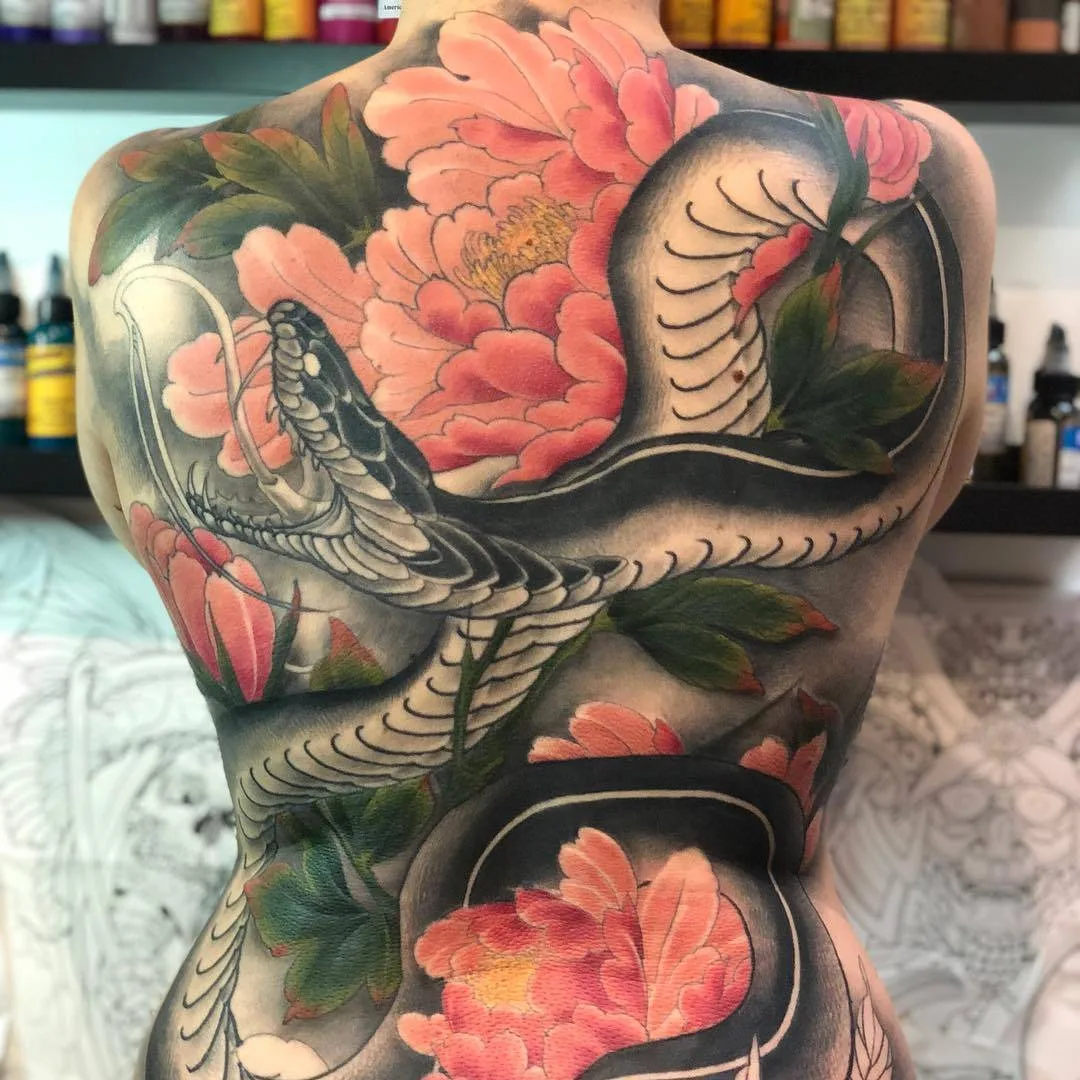
Japanese. The natural home of the protective hebi, and the style that treats the snake as part of a scene rather than an object. Irezumi snakes coil through water, wind bars and flowers, with scale patterns worked into the body's twist and colour set inside a strong outline. It holds large areas (half sleeves, thigh panels, backs) better than any other approach, and it ages well because the outline carries the image.
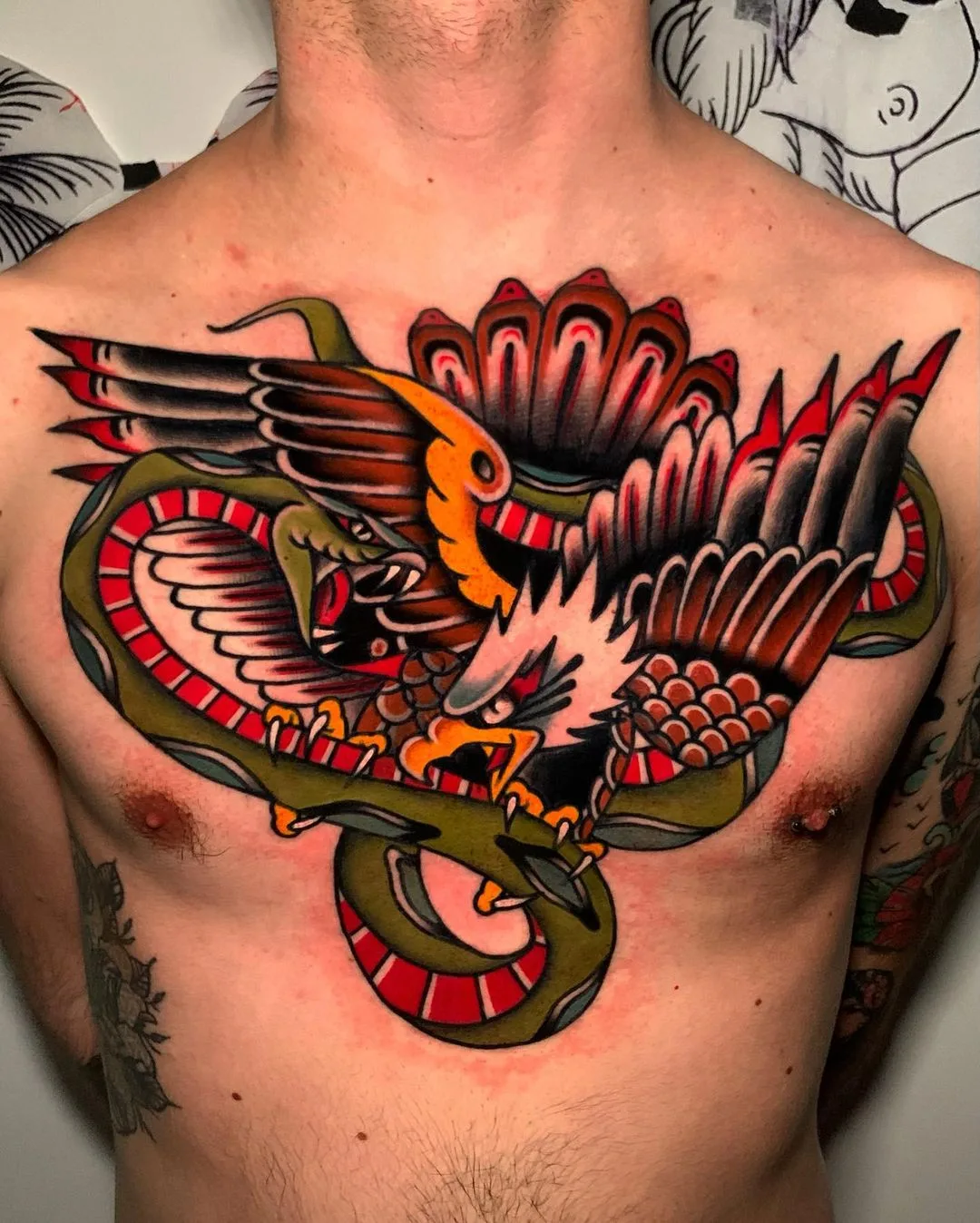
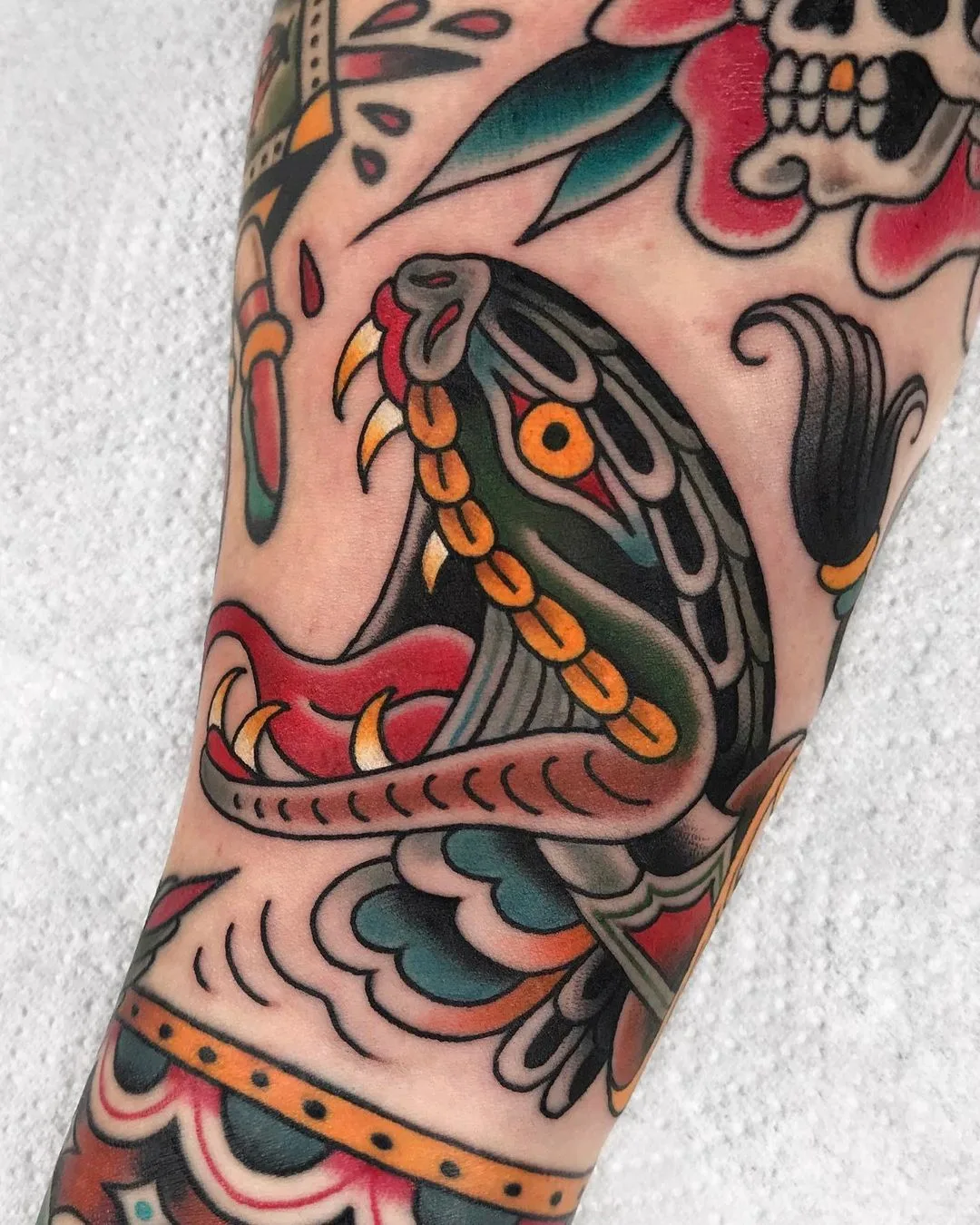
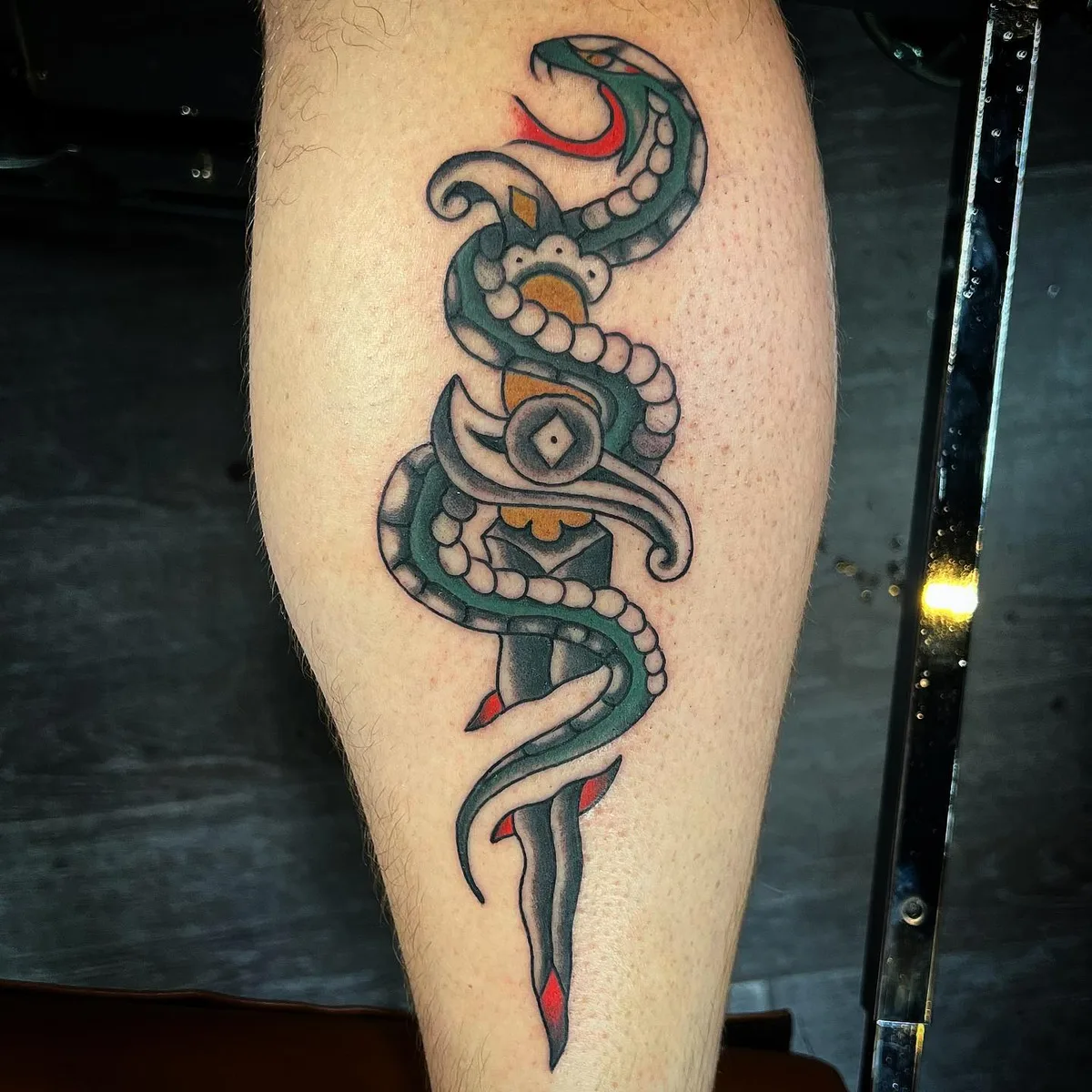
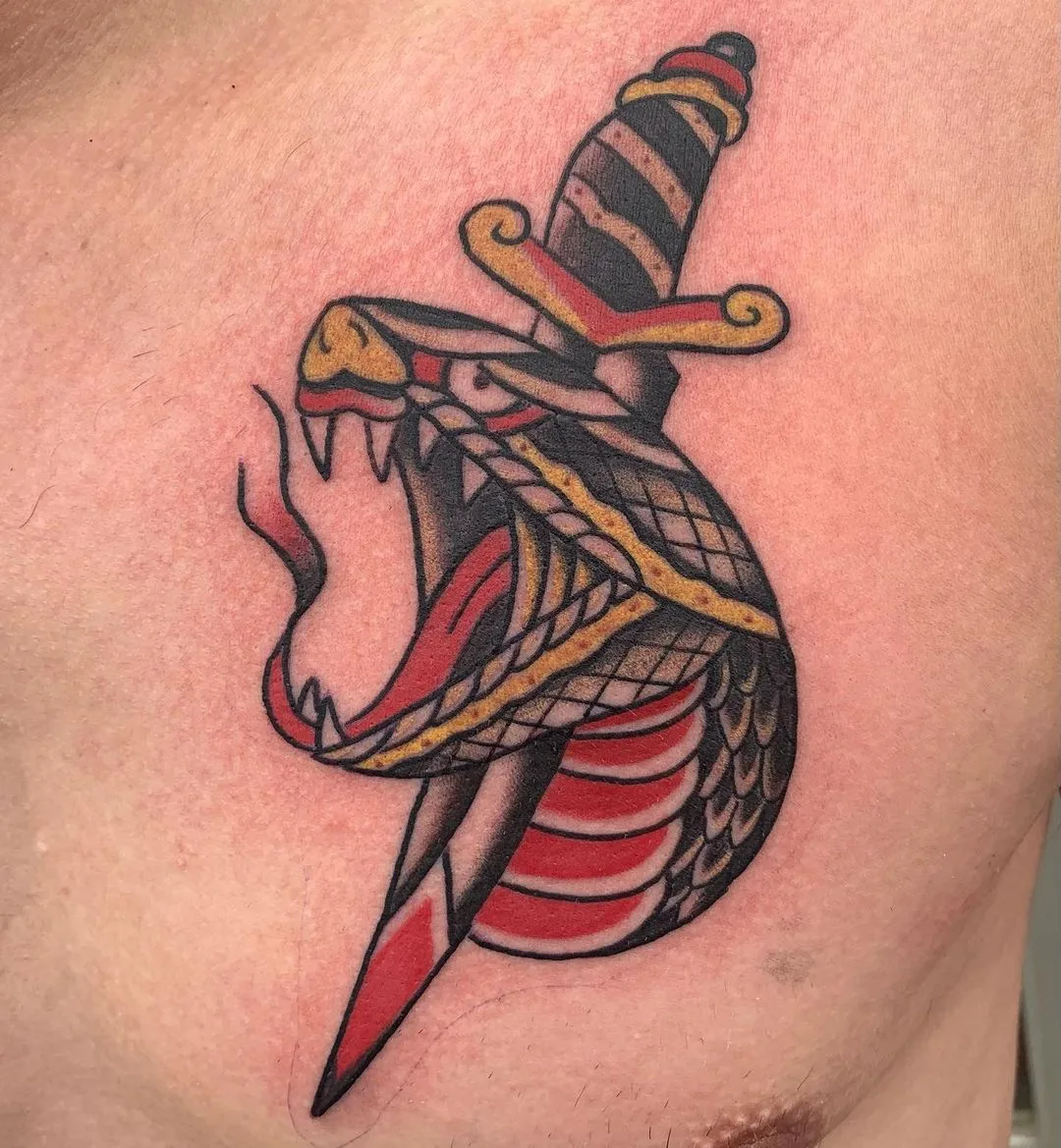
American traditional. The coiled snake of old flash: heavy black outline, a few flat colours, mouth open, tongue out. The snake-and-dagger and the cobra with a raised hood come from this tradition, and they are still among the cleanest designs on the list. Traditional snakes read from across a room and survive forty years without losing their shape.
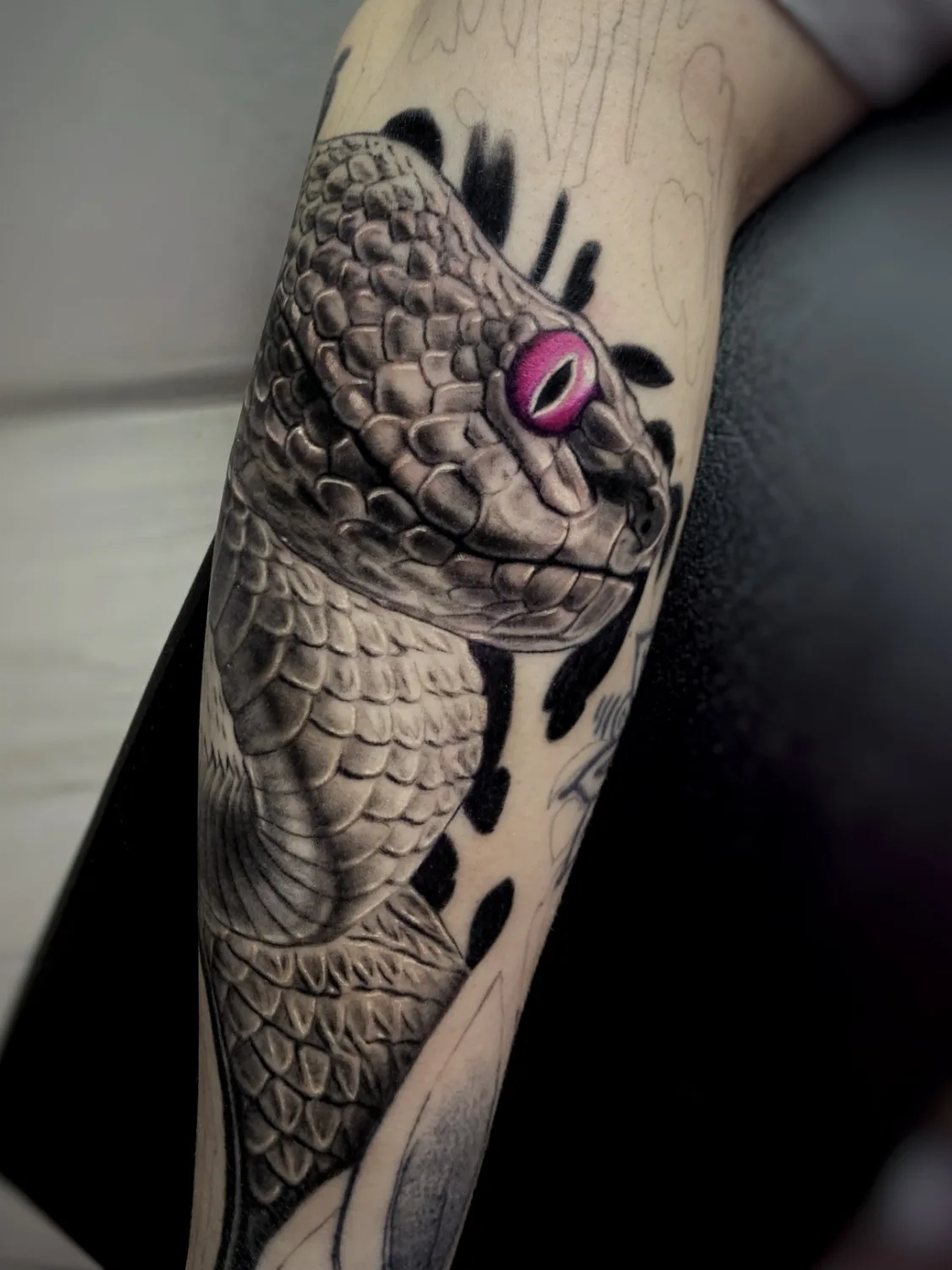
Realism. Photographic scale texture, the wet gloss of the body, a slit pupil that people look twice at. It strips the mythology out and presents the animal as it is, which some clients want. It is also the most demanding style for a snake, because scales foreshorten as the body turns and an artist who has not solved that produces a flat ribbon. Realism needs size and a plan for touch-ups.
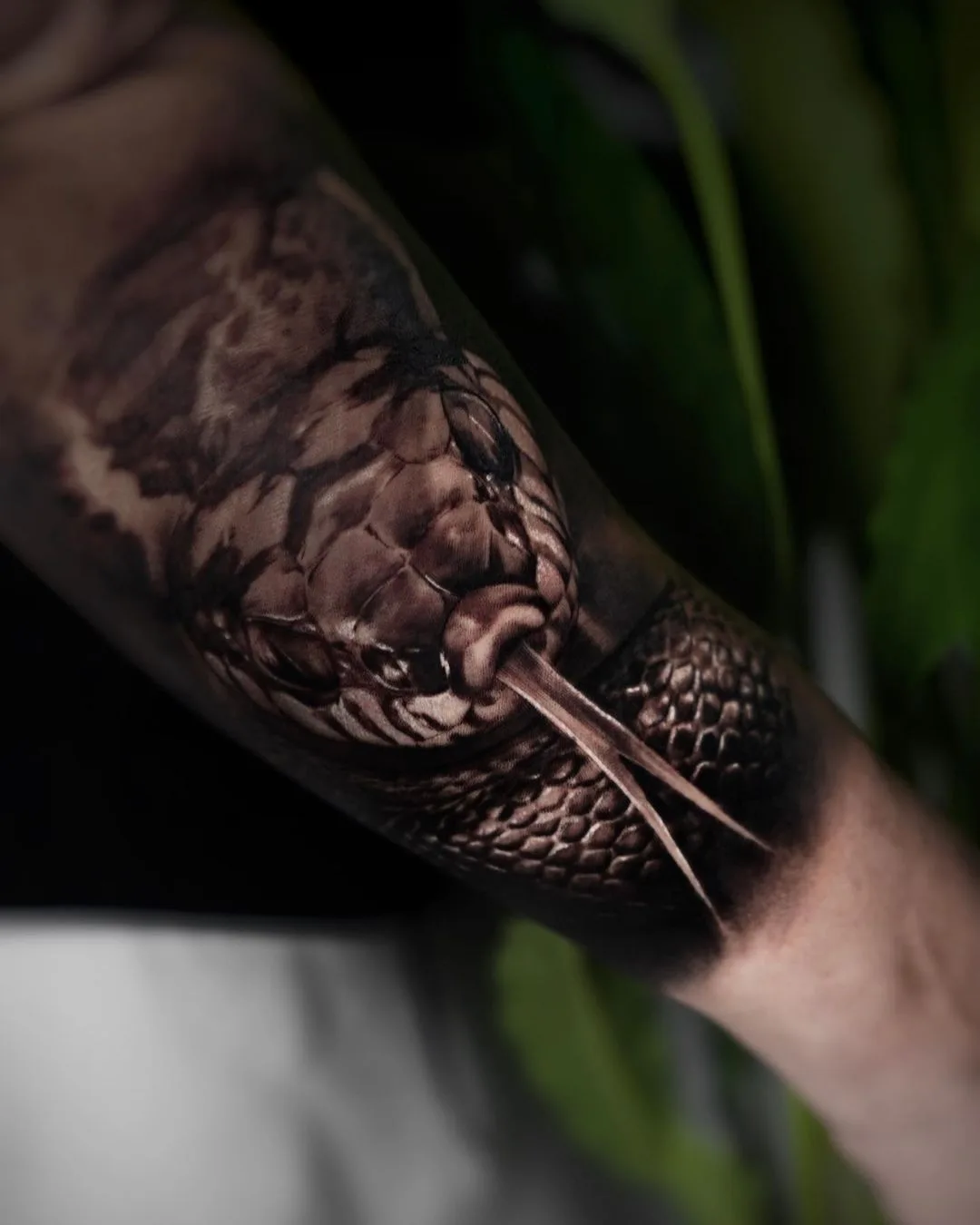
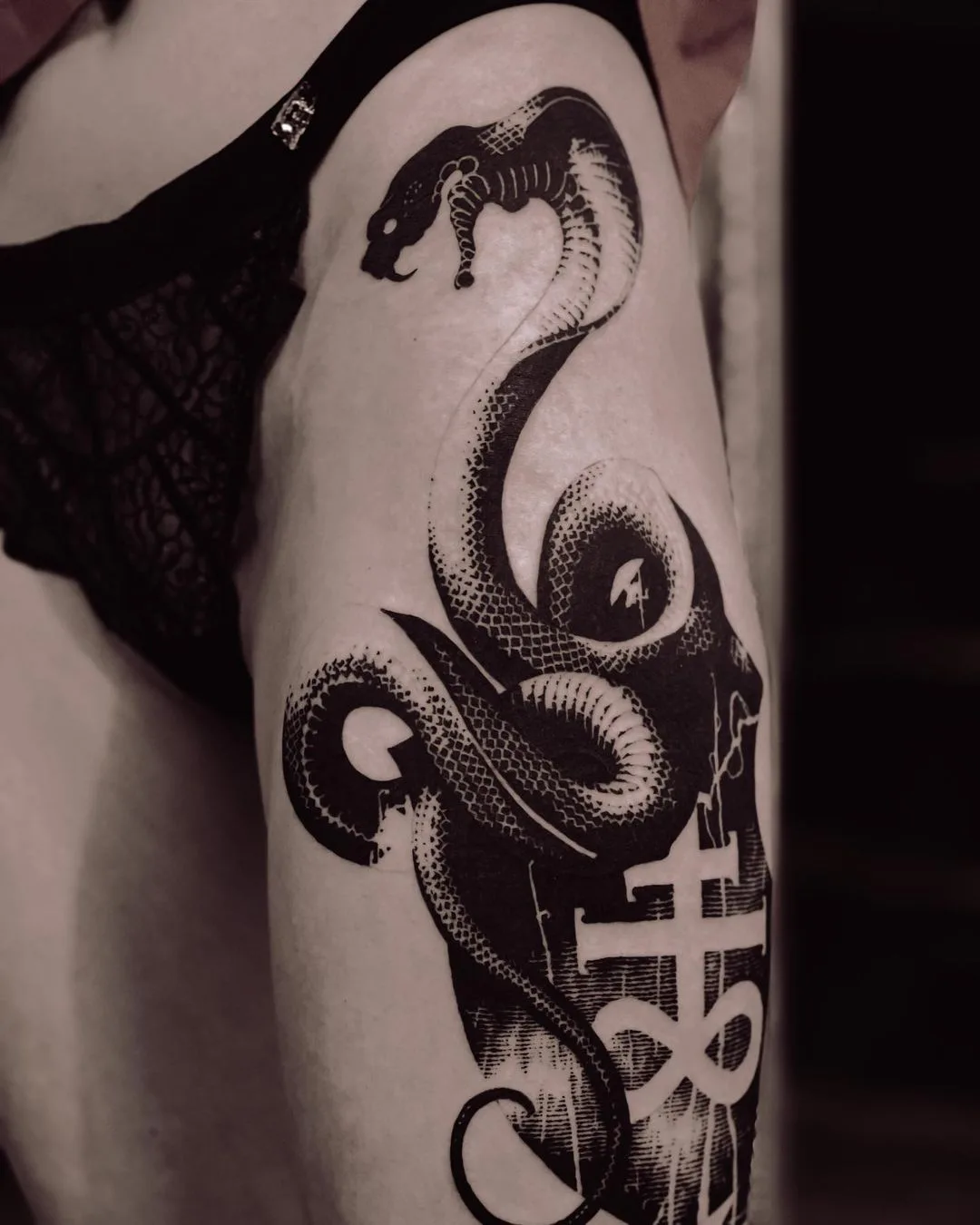
Blackwork. Solid black, high contrast, often ornamental. Blackwork snakes look heavier and more graphic, they work at almost any size, and they age better than anything but traditional. Many of the strongest recent snake pieces are blackwork built into floral or ornamental frames, where the body becomes the structural line.
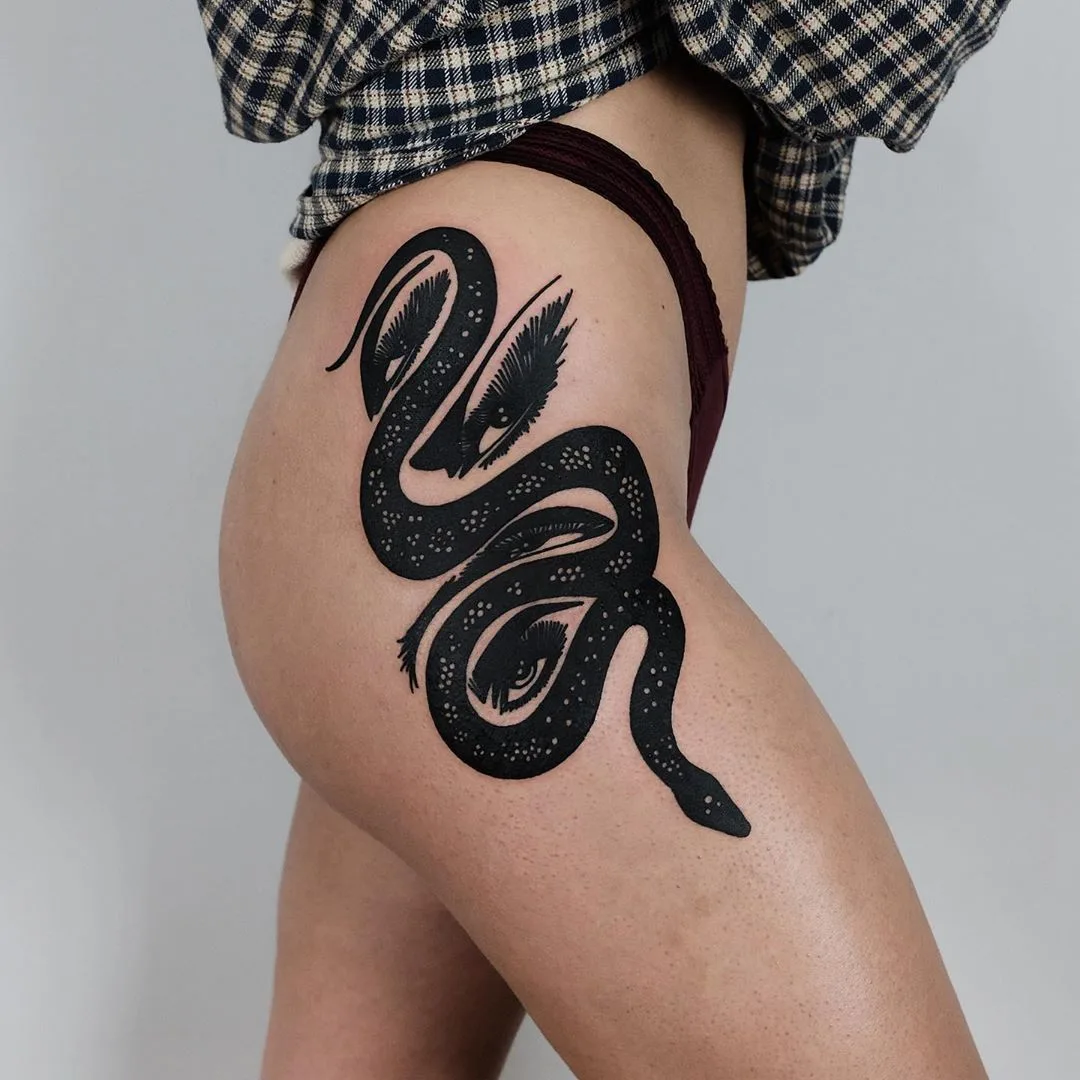
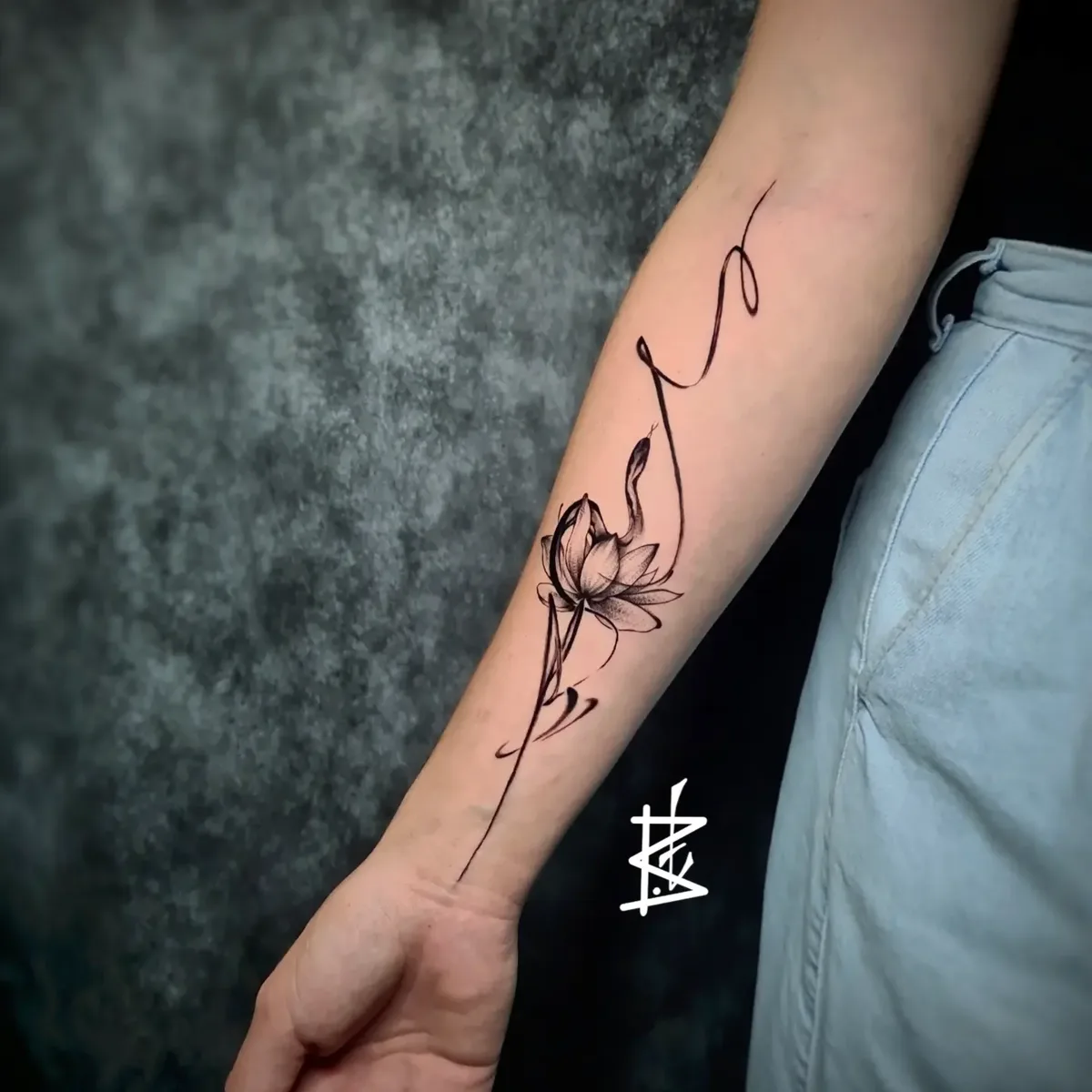
Fine line. Single-needle snakes threading between stars, flowers or lettering, usually on a forearm, ribs or hand. Subtle, quick to heal, easy to hide, and the least durable style here. Fine lines spread; a snake that looks crisp at twenty-five is soft at forty-five.
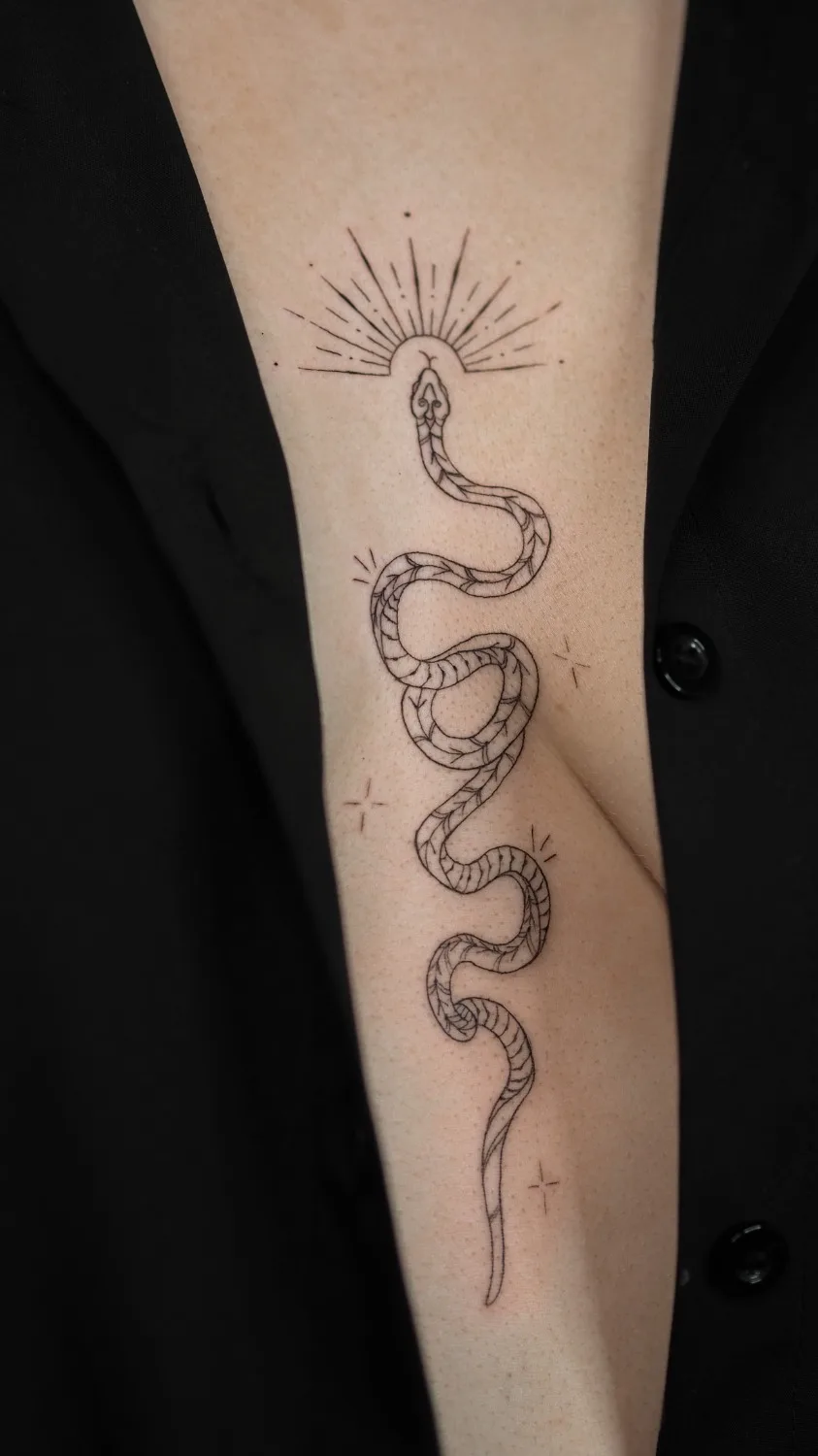
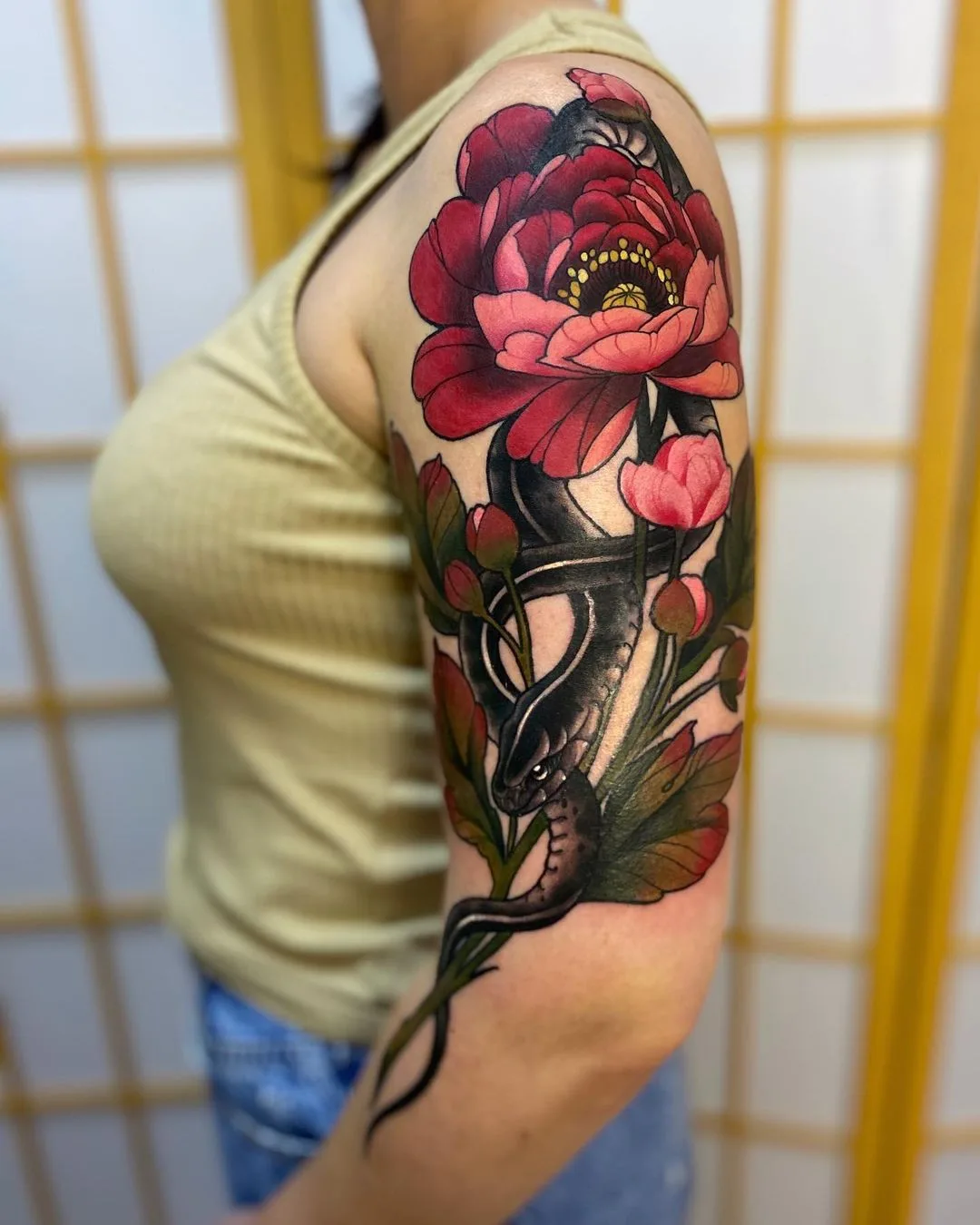
Neo-traditional and illustrative. The middle ground: traditional line discipline with more detail and a wider palette. Snakes paired with Medusa heads, roses, birds and skulls tend to be done this way. To see how the same animal changes across these approaches, and how differently a coil sits on a back, a thigh and a hand, the snake motif page gathers the work by style and placement.
Placement and scale
The snake has no fixed shape. A wolf has to face somewhere; a snake can follow a bone, wrap a limb or fold into a circle, and placement decides what the design looks like more than it does for any other subject.
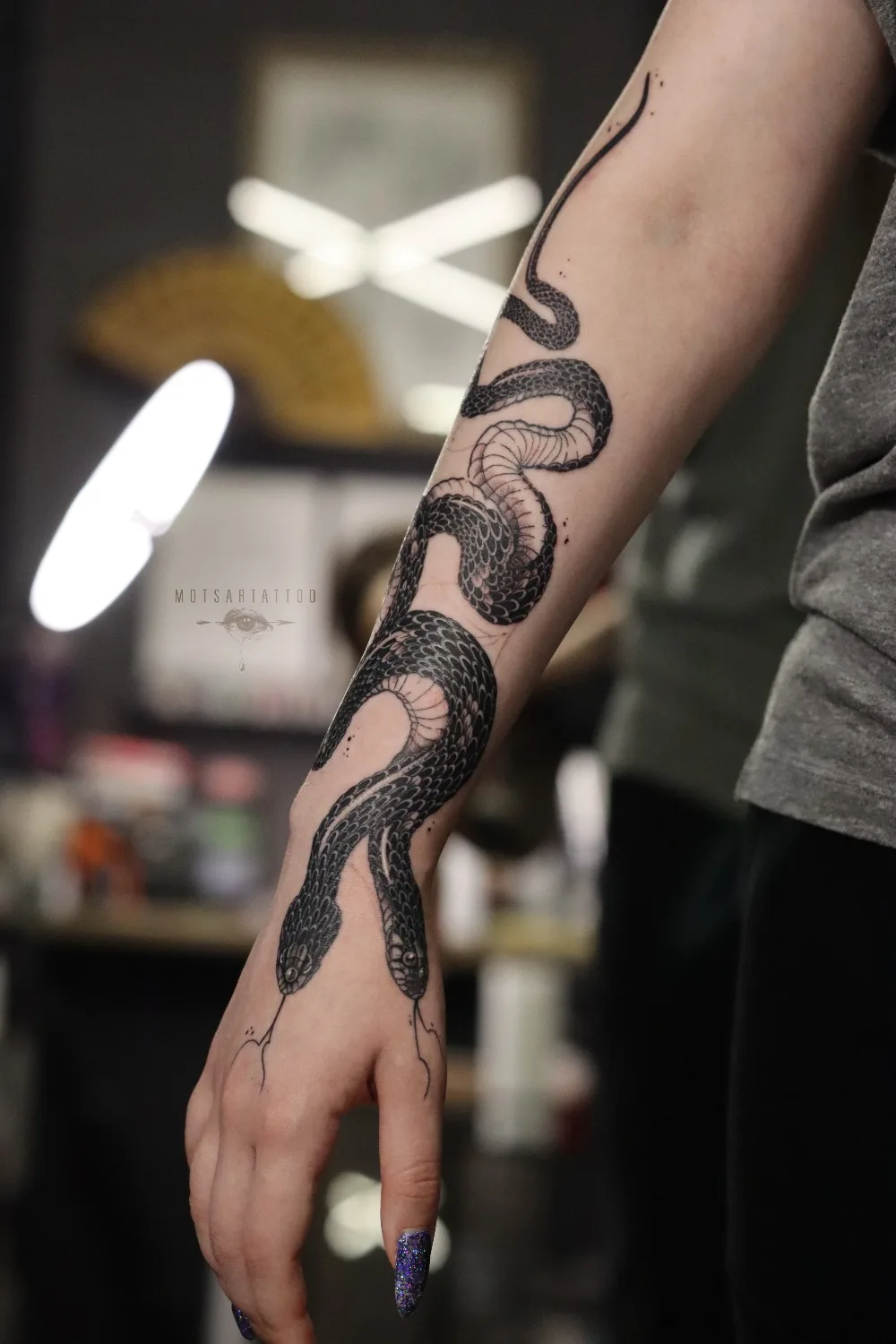
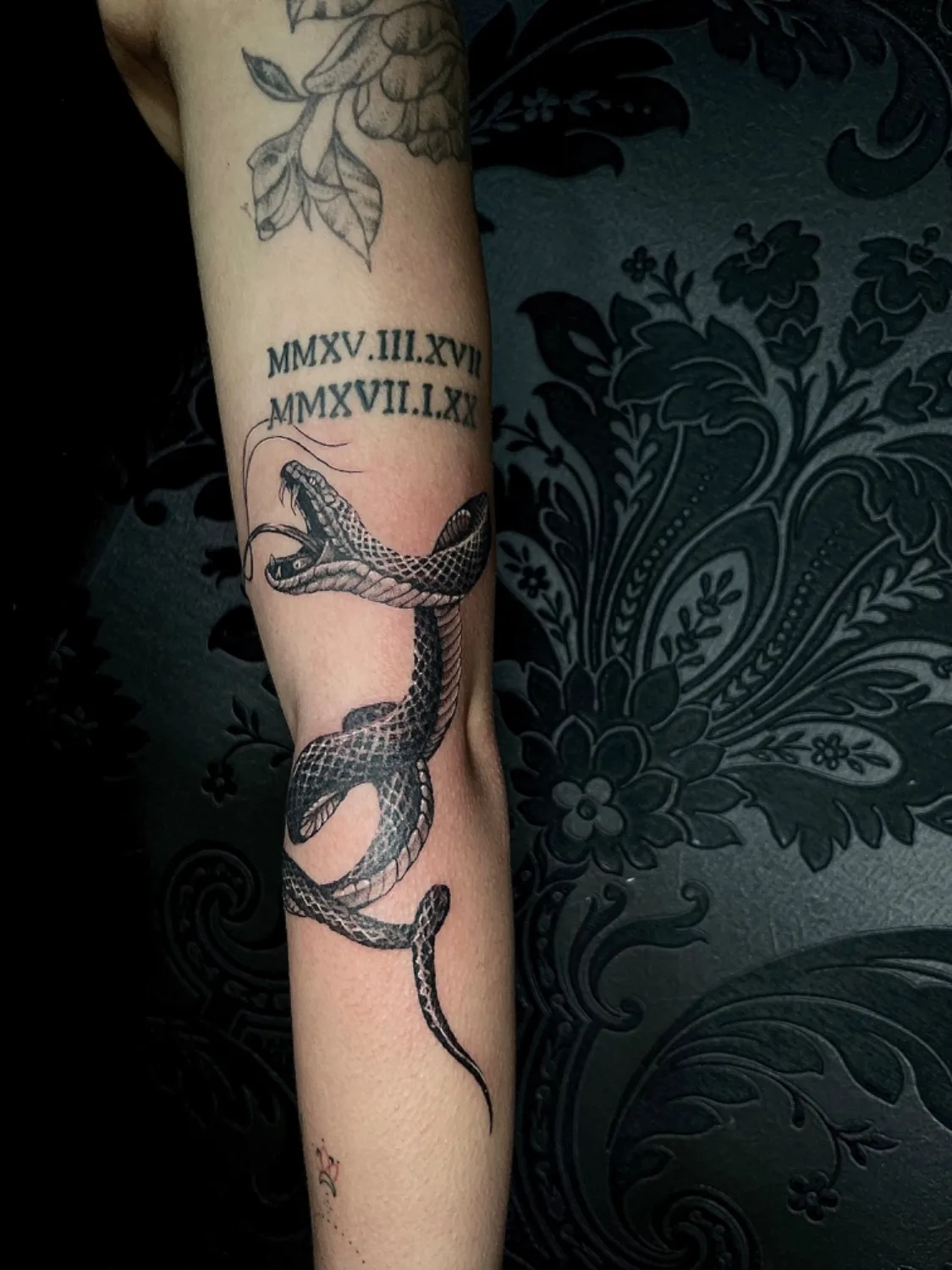
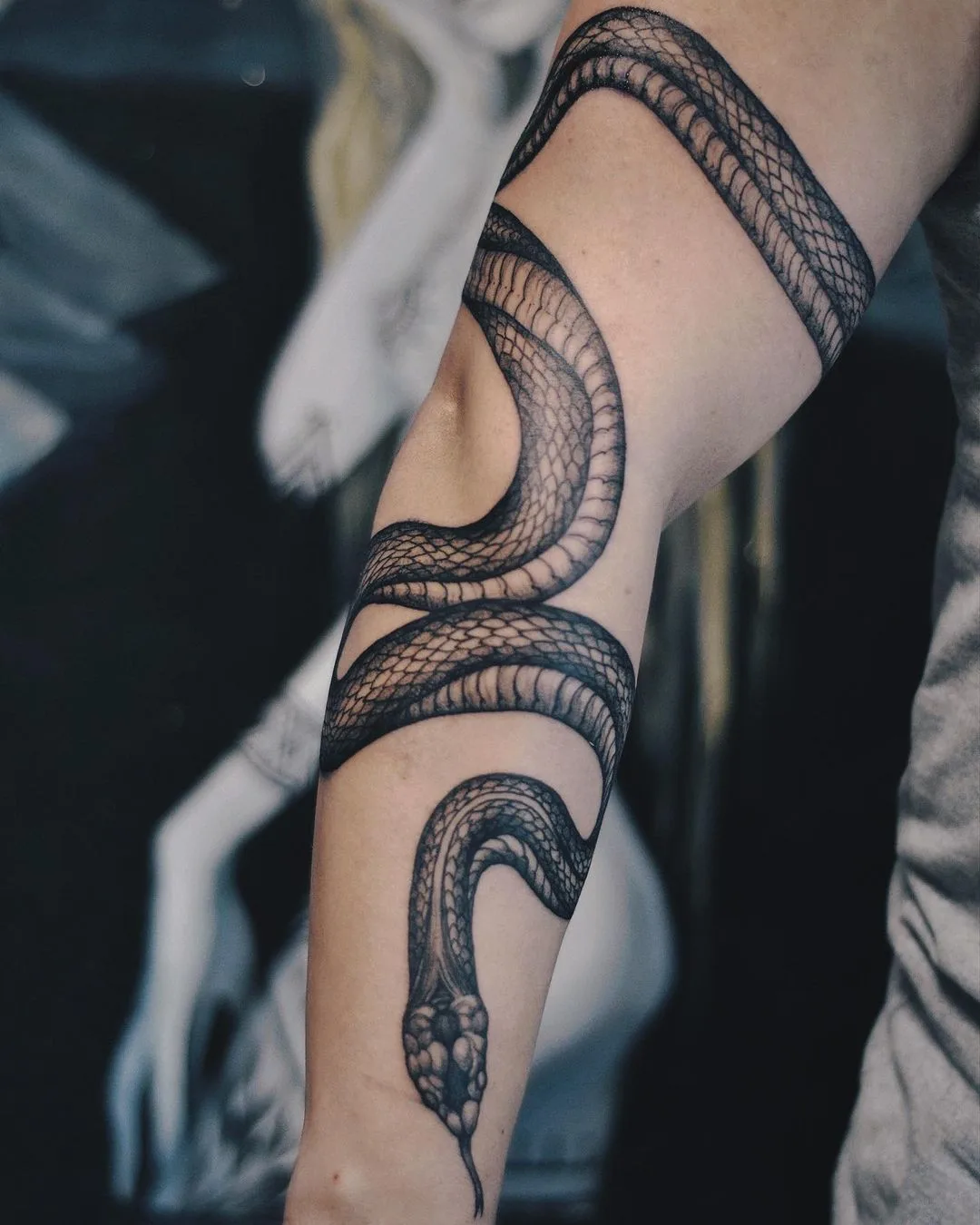
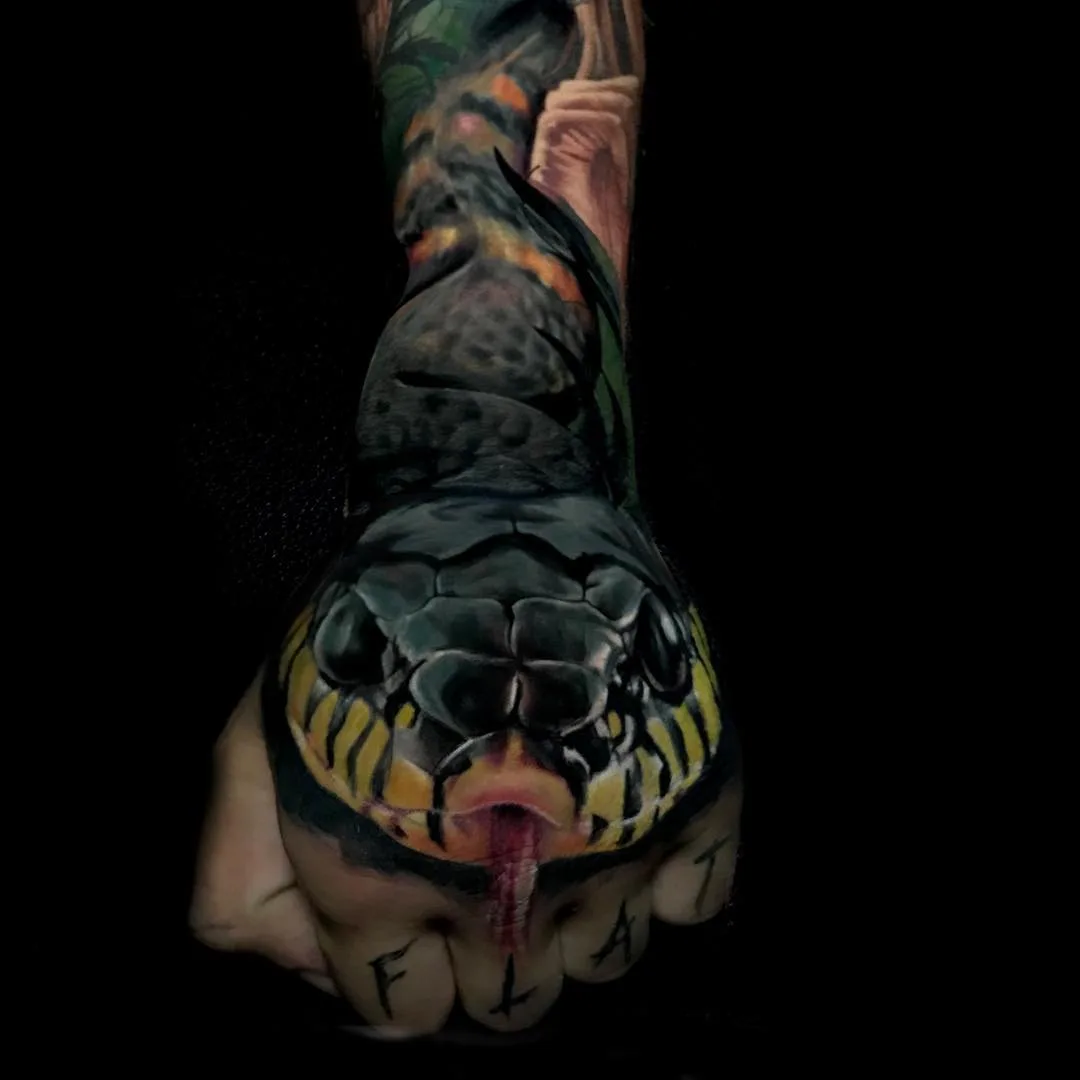
The wrap is the classic. A snake coiling around a forearm or a calf uses the body as a cylinder: the animal disappears round the back and reappears, and the eye follows it. It is also the hardest to draw well, because the coil has to keep its width as it goes round and the line has to meet itself on the other side. Ask to see healed wraps in a portfolio, and keep the coil clear of the elbow and knee creases, where it blurs first.
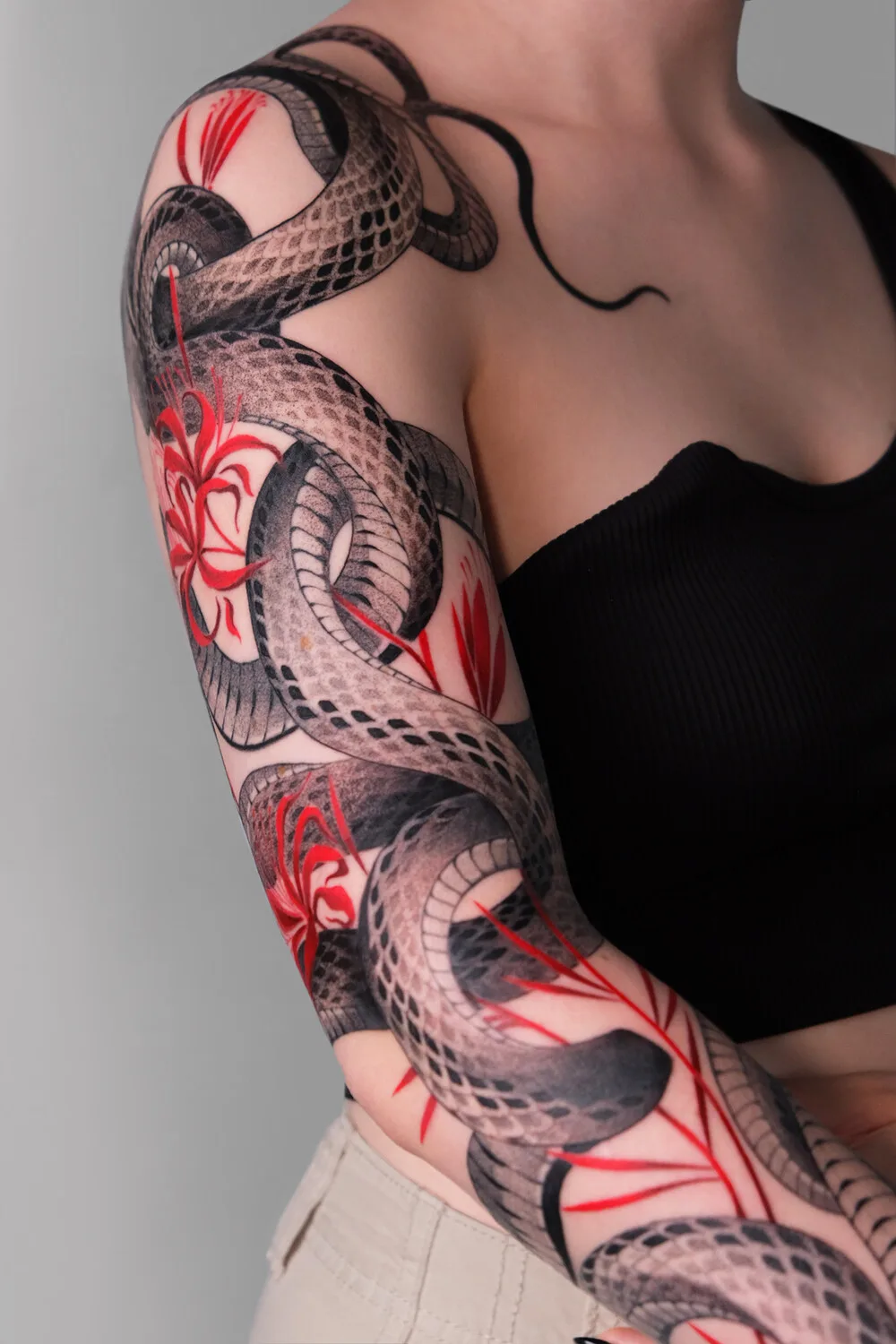
The spine gives the snake its longest straight run and is the required placement for a kundalini piece. Ribs and side suit an S-shaped snake in motion, tail at the hip and head under the arm, following the body's own curve. The thigh suits large snakes: broad surface, moderate pain, control over who sees it, and room to add flowers or a skull later.
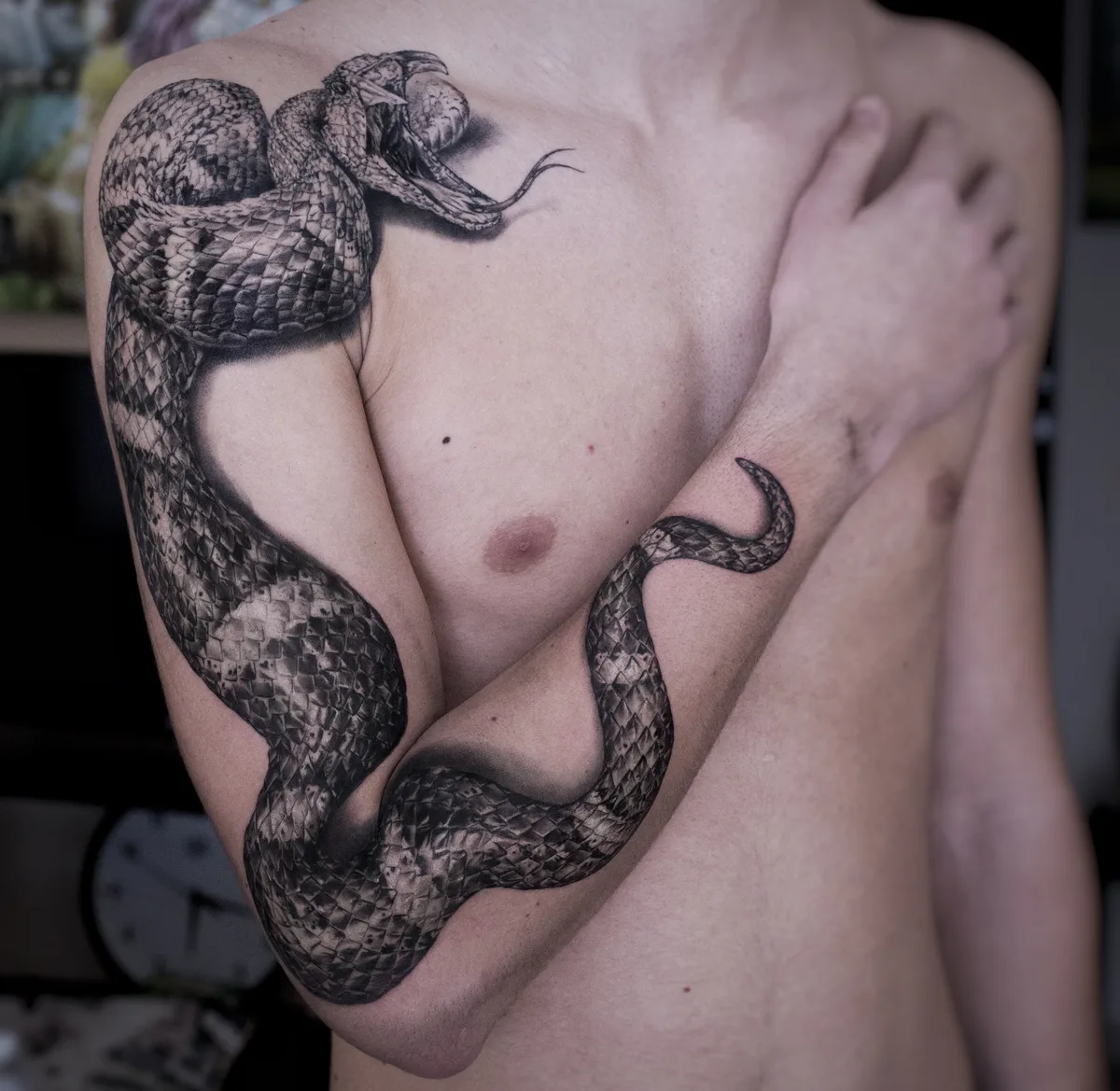
Hands, fingers and the side of the neck take small fine-line snakes and show them constantly. They also fade fastest, because the skin there turns over quickly, and a finger snake will need reworking within a few years.
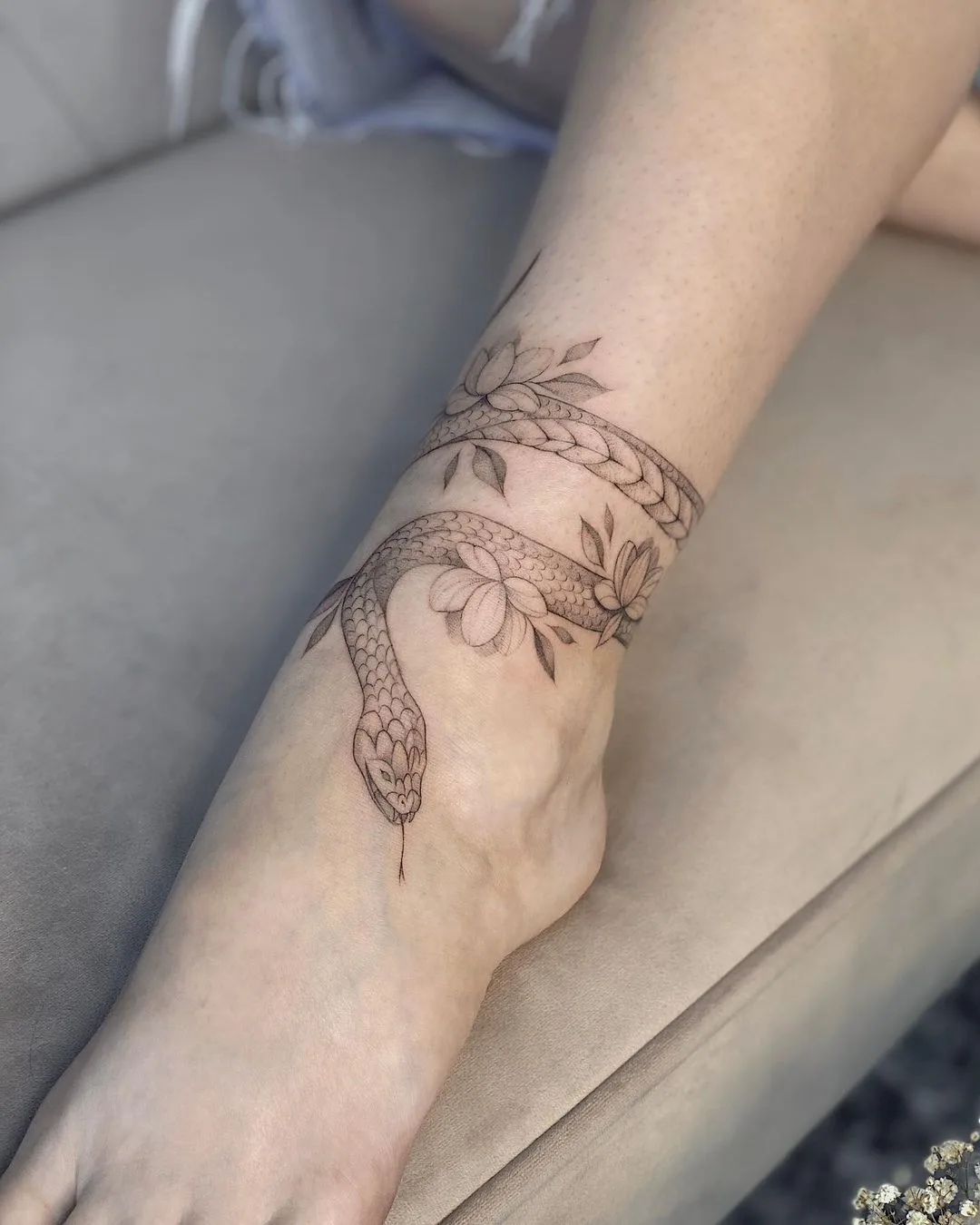
Scale is the decision people skip. A snake's identity is in its scales and its head, and both need room. Below roughly six centimetres of body width the scales cannot be drawn individually and will close into a dark band as the piece heals; at that size the honest options are a silhouette, a traditional outline or a fine line with no scale texture. A cobra's hood, a rattle, an open mouth with fangs: each needs its own space. The head is the focal point wherever it sits, so decide where the head goes first and let the body find its own route.
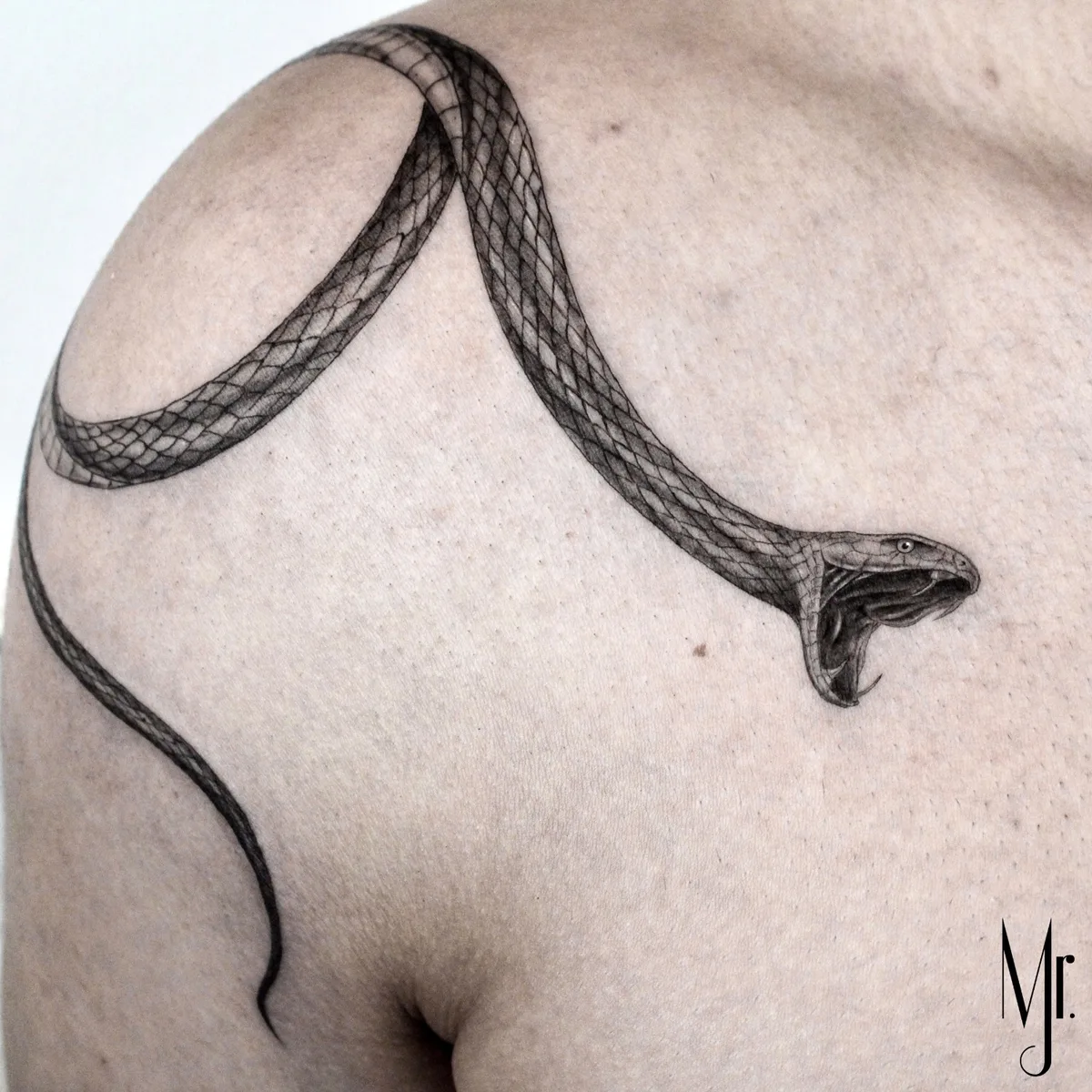
Design variations and what they change
Inside a snake design, small decisions move the meaning further than switching style does.
Pose. A coiled snake is potential: patience, readiness, a threat held back. A striking snake with the mouth open is the threat delivered, and it is harder to live with on a forearm you see all day. A snake in an open S, moving without aggression, reads as grace and adaptation, and it is the pose that suits the renewal meaning best.
Species. A cobra with its hood spread points to Egypt (the uraeus on the pharaoh's forehead, the goddess Wadjet) or to the Indian naga, and it means sovereign protection. A rattlesnake is American and carries the Gadsden flag's "Don't tread on me", with the political freight that phrase has picked up; know that before you choose it. A white snake is Japanese luck. A python or boa, thick and unhurried, is strength without venom. Pupils matter to a realist: vipers and rattlesnakes have vertical slits, cobras and most harmless snakes have round pupils.
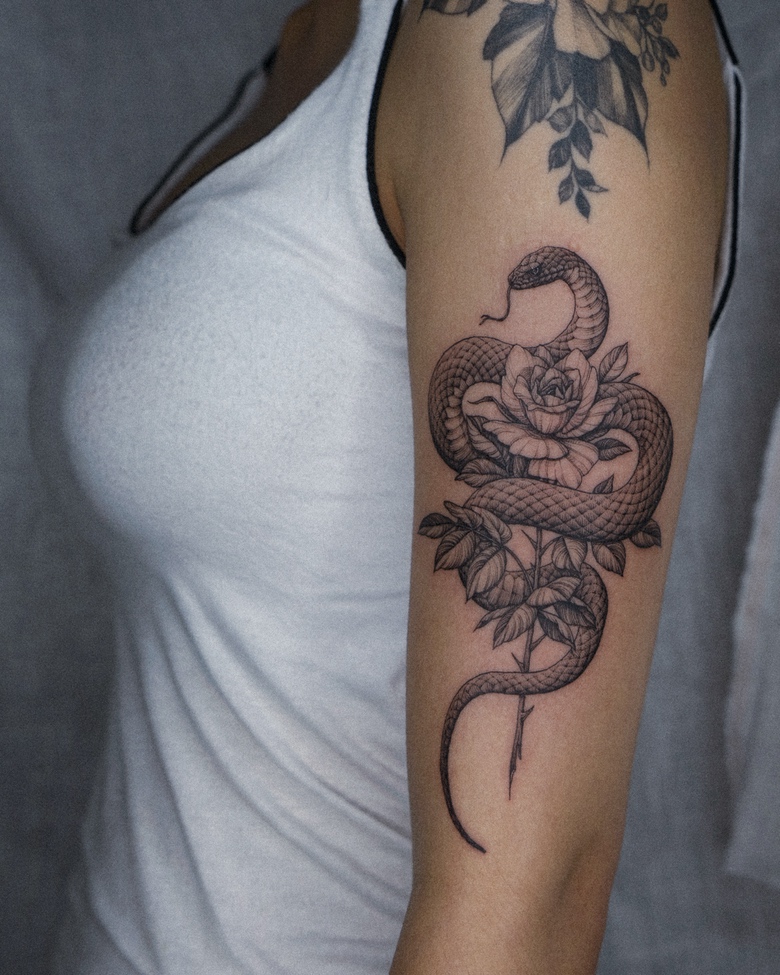
Blackwork snake and rose tattoo with botanicals by @tattooer_intat
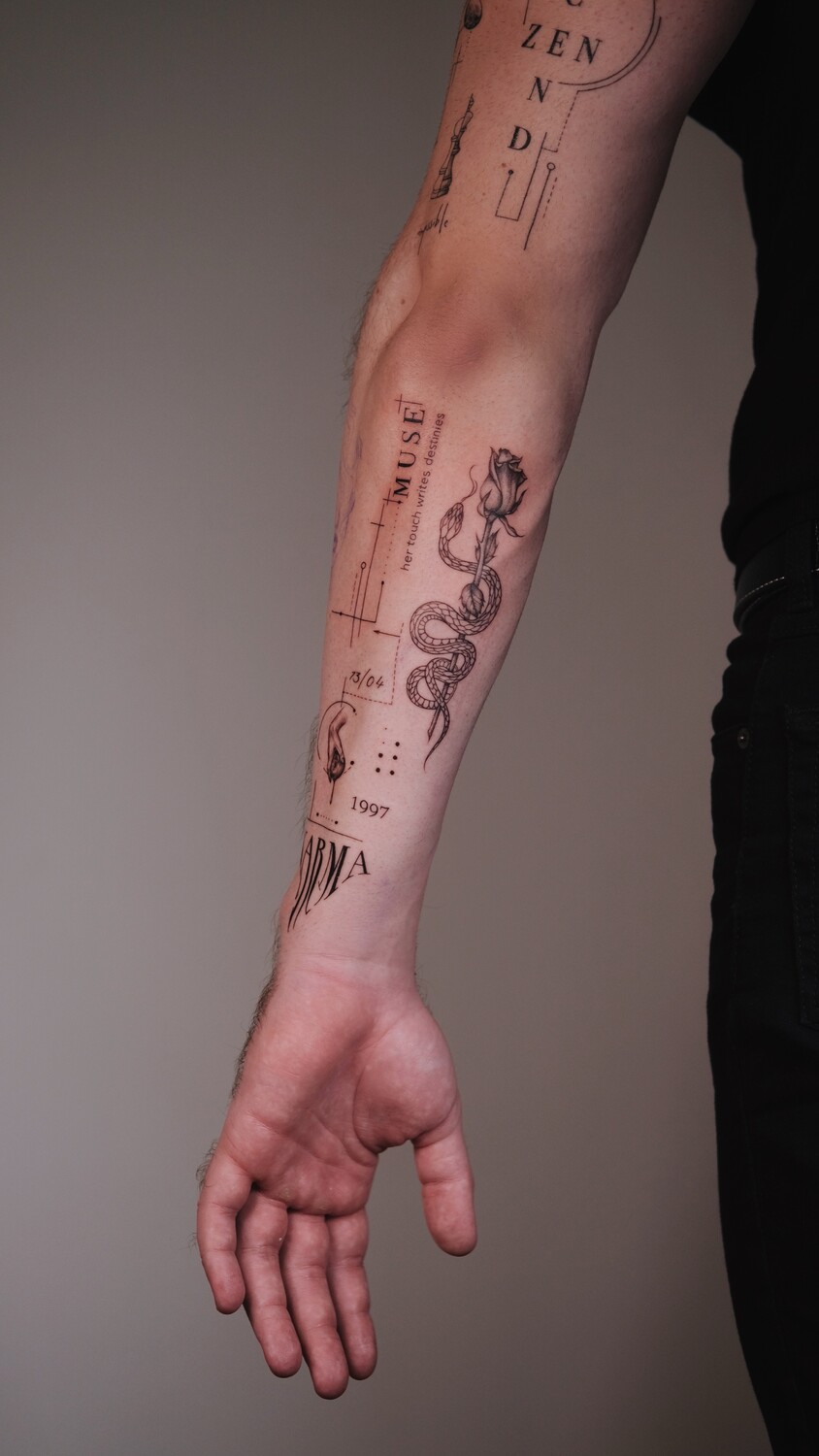
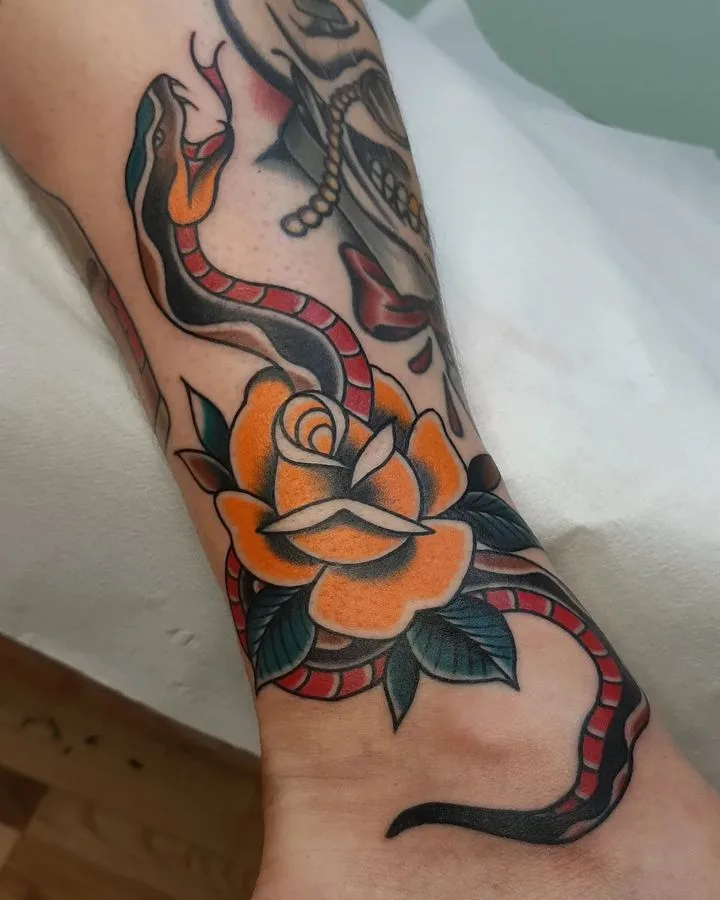
Snake coiled on a rose with text elements by @ira_shmarinova
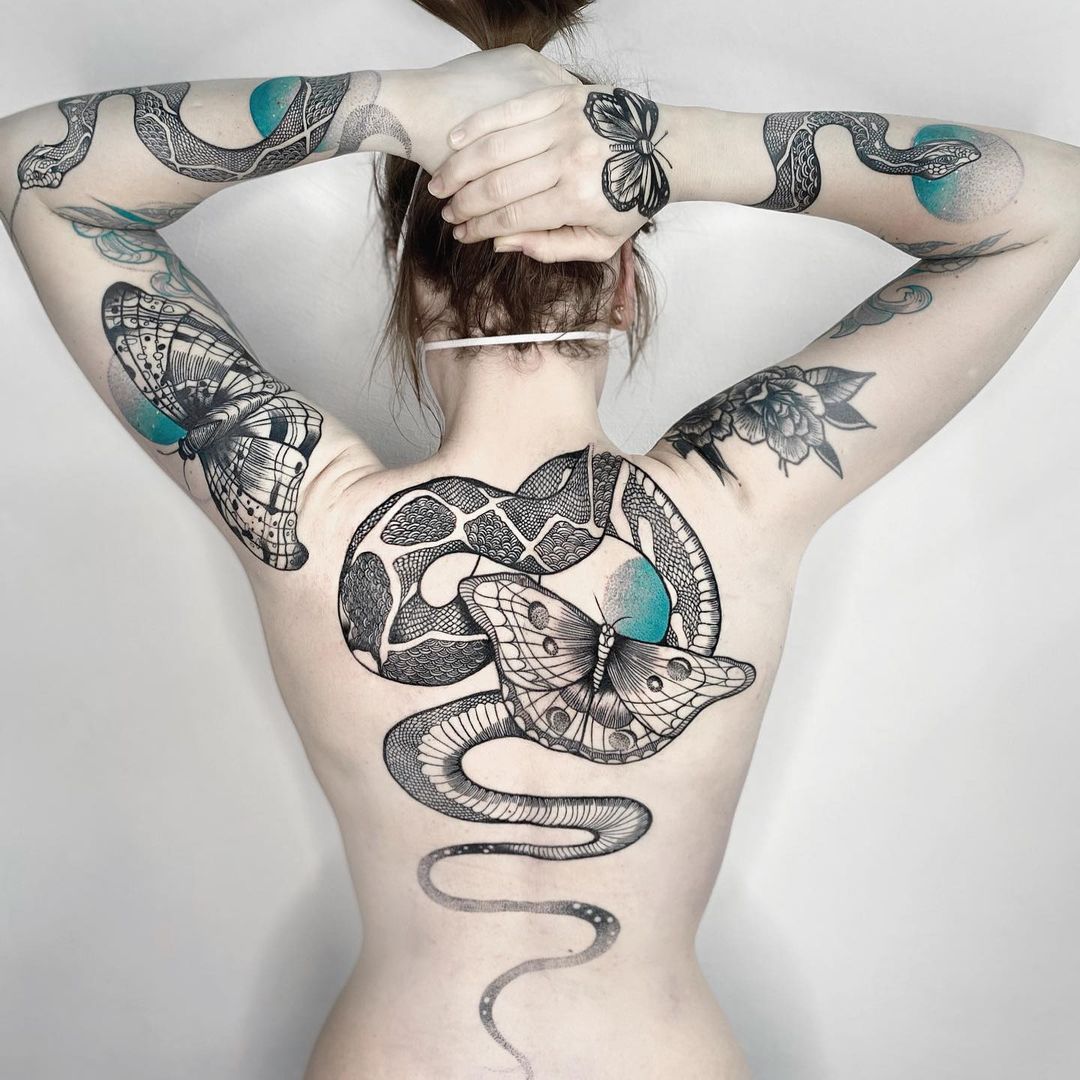
Blackwork snake with butterfly and florals by @jessicasvartvit
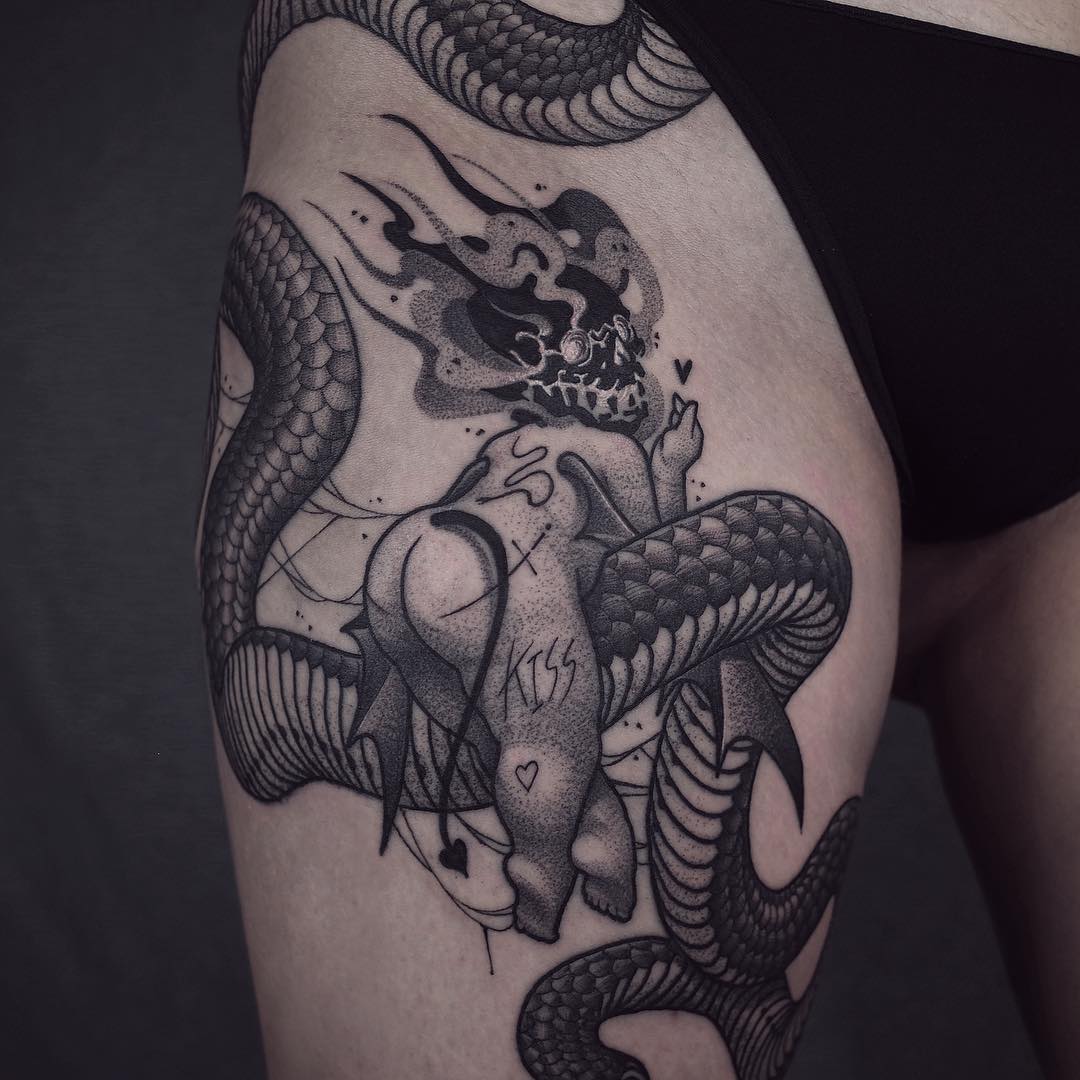
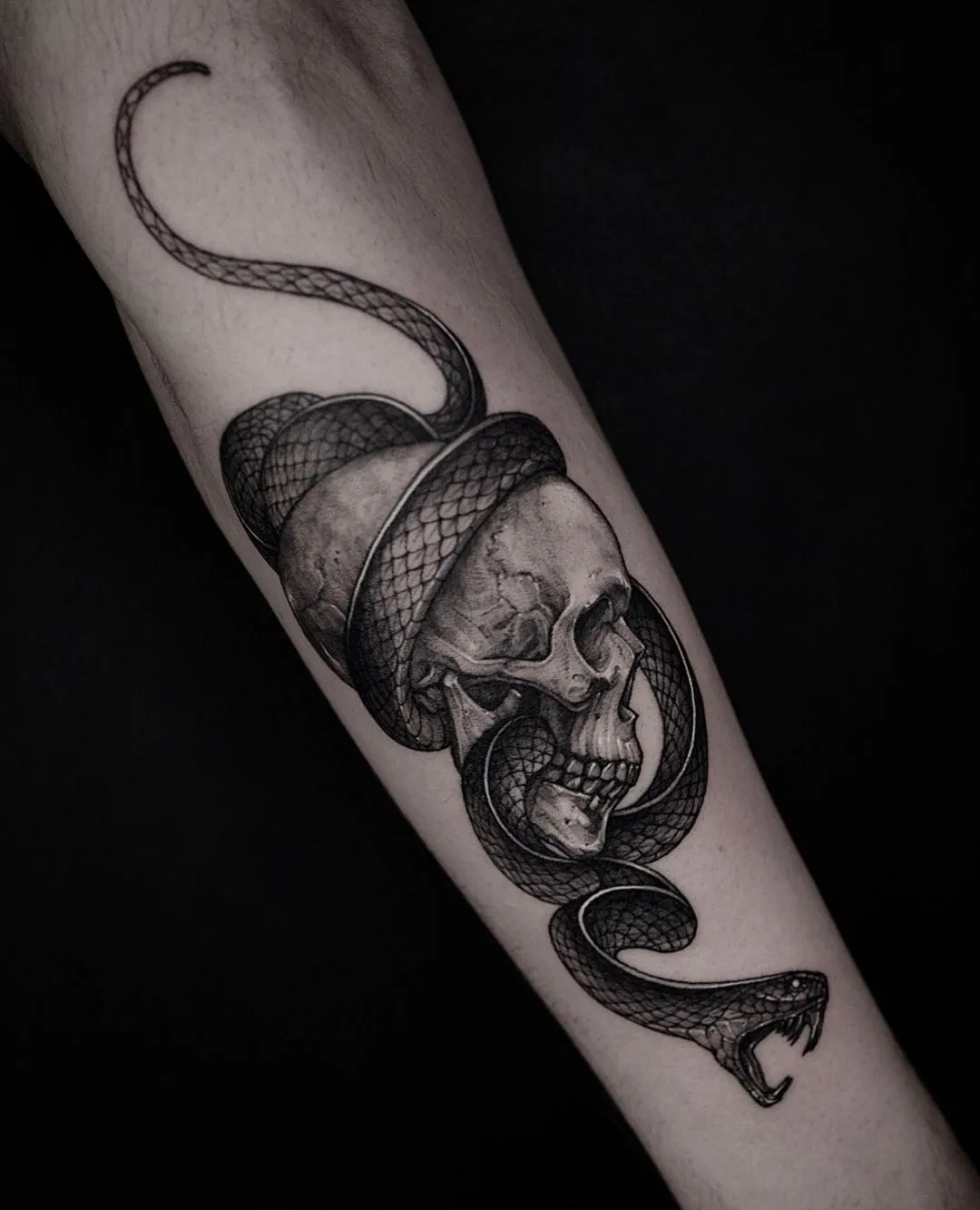
Snake around a skull figure — dark illustrative by @bb_rung
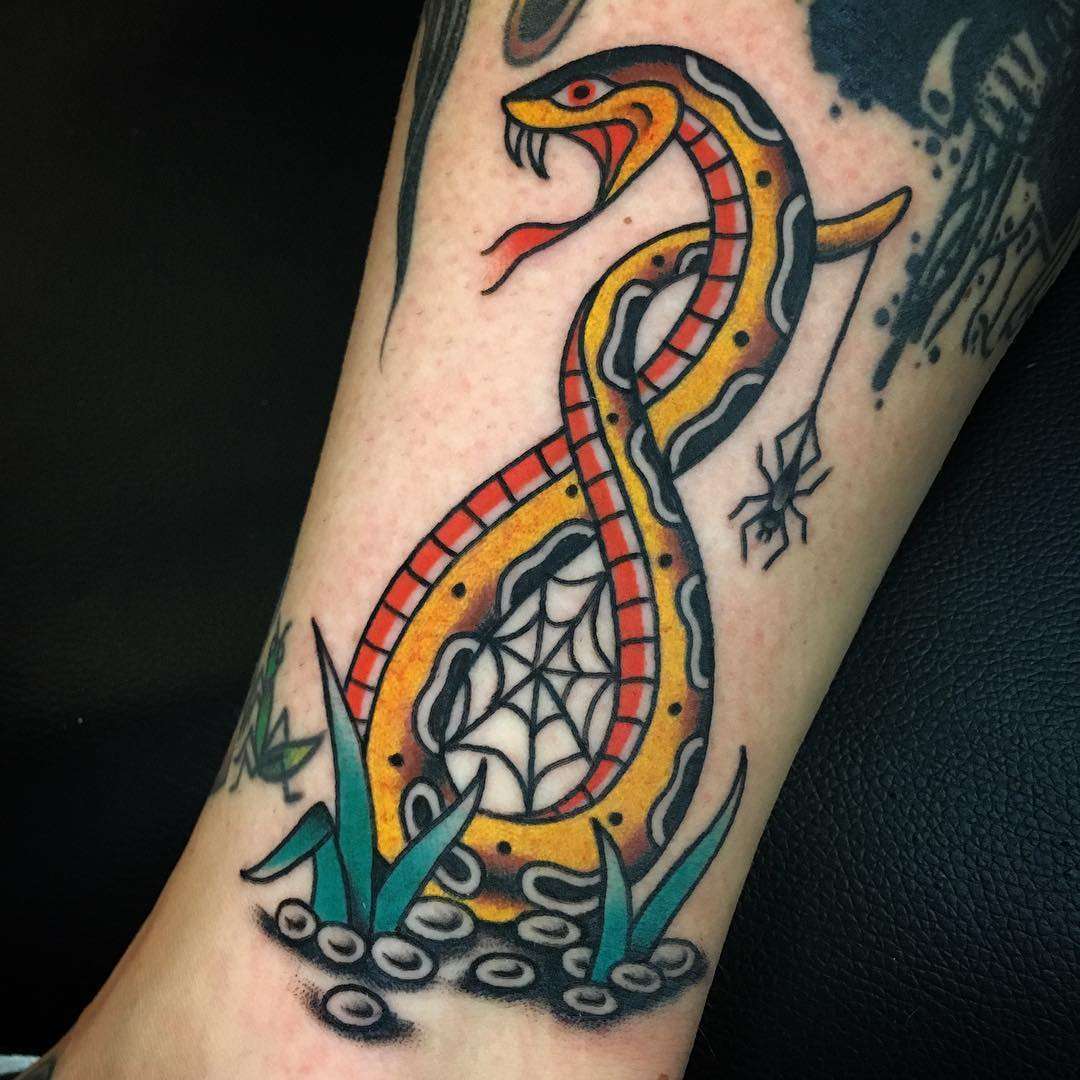
Traditional snake with spider web and spider by @beexgood

Traditional snake around a palm tree by @daniqueipo
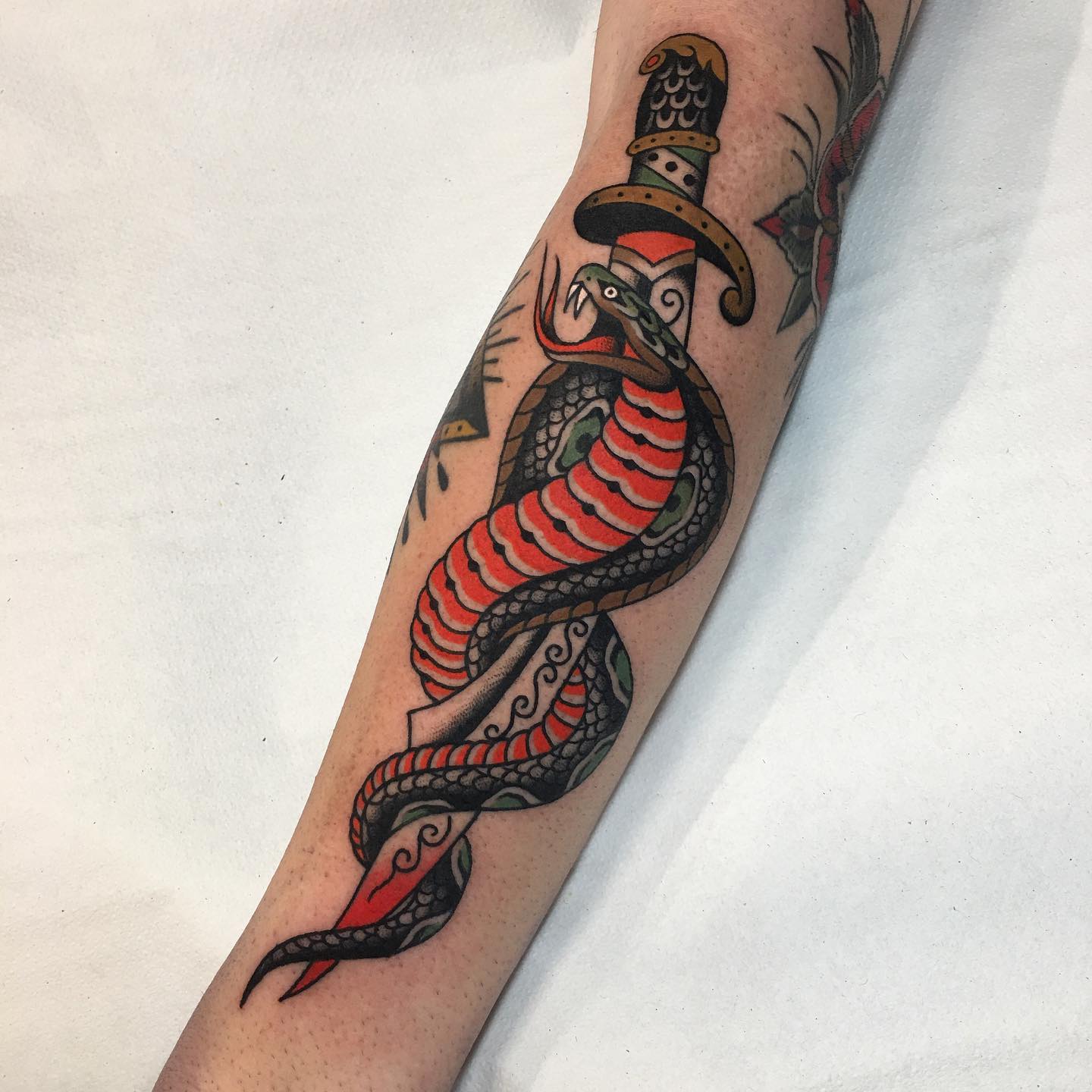
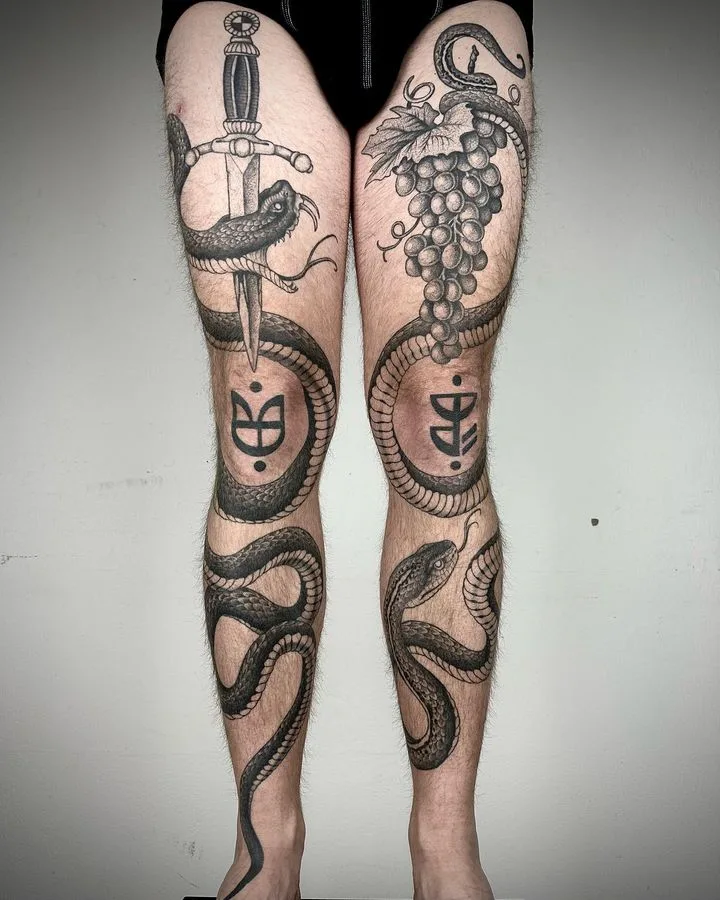
Traditional snake tattoo around a dagger by @paola.fdz
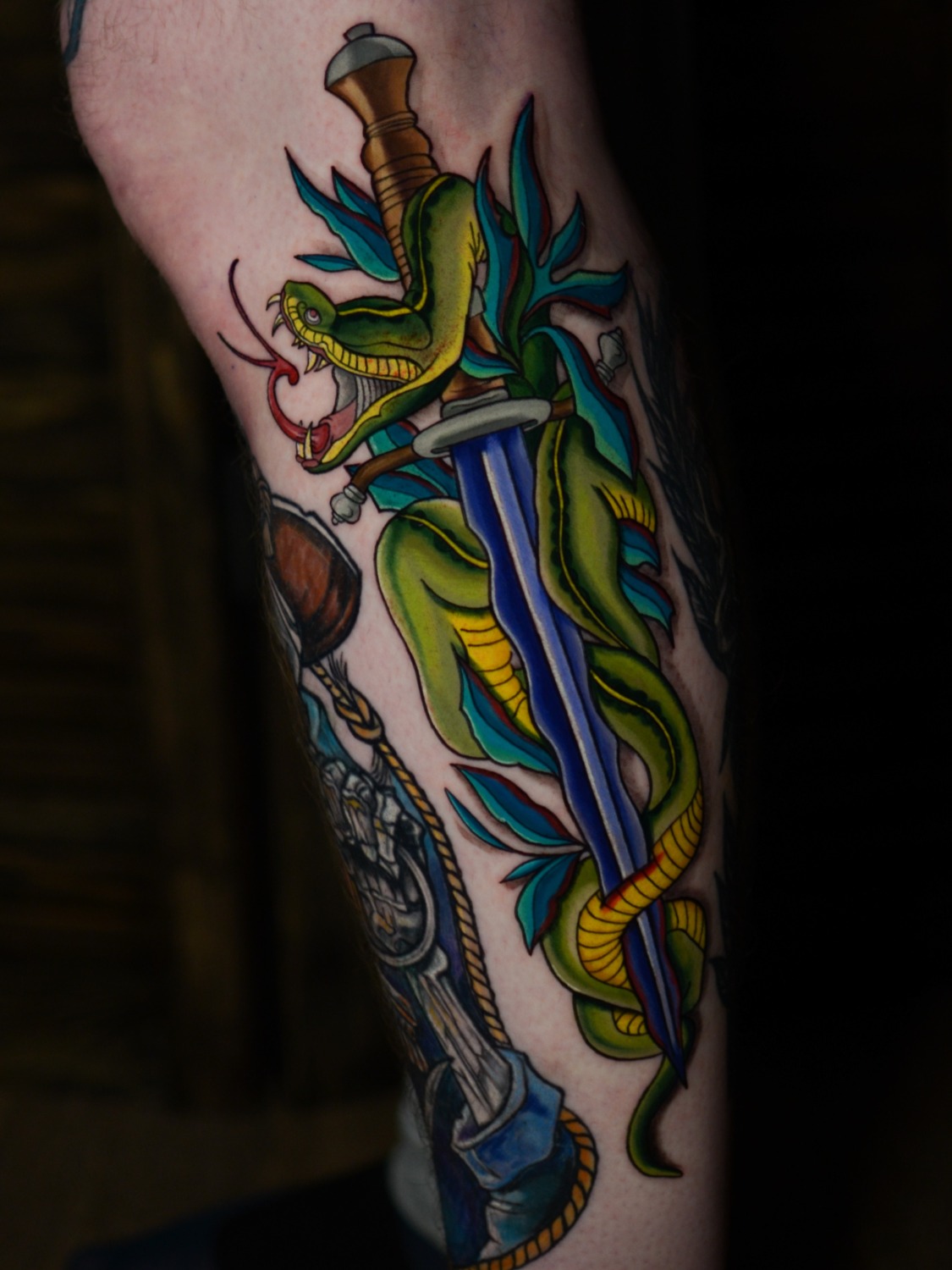
Colourful neo-traditional snake and sword by @anny_lorylin
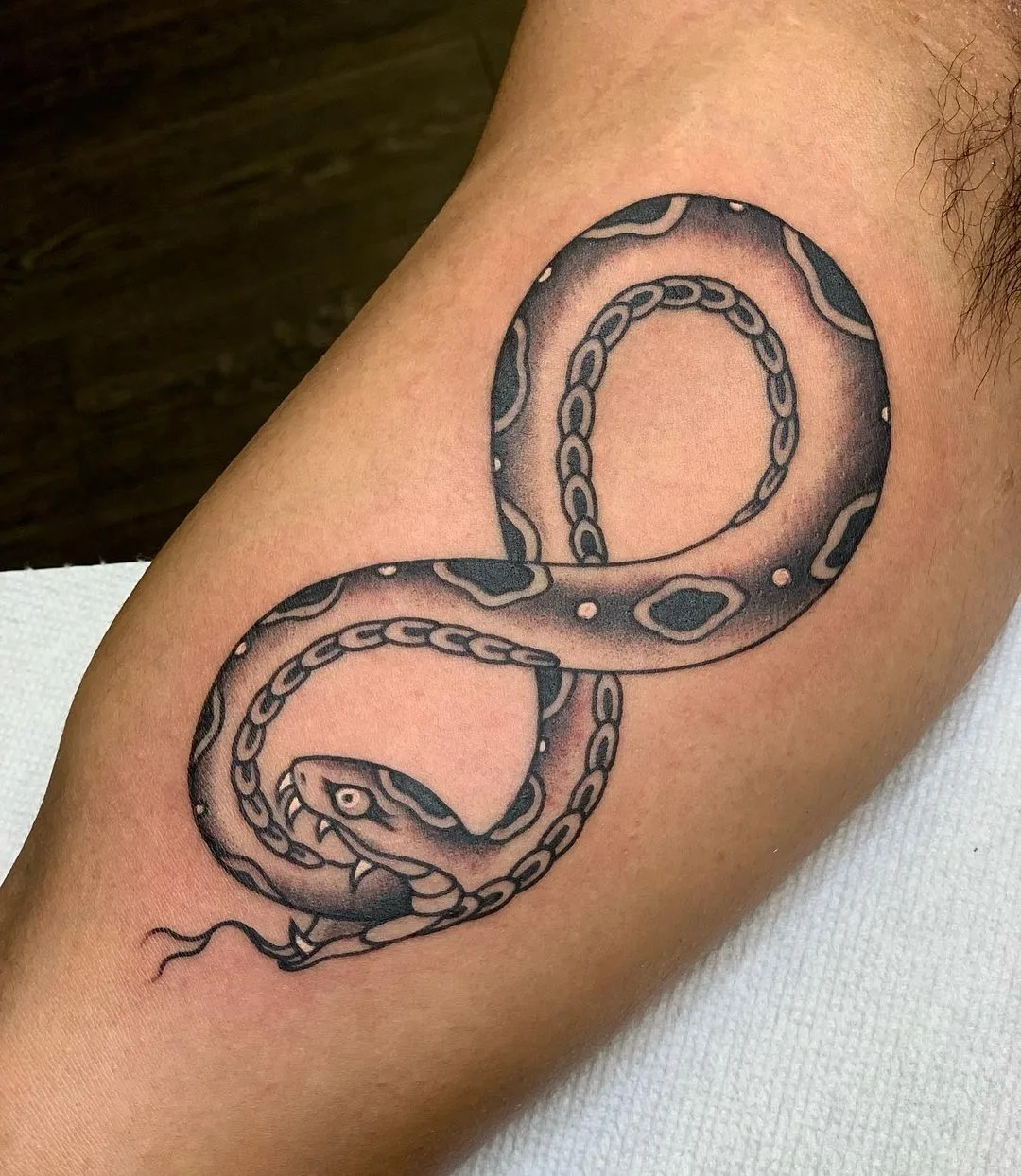
Ouroboros. The self-contained ring, and the most portable snake design there is; two snakes in the loop read as balance or the double helix.
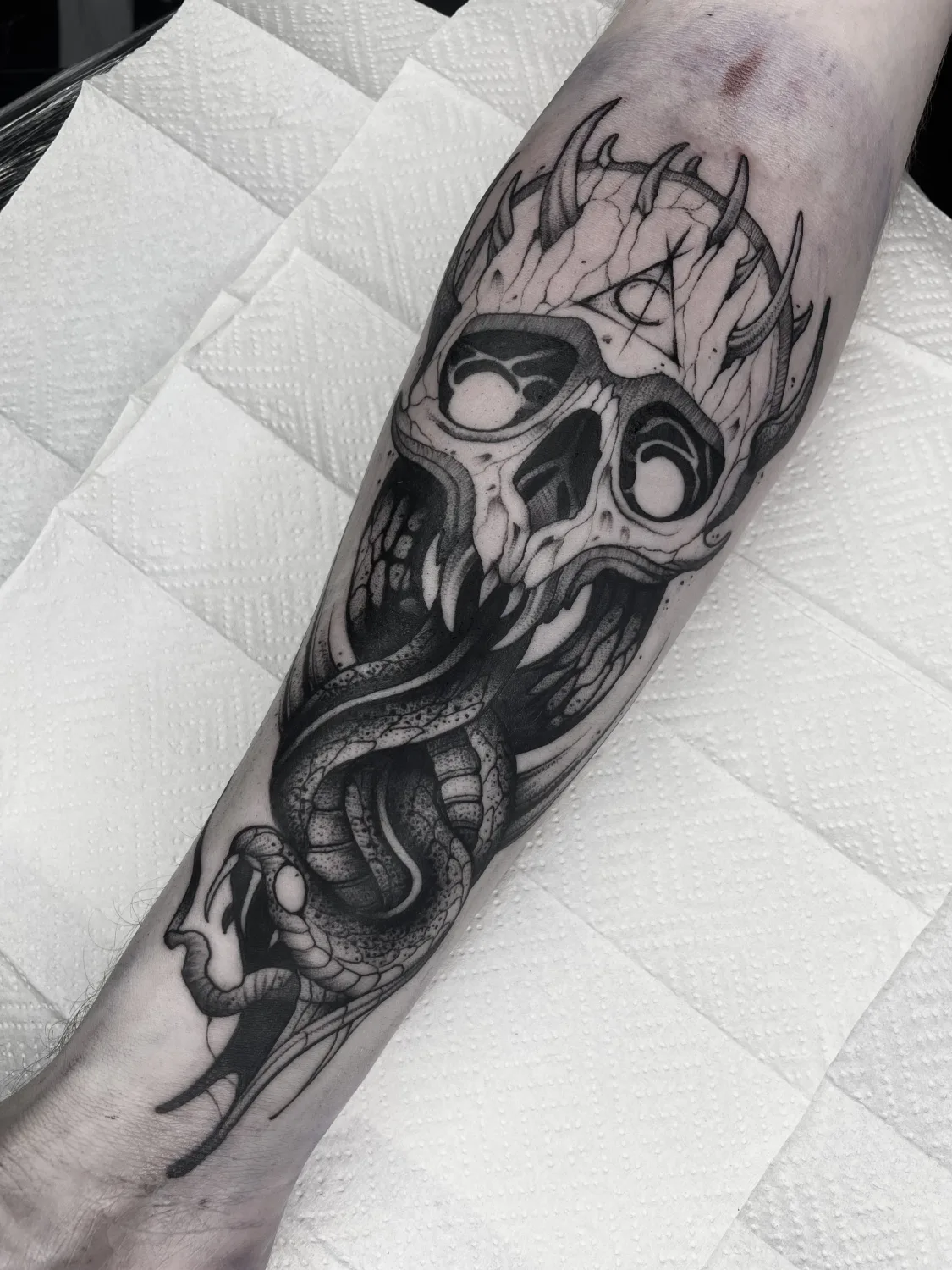
Snake and skull. Life persisting through death: the body threading the eye sockets, or wrapped around the jaw. Done thousands of times and still not tired.
Snake and rose. Beauty and danger, pleasure and its price. The Eden echo is available but not required; the contrast between hard scales and soft petals carries the piece. Snake and peony is the Japanese version.
Snake and dagger. Straight from traditional flash: overcoming an enemy, or danger pierced through. The snake is sometimes read as carried by the blade rather than killed by it, and that ambiguity is why the image has lasted.
Medusa. Snakes for hair. Medusa has become a common snake design, often chosen by women, because the myth has been reread: punished by Athena after Poseidon assaulted her, the snakes are armour rather than curse, and the tattoo says survivor rather than monster. A Medusa piece is a statement about the wearer; a plain snake is a statement about the animal.
Choosing an artist for a snake tattoo
The snake exposes one specific weakness: scales. On a straight body they are simple. The moment the animal turns, every row has to compress on the inside of the bend and stretch on the outside, and the pattern has to keep flowing over the top of the coil and under it. An artist who has not solved that draws scales as a flat net over a ribbon, and the snake stops being a snake at conversational distance. Look for snakes specifically in a portfolio, not dragons and not koi, and look at the bends.
Three checks before you book. Ask for healed photographs, because fresh scale work tells you nothing about how the contrast settles. Match the style to the artist rather than the other way round; a superb realist asked for a traditional cobra will give you a competent copy of someone else's speciality. And say plainly whether the piece stops at the forearm or continues into a sleeve, because a wrap drawn for one section rarely extends without being redrawn. Bring reference of real snakes, not other people's tattoos. You can filter by style, country and city in our tattoo artist directory.
It helps to see how differently the same animal is handled. Mike Rubendall runs a snake through a full Japanese sleeve alongside waves, flowers and a geisha, so the animal is one current in a larger scene. Javier Betancourt does the opposite: a black-and-grey cobra across the chest, hood spread, a portrait of the animal itself. Nomi Chi builds a blackwork snake into a full-leg composition of flowers and a wing, where the body works as the line that ties the ornament together. Three answers to one motif.
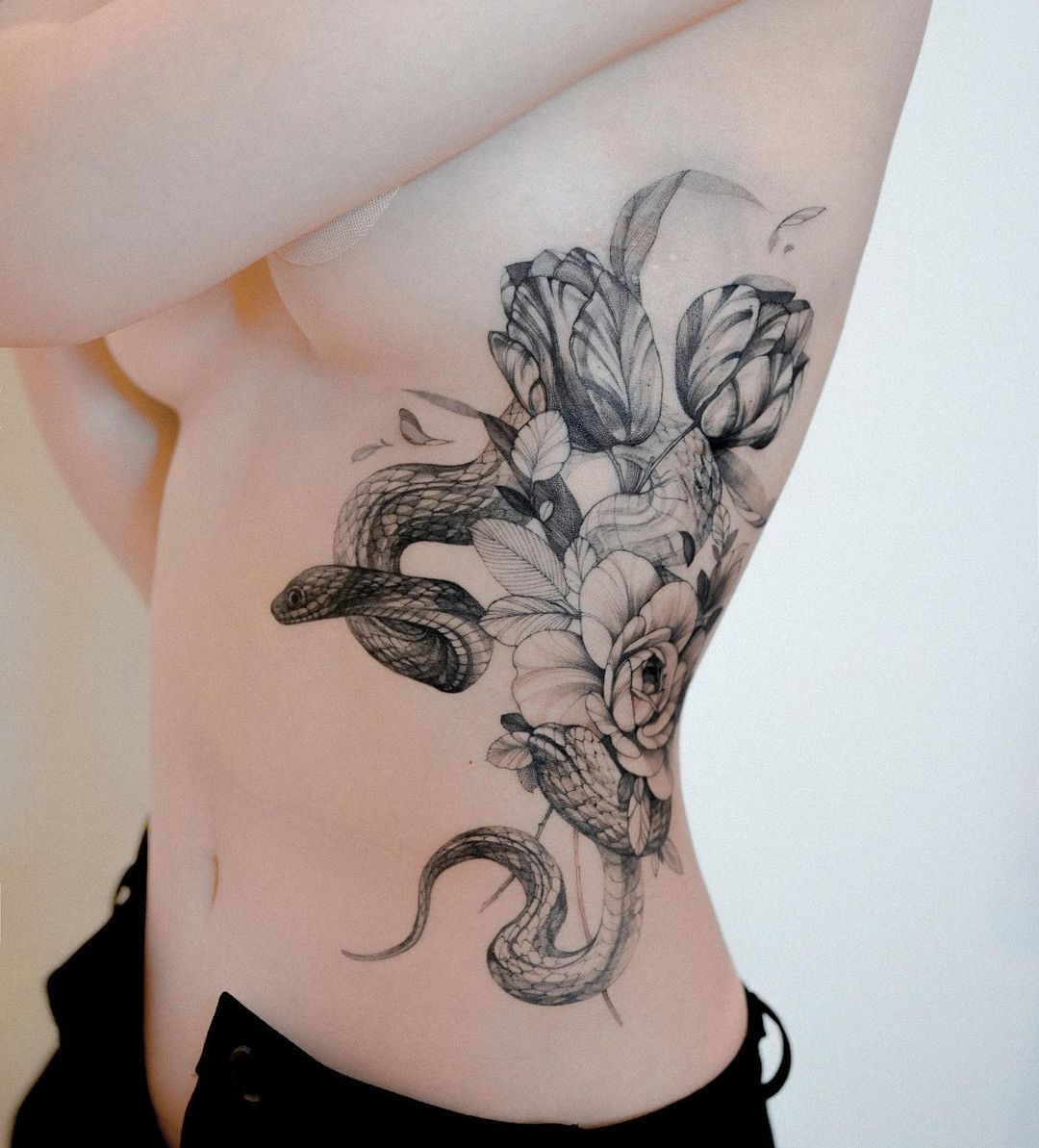
Snake tattoo with flowers on the ribcage by @zihwa_tattooer
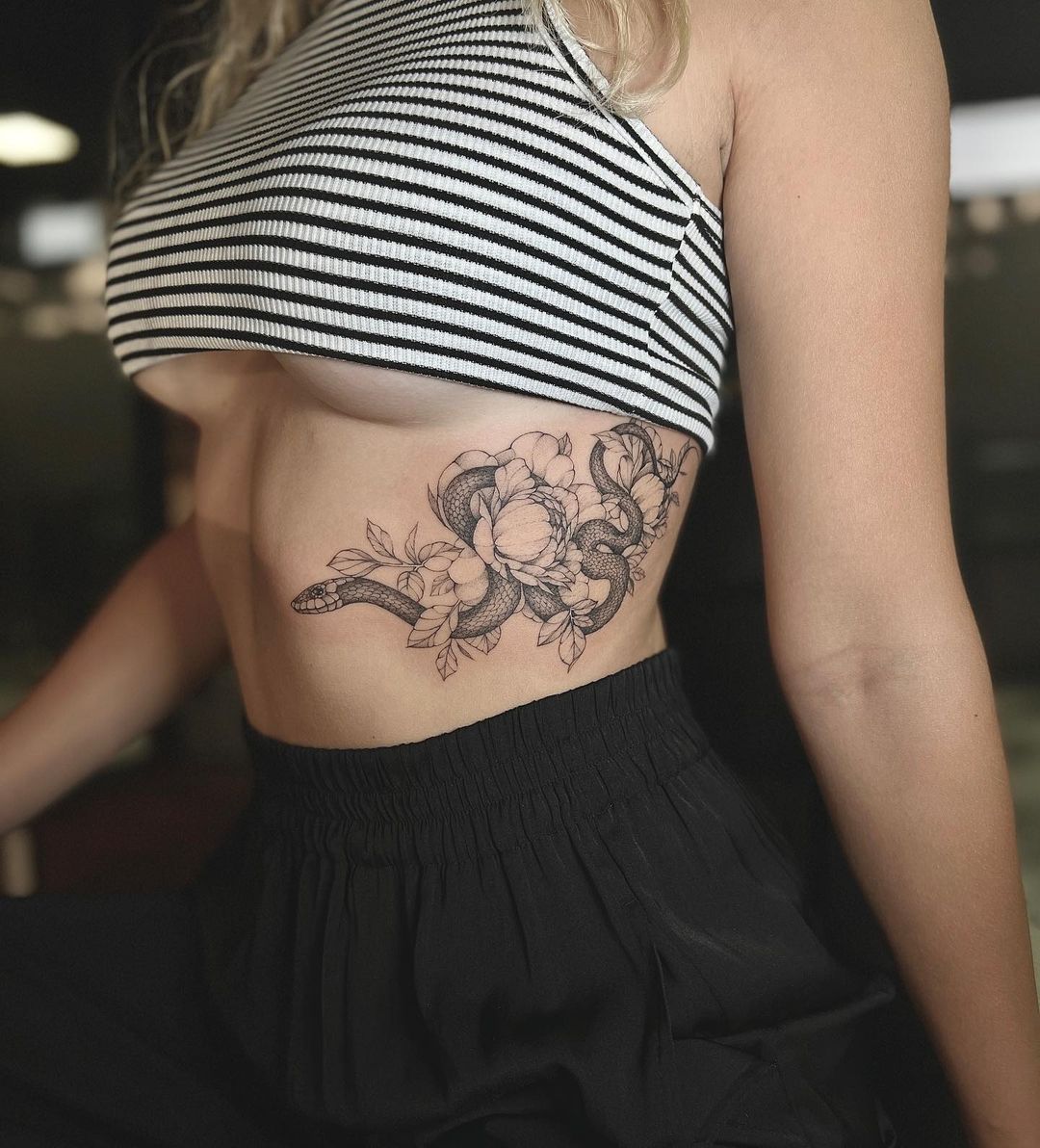
Snake and floral tattoo on the ribcage by @tattoo_black_zone
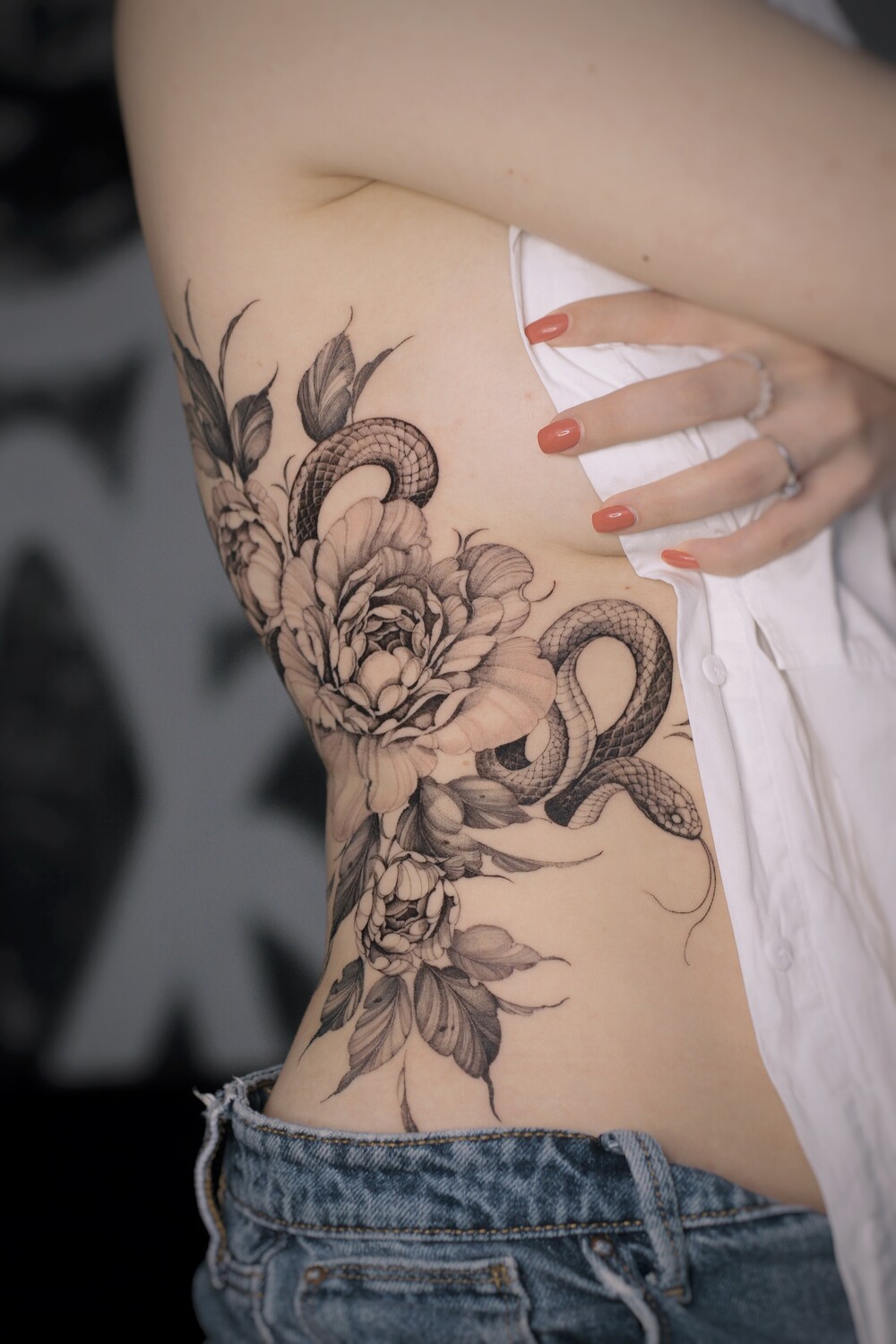
Black and grey snake with flowers on side body by @juliaavoo
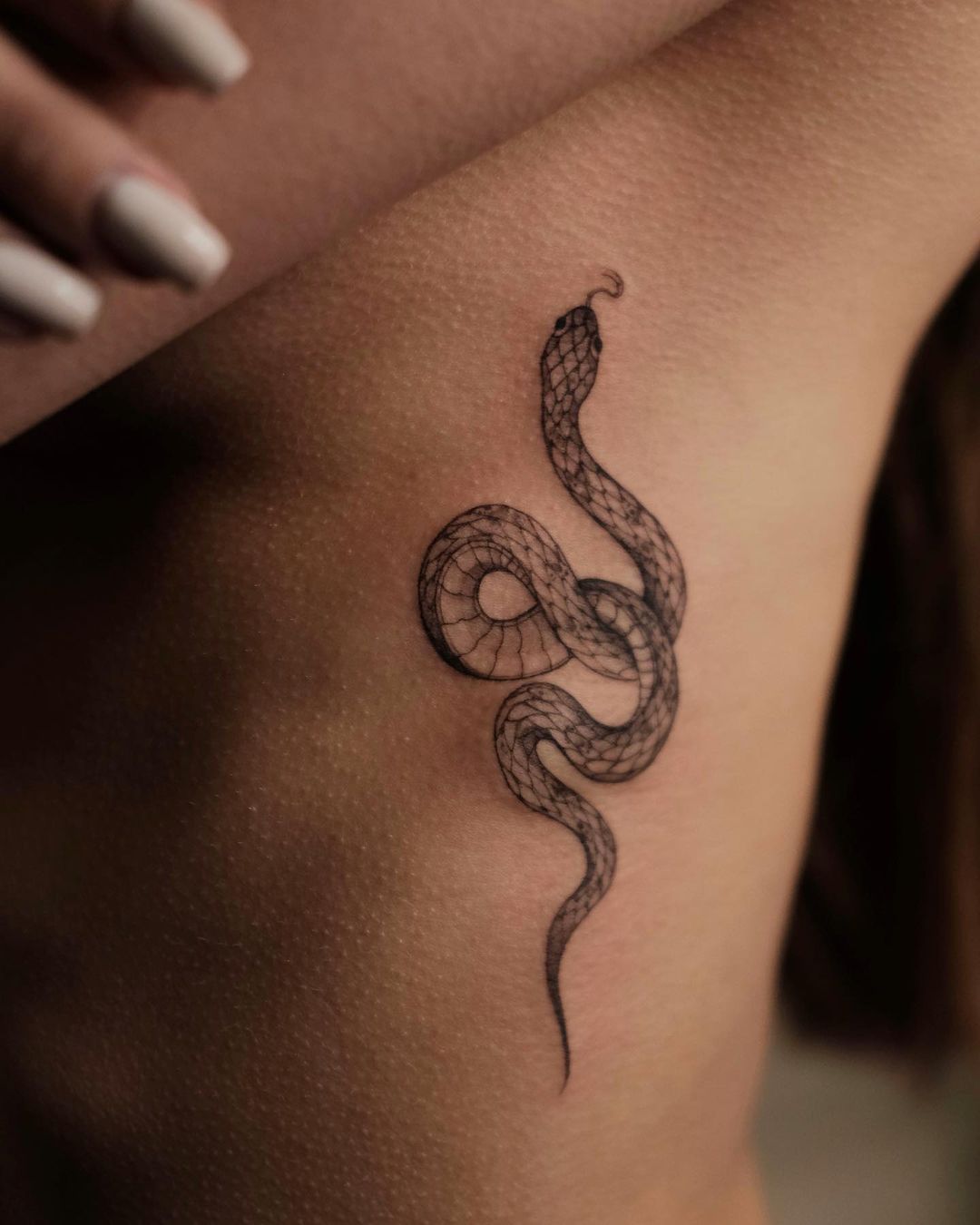
Fine-line snake tattoo on the side body by @sidor_tattoo_
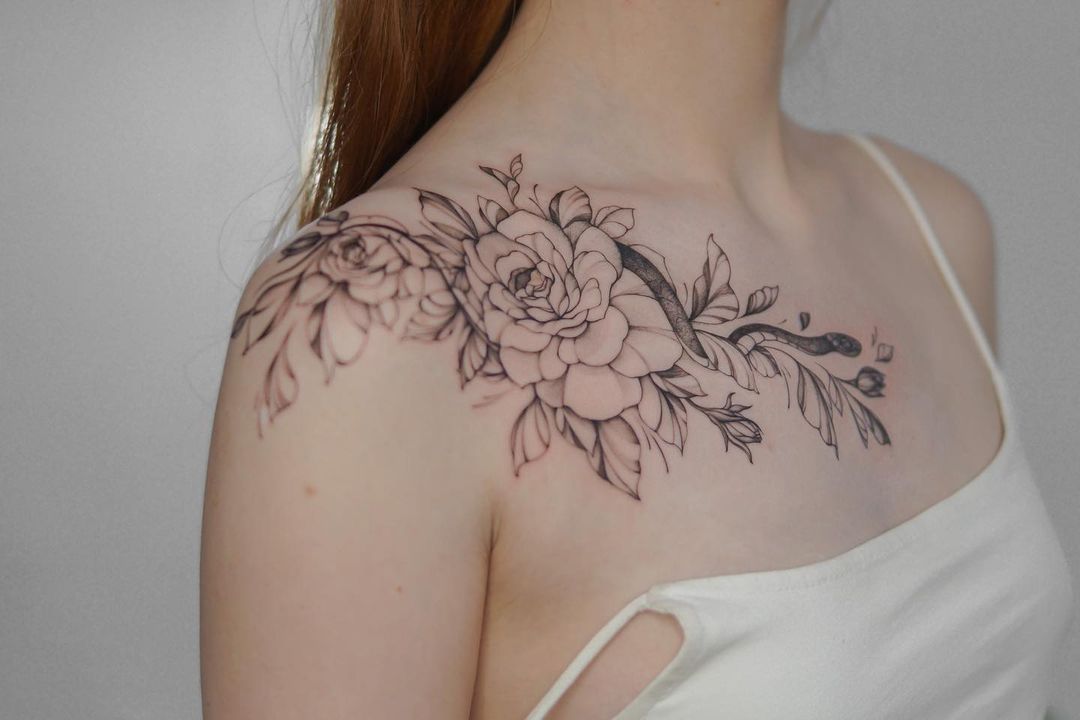
Snake tattoo through a floral arrangement by @tainatattooing
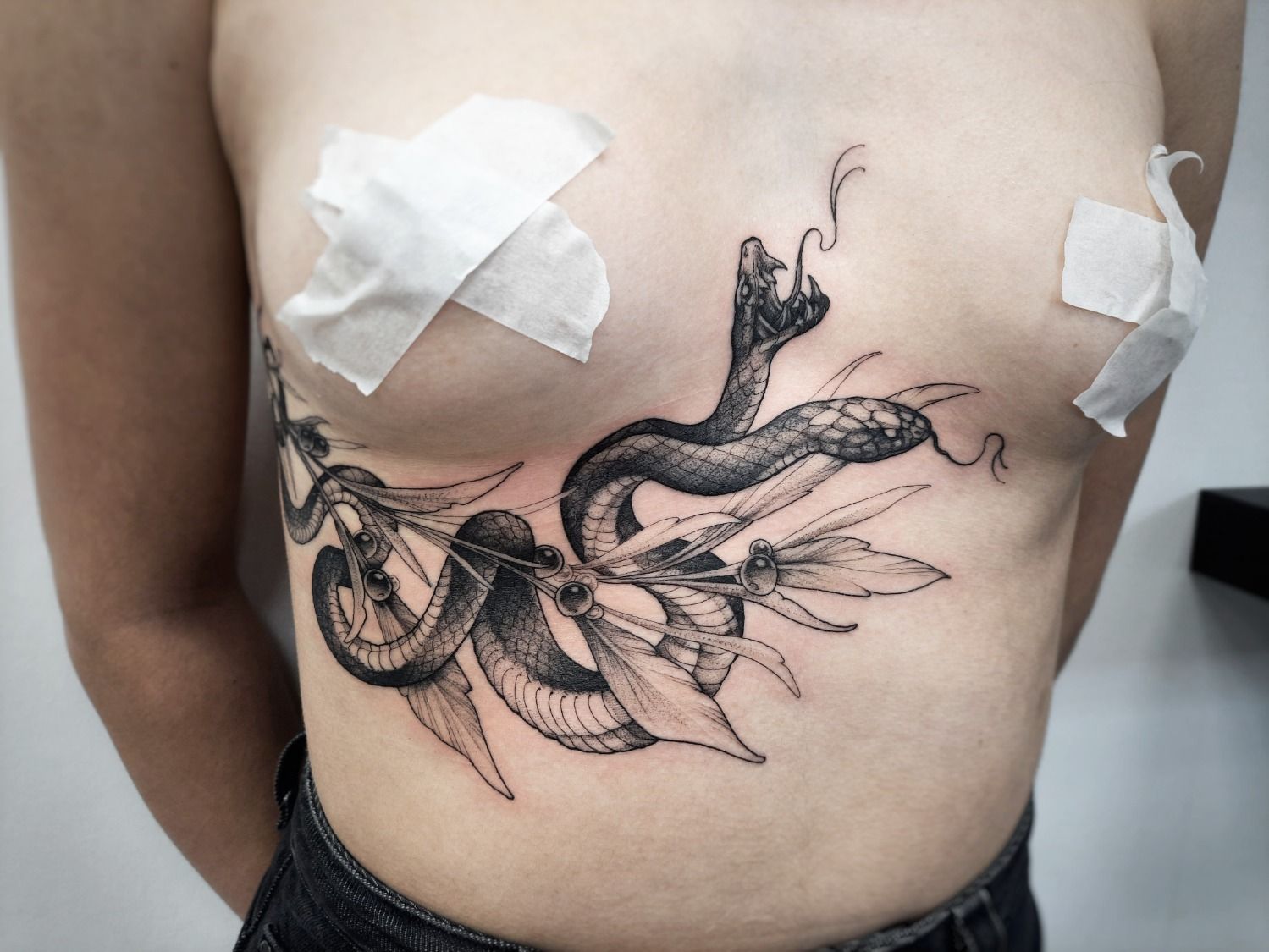
Snake and botanical tattoo — fresh linework by @maryanntattoo
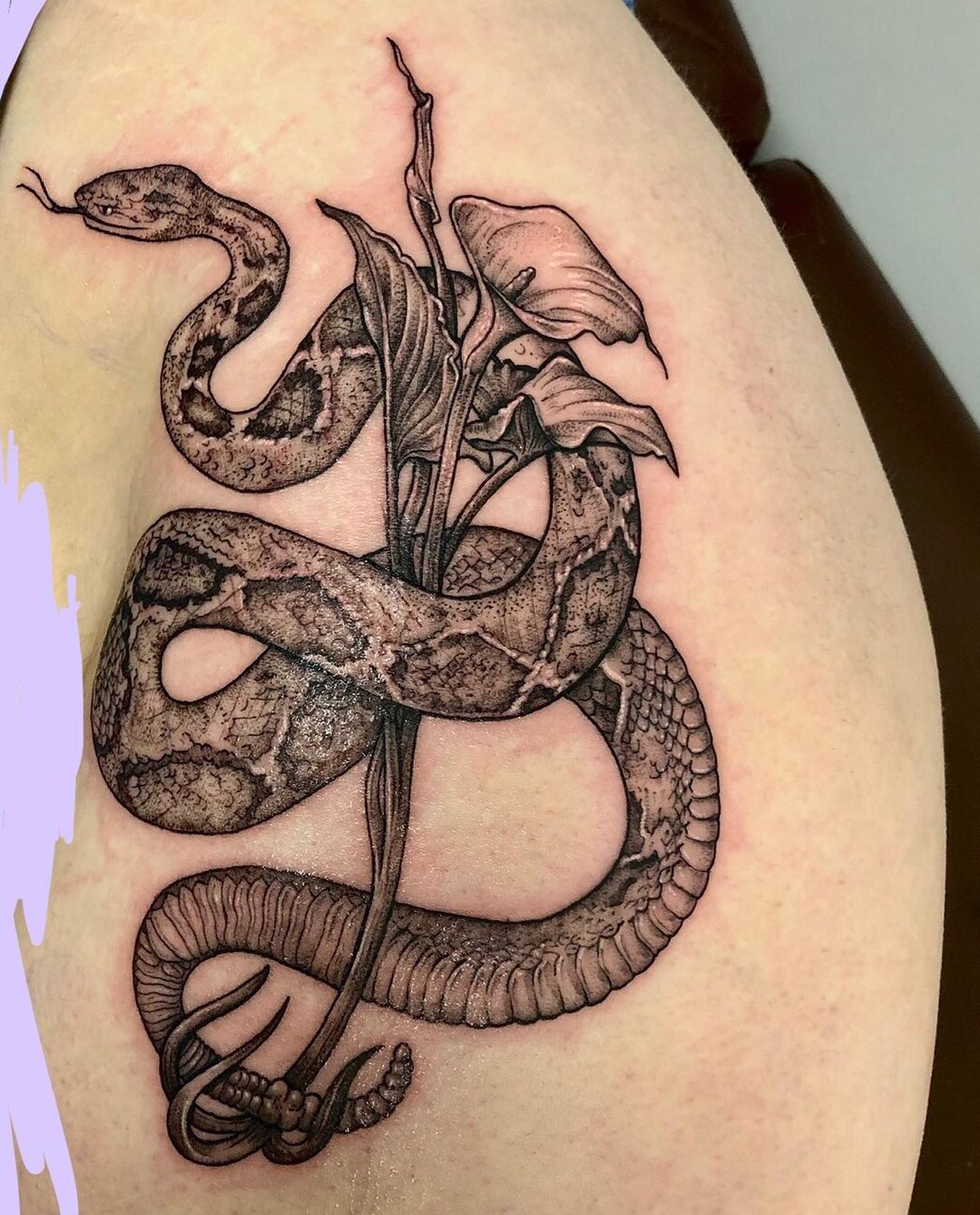
Black and grey snake around a leafy plant by @emfalk96
Aftercare and how a snake tattoo ages
Standard aftercare applies: keep it clean, moisturise lightly, leave the scabs alone, and stay out of pools and direct sun until the surface has healed. That takes two to three weeks, with the deeper layers taking a few months.
Beyond that the snake has two ageing risks of its own. The first is scale texture. Fine scale detail is exactly what blurs first, and a piece that depends on it will read as a dark band within five to ten years. The fix is structural: an outline strong enough to hold the body's shape, and scales that support the form rather than carry it. Traditional and Japanese snakes survive for this reason.
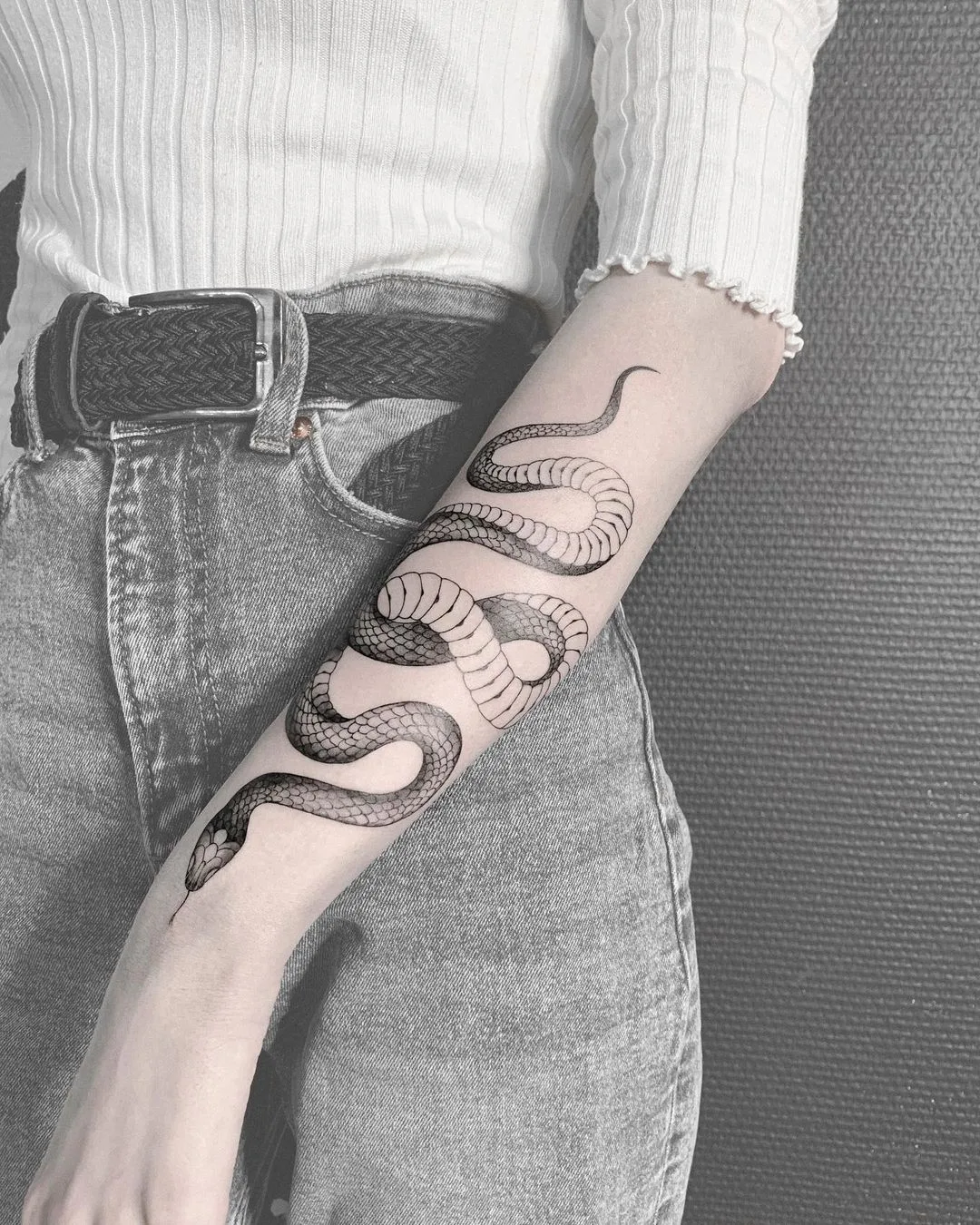
The second is the wrap. A snake that coils around a limb crosses skin that moves, and where it crosses a joint the line thickens and softens sooner than the rest; muscle gain or loss changes the coil's shape as well.
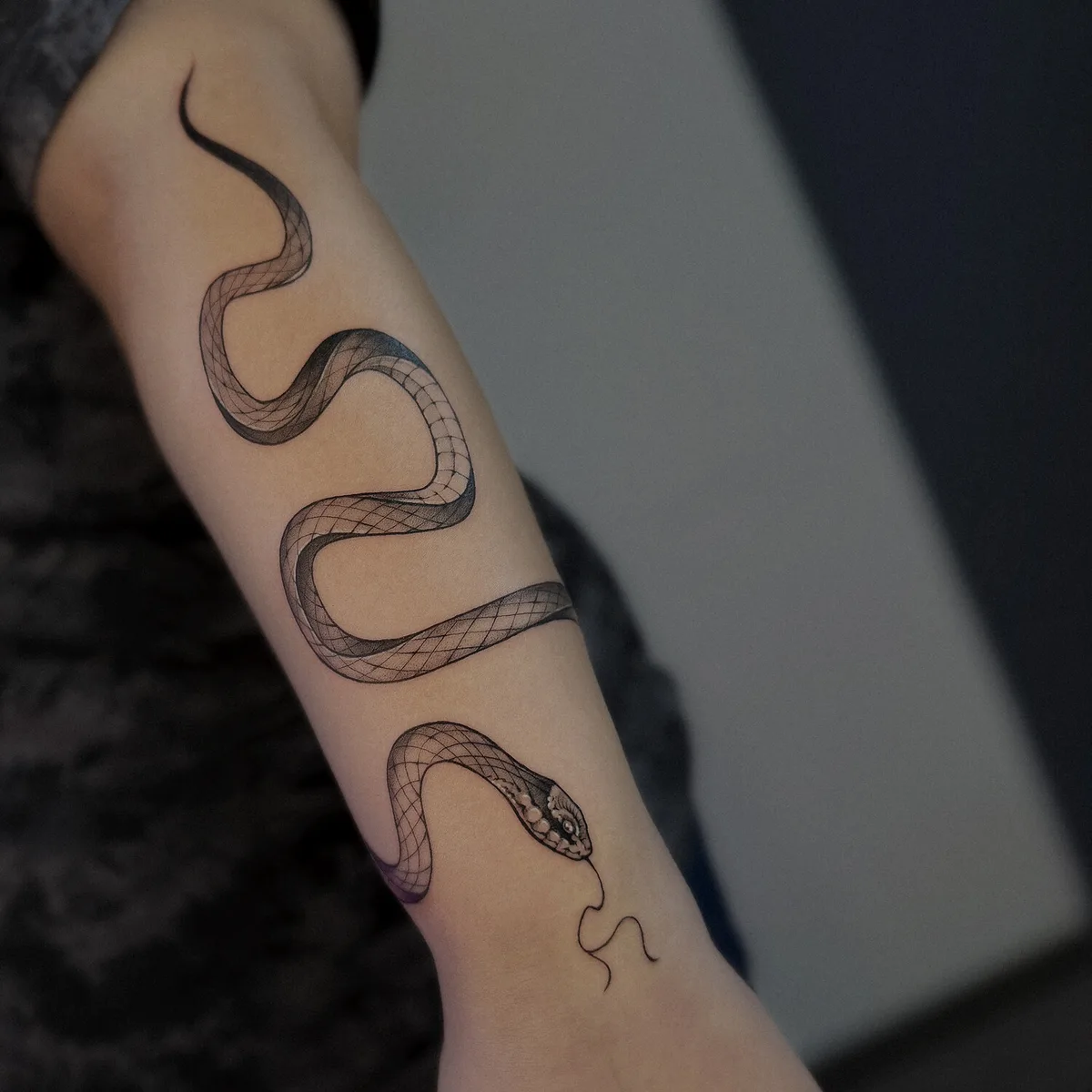
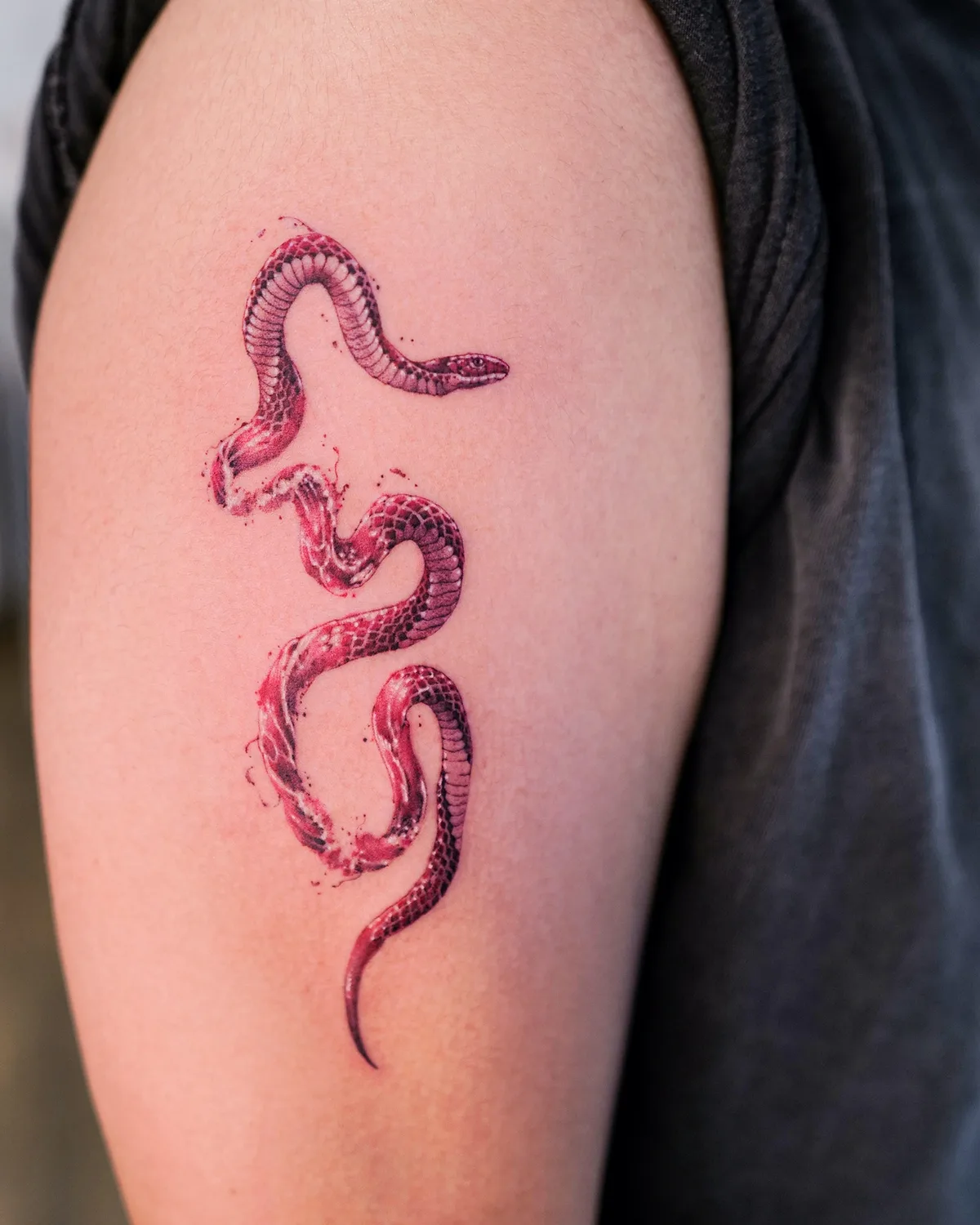
Colour fades unevenly, reds and yellows first, so a green Japanese snake holds better than a red one, and a realist's warm eye can go grey before the rest of the head does. Sunscreen on an exposed forearm does more for a snake's twenty-year life than any product sold for tattoos. Budget one touch-up in the first year for anything with fine linework.
Frequently asked questions
What does a snake tattoo mean spiritually?
Renewal first, and after that whichever tradition you are drawing on. In Hindu and Buddhist contexts the naga guards water and sacred space; in Japan the white snake brings luck and health; the ouroboros is the cycle of death and rebirth; in Christian symbolism the serpent is temptation. There is no single spiritual meaning, which is why the snake suits people from so many backgrounds.
Is a snake tattoo bad luck?
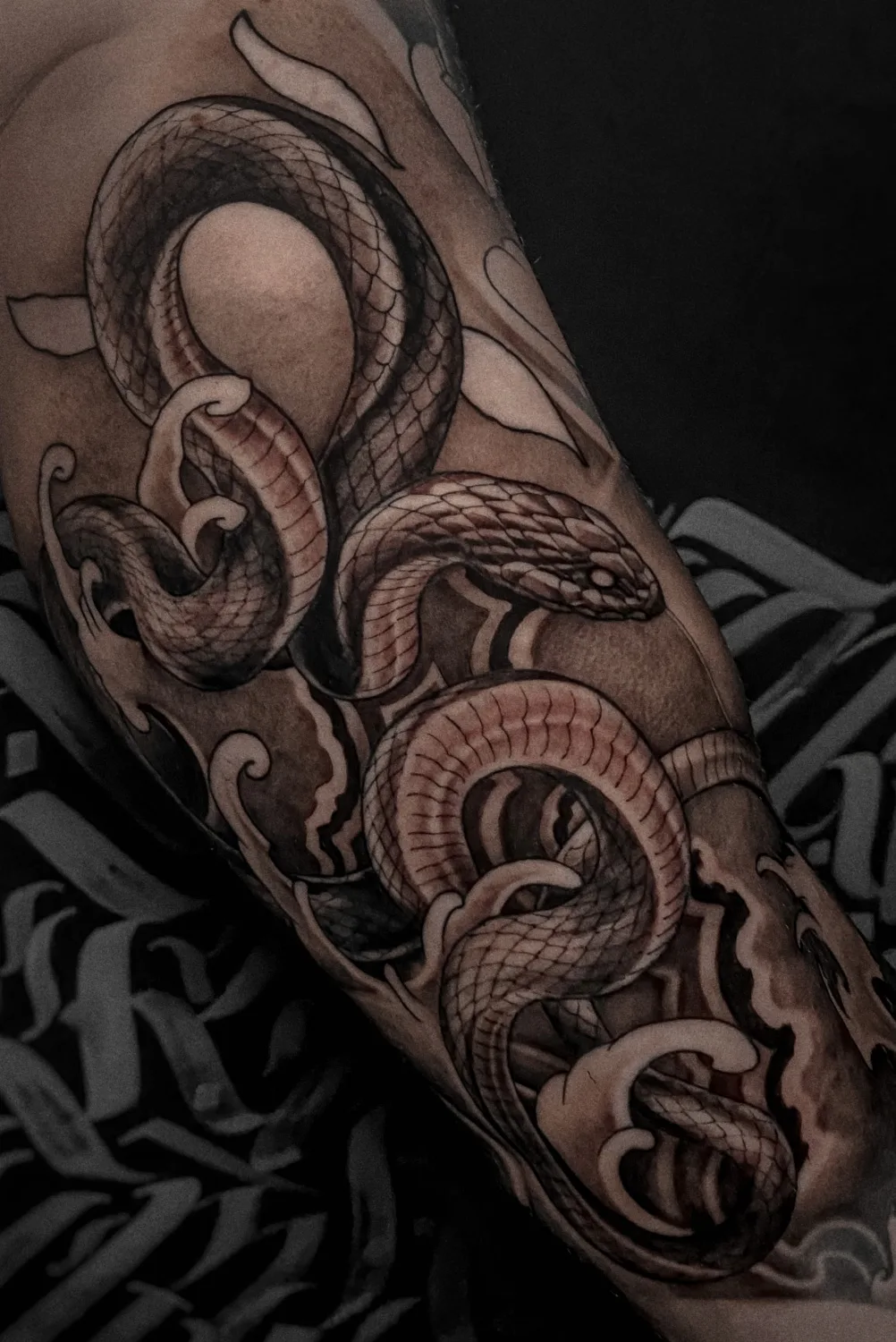
Not in most of the world. Japan treats the snake as lucky, especially a white one; Hindu tradition honours it as a water god; Sak Yant snake designs in Thailand are worn specifically for protection. The unlucky reading is Western and Christian, and even there most people wear snakes without a second thought. The answer depends on where you are, not on the animal.
What does a snake wrapped around the arm mean?
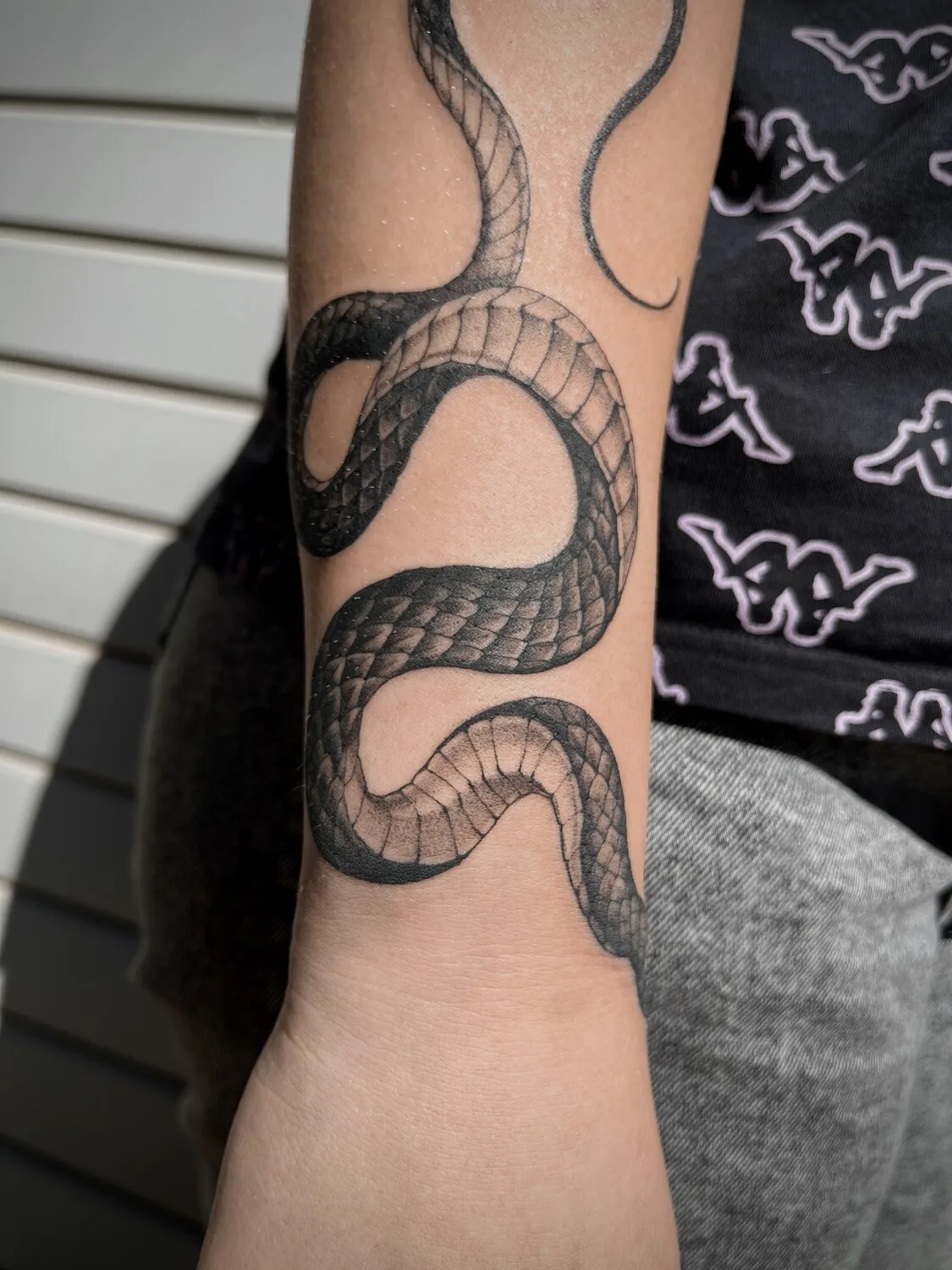
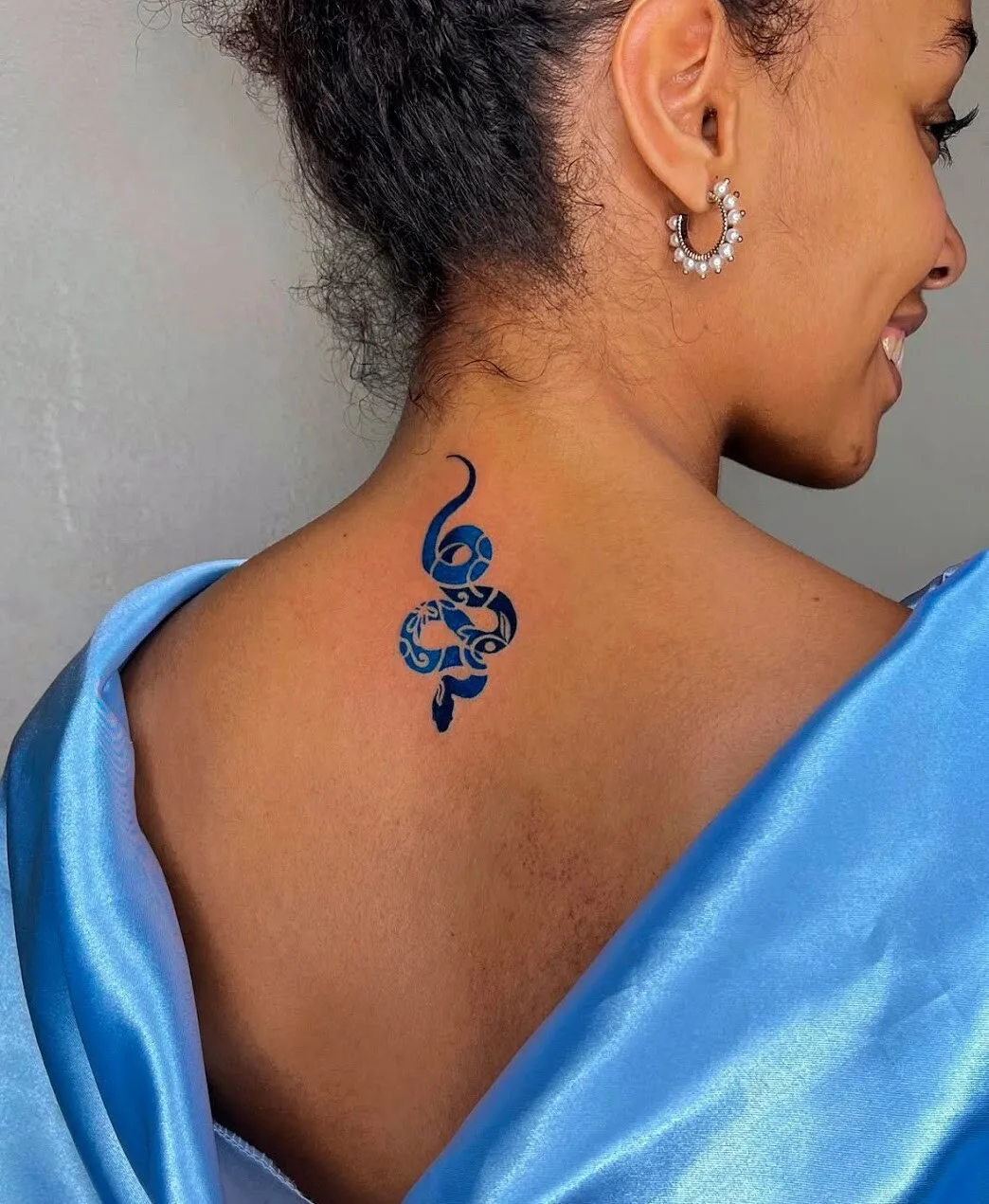
Usually protection or renewal, the animal holding the limb; if it is a single snake on a rod, medicine. The wrap is chosen as much for how it uses the arm as for what it says: it is the one snake design that treats the body as three-dimensional.
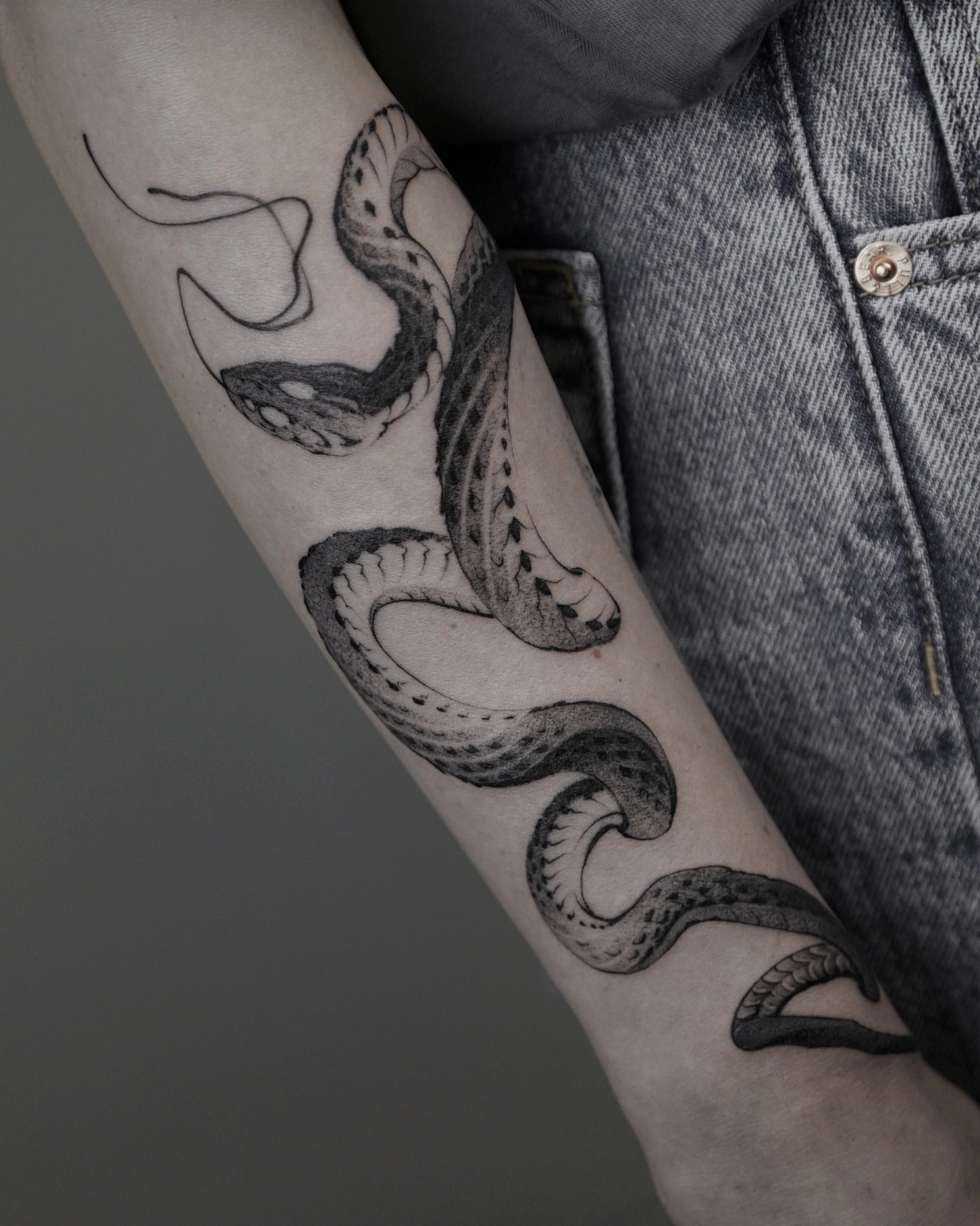
Black and grey snake wrapping the forearm by @mitya.sobakov
Fine-line snake wrapping the forearm by @Annaguskova
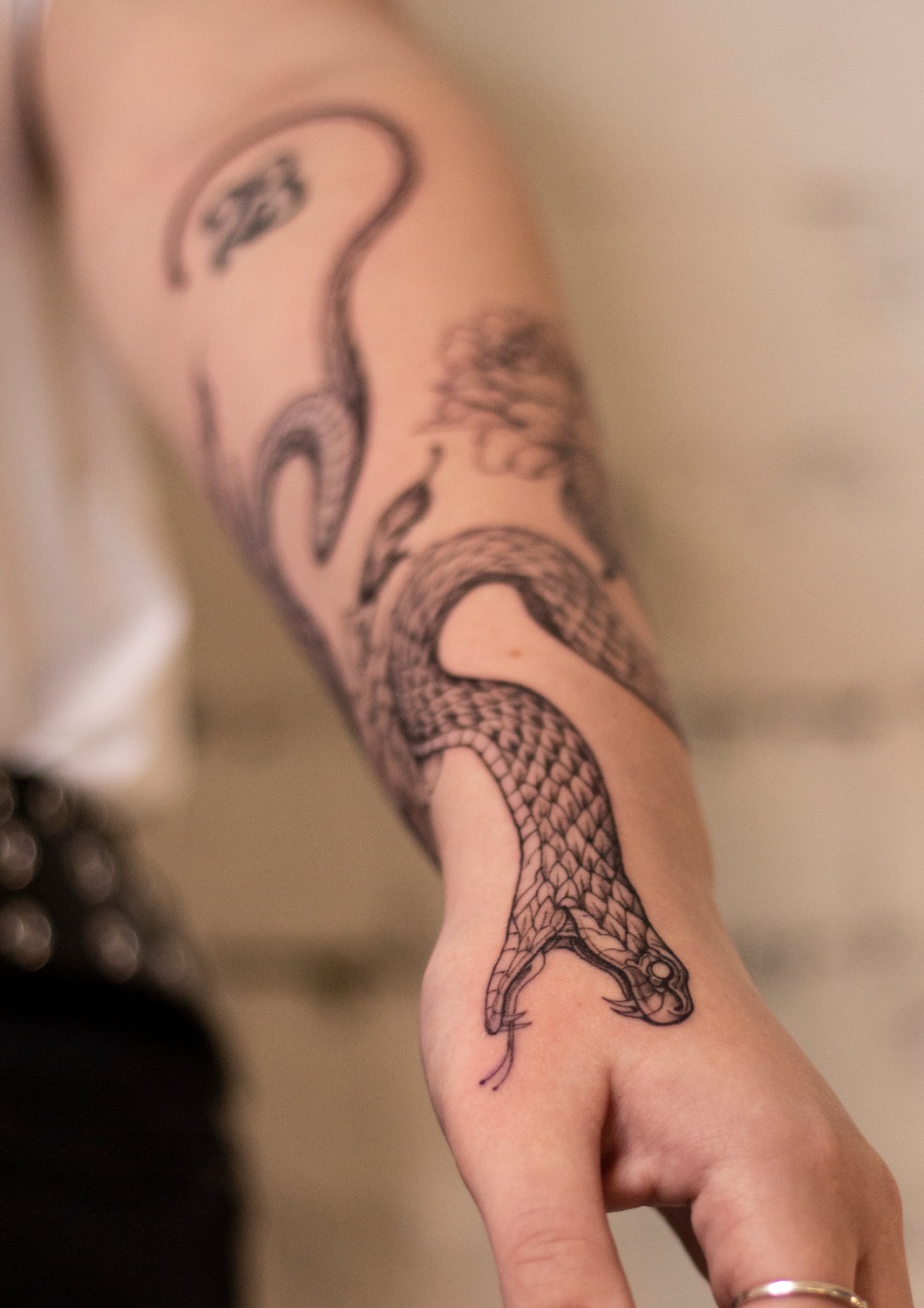
Detailed scale snake tattoo on the forearm by @irisqult
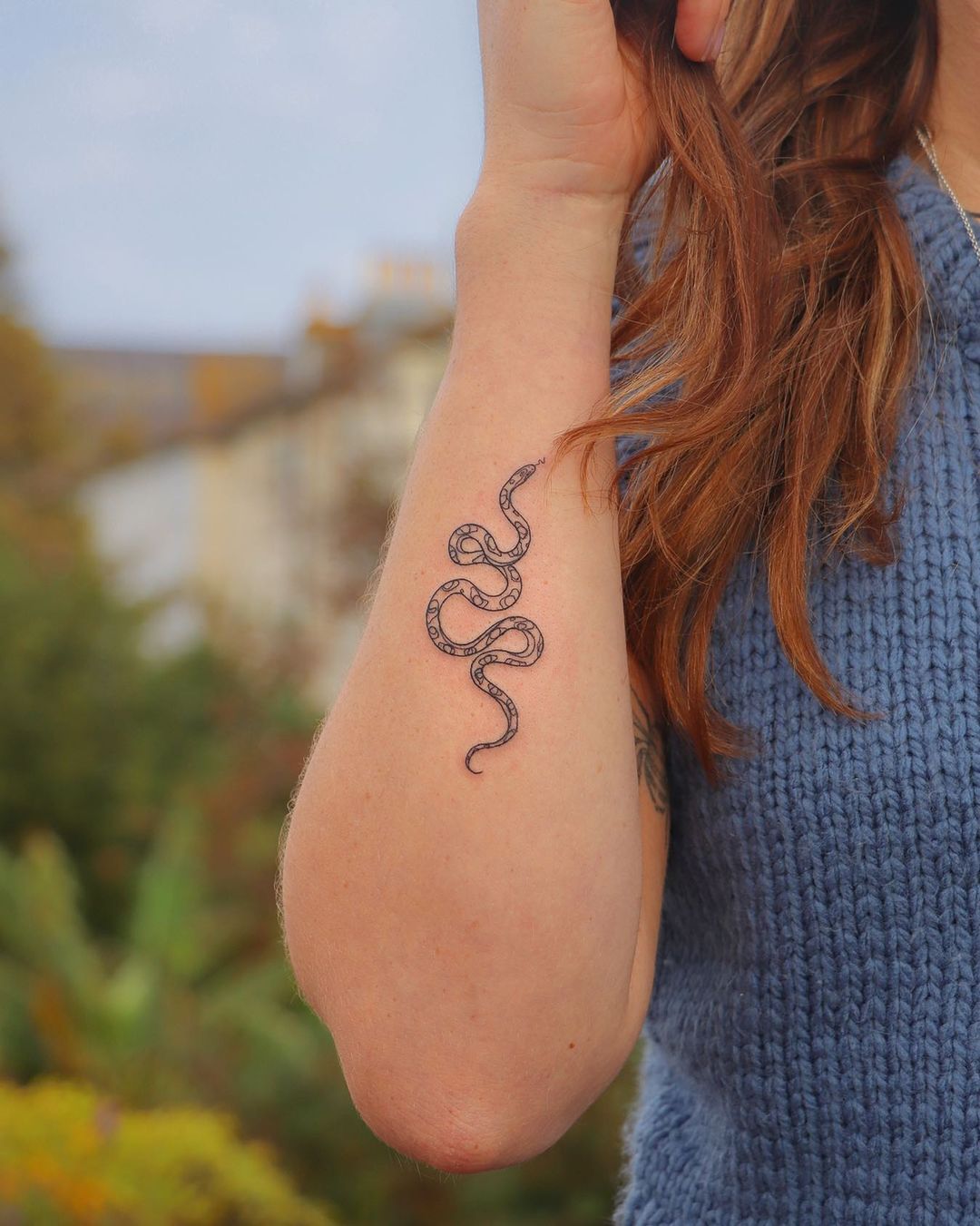
Minimalist linework snake down the forearm by @zaya
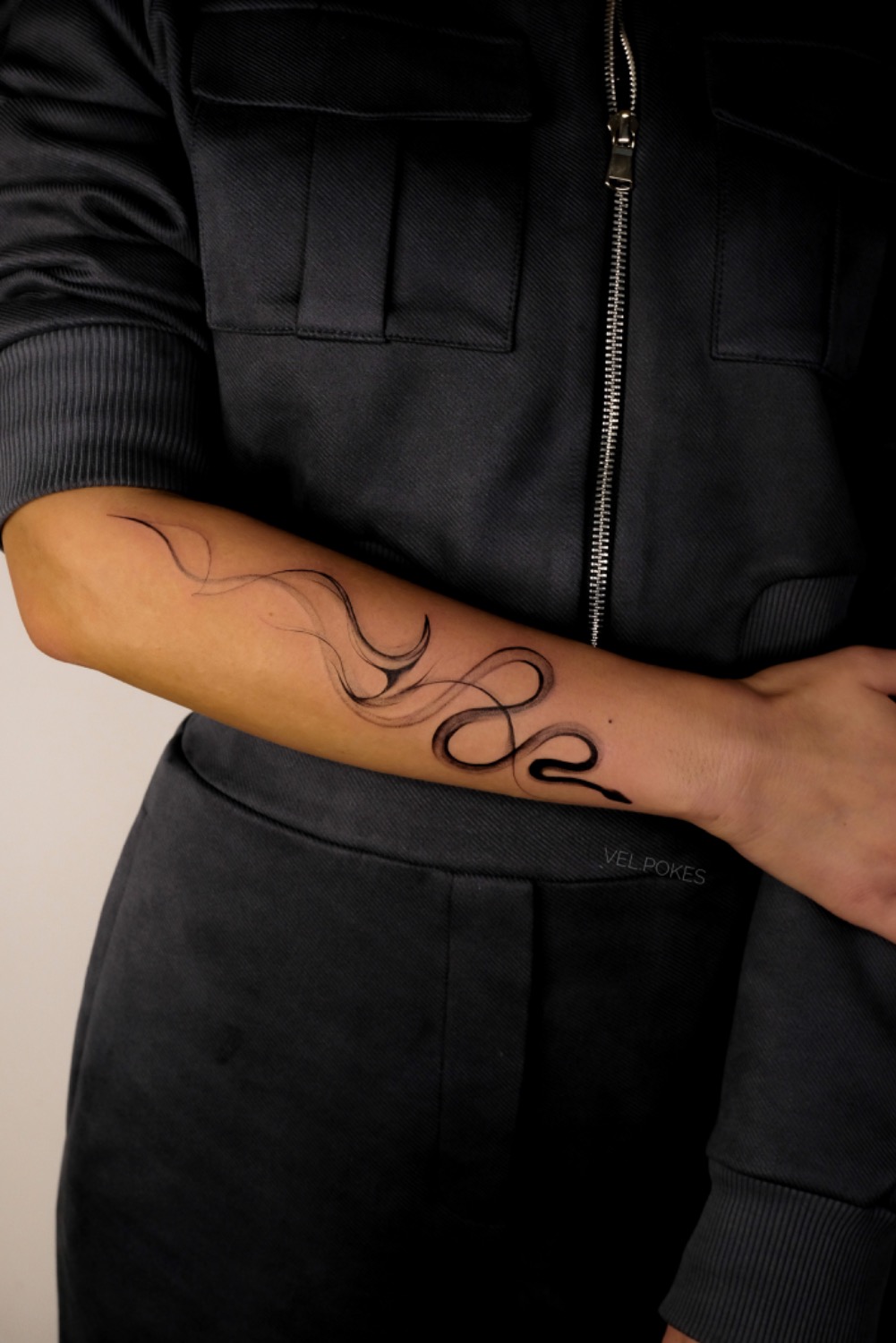
Minimalist snake with abstract lines by @Vel
What does a snake tattoo mean on a woman?
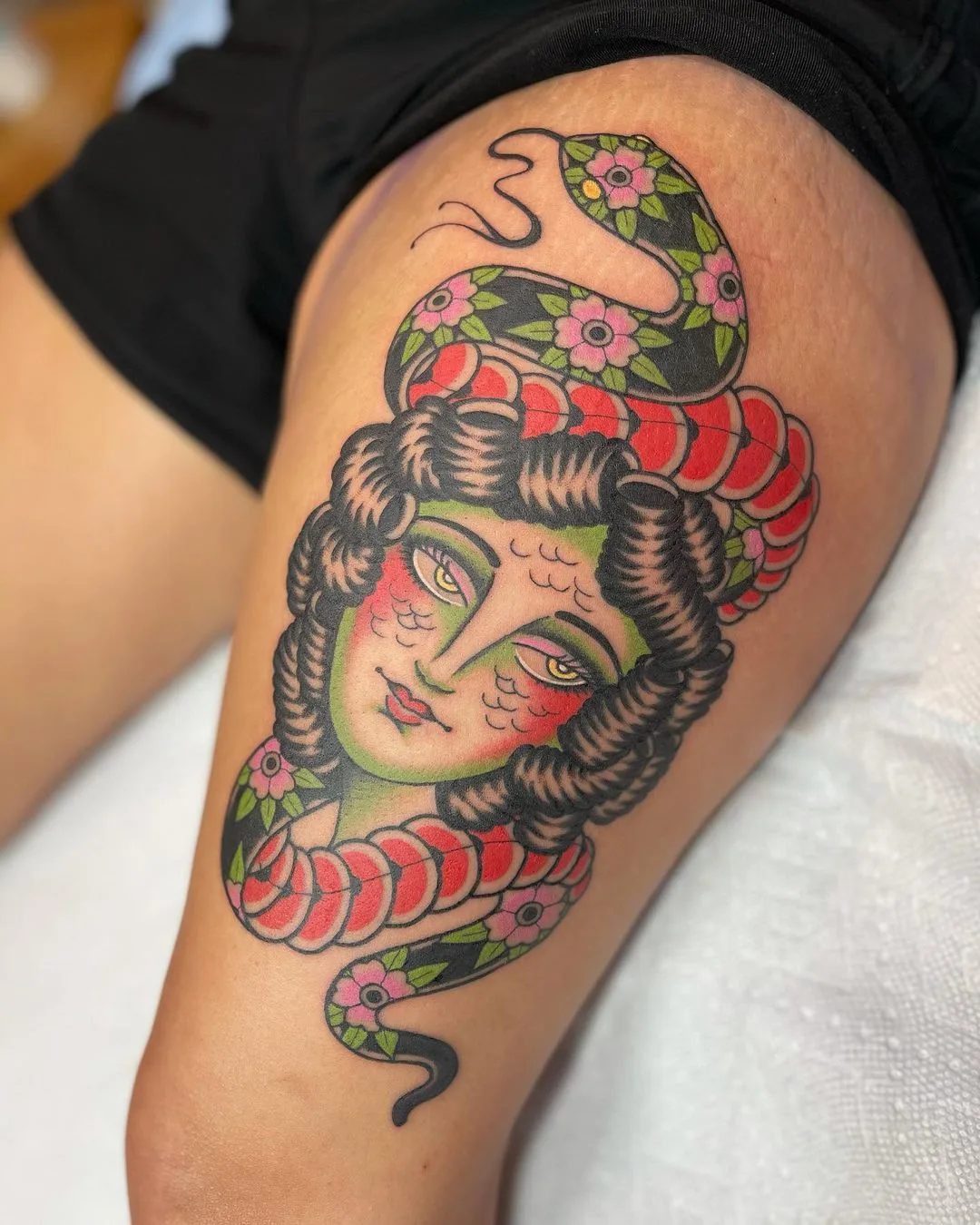
Nothing different from what it means on a man, though some designs are chosen more often by women: the Medusa, reread as a survivor, and long sinuous snakes along the ribs, thigh or collarbone. The link between snakes and feminine power is ancient (one of the Minoan "snake goddess" figurines from Knossos holds a serpent in each hand) and owes nothing to Eden.
Where is the best place for a snake tattoo?
Wherever the body gives the snake a line to follow: a forearm or calf for a wrap, the spine for a kundalini piece, ribs or thigh for a large snake in motion. Hands and fingers suit small fine-line snakes but fade fastest. Decide where the head goes first, at a size that lets the scales survive healing.