An owl tattoo means wisdom, foresight and knowledge of things hidden in the dark. Or it means death is coming. Both readings are old, both are still alive, and which one you are wearing depends on the culture doing the reading. In Athens the owl was a coin. In the Navajo Nation it is a message nobody wants. In Tokyo it is a lucky charm.
- The wisdom reading comes from one place: Athena's owl on the coins of Athens. The death-omen reading is older and wider, from Rome to the Diné.
- Japan's lucky owl is a pun (fukurō = "no hardship"), and in Bengal the owl carries Lakshmi, goddess of wealth, with a built-in warning about greed.
- Accessories decide the meaning: a skull makes it a memento mori, a crescent quotes Athens, a maple leaf makes it a fukurō.
- Feathers, not fur, are the technical test: ask for healed owl work, and keep the facial disc above eight centimetres for realism.
What an owl tattoo means
Start with the animal, because the symbolism follows the biology. Owls hunt at night and in silence (the serrated edge of the flight feather kills the sound of the wingbeat), and both eyes face forward, which gives an owl the one thing almost no other bird has: a face that looks straight at you, at night, without a sound. Every culture that lived near owls noticed the same facts and drew different conclusions.
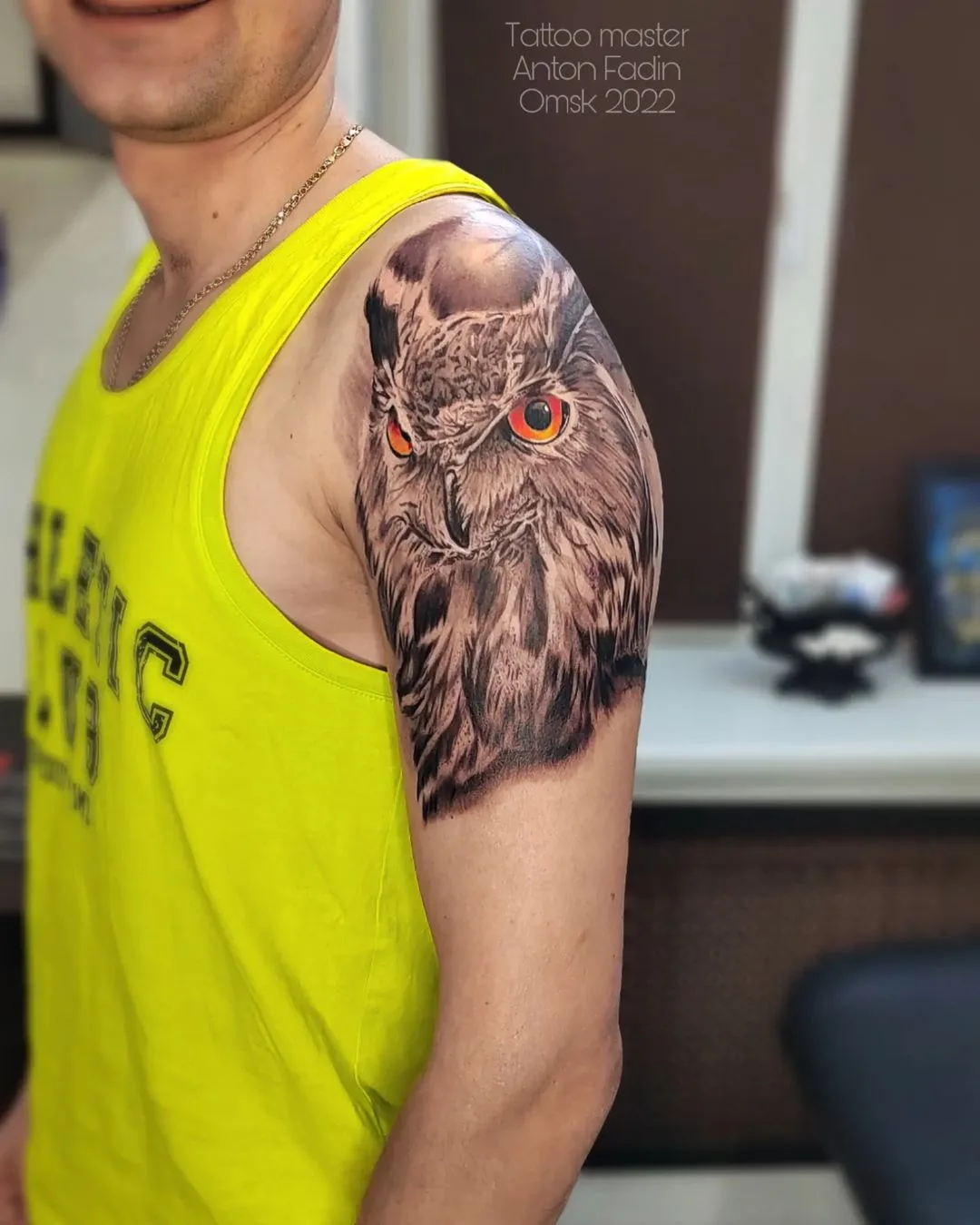
The Western reading, the one most people mean by owl tattoo, is wisdom. It comes from Athens and from nowhere else; the scholar's owl on a stack of books is Athena's bird with fifteen centuries of wear. In this register an owl tattoo says: I see what others miss, I watch before I speak, I am at home after dark.
The other reading is older and wider. For the Romans, many Indigenous nations of North America, much of Africa, the Arab world and rural Europe until living memory, the owl was a messenger of death: the bird that calls outside the window the night before someone in the house dies. Pliny the Elder called the eagle owl "the very monster of the night" and wrote that one seen inside the city walls was a public omen. An owl tattoo in this register is a memento mori: a death survived, a loss carried, or a plain statement that the wearer is not afraid of what the bird announces.
Then there are the traditions that flip it again. Japan turned the bird's name into a pun meaning "no hardship" and sells it as a good-luck charm. Bengal put it under the feet of the goddess of wealth. Hindi speakers call a fool an ullu, an owl.
So an owl tattoo has not one meaning but a small set of strong ones that contradict each other, and the design decides which wins: the crescent of the Athenian coin, the skull, the maple leaf, the lotus.
Greek mythology: Athena's owl and the coin of Athens
The Greek owl is a specific bird: the little owl, Athene noctua, barely bigger than a fist, which still nests on the Acropolis. Homer's stock epithet for Athena is glaukopis, usually translated "bright-eyed" and often linked to glaux, the Greek word for that owl.
Around 510 BC Athens began striking silver tetradrachms with Athena's helmeted head on one side and the owl on the other, with an olive sprig, a crescent moon and the letters ΑΘΕ. Athenians simply called the coins "owls". The design stayed almost unchanged for two centuries while every other Greek city redesigned its money, which is why the Athenian owl is often called the first international currency. Greece put the same owl on its one-euro coin in 2002, and Aristophanes gave the language a proverb, "owls to Athens": bringing something to the one place that already has too much of it.
For a tattoo, the Athenian owl is the most legible version of the wisdom reading, and it comes with its own kit: olive sprig, crescent, three letters. Rendered as a coin, in relief or with a worn edge, it reads as heritage and clear sight rather than as wildlife.
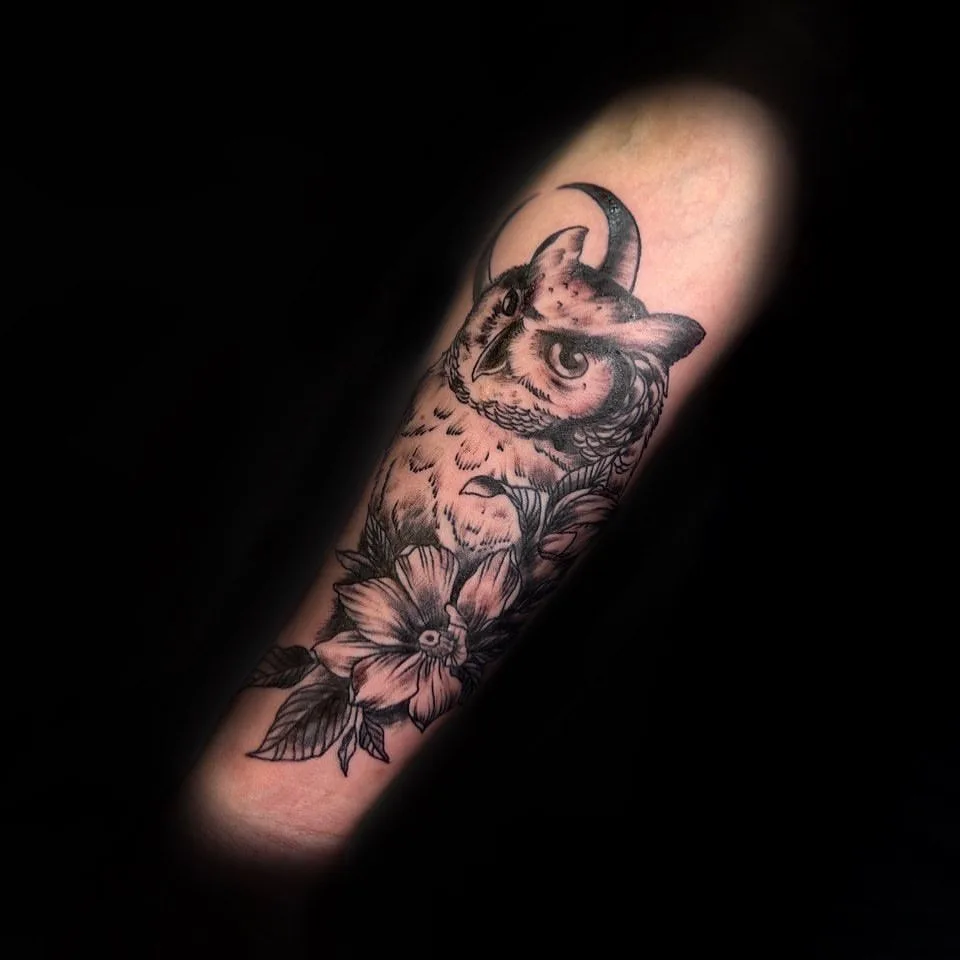
Native American traditions: the owl as omen
There is no single Native American view of the owl. What follows is documented in specific nations, and the beliefs belong to those communities.
Among the Diné (Navajo), the owl is tied to the ch'į́įdii, the part of a person that stays behind after death and carries their wrongs. An owl calling near the home is heard as that presence, and an owl on the roof is a warning that calls for a ceremony. Apache traditions are close: owls carry the ghosts of the dead. Among the Cherokee, the owl stayed awake through the seven nights of creation and was given sight in the dark. That same power made it the bird of witches, and its cry near a sick person was a bad sign. The Seminole tell of the stikini, a witch who becomes a great horned owl at night.
The counter-reading exists. The Hopi katsina Mongwu, the Great Horned Owl, is a warrior figure who disciplines the clowns when they get out of hand: an enforcer, not a ghost. But the weight of the record is on the omen side.
For anyone outside these nations: draw on the general reading if it speaks to you (the bird that sees death coming) and leave the specific figures, regalia and ceremonies alone. Mongwu on someone who is not Hopi is not a tribute. It is a costume.
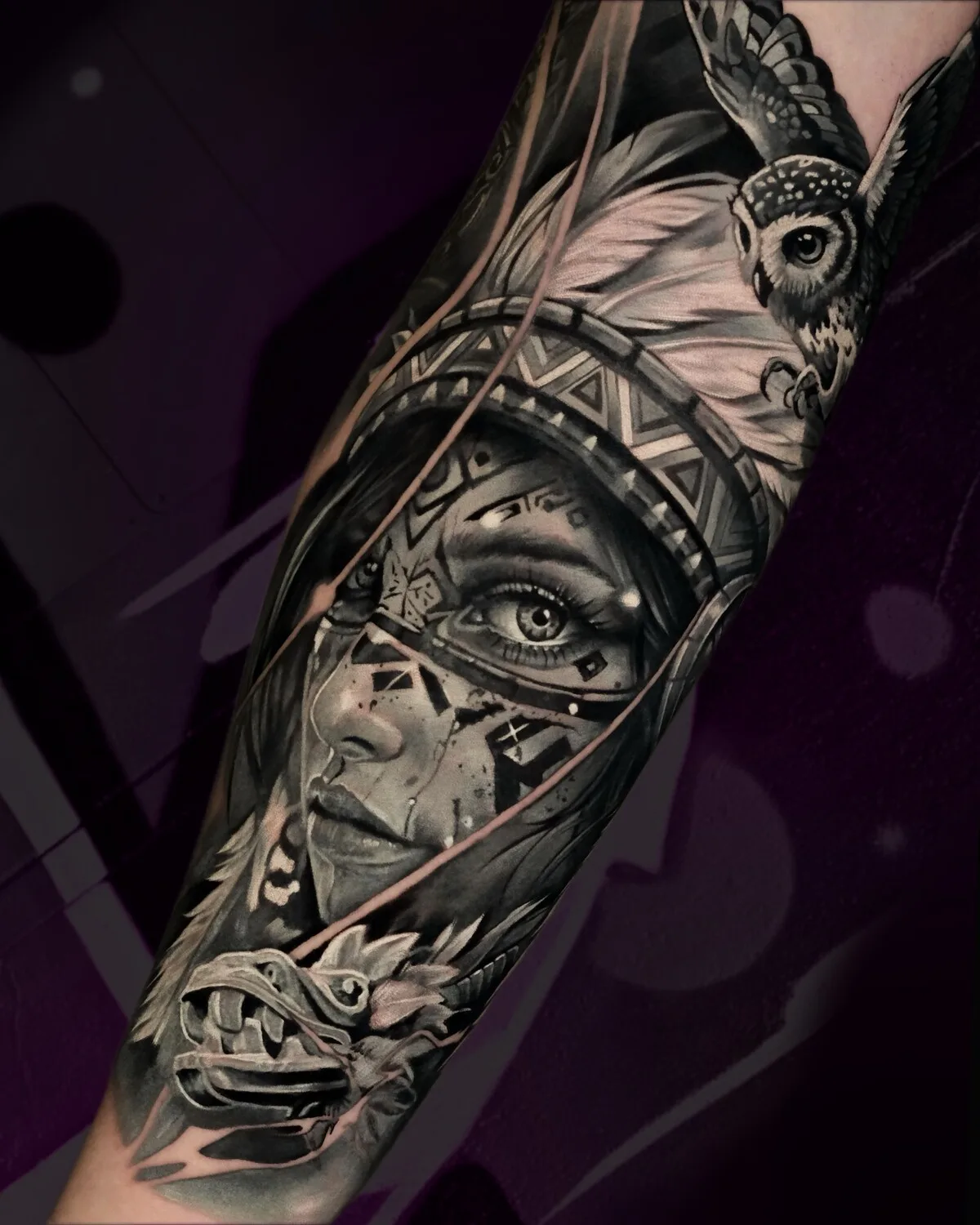
Japanese tradition: fukurō and the pun that made it lucky
Japan's owl luck is not built on myth. It is built on a pun.
The Japanese word for owl, fukurō, is normally written with the single character 梟. But it can also be spelled phonetically as 不苦労, fu (no) + kurō (hardship): "a life without trouble". A second spelling, 福来郎, reads as "luck comes"; a third, 福籠, is "a basket of fortune". None of these is the etymology; all of them are why owl figurines sit by the till in Japanese shops next to the beckoning cat.
The clearest public example is Ikebukuro in Tokyo, whose name is close enough to fukurō that the district adopted the bird: the bronze statue Ikefukurō outside the station is one of the city's standard meeting points.
Hokkaido carries a separate and older tradition. For the Ainu, Blakiston's fish owl, the largest owl on earth, is Kotan-kor-kamuy, "the god who protects the village". Two positive owls: one from a joke, one from a river god.
As a tattoo, the fukurō belongs in Japanese composition (maple leaves, a moon, water or wind bars) and reads as fortune and freedom from worry. It is the opposite of the Roman bird, and the same animal.
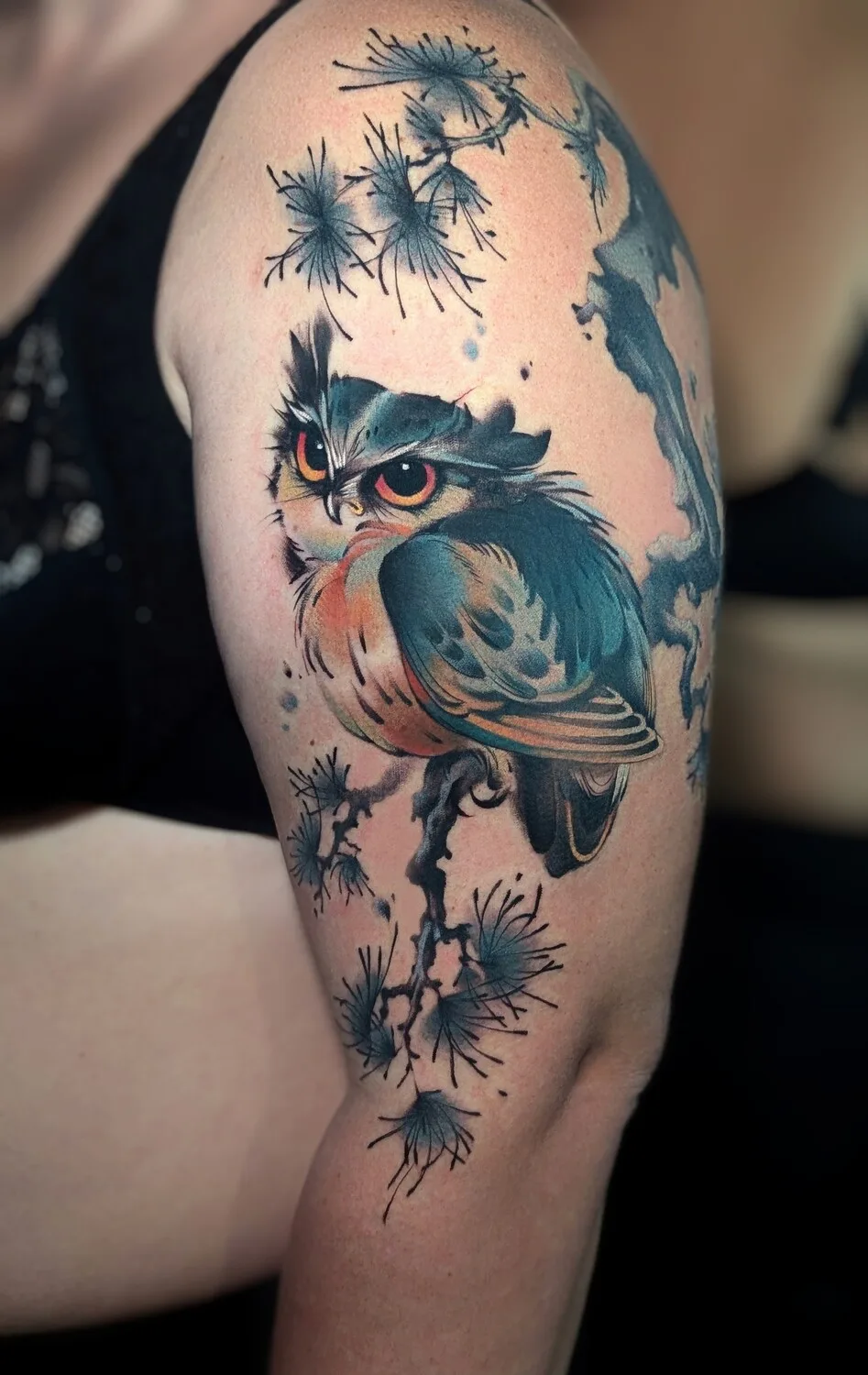
Medieval Europe: the owl and the witch
The Latin word for the screech owl is strix. It is also the Latin word for a witch (Ovid's Fasti describes striges as owl-like women who fly at night and feed on children), and the word outlived Rome as the Italian strega and the Romanian strigoi. The owl and the witch have shared a name for two thousand years.
Medieval bestiaries made this theological. The owl "loves darkness and flees the light", and so it became the standard image for the sinner and the heretic and, in a strand that is ugly and well documented, for the Jew who refuses the light of Christ. Small birds mobbing an owl in daylight, painted in dozens of manuscripts, was read as the righteous driving out the enemy of the faith.
In the countryside the response was practical: across England, France and Germany, into the nineteenth century, a dead owl was nailed to the barn door to keep away lightning, hail and the evil eye. The omen turned against itself. Shakespeare's audience knew the code: in Macbeth the owl is "the fatal bellman" that shrieks the night Duncan is murdered.
Painters kept the bird: Hieronymus Bosch put an owl into almost every panel he made, and Goya's "The Sleep of Reason Produces Monsters" shows the dreaming artist swarmed by owls and bats. That is why an owl in black and grey, eyes wide, reads as ominous to a European viewer without any prompting.
Hindu mythology: Lakshmi's unlikely vehicle
In Bengal and much of eastern India, the goddess of wealth rides an owl. Lakshmi's vahana, the animal vehicle every Hindu deity has, is the ulūka, shown as a white owl at her feet in Kalighat paintings and in the clay figures made for the Lakshmi Puja. Bengali households call the bird Lokkhi pecha, "Lakshmi's owl", and a white owl at the house in autumn is the goddess arriving with it.
The pairing is deliberately uncomfortable. One reading: wealth comes in the dark, to those who can see when others cannot. The other: the owl is dazzled and helpless by day, and a person blinded by wealth is exactly that bird. Lakshmi rides her own warning.
Hindi uses ullu, owl, as an everyday word for a fool, the flat contradiction of Athena. And the link between the owl and money has a cost for the bird: the wildlife-trade monitor TRAFFIC documented in its 2010 report "Imperilled Custodians of the Night" that owls are trapped and sacrificed around Diwali in parts of northern India by people hoping to capture the goddess's luck.
For a tattoo the Lakshmi owl brings a lotus, coins and a white bird, and says prosperity with a caution built in. It is religious imagery, and not everyone raised in the tradition is comfortable seeing the goddess on skin; an artist who knows the iconography will handle it with more care than one who found a picture online.
Tattoo styles that suit the owl
Realism. The owl may be the best bird subject realism has. The facial disc, the layered feather edges, and above all the eyes: an owl's eyes carry a realistic piece the way a wolf's do. The species is a style choice in itself: the barn owl's heart-shaped white face reads as ghostly and clean; the great horned owl's tufts and yellow glare read as imposing. Realism needs space, and an artist who has done feathers rather than fur; the two are different technical problems.
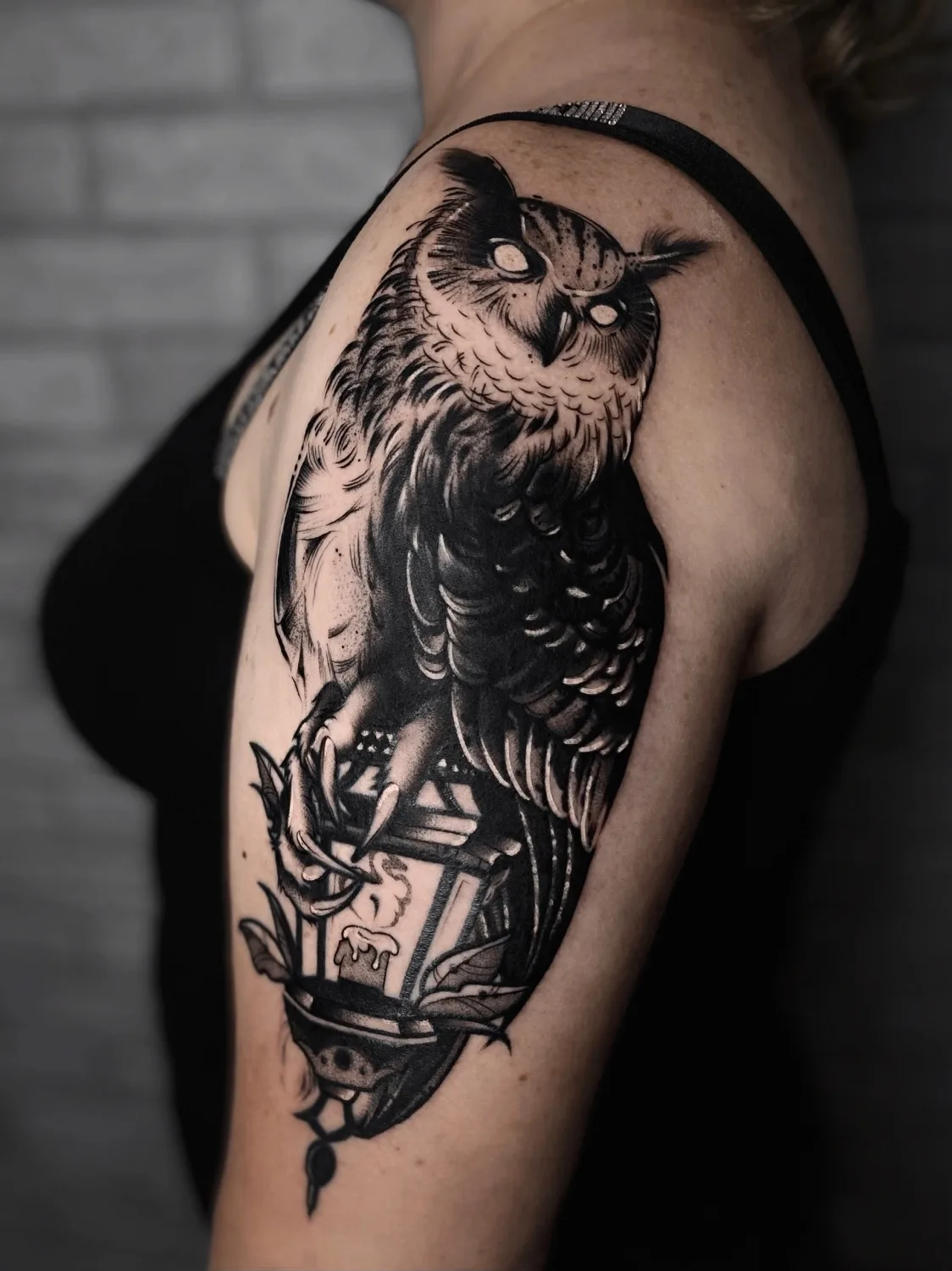
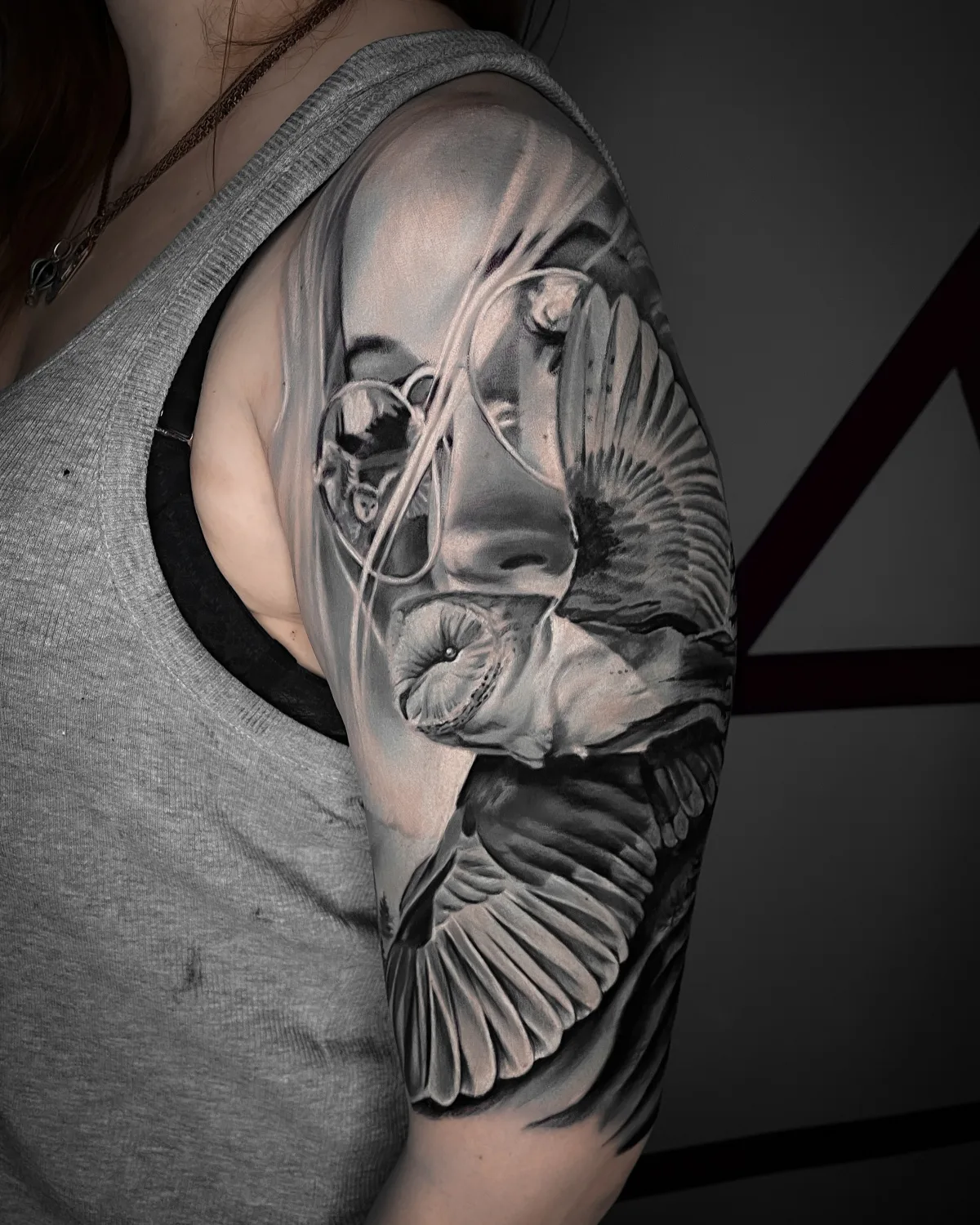
Black and grey. The natural home for the omen reading. Stripping colour pushes the owl toward the Bosch and Goya bird, a pale face out of shadow, and smooth grey gradients suit feather texture better than almost any other animal's coat.
Blackwork and dotwork. Solid black owls have gravity. Dotwork builds the bird out of density rather than line, which gives it the look of emerging from the dark and solves the scaling problem, since dot density can be tuned to the size of the piece. Blackwork with an ornamental surround is the usual sleeve solution.
Geometric. The owl's face is already geometry: a symmetrical disc, a triangle of beak, two circles. Geometric treatments (the owl built from facets, or a realistic head dissolving into linework) use that, and they work at medium sizes where realism starts to fail.
Neo-traditional. Bold outline, saturated colour, decorative accessories: keys, crystals, moons, skulls, roses. This is where most colour owl tattoos live, and it ages better than realism because the line carries the image. Larger eyes and a rounder head make the neo-traditional owl the friendliest version of the bird.
Japanese. Rare in the West and the correct home for the fukurō. Japanese composition treats the owl as part of a scene, with a branch of maple, a moon or wind bars, rather than a floating portrait, and the owl's compact body fits the flowing layout well.
Watercolour and sketch. The owl in flight, colour bleeding out from a line drawing, is a common request and a fragile one: colour without a line base spreads and fades faster, so agree on touch-ups before you start.

Watercolor owl tattoo with snowflakes by @misspank

Watercolor owl eye tattoo with landscape by @tattoosigal
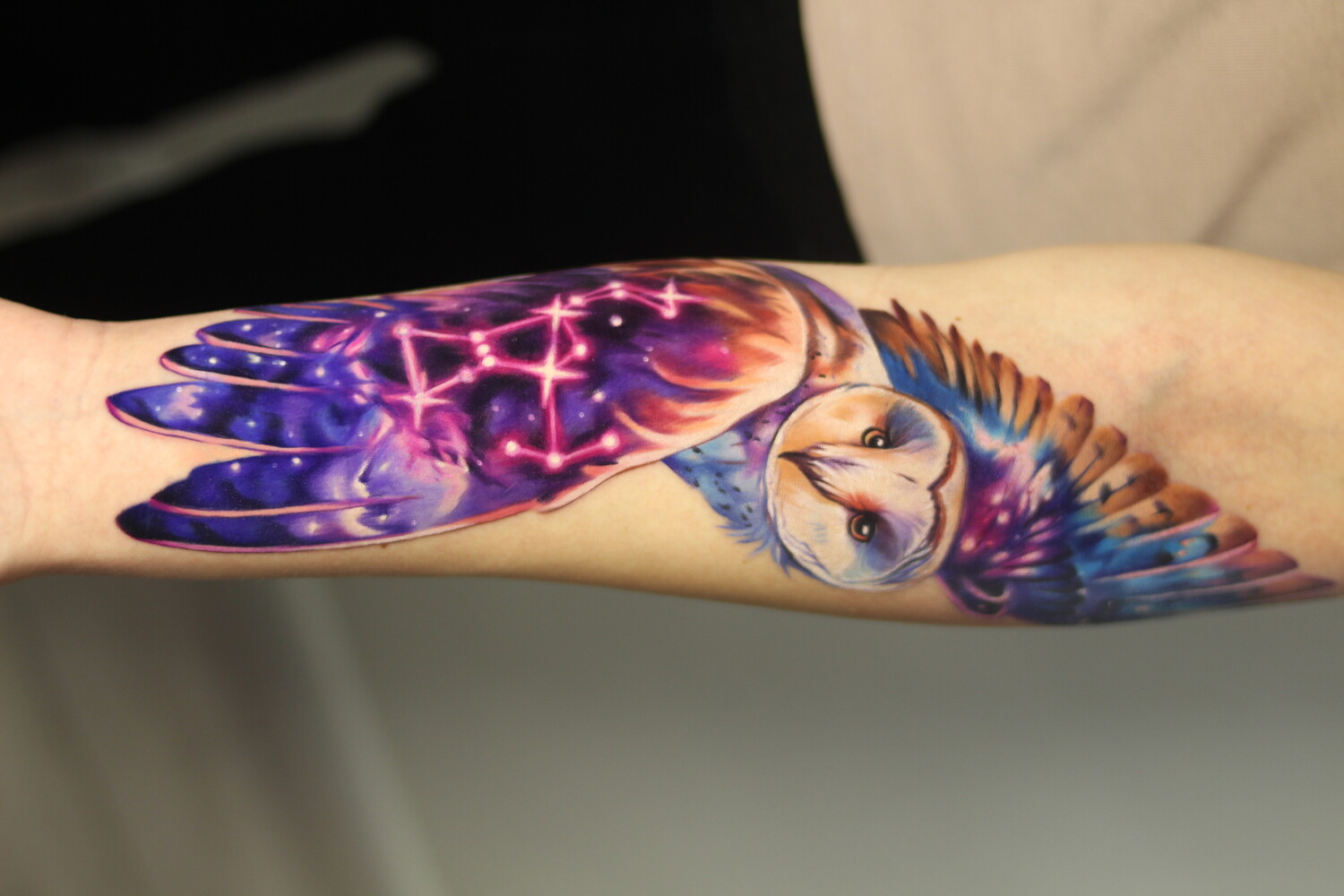
Watercolor owl tattoo with galaxy wing by @Hakisha

Watercolor owl tattoo on the calf by @mazalovatattoo

Neo-traditional owl tattoo on a branch by @cjtat1

Geometric pop-art owl tattoo with bold colors by @hurjaesae
To see how these look side by side on real skin (the same bird as a chest portrait, a geometric sleeve, a thigh piece with feathers), the owl motif page collects the work by style, placement and colour.
Placement and scale
Owl compositions divide into two shapes, and the shape picks the placement: a perched, forward-facing owl is tall and narrow; an owl with spread wings is wide. Match the shape to the body part first.
Forearm. The default, and for good reason: a perched owl fits the forearm's proportions almost exactly, with room for a branch below and a moon above. Owl-and-rose and owl-and-skull pairings on the forearm are among the commonest owl tattoos.
Chest. The spread-wing owl across the chest is the dramatic version: symmetrical, the face on the sternum, wings following the collarbones. It is large, painful, and where the Athena or Lakshmi readings look most like an emblem. A single perched owl on the sternum works for people who want the vertical shape without the wingspan.
Thigh. Increasingly the placement of choice for larger owl pieces: a big flat surface, moderate pain, full control over who sees it. A realistic owl with feathers scattered around it, or an owl set into a forest scene, needs the thigh's area to breathe.
Upper arm and shoulder. The shoulder's curve suits a perched owl looking outward, and the piece extends into a half sleeve later.
Back. Maximum canvas for a scene: the owl in flight over a landscape, or a Japanese composition with the bird in a maple tree. Multi-session, expensive, and the only placement that gives a wide-winged owl its full span.
Small placements. Wrist, ankle, behind the ear, the back of the hand. A silhouette or linework owl survives at three or four centimetres; a detailed one does not.
Scale is a separate decision from location. The facial disc needs about eight centimetres across before the feather detail that makes a realistic owl convincing can survive healing; below that, fine feather work closes up into a grey shape within a few years. Under eight centimetres the honest options are a silhouette, a geometric build, or a neo-traditional owl with a heavy outline. Artists will say this if asked directly. Ask directly.
Design variations and what they change
Small choices inside an owl design move the meaning further than switching styles does, because the accessories decide between readings that contradict each other.
Owl and skull. The most direct memento mori in tattooing: the bird that sees death, perched on death. It reads as mortality accepted rather than feared, and it is the commonest pairing for people marking a loss or a near miss.
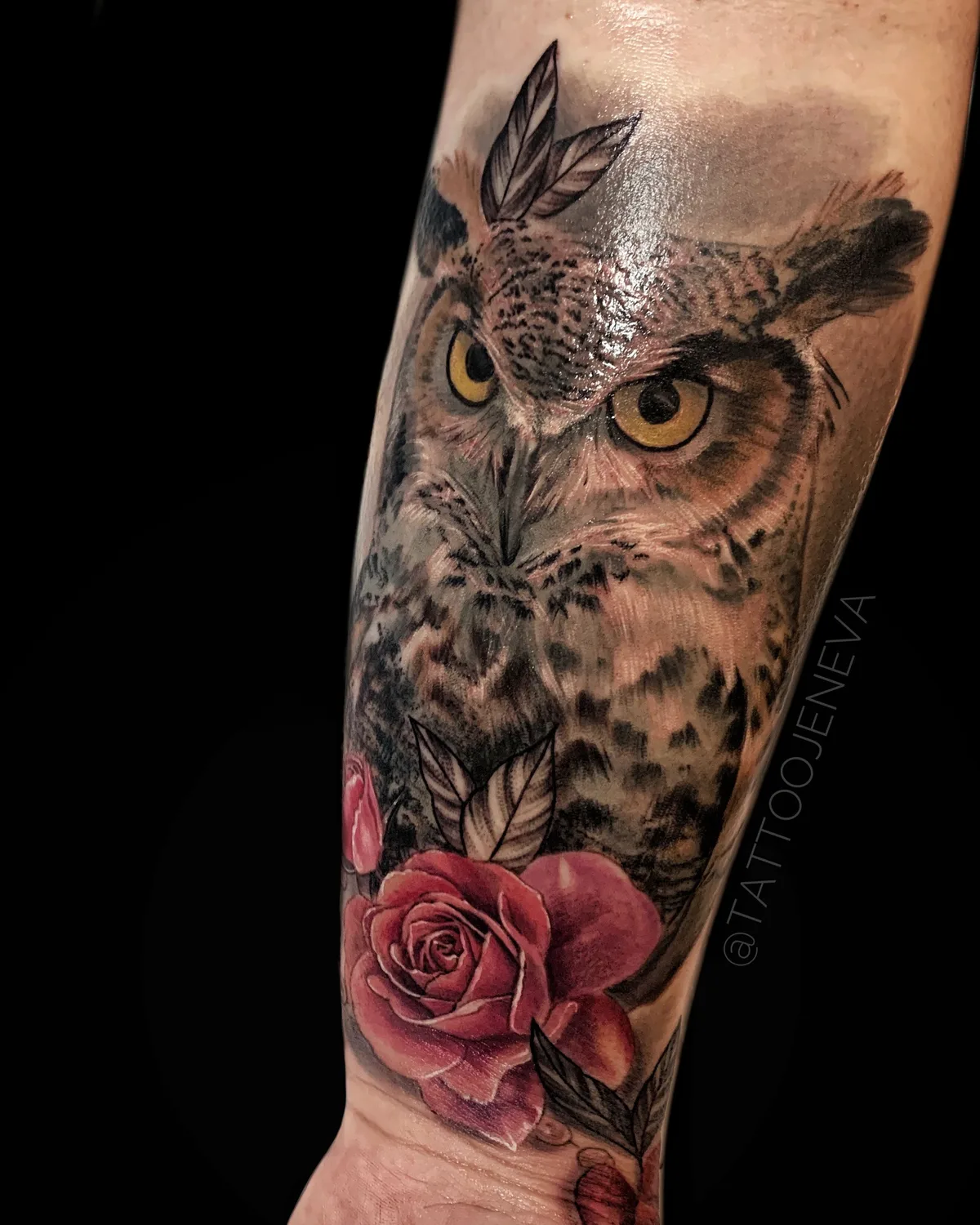
Owl and crescent moon. The Athenian coin had one; every neo-traditional owl has one. As a full moon behind the head it reads as mystical; as a thin crescent beside the bird it quotes Athens directly.
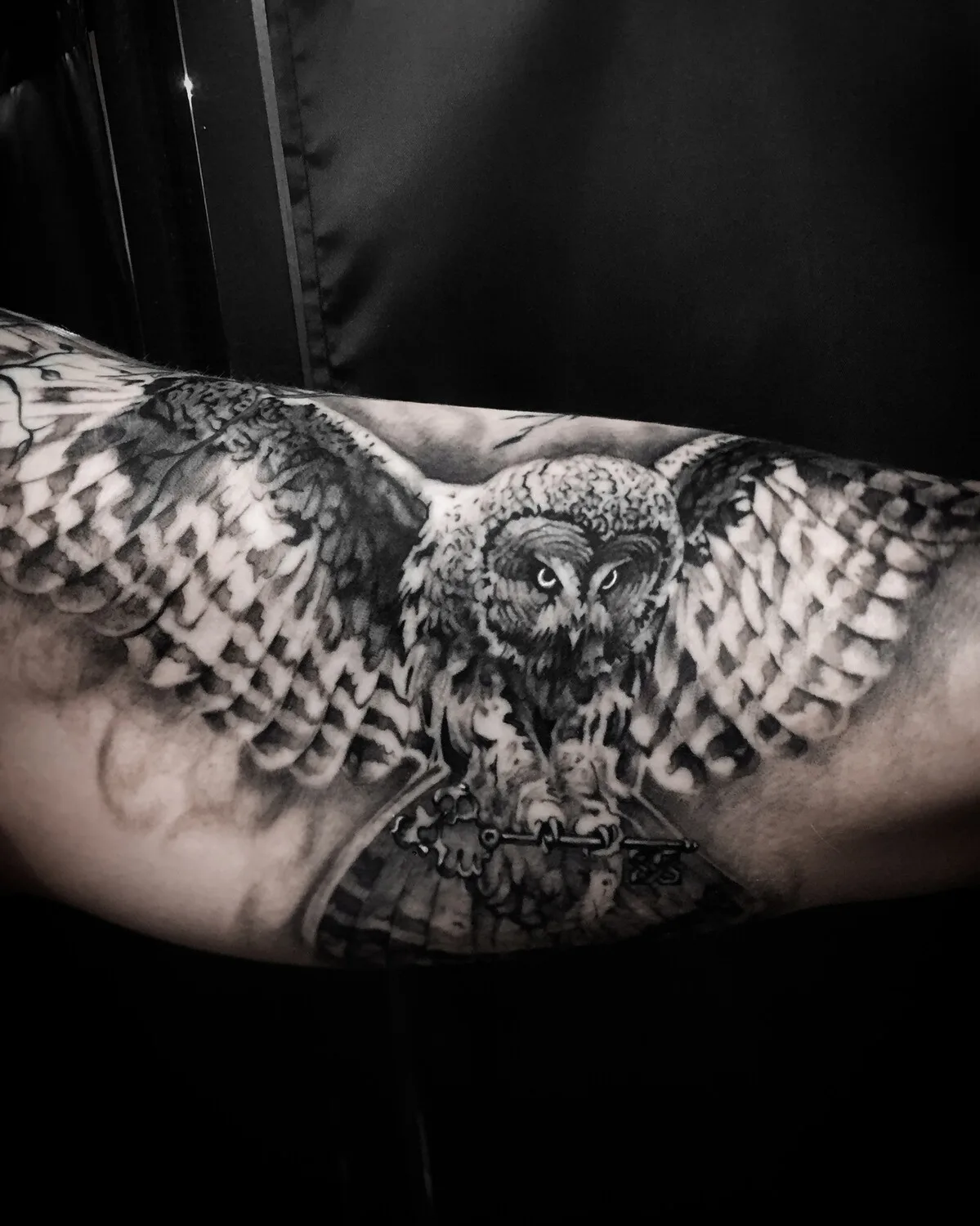
Owl and key. The owl holding a key in its talons is the knowledge reading made literal: access to something locked. It comes from Hermetic and occult imagery, where the owl guards hidden wisdom, and it suits the forearm and the upper arm.
Owl and a woman's face. An owl perched on a woman's head, or a face dissolving into feathers, turns the bird into a statement about the wearer: the wise or witch-like feminine, Athena and the strix at once. A frequent illustrative theme on the thigh.
Species. A barn owl means something different from a great horned owl. The barn owl, pale, heart-faced and silent, carries the ghost reading and the purity reading at the same time and is the choice for a light piece. The great horned owl is the aggressive version: tufts, glare, talons. The snowy owl has been the Hogwarts owl since Harry Potter, and a snowy owl with a letter in its beak is a Harry Potter tattoo whether or not you intend it.
Eyes. The detail that decides everything. Wide-open yellow eyes in a black and grey face pull every viewer to them and read as watchfulness or confrontation. Half-closed eyes read as calm. Closed eyes read as memorial. Eyes looking out of the frame instead of at the viewer soften the whole piece.
Flight or perch. A perched owl is a portrait: presence, identity, the observer. An owl in flight, head-on with talons forward, is a hunt: intent, arrival, the message being delivered. Flight designs also need double the width, which matters for placement.
Choosing an artist for an owl tattoo
Feathers are the problem. An owl is a study in layered, overlapping edges (the disc, the wing coverts, the barred tail), and an artist who has not solved feathers produces a bird that reads as a soft brown blob at conversational distance. Fur skill does not transfer.
Three checks before you book. Ask for healed photographs: fresh feather work photographs beautifully and tells you nothing about how the fine edges settle. Look for owls specifically in the portfolio, or at least other raptors: an eagle proves feathers, a swallow does not. And match the style to the artist rather than asking a blackwork specialist for photorealism. Bring photographs of real owls rather than screenshots of other people's tattoos, and if you are quoting a tradition (the Athenian coin, the fukurō, the Lakshmi owl), say so, because it changes the composition.
The tattoo artist directory filters by style, country and city, and seeing how differently the same bird is handled is the fastest way to know what you want. Nick Noonan in Auckland builds a colour realism owl as a chest piece where the face carries everything and nothing else is added. Paul Davies takes the opposite road: a blackwork owl set inside geometric and ornamental work with an eye motif, running the length of a sleeve, so the bird is one part of a pattern. Yushi in San Diego pairs a neo-traditional owl with a skull and an eye on the calf: the memento mori in bold colour. Jim Leclerc in Montréal renders the bird in black and grey realism with loose feathers drifting around it on the thigh. Four approaches to one animal, and the choice between them decides more than size or placement will.
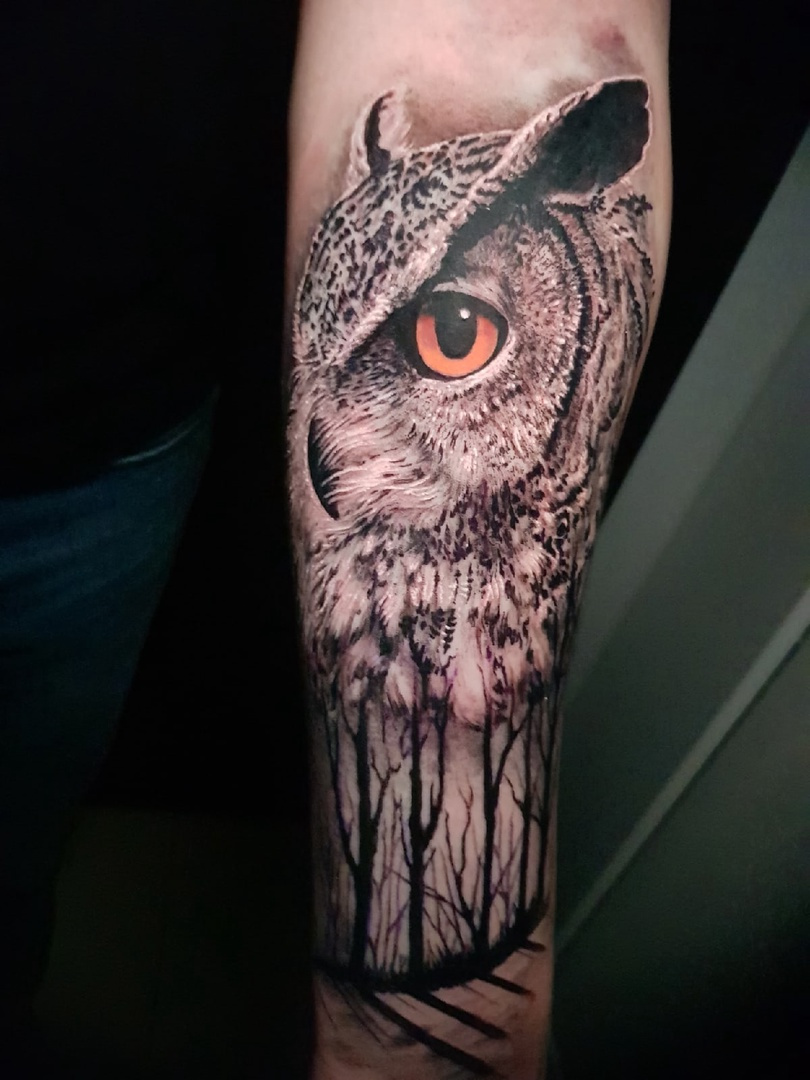
Owl head tattoo with forest scene below by @chikai72
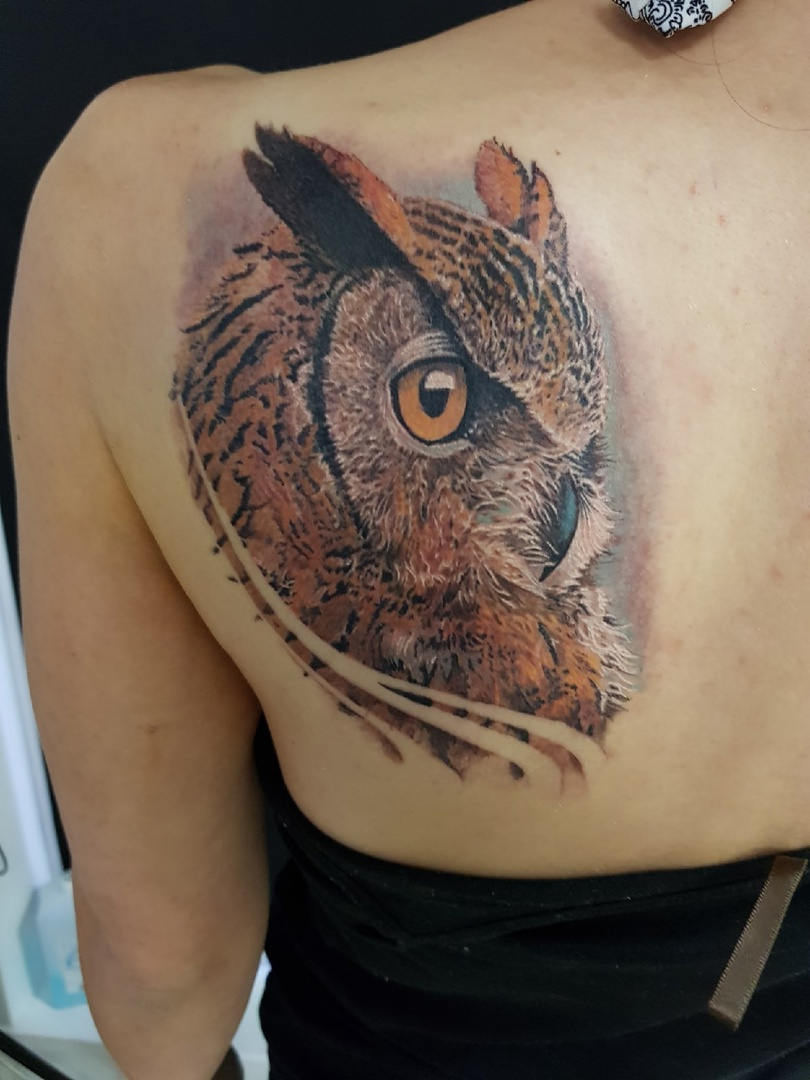
Color owl head tattoo with detailed feathers by @chikai72
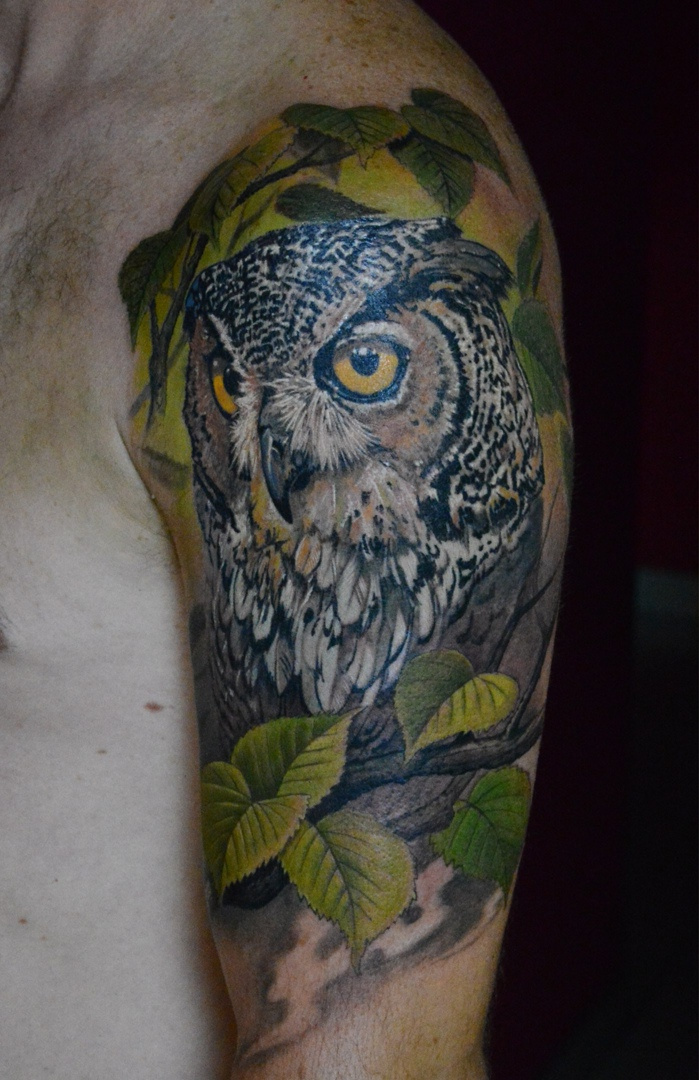
Realistic color owl tattoo with autumn leaves by @chikai72
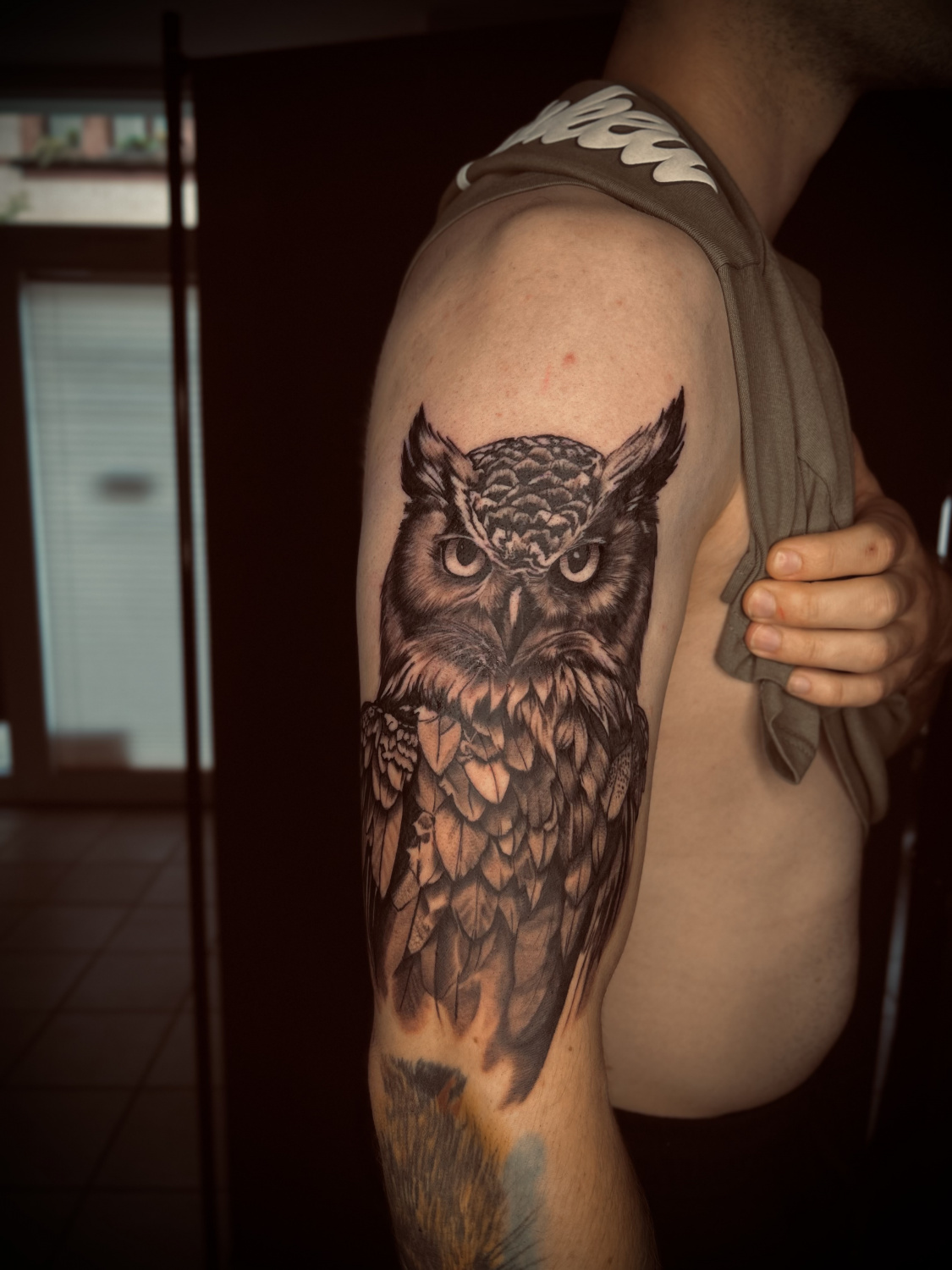
Realistic owl tattoo on the upper arm by @bienen_stich_olga

Close-up owl face tattoo in b&g by @Gregorygpta

Owl eye tattoo with orange and yellow irises by @postoronniy

Realistic owl face tattoo with orange eyes by @guzman_tattoo
Aftercare and how an owl tattoo ages
Standard aftercare applies: keep it clean, moisturise lightly, leave the scabs alone, no pools and no direct sun until the surface has closed. Two to three weeks for the skin, a few months for the deeper layers.
Owls have one specific ageing risk, and it is what makes them beautiful: fine feather detail. Thin light lines, the barring on the wings, the soft edge of the facial disc: all of it blurs first, and a piece that depends on it alone will read as a grey shape in five to ten years. The fix is structural: strong contrast under the detail, a clear silhouette, and an outline that would still make an owl if every fine line vanished.
White ink, which barn-owl and snowy-owl designs lean on, is the least stable pigment in the kit and yellows within a few years; a good artist uses the skin itself for the white. And yellow eyes, the detail everyone wants, are made of the pigment that fades fastest, so a colour owl can end up staring out of a grey face after a decade unless the artist has built the eye on an orange or brown base.
Sunscreen on an exposed forearm owl does more for its twenty-year life than any product sold for tattoos. Expect a touch-up in the first year for fine feather work.
Frequently asked questions
Is an owl tattoo bad luck?
Depends who is looking. In Japan the owl is a good-luck charm because its name puns on "no hardship"; in Bengal it carries the goddess of wealth; in Roman, medieval European, Arab and many Native American traditions it announces a death. The design usually settles it: a fukurō under a maple leaf will not be mistaken for an omen.
What does an owl with a skull tattoo mean?
Mortality, seen clearly. The owl sees in the dark and, in half the world's traditions, sees death coming; the skull is death itself. Together they read as memento mori: a loss, a near miss, or acceptance.
What does an owl tattoo mean in Native American culture?
There is no single answer. Among the Diné (Navajo), Apache and Cherokee the owl is tied to ghosts, witchcraft and death; the Hopi katsina Mongwu is a warrior enforcer. The specific imagery belongs to those nations; the general reading, the bird that sees death, is what an outsider can honestly draw on.
What does a barn owl tattoo mean?
The barn owl's pale heart-shaped face and silent flight made it the ghost owl of English folklore and also the clean, white version of the bird: spirit and purity at once. Realistic barn owls need bare skin rather than white ink to age well.
What does an owl tattoo mean for a woman?
The same as for anyone, with one extra layer: two of the strongest owl traditions belong to goddesses, Athena and Lakshmi, and a third, the European strix, is the owl-witch. Nothing about the symbol itself is gendered.
How much does an owl tattoo cost?
Size and style decide it. A small linework owl is a single short session; a realistic forearm owl is one long session or two; a chest piece with spread wings is a multi-session project. Ask for a quote on the whole piece rather than an hourly rate, and treat a cheap quote for feather realism as a warning.