Some animals become symbols because people decide to make them one. And then there are animals that simply force the issue. The tiger is the second kind. When a 300-kilogram predator walks through dense forest without a sound, it doesn't need mythology to build its reputation. The reputation builds itself.
But here's what makes the tiger genuinely fascinating as a tattoo subject: three major cultures looked at the same animal and saw three completely different things. Japan saw a protector. The West saw a fighter. Korea saw something almost comedic, a wise, bumbling figure that teaches through humor. Same stripes, same teeth, same raw physical power. Totally different readings. That range gives the tiger tattoo a depth most animal symbols can't touch.
Japan: The Tiger as Protective Guardian
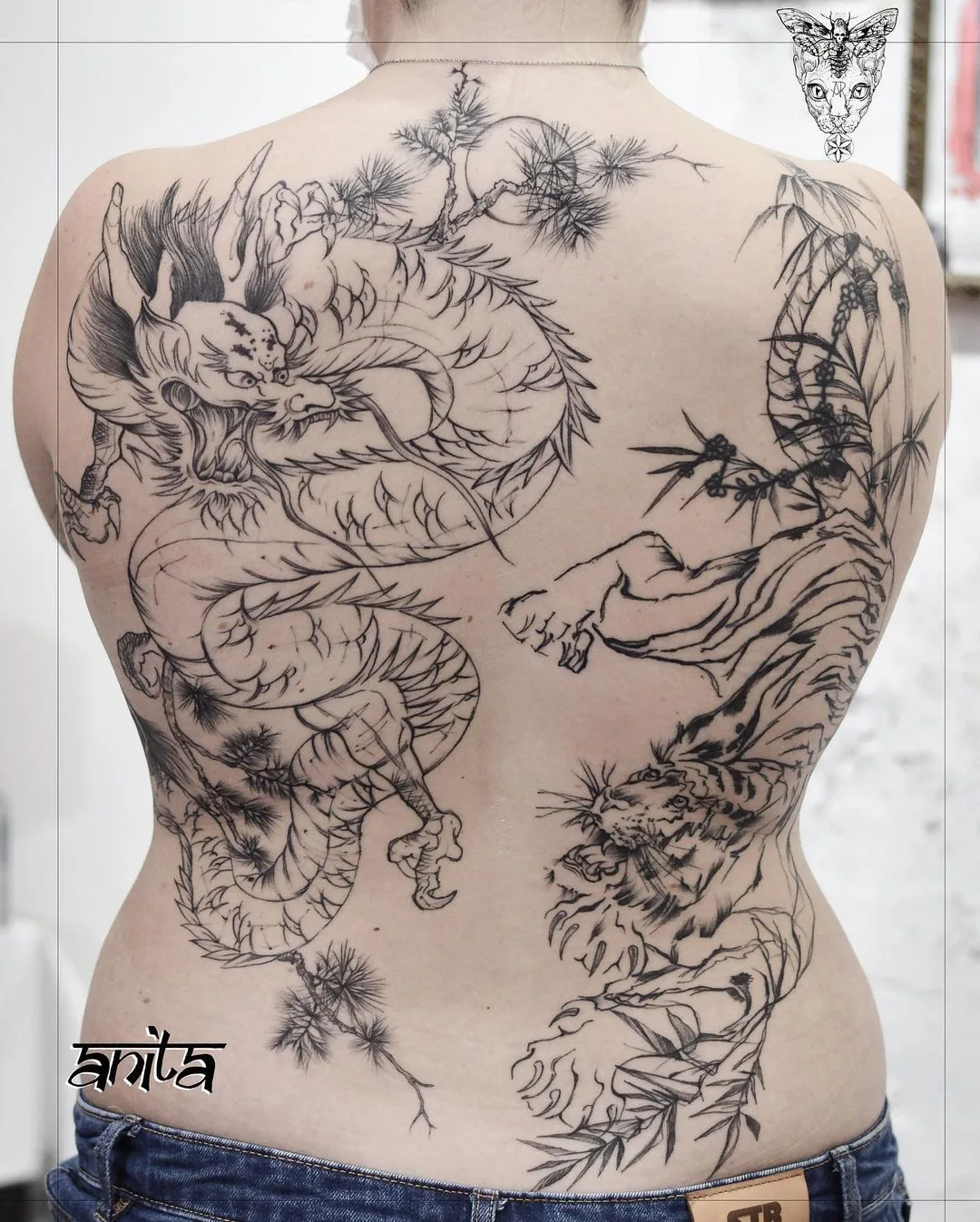
In Japanese irezumi, the tiger holds a position of real importance, comparable to the dragon, which is saying something. The two are often depicted together, representing opposing but complementary forces. The dragon controls wind and sky; the tiger commands earth and storms. When they appear as a pair, the image represents the balance between celestial and terrestrial power. It's not a fight scene, though it might look like one. It's a conversation.
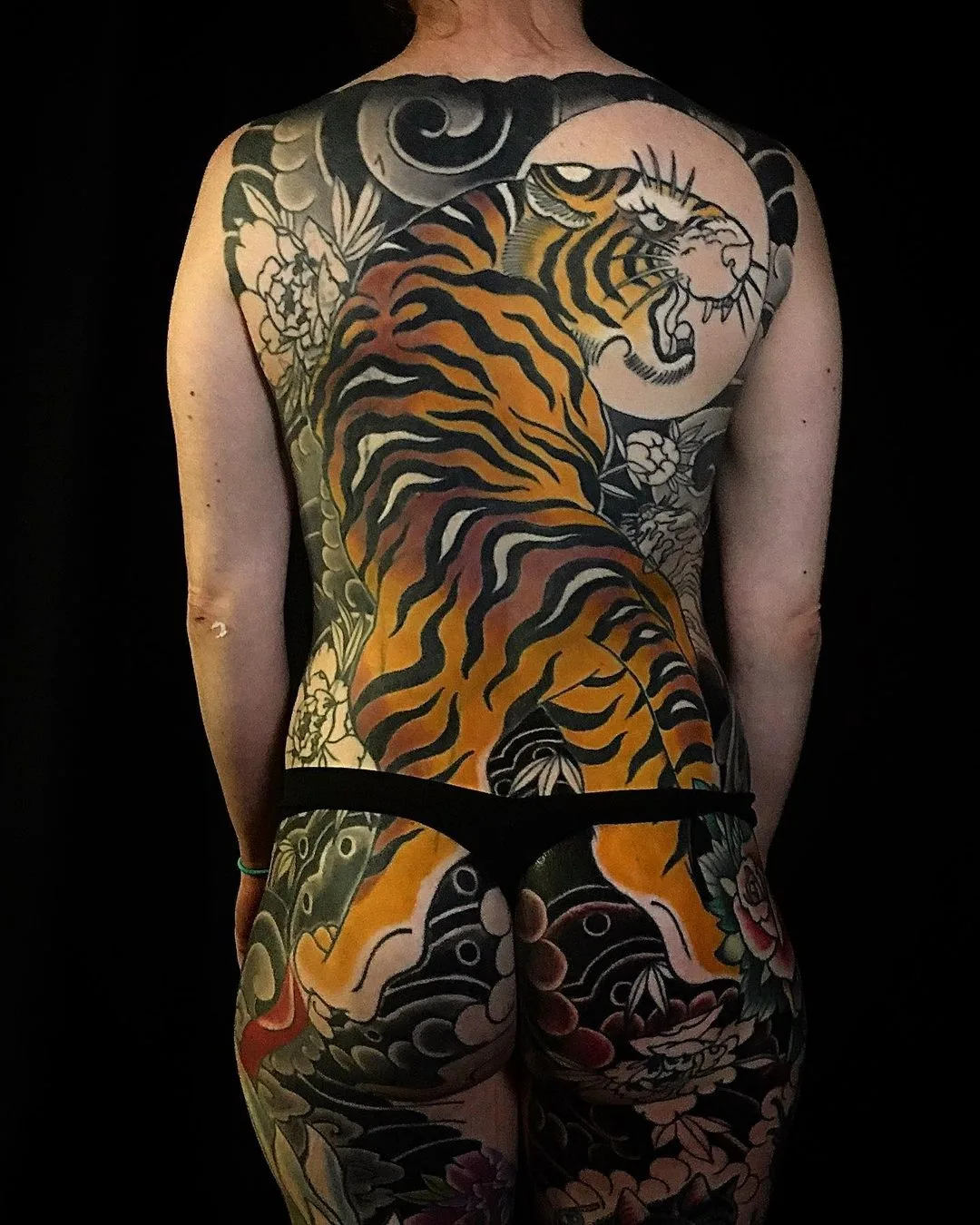
The Japanese tiger, torais almost always shown in motion. Crouching, leaping, prowling through bamboo. That bamboo detail isn't random. In Japanese art, the tiger-and-bamboo combination represents resilience paired with flexibility: the bamboo bends but doesn't break, and the tiger strikes but chooses its moments. Together they suggest intelligent strength, powerful without being reckless, patient without being passive.
Wind is the other element that consistently appears with the Japanese tiger. Those swirling bars behind the figure in traditional irezumi? They represent wind, or more precisely, the force the tiger generates simply by moving. The idea is that the tiger doesn't just pass through the world, it displaces air, changes the atmosphere around it. Come to think of it, that's a pretty compelling metaphor for the kind of personal presence some people spend a lifetime trying to cultivate.
Japan doesn't actually have native tigers. The animal entered Japanese art and symbolism through Chinese and Korean cultural influence, filtered through Buddhism. Despite being foreign to the islands, the tiger was fully absorbed into the Japanese visual vocabulary, probably because the concept was too powerful to set aside, regardless of whether the actual animal ever roamed local forests. What the Japanese artistic tradition did with that imported symbol, though, became distinctly its own.
China: The White Tiger and the Four Sacred Beasts
Chinese tiger symbolism runs deeper than most people realize. The tiger is one of the Four Sacred Beasts (Si Ling), each assigned to a cardinal direction and a season. The White Tiger of the West, Baihu, guards the western horizon and corresponds to autumn and the element of metal. A cosmic guardian, essentially. Not just a powerful animal but a fundamental structural element of how the Chinese organized the universe itself.
That sounds abstract, maybe even academic. But as a tattoo, the White Tiger carries genuine weight in Chinese cultural context. It's protective in the largest sense, not just guarding a person, but participating in the maintenance of cosmic order. There's a complexity here that's easy to miss, though. In some Chinese folk traditions, the white tiger is also associated with death and the afterlife, because the west is where the sun sets. Endings. Transitions. So the protector is also, in a certain reading, an escort to what comes next.
The Chinese character for "king" (王) naturally appears in a tiger's forehead markings, three horizontal stripes crossed by one vertical line. This coincidence reinforced the tiger's status as the king of all land animals in Chinese culture for centuries.
The Chinese character for "king", wang (王), appears naturally in the stripe pattern on a tiger's forehead. Three horizontal lines crossed by one vertical. The Chinese noticed this centuries ago, and it reinforced the tiger's status as the king of all land animals. The dragon rules the sky; the tiger rules the earth. A clean division of power, and one that has held up across centuries of art and literature.
In Chinese military culture, the tiger has represented courage and martial prowess for millennia. Tiger imagery appeared on shields, banners, and armor. Brave soldiers were called "tiger generals." The association between the tiger and warfare is more direct in China than in Japan, less philosophical, more plainly about combat effectiveness. As a tattoo, this military reading appeals to people who want the tiger to mean exactly what it looks like: strength, dominance, the capacity for decisive action when it counts.
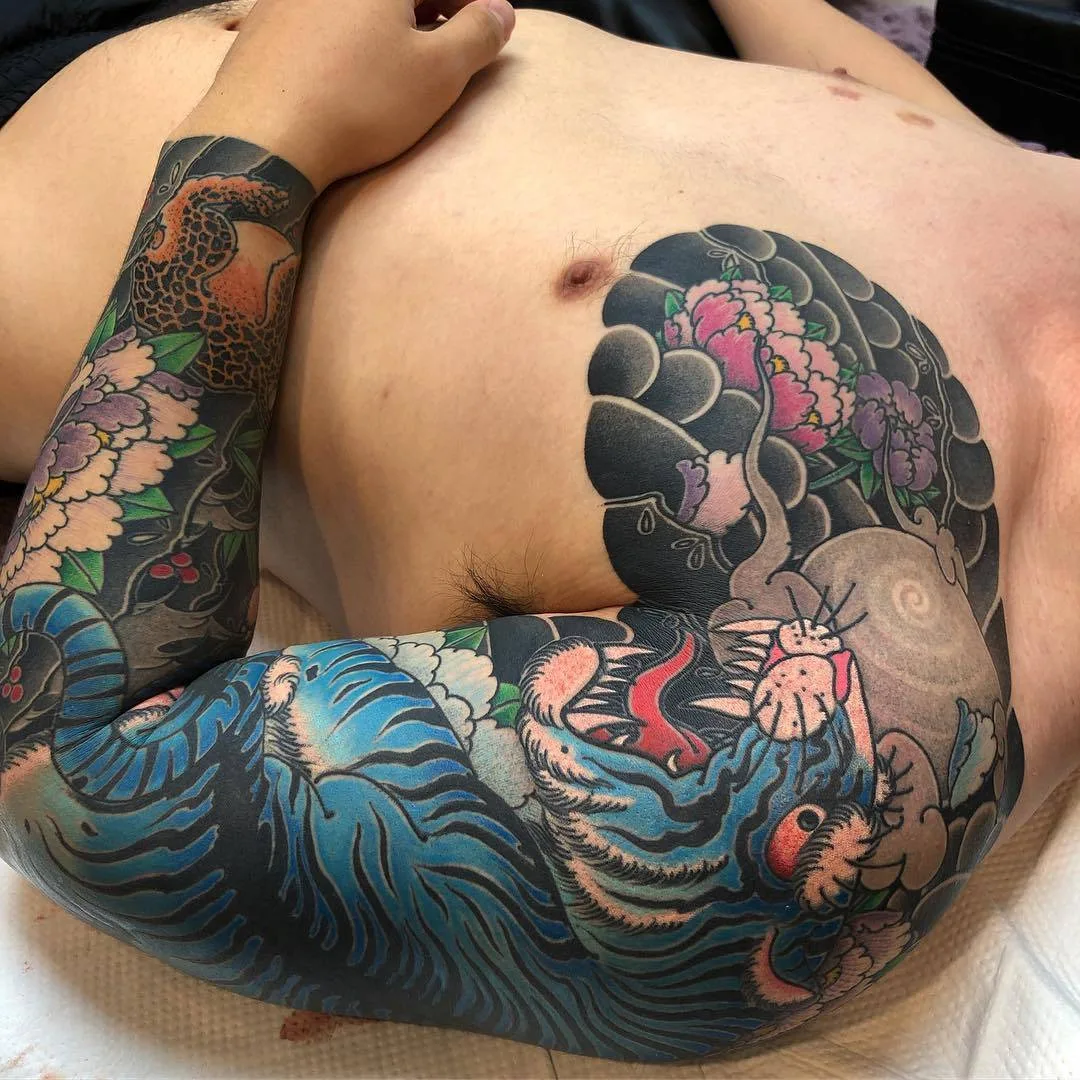
There's also the folk belief that tigers ward off evil spirits. Tiger amulets and tiger-decorated children's clothing have been common throughout Chinese history. Parents would dress babies in tiger hats and tiger shoes to keep malevolent forces away. That dimension, the tiger as fierce guardian of the vulnerable, adds an interesting layer to the symbol that doesn't always get mentioned.
Korea: The Minhwa Folk Painting Tiger
And then there's Korea. This is where the tiger gets interesting in a way most people genuinely don't see coming.
Korean folk art, minhwadepicts the tiger in a way that, to put it plainly, catches most people off guard. The kkachi horangi paintings, those magpie-and-tiger compositions, show a tiger that looks almost goofy. Wide eyes, exaggerated proportions, a facial expression closer to baffled than threatening. Beside it, perched in a pine tree, a magpie, small, quick, relentlessly chatty, seems to be enjoying the whole situation at the tiger's expense. The magpie represents ordinary people; the tiger represents authority or the aristocracy. And the joke, told again and again across hundreds of these paintings, is that the magpie is winning.
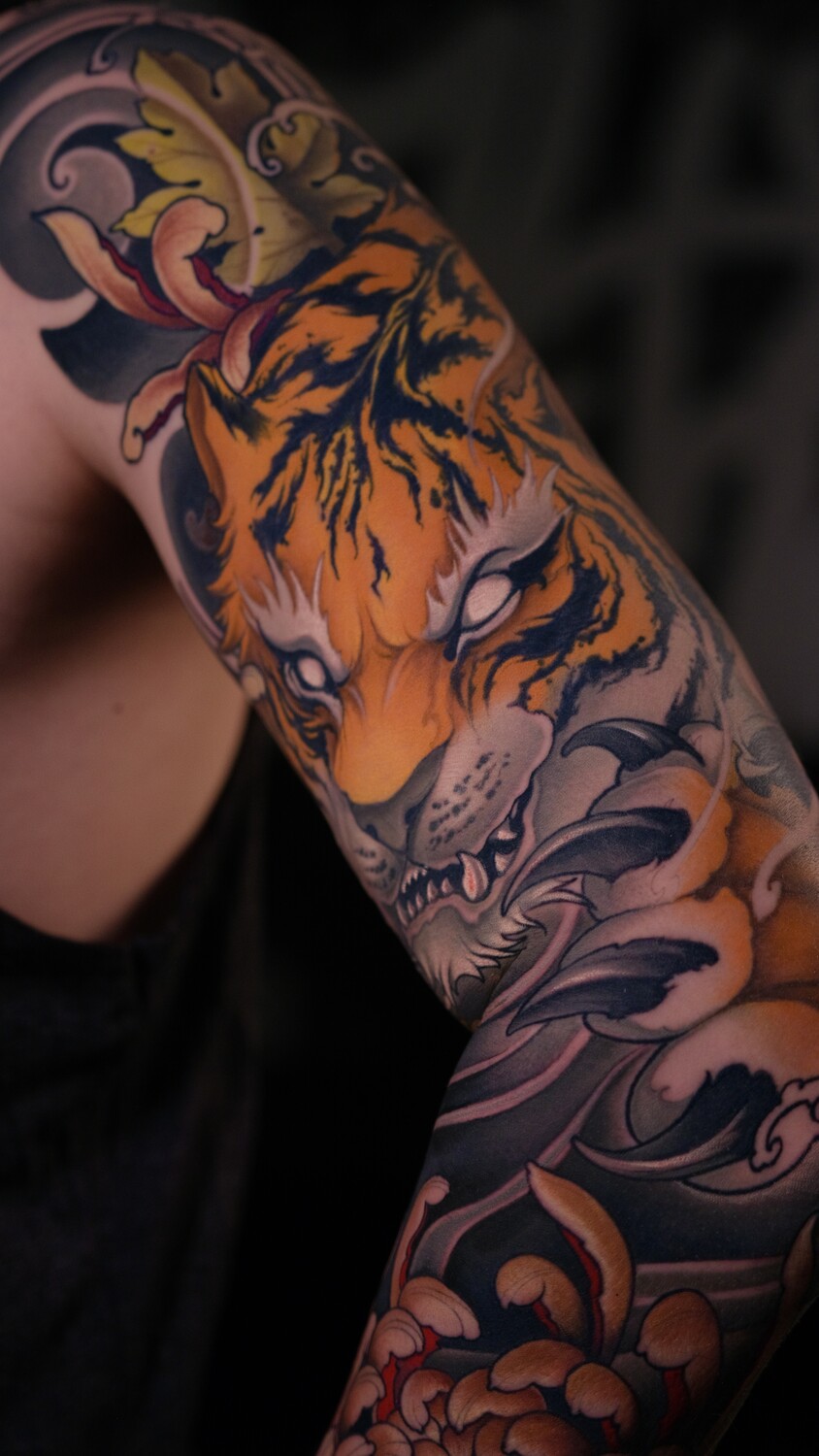
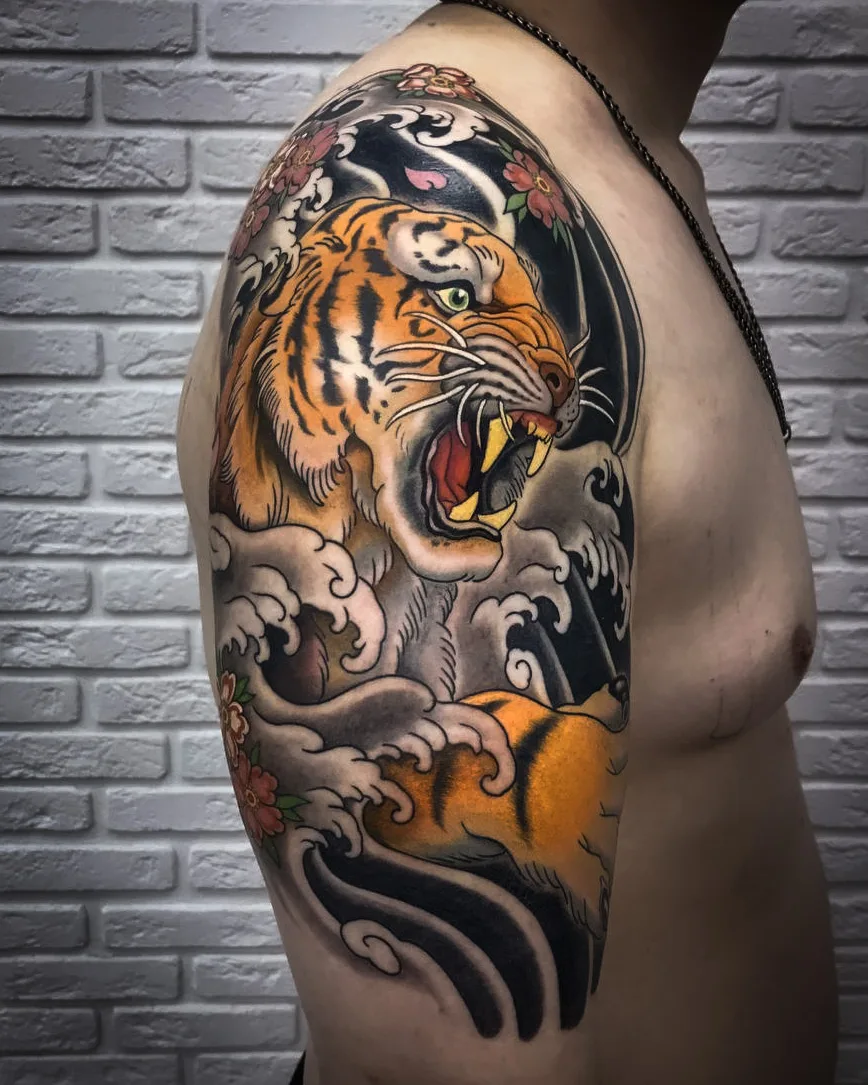
Japanese tiger tattoo with waves
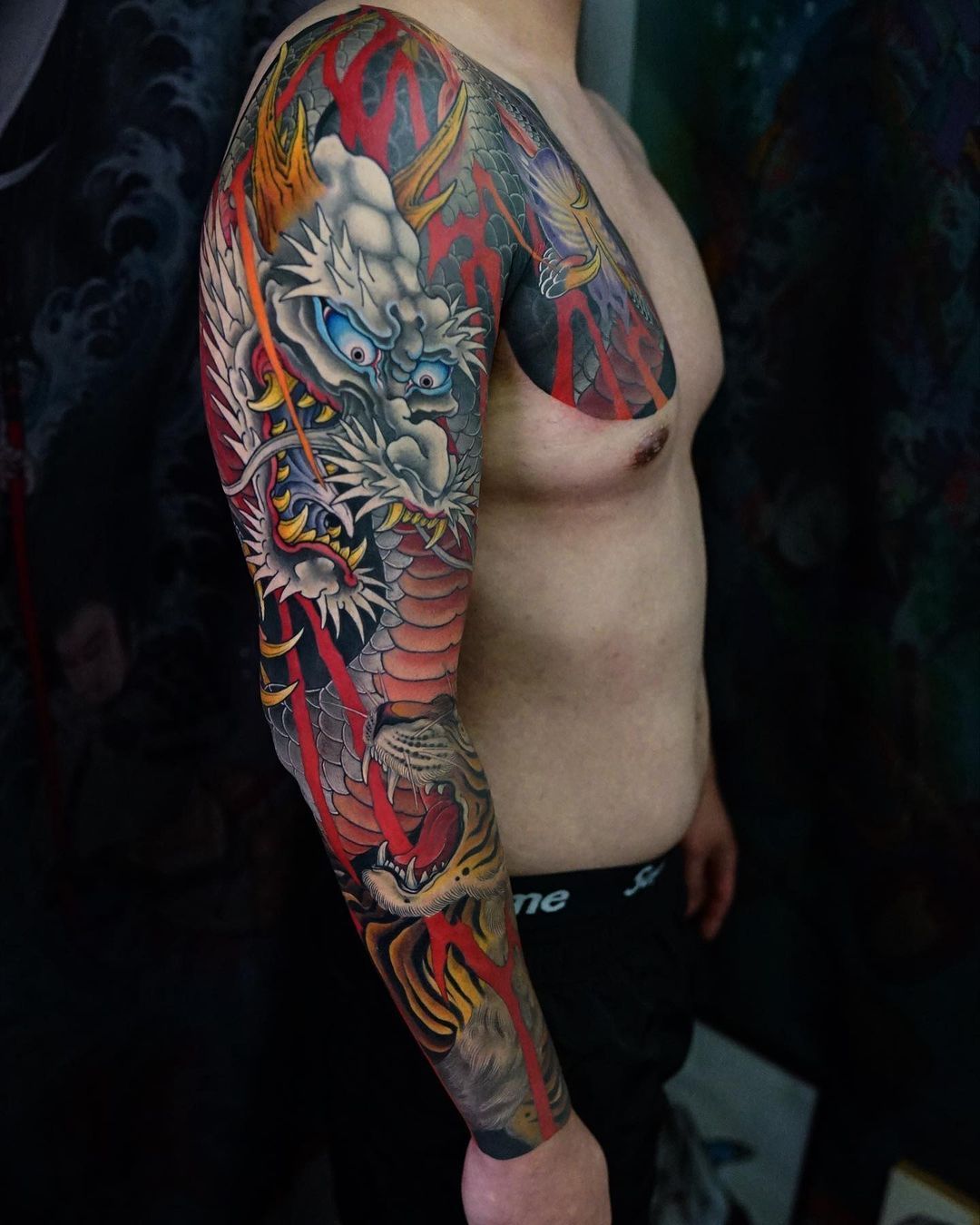
Dragon and tiger full sleeve, Japanese style
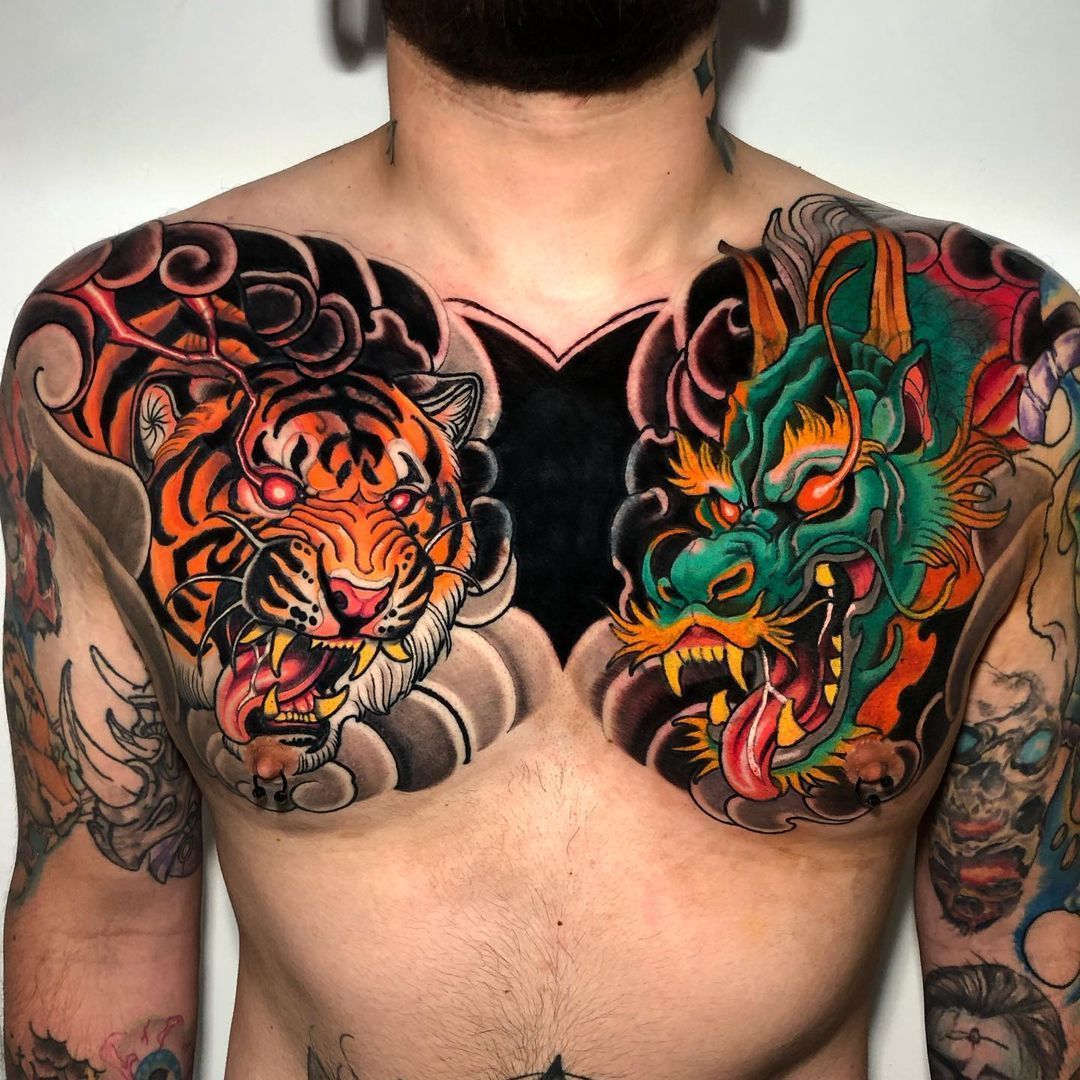
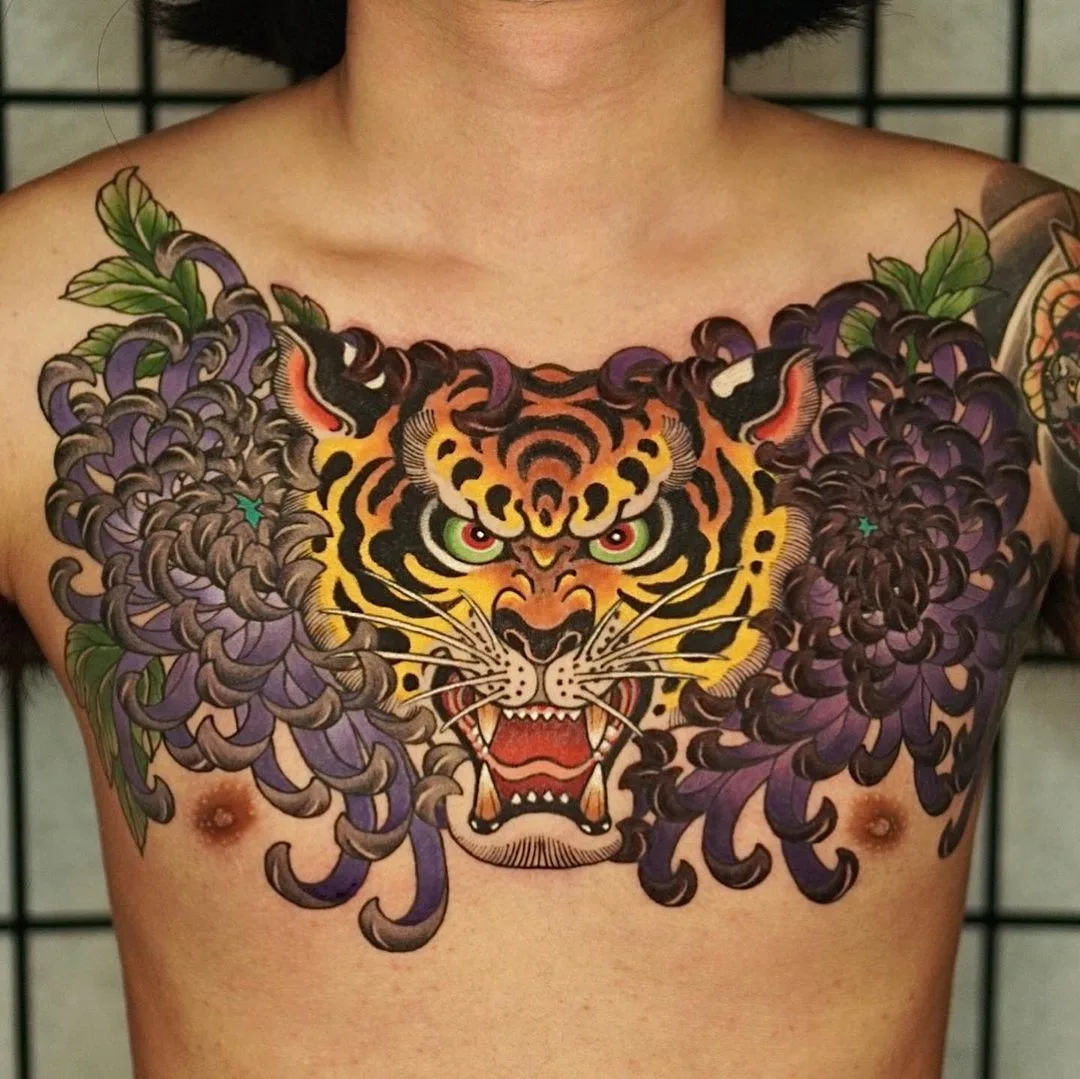
Tiger and dragon chest piece, Japanese style
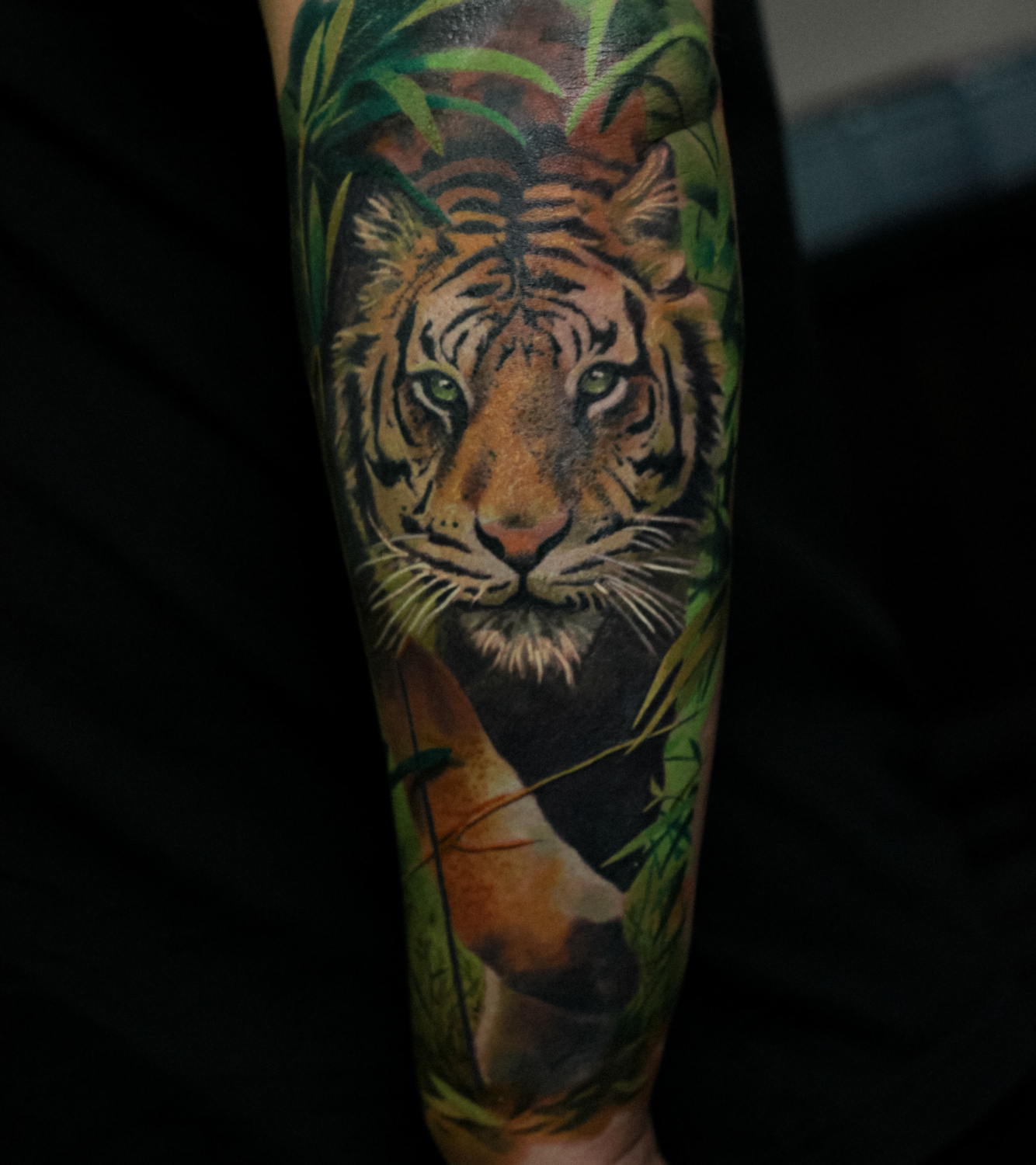
Realistic tiger with foliage
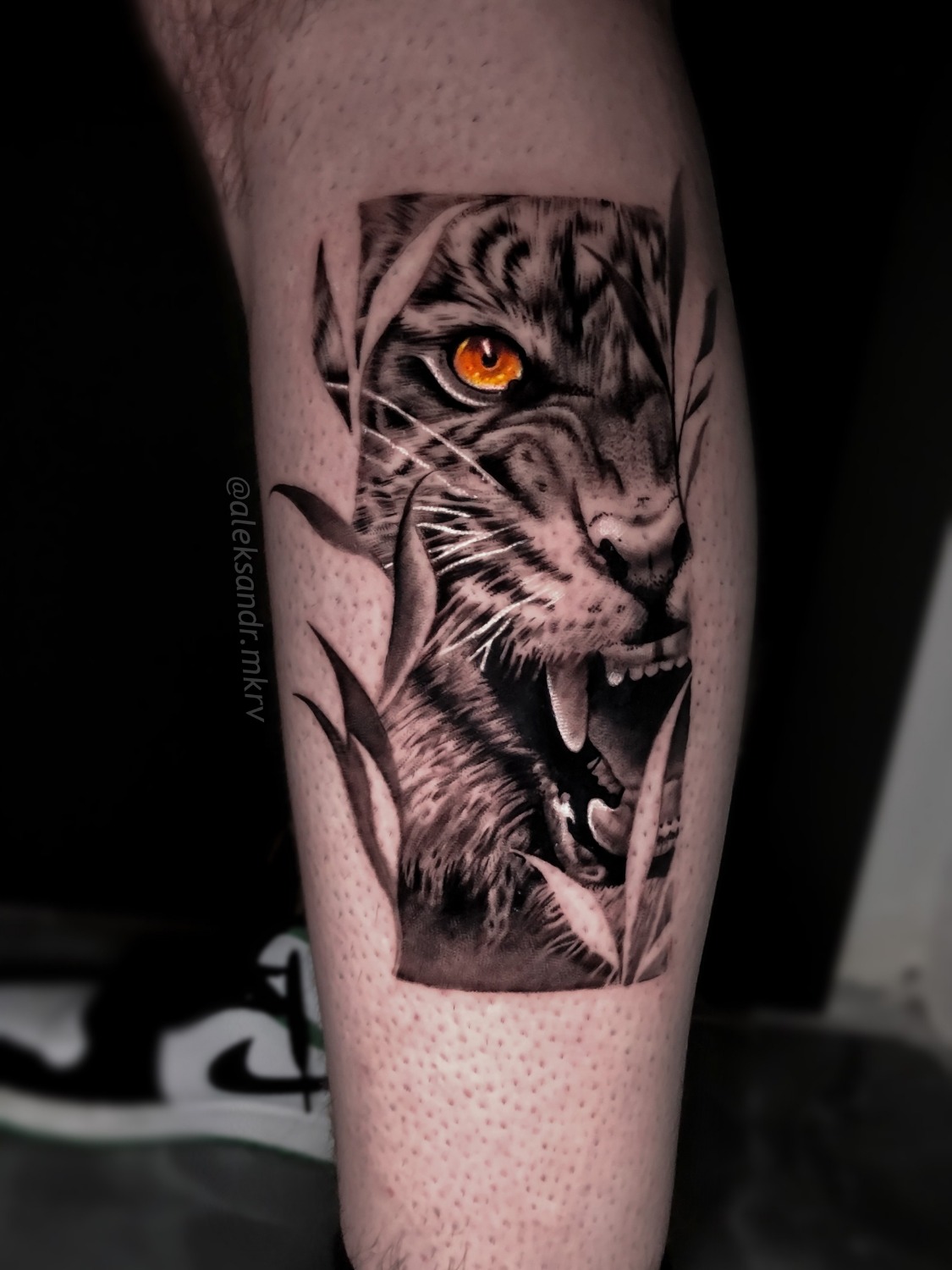
Petersondtattoo: black and grey tiger realism
This is a sharp departure from how Japan and China handle the same animal. The Korean minhwa tiger isn't majestic or terrifying. Approachable, even endearing. But that doesn't make it shallow, there's real social commentary buried in these images. A tiger you're allowed to laugh at becomes a way of processing power without being flattened by it. A coping mechanism, raised to the level of art.
The Korean tiger also turns up in origin mythology. Dangun, the legendary founder of Korea, figures in a story where a tiger and a bear compete to become human. The bear endured, eating only garlic and mugwort for a hundred days inside a cave. The tiger quit. Left. In that context, the tiger stands for impulsive strength that can't sustain the long work of true transformation. It's probably the only major Asian tradition where the tiger sometimes functions as a cautionary example rather than something to aspire toward.
When choosing a Korean minhwa tiger design, look for artists familiar with this specific folk art style. The "awkward dignity" and playful proportions require understanding of the cultural context to execute properly, this is sophisticated social commentary wearing a cartoon face.
And yet Korea also claimed the tiger as a national symbol. Hodori, the mascot of the 1988 Seoul Olympics, was a friendly tiger. The national football team still plays under a tiger emblem. So even in a culture where the tiger can be a figure of fun, it remains fundamentally respected. The humor doesn't cancel the power. They coexist, and honestly, that might be the most sophisticated reading of the three traditions covered here.
As a tattoo subject, the Korean minhwa tiger draws people who want something that doesn't take itself too seriously while still carrying genuine cultural weight. Playful, but not lightweight. Finding an artist who can actually capture that specific quality, the awkward dignity of the minhwa tiger, takes real searching. Most Western tattoo artists simply haven't worked in this visual language.
India and Southeast Asia: Vehicle of Durga and Sak Yant Tigers
In Hindu tradition, the tiger serves as the vahanathe divine vehicle, of the goddess Durga. Durga ranks among the most powerful figures in the Hindu pantheon: a warrior goddess who defeats demons the male gods couldn't handle. Her tiger (sometimes depicted as a lion, depending on regional tradition) carries her ferocity, her independence, her absolute refusal to be governed by any outside force. The image of Durga riding a tiger into battle is one of the most kinetic compositions in Hindu religious art. Hard to look away from.
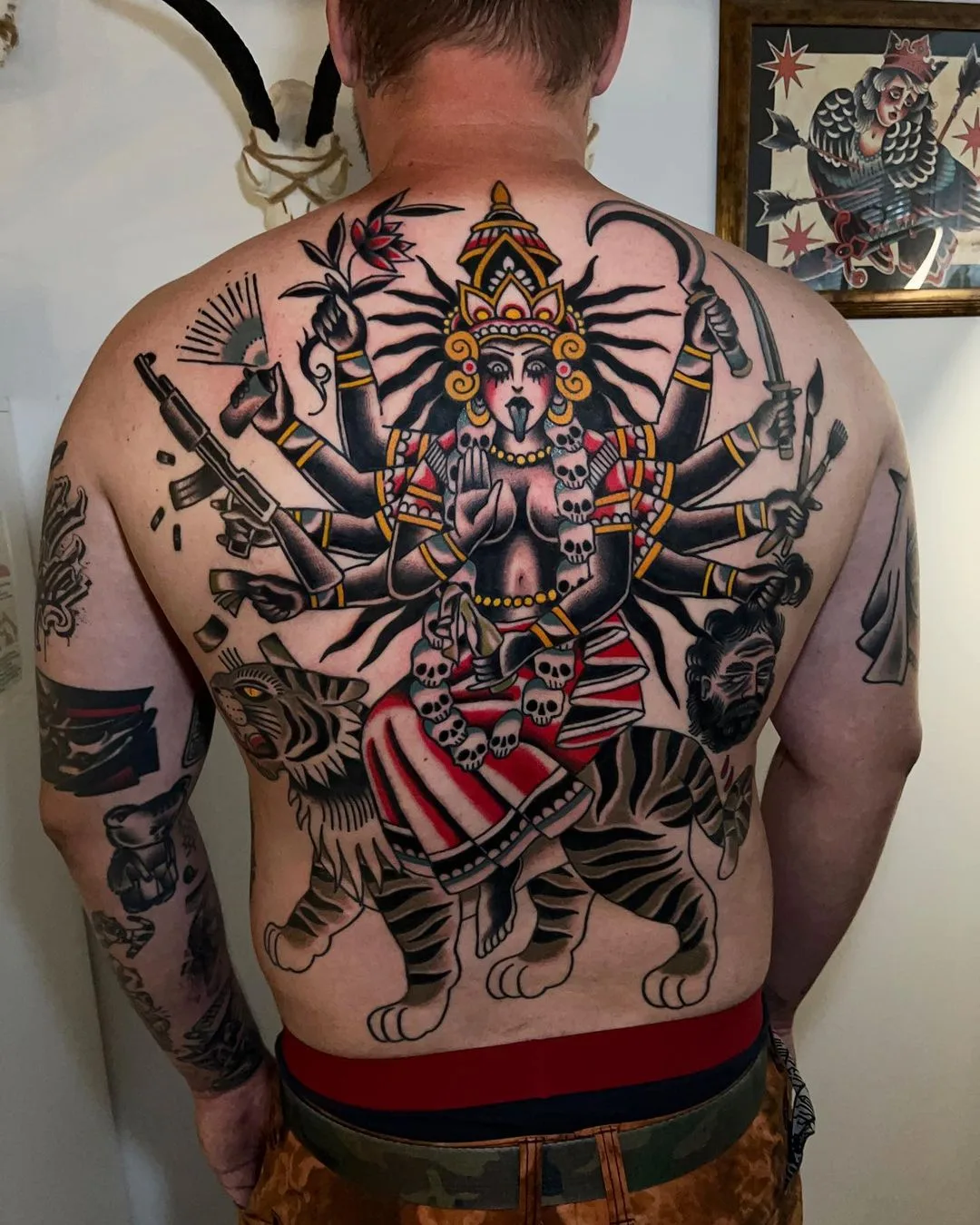
For tattoo purposes, the Durga-and-tiger pairing sends a specific message: feminine power that is both protective and destructive, with no softening in between. This isn't diplomacy. It's the kind of strength that surfaces when everything else has already failed. That resonates with a wide range of people. However, tattooing a Hindu deity raises real questions about cultural respect and appropriation, questions worth sitting with before booking an appointment. To practitioners of Hinduism, this image is sacred, not decorative.
In Thailand and across Southeast Asia, the tiger appears prominently in Sak Yant tattooing. The Suea (tiger) Yant is among the most requested designs, believed to bestow authority, fearlessness, and the capacity to influence others. Twin tigers, Suea Koorepresent power compounded, protection against both physical threats and supernatural ones. Muay Thai fighters have historically received tiger Sak Yant before fights, trusting the tattoo to carry the tiger's ferocity and invulnerability into the ring with them.
The Sak Yant tiger is functional within its belief system, not decorative. The tattooing process involves prayer, sacred geometries, specific Pali script. The tiger image is inseparable from that ritual context. Receiving a Sak Yant tiger from a trained ajarn is a spiritual event. Getting the same image from a regular tattoo shop is just a picture. It looks identical from the outside, but practitioners would disagree strongly about what it actually is.
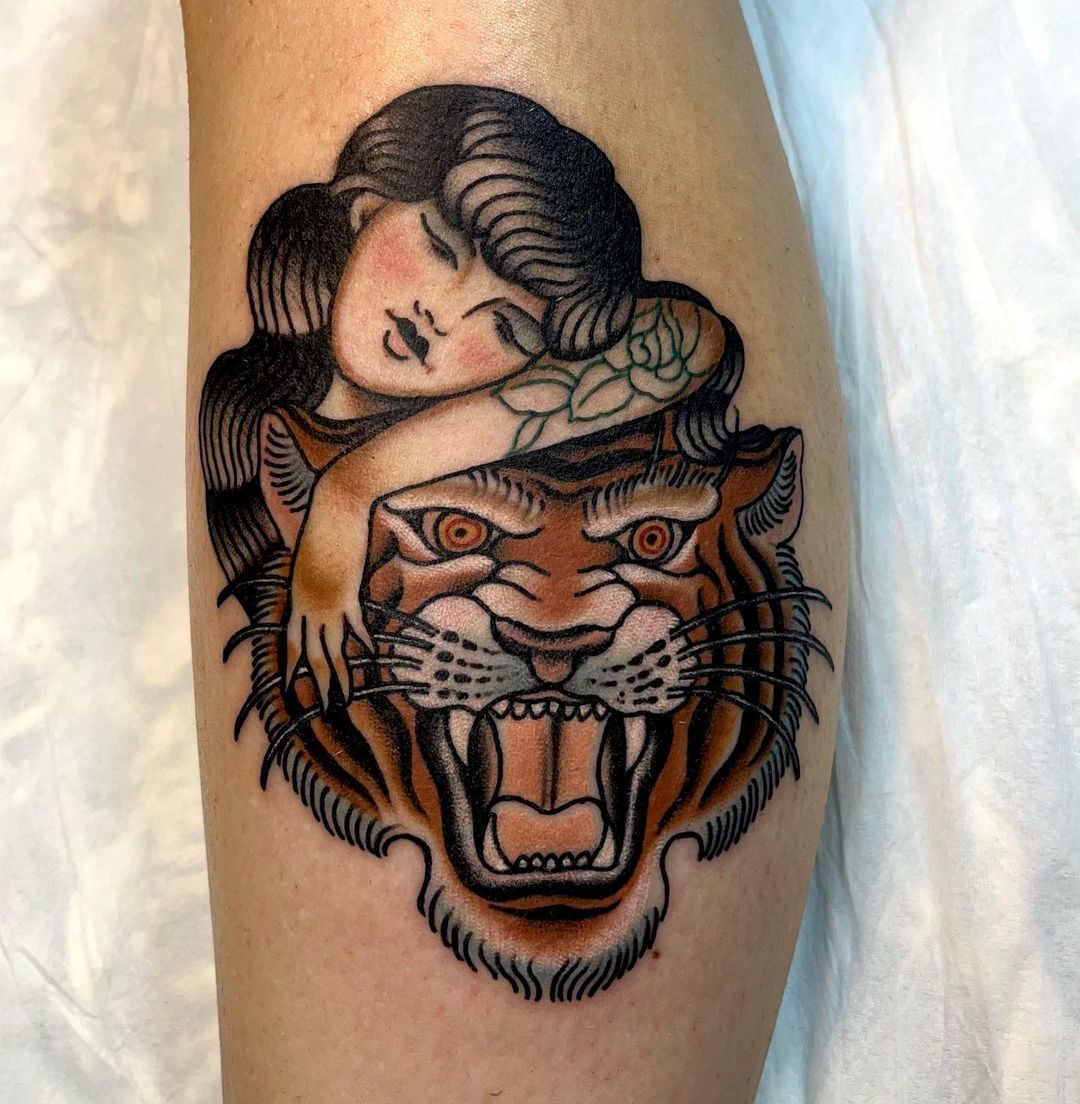
Traditional woman and tiger
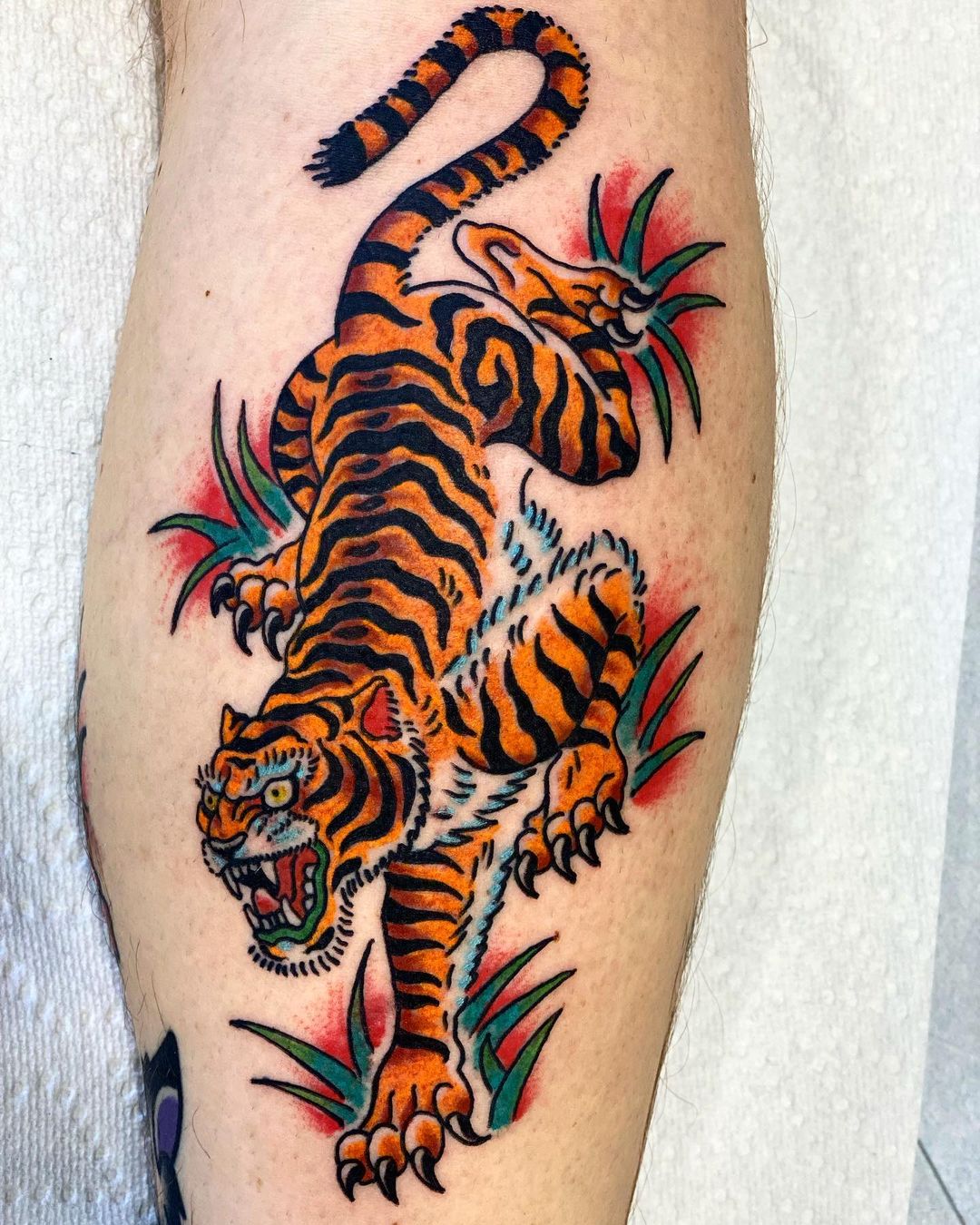
Traditional American tiger tattoo
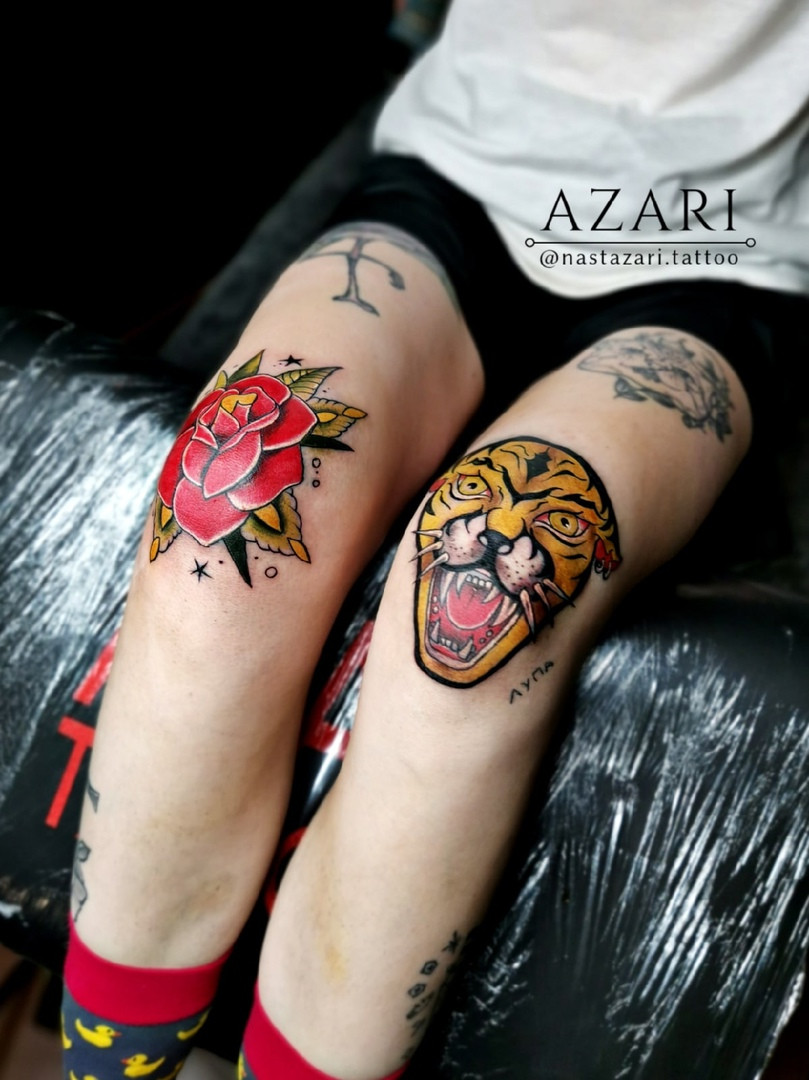
Azari: rose and tiger old-school
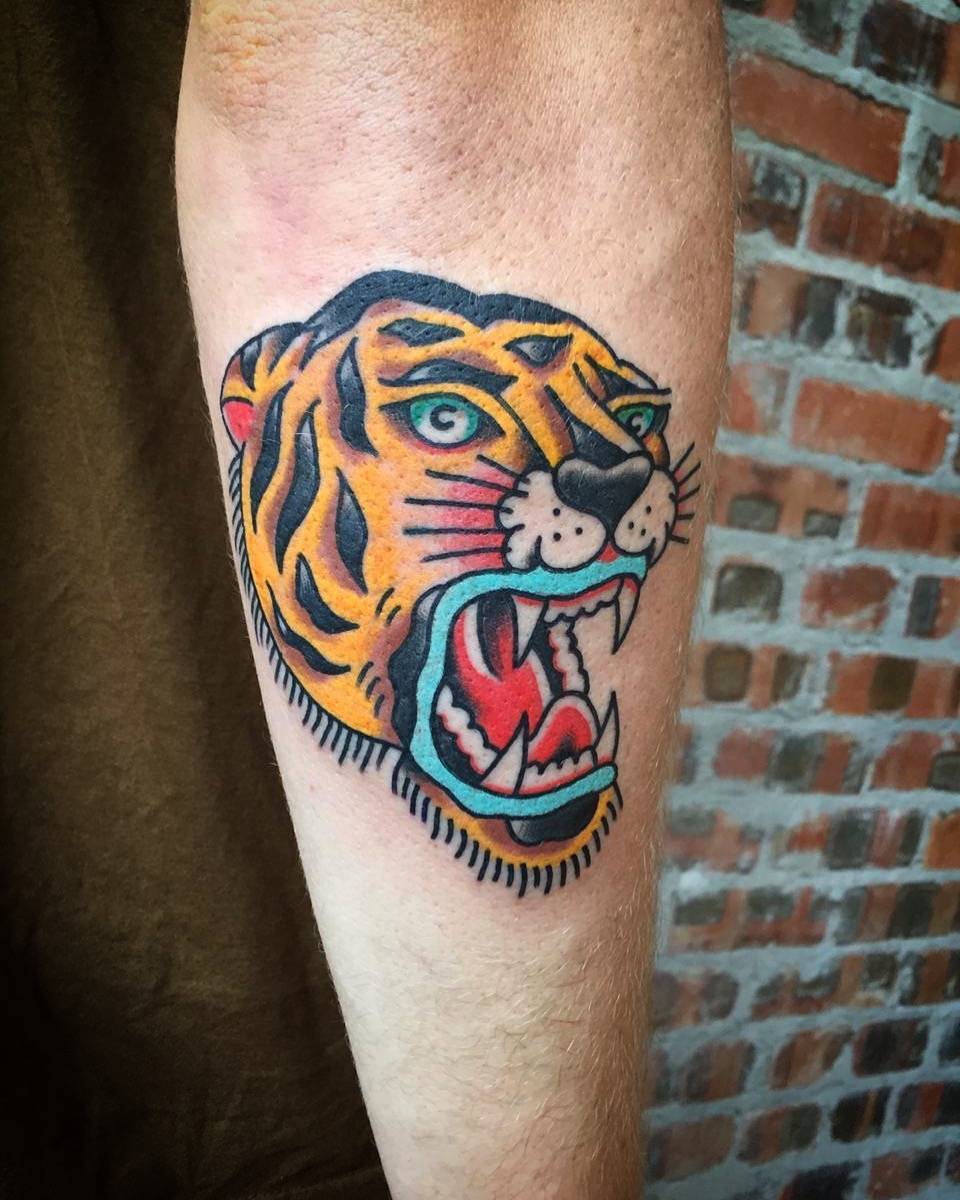
Traditional tiger head tattoo
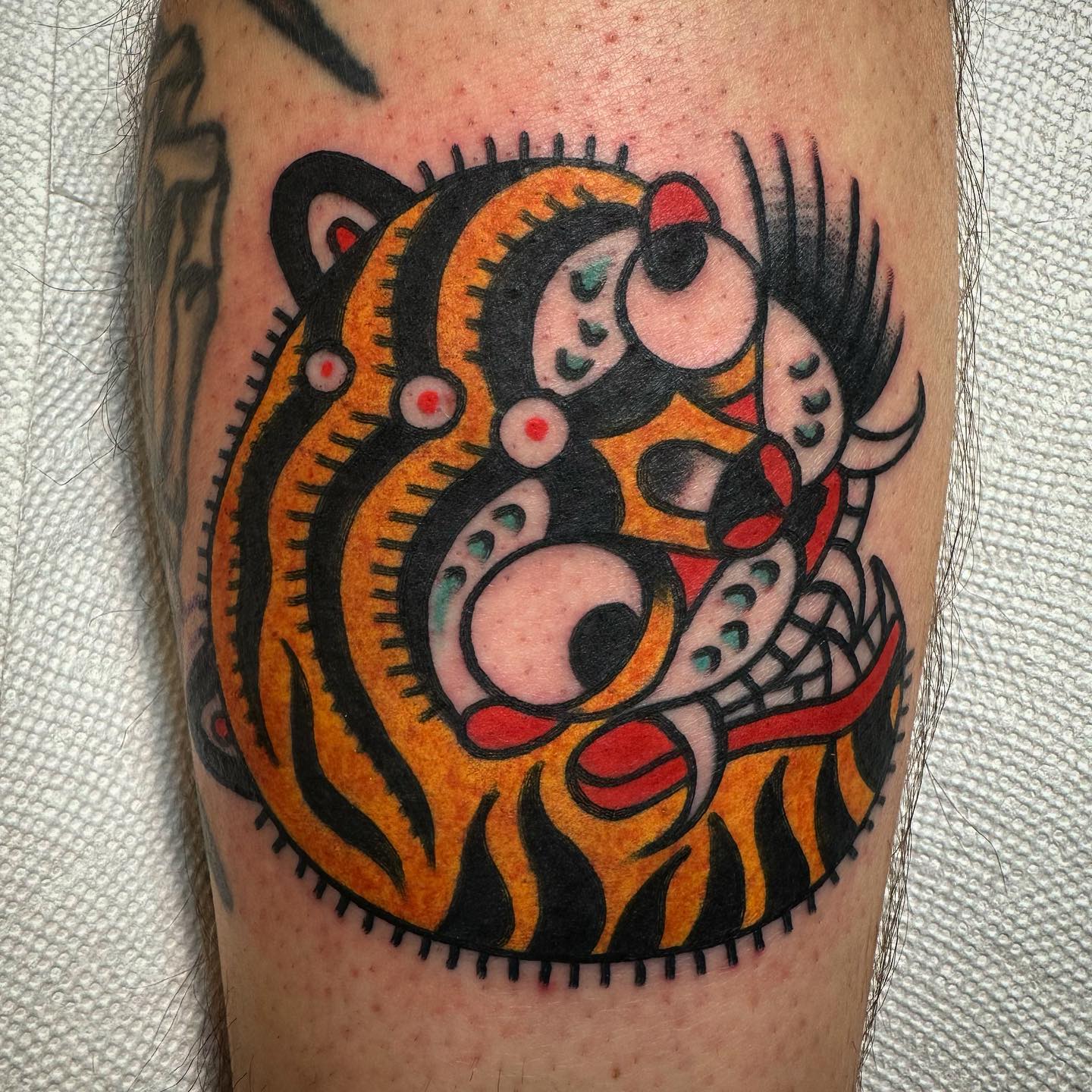
Traditional tiger in bright colours
Western Interpretations
Western culture came to the tiger relatively late, and the reading is predictably more direct. Without the dense mythological frameworks Asian cultures built around the animal over centuries, the West tends to see the tiger for what it physically is: apex predator. Raw aggression. Dominance. "King of the jungle", though tigers live in forests, not jungles, and the phrase was borrowed from lion iconography anyway. Details, apparently.
- Tigers symbolize different qualities across cultures: protection in Japan, cosmic order in China, and approachable wisdom in Korea
- Japanese tigers represent intelligent strength paired with flexibility, often depicted with bamboo and wind elements
- Chinese White Tigers are cosmic guardians associated with the west, autumn, and metal element in the Four Sacred Beasts system
- Korean minhwa tigers offer a unique playful interpretation that uses humor to process power and authority
- The tiger's natural forehead markings resemble the Chinese character for "king," reinforcing its royal symbolism
William Blake's "The Tyger" (1794) gave the English-speaking world its most enduring literary tiger: "What immortal hand or eye / Could frame thy fearful symmetry?" Blake wasn't writing about an animal in a zoo. He was asking how the same creator who made lambs could also make this, this beautiful, terrifying, formally perfect predator. The poem lands on something Asian traditions already understood: the tiger produces a response that sits somewhere between awe and fear, and you can't quite choose which one.
In Western tattooing, tigers arrived through a few different channels. Military service members stationed in Asia brought tiger tattoos home as souvenirs and signals of toughness. Circus and carnival culture tied the tiger to spectacle and danger. And more recently, the tiger has been absorbed into a broader vocabulary of personal power, "I am fierce, I am independent, I answer to no one."
That reading isn’t wrong. It’s just thinner than what the tiger carries in its home cultures. But not every tattoo needs to be an anthropology lecture. Sometimes the tiger means strength because the tiger is strong. That’s enough. Or rather, it can be enough, depending on what you’re actually after.
Styles
The style you choose shapes not just how the tiger looks, but what it actually says. Rendered in different techniques, the same animal tells completely different stories.
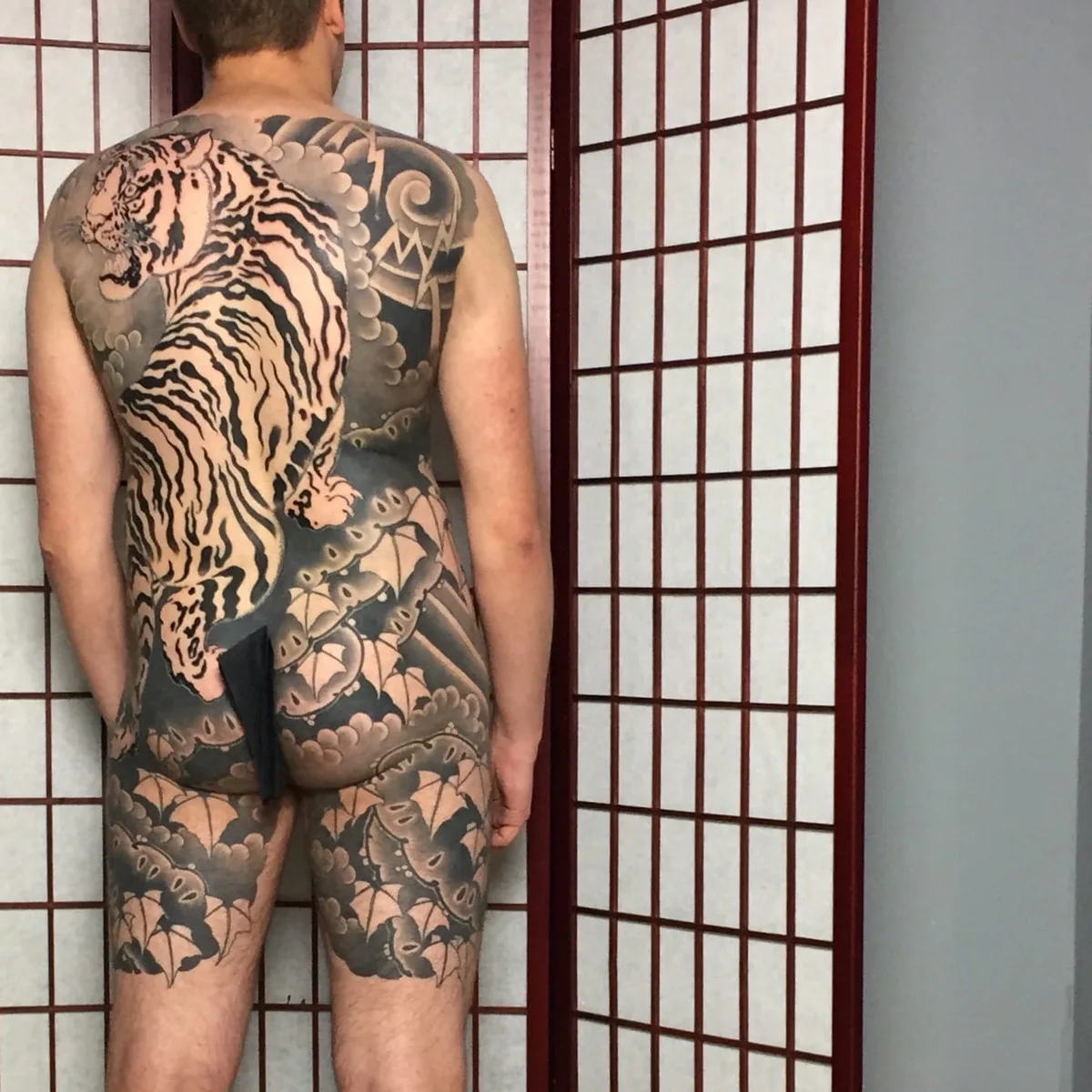
Irezumi (Japanese traditional). Full-body compositions, rich color, the tiger set within its environment. Wind bars, clouds, bamboo, waves. The irezumi tiger exists inside a world, never isolated from it. These pieces take multiple sessions and demand scale to work properly. Quarter sleeves, half backs, full leg panels. The style asks a lot from both the wearer and the artist, but when it lands, nothing else in tattooing quite matches the visual weight. Colors are dense, movement is alive, and the composition rewards a long look -- different details surface depending on where your eye lands.
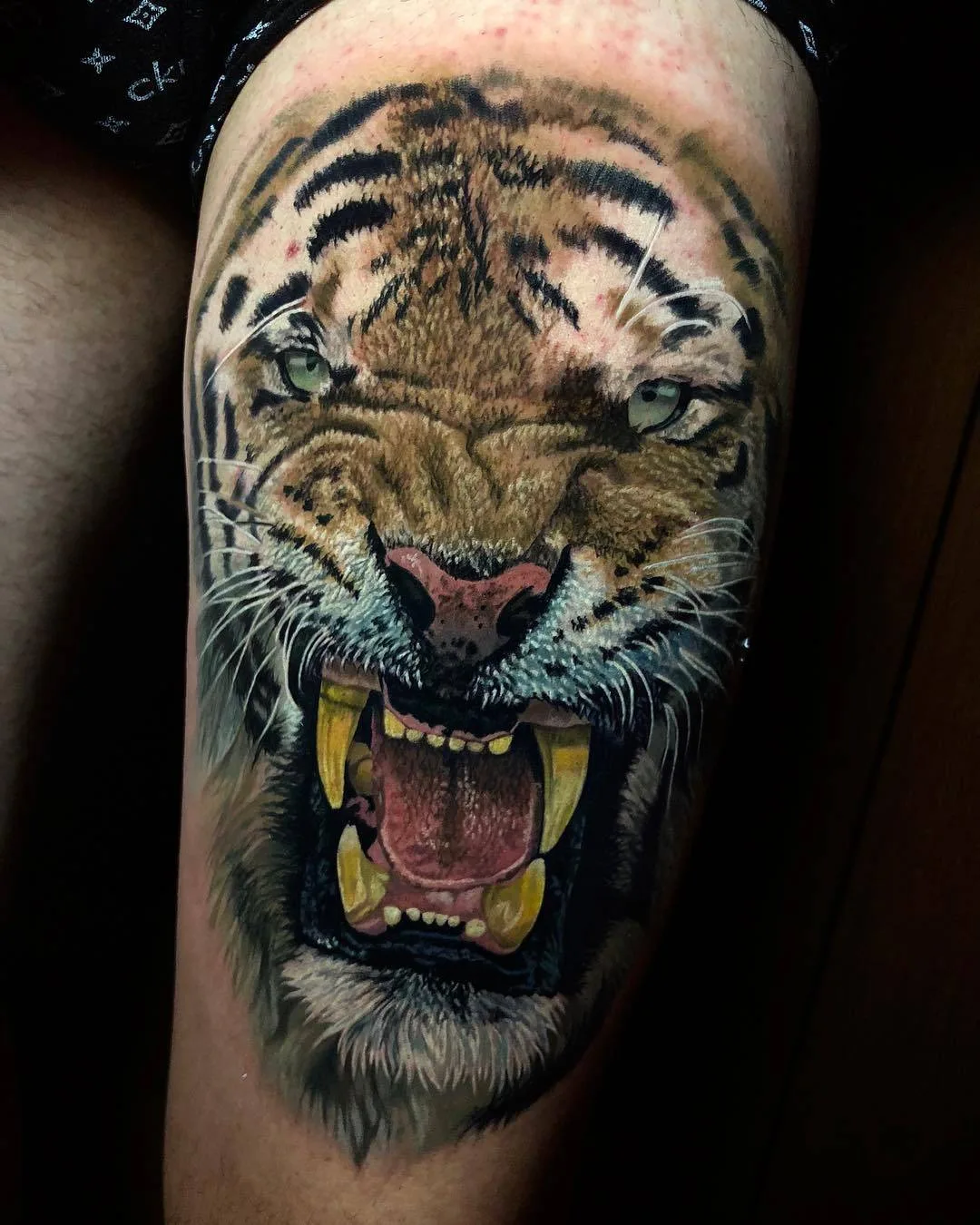
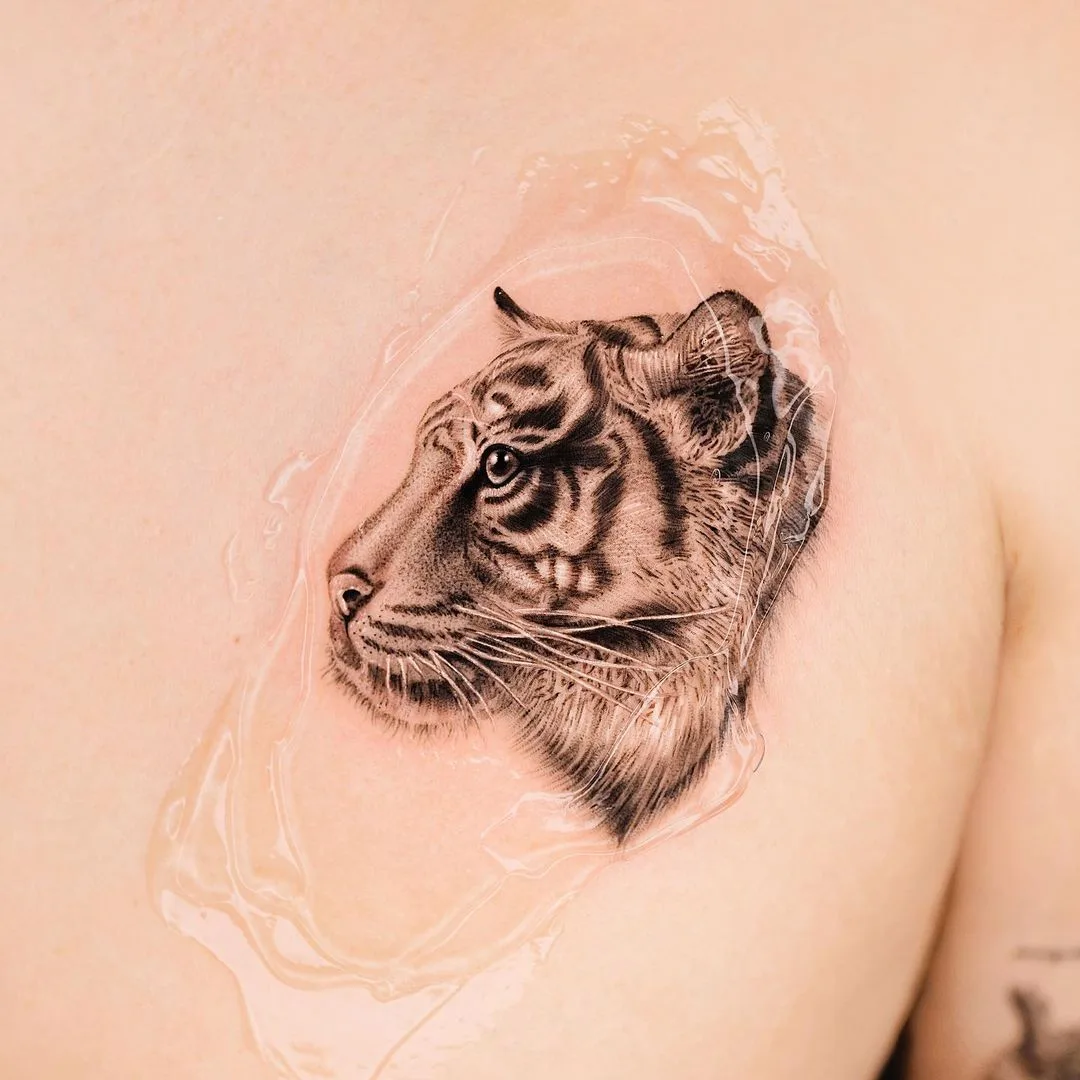
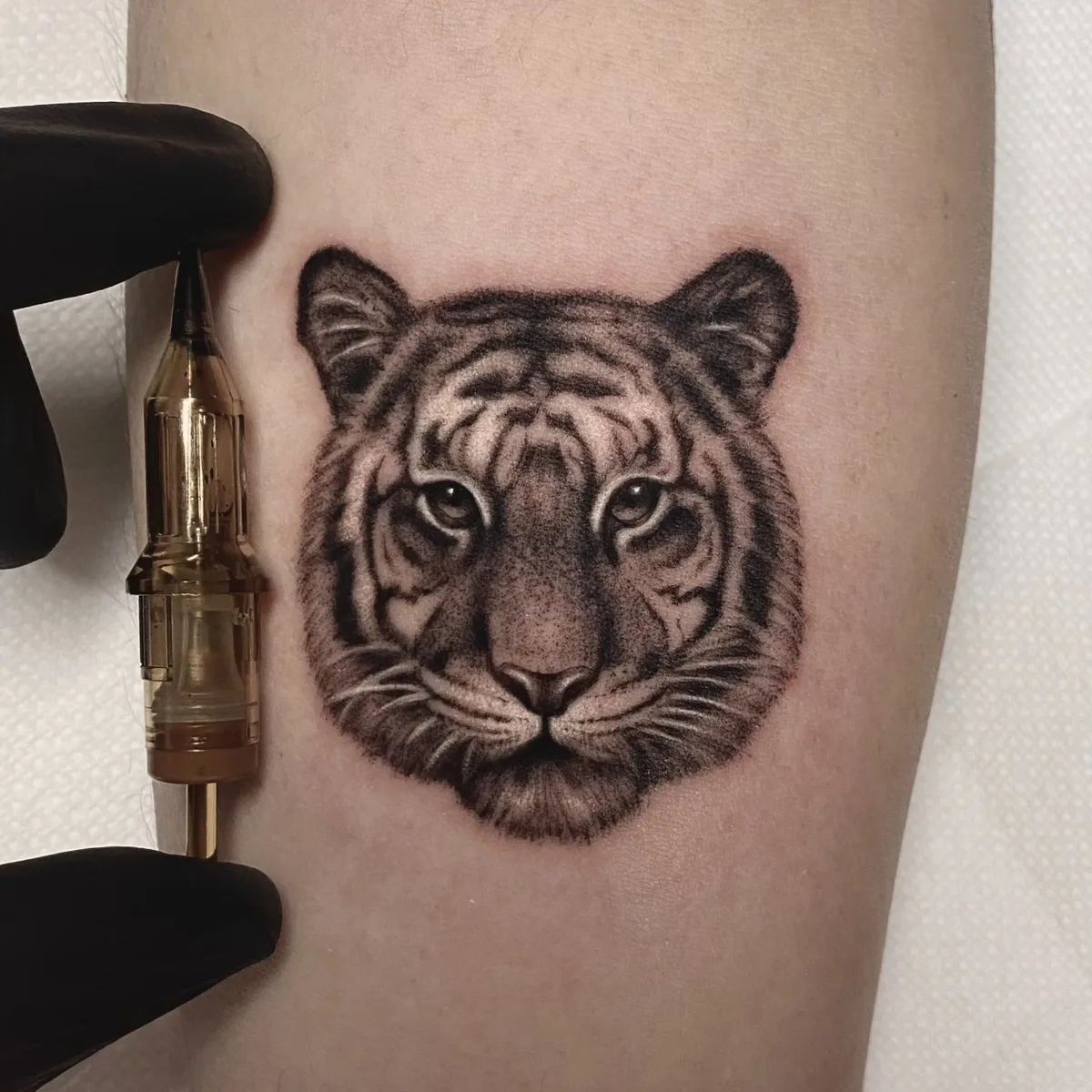
Realism. Photographic rendering: actual fur texture, the wet gleam of eyes, light moving across muscle. Realistic tiger portraits rank among the most technically demanding work being done today. They strip away cultural symbolism entirely and present the animal as pure biology -- which has its own kind of power, honestly. The tiger doesn’t need mythology to be impressive. It just needs to show up. However, realism leaves nowhere to hide. A weak realistic tiger looks like a stuffed animal, and no stylistic framework will save it.
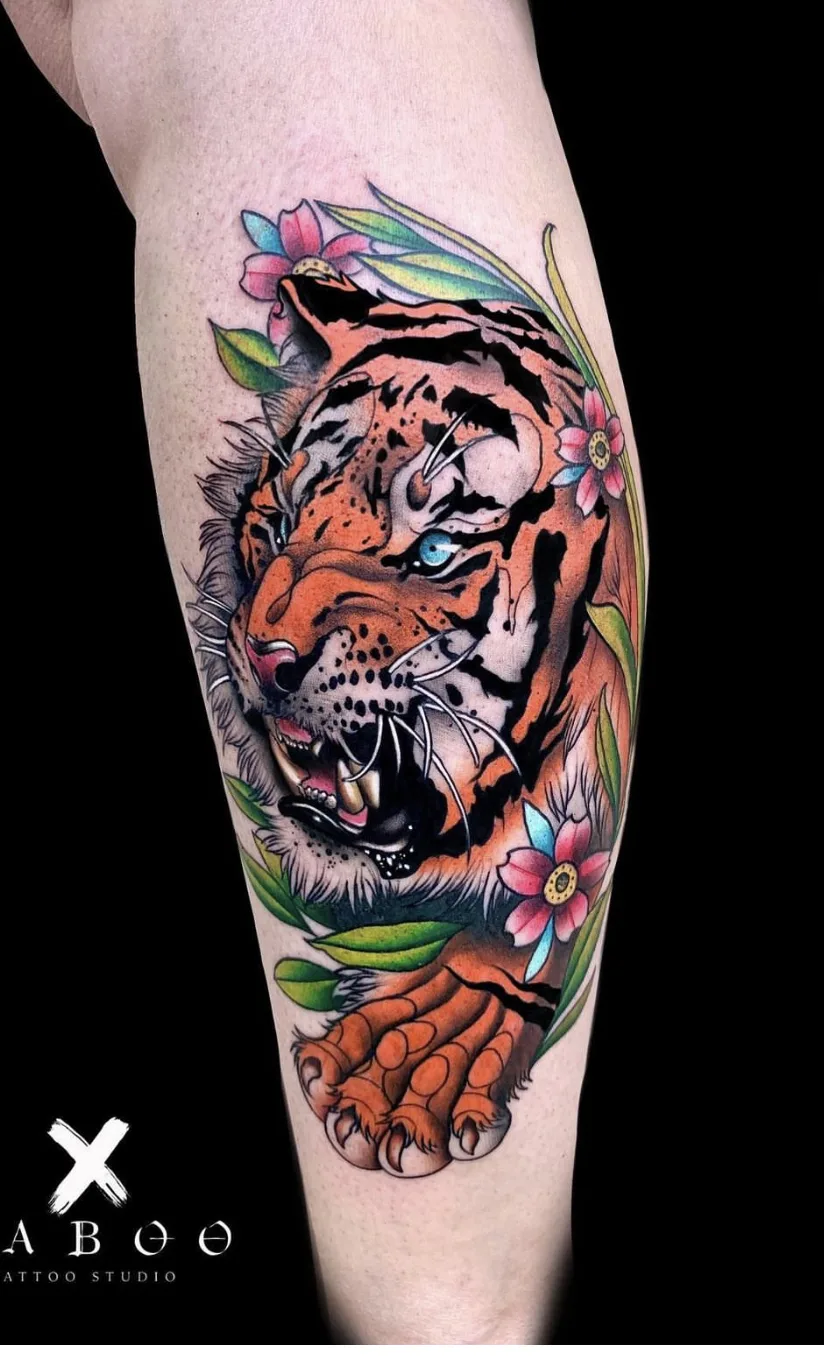
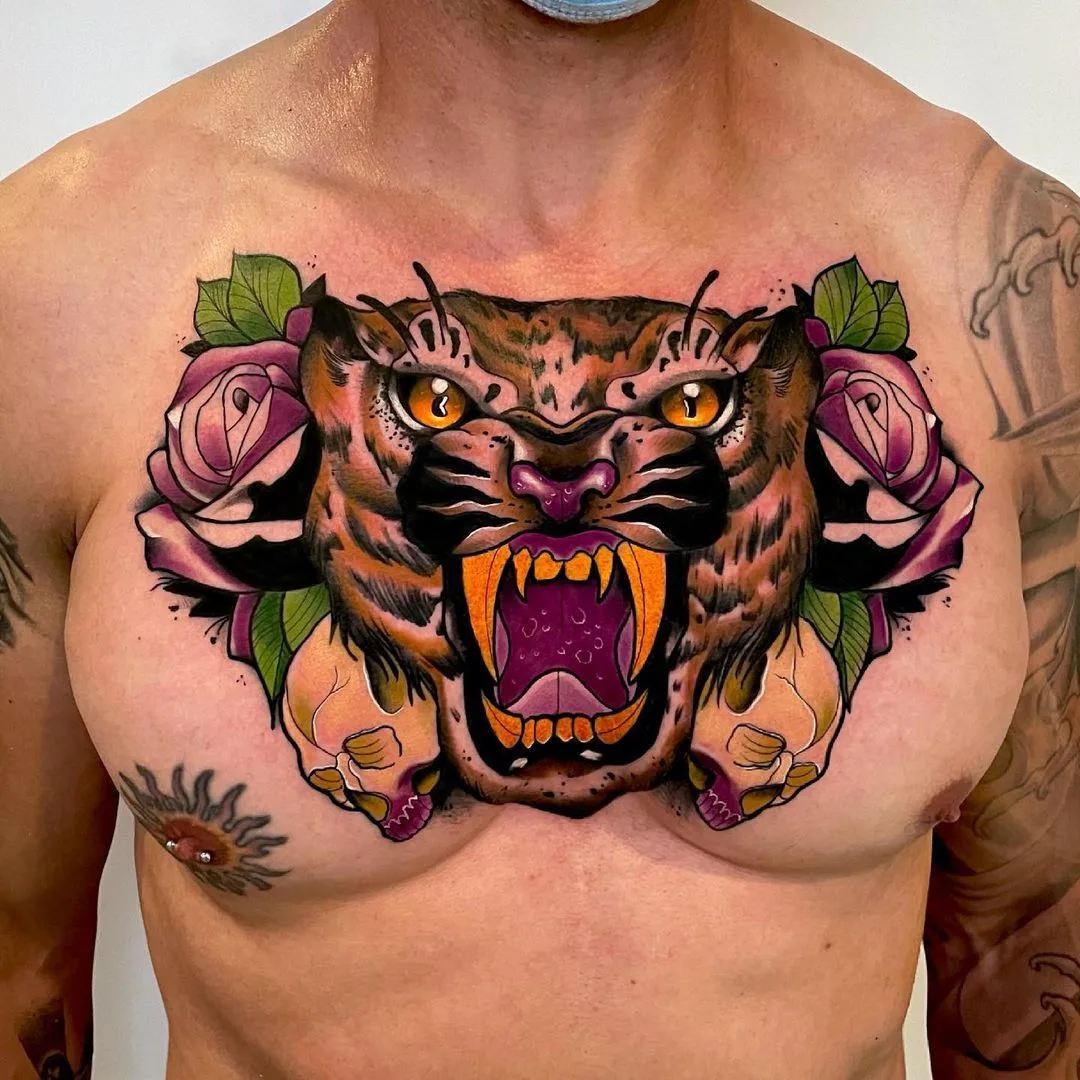
Neo-traditional. This is where things get genuinely interesting. Neo-traditional keeps the bold lines and composition of traditional tattooing but opens up the color range, deepens the shading, and brings in contemporary design thinking. The result has the graphic punch of old-school work alongside the detail range of modern technique. It splits the difference between symbolic weight and visual impact. Probably the most versatile approach for collectors who want something that reads as both classic and current.
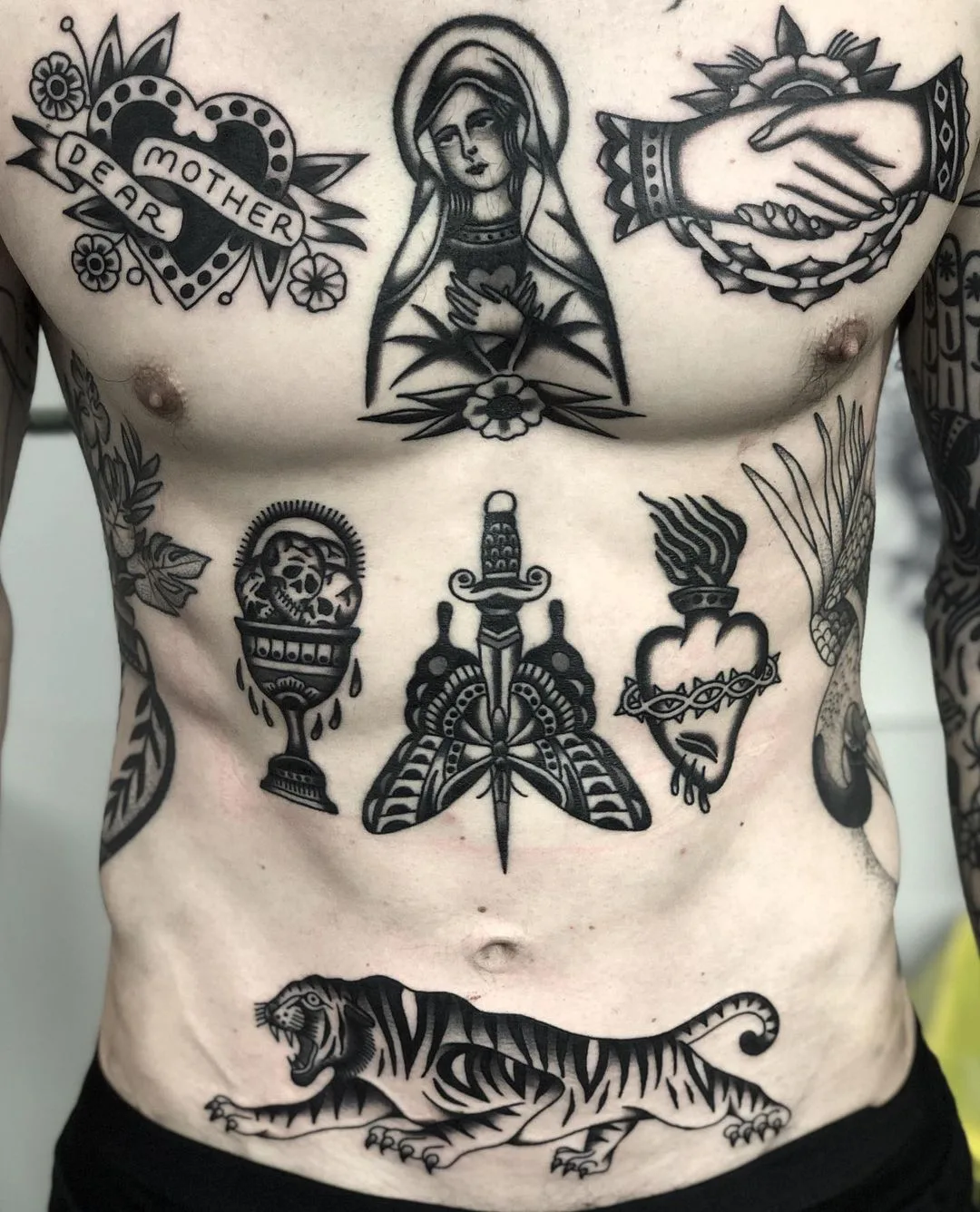
Blackwork. High contrast, graphic, uncompromising. Blackwork reduces the tiger to its most essential visual elements: stripes, mass, eyes, teeth. The simplification amplifies rather than diminishes. Without color or subtle shading to soften things, what you get is something genuinely primal. These pieces age exceptionally well too -- solid black ink holds its integrity for decades, and the approach scales from a small forearm piece all the way up to a full back panel.

Placement
Tiger tattoos need room. The animal’s body -- long, muscular, built for movement -- loses everything when it’s compressed into a space that can’t hold it. Cramming it in kills the sense of motion that makes the image work in the first place.
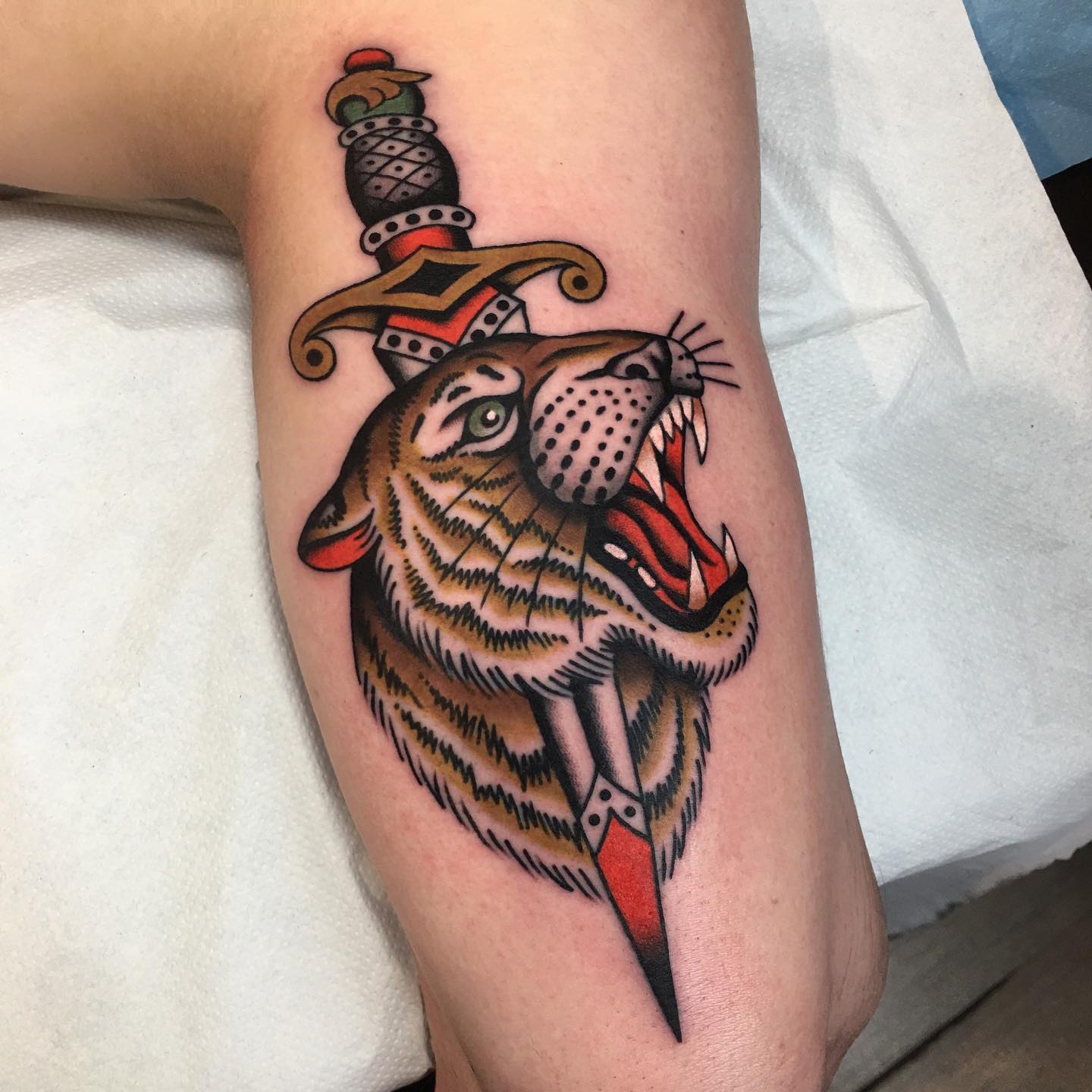
Traditional tiger and dagger tattoo
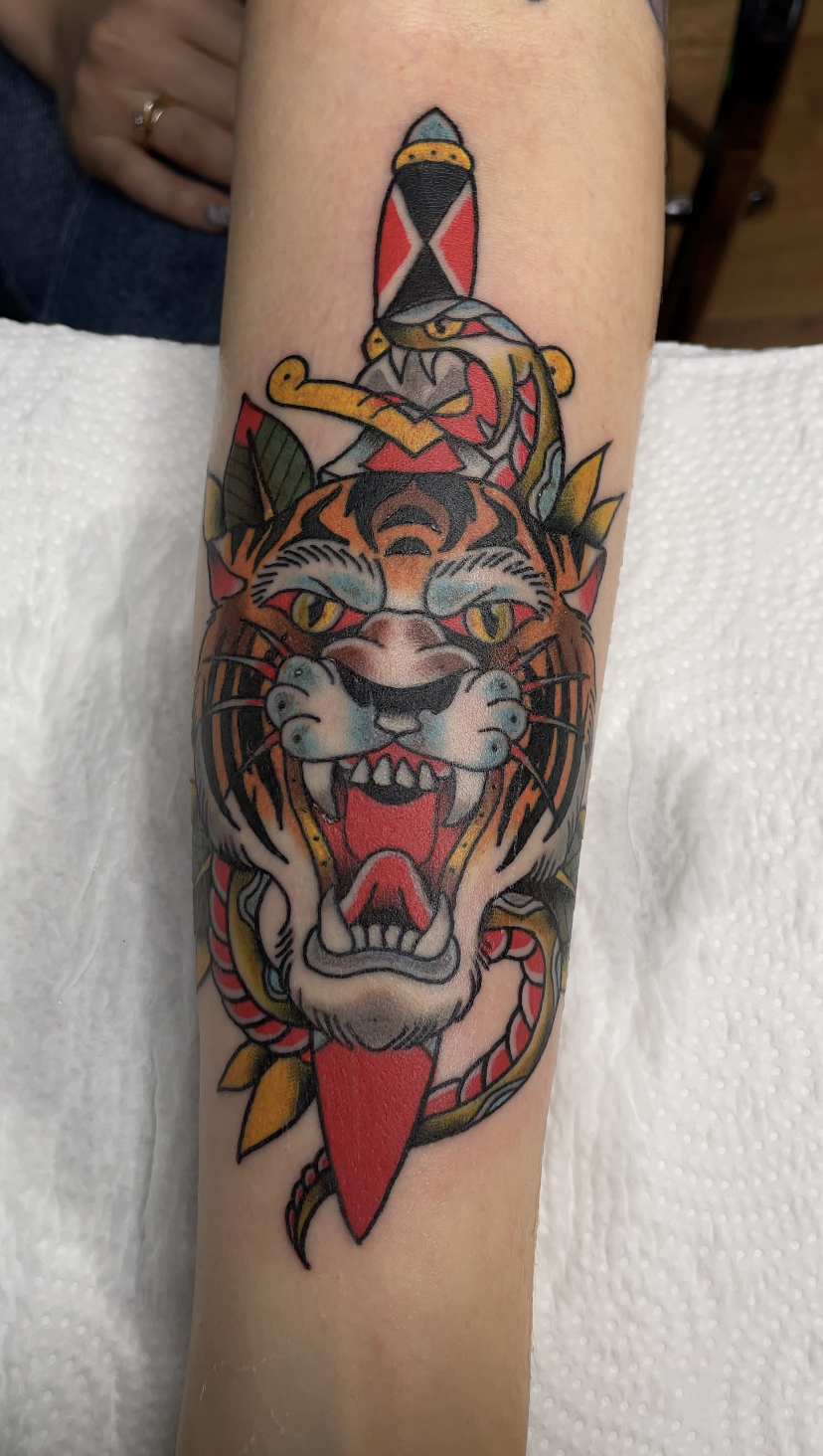
Traditional tiger, dagger and snake
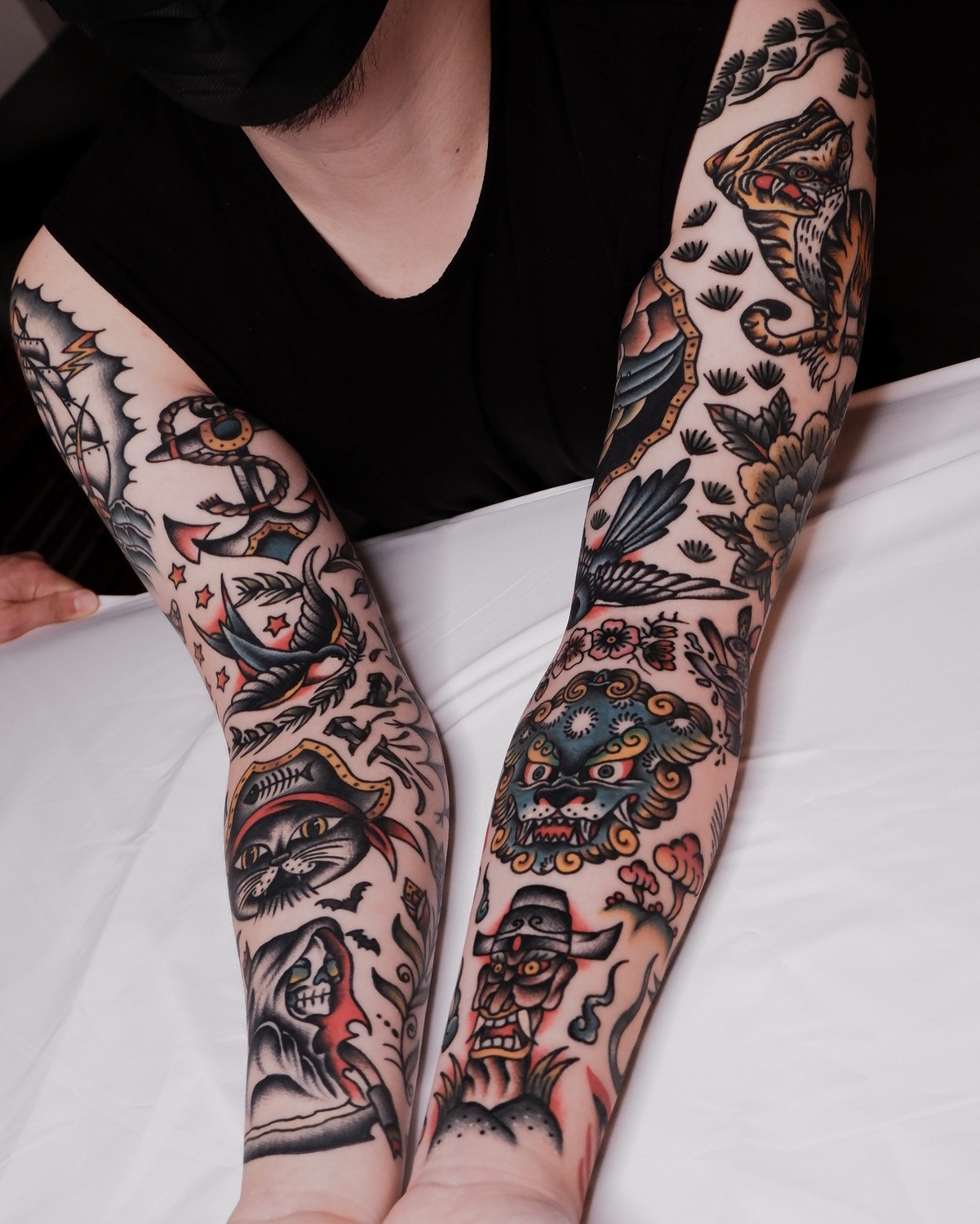
Traditional full sleeves with tigers and anchors
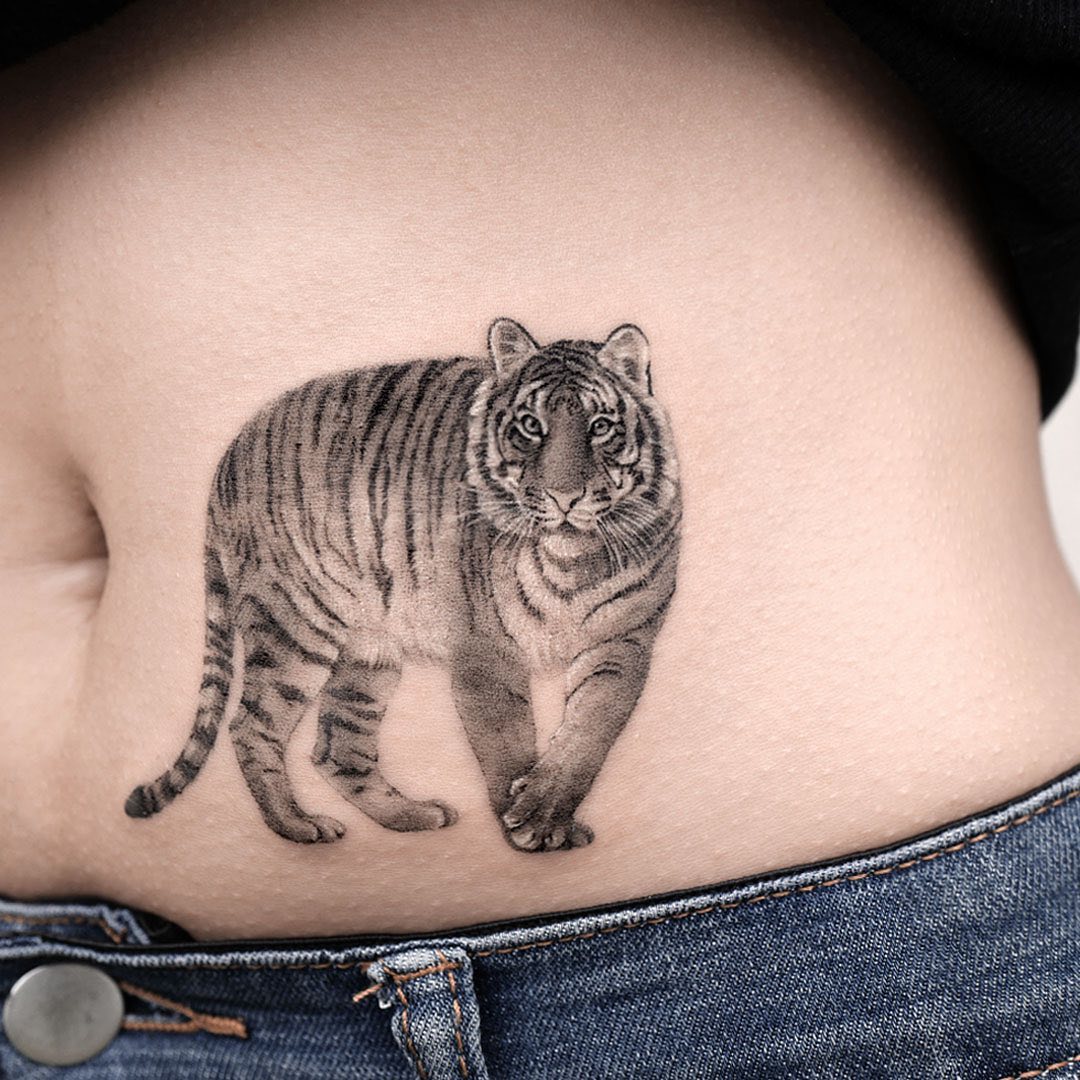
Realistic tiger with dotwork shading
Upper arm and shoulder. Classic for a reason. The natural curve of the deltoid gives the tiger a sense of coiled energy that flat surfaces don’t quite replicate. This is one of the most popular spots for tiger portraits and holds up across all major styles. The arm also offers a natural path outward -- a shoulder tiger can grow into a half or full sleeve down the line.
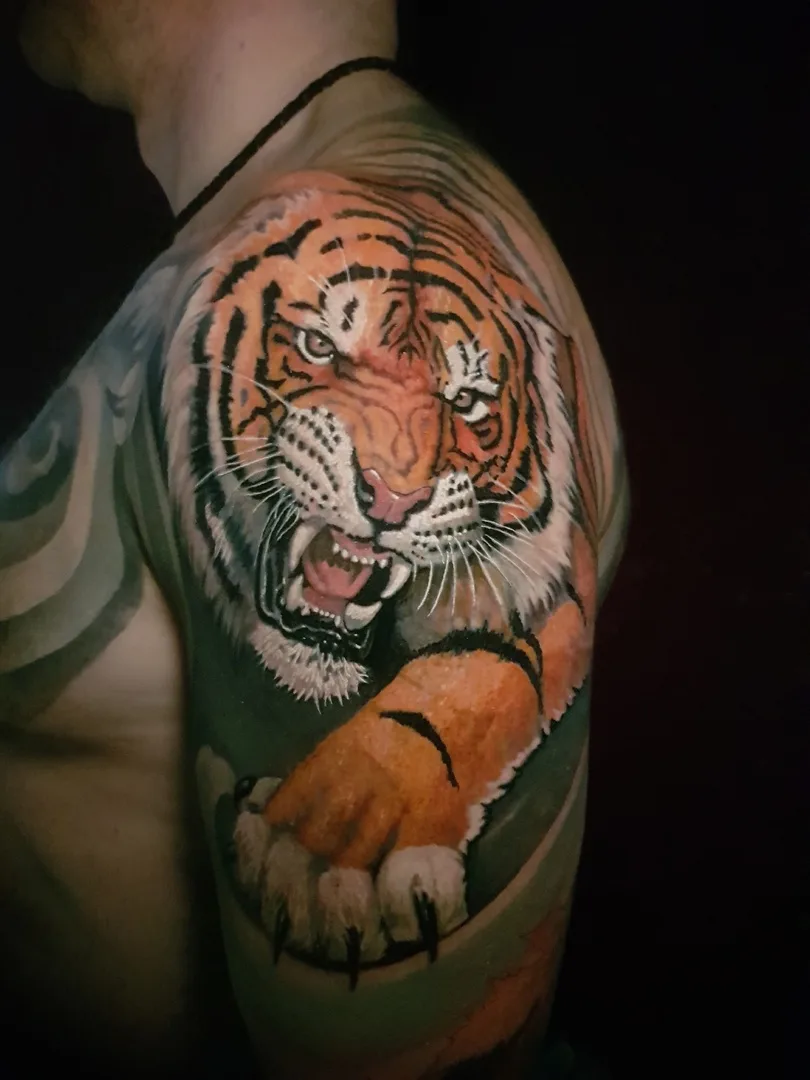
Japan has no native tigers, yet the tiger became central to Japanese irezumi through cultural exchange with China and Korea. The imported symbol was so powerful that Japanese artists developed it into something distinctly their own, proving that cultural symbols can transcend geographic boundaries.
Back. The full back is, traditionally, where the most ambitious tiger work lives. In irezumi culture, a full back tiger is a serious commitment -- months, sometimes years of sessions. But the result is monumental in a way few other placements can touch. The back gives the tiger room to move in full, surrounded by environmental elements. It’s the closest most people will get to wearing a painting.
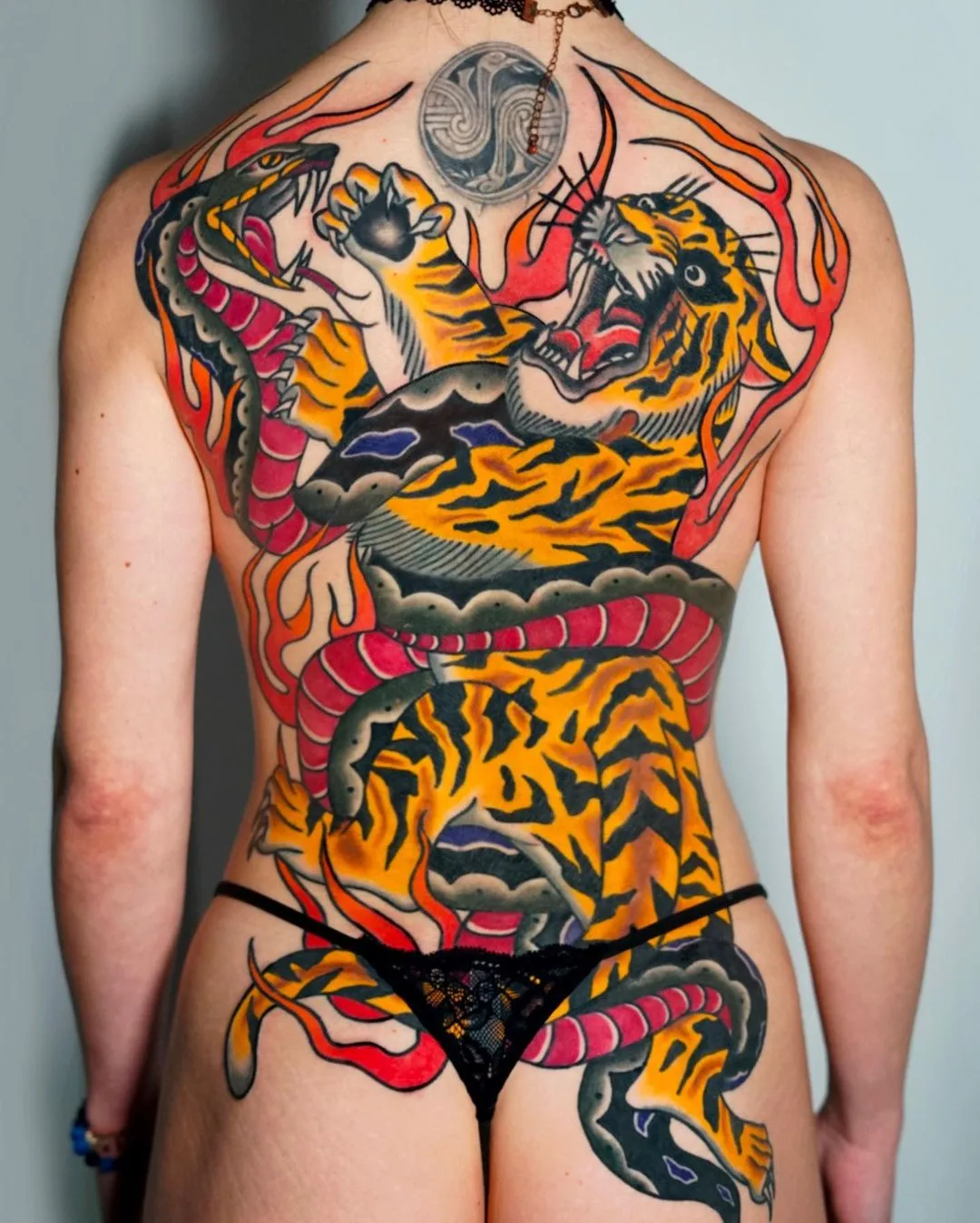
Thigh. Increasingly popular, especially for larger compositions. The thigh offers a flat, wide canvas that handles detail well and accommodates the kind of surrounding design elements that Japanese-style pieces require. These pieces can face outward or inward, which changes the energy of the placement considerably -- one is a public statement, the other is almost private.
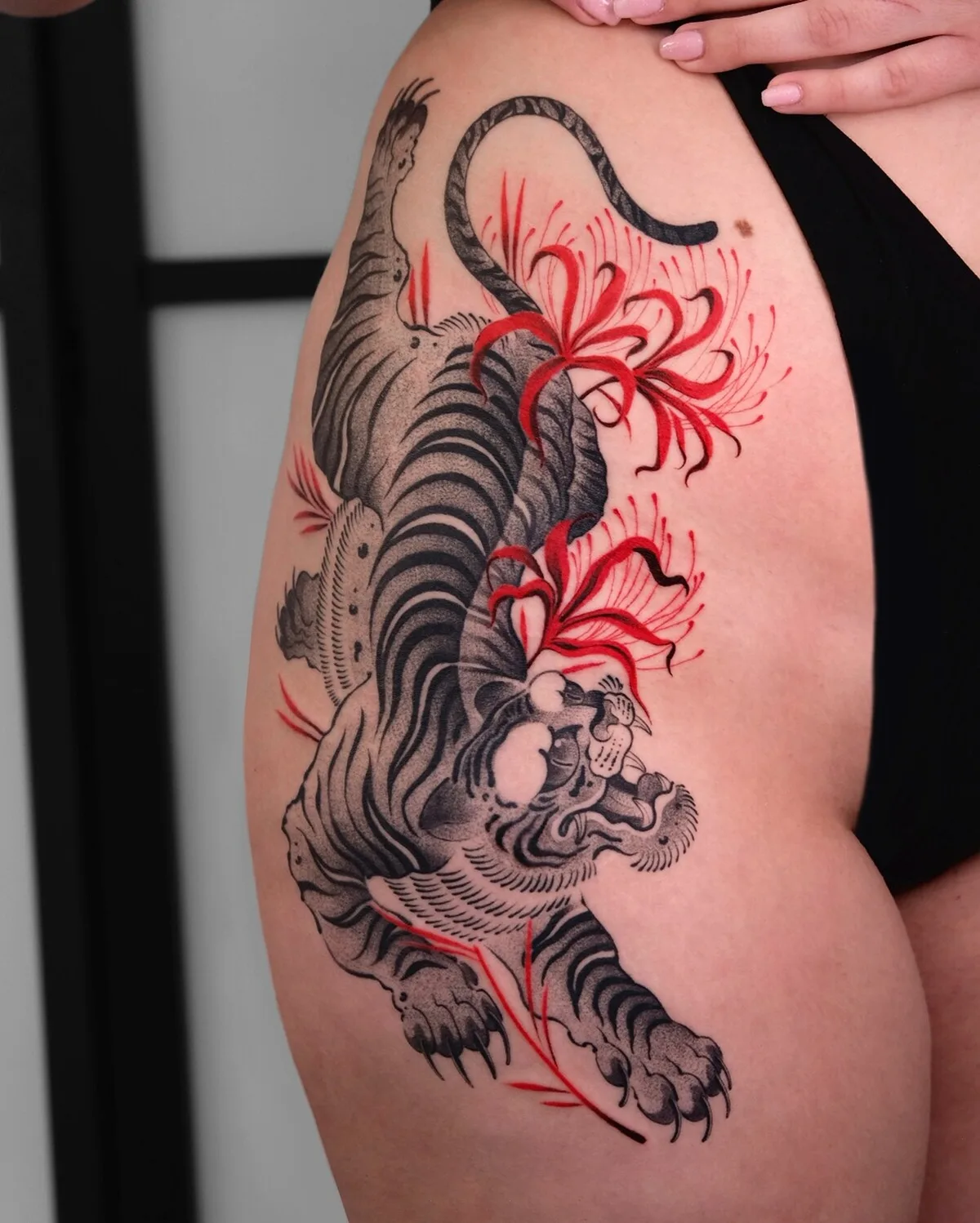
Forearm. Tighter space, so the design needs real thought. Tiger heads and portraits work far better here than full-body compositions. A snarling tiger face on the forearm is direct, visible, immediately readable -- a statement that needs no explanation. That said, forearm tigers in smaller scale can lose fine detail over time, particularly in styles that rely on delicate linework. Worth a serious conversation with your artist before you commit.
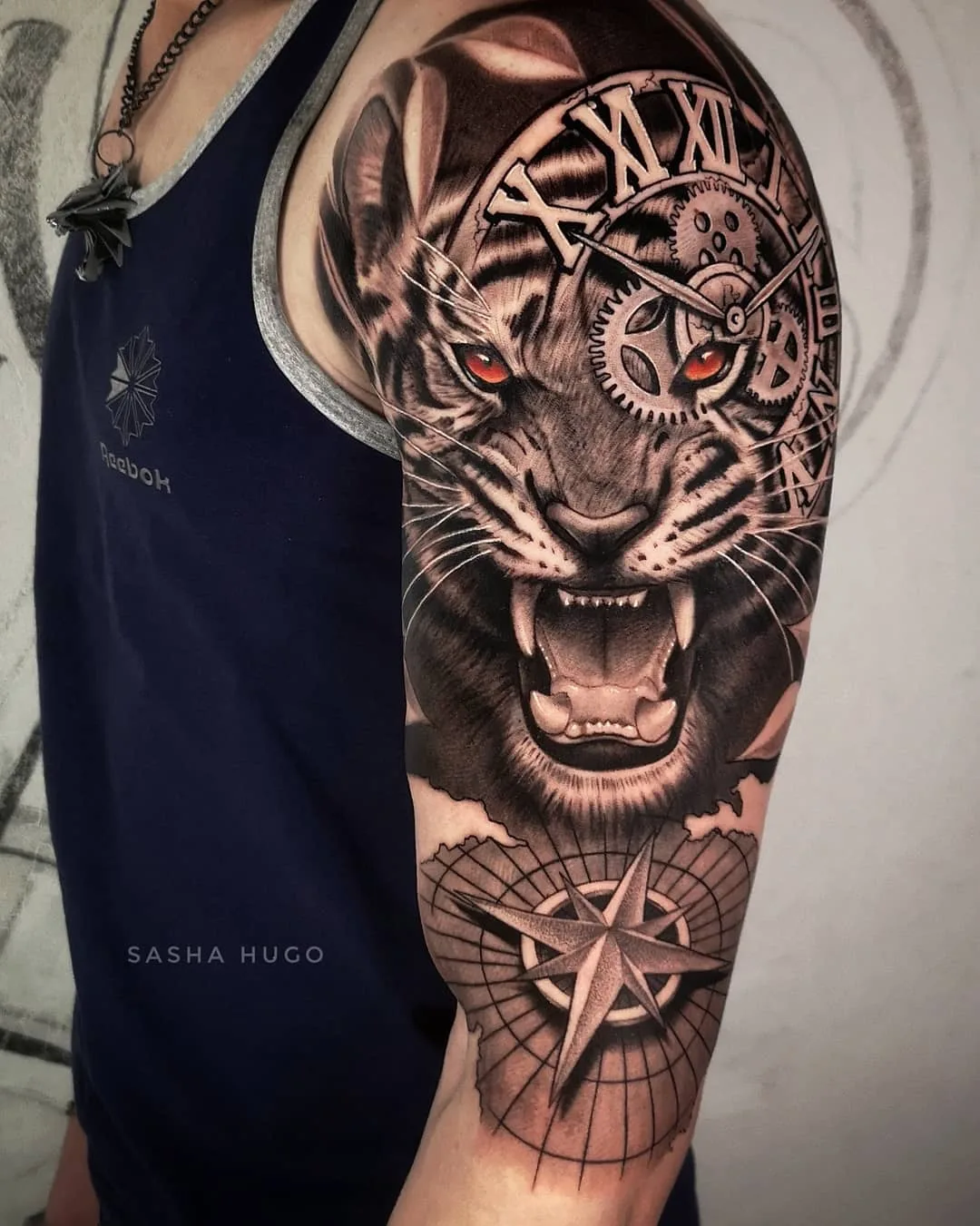
Chest. The chest tiger tends to carry confrontational energy. It faces outward. It’s the first thing someone sees when the shirt comes off. In several Asian cultural contexts, a chest tiger signals personal sovereignty -- this is my territory. Whether or not you intend that reading, the placement communicates it anyway.
Frequently Asked Questions
What does a tiger tattoo mean for women?
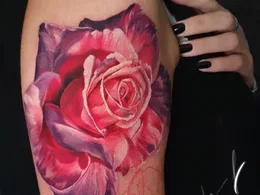
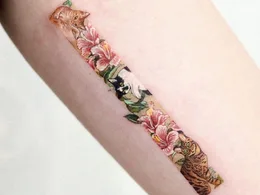
The same thing it means for anyone -- strength, protection, independence. The idea that tiger tattoos are somehow “masculine” doesn’t hold up historically. Durga, one of the most powerful figures in Hindu mythology, rides a tiger. The tiger-as-feminine-power reading is older and more deeply rooted than the Western macho interpretation. Women getting tiger tattoos is a return to one of its original meanings, not a subversion of it.
Is it disrespectful to get a Japanese-style tiger tattoo if I’m not Japanese?
Honestly, there's no clean answer here. Many Japanese tattoo artists welcome international clients and see the global spread of irezumi as appreciation rather than appropriation. Others feel the tradition carries cultural weight that takes years of immersion to truly grasp. The safest path is straightforward: work with a reputable artist, learn something real about the tradition you're drawing from, and go into the process with genuine respect. Intent matters. So does effort.
What pairs well with a tiger tattoo?
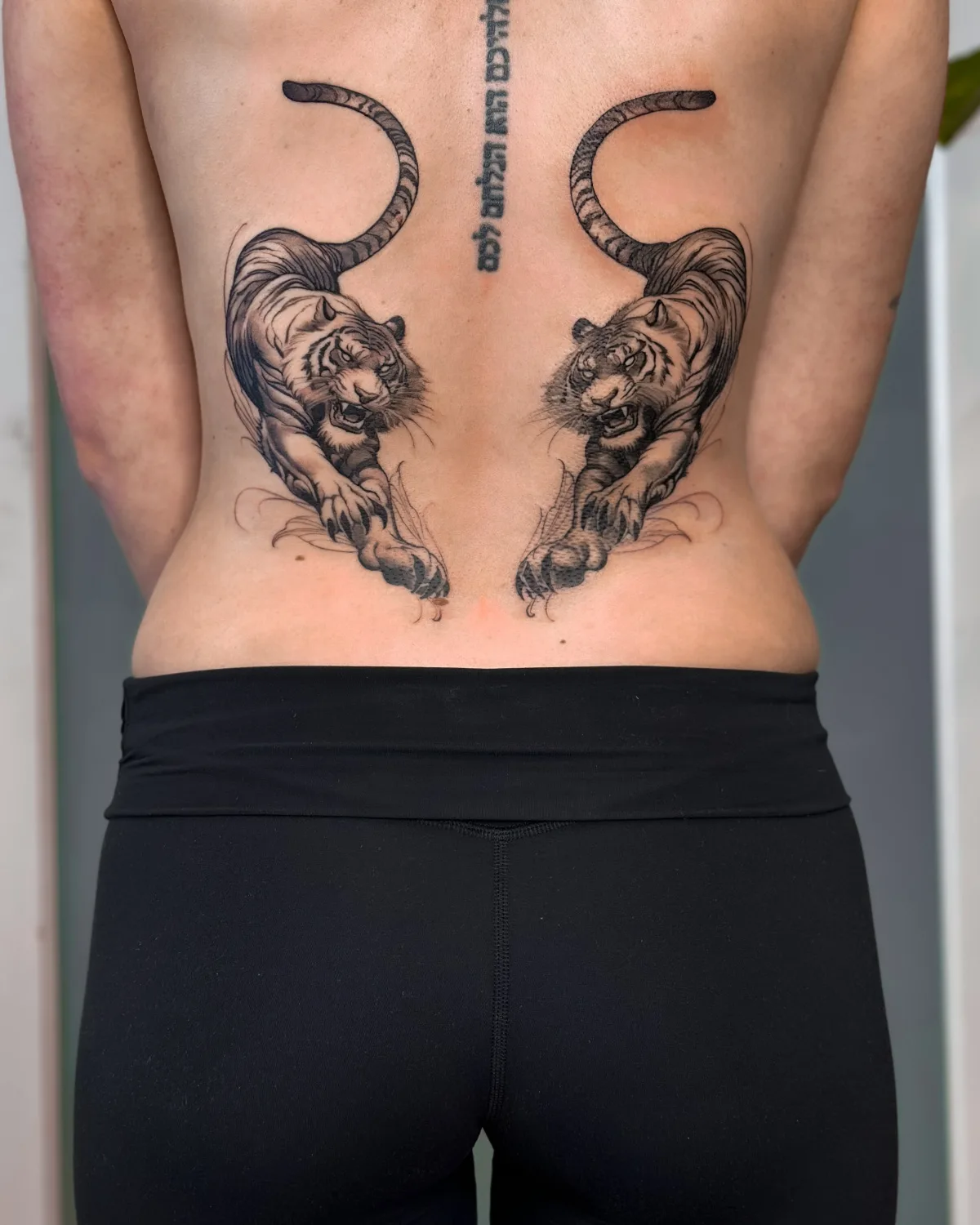
In Japanese tradition, the classic pairings are dragons, bamboo, wind bars, and peonies -- each carrying its own symbolic weight that compounds the tiger's meaning. Chinese symbolism reaches for clouds, mountains, the character for "king." Western work tends toward roses, skulls, geometric elements, or text. The tiger is versatile enough to sit alongside most complementary imagery, but the style has to stay consistent. A realistic tiger dropped next to traditional flash elements will look disjointed -- keep the design language coherent from start to finish.
How painful is a tiger tattoo?
Placement drives the pain more than the design itself. Back pieces are moderate in most areas, though the spine and ribs are a different story entirely. Upper arm and thigh tend to be manageable for most people. The chest is rough, particularly near the sternum and collarbone. Tiger tattoos typically involve heavy shading and dense color packing, which stretches session times well beyond what simpler designs require -- multiple sessions of four to six hours each is standard for large pieces. Your pain tolerance is part of the equation, but so is finding an artist who works efficiently and doesn't drag it out.
Should I choose a realistic or stylized tiger?
That really comes down to what you want the tattoo to say. Realism puts the animal front and center -- raw, photographic, immediate. Japanese style frames the tiger as a mythological guardian with centuries of symbolic baggage attached. Neo-traditional makes a bold graphic statement; blackwork strips it down to something primal. Korean minhwa gives you something altogether different: a creature that's wise, a little funny, and quietly powerful all at once. No wrong choice exists here, but each style carries connotations that become part of what the tattoo means, whether you planned for that or not. Choose the version that feels most honest to what you're actually trying to say.
The tiger, across every tradition that has ever encountered it, refuses to be ignored -- and that quality is exactly why it remains one of the most enduring subjects in the history of tattooing.