A bee tattoo means work done for something larger than yourself: the hive before the single bee. Since about 2007 it has carried a second meaning as well, a stake in the survival of a species we depend on for food. Which of the two a piece is wearing depends on the design, and on whether it quotes an Egyptian throne, a Greek oracle, a Masonic lodge or a city in the north of England.
- The core meaning is work for the hive, not the single bee: contribution, loyalty and self-sacrifice for a community.
- Since colony collapse disorder was named in 2006, an anatomically correct bee on a native flower reads as an ecological statement rather than a mystical one.
- Each tradition pulls the symbol a different way: royalty in Egypt, prophecy and the soul in Greece, order and industry in the Church and the lodge.
- The Manchester worker bee changed meaning in one week in May 2017, from a civic badge to a memorial of solidarity worn far beyond the city.
- Worker versus queen, honeycomb versus flower, and the size of the piece move the meaning more than the choice of style does; small fineline bees blur fastest.
What a bee tattoo means
Start with the animal, because the symbol follows it closely. A honey bee colony is a single organism spread over forty or fifty thousand bodies. The workers build the comb, feed the larvae, guard the entrance and forage until their wings wear out; in summer a worker lives five or six weeks and dies in the field. Nothing about that is a metaphor, and it is why the bee has meant labour and self-sacrifice in every culture that kept it.
The collective is the point. No worker decides anything alone; the hive decides. Karl von Frisch spent decades proving that a returning forager tells the others where the flowers are by dancing a figure of eight on the comb, the angle of the run giving the direction relative to the sun and the length giving the distance. He received the Nobel Prize for it in 1973. People who get bee tattoos after years in a kitchen, a ward, a crew or a band are usually marking that: the work only counts because of who it feeds.
The flight myth belongs here too. A 1930s calculation, usually credited to the French entomologist Antoine Magnan, suggested that by fixed-wing aerodynamics a bee should not be able to fly. It flies anyway; its wings twist and generate vortices the old model ignored. The story survived the correction because it is useful. A bee on the wrist of someone who was told they would not manage is that story, compressed.
Then there is the reading that made the motif spike. In the winter of 2006 to 2007 beekeepers in the United States began opening hives to find the workers gone and the queen abandoned with the brood. The condition was named colony collapse disorder, and for the next decade the bee became the emblem of a specific fear: losing the pollinators that, by the usual estimate, stand behind about a third of what we eat. The European Union banned outdoor use of three neonicotinoid pesticides in 2018 on that argument. A bee tattoo commissioned after 2010 often means "I care about this" in a way that is political rather than mystical, and the design shows it: anatomically correct bees, native flowers, no crown.
Egyptian tradition: bees from the tears of Ra
Egypt made the bee a royal sign before almost anything else. From the First Dynasty, around 3000 BCE, the king's formal title was nswt-bity, "He of the Sedge and Bee": the sedge stood for Upper Egypt in the south, the bee for Lower Egypt in the Nile delta. The bee hieroglyph sits beside royal names for the next three thousand years, and the temple of the goddess Neith at Sais was called the House of the Bee.
The origin story is precise. A magical papyrus now in the British Museum says that when Ra wept, the tears that fell from his eyes to the ground became bees, and the bees made honeycomb and busied themselves among the flowers, which is how wax and honey came into the world. Honey, on that account, is the solidified grief of the sun.
The Egyptians also kept bees more seriously than anyone before them. The oldest known picture of beekeeping is a relief in the sun temple of Nyuserre at Abu Ghurab, around 2400 BCE: men blowing smoke into clay hives and pouring honey into jars. Honey went into hundreds of remedies in the Ebers Papyrus, into offerings, and into tombs. A bee tattoo that quotes this tradition is quoting kingship and the sacred, not labour. The bee is small, but in Egypt it sat next to the crown.
Greek tradition: the Melissae and the oracle
The Greeks moved the bee from the throne to the temple. Melissa, "bee", was a title for priestesses of Demeter, and is often said to have been used for the priestesses of Artemis at Ephesus, a city whose coins carried a bee for centuries; Pausanias mentions officials of the Ephesian cult called Essenes, a word later glossed as "king bees".
Honey was the food of prophecy. The Homeric Hymn to Hermes describes three winged sisters on Parnassus, above Delphi, who tell the truth when they have eaten honey and lie when they have not; Apollo hands them to Hermes as a lesser oracle. Pindar simply calls the Pythia "the Delphic bee", and Pausanias records the tradition that the second temple of Apollo at Delphi was built by bees out of wax and feathers.
Bees also fed the gods: in the Cretan story the infant Zeus is hidden in a cave and nursed on honey by the nymph Melissa. In a later philosophical reading, written down by Porphyry in his commentary on the cave of the nymphs in the Odyssey, souls descending into bodies are called bees. That is one source of the idea, repeated in tattoo shops, that bees carry souls between worlds. A Greek bee tattoo is about voice and passage: the messenger who speaks true when fed, and the small winged soul.
Christian and Masonic symbolism: the hive as model
The Church kept the bee's industry and added chastity to it. The Easter Vigil chant, the Exsultet, pauses in praising the risen Christ to praise the bee that made the wax of the paschal candle, because for centuries bees were believed to reproduce without mating. Beeswax was therefore the pure substance, fit for the altar. Ambrose of Milan, on whose infant mouth a swarm was said to have settled, became patron of beekeepers and candle-makers, and John Chrysostom is credited with the line that the bee is honoured above other creatures not because she labours, but because she labours for others.
The hive itself became the picture of the Church: many bodies, one order, one purpose. When Maffeo Barberini became Urban VIII in 1623 he put his family's three bees on everything he commissioned, including the bronze columns of Bernini's baldacchino over the high altar of St Peter's.
Freemasonry took the hive without the theology. In the lecture of the third degree, as fixed by Thomas Smith Webb's monitor of 1797, the beehive is "an emblem of industry" that teaches the Mason never to sit content while others around him are in want. The same emblem travelled west with the Latter-day Saints, whose scripture gives the honey bee the name Deseret; it is on the seal of Utah, the Beehive State. A bee tattoo in this line is a lodge or a church in miniature: order, duty, work for the common good.
Manchester and the worker bee
Manchester chose the worker bee in 1842, when the city was granted arms with bees on a globe in the crest, a plain statement that the first industrial city was a hive. Alfred Waterhouse set bees into the mosaic floor of the Town Hall in 1877, and for a century afterwards the bee stayed on bollards, bins and lamp-posts.
On 22 May 2017 a bomb was detonated at the exit of an Ariana Grande concert at Manchester Arena. Twenty-two people were killed, many of them teenagers. Within days a tattooist from Stalybridge, Sam Barber, had organised what became the Manchester Tattoo Appeal: studios across the city, then across Britain, then abroad, tattooed a worker bee for a fixed donation, usually fifty pounds, with the money going to the emergency fund for the families. Queues formed round the block. More than half a million pounds was raised, which means thousands of bees put into skin that summer.
That is the clearest modern case of a motif changing meaning in one week. Before the bomb, a Manchester bee tattoo said "I am from here". After it, the same design said "we held together", on people who had never been to the city. The appeal also settled the form: a stylised worker bee in profile or from above, black or gold, often with the date or the number 22. A bee tattoo commissioned in Britain since 2017 will be read in that light whether or not the wearer intends it.
Tattoo styles that suit the bee
The bee is small, striped, hairy and translucent-winged, and each of those four facts favours a different style.
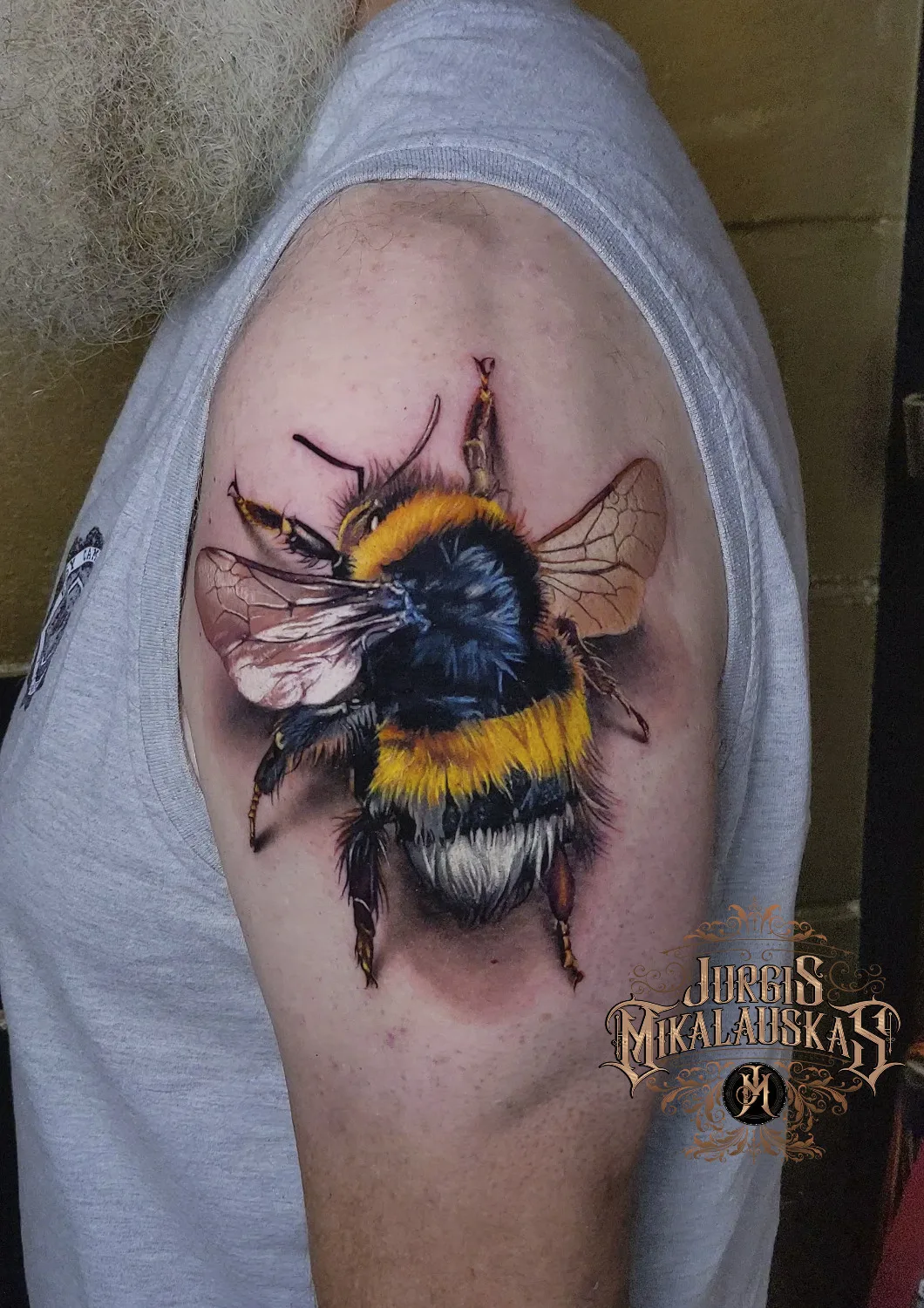
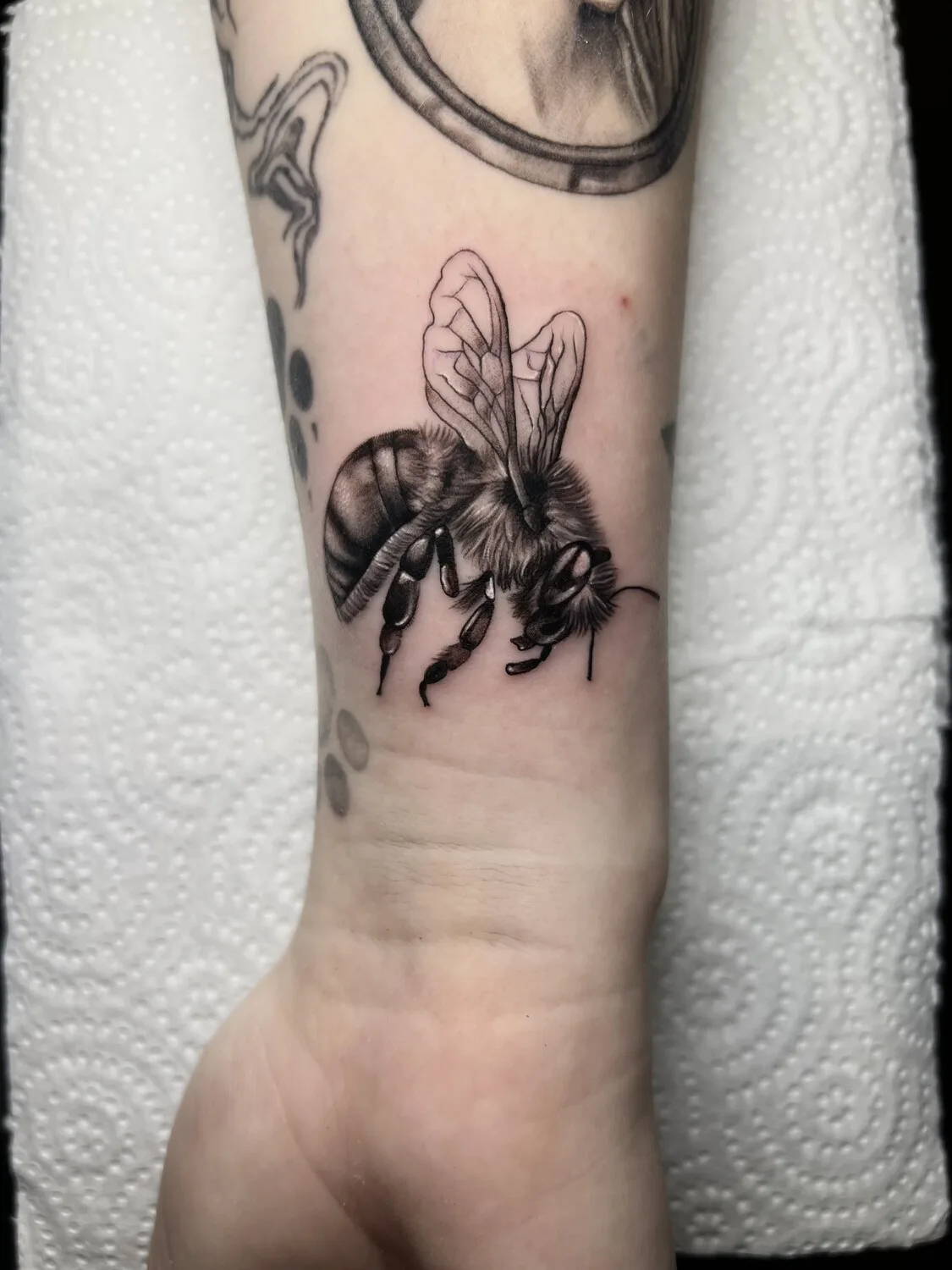
Realism. A realistic bee lives or dies on three details: the fuzz on the thorax, which needs soft stippled shading rather than solid fill; the wing veins, which have to read as thin and transparent; and the bands of the abdomen, which are a gradient of ochre, rust and dark brown with hair on top, not flat yellow and black. A bumblebee gives the artist more fur than a honey bee, which is why so many realistic pieces quietly switch species. Realism needs size: below the width of a palm the fuzz turns to mud.
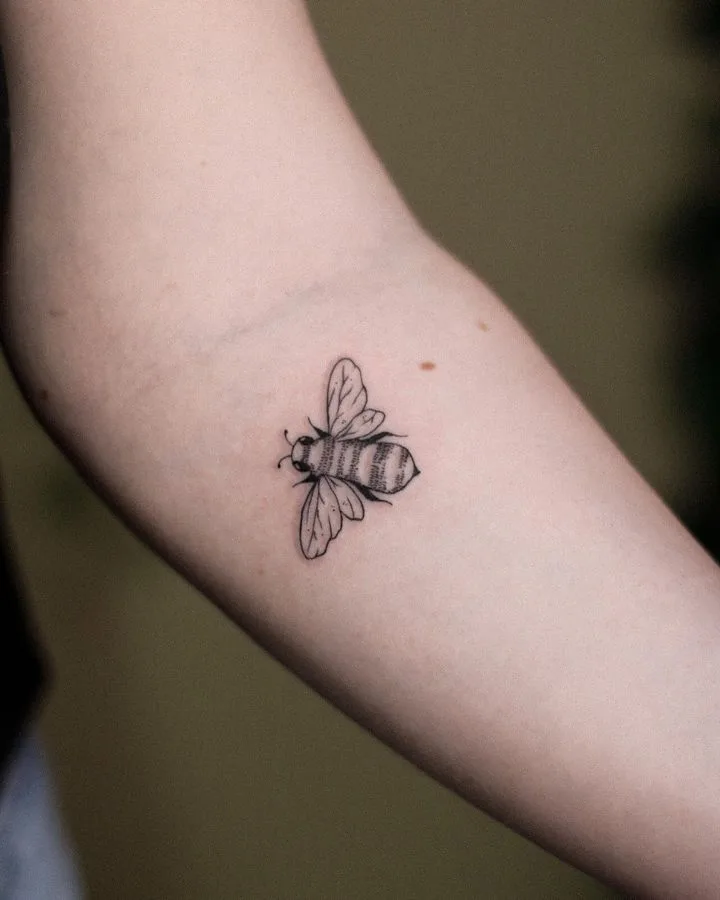
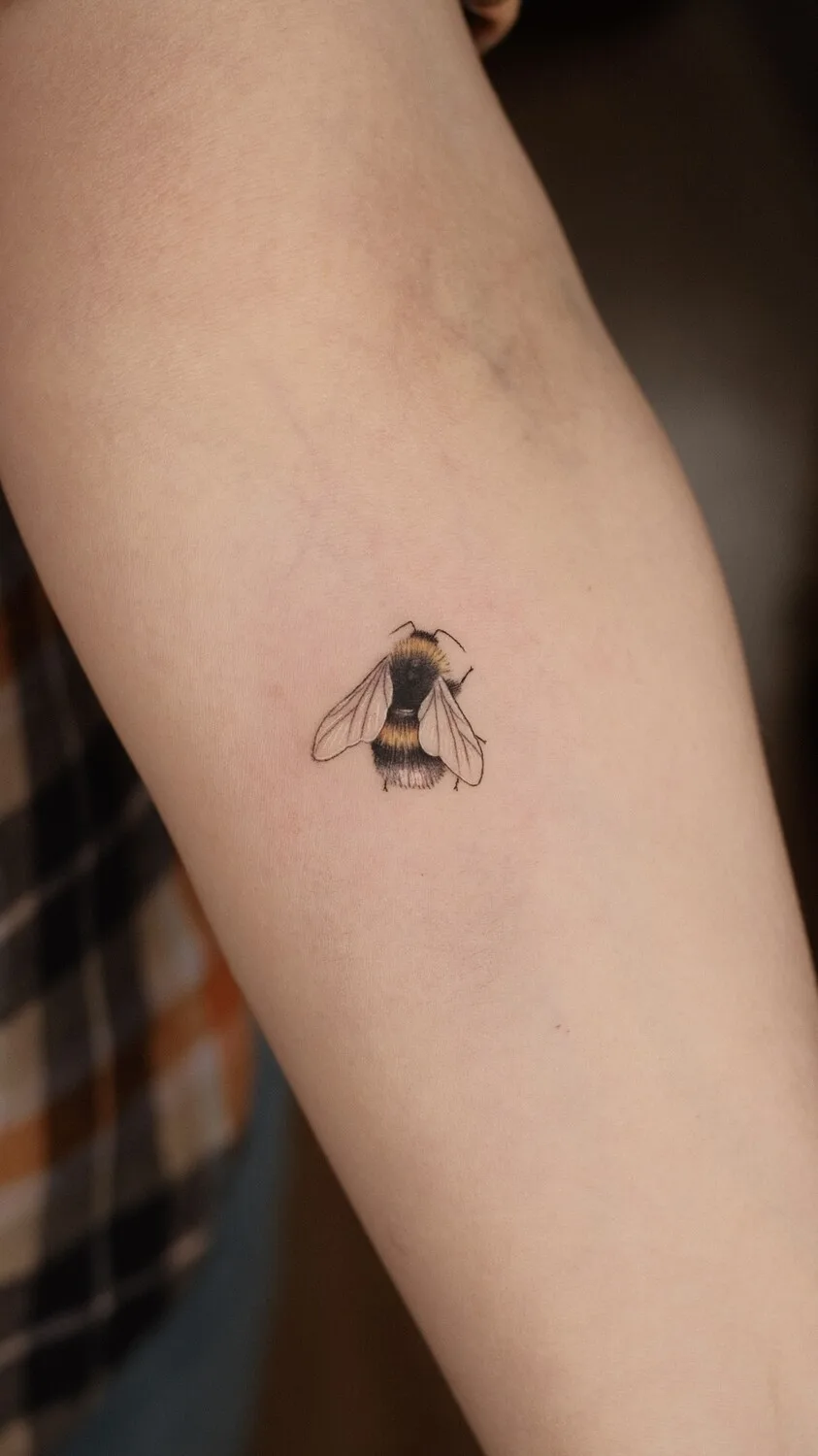
Fineline and minimal. Single-needle outlines, a few centimetres long, on a wrist, an ankle or behind the ear. The most popular request by volume and the one with the shortest shelf life: a hairline keeps expanding for years, so a two-centimetre bee drawn with ten separate lines merges into a smudge faster than most people expect. It ages best when the line count is low and the gaps generous.
Blackwork and engraving. The bee has a natural home in the language of old natural-history plates: cross-hatched body, stippled thorax, wings drawn as a net of black lines on bare skin. It holds well because the contrast is built into the drawing rather than added as shading, and it takes ornament (acanthus scrolls, honeycomb, wildflowers) without losing the insect in the middle. Most of the large bee pieces on the bee motif page sit in this territory, and it is the fastest way to see how differently the same insect can be drawn in black alone.
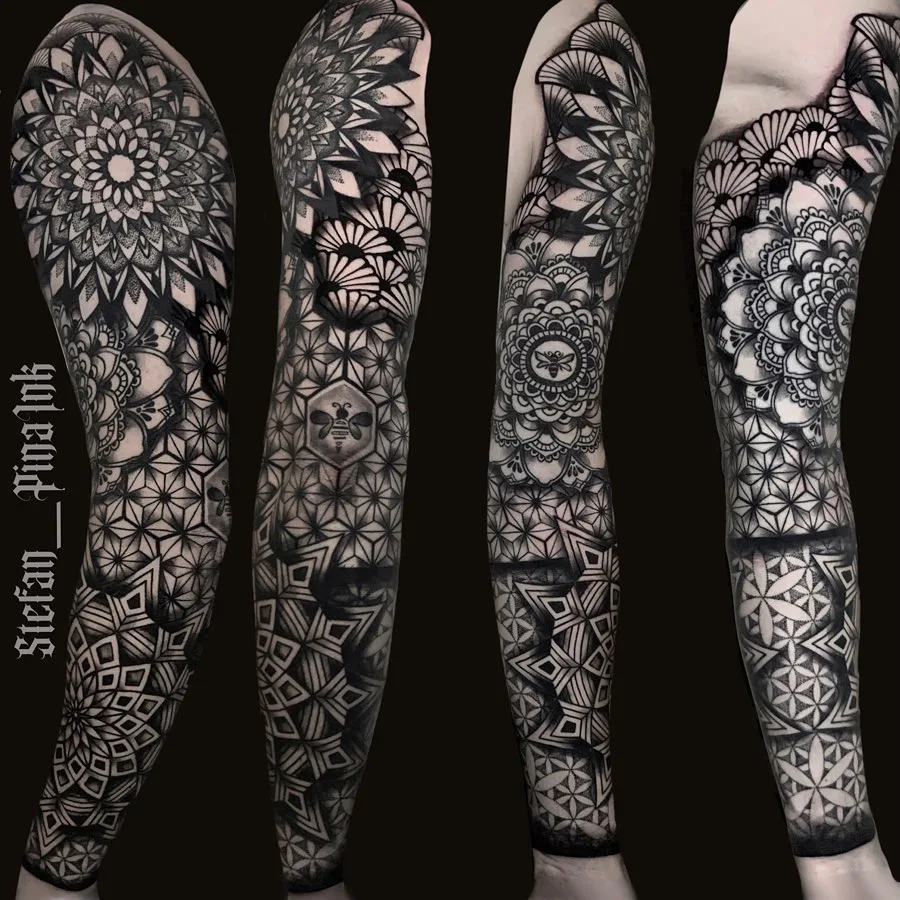
Geometric. The honeycomb hands this style its structure for free. Hexagons behind the bee, a bee dissolving into cells at one edge, a mandala on a six-fold grid: the geometry is the animal's own architecture, and it reads as the hive rather than the individual.
Traditional and neo-traditional. Bold outline, flat saturated colour, a slightly heraldic bee that looks as if it came off a tin. This ages best of all, because the outline carries the image and the yellow can fade without the piece losing shape. The Manchester appeal bees were mostly in this register: quick, legible at any size, and consistent across hundreds of hands.
Botanical and illustrative. The bee with the flower it feeds on: lavender, clover, sunflower, thistle, foxglove. Watercolour washes fade fastest, so most artists now anchor the colour with a fine black line. The style suits the ecological reading, because the plant tells you which bee and which landscape you mean.

Watercolor floral bee tattoo by @katy_garnet

Watercolor bouquet tattoo with a bee by @watercolor_di

Flowers, bees, and dragonfly tattoo by @tattooistsion

Delicate watercolor daffodils and bee tattoo by @Fenman

Watercolor bumblebee ankle tattoo by @evg_e_sha

Colorful bee and flower tattoo by @evg_e_sha
Placement and scale
A real honey bee is about fifteen millimetres long. Most tattoo artists will not draw one that small, and the ones who will should not be encouraged. Scale is the first decision, and it decides the placement.
Small: two to five centimetres. Wrist, inner forearm, ankle, behind the ear, collarbone, the side of a finger. This is where the majority of bee tattoos go, and where the majority of blurred bee tattoos come from. At this size the honest options are a clean outline, a filled silhouette, or a traditional bee with a heavy line. Behind the ear is the most requested spot for a tiny bee: the curve of the skull suits the shape, and a haircut hides or shows it. Fingers and the sides of hands push pigment out as the skin turns over, so expect a touch-up and some loss of detail regardless of the artist.
Medium: a palm's width. Upper arm, shoulder, shoulder blade, calf, the outside of the thigh. This is the minimum for realism and the comfortable size for an engraving-style bee with ornament round it. On the shoulder or upper arm the bee reads as a badge, which is why it is the natural place for a Manchester bee with a date or a Masonic hive. The shoulder blade gives a flat surface for a bee in flight, wings spread, seen from above.
Large: chest, back, sleeve. A single bee will not fill a chest. What fills it is the hive: honeycomb built across the sternum, flowers and fungi growing out of it, the bee hanging below as the one living thing among the structure. Sleeves usually run the other way, a swarm moving up the arm through a botanical, so that the arm becomes the field the bees are working. Both are multi-session projects.
The bee's outline is nearly symmetrical, so it sits well on the centre lines of the body (sternum, spine, nape), and it has no fixed direction of travel, so it can face whichever way the placement needs.
Design variations and what they change
Small choices in a bee design move the meaning further than the choice of style does.
Worker bee or queen bee. The most consequential decision. A worker bee, especially in profile and without ornament, means contribution, humility, the crew rather than the captain; the Manchester bee is a worker, deliberately. A queen bee, usually larger, often crowned, sometimes with attendant workers, means authority and fertility. The queen is the only fertile female in a colony of tens of thousands, and the title has become a claim to female power, most visibly among Beyoncé's fans. No bee in nature wears a crown; most European writers called the queen a king until Charles Butler's The Feminine Monarchie of 1609 made her sex widely known.
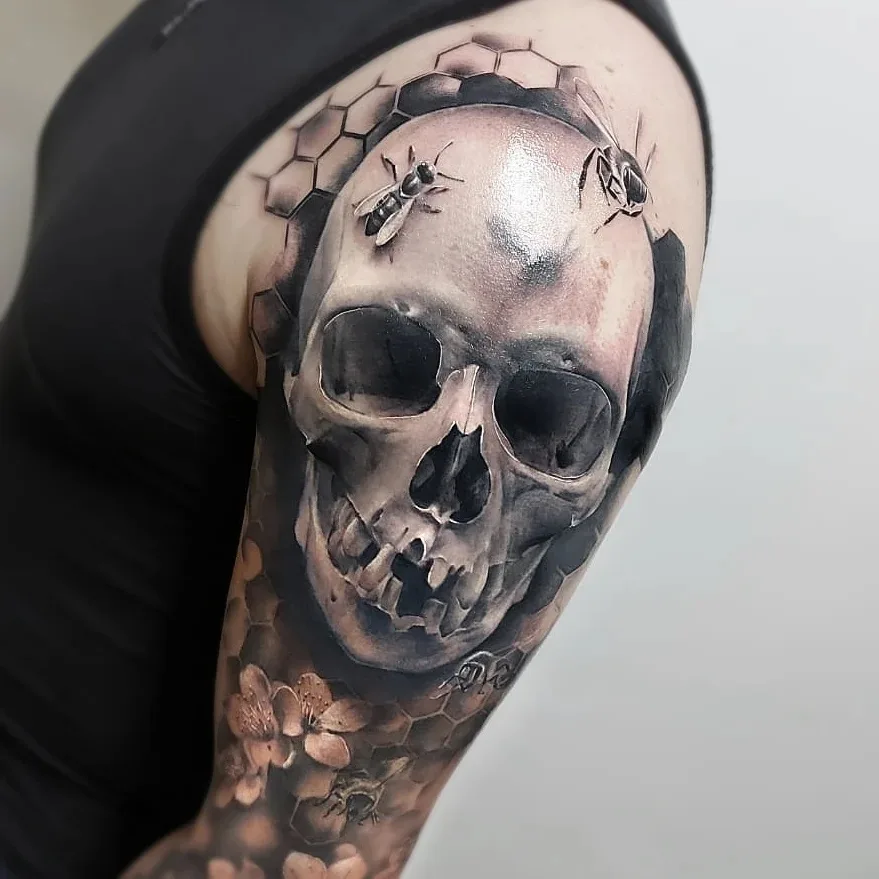
Bee and honeycomb. Adding cells puts the bee in its context. A few hexagons behind the insect say home and structure; a full comb turns the piece into a statement about community; empty cells can read as loss. Honeycomb is also the easiest way to extend a bee tattoo later without redrawing it.
Bee and flower. The plant carries the second half of the sentence. A sunflower says plenty, lavender says calm, a thistle says Scotland, a poppy in Britain says remembrance. A bee on a native wildflower is the ecological reading in its clearest form.
The imperial bee. When Childeric I's tomb was opened at Tournai in 1653 it held about three hundred small gold insects with garnet wings, read at the time as bees. Napoleon took them as his emblem at his coronation in 1804 to reach past the Bourbon fleur-de-lis to the first Frankish kings, and scattered bees across his robes and furnishings. A gold bee on a dark ground means empire and legitimacy rather than the hive.
The dead bee. A bee on its back, or a bee inside a bell jar, is grief: for the pollinators, or for a person who worked themselves to nothing for others. It is one of the few bee designs that reads as dark.
Swarm. Many small bees rather than one detailed one, usually in flight along a limb. It shifts the meaning from the individual worker to the collective decision, which is what a swarm actually is: half a colony leaving together for a new home the scouts have agreed on. It ages well too: a hundred simple shapes survive blur better than one complicated one.

Bee, honeycomb, and snake thigh tattoo by @india.tattooartist

Floral and bee tattoo by @korovles

Fineline bee and floral collarbone tattoo by @anhen_tattoo

Branch, berries, and bee tattoo by @songe.tattoo

Bumblebee and flowers tattoo by @Alina VIVES

Rose, face, and bee tattoo by @vorob
Choosing an artist for a bee tattoo
The bee looks easy and is not. Its body is three distinct textures within two centimetres: fur, chitin and membrane. An artist who treats all three the same produces a striped blob with wings.
Ask for healed photographs of bees, not fresh ones and not butterflies. Fresh work hides everything that matters: whether the wing veins stayed separate, whether the fuzz stayed soft, whether the yellow held. Butterflies are a different problem: flat, coloured wings rather than transparent ones, and no fur.
Decide which bee before the consultation. A honey bee is slim, with a narrow waist and a smooth abdomen; a bumblebee is round and furred all over. Artists often draw the second when asked for the first because it reads better, and for a Manchester bee or an ecological one the species matters. Bring a photograph of the insect rather than a screenshot of somebody else's tattoo: the first gives the artist a problem to solve, the second a solution to copy.
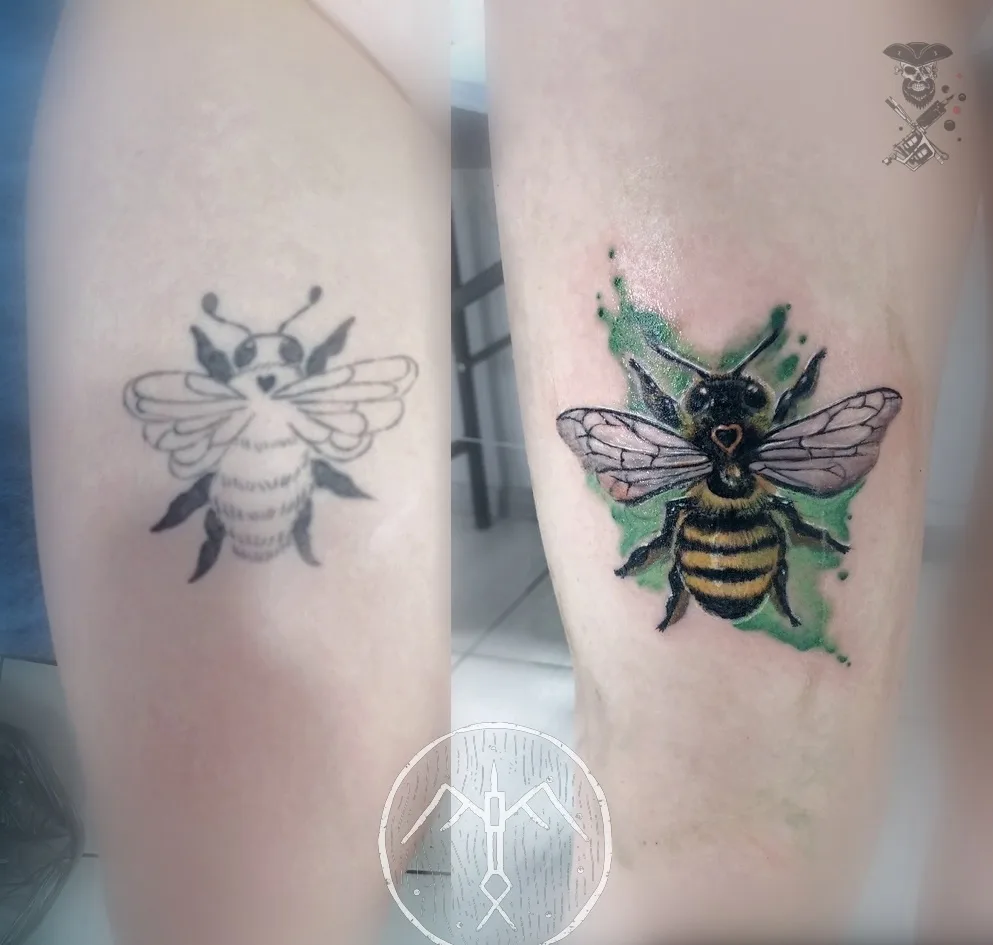
Match the design to the artist's language. A fineline specialist will give you a beautiful minimal bee that needs redoing in eight years; an engraving-style blackwork artist will give you one that looks the same in twenty. A crowned queen with ornament wants neo-traditional; a bee on a specific flower wants someone whose botanicals you already trust. You can filter by style, country and city in our tattoo artist directory.
It helps to see how differently the same insect is handled. Jurgis Mikalauskas renders a bumblebee in full-colour realism on the upper arm, with a cast shadow under it so the animal appears to sit on the skin; Lozzy Bones draws the bee as an engraving, framed in baroque acanthus scrolls and scattered honeycomb, so it reads as a heraldic emblem; Pony Reinhardt builds a whole chest piece in black linework, honeycomb and sunflowers and mushrooms above, the bee hanging alone beneath as the only living creature in the composition. Three answers to one motif.
Aftercare and how a bee tattoo ages
Standard aftercare applies: keep it clean, keep it lightly moisturised, leave the scabs alone, and stay out of pools and direct sun for two to three weeks. A small bee heals fast; a colour realism piece takes a month before the wings look right again.
Beyond that, the bee has two specific ageing problems. The first is scale. Most bee tattoos are small and drawn with fine lines, and fine lines spread. A tiny bee with individually drawn legs, antennae and wing veins will be a soft dark shape in five to eight years. The fix is at the design stage: fewer lines, wider gaps, a stronger outline, or simply a bigger bee.
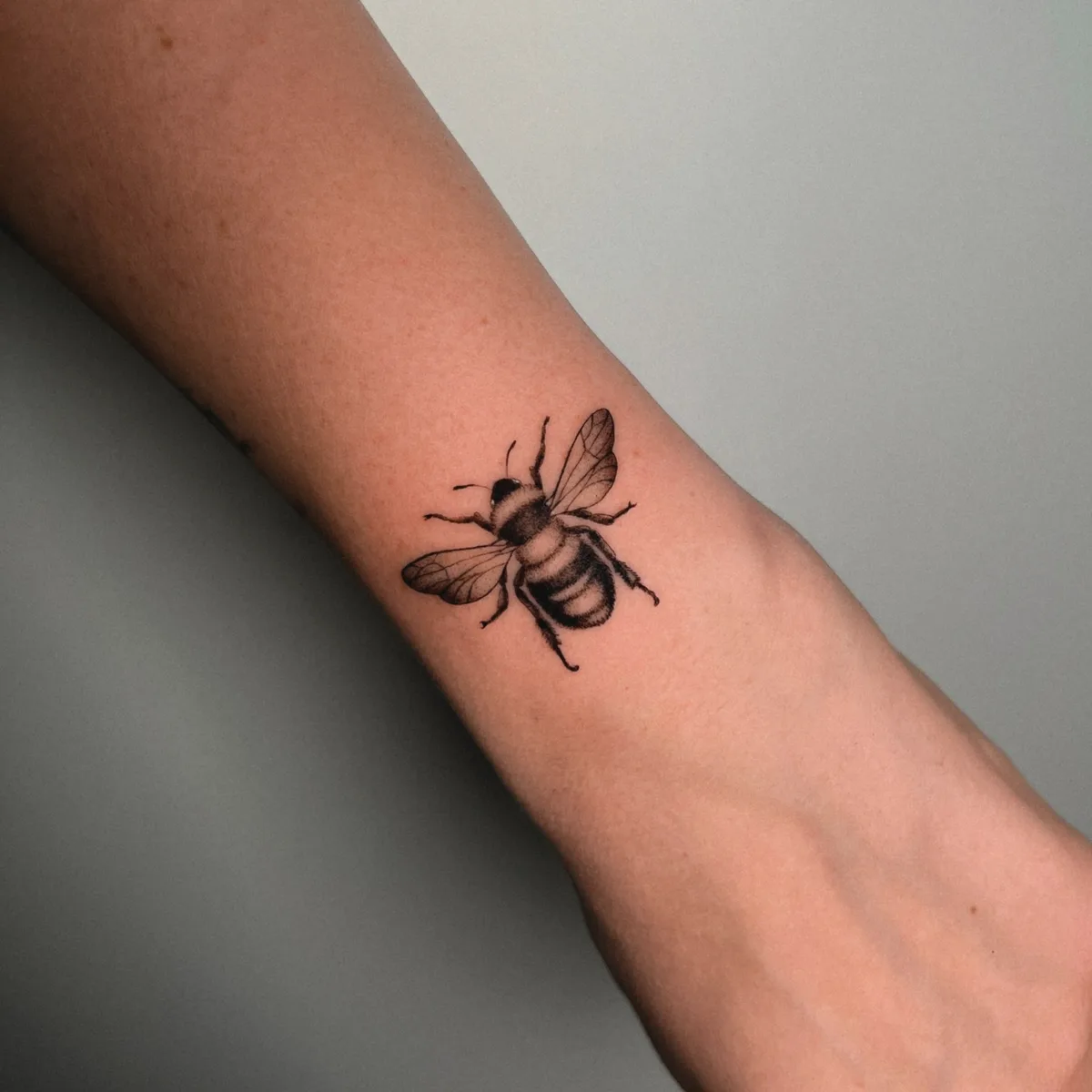
The second is yellow. Of all tattoo pigments, yellow fades soonest under sunlight, and a bee's whole identity is a yellow-and-black stripe. A colour bee on a forearm that sees the sun will lose its bands well before it loses its outline. Artists compensate with a warm ochre rather than a lemon yellow, with black bands heavy enough to carry the stripe on their own, or by leaving the yellow out entirely, which is one reason black-and-grey bees have become so common. Sunscreen on an exposed bee does more for its long-term life than any product sold for tattoos. Budget for one touch-up in the first year for anything with fine wing detail.
Frequently asked questions
What does a bee tattoo symbolise?
Work for the common good, loyalty to a community, and resilience. Since colony collapse disorder was named in 2006 and 2007 it has also meant care for the natural world. The design narrows it: a worker bee says contribution, a queen says authority, a bee on a wildflower says ecology, and in Britain a stylised worker bee says Manchester.
What does the Manchester bee tattoo mean?
Solidarity after the Manchester Arena bombing of 22 May 2017. The worker bee had been the city's emblem since 1842; after the attack, studios across Britain tattooed it for a fixed donation to the victims' fund, and thousands of people wear it. On a Mancunian it also still means simply "I am from here".
What does a bee tattoo mean spiritually?
In Greek tradition the bee was the priestess and the soul: Melissa was a title for priestesses, and Porphyry called souls entering the world bees. In Egypt bees were born from the tears of Ra. In Christian use the hive is the Church and beeswax is pure enough for the altar. Most modern spiritual readings, including the idea that a bee visiting you carries a message, draw on one of those three sources.
What does a queen bee tattoo mean?
Leadership, fertility and being the centre of a community. The queen is the one bee a colony cannot replace quickly, and the design usually shows her larger and crowned. It reads differently from a worker bee, which is about serving the group rather than leading it.
What does a dead bee tattoo mean?
Grief or sacrifice: a memorial for pollinators lost to pesticides and habitat loss, or for a person who gave everything to their work or their family. It is the one bee design that reads as dark, and it is often paired with a bell jar or a dried flower.