A crow tattoo means intelligence that survives on its wits: memory, tool use, the ability to recognise a face and hold a grudge against it. The death reading exists, but it is the second layer, not the first. Which one your tattoo carries depends on the tradition behind it, because the crow is a state emblem in Japan, a goddess in Ireland, a courier to the ancestors in India and a bad omen in an English hedgerow.
- The crow's first meaning is a working intelligence: tool use, face memory and grudges passed to the next generation, documented in Oxford, Sendai and Seattle.
- The death reading is mainly European; in Japan (Yatagarasu), Ireland (the Badb), Hopi ceremony and Hindu shraddha rites the crow is a guide, a witness, a law-keeper or a courier to the ancestors.
- A crow is not a raven: straight beak, fan tail, smaller body. Ask the artist for the bird you mean, and check the portfolio for healed crows rather than fresh eagles.
- Blackwork and neo-traditional age best; realism lives or dies on the purple-green feather sheen; fine feather texture under six centimetres blurs into a blob.
- Number changes meaning: one crow is watchfulness, three on a wire is the city bird, a murder in flight is transformation or a reckoning.
What a crow tattoo means
Start with the animal, because that is where the meaning comes from. Crows make and use tools: New Caledonian crows cut hooked probes from pandanus leaves and keep the good ones. In 2002 a captive crow named Betty, in Alex Kacelnik's lab at Oxford, bent a straight wire into a hook to lift a bucket of food out of a tube, with no example to copy. Carrion crows in Sendai, Japan, have been filmed dropping walnuts onto pedestrian crossings, let the traffic crack them, and collect the kernels when the light turns red.
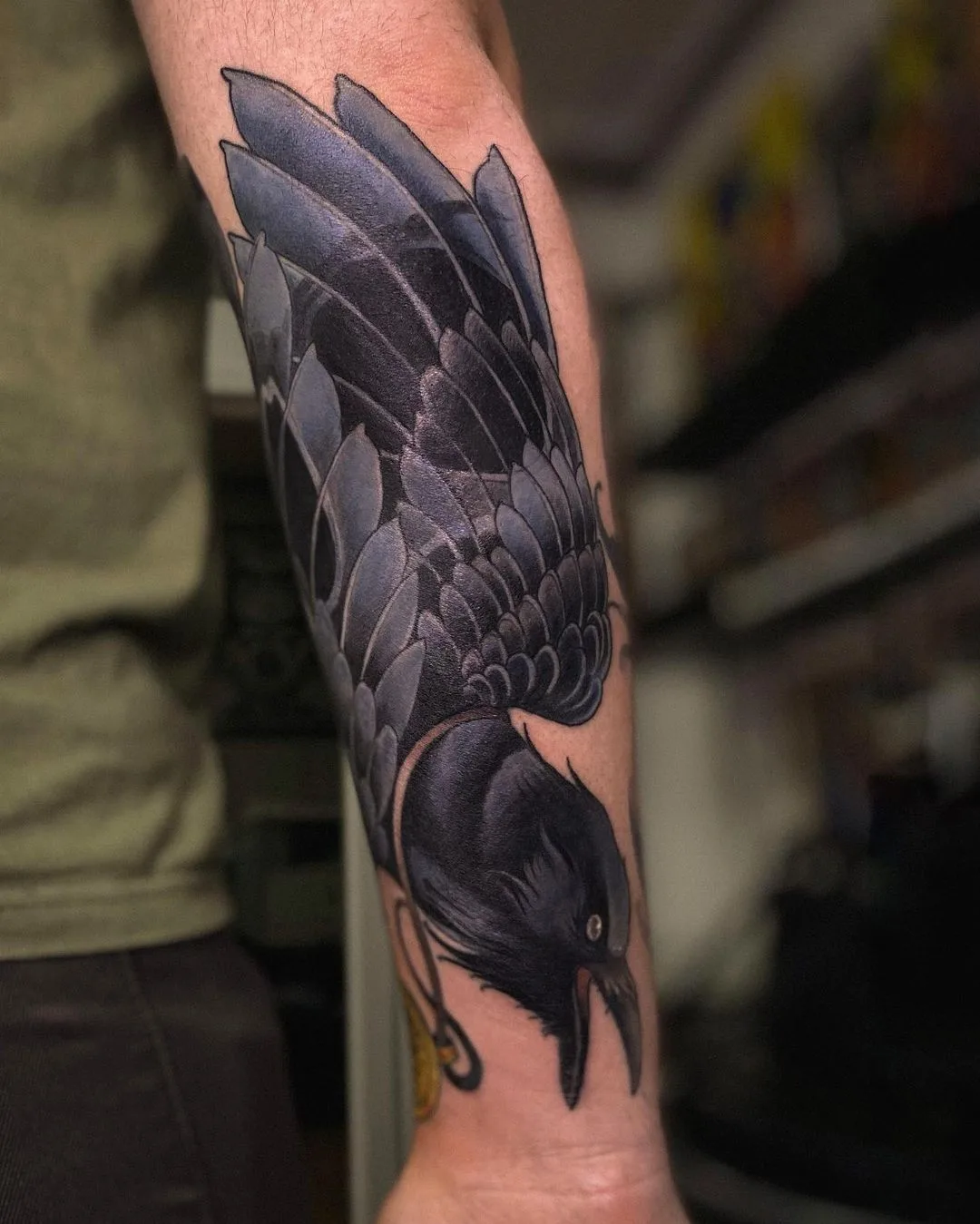
Then there is the face thing. Between 2006 and 2008, John Marzluff's team at the University of Washington trapped crows on the Seattle campus while wearing a rubber caveman mask. For years afterwards, anyone crossing the campus in that mask was scolded and dive-bombed by crows, including birds that had never been trapped: the others had taught them. The response only faded after seventeen years.
That is the baseline of a crow tattoo: a mind, not a mood. It suits people who got through something by being clever rather than strong, who adapted to a city or a country they were not born in and learned its rules fast enough to survive it. Crows do that literally: they thrive in farmland, forest, coast and downtown, and have done better out of human civilisation than most wild birds.
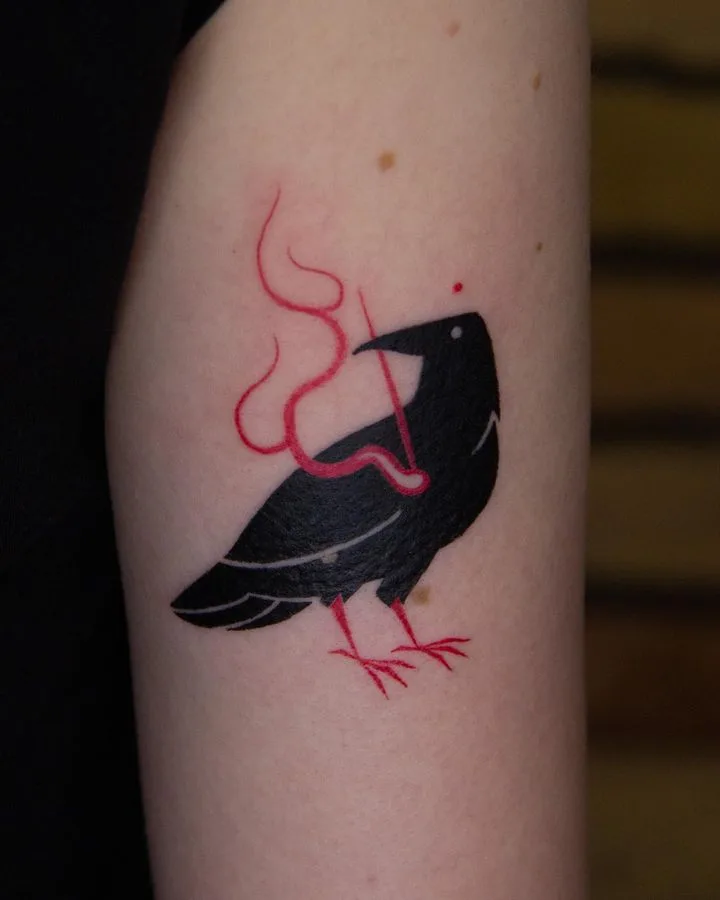
The darker reading is real but narrower than people assume. Crows eat carrion and gather where there has been a fight, so European folklore made them omens. In many other traditions the crow's connection to death is a job, not a curse: it carries messages across the boundary, escorts the dead, brings word back. A crow tattoo chosen for grief usually means that.
The third strand is the trickster: clever, amoral and useful, acting on a logic of its own that serves everyone in the end. A crow tattoo can mean that you do not play by the obvious rules, or that you understand them better than the people enforcing them.
One distinction is worth settling early. The raven is the crow's larger cousin and carries the heavy mythology: Odin's messengers, Poe's poem, the Pacific Northwest creator. The crow is the working bird: smaller, more social, more urban, more often in a group. If the raven tattoo says fate and prophecy, the crow tattoo says memory, adaptation and the intelligence you use every day.
Japanese tradition: Yatagarasu, the three-legged crow
In the Kojiki and the Nihon Shoki, Japan's eighth-century chronicles, the first emperor, Jimmu, is lost in the mountains of Kumano on his way to Yamato. Heaven sends down a great crow (the deity Takamimusubi in the Kojiki, the sun goddess Amaterasu in the Nihon Shoki), Yatagarasu, to fly ahead and show the way. The army follows the bird out, and the Japanese state is founded at the end of the road.
Nothing in those texts says the crow had three legs. The extra leg comes from Chinese sun-crow imagery, where a three-legged bird lives inside the sun, and merged with Yatagarasu over the centuries. Later readers gave the legs meanings: heaven, earth and humanity, or wisdom, benevolence and courage.
The bird is still in daily use. The Kumano shrines print it on their goō talismans, the paper oaths samurai once swore on; breaking such an oath was said to kill a crow in Kumano. The Japan Football Association has carried Yatagarasu on its crest since 1931, so it appears on every national team shirt. It is the most optimistic crow in this article: not an omen, a guide that gets you home.
Celtic mythology: the Badb on the field
The Irish word badb means a crow, specifically the hooded crow, the grey-and-black scald-crow of Irish and Scottish fields. It is also the name of a goddess. Badb Catha, the battle crow, is one of the three war goddesses of Irish myth, alongside Macha and the Morrígan, and she is the one most closely identified with the bird. The figure is older than the Irish texts: a Gaulish inscription found at Mieussy in Haute-Savoie records a goddess Cathubodua, built from the same two words.
Badb does not fight. She appears over the field before the battle to unsettle the armies with her screaming, and after it to speak. At the end of Cath Maige Tuired, the second battle of Mag Tuired, the war goddess delivers the closing prophecy, first of peace and then of the world's decline; most translations name the Morrígan, with whom Badb is often merged. In the later folklore of Munster and south Leinster, the badhbh became the local name for the banshee, the death-messenger heard outside a house before a death.
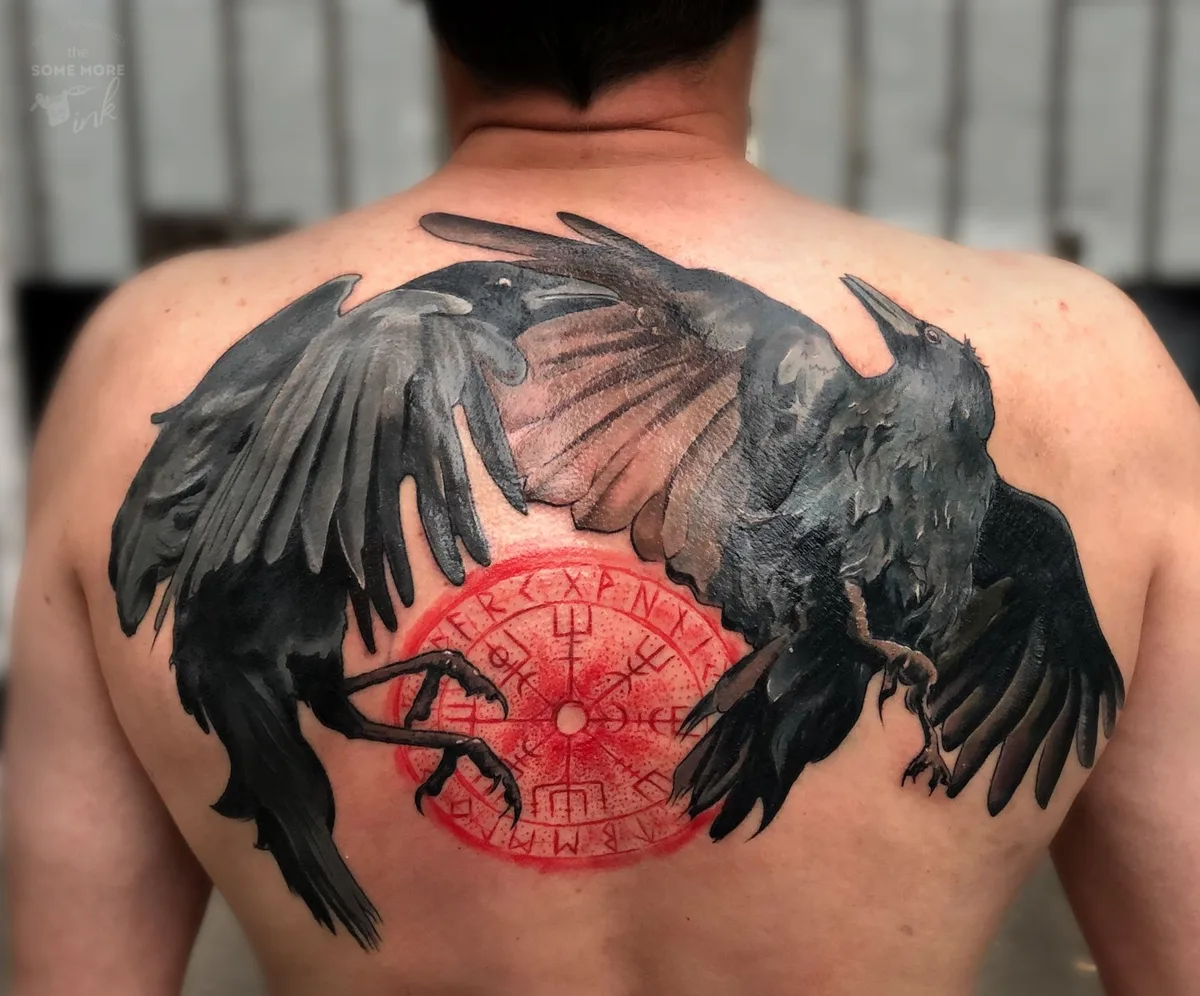
As a tattoo, the Badb is the crow as witness and voice: the bird that arrives before the outcome and names it. A hooded crow with its grey mantle, rather than an all-black bird, tells people who know the tradition exactly which crow you mean.
Native American traditions: the crow as law-keeper
Indigenous crow symbolism varies by nation; each of the traditions below belongs to its community.
Among the Hopi, the crow is a disciplinarian. Angwusnasomtaqa, Crow Mother, wears two crow wings on her head and appears at Powamu, the February bean-planting ceremony, as mother of the Hú kachinas, the whippers. When Hopi children are initiated into the kachina society, it is Crow Mother who holds the yucca whips and oversees the ritual whipping. She is not a trickster in that story. She is the one who makes sure the law of the ceremony is kept.
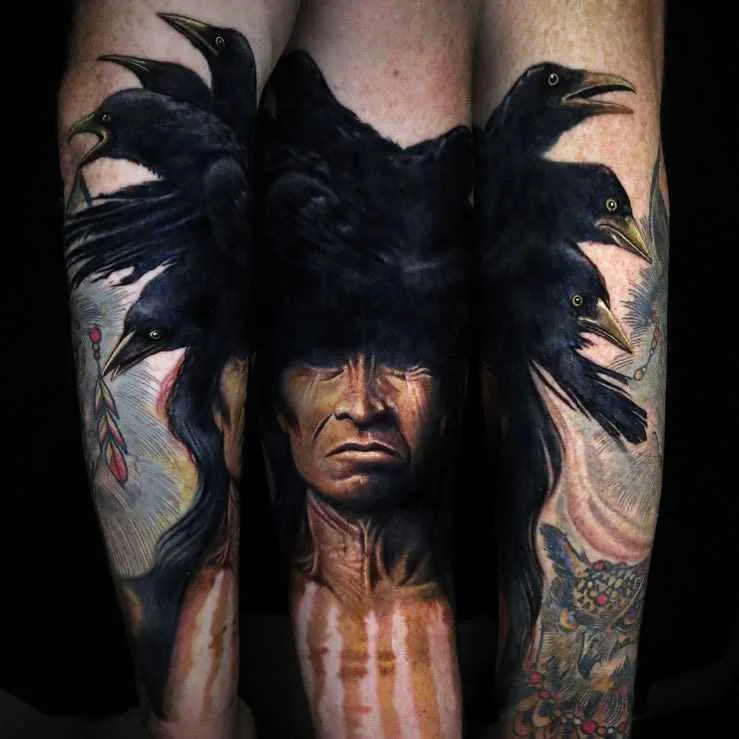
On the Plains, a story often attributed to the Lakota explains the crow's colour by its old job. The crow was once white and served as sentinel for the buffalo, warning the herd whenever hunters approached. The people caught him and threw him in the fire; he escaped scorched black. He kept the herd's order and paid for it.
In the Ghost Dance of the 1890s, recorded by James Mooney among the Arapaho, the crow is the messenger of the world to come, and dancers wore crow feathers for that reason. The Apsáalooke, the Crow Nation, owe their English name to a French translation of a word meaning children of the large-beaked bird; which bird is still debated.
For anyone outside those nations, the workable path is the same as for any Indigenous motif: take the qualities, order, vigilance, message-bearing, and leave ceremonial imagery alone.
European folk omen and the 'murder' of crows
The English collective noun is older than most people expect and younger than it sounds. A murther of crowes appears in the Book of Saint Albans of 1486, in a list of hunting terms, next to an unkindness of ravens. It then fell out of use for four centuries and was revived in the twentieth, largely by James Lipton's 1968 book An Exaltation of Larks, which is why it feels medieval and modern at once.
The reputation was earned on farms rather than battlefields. In 1532 Henry VIII's parliament passed an Act for the destruction of crows, choughs and rooks, ordering every parish to keep crow nets and pay bounties per head; Elizabeth I's Vermin Act of 1566 widened the list. Three centuries of paid persecution taught Europeans to see the crow as a pest, and the scarecrow is the monument to that.
The counting rhyme adds the omen. One for sorrow, two for joy was first written down in 1780 in John Brand's Observations on Popular Antiquities, and it was originally about magpies. Crows inherited it. The Scots ballad The Twa Corbies, printed in Walter Scott's Minstrelsy of 1803, has two crows deciding who gets the eyes of a slain knight. That is the European crow: the bird that knows where the body is.
Hindu and Indian tradition: the crow and the ancestors
In Hindu practice the crow is a courier between the living and the dead. During Pitru Paksha, the sixteen lunar days of Bhadrapada dedicated to the ancestors, families perform shraddha rites and set out rice balls, pinda, for crows to eat. A crow that takes the food promptly is a sign the ancestors have accepted the offering; a crow that refuses suggests something unresolved between the living and the dead. In many Tamil households the practice extends through the year: a portion of cooked rice is put out for crows before the household eats, and a crow calling from the roof means a guest is coming.
The crow is also the vahana, the mount, of Shani, the planetary deity of Saturn who governs justice and the slow consequences of past actions. The crow sage Kakabhushundi, in Tulsidas's Ramcharitmanas, tells the whole story of Rama to Garuda the eagle, so the bird that eats scraps holds the scripture. A crow tattoo drawn from this tradition means duty to the dead, karma and remembrance.
Tattoo styles that suit the crow
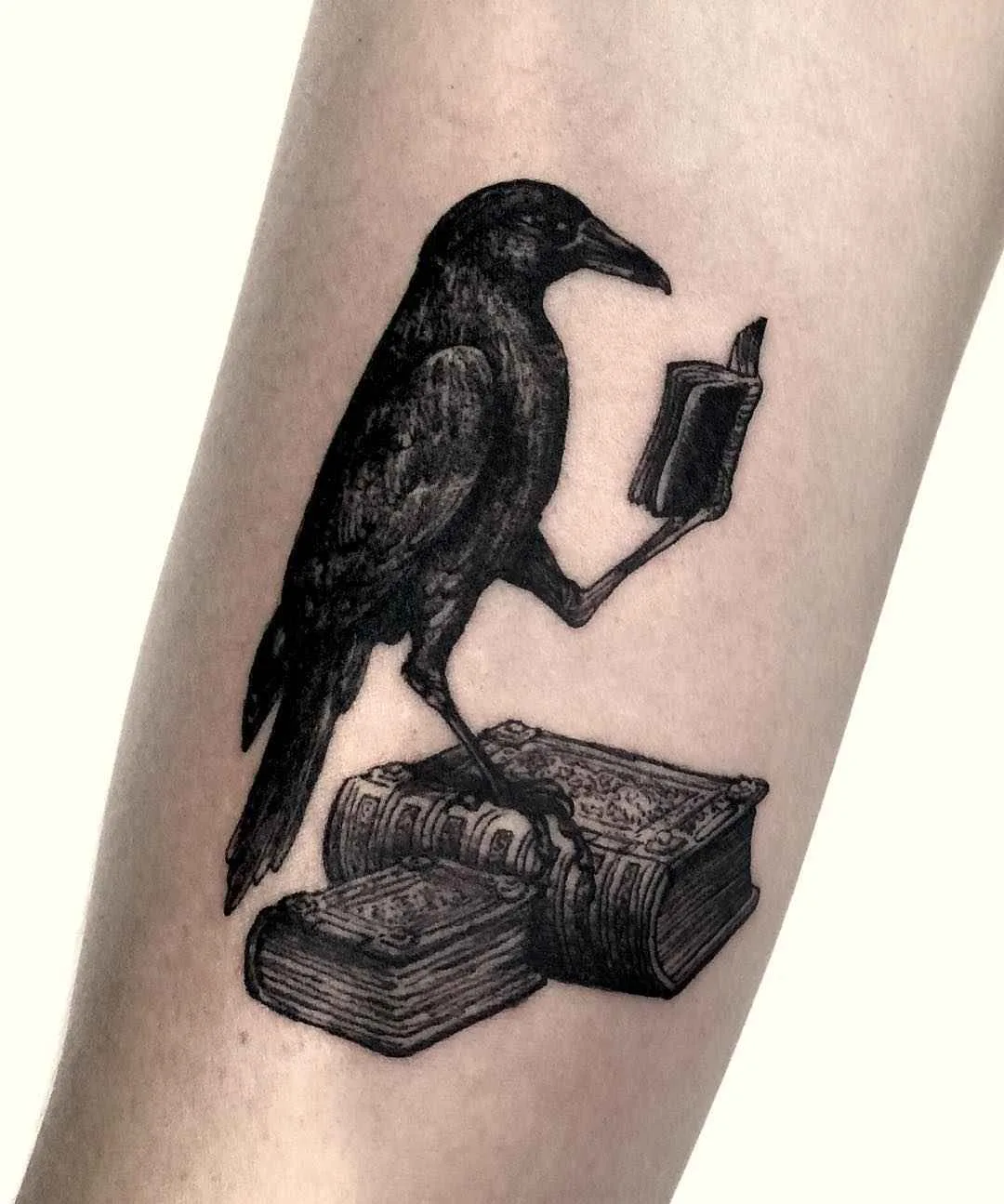
Blackwork. The obvious match and the most common. Solid black feathers, a black beak, a black eye with one point of light: the bird is already a silhouette, and blackwork keeps it one. The style runs from a small flat silhouette to heavy dotwork and etched line, and it gives the crow a weight colour rarely does.
Realism. The harder job, because a real crow is not black. In direct light the feathers throw purple, blue and green, and the difference between a photographic crow and a flat one is whether the artist has painted that sheen. Realism also has to get the beak right: straight and modest on a crow, heavy and curved on a raven, and a viewer who knows birds will spot the wrong one from across the room.
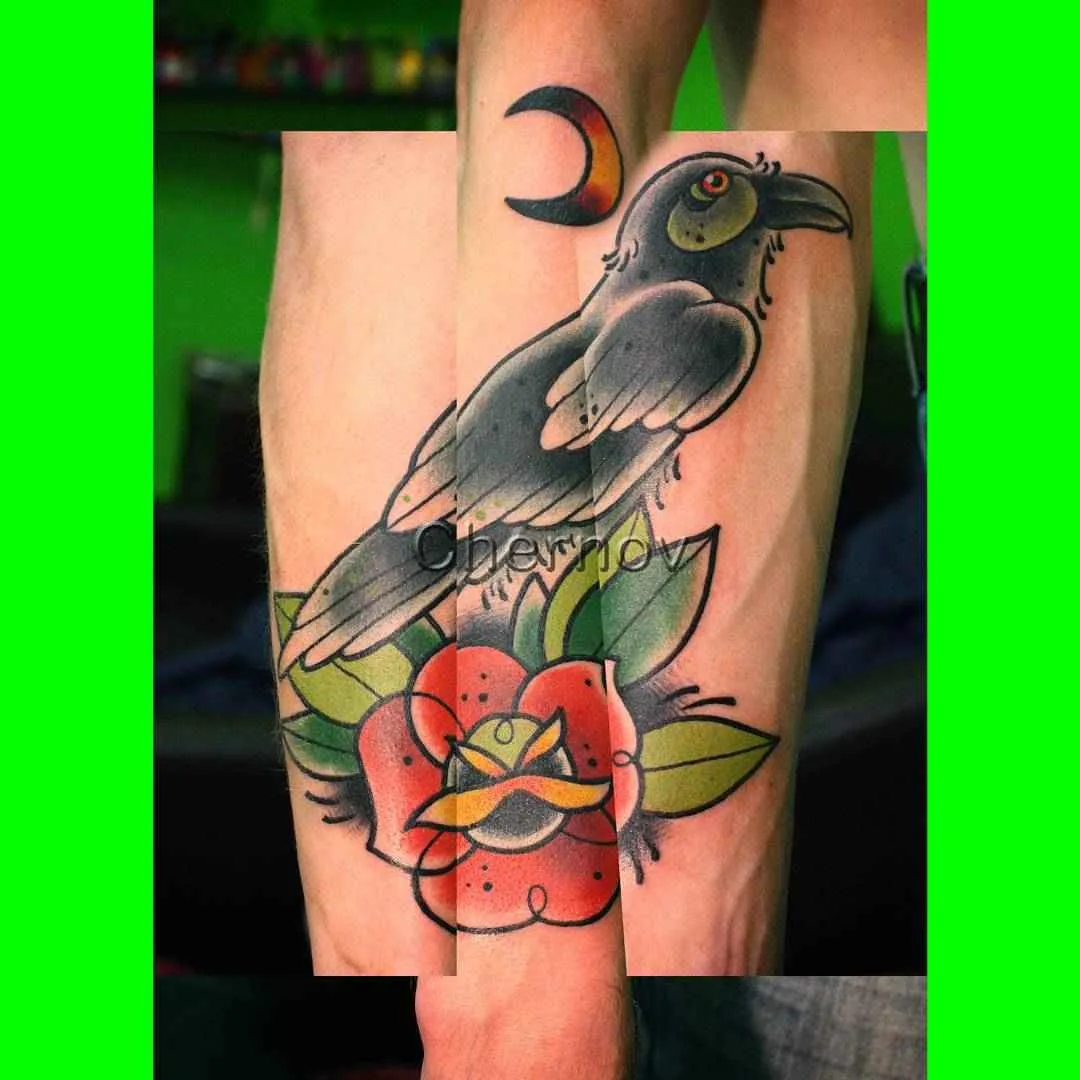
Traditional and neo-traditional. Bold outline, limited palette, a crow that reads at ten paces and still reads in twenty years. Traditional pairs the bird with roses, skulls and daggers; neo-traditional adds the iridescent colours, ornamental foliage and a fuller drawing of the bird while keeping the line discipline. For a chest or upper-arm piece this is the safest long-term bet.
Illustrative and sketch. A crow drawn as if in ink and pencil, with visible line, cross-hatching, berries or wildflowers around it. It has become a popular style for the motif because it makes the crow gentle without making it cute, and it takes a small forearm well.
Watercolour. A black bird with colour bleeding off its wings into the skin. The contrast between the solid crow and the loose wash is the whole point, and it carries the iridescence idea further than realism can. Colour without outline spreads faster, so agree on touch-up terms before the first session.
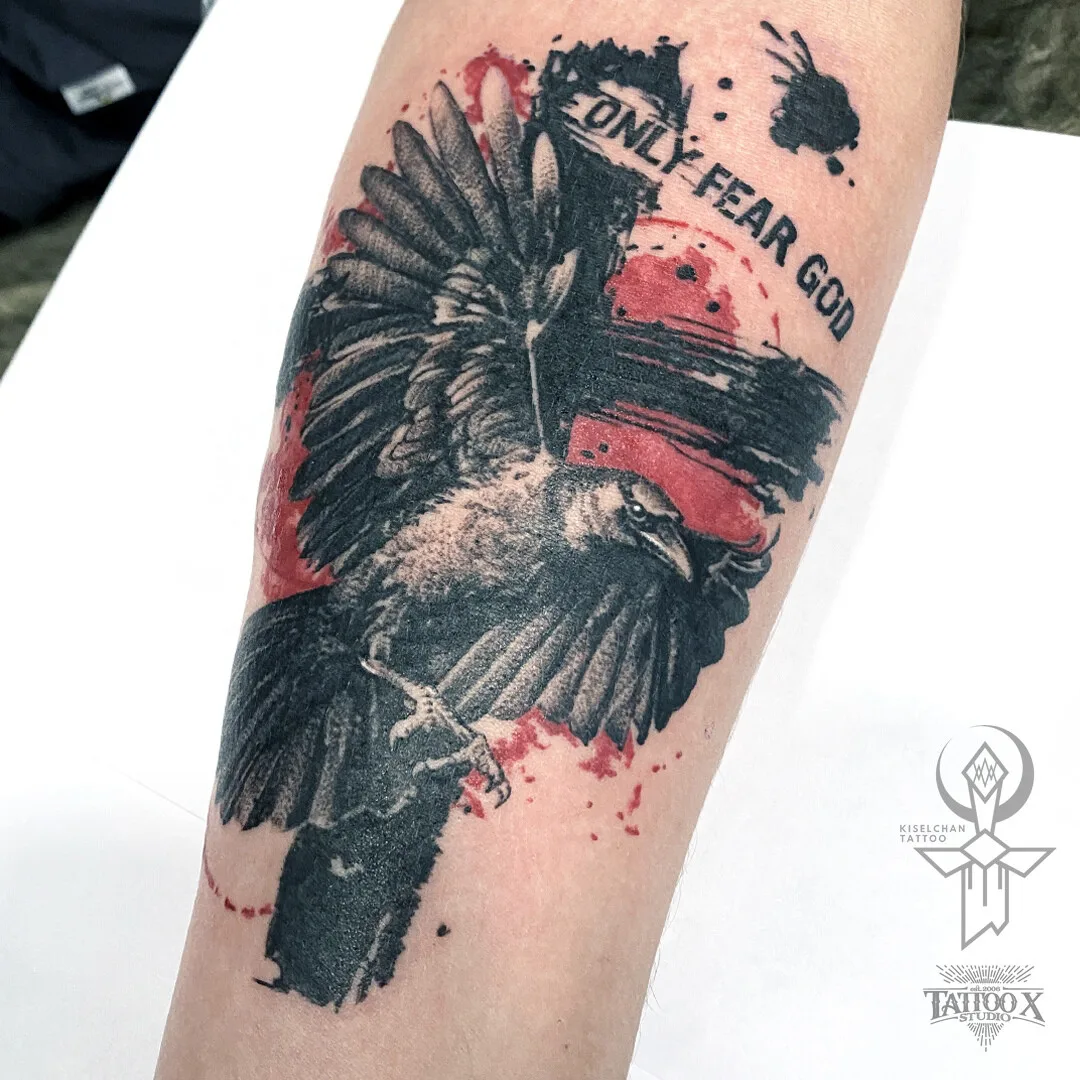
Trash polka. The German style built from realistic fragments, red and black blocks, splatter and text. It suits the crow's trickster side, and it is deliberately chaotic, which is either the attraction or the problem.
Japanese. The natural home for Yatagarasu: three legs, a sun disc, cloud bars, bold outline and flat colour. Few clients outside Japan ask for it, which is a reason to consider it.

Watercolour crow sleeve tattoo by @tattoosemenenko777elena

Watercolour crow tattoo with colour splash by @szymgo

Crow tattoo with starry background by @yelizozcan_tattooer

Trash polka crow tattoo with wings by @vladimircherep

Sketch crow tattoo with splatter by @Nik.ot.ink

Full sleeve crow tattoo in blackwork by @3kreuze

Crow tattoo with red maple leaves by @strange_diary
To see how those approaches differ on actual skin, and which artists work in each, the crow motif page collects finished pieces by style and placement.
Placement and scale
The crow's advantage over the raven is size. The animal is smaller, so the tattoo can be smaller without lying about the bird, and it works at almost every scale from a two-centimetre silhouette to a full back.
The forearm is the default placement, and for good reason. A crow in flight, wings out and tail fanned, is a long horizontal shape that fits the inner forearm exactly. A perched crow fits the outer forearm and wraps with the muscle. Inner forearm shows the piece to the wearer; outer shows it to everyone else.
Small silhouettes go behind the ear, on the wrist, at the nape of the neck, on the ankle. At that size the honest options are a clean solid shape or a few confident lines: fine feather texture under about six centimetres closes into a black blob within a few years.
The upper arm and shoulder buy room for context, a branch, a moon, a second bird, and they extend into a half sleeve later without redrawing. The chest suits a single perched crow with a skull or a heart, and two crows facing across the sternum make a strong composition at the cost of one of the more painful spots on the body.
Flocks want length. A line of crows lifting off from the hip and climbing the ribs to the shoulder blade, or running up the calf, uses the body's long axis as a single bird cannot. The thigh has become popular for larger crow scenes for the same reasons it has for every large motif: good flat surface, moderate pain, complete control over who sees it.

Crow in flight tattoo with branches by @swan_tattooer

Crow tattoo in flight on hand by @174174

Crow tattoo on branch with linework by @C.tattooing

Realistic crow portrait tattoo by @jeffraum

Crow tattoo on branch by @d89379668070@mail.ru

Crow tattoo on branch with pink flowers by @Taramorgan
Scale decides one more thing. A large black bird is close to permanent even by tattoo standards, because there is nothing darker to cover it with, and a later cover-up would have to be bigger and blacker still. That is worth saying out loud at the sketch stage, not after, and it is the strongest argument for getting the drawing right the first time.
Design variations and what they change
One crow or many. The single biggest decision. A single crow, perched and still, is contemplative: solitude, watchfulness, a touch of melancholy. Two crows are partnership or, by the rhyme, joy. Three on a wire is the urban crow watching the street. A murder in flight is drama and momentum, and it usually means transformation or a reckoning arriving.
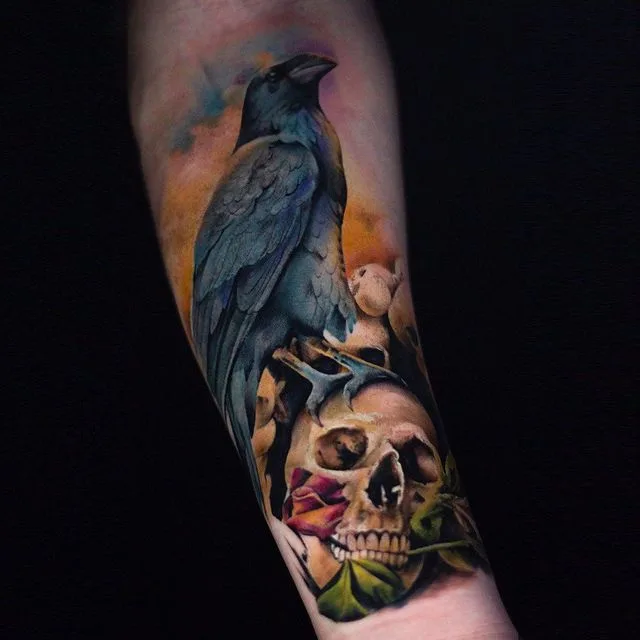
Crow and skull. A classic pairing and the most direct: memento mori, the bird that knows where the body is. Traditional and neo-traditional handle it best because the two shapes lock together. It reads darker than most wearers intend.
Crow with a key, a ring or a coin. The thief of shiny things. The folk belief is largely wrong (a 2014 University of Exeter study found magpies wary of shiny objects), but crows do carry things and leave them. In 2015 a Seattle girl named Gabi Mann became briefly famous for the beads and buttons the crows she fed kept bringing her. A crow holding a small object reads as a gift or a stolen secret.
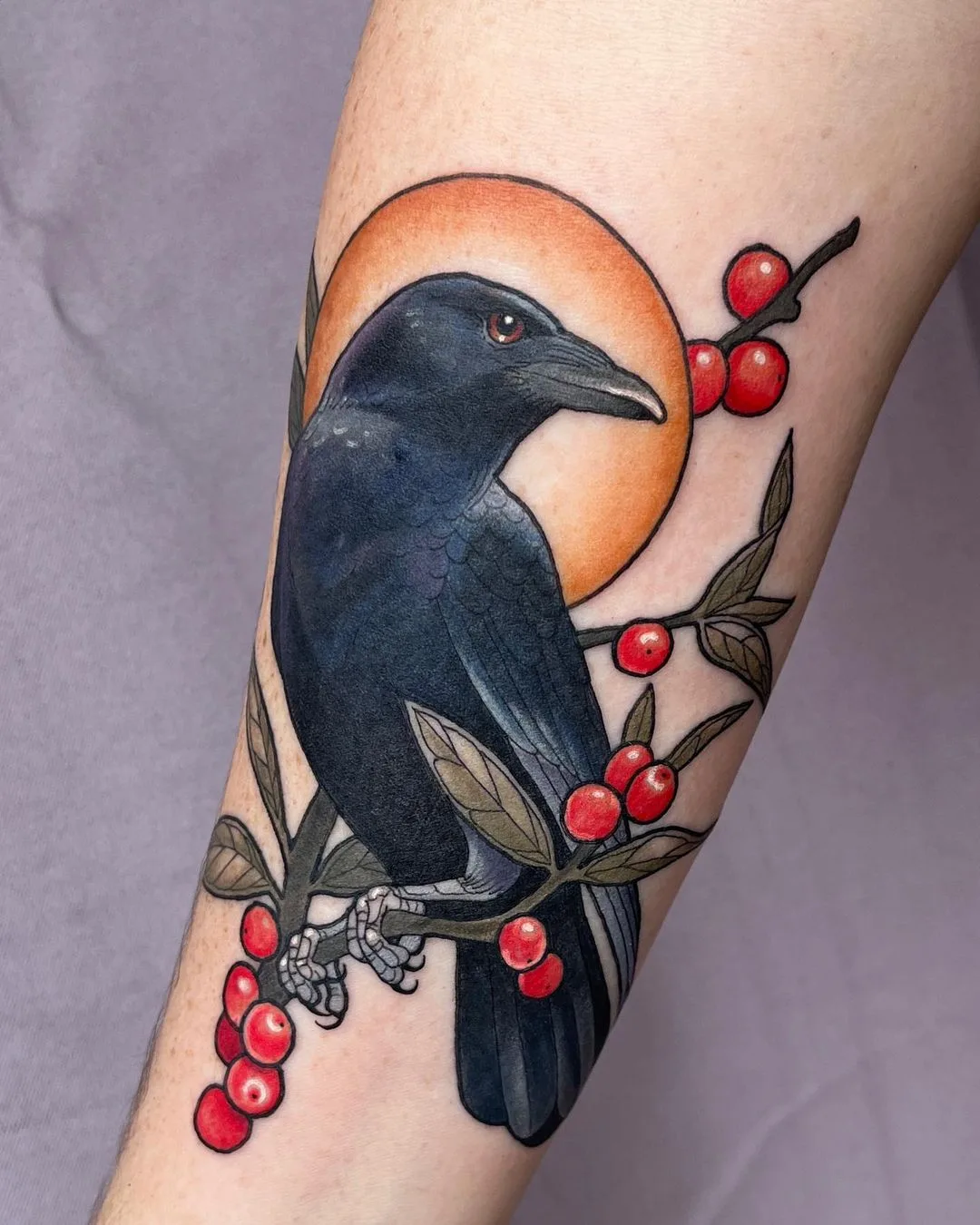
Crow and moon. The night bird, and the composition most likely to look like everybody else's. A crescent or a phase sequence gives the moon a job; a full disc behind the head is the default.
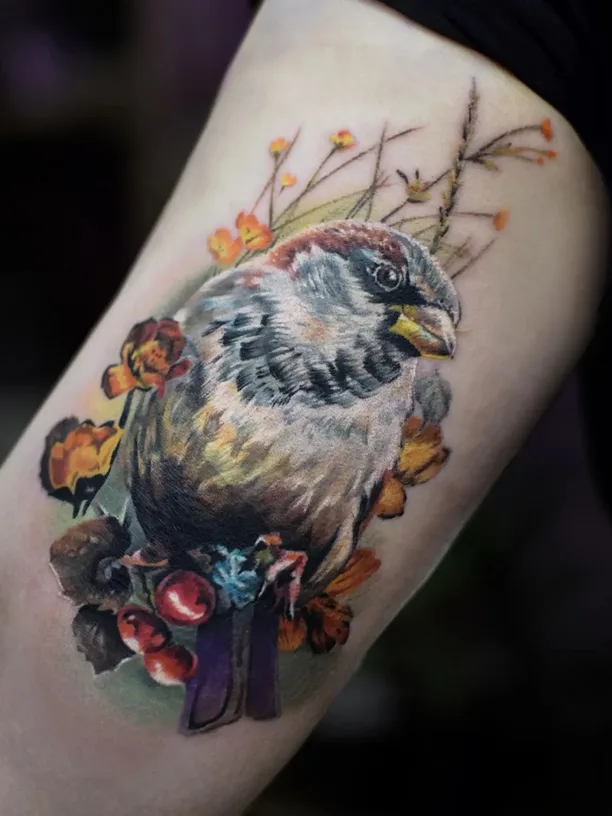
Crow with berries, branches or wildflowers. The illustrative pairing that has softened the motif in the last decade: the crow of the garden and the hedgerow rather than the battlefield. Memory, seasons, a domestic intelligence.
The three-legged crow. Yatagarasu, usually with a sun disc. This one is a specific reference to a specific tradition, and it turns the crow into guidance and homecoming instead of omen.
Crow becoming something else. A bird dissolving into feathers, smoke or bare skin says transition rather than presence, and it hides a practical benefit: less fine detail to blur over twenty years, because part of the bird is deliberately unfinished.
The eye. One point of white in a black head is the whole expression. A crow looking at the viewer is confrontation; one looking out of frame is watchfulness; one with its head cocked is the intelligence this article opened with. Decide it at the drawing stage.
Choosing an artist for a crow tattoo
The crow punishes two mistakes. The first is drawing a raven and calling it a crow: heavy curved beak, shaggy throat, wedge tail, a bird half again too big. The second is flat black: a crow with no sheen and no structure in the wing reads as a shape cut from paper.
Ask to see healed crows in the portfolio, not fresh ones and not eagles. Fresh work photographs well and says nothing about how the black settles; a healed crow shows whether the artist built the feathers in layers or painted a silhouette and hoped. Then match the style to the artist rather than asking one to imitate another: a superb blackwork artist asked for photorealistic iridescence will give you a competent version of someone else's speciality.
It helps to look at how differently the same bird can be handled. Zoria Julia builds a forearm crow from solid black and clean line, closer to a woodcut than a photograph; Shae Motz pairs a neo-traditional crow with a skull on the chest, bold outline and full colour; Jake Danielson sets a realistic crow beside a portrait across a full back, which makes the bird part of a scene rather than the subject. Three approaches to one motif, and the choice between them decides more than the placement will.
Bring reference photographs of real crows rather than screenshots of other tattoos: the second hands the artist somebody else's answer, the first hands them the bird. Say which tradition you are drawing from if there is one, because a Yatagarasu and a Badb are composed differently. You can filter by style, country and city in our tattoo artist directory.
Aftercare and how a crow tattoo ages
Standard aftercare applies: keep it clean, moisturise lightly, leave the scabs alone, stay out of pools and direct sun for two to three weeks. Large areas of solid black scab more heavily than linework and can look patchy for a week or two; that is normal.
Black is the most stable pigment in the trade, so a blackwork crow ages better than almost any other motif. What fades is the detail inside it. The fine light lines that separate one feather from the next are the first thing to blur, and a crow that depends on them for its shape will read as a dark smudge in ten years. The fix is structural: a clear silhouette, real contrast between the bird and the skin, and detail that decorates the form rather than defining it.
Colour ages differently. The purple and green sheen of a realistic crow is built from pigments that fade faster than black, so the bird slowly turns matte. Watercolour washes spread. Neither is a disaster if it was planned for; both are if it was not. Sunscreen on an exposed forearm does more for the piece over twenty years than any dedicated tattoo product, and one touch-up in the first year is part of the cost of fine work, not a failure of it.
Frequently asked questions
What does a crow tattoo symbolise?
Intelligence, memory and adaptability first: crows make tools, recognise faces and pass grudges to their young. By tradition it also means guidance (Japan), prophecy (Ireland), duty to the dead (India) and, mainly in European folklore, a bad omen.
Is a crow tattoo bad luck?
Mostly through a European lens, where the counting rhyme starts with one for sorrow and three centuries of vermin laws made the bird a pest. In Japanese, Hindu and most Indigenous American traditions the crow is a guide, a courier or a divine emblem. The tattoo carries the tradition you choose for it, and the design (a three-legged crow, a hooded crow, a crow with rice) tells people which one.
What is the difference between a crow and a raven tattoo?
A raven is much larger, with a heavy curved beak, shaggy throat feathers and a wedge-shaped tail; a crow is sleeker with a straight beak and a fan tail. Symbolically the raven leans toward Norse and gothic fate, the crow toward everyday intelligence, cities and flocks. Ask for the one you mean.
What does a three-legged crow tattoo mean?
It is Yatagarasu, the crow that guided Emperor Jimmu through the mountains in Japan's founding myth, and it means guidance and finding your way. The three legs came later, from Chinese sun-crow imagery, and are usually read as heaven, earth and humanity.
What does a murder of crows tattoo mean?
Transformation, momentum or a reckoning arriving. The word murder is a fifteenth-century hunting term revived in the twentieth century, so it carries a medieval sound without much medieval meaning.
Do crow tattoos have to be black?
No. Realistic crows use purple, blue and green for the feather sheen, traditional designs add red and yellow accents, watercolour adds washes, trash polka adds red blocks. Black is the base; the sheen is what makes a crow look alive.