A deer tattoo means renewal, gentleness and watchfulness: a stag stands for strength that is regrown every year rather than held, and a doe for care and quiet attention. Which of the two you wear changes the reading, and the antlers are the reason. They fall in late winter and grow back by autumn, which is why the stag has stood for rebirth in many places where people watched it happen, from a silver cauldron in a Danish bog to a shrine park in Nara.
- The antler cycle is the core of the symbol: shed in winter, regrown by autumn, so a stag means strength that is rebuilt rather than held, and a doe means attention and care.
- Every tradition gave the deer a specific job: Cernunnos and the white stag as threshold guides, the Nara deer as Shinto messengers, Eikþyrnir feeding the rivers of Yggdrasil, Little Deer's contract with hunters, Hubert's crucifix stag.
- Antlers decide placement and scale: a frontal stag needs chest, back or thigh; a profile head fits the forearm; under about ten centimetres the tines blur, so simplify the rack or drop the animal.
- Judge an artist on antler structure and the eye, and ask for healed deer, not fresh dogs or wolves.
What a deer tattoo means
The symbol comes from the biology. Antlers are bone. They grow from the skull each spring under a skin called velvet, at up to about two centimetres a day in large deer, one of the fastest-growing tissues in any mammal. By late summer the bone hardens and the stag carries the rack through the autumn rut. In winter the base weakens and the whole thing falls off. Soon after, the cycle starts again. No other mammal sheds part of its skeleton every year and rebuilds it, often bigger.
The stag reading follows from this: strength, authority and protection, but strength that has to be grown back. People who ask for a stag after an illness, a divorce or a bankruptcy usually mean the cycle rather than the trophy; the rack stands for winters survived.
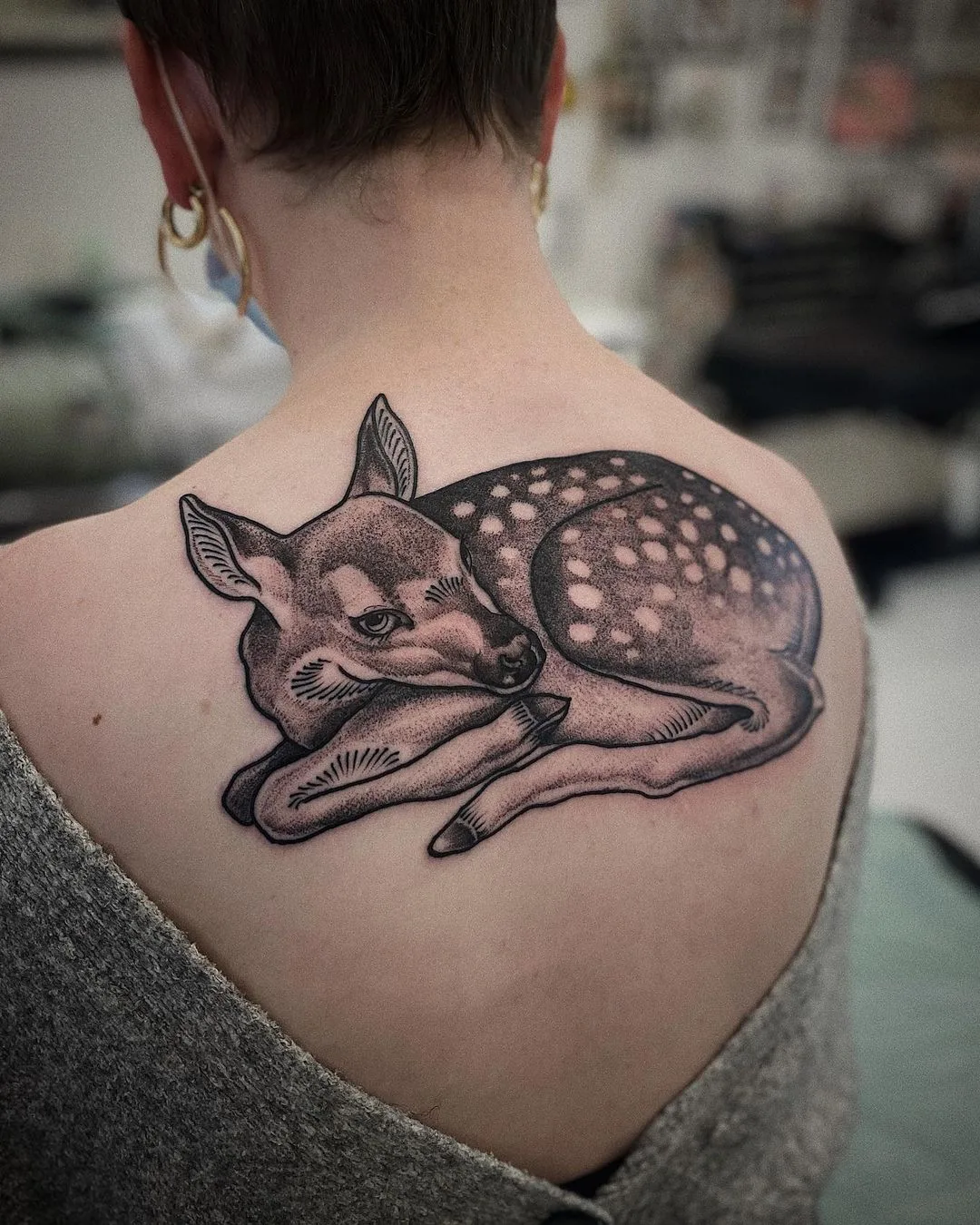
The doe has no antlers, and her symbolism rests on attention instead. She freezes, tests the wind and bolts at the first sign of danger. She hides her fawns in long grass and returns only to feed them, so her scent does not lead a predator to the spot. A doe tattoo reads as motherhood, gentleness and vigilance, and the vigilance is a survival strategy: an animal that leaves at the right moment escapes most of what hunts it.
Stag and doe share a third reading. A deer appears at the edge of a wood, looks at you for a second and is gone, and many cultures that lived near deer turned that moment into a story about the animal that leads people out of the ordinary world: into the Celtic otherworld, into a Christian conversion, into a Shinto shrine. In tattooing this is the reading behind the deer in mist and the white stag.
In practice most commissions fall into one of three shapes: the stag head, for authority and renewal; the doe or fawn, for tenderness and a new start; the antlers alone, for the cycle without the animal.
Celtic mythology: Cernunnos and the antlered god
In 1891 peat cutters in Himmerland, northern Denmark, dug a silver cauldron out of a bog. On one inner plate of the Gundestrup cauldron a figure sits cross-legged with a full set of antlers, a torc in one hand and a ram-horned serpent in the other, and beside him stands a stag wearing the same antlers. The figure is usually identified as Cernunnos, a name known from a pillar dug up under Notre-Dame in Paris in 1710, which carries an antlered head and that inscription; it is usually translated as "the horned one". He is generally read as a lord of animals, of the wild and of wealth.
The stag itself is the threshold animal in Celtic story. In the Welsh Mabinogion, Pwyll is hunting a stag in Glyn Cuch when he meets Arawn, king of the otherworld Annwn, and the meeting ends with the two men trading places for a year. In the Irish cycle, Fionn mac Cumhaill's wife Sadhbh is turned into a deer, and their son is named Oisín, little fawn. The white stag of the Arthurian romances works the same way: the hunt for it draws knights into adventure.
As a tattoo, the Cernunnos figure or a stag with a torc reads as command of your own wild side, and as a place between two worlds.
Japanese tradition: the sacred deer of Nara
Kasuga Taisha, the great shrine of Nara, was founded in 768, and its story says the god Takemikazuchi arrived from Kashima riding a white deer. The deer of Nara have been treated as his messengers ever since. More than a thousand sika deer live in Nara Park today, protected as a natural monument since 1957, and they walk through the city as if they own it: the local telling is that killing one in the Edo period was a capital crime. They bow for the rice crackers sold on every corner, but the belief behind them is old. In the Kasuga deer mandalas painted from the Kamakura period on, a deer carries a sakaki branch and a mirror on its back and stands in for the deity itself.
Japanese design has its own pairing for the animal: shika to momiji, deer and maple, the autumn image on the October hanafuda card. The deer on that card turns its head away, which is where the slang shikato, to ignore someone, is usually said to come from. A deer set against maple leaves and wind bars in a Japanese composition reads as a divine messenger rather than prey.
Norse mythology: the stags of Yggdrasil
The Norse put deer at the top of the world and at its roots. In the Grímnismál, one of the poems of the Poetic Edda, a stag called Eikþyrnir stands on the roof of Valhalla and browses the leaves of the tree Læraðr. Water drips from his antlers into the well Hvergelmir, and from that well flow all the rivers there are. A few stanzas later four more stags, Dáinn, Dvalinn, Duneyrr and Duraþrór, run through the branches of Yggdrasil eating the new shoots. The world tree is eaten from the top by stags and gnawed from below by a dragon; the poem says it suffers more than men know, and it still stands.
For a tattoo, the Norse stag reads as renewal on the scale of a world: antlers as the source of rivers, stags feeding on a tree that endures. It suits blackwork and knotwork, and it gives an antler-only piece a specific story.
Native American traditions: the deer as provider
Deer symbolism differs between nations, and what follows is documented in specific traditions rather than one shared belief. The common ground is provision. Across most of the continent the deer fed people and clothed them: buckskin for clothing, sinew for bowstrings, antler for tools, hooves for rattles. The stories are about the terms of that gift.
The Cherokee tell of Awi Usdi, Little Deer, chief of the deer, who runs to any deer that has been shot and asks whether the hunter prayed for pardon. A hunter who did not is struck with rheumatism. The story sets the terms: a hunter may take a deer, but must ask its pardon.
The Yoeme, or Yaqui, of Sonora and southern Arizona carry the same idea in the deer dance. The dancer wears a deer head tied on top of his own, gourd rattles in his hands and cocoon rattles wound around his legs, and to water drum and rasps he becomes the deer: alert, feeding, startled, hunted, killed. The dance runs through Lent and Easter, and it is often described as the deer giving itself so that the people can live.
For anyone outside those nations, a respectful version of the tattoo takes the idea (gratitude, and gentleness as a form of strength) and leaves the ceremonial regalia to the people it belongs to.
Christian symbolism: Psalm 42 and Saint Hubert
"As the deer pants for streams of water, so my soul pants for you, my God." Psalm 42 opens with the line, and Christian art took its deer from there; Palestrina set the Latin, Sicut cervus, to music. Stags drinking from a spring appear in the fifth-century mosaics of the Mausoleum of Galla Placidia in Ravenna and on the walls of early baptisteries, where the deer at the water stood for the newly baptised.
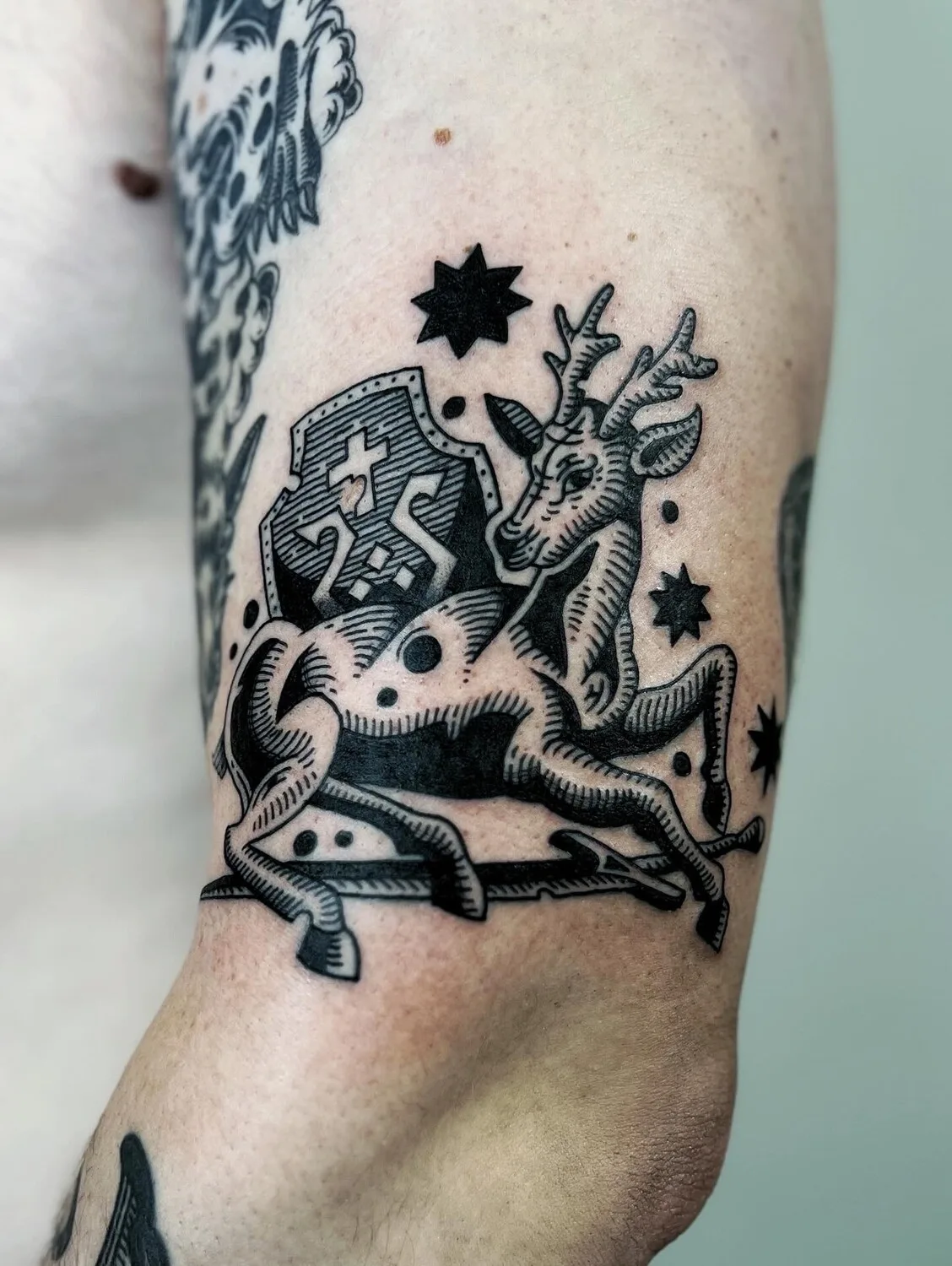
Saint Hubert is the other half. By tradition he was a nobleman in the Ardennes who went hunting on Good Friday around the year 683 instead of going to church, and in the forest met a stag with a crucifix glowing between its antlers. He gave up hunting, became bishop of Maastricht and later of Liège, and ended as the patron saint of hunters. Saint Eustace, in an older legend, has the same vision; Pisanello's painting of it hangs in the National Gallery in London. Jägermeister put the stag on its label in 1935, so the image has a commercial echo, but a crucifix stag drawn in the manner of a medieval woodcut still reads as conversion, longing and the sacred appearing unexpectedly.
Tattoo styles that suit the deer
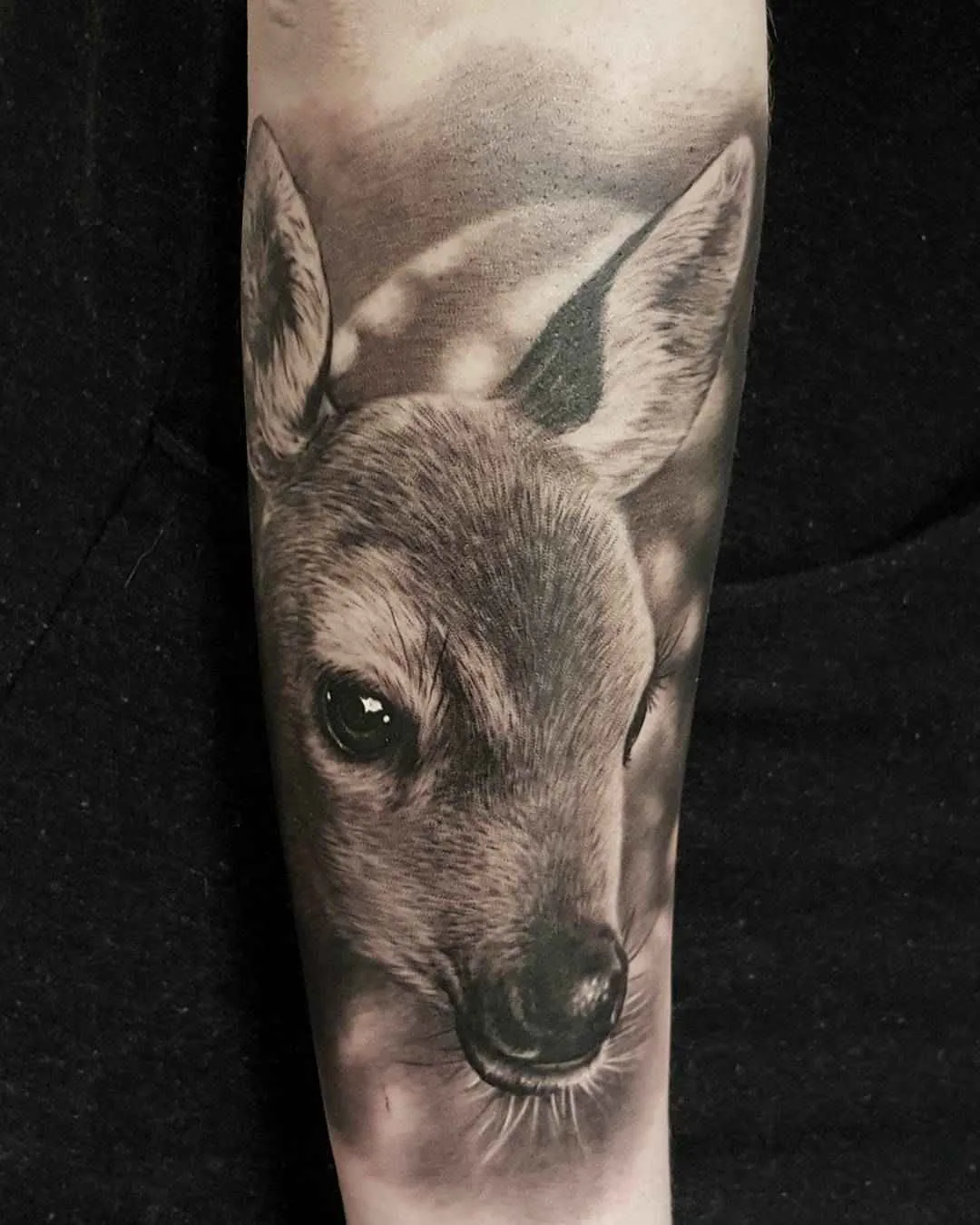
Black-and-grey realism. A common choice, and a demanding one. A realistic deer depends on three details: the eye, large, dark and wet, which carries the whole expression; the muzzle, where fur direction changes every centimetre; and the antlers, which are bone and have to look like bone, with the ridges and the rough burr at the base, not like darker fur. Before booking, ask to see healed deer from the artist, not only fresh photographs of other animals.
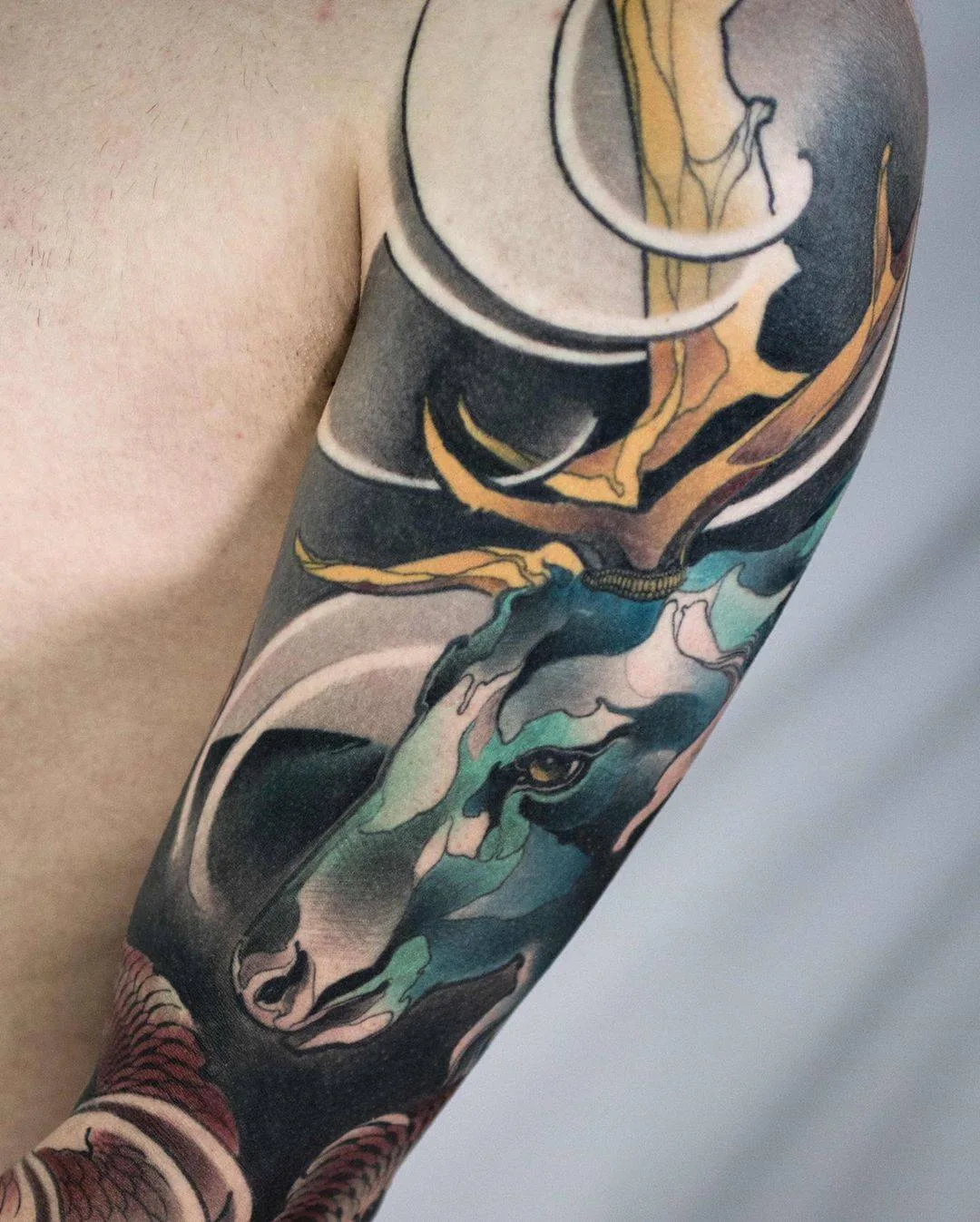
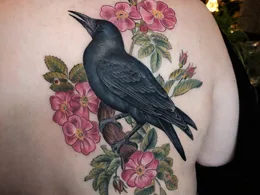
Neo-traditional. Bold outlines, saturated colour, and a stag head framed in leaves, berries or roses. This style ages well, because the line carries the image after the colour softens, and the antlers give the composition a built-in frame: a rack is already a decorative structure.
Blackwork and illustrative. The stag as woodcut or engraving: hatching, dotwork, solid black. It suits the mythological readings above, because a Cernunnos or a Norse stag sits more naturally in something that could have been cut into a block than in colour realism.
Geometric. A deer head where one side is drawn and the other dissolves into triangles and facets. It fits the deer better than most animals, because antlers are already branching geometry. Let the polygons follow the skull and the beam of the antlers rather than scatter them for effect.
Fineline and minimalist. A single-line doe, a small stag profile, antlers alone in one continuous stroke. These are common first tattoos and suit wrists, ankles and the space behind the ear. The caveat is the tines: below a certain size the fine points of a rack are the first thing to blur, so a minimal deer should be built from a few confident lines, not a dozen hair-thin ones.
Watercolour. Colour bleeding out of a deer shape catches the animal disappearing into dappled light. It fades faster than any other style here and needs black structure underneath to survive a decade. Agree on touch-ups before you start.
Japanese. The natural home for the Nara reading: a sika deer with maple leaves, wind bars and water, composed as a scene rather than a portrait. It suits large areas such as the back, the thigh or a full sleeve, where the background has room to move around the animal. To see how all of these look next to one another across real work, the deer motif page collects the pieces by style and placement.

Neo-traditional stag tattoo with leaves and sunset by @mattcurzon

Neo-traditional tattoo: deer, floral antlers, red star by @kimsany

Deer tattoo head in a knight's helmet by @friedrichuebler

Deer tattoo head with pearl necklace by @brian_povak

Deer tattoo portrait with berries and vines by @sadee_glover

Watercolour deer tattoo with circular backdrop by @yelizozcan_tattooer

Deer tattoo with galaxy and planets in antlers by @olggah_grigoryeva
Placement and scale
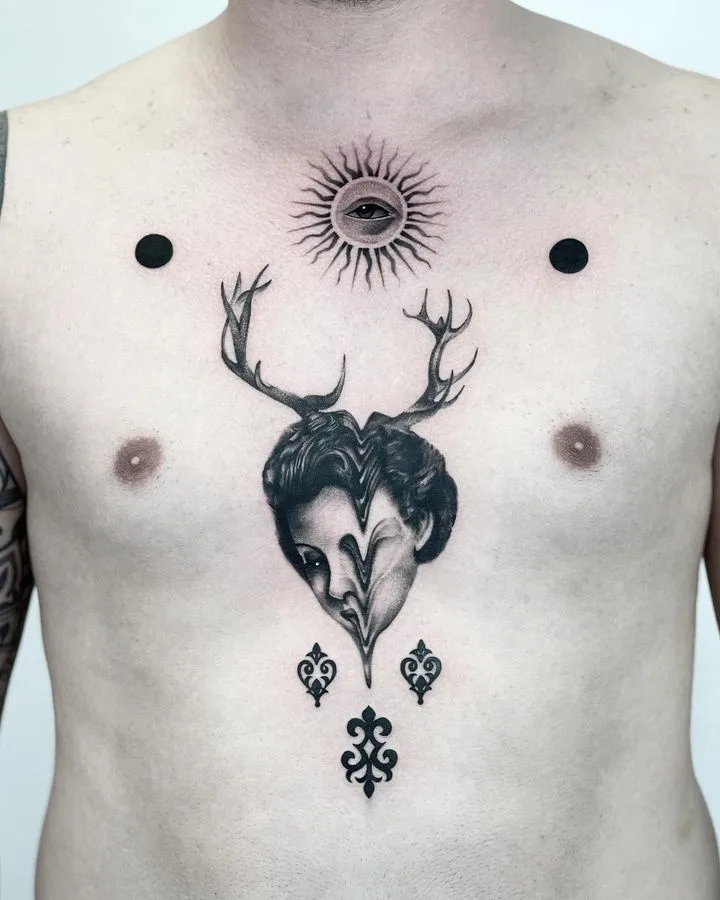
The antlers largely decide the placement, more than the rest of the animal does. A stag seen from the front is a wide triangle, narrow at the muzzle and broad across the rack, and it wants a surface with that shape: the chest, with the antlers reaching towards the collarbones; the upper back, with the rack spreading across the shoulder blades; the front of the thigh; the shoulder and upper arm. Force a frontal stag onto a forearm and the antlers get cropped or wrapped, and a cropped rack looks like a mistake.
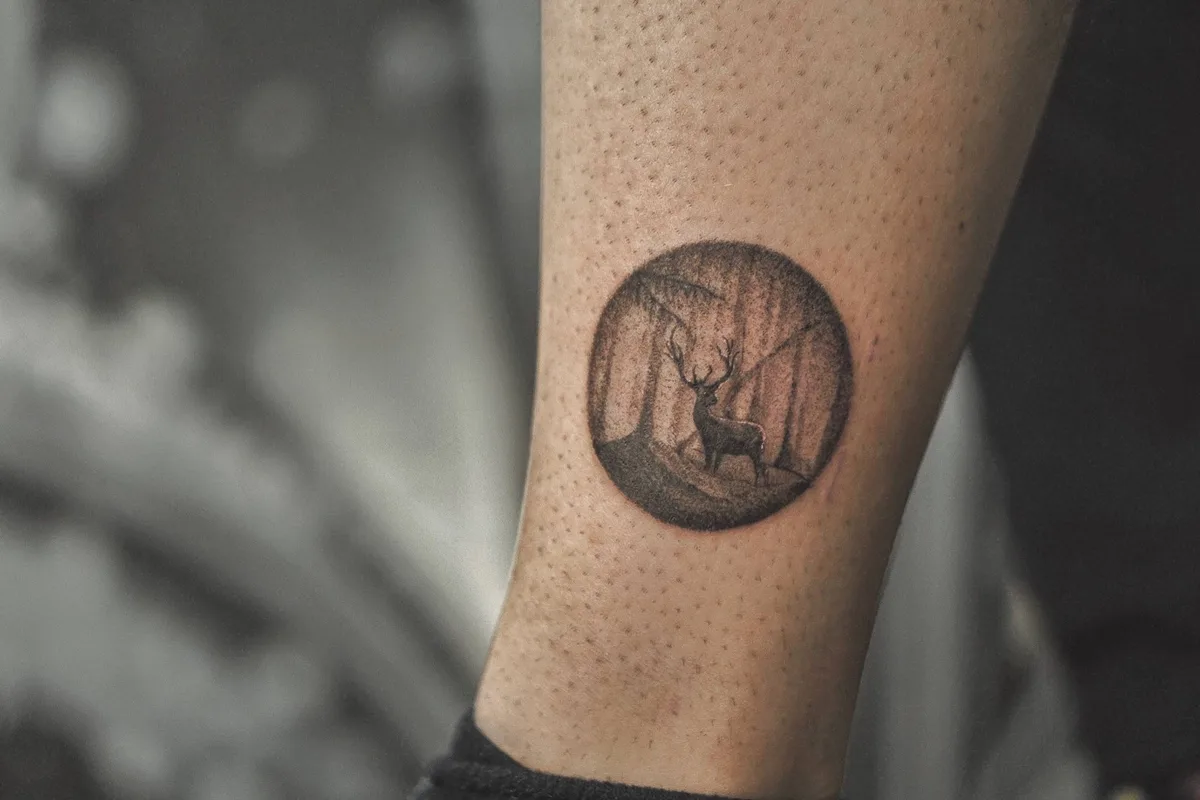
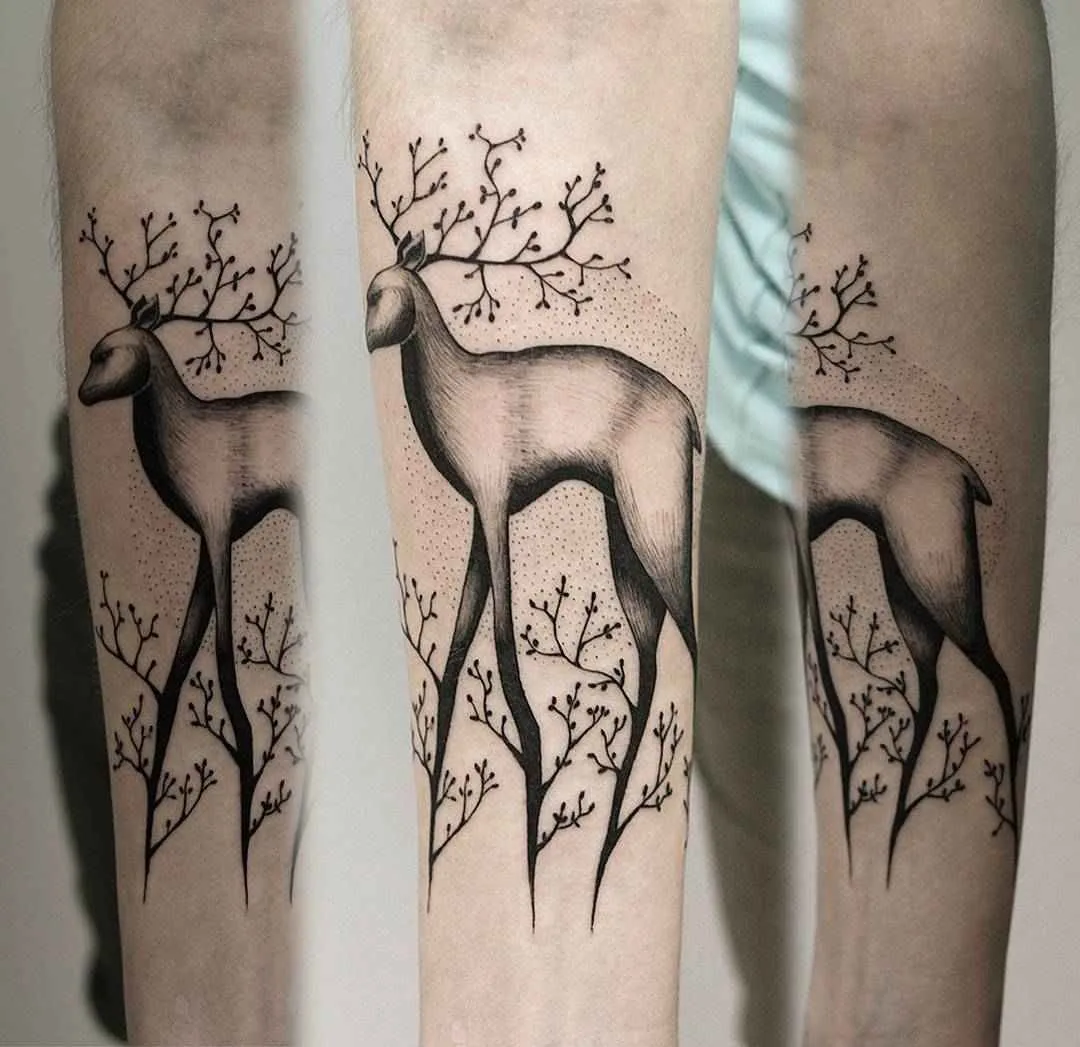
The forearm is a popular placement too, and works best with a head in profile or three-quarter view, a doe, or a stag walking. The profile head gives you the eye and the muzzle at full size while the antlers sweep back along the arm instead of across it. The calf likes a full-body deer standing, because the animal is taller than it is wide. The sternum takes an antler-only piece spreading under the collarbones.
Small deer and single-line antlers go almost anywhere: inner wrist, ankle, behind the ear, along the collarbone.
Scale is a separate decision from placement, and it is a common source of problems in deer tattoos. A stag head under about ten centimetres cannot hold both a realistic eye and a full rack. The tines are drawn as thin lines, thin lines spread as they heal, and within a few years a twelve-point rack has become a six-point one with fuzzy ends. Below that size, choose one: the head with simplified antlers, or the antlers alone at a size where each point gets a real line. A profile head holds a smaller size than a frontal one, because the antlers overlap instead of spreading.
Full scenes, a stag in a forest, deer at a river, belong on the back, the ribs or the outer thigh, and they are multi-session projects. The thigh is another good option for a full scene: enough surface for a full-body deer with background, moderate pain, and control over who sees it.

Sketch deer tattoo with geometric elements by @orlando_tattooing

Deer tattoo framed by geometric shape by @dotyk.tattoo

Deer tattoo merged with geometric abstract elements by @dynozartattack

Geometric deer tattoo in blues and purples by @dustyduza

Linework deer tattoo with geometric floral elements by @mitatink
Design variations and what they change
Stag, doe or fawn. The first choice, and the one that sets the rest of the design. A stag with a full rack reads as authority, protection and the antler cycle. A doe reads as care and watchfulness; a doe with a fawn is one of the plainest mother-and-child images in animal tattooing. A fawn alone, spotted and unsteady, is about beginnings and vulnerability. People also cross the lines on purpose, a woman with a stag, a man with a doe. One footnote: among deer, only female reindeer regularly grow antlers, so an antlered doe is, strictly, a reindeer.
Antlers alone. The cycle without the animal: growth that happens in rounds rather than once. They drop in late winter and regrow in spring, which ties them to recovery of every kind, from illness, from addiction, from a personal winter. Flowers growing from the points, a popular variation in fineline and neo-traditional work, soften the stag's masculinity: strength that flowers into something delicate.
Deer skull. A clean skull with the antlers attached adds mortality to everything above. Flowers through the eye sockets say life after loss; a bare skull says the hunting tradition, or respect for a cycle that ends the way all cycles do.

Deer skull tattoo with geometric design by @xelabarraza

Deer skull tattoo with spiderweb background by @gara_tattooer

Deer skull tattoo with geometric and green accent by @herpelz

Blackwork deer tattoo pierced by arrows by @snelgrove

Deer tattoo with snake-entwined antlers by @lucy.moana
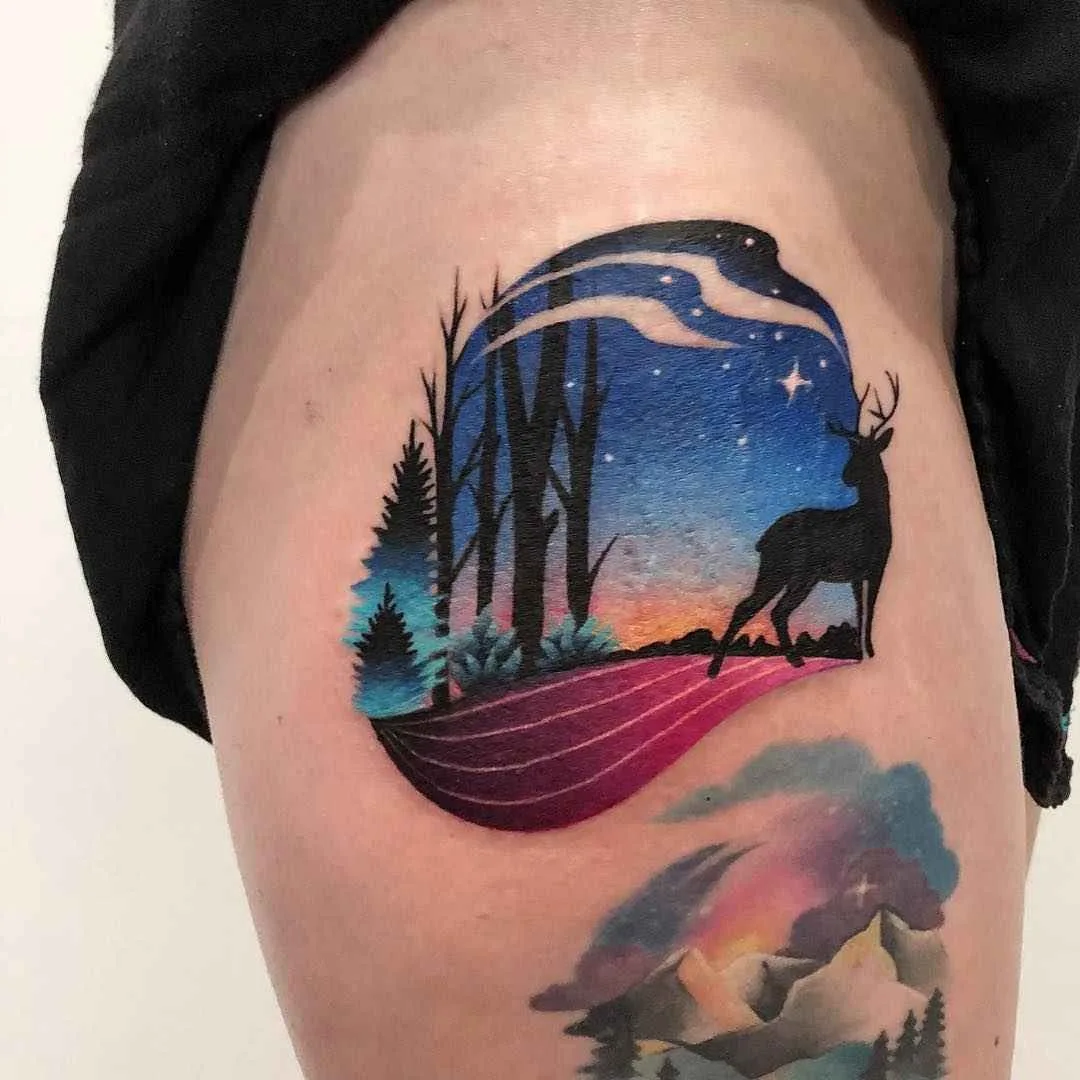
Forest inside the silhouette. The double-exposure deer, with trees, mountains or a night sky drawn inside the outline of the animal, is a common way to say that the deer and the place are one thing. It suits the threshold reading and has a technical advantage: less fur to blur.
The white stag and the crucifix stag. Two ways to make the deer openly supernatural, each tied to one of the traditions above. A white stag, in negative space or pale ink on a dark ground, is the Celtic and Arthurian guide. A stag with a cross between its antlers is Hubert's vision, and it announces a religious reading whether the wearer means it or not.
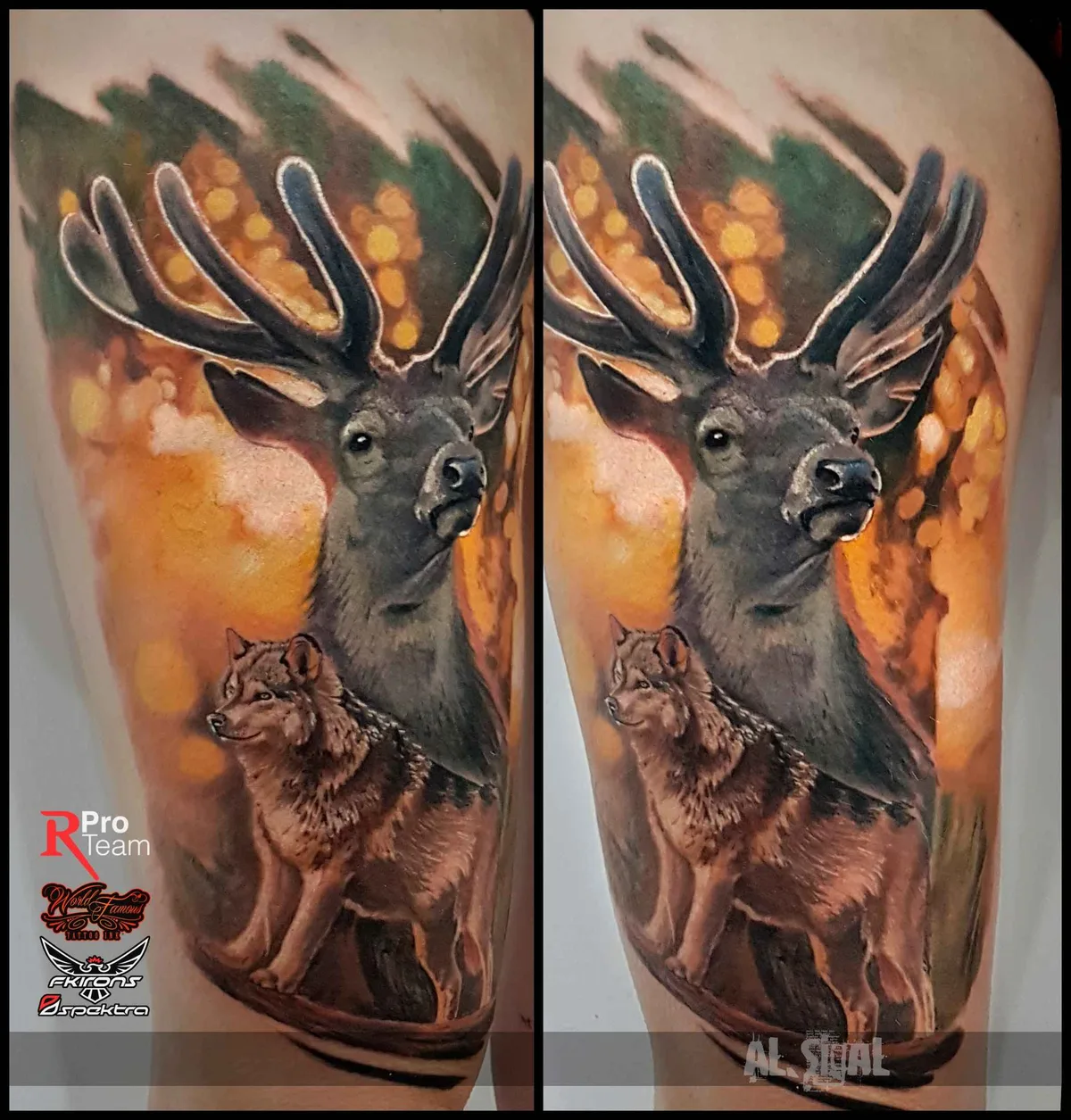
Deer with other animals. Deer and wolf sets prey against predator and usually means two sides of one person; the wolf will take over the composition unless the artist decides otherwise at the sketch stage. Deer and moon leans on cycles and is the pairing most likely to look generic.
Choosing an artist for a deer tattoo
The antlers and the eye are where a deer tattoo most often goes wrong. Antlers have a structure. On a red deer or elk the beam sweeps back and up with a brow tine, a bez tine, a trez tine and a crown; on a whitetail the main beam curves forward and the points rise from it; on a fallow deer the top is palmated like a hand. An artist who has not looked at that draws a symmetrical tree of sticks, and anyone who has seen a real stag will notice. The eye matters as much: without life in it, the whole animal looks flat.
Three checks before you book. Look for deer specifically in the portfolio, not "animals": wolves and big cats are a different problem. Ask for healed photographs, since fresh work photographs beautifully and tells you nothing about how the fine tines settle. And bring photographs of the actual species you want, because a sika, a whitetail and a red stag are three different animals with three different racks; a screenshot of somebody else's tattoo gives the artist their solution instead of yours. If your design leans on a tradition, say which one; a Norse stag and a Nara deer are composed differently.
You can filter by style, country and city in our tattoo artist directory, and it helps to see how far apart the approaches to one animal can be. Otto D'Ambra builds a black stag into a tree and a geometric structure across the upper back, so the animal and the forest are one drawing; Nick Imms works the deer as tight black-and-grey realism with a forest behind it on a forearm, where the eye and muzzle carry everything; Teresa Sharpe paints the deer in colour as an illustrative creature surrounded by nature and spirits, closer to a storybook than a photograph.
Aftercare and how a deer tattoo ages
Standard aftercare applies: keep it clean, keep it lightly moisturised, leave the scabs alone, and stay out of pools and direct sun until it has healed. Two to three weeks for the surface, a few months for the deeper layers.
Deer have two specific ageing risks. The first is the antlers. The tines are the finest lines in the piece, and fine lines spread first: a rack drawn with hair-thin points will lose its ends within five to ten years and read as a blunt fork. A rack with eight confident points will outlast one with fourteen delicate ones. The second risk is the fawn's spots and any dappled texture on the coat: small light patches inside dark fur close up as the black softens around them, so they need to be larger than looks right on the day.
Black and grey softens evenly and stays legible. Colour fades unevenly: the warm browns and oranges of a deer's coat go before the blacks do, and a watercolour deer without black structure can lose its shape entirely. Sunscreen on an exposed piece does more for its twenty-year life than any tattoo-specific product. Expect one touch-up in the first year for anything with fine antler work, and budget for it as part of the piece.
Frequently asked questions
What does a deer tattoo symbolize?
Renewal, gentleness and watchfulness. The stag carries the antler cycle, strength that is shed and regrown every year. The doe carries attention, care and the instinct to leave at the right moment. Both carry the older reading of the deer as a guide between worlds, the animal that leads people out of the ordinary world.
What does a stag tattoo mean compared to a doe?
A stag means authority, protection and rebuilt strength; the rack is a record of survived winters. A doe means motherhood, gentleness and vigilance. Neither is the weaker symbol: stags settle many rivalries by roaring and parallel walking before any fight, and the doe survives by reading danger early.
What does a deer skull tattoo mean?
The deer's symbolism plus mortality. A deer skull with antlers says the cycle includes its end: respect for nature, the hunting tradition, or life persisting after loss when flowers grow through the eye sockets.
What does a deer with antlers mean spiritually?
In most traditions the antlers carry the meaning. They fall and regrow every year, so a stag in full antler stands for rebirth; in Norse poetry the antlers of Eikþyrnir are the source of every river, and in Christian art the stag at the water is the soul thirsting for God.
Are deer tattoos masculine or feminine?
Both. A stag with a large rack tends to read as masculine and a doe or fawn as feminine, but geometric, minimalist and antler-only designs are neutral.
What goes well with a deer tattoo?
Forest and trees, the obvious habitat. Flowers, especially on the antlers. A moon, for cycles. Maple leaves, for the Japanese pairing of deer and autumn. A cross between the antlers for Hubert's vision, and a wolf for the prey-and-predator reading, with the warning that the wolf will dominate the composition unless the artist decides otherwise.