A dolphin tattoo means joy, intelligence and safe passage: the animal that plays, the animal that thinks, and the animal that, in many sea cultures, brings people home. Which of those you are wearing depends on the design, and the design carries a history other animals do not: in the 1990s the dolphin was one of the most popular small tattoos, usually on an ankle, and that version is still what many people picture first. What follows is where each reading comes from, and what makes a dolphin tattoo look current today.
- The deepest reading is safe passage: Arion's rescue, the hidden Christ of the catacombs and the Māori guardian Kaikaiawaro all make the dolphin the animal that brings you to shore.
- Every leaping dolphin descends from the Knossos fresco of c. 1600 BC; the arc that made the motif work is the arc the 1990s wore out.
- The dated look is a recipe (tiny scale, generic species, fixed smile, body floating in bare skin), and each part has a modern alternative.
- Under about eight centimetres the animal cannot hold gradation: commit to line or silhouette, or give it room and water.
What a dolphin tattoo means
Start with the animal. Dolphins leap, ride the bow waves of boats, pass seaweed between each other and toss fish around before eating them. Whether that is joy in the human sense is a question for philosophers; joy is the first thing the tattoo says.
Intelligence is the second reading, and it rests on real evidence. Bottlenose dolphins pass the mirror test; Diana Reiss and Lori Marino showed it in 2001. They use signature whistles that work like names, a finding tested in wild animals by Vincent Janik's group at St Andrews. In Shark Bay, Western Australia, some dolphins carry a sponge on the beak while foraging, and the habit passes from mothers to their young, mostly daughters. Researchers count it as culture rather than instinct.
The third reading is the one the ancient world cared about: rescue. Dolphins have been seen holding sick companions at the surface so they can breathe, and sailors have reported dolphins escorting ships since antiquity. In Greek, Christian, Māori and Polynesian tradition the dolphin takes you safely to shore, and that reading (protection, guidance, a good crossing) is the deepest layer the tattoo has.
Then there is the problem. In the 1990s the dolphin became a favourite first tattoo: a small blue-grey animal arcing over the ankle bone or the hip, often with a sunset, a yin-yang or a tribal wave behind it. Flipper was back in cinemas in 1996, Lisa Frank stickers were on school folders, and a leaping dolphin was an easy, friendly choice. That version now reads as tied to its decade in a way a wolf or a snake does not, and the choices behind it are easy to change.
That version has a recipe: small scale, a generic species, a fixed smile, the body floating in empty skin, and a palette lifted from a beach towel. Each is a decision with an alternative. Real species anatomy gives the animal weight. An environment (water, spray, a composition) stops it floating. Dropping the smile, which is only the shape of the jawline, makes the face read as an animal, not a mascot. And scale: a bottlenose weighs several hundred kilos, and drawing it at three centimetres is what made it a charm-bracelet symbol.
Greek mythology: Delphinus and the rescued sailor
The Greeks put the dolphin in the sky, and the story of how it got there is where the rescue reading begins.
Herodotus tells it in the first book of the Histories. Arion of Methymna, the finest kithara player of his age, was sailing from Tarentum to Corinth with prize money from Sicily. The crew decided to keep it and told him to jump. Arion asked to sing once more, sang, and leapt. A dolphin, drawn by the music, carried him to Cape Taenarum. He reached Corinth before the ship, and the tyrant Periander confronted the sailors with the man they thought they had drowned. Herodotus adds that a bronze of a man on a dolphin still stood at Taenarum in his day.
The constellation Delphinus was explained two ways. In one it is Arion's dolphin. In the other, told by Eratosthenes and Hyginus, Poseidon sent a dolphin to find the Nereid Amphitrite, who had fled his proposal; it talked her round, and the god set it among the stars. Either way, a small diamond of four stars beside Aquila has meant safe passage ever since.
Apollo has a dolphin of his own. In the Homeric Hymn to Apollo the god takes dolphin form, leaps onto a Cretan ship out of Knossos and steers it to the harbour below Parnassus, where the crew become the first priests of his oracle. The sanctuary was Delphi, and the Greeks heard delphis, the word for dolphin, in the name. The coins of Tarentum, where Arion's voyage began, showed a boy riding a dolphin for three centuries. This is the tradition that ties the animal to music, prophecy and a crossing survived.
Christian symbolism: the dolphin as Christ
The early Church inherited the Greek dolphin and gave it a job that was not decoration.
In the Roman catacombs of Callixtus, Priscilla and Domitilla, the wall paintings and grave slabs of the second and third centuries carry a small vocabulary of images that looked harmless to a pagan eye and meant something specific to a Christian one. The fish was the best known. The dolphin sat beside it, and sometimes in its place, because it was already a figure of rescue: a Roman looking at a carved dolphin saw Arion and nothing to report. A Christian saw Christ, who brings the drowning to shore.
Two compositions carry the meaning. A dolphin twined around an anchor is the oldest: the anchor was a cross in disguise, its crossbar passing as ship's tackle, and the dolphin on it is Christ on the cross. A dolphin pierced by a trident says the same with the sea god's weapon standing in for the nails. Both appear on rings, lamps and epitaphs from centuries when Christianity was illegal and periodically persecuted, and part of the image's appeal was that it did not give its owner away.
Because dolphins were believed to carry the dead across water, the animal also became a figure of the soul's passage; because it leaps clear of the sea and returns, a figure of resurrection. For a Christian wearer today the dolphin is a link to the first generations of the faith, older than the standardised cross, and it does not announce itself.
Polynesian and Māori tradition: the dolphin as sea guide
Across the Pacific the dolphin is not a pet. It is a navigator, and in Māori tradition it can be a guardian with a name.
The Māori word for dolphin is aihe, and dolphins appear in tribal histories as taniwha or kaitiaki, guardians attached to a place or a people. The best-documented case is Te Aumiti, the French Pass at the top of the South Island. Ngāti Kuia hold that the taniwha Kaikaiawaro guided the ancestor Matua Hautere and the waka Te Hoiere through those waters to the sounds where the tribe settled. When a Risso's dolphin began meeting steamers at the pass in 1888 and escorting them through, Ngāti Kuia recognised Kaikaiawaro. Pākehā New Zealand called it Pelorus Jack. It met ships for twenty-four years, and in 1904 an Order in Council protected it, which is often described as the first law protecting an individual sea creature. Half a century later a bottlenose called Opo did much the same at Opononi in the Hokianga through the summer of 1955–56, and was mourned nationally when it died.
Further out in the Pacific the dolphin's role was navigational in a literal sense. Wayfinders on Satawal in the Caroline Islands of Micronesia kept a catalogue called pookof: the creatures (a particular pod of dolphins, a whale, a bird) that belonged to each island and could be met at sea near it. Sight the right animal and you knew where you were. A dolphin in a Pacific-style tattoo can carry that competence: I can read the sea. It is the reading most often lost when the style is borrowed for its look.
Minoan Crete: the fresco that set the image
Much of the leaping-dolphin imagery on skin goes back, whether the artist knows it or not, to one room in a Bronze Age palace.
The Dolphin Fresco at Knossos was painted around 1600–1500 BC and dug out by Arthur Evans's excavation in the early 1900s. Fragments were found in the Queen's Megaron, and the reconstruction, blue-and-yellow dolphins arcing through a shoal of small fish bordered by rock and coral, was assembled by Evans's restorers, the Gilliérons. Later scholars argue the panel was originally a floor in the room above and fell through when the building collapsed. Either way, it is the best-known early dolphin picture in the Mediterranean, and it fixed the image: the animal in profile, mid-leap, back dark and belly pale, a curve of motion with no ground under it.
The Minoans lived from the sea. Their Marine Style pottery wraps octopus and dolphins around the whole surface of a jar so that the animal has no top and no bottom, only movement. On Thera, buried when the volcano erupted, the West House at Akrotiri kept a miniature fresco of a fleet under way with dolphins running beside the hulls: the escort motif a thousand years before Arion. These are the sources the Greeks inherited and the Romans copied onto mosaic floors.
For the tattoo, the Knossos dolphin is both why the motif works and why it went stale. That arc is graphically perfect, which is why the 1990s reproduced it so often at ankle scale. Quoted knowingly, with the flat colour, black outline, fish and coral border, it becomes a piece about the oldest picture of the animal.
Tattoo styles that suit the dolphin

Watercolour dolphin wave tattoo by @patch_tattoo_therapy

Blue wave and dolphin tattoo by @fluffy_tattoo

Watercolour pod of dolphins near coral reef by @songe.tattoo

Dotwork dolphin tattoo in waves by @tomas_garcia

Dolphin tattoo with blue flowers by @fluffy_tattoo

Dolphin and rose sketch tattoo by @vader.tattoo
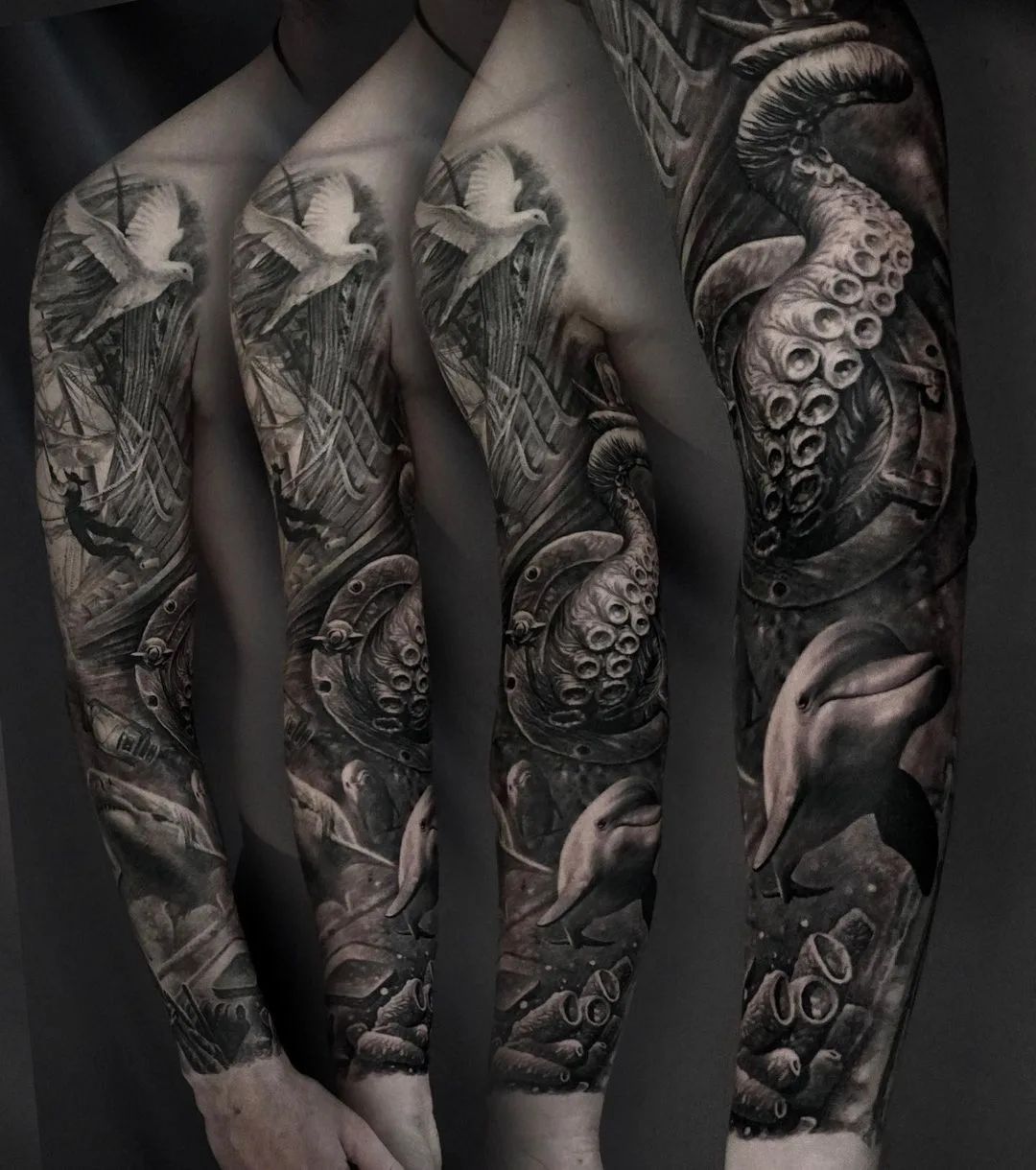
Realism. The strongest answer to the dated version, because the real animal is nothing like the clip-art one: a bottlenose has a blunt, heavy head and a body that is mostly muscle. Good realism picks one species and draws it, with the wet sheen where the skin breaks the surface and the greys graded rather than flat. It needs room (forearm, thigh, shoulder blade) and an artist who has worked on marine animals, whose surfaces behave nothing like fur.
Black and grey and dotwork. Removing colour removes the beach-towel palette at a stroke, which is why black-and-grey dolphins are the ones most likely to age well. Stippled dotwork suits the animal's smooth skin, and dense black water against the pale belly does the highlighting.
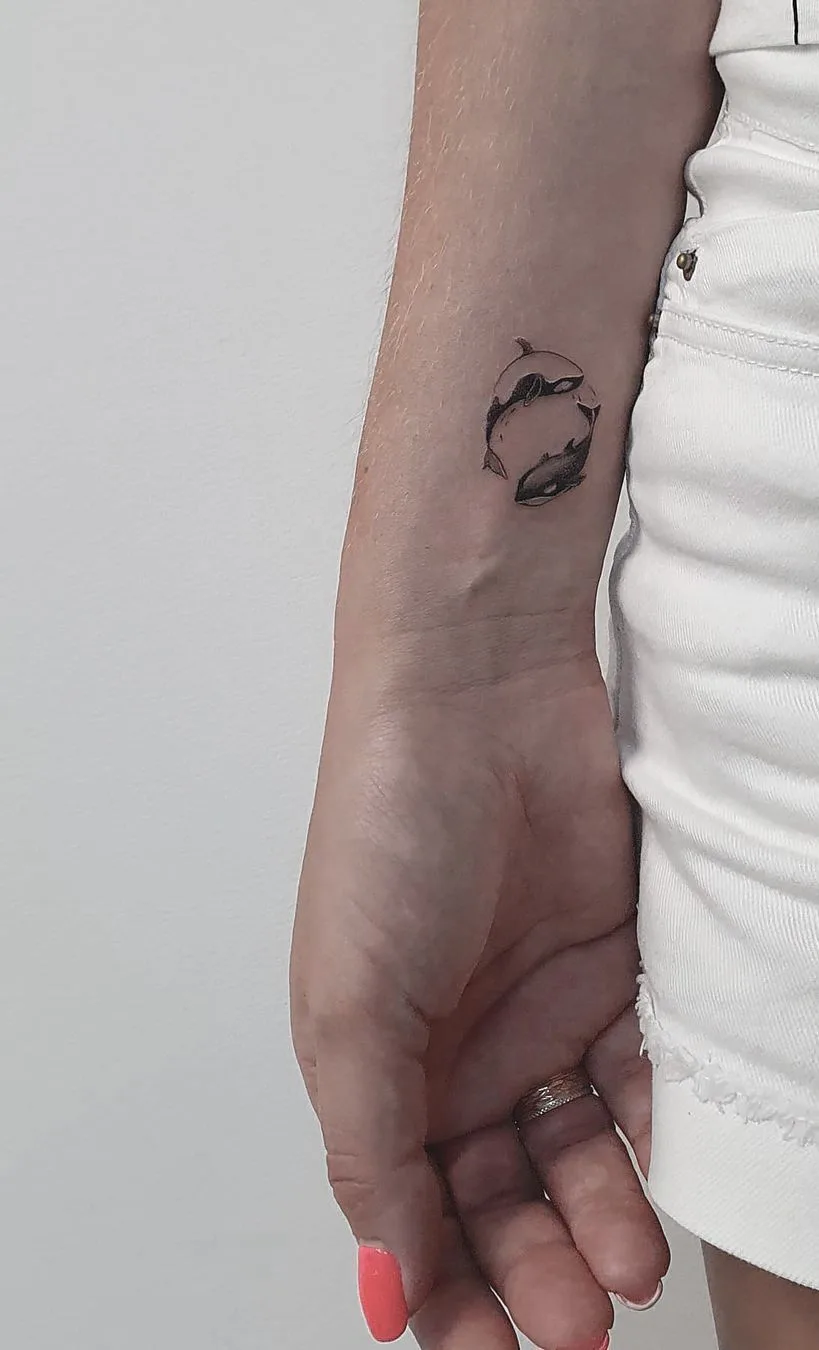
Fine line. The modern successor to the ankle dolphin, and the difference is discipline: a single clean line tracing the animal, or two dolphins circling nose to tail, at wrist or collarbone scale. It works because it does not pretend to be more than a line, and that honesty is the whole point.
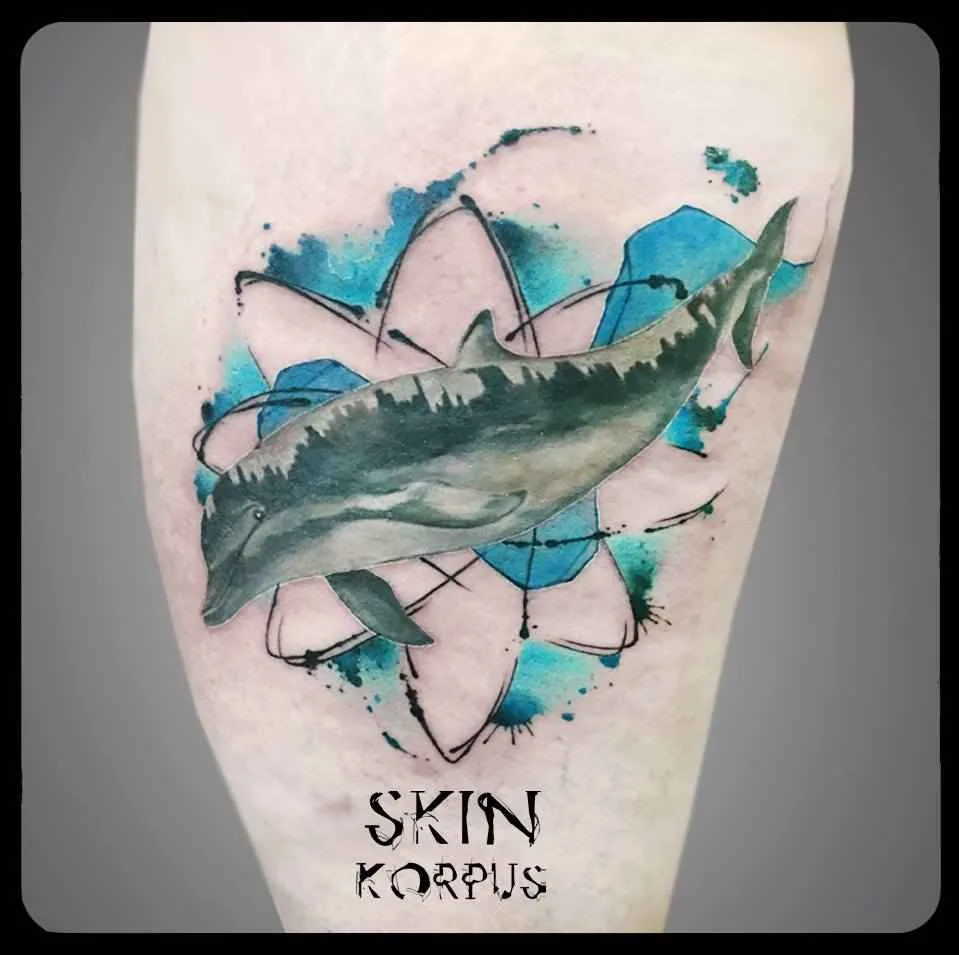
Watercolour. The most requested contemporary treatment, and the most double-edged. Blues and teals bleeding from the animal into a suggestion of water catch the motion well. Done badly the piece looks like a bruise, and colour without a line base fades faster than anything else here, so agree on touch-ups before the first session.
Traditional and neo-traditional. Bold outline, limited palette, the dolphin paired with anchor, rope or a sailor, the oldest pairing the motif has. These age better than anything else here, and the iconic quality suits an animal that has been an emblem for three thousand years.
Polynesian and geometric. The animal built from the pattern vocabulary of the Pacific, or from Western geometry. Both abstract the body into something that no longer resembles a sticker; the Polynesian version carries the navigational reading above, provided the artist knows the vocabulary.
Minoan and classical. Underused and the freshest option available: the flat colours of the Knossos fresco, the boy-on-dolphin of the Tarentine coins, the dolphin-and-anchor of the Roman seal. Any of these turns the piece into a quotation, and a quotation cannot date the way a fashion does. To see how each approach looks on skin, the dolphin motif page collects the work by style and placement.
Placement and scale
Placement is where the 1990s reputation was made, so it deserves a decision rather than a default.
The ankle is the placement everyone remembers, and it is not wrong so much as small. A dolphin wrapping the ankle bone uses the joint's curve well; the problem is that most were drawn at three or four centimetres and filled with detail that had nowhere to go. If you want the ankle, the honest options are a fine-line silhouette or a traditional design with a heavy outline.
The forearm is the modern default. The cylinder of the arm suits a wrap-around composition where the animal is in motion, entering one side and leaving the other, and inner-forearm dolphins can be shown or covered.
The shoulder blade and the ribs give a flat plane for a leaping figure. A dolphin placed on the scapula as if surfacing through the skin moves with the body when the arm does, one of the few placements where anatomy improves the design. Ribs offer a similar canvas at a higher pain cost, and the intercostal curve suits a dolphin arching downward.
The thigh has become the placement for larger work (a dolphin with a wave, a pod, the Akrotiri fleet) for the reasons it has for every animal: good surface, moderate pain, control over who sees it, and room to add to the piece later. Most of the realistic dolphins on the motif page sit here.
Scale is a separate decision from location, and it is the one that most decides whether the piece reads as current. Under roughly eight centimetres the animal cannot hold gradation: the greys close up within a few years and the belly-back contrast vanishes. At that size, commit to line or silhouette, and accept that the eye will be a dot. Above it, give the dolphin something to be in (water, spray, a coral border), because an animal floating in bare skin is the strongest visual signal of the era you are trying not to quote.

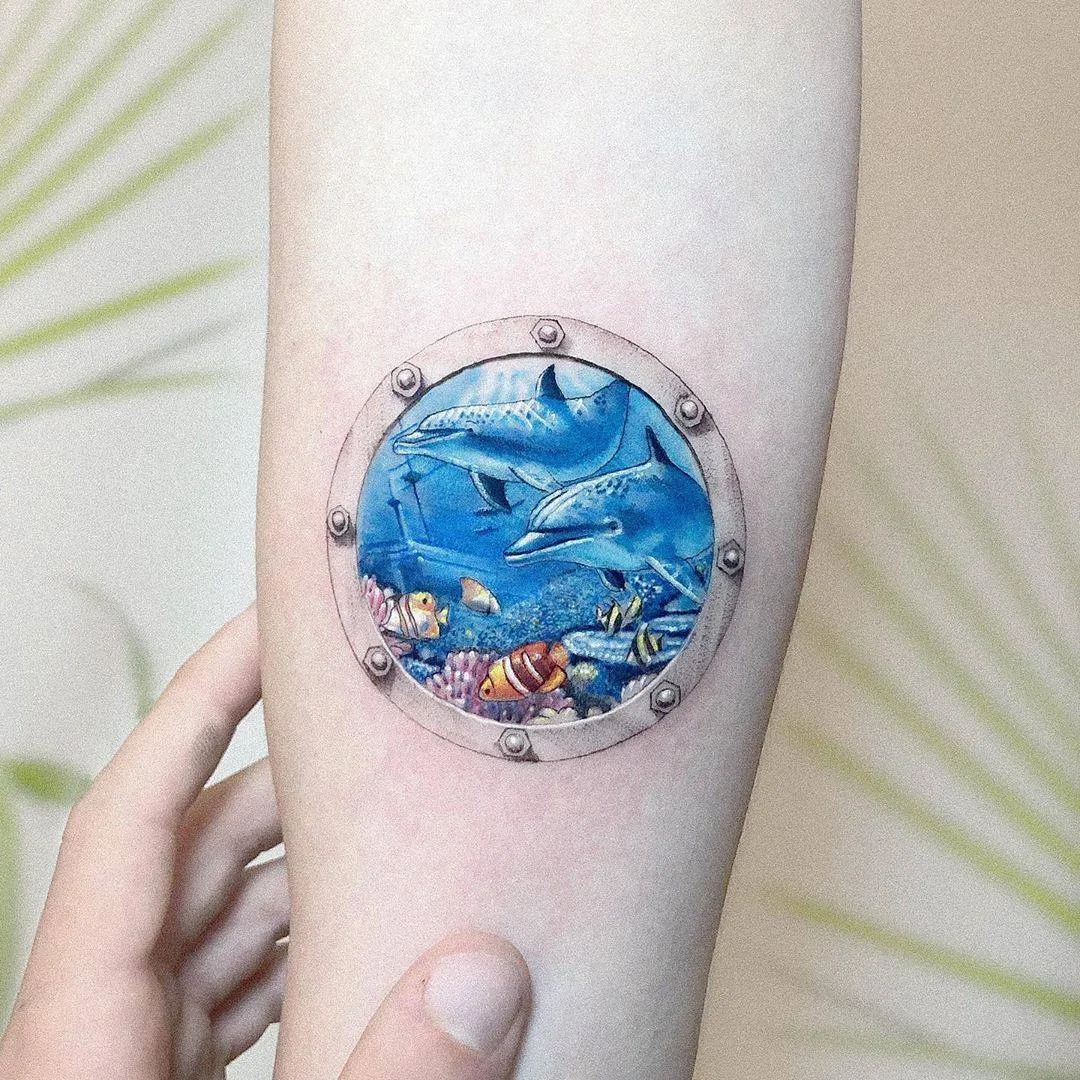
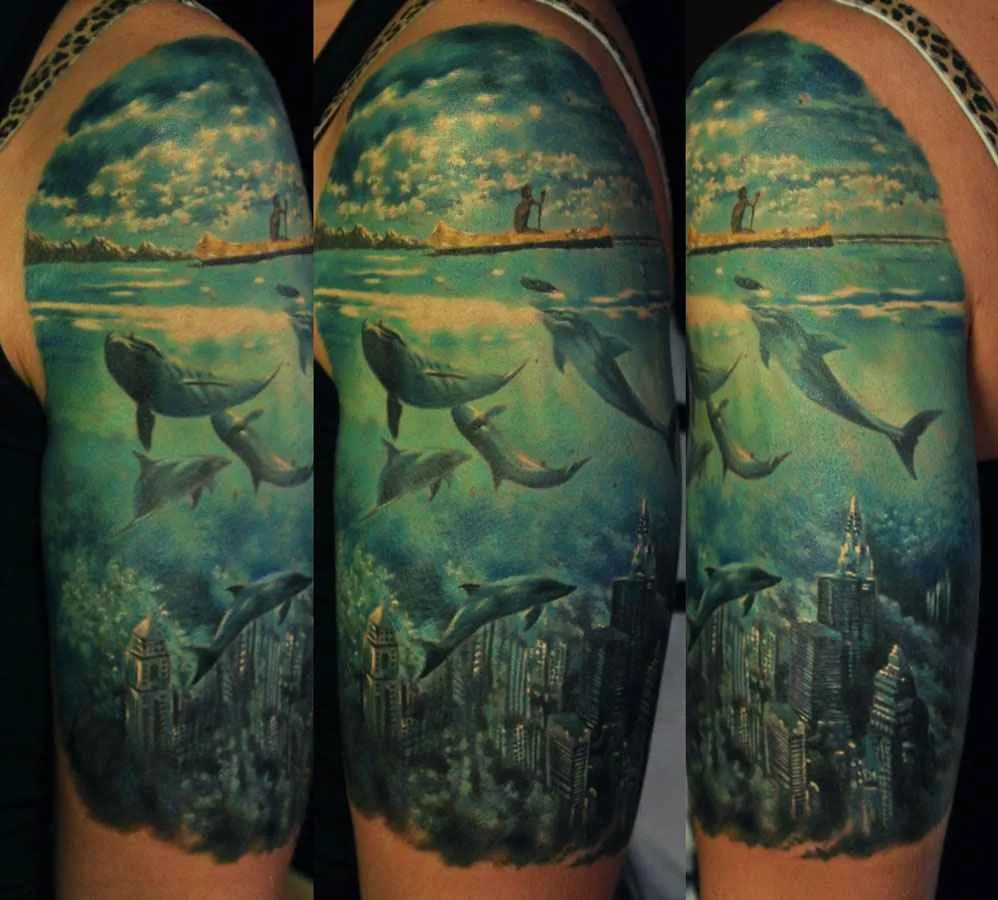
Underwater scene tattoo with dolphins by @Gastattoo

Dolphin leaping over turtle tattoo by @michaeltaguet

Dolphin above swimmer colour tattoo by @Leeahim_tattoo

Jellyfish and dolphins underwater tattoo by @ilya_fom_43

Dolphin, whale and turtle tattoo by @lavaletattoo
Design variations and what they change
The choices inside a design move the meaning further than the choice of style does.
Two dolphins. The most common variation and the clearest reading: partnership, balance, mutual support. Two animals circling nose to tail make a yin-yang without drawing one, which is how to avoid the literal yin-yang that dated the 1990s version. A larger and a smaller dolphin is the standard parent-and-child design; a pod is a family with a member for each. It says companionship, not passion.
Dolphin and anchor. The oldest combination in the motif's history and the most loaded. In the catacombs it was Christ on the cross; on a coin of the emperor Titus it appears as the device Aldus Manutius later took for his press with the motto festina lente, make haste slowly: the fast animal and the fixed weight held together. For the Christian reading, wrap the animal around the shank; for the Renaissance one, set them side by side.
Dolphin and wave. Gives the animal an environment, which is the main fix for the floating-sticker look; in Japanese-influenced compositions the wave can carry the whole piece. Leave the sunset out.
Dolphin and stars. Delphinus is four stars in a small diamond, easily added above the animal, and it turns a leaping dolphin into a piece about Arion rather than the beach.
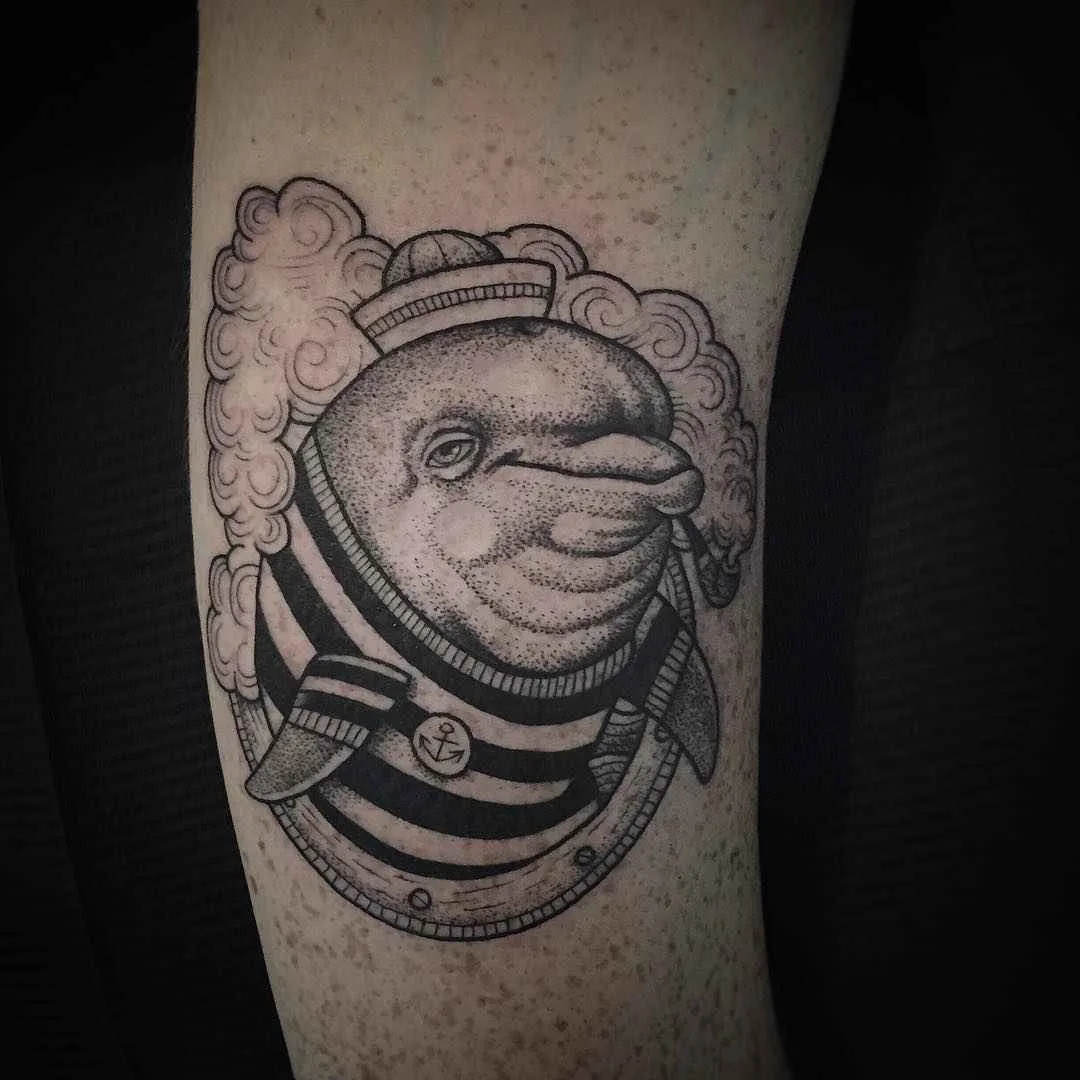
Dolphin and sailor. Traditional work has rediscovered the animal in a striped jersey with rope, anchor and pipe: the rescuer dressed as the rescued. It reads as old-navy heritage, and is the variation least likely to be mistaken for the ankle dolphin.
The Minoan quotation. A dolphin drawn in the Knossos manner, flat blue and ochre, black outline, small fish and a coral border, is a picture of a picture, and it lets the wearer have the leaping arc without the baggage.
Species and the smile. Drawing a specific species (bottlenose, common, or orca, which is a dolphin too) turns the symbol into a portrait. And the mouth: the upturned jawline is a feature of the skull, not an expression, and an artist who softens it produces a face that reads as watchful instead of cheerful. The cartoon-cheerful version is the one most tied to the 1990s.
Choosing an artist for a dolphin tattoo
The dolphin is not technically demanding the way fur is. Its difficulty is judgement: the line between an animal and a mascot is thin, and it is crossed at the sketch stage.
Three checks before you book. First, ask to see healed marine work, not fresh: smooth-skinned animals rely on gradation, and fresh photographs say nothing about how greys settle. Second, look for a species in the portfolio rather than a shape: an artist who draws a bottlenose with the heavy forehead and short beak has looked at the animal; one who draws the generic curve has looked at tattoos. Third, match the style to the person: a watercolour specialist asked for classical linework will give you a competent version of somebody else's discipline.
Bring the right reference: photographs of real dolphins rather than screenshots of tattoos, and if you are quoting a tradition such as the fresco or the catacomb anchor, the source image itself. Say which reading you want: a dolphin for a lost friend and one for a holiday with your sister are different compositions. You can filter by style, country and city in our tattoo artist directory.
See how differently one animal is handled. Susanne Suflanda Konig puts a dotwork dolphin in a striped sailor's jersey with an anchor at the collar, framed by clouds on the forearm: the old-navy reading in black and grey. Jingxi Gu takes the opposite road: a realistic animal driving up through a wave with white spray on the thigh, where the water anchors the figure. Anna Voevodina shows the small version done with restraint: two tiny fine-line dolphins circling nose to tail on the wrist. And Marco Pepe folds the dolphin's silhouette into an abstract colour piece with a helmeted Greek statue on the calf: the classical reading in a contemporary vocabulary. Four approaches to one motif, and the choice between them decides more than size or placement.
Aftercare and how a dolphin tattoo ages
Standard aftercare applies: clean it, keep it lightly moisturised, leave the scabs alone, and stay out of the sea, pools and direct sun until the surface has healed: two to three weeks, with the deeper layers taking a few months.
Beyond that, dolphins have two ageing risks. The first is gradation. The animal's look depends on the transition from dark back to pale belly, made of mid-tone greys, the values that soften first. A piece built on gradation alone will flatten into a dark shape inside a decade. The fix is structural: a clear silhouette, a real black somewhere in the design, and the belly left as skin rather than filled with light grey.
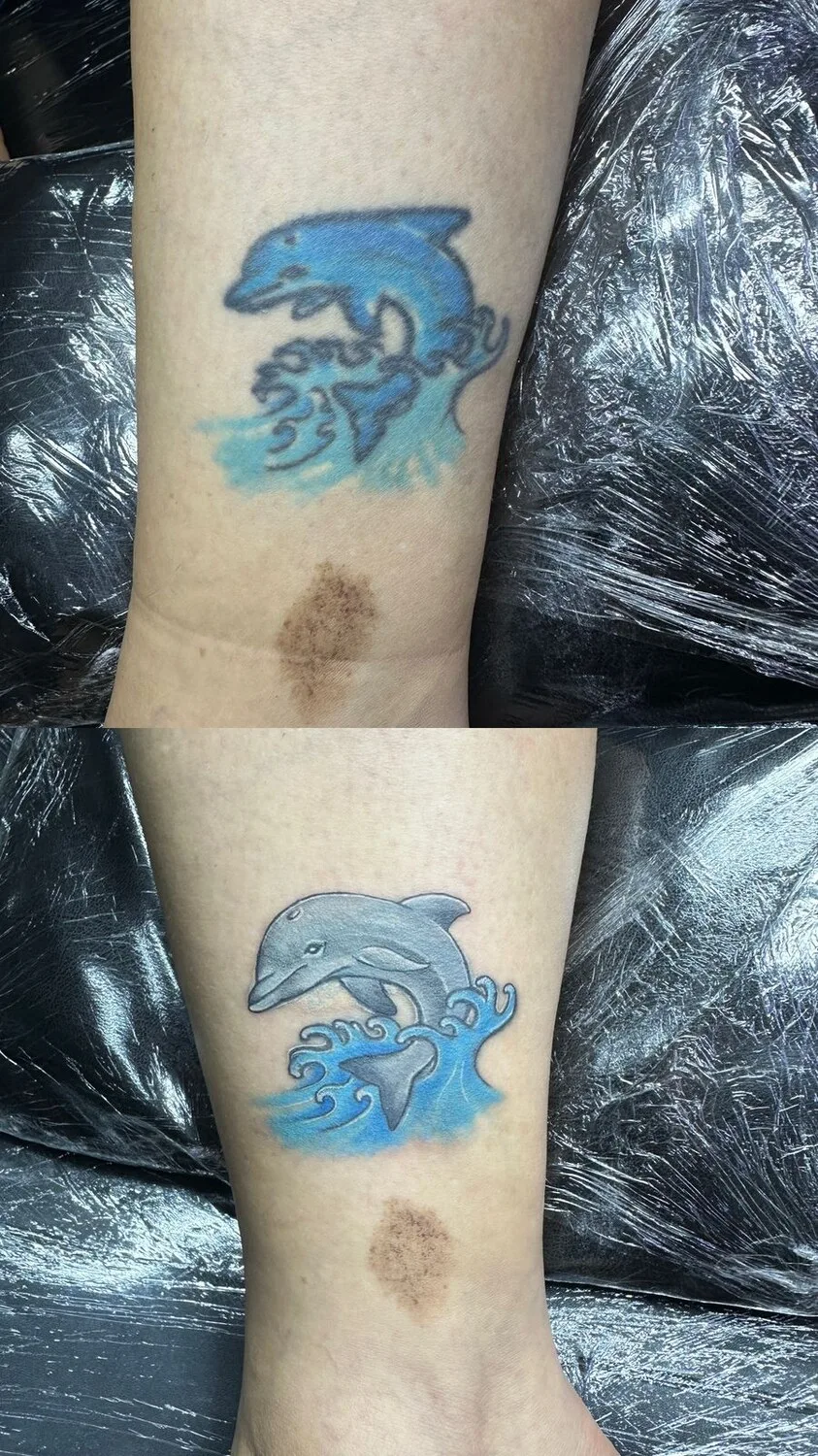
The second is colour. Blues and teals hold better than reds and yellows, a small mercy for a motif that lives in blue, but watercolour without a line base spreads; the 1990s dolphins that look worst today are the pale-blue ones whose outlines went first. Traditional and black-and-grey work softens evenly and stays legible.
Sun is the variable you control afterwards. An ankle or forearm dolphin gets more ultraviolet than most placements, and sunscreen does more for its twenty-year life than any product sold for tattoos. Expect one touch-up in the first year for fine line and watercolour.
Frequently asked questions
What does a dolphin tattoo mean?
Joy, intelligence and safe passage. The play reading comes from the animal's behaviour, the intelligence reading from research on self-recognition and signature whistles, and the passage reading from Greek myth, early Christian art and Pacific tradition.
Are dolphin tattoos outdated?
The 1990s version is: the small, smiling, floating animal at the ankle or hip. The motif itself is three and a half thousand years old. What reads as current is a matter of choices: real species anatomy, an environment around the animal, a scale that lets the design breathe, and a disciplined style.
What does a dolphin tattoo mean spiritually?
Guidance and protection on a crossing. The Greeks made the dolphin sacred to Apollo and Poseidon; early Christians used it as a hidden image of Christ; Māori tradition holds dolphins as kaitiaki, guardians who escort canoes. In all three the animal takes you somewhere safely.
What do two dolphins mean in a tattoo?
Partnership and balance. Two animals circling nose to tail read as mutual support; a large and a small dolphin read as parent and child; a pod reads as a family or a group of friends, one animal per person.
What does a dolphin and anchor tattoo mean?
Two things at once. In the Roman catacombs a dolphin twined on an anchor was Christ on the cross, the anchor standing in for a cross that could not be shown openly. In the Renaissance the same pair became Aldus Manutius's printer's emblem for festina lente, speed held by steadiness.
Where is the best place for a dolphin tattoo?
The forearm for a mid-sized animal in motion, the thigh or shoulder blade for anything realistic or with water around it, and the wrist or ankle only for a fine-line or traditional design that does not depend on shading. The ankle is not a mistake; a detailed dolphin at three centimetres there is.