Every culture that has watched an eagle fly has come to roughly the same conclusion: that bird is in charge. The specifics vary, freedom here, divine authority there, military dominance somewhere else, but the underlying reaction is remarkably consistent across thousands of years and thousands of miles of human civilization. Something about watching a raptor command the sky from a height nothing else can reach triggers a deep response. We want to be that. Or at least, we want to carry some of that energy with us.
Eagle tattoos are among the most popular bird designs worldwide, and for good reason. But the meaning goes far deeper than most people think, touching on national identities, ancient warfare, founding myths, and legal protections you might not expect.
American Symbolism: The Bald Eagle and Everything It Carries
The bald eagle became the national emblem of the United States in 1782, and it hasn’t loosened its grip on American identity since. You’ll find it on currency, military insignia, government seals, and an enormous number of tattoos. For many Americans, particularly those with military service, the bald eagle represents freedom, patriotism, and sacrifice. It’s one of the most immediately recognizable patriotic tattoo symbols in the world.
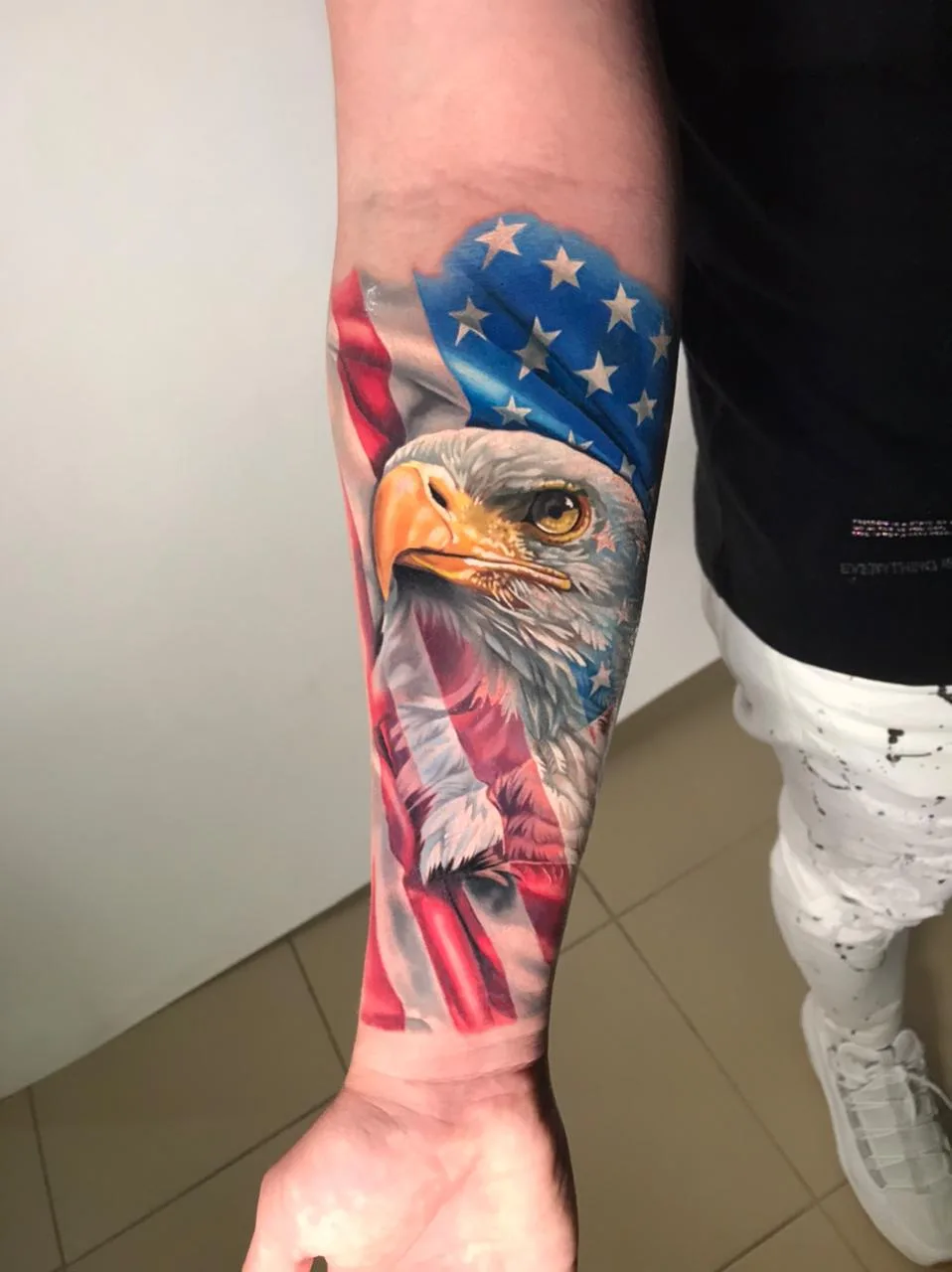
But here’s a detail that most eagle tattoo articles skip. Benjamin Franklin wasn’t thrilled about the choice. In a letter to his daughter in 1784, he called the bald eagle “a Bird of bad moral Character” who doesn’t get his living honestly, because bald eagles frequently steal fish from other birds. Franklin thought the turkey was a more respectable choice. “A Bird of Courage,” he called the turkey, one that “would not hesitate to attack a Grenadier of the British Guards.”
Now, Franklin was probably being at least partly humorous. And he lost the argument anyway. But it’s a fun reminder that national symbols are chosen, not inevitable. The bald eagle wasn’t universally beloved from day one. It was debated, questioned, and ultimately selected through a political process. That doesn’t diminish its power as a symbol, if anything, it makes it more interesting. We chose to see ourselves in this bird.
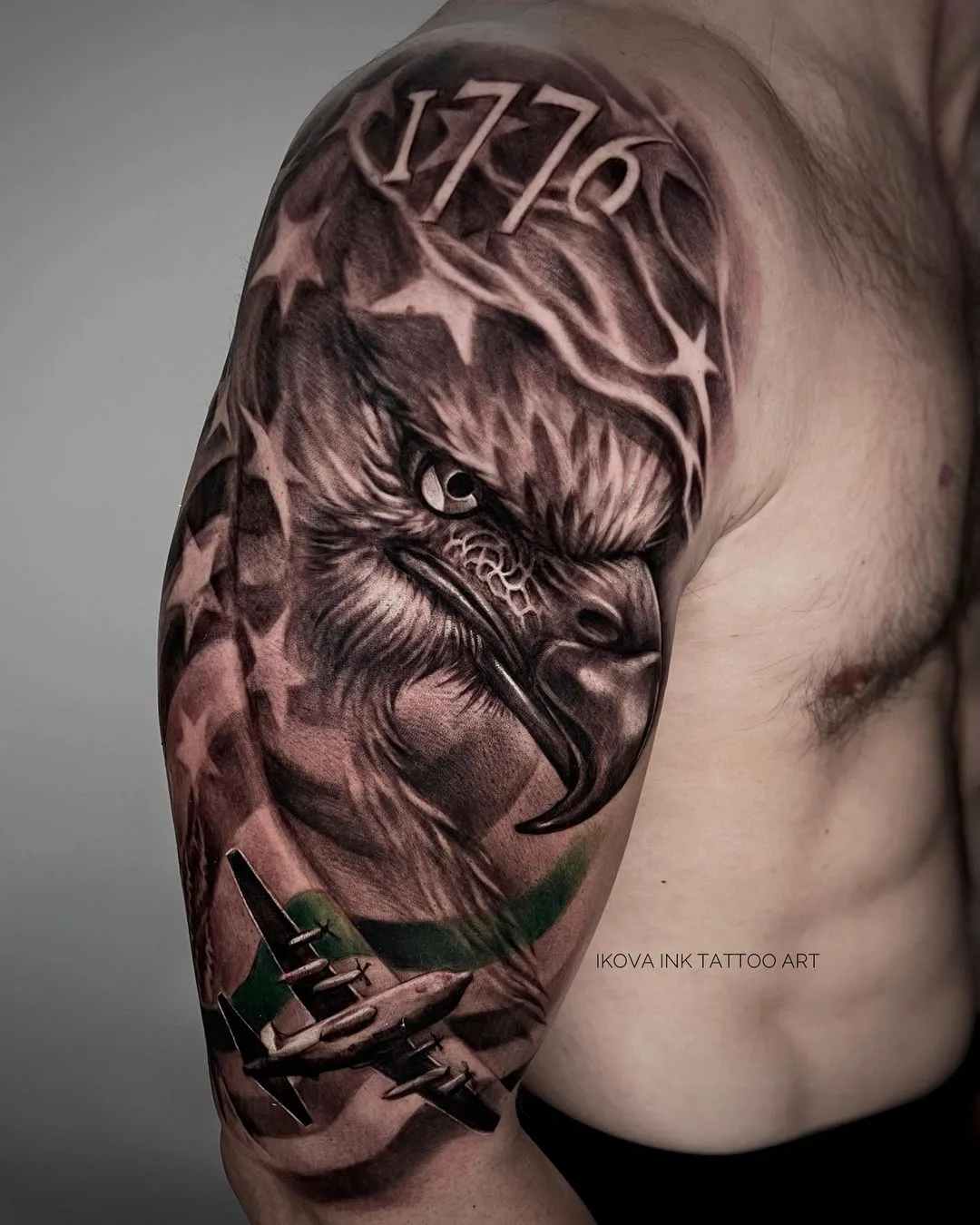
For tattoo purposes, the American eagle often appears with flags, shields, arrows, or banners. Military eagle tattoos frequently incorporate unit insignia or memorial dates. The style tends toward traditional American tattooing, bold outlines, strong color, flat perspective, which makes sense since this is one of the designs that literally defined the American traditional style.
The Aztec Eagle Warrior and the Founding of Tenochtitlan
This is the section that competitors almost universally miss, and it’s arguably the most visually powerful eagle story in any culture.
The Aztec cuauhtli (eagle) was central to Mexica civilization in ways that went far beyond symbolism. Eagle warriors (cuāuhocēlōtl) were one of the two elite military orders, alongside jaguar warriors. To become an eagle warrior, a young soldier had to capture four enemy combatants alive in battle. Not kill, capture. Alive. This was the ultimate proof of skill and courage, and those who achieved it earned the right to wear eagle-feather headdresses and suits designed to make them look like the bird itself.
But the bigger story is the founding myth. According to Aztec tradition, the god Huitzilopochtli told the wandering Mexica people to look for an eagle perched on a prickly pear cactus, devouring a snake. Where they found this sign, they should build their city. They found it on an island in Lake Texcoco, and they built Tenochtitlan, which eventually became Mexico City, one of the largest urban areas on Earth.
That image, eagle on cactus eating snake, is on the Mexican flag today. Right there in the center. It’s on the coat of arms, on coins, on government documents. Roughly 130 million people live under a national flag featuring this exact scene, yet somehow the vast majority of tattoo meaning articles don’t mention it at all. That seems like a significant oversight, actually.
For people of Mexican heritage, an eagle tattoo based on this imagery carries layers of meaning that touch on ancestry, national pride, divine mission, and founding mythology all at once. It’s not just patriotic decoration. It’s a story about being chosen to build something lasting, against enormous odds. And that translates into deeply personal tattoo meaning for a lot of people.
The Roman Aquila: Power Made Portable
Rome was, in some ways, the first civilization to turn the eagle into a brand. The aquilaa golden eagle standard carried at the head of each Roman legion, was perhaps the most important military symbol in the ancient world. Losing your legion’s eagle was a catastrophic disgrace. Entire military campaigns were launched specifically to recover lost standards.
The eagle represented Jupiter, king of the gods, and by extension it represented Roman authority itself. When a Roman emperor died, an eagle was released during the funeral ceremony, symbolizing the emperor’s soul ascending to join the gods. The message was not subtle: Rome commands, like the eagle commands the sky. Obey or be conquered.
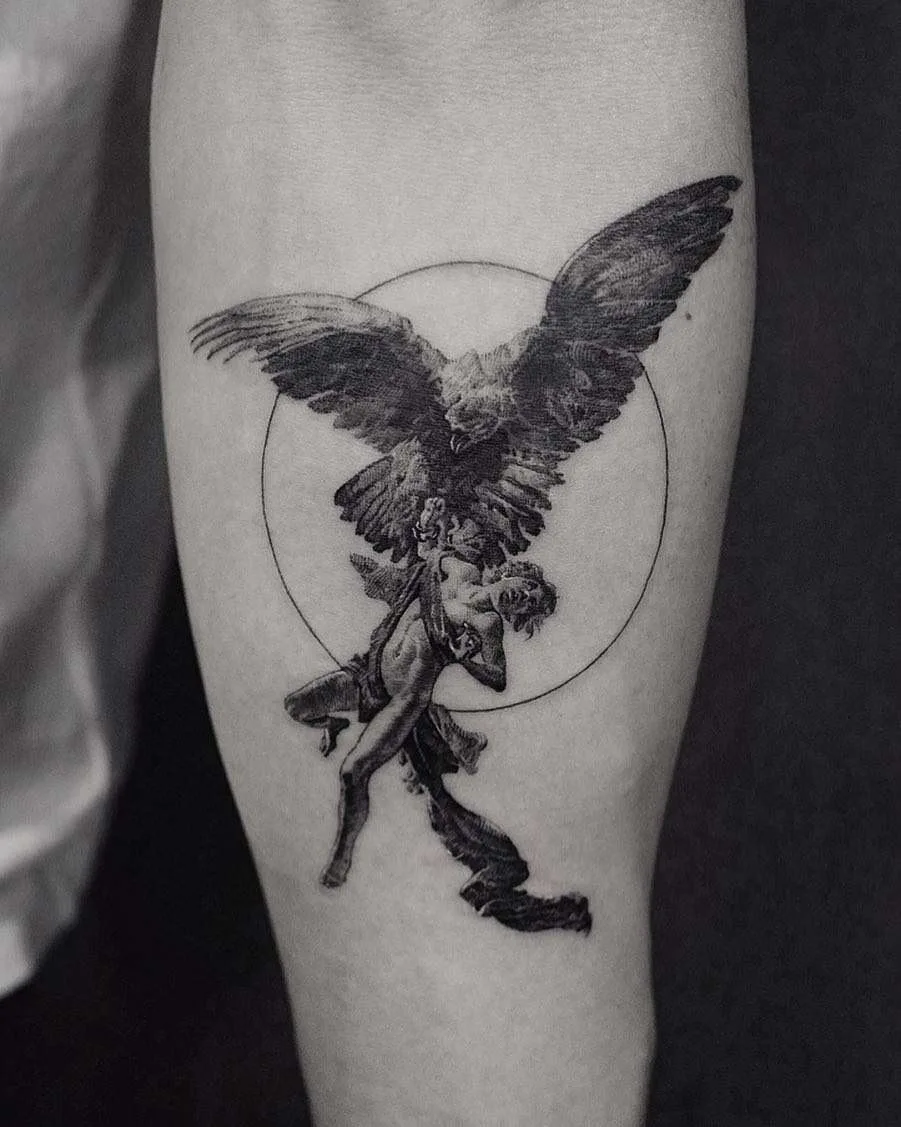
This is where the eagle starts to acquire its association with imperial power and dominion, meanings that persist in heraldry and national symbols to this day. However, it’s worth noting that this association cuts both ways. The eagle as imperial power symbol has been used by conquering empires throughout history, which means it carries some complicated historical baggage depending on context. But that said, in tattoo form, the Roman eagle usually reads as strength, authority, and ambition rather than anything more politically charged.
Germanic and Slavic Eagles: Empires and Identity
The eagle spread across European heraldry like, well, like an eagle. The Prussian black eagle. The Russian double-headed eagle looking both east and west simultaneously. The Habsburg double-headed eagle that symbolized an empire spanning half of Europe. The Polish white eagle, which survived even when Poland itself was erased from the map for over a century.
The double-headed eagle deserves special mention. It probably originated in the Byzantine Empire and spread to Russia, the Habsburgs, and several Balkan nations. The two heads supposedly represent authority over both secular and religious matters, or dominion over East and West. It’s a striking image, symmetrical, imposing, unmistakable.
For people with Eastern European or Germanic heritage, eagle tattoos often connect to these specific national traditions. A Polish person getting a white eagle tattoo is making a very different statement than an American getting a bald eagle. Same bird, completely different cultural weight. The Polish eagle specifically represents survival and resilience, the nation persisted through partition, occupation, and attempted erasure. It’s a defiance symbol as much as a pride symbol.
I should point out, though, that eagle imagery in certain Germanic and Nordic contexts has been unfortunately co-opted by extremist groups. This doesn’t mean eagle tattoos are inherently problematic, obviously not. But it’s something to be aware of in terms of specific styling choices. An experienced tattoo artist can help navigate this, and should.
Native American Eagle Feathers: Sacred and Legally Protected
This section comes with both cultural and legal weight that most tattoo articles completely ignore.
For many Native American tribes, the eagle is the most sacred of all birds. Eagle feathers are used in ceremonies, given as honors, worn with specific spiritual significance. The eagle is often understood as a messenger between humans and the Creator, carrying prayers upward. In many traditions, receiving an eagle feather is among the highest honors a person can be given.
Here’s the legal dimension that surprises most people. Under the Bald and Golden Eagle Protection Act (BGEPA) of 1940, possessing eagle feathers, parts, or eggs is a federal crime in the United States. The fine can reach $100,000 and imprisonment up to one year. There is exactly one exception: enrolled members of federally recognized Native American tribes can possess eagle feathers for religious and cultural purposes through the National Eagle Repository.
You can’t tattoo a feather onto someone’s skin and arrest them for it, obviously. But the legal framework illustrates just how seriously eagle symbolism is treated in indigenous contexts. This isn’t casual imagery. For many Native people, non-Native individuals getting eagle feather tattoos, especially designs that mimic specific tribal patterns, raises legitimate concerns about cultural appropriation.
That doesn’t mean you can’t get an eagle or eagle feather tattoo. But it means doing so thoughtfully, understanding what you’re referencing, and making design choices that reflect genuine respect rather than aesthetic borrowing. This applies especially to headdress designs, war bonnet imagery, or anything that references specific ceremonial objects.
Modern Meanings: Vision, Ambition, and Independence
Beyond the national and cultural frameworks, eagles carry a set of personal meanings that transcend any single tradition.
Vision. Eagles can see prey from over a mile away. Their eyesight is roughly four to eight times sharper than a human’s. As a tattoo symbol, this translates to clarity of purpose, the ability to see goals that others can’t, and strategic thinking. People in leadership positions or entrepreneurs sometimes gravitate toward eagle tattoos for this reason. Maybe it’s a bit on the nose. But symbols don’t have to be subtle to be effective.
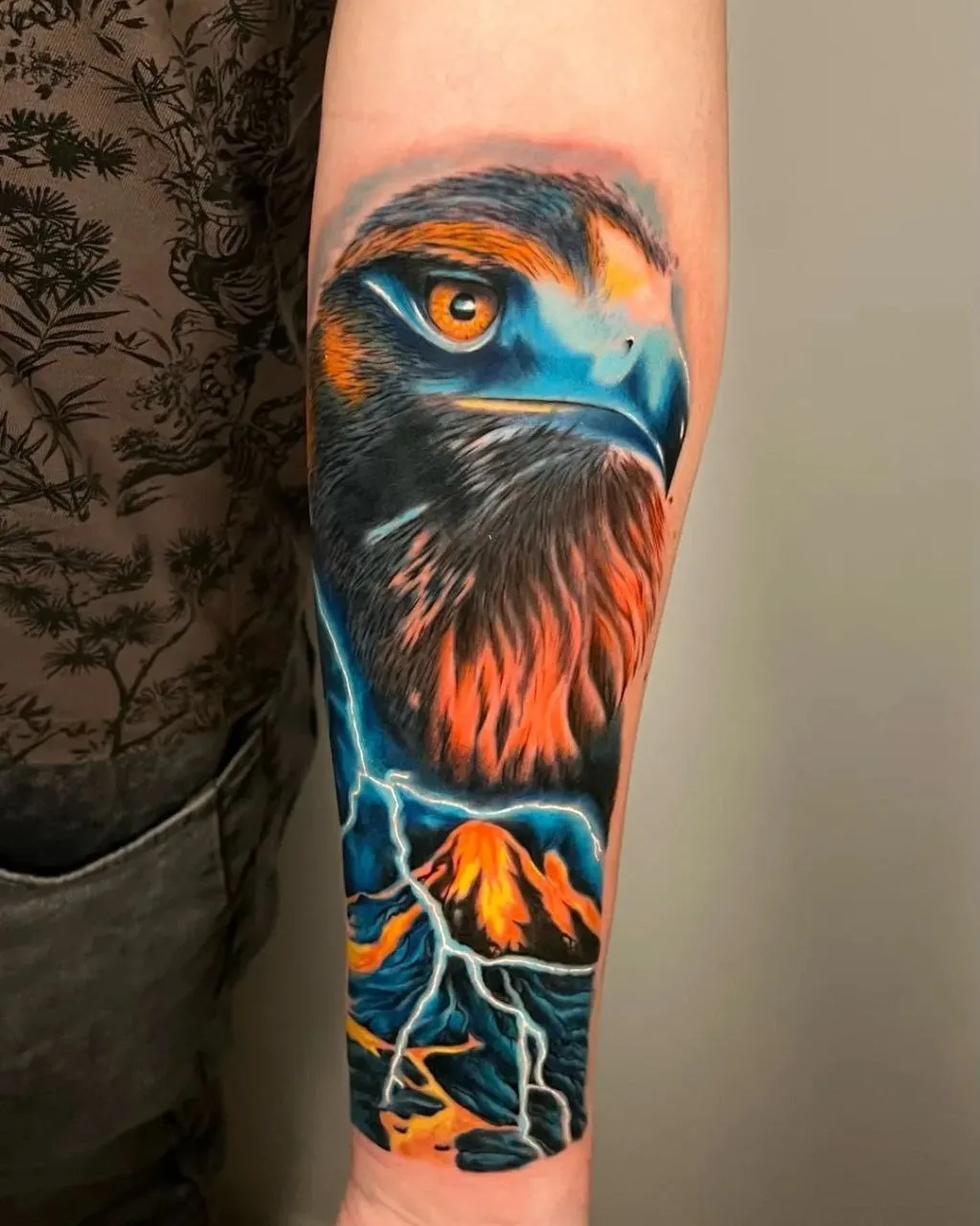
Independence. Eagles are generally solitary hunters. They don’t flock. They don’t follow. For people who value self-reliance and personal freedom, whether that’s philosophical, professional, or just temperamental, the eagle captures something genuine about how they see themselves. Or how they want to.
Renewal. There’s an old (and scientifically inaccurate, but symbolically persistent) belief that eagles can renew themselves by flying close to the sun and then plunging into water. The Bible references this in Psalm 103: “your youth is renewed like the eagle’s.” While the biology is wrong, the symbol of transformation and comeback resonates with people who’ve gone through difficult periods and emerged stronger. Actually, the fact that it’s biologically impossible might make it more powerful as a metaphor. Real renewal always feels a bit impossible when you’re in the middle of it.
Tattoo Styles for Eagle Designs
Eagles work across virtually every tattoo style, but four stand out.
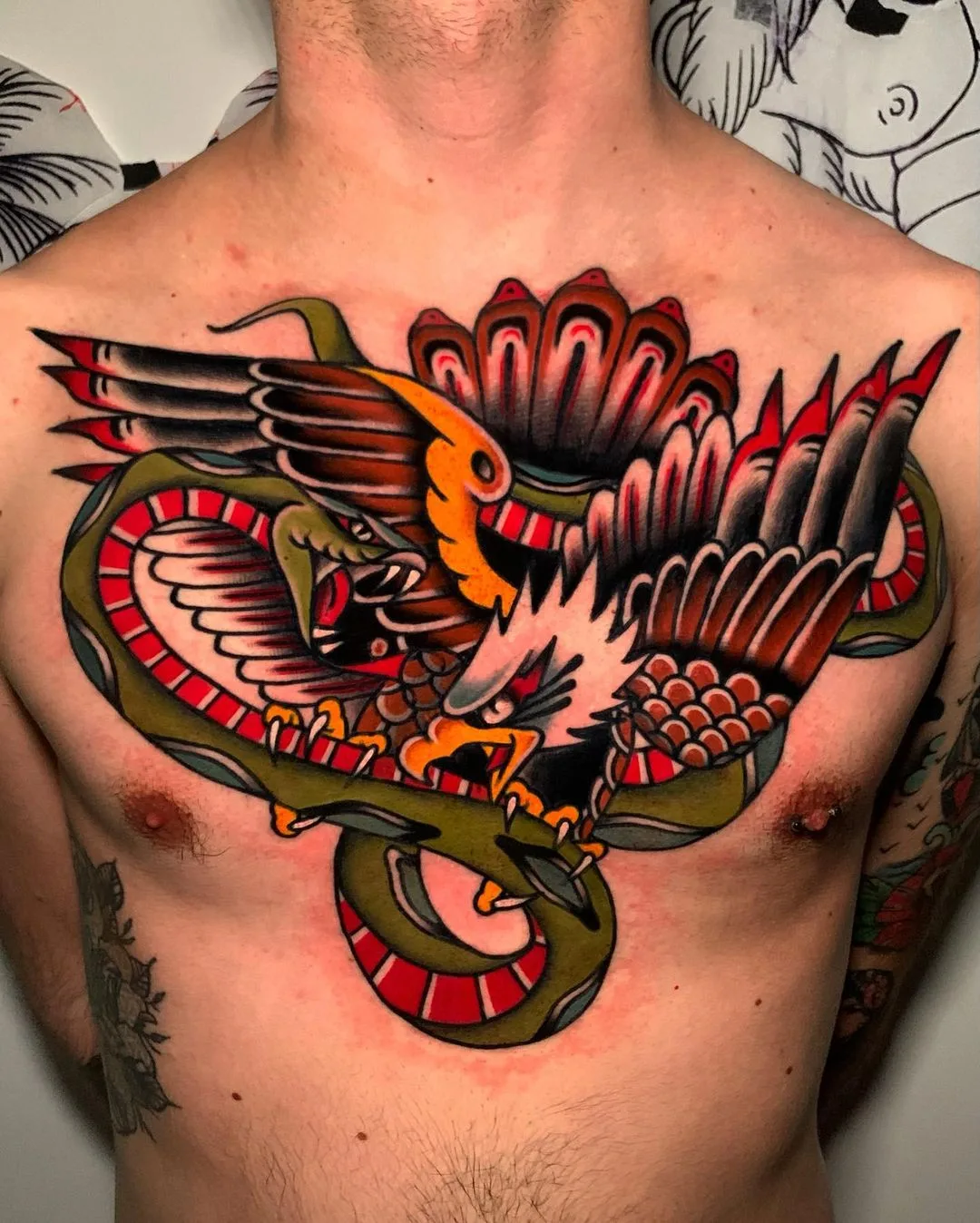
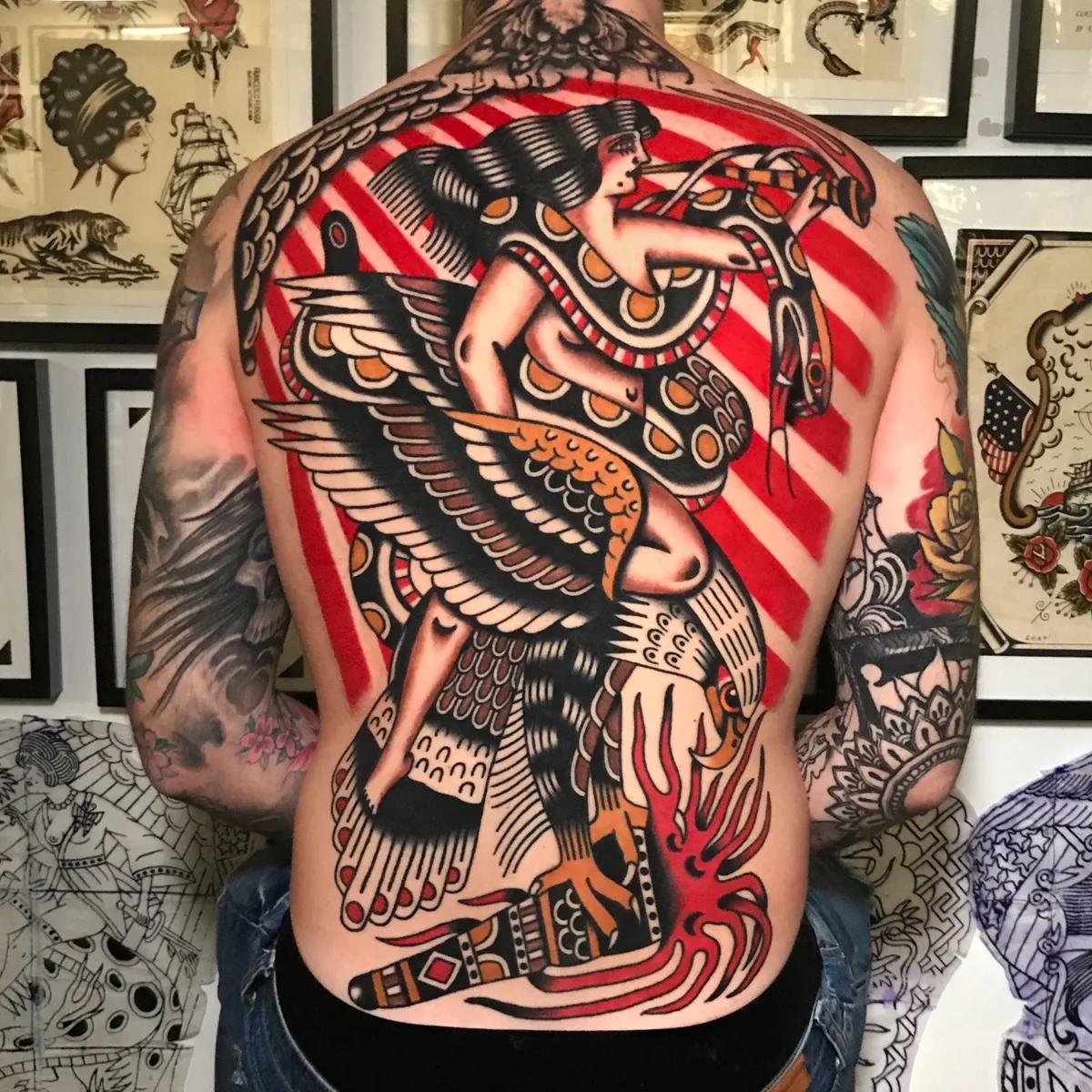
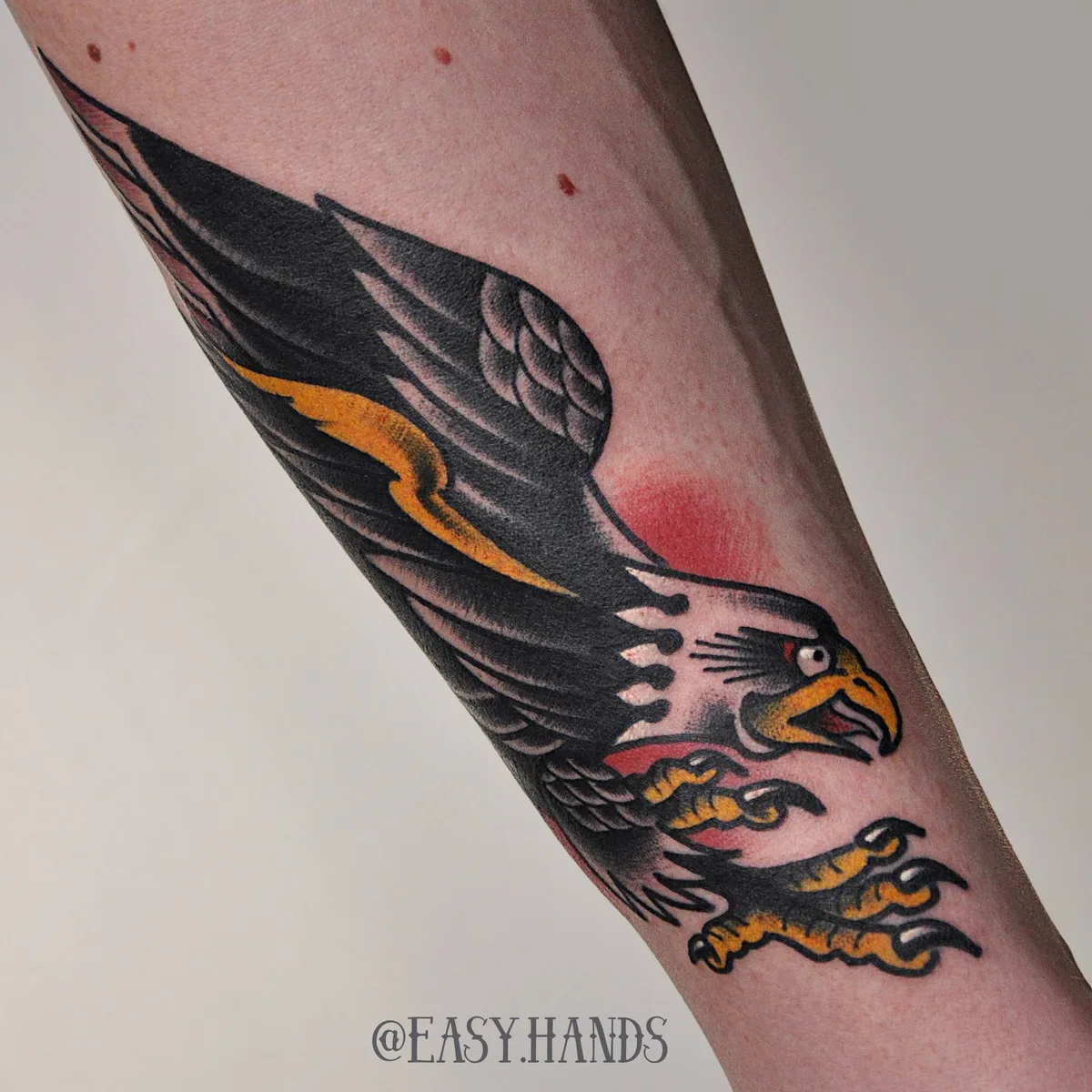
Traditional American. This is THE classic eagle tattoo style. Bold black outlines, limited color palette (red, blue, yellow, green), flat perspective, minimal shading. The style was literally built around subjects like eagles, anchors, and pin-ups. If you want an eagle that looks like it belongs in tattoo history, traditional is the default, and there’s nothing boring about doing the classics right.
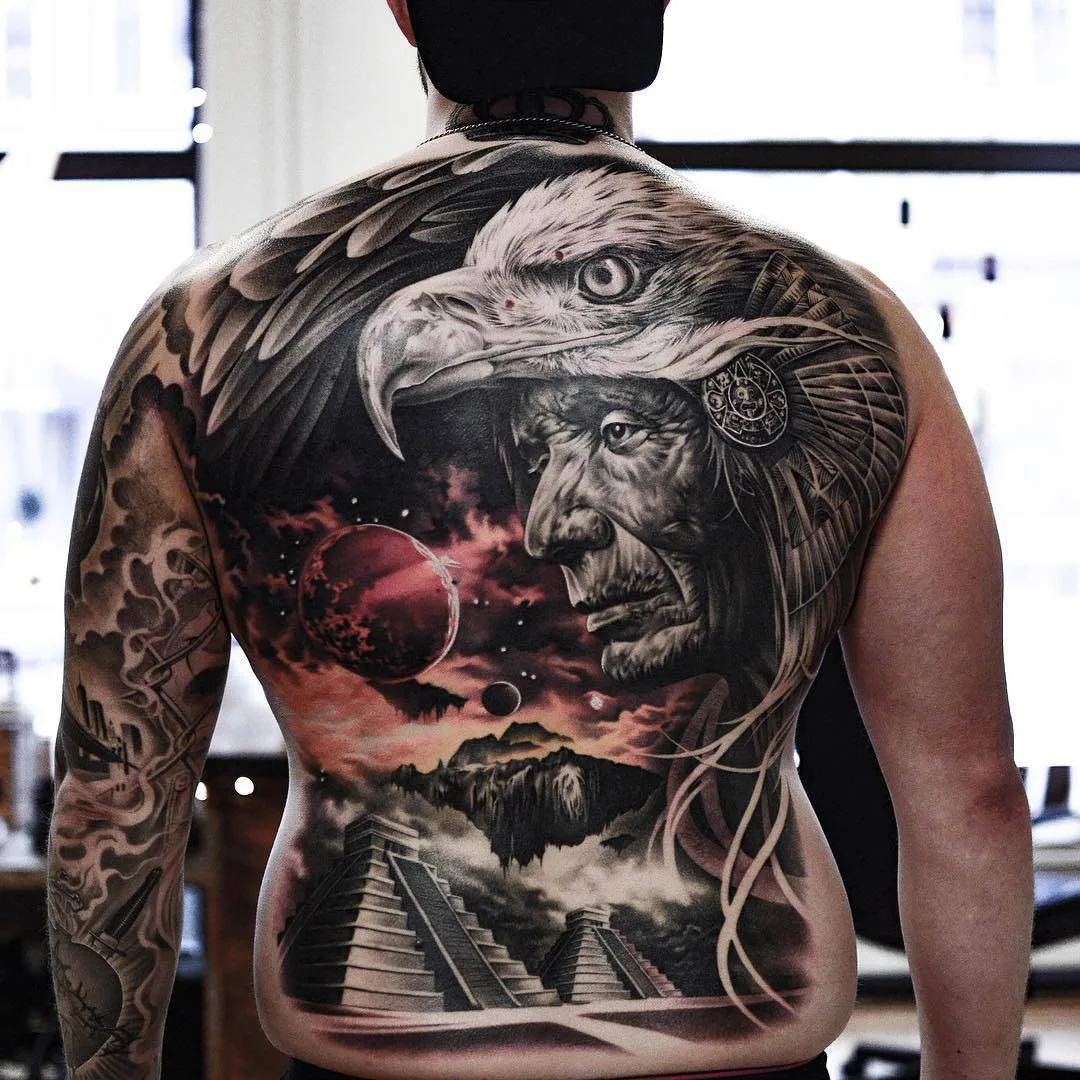
Realism. A realistic eagle in flight, talons extended, feathers individually rendered, this is one of the most dramatic images in tattooing. It demands skill from the artist and space on the body, but the result can be genuinely breathtaking. Black and grey realism works beautifully for eagles, though color realism captures the golden-brown tones of golden eagles or the distinctive white head of the bald eagle.
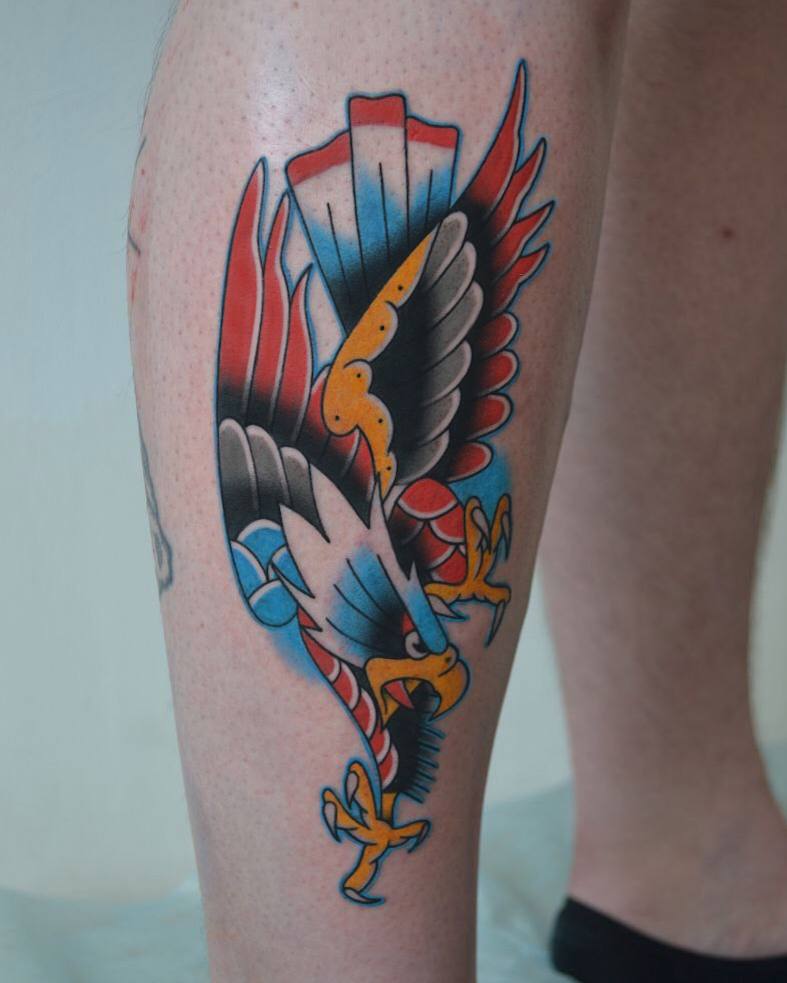
Classic American traditional eagle
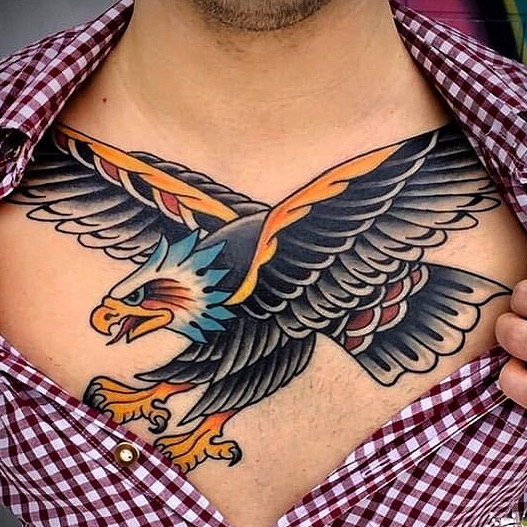
Traditional American eagle tattoo
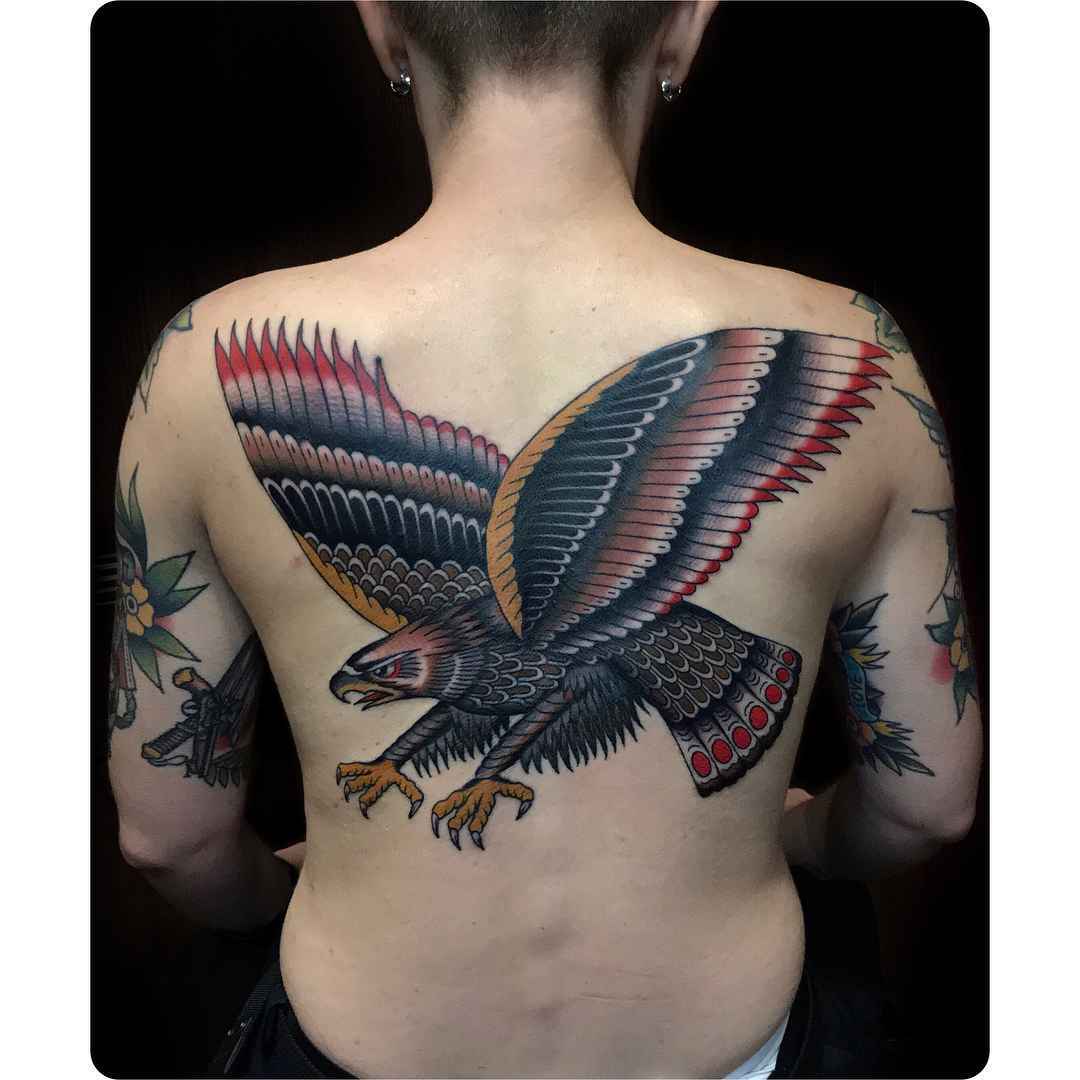
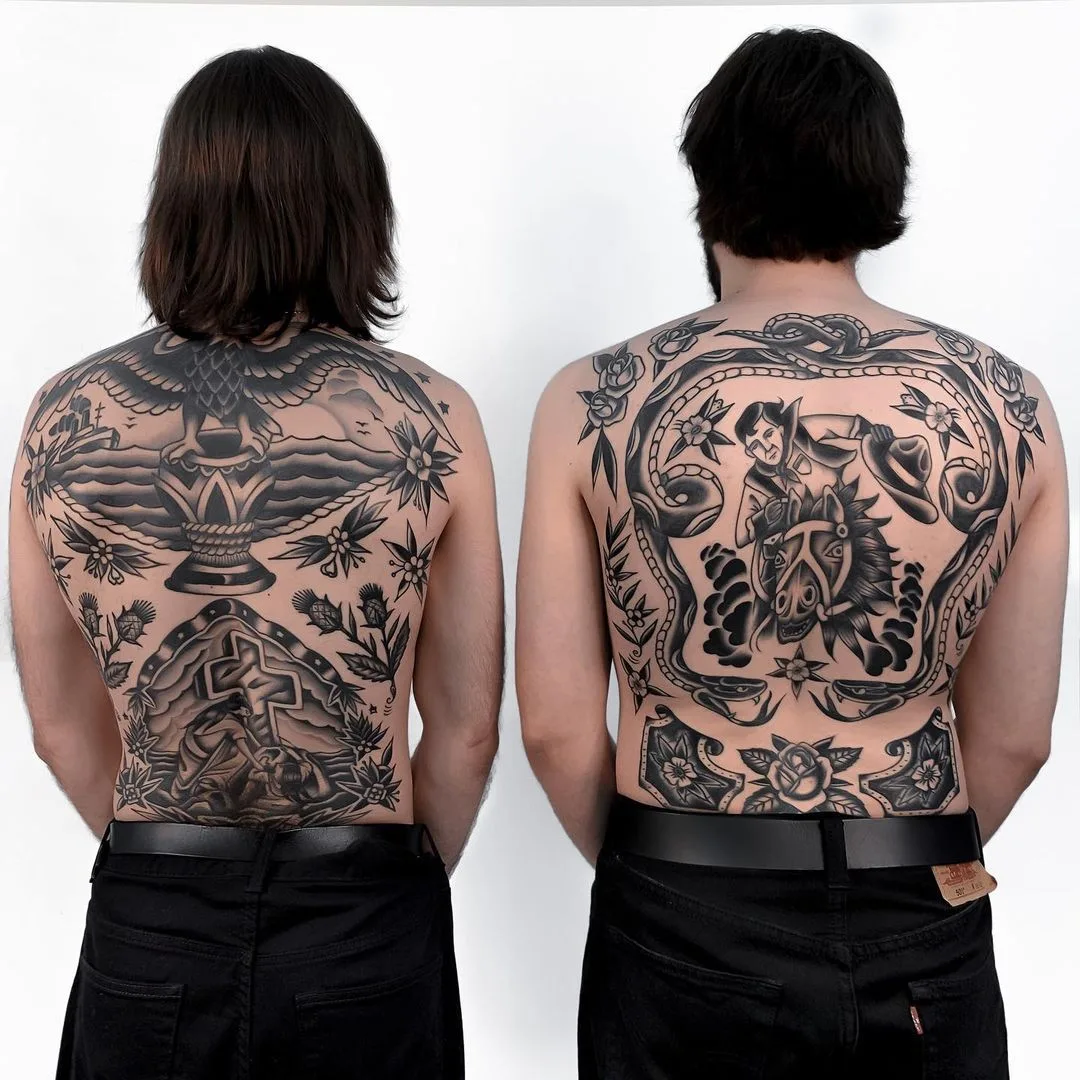
Traditional full back eagle

Traditional full back eagle, snake, skull and woman
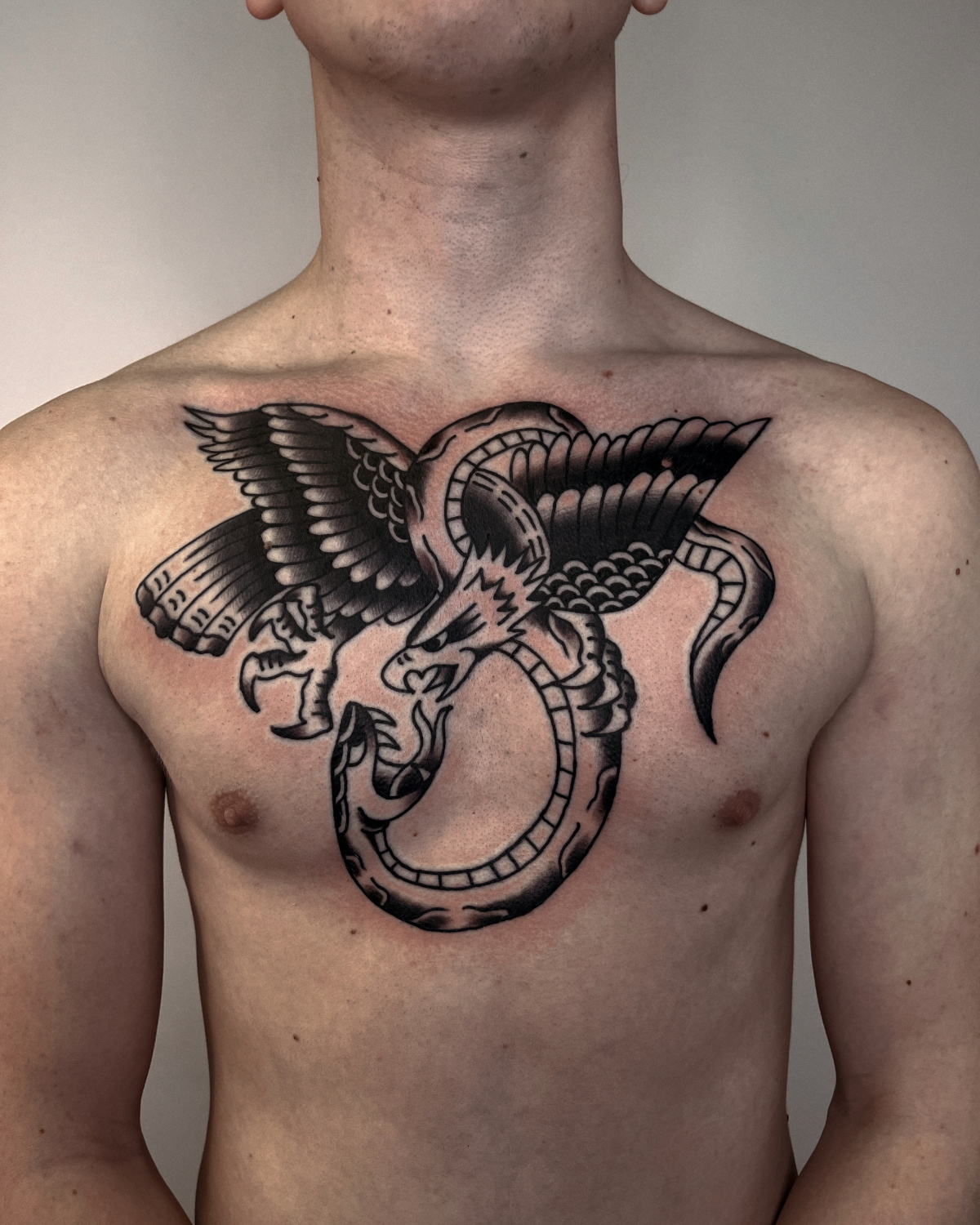
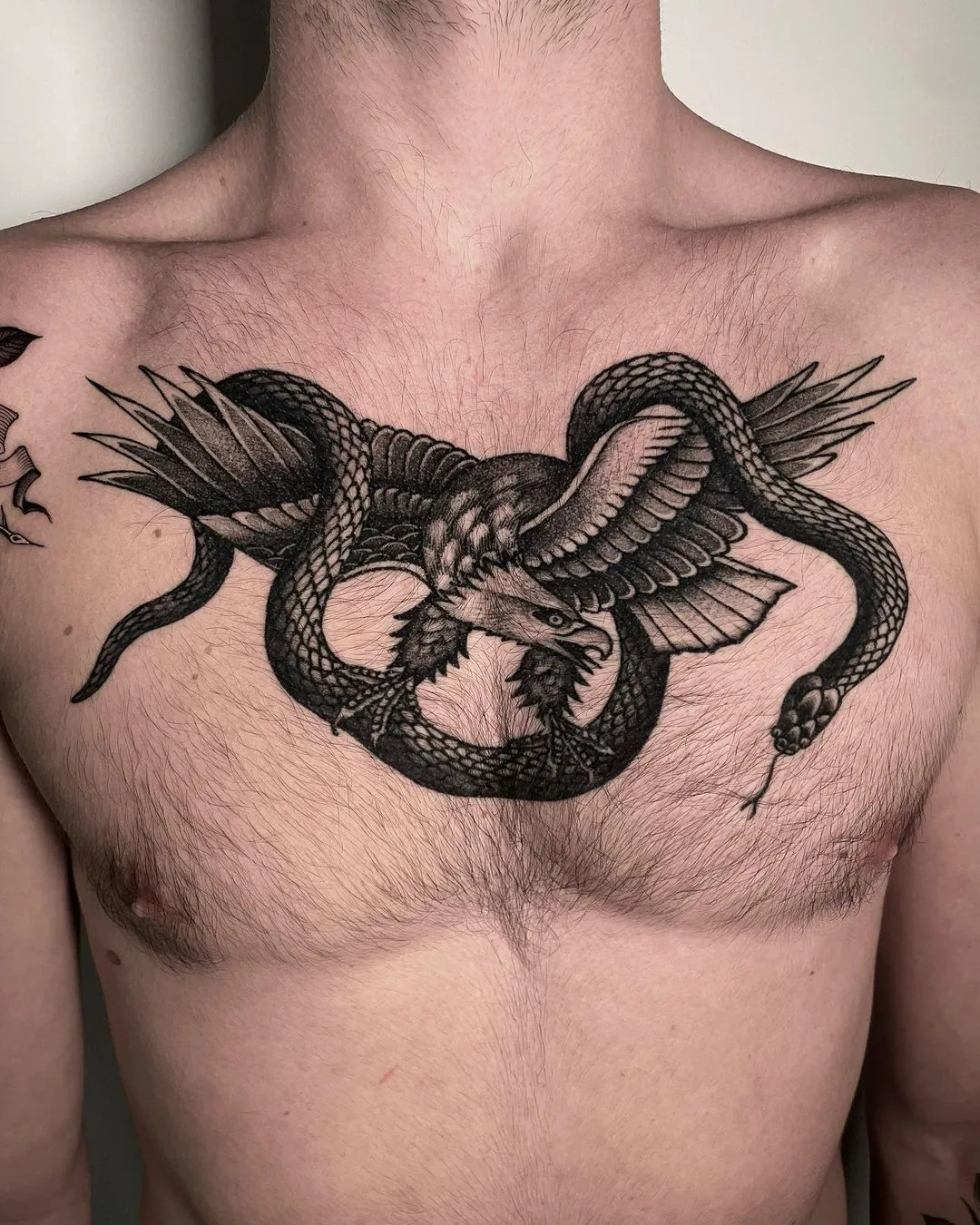
Traditional eagle and snake in black ink
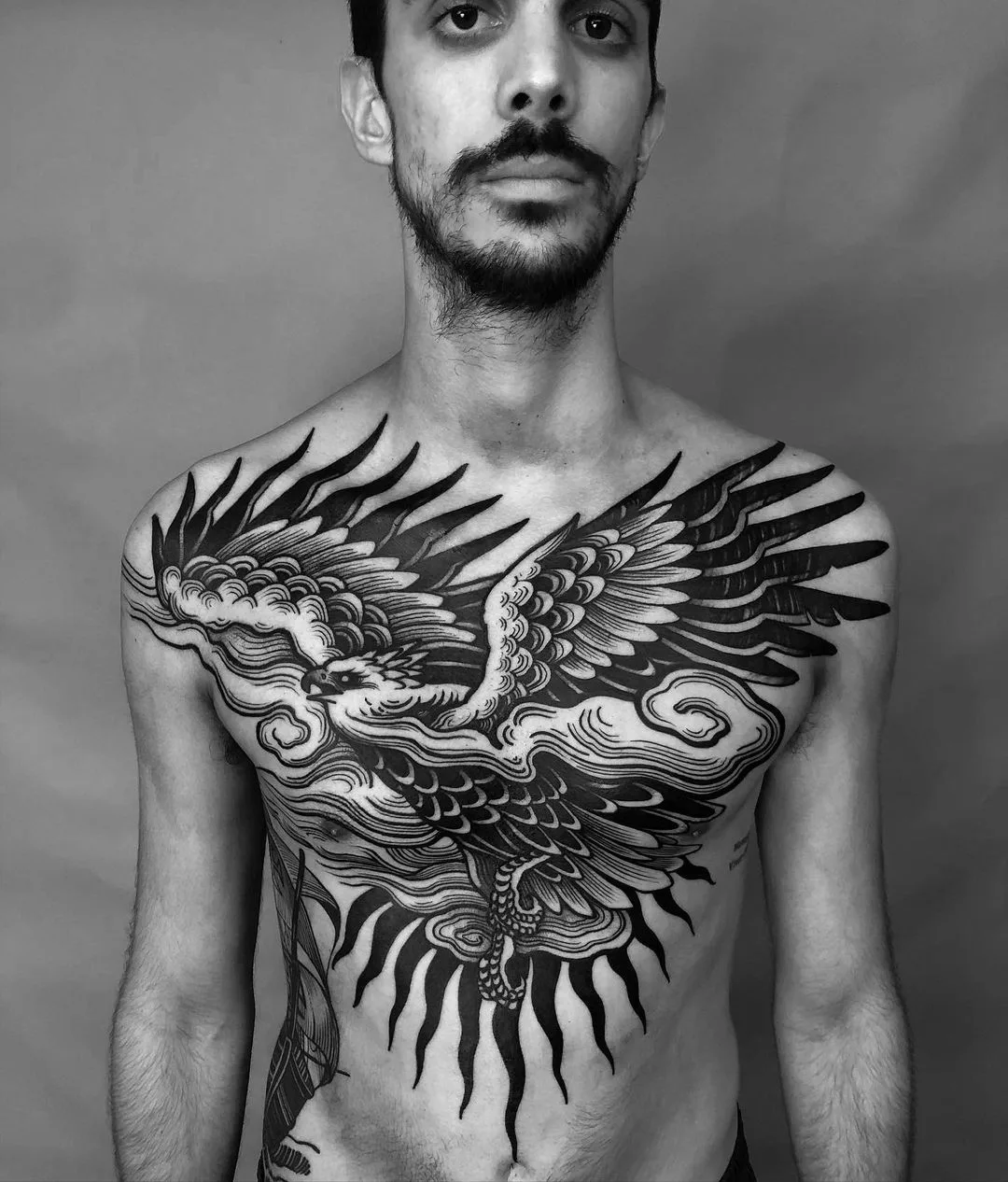
Blackwork. Heavy black fills with negative space creating the details. Blackwork eagles have a graphic, almost woodcut quality that reads as powerful and slightly aggressive. The style simplifies the form while amplifying the visual impact. Good choice for people who want something bold and masculine without going the traditional route.
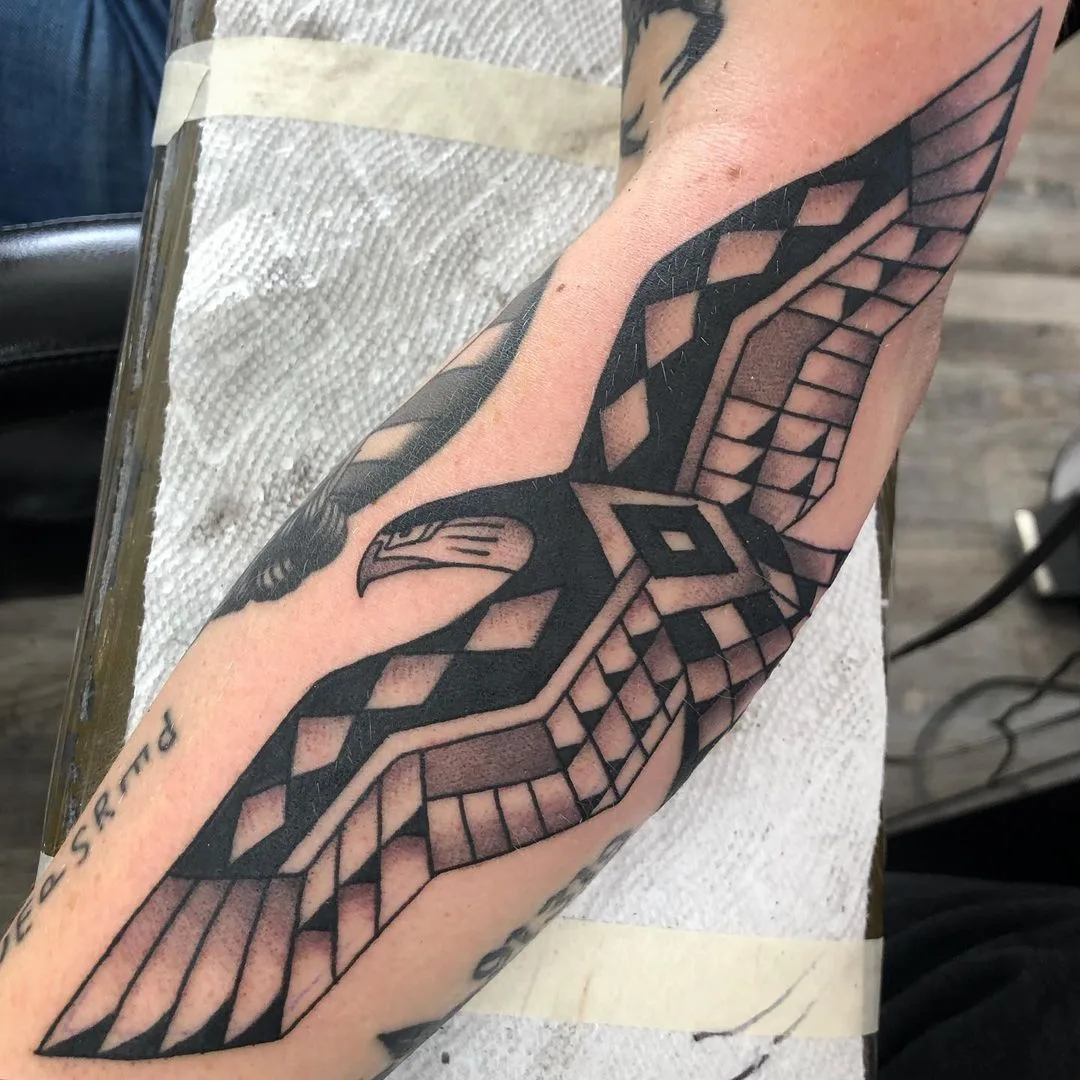
Geometric. Geometric eagles break the bird into triangles, hexagons, and clean lines. It’s a more modern, design-forward approach that appeals to people who want the symbolism without the traditional or realistic aesthetic. Geometric eagles can range from highly abstract, barely recognizable as a bird, to structured-but-detailed compositions where the geometry enhances rather than replaces the natural form.
Placement: Wingspan Needs Space
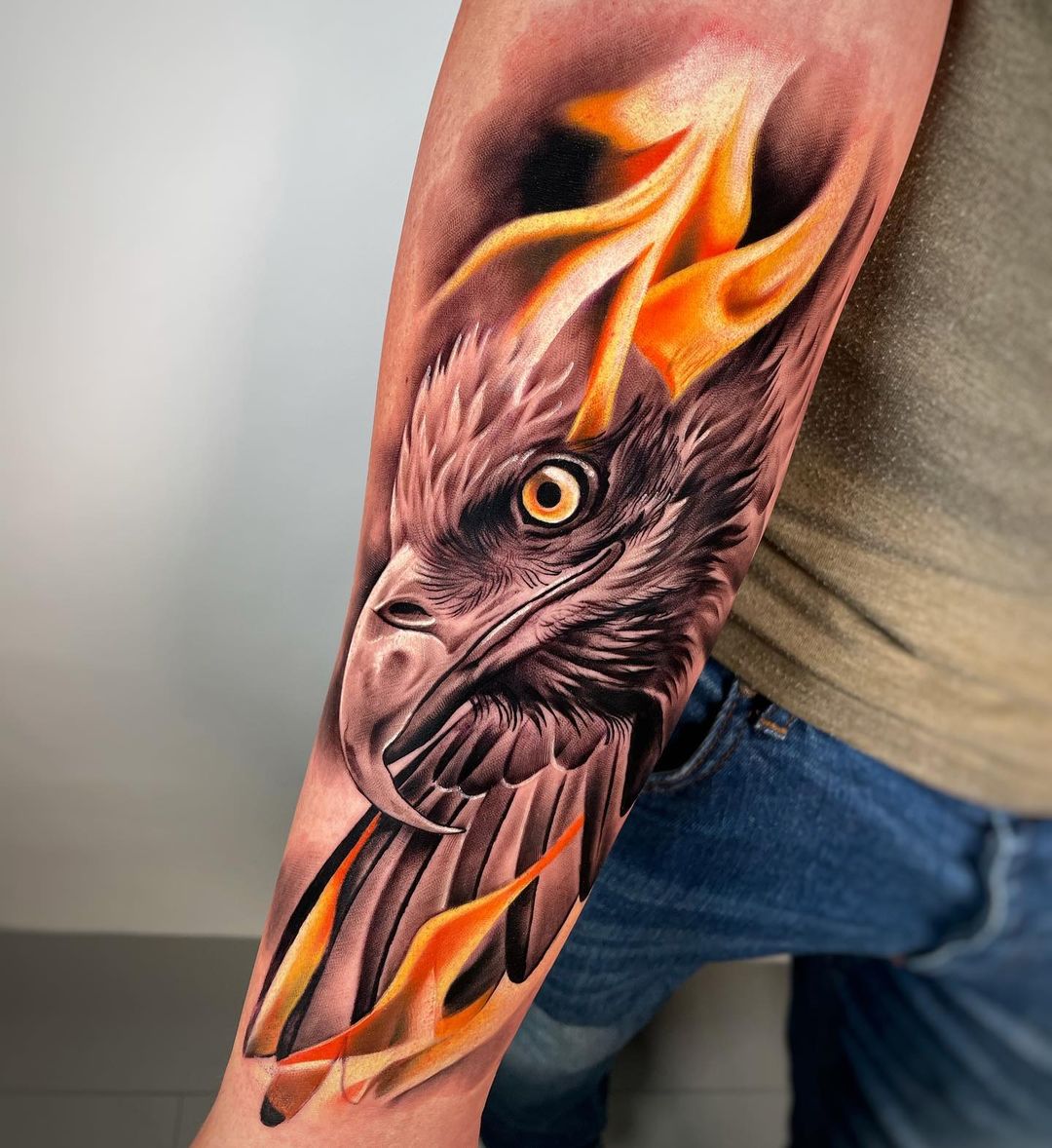
Realistic flaming eagle head
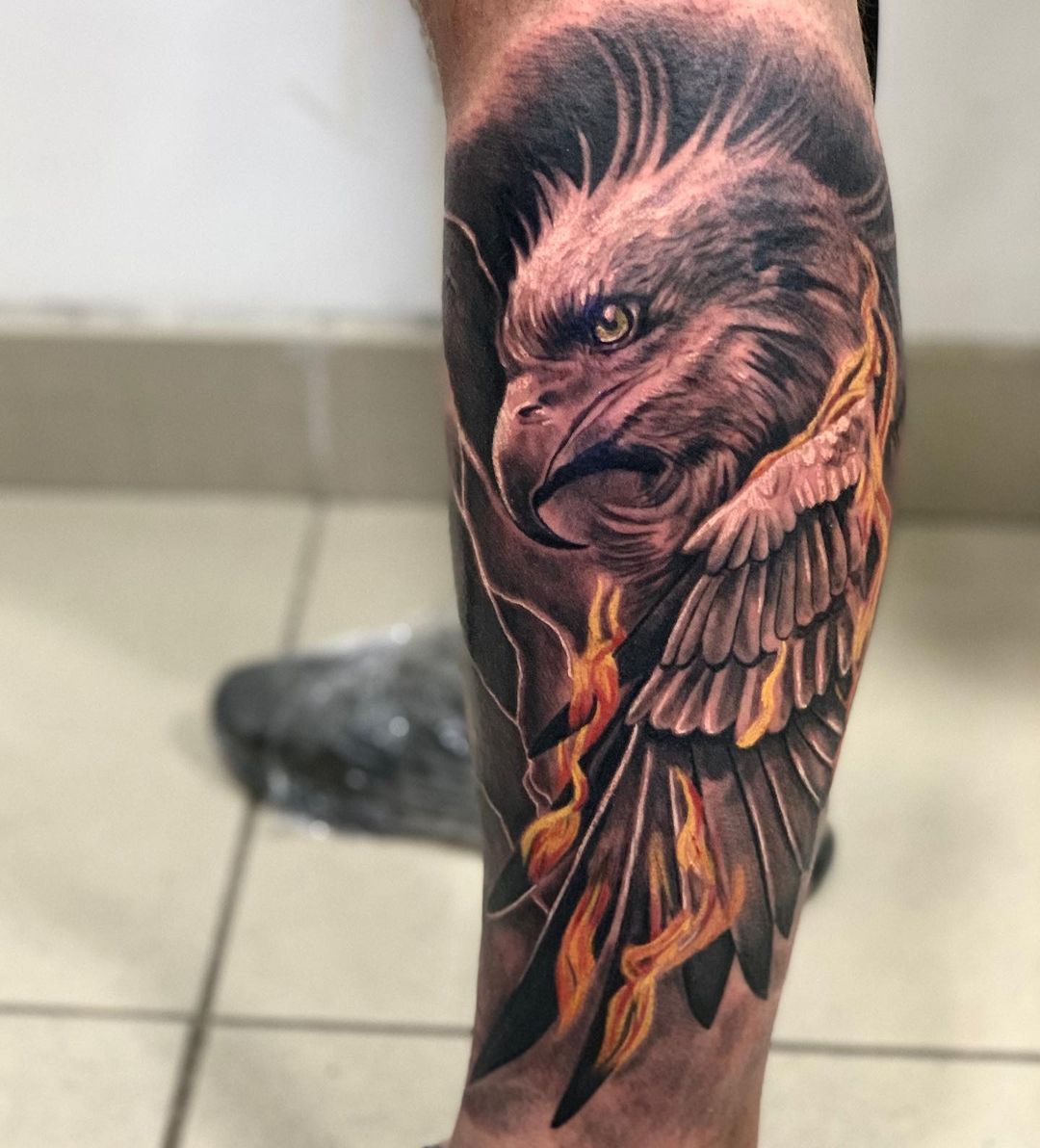
Realistic eagle with flames
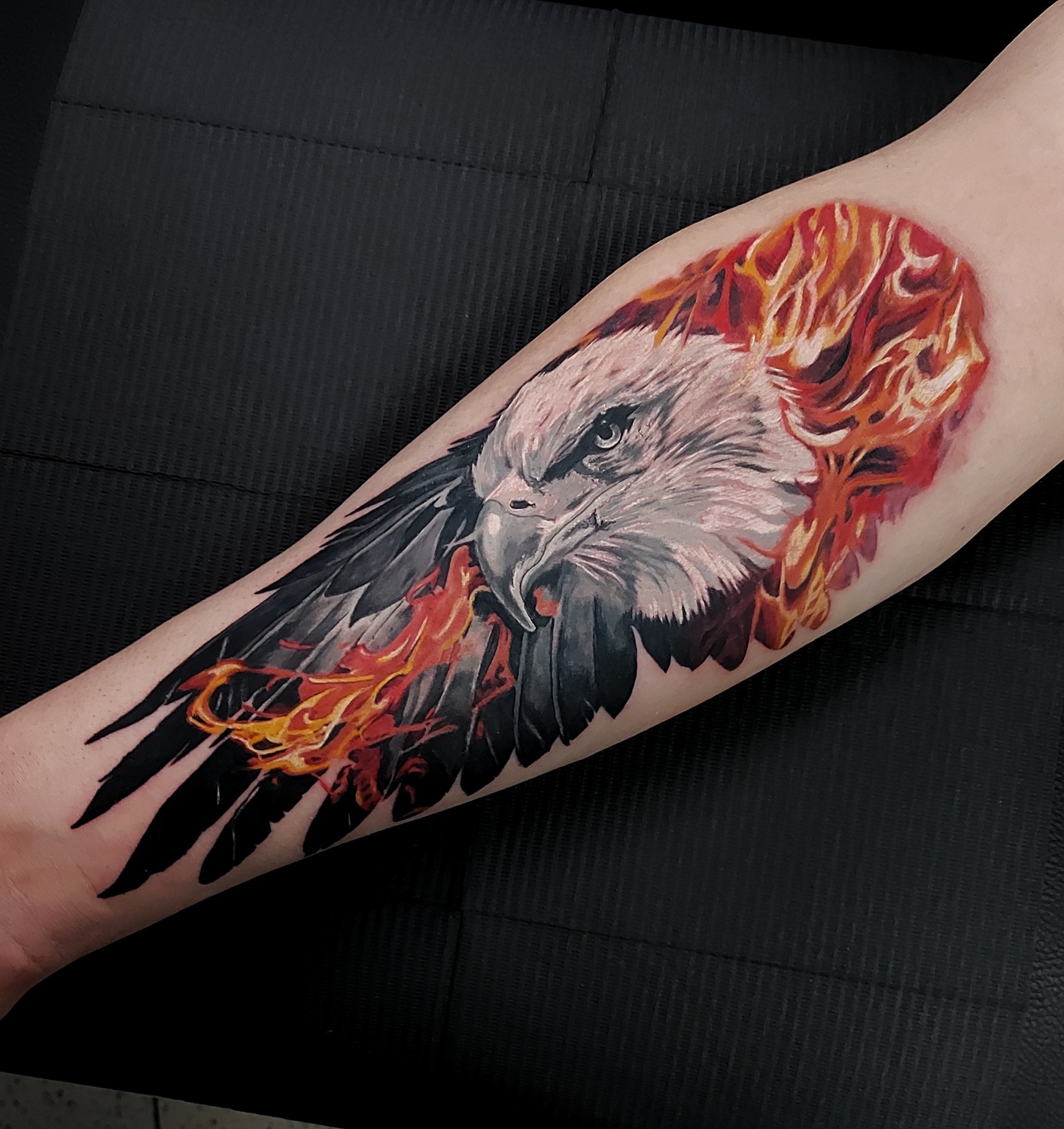
Realistic eagle with watercolor flames
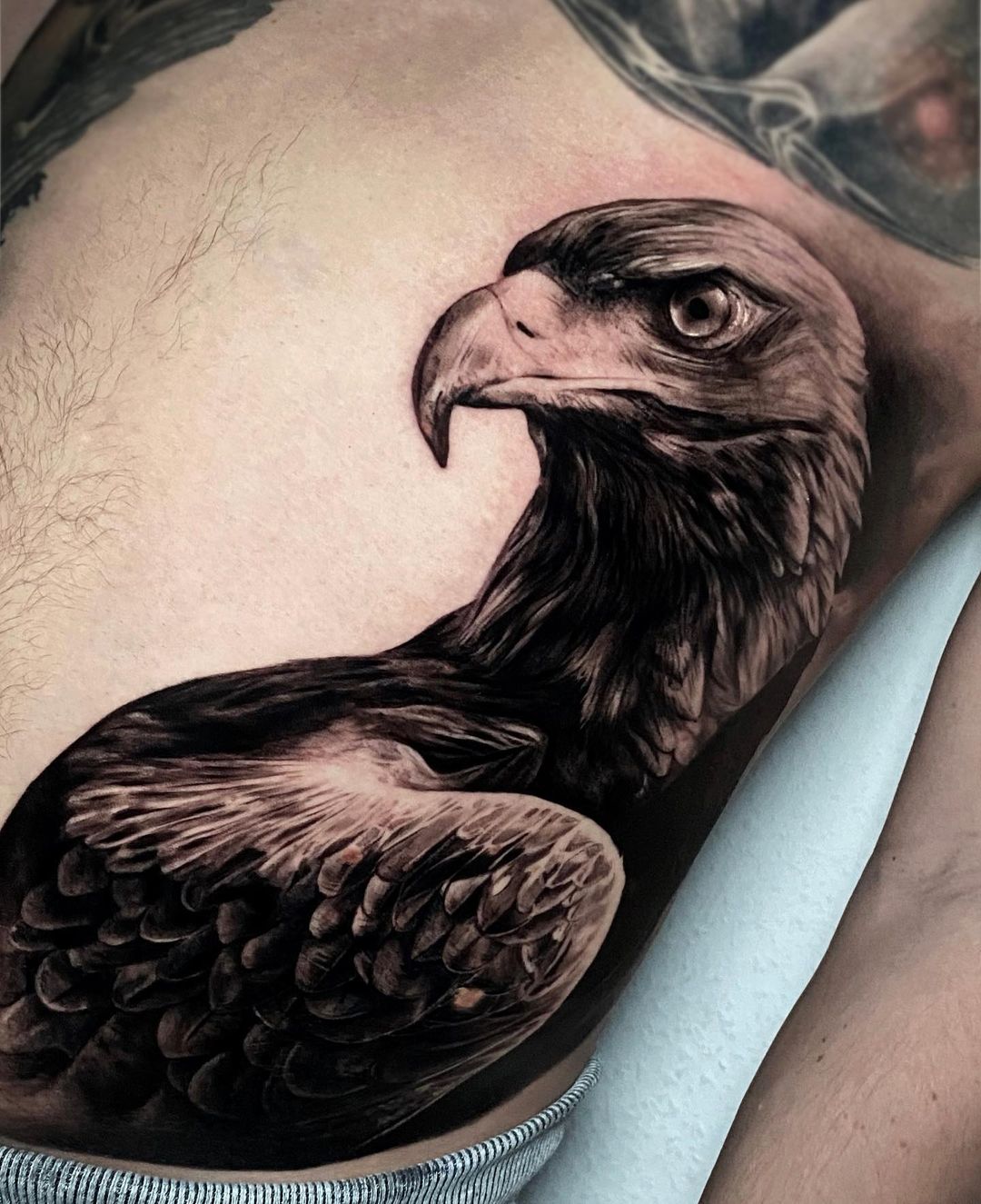
Black and grey realistic eagle tattoo
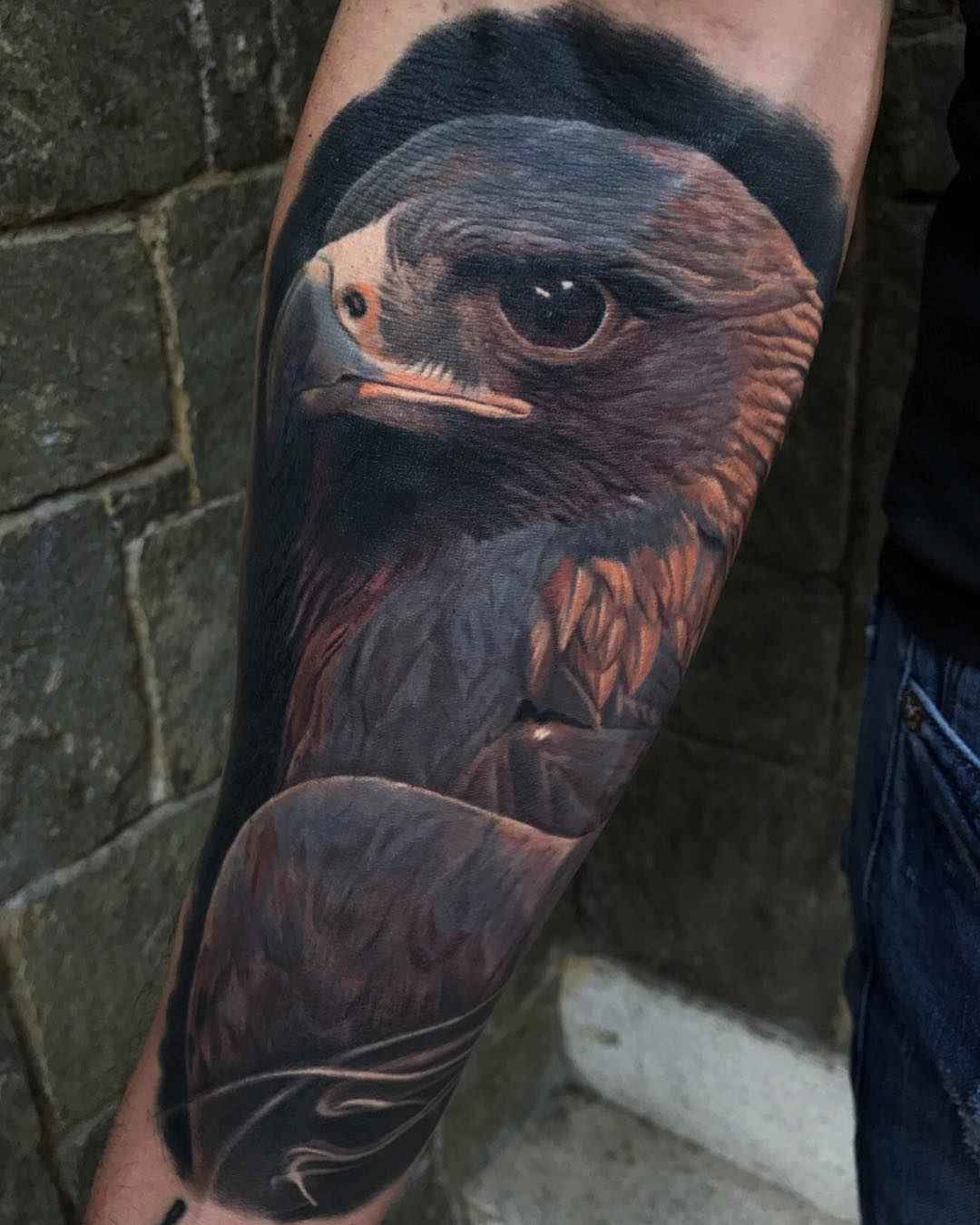
Photorealistic eagle head tattoo
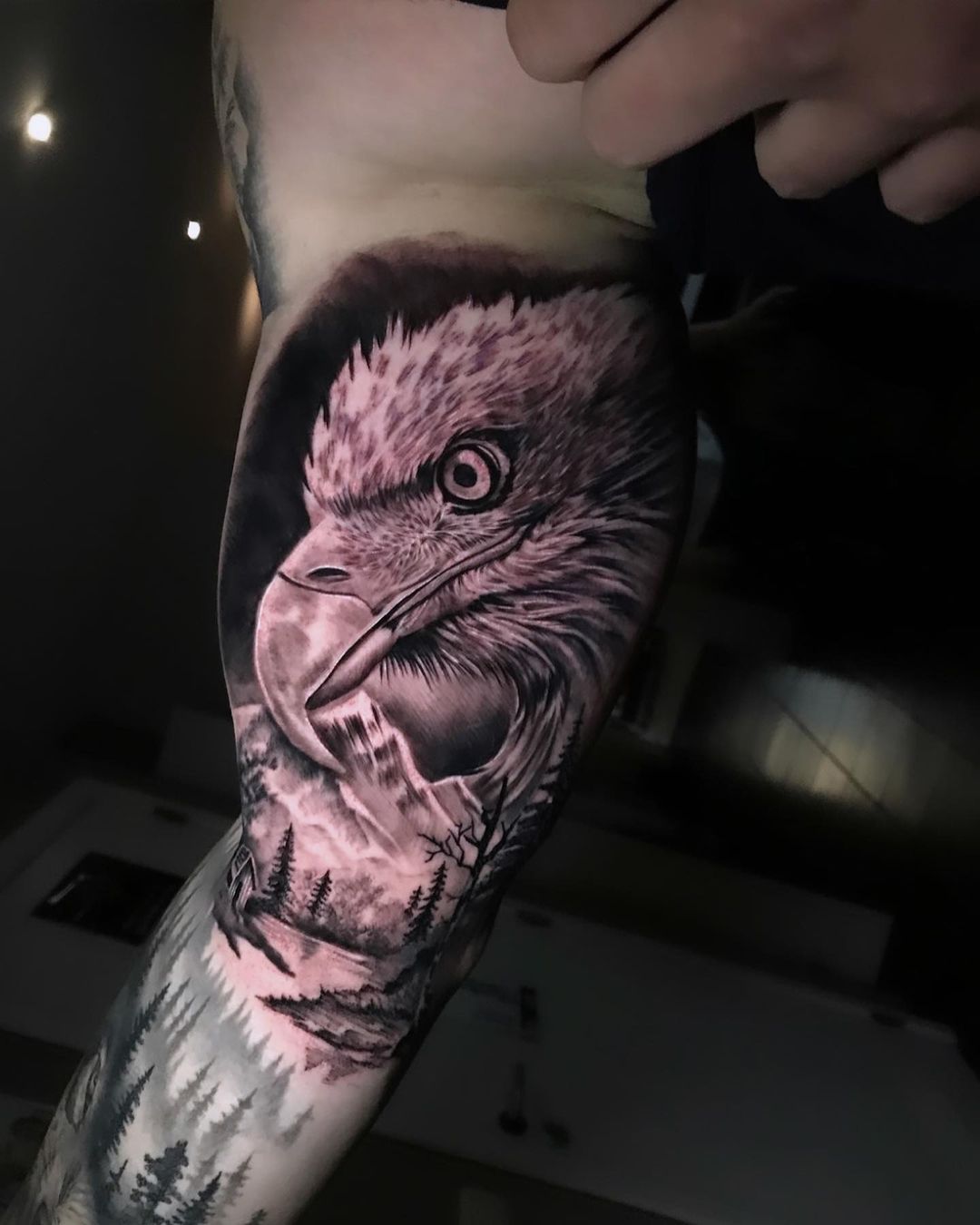
Realistic eagle with landscape
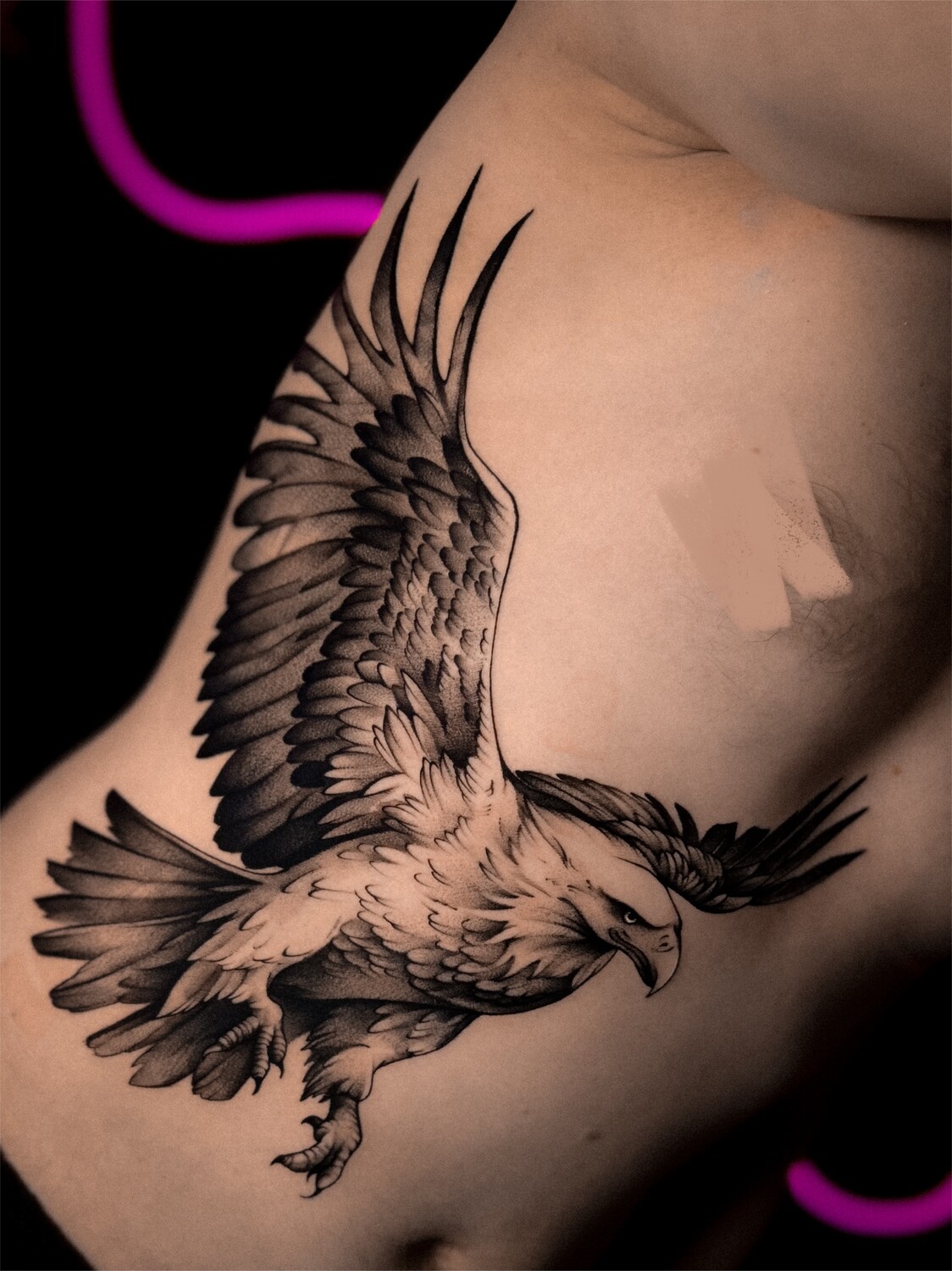
Black and grey eagle tattoo on ribs
More than almost any other tattoo subject, eagles demand appropriate real estate. A bird defined by its wingspan looks cramped on a wrist. Give it room to fly.
Chest. The natural choice for spread-wing eagles. A chest piece allows the wings to follow the body’s natural contours, stretching across the pectorals with the head centered at the sternum. This is a commitment piece, large, visible, and hard to ignore. Military and patriotic eagle tattoos particularly suit this placement.
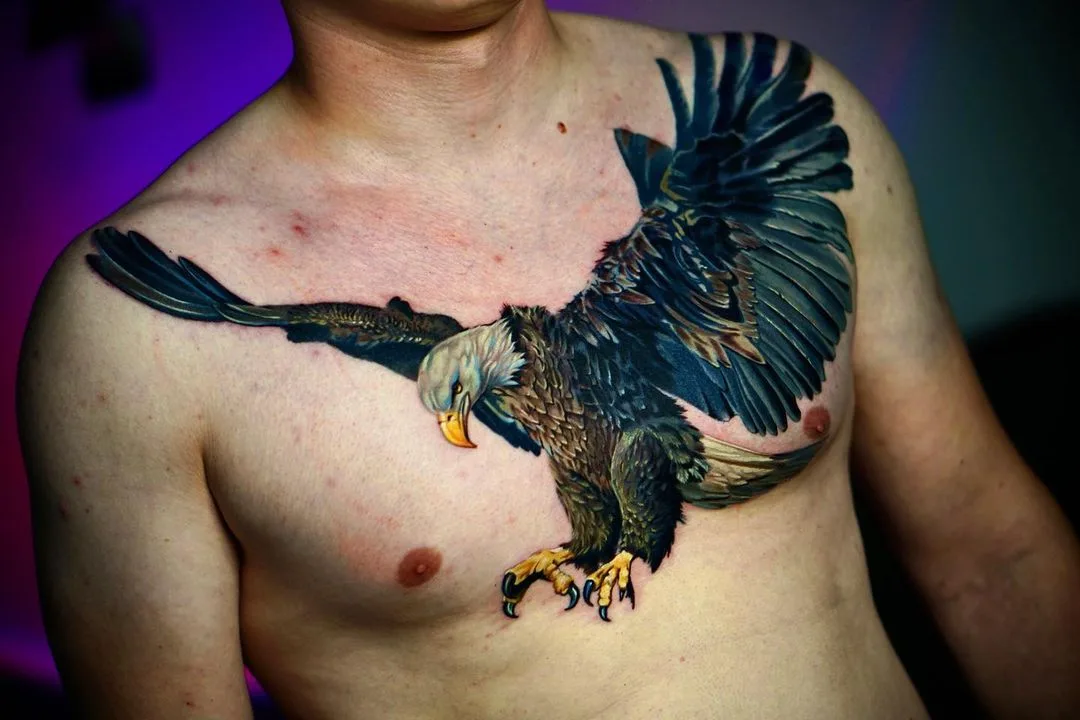
Back. Maximum canvas. A full back eagle with extended wings and detailed feather work is one of the most impressive things in tattooing. Japanese-style eagles, Aztec-inspired compositions, or hyper-realistic flight scenes all have enough room to develop fully. The back also allows for complex backgrounds and supplementary elements.
Shoulder and upper arm. Good for eagles in profile or perched positions. The shoulder provides a rounded surface that suits compact, powerful compositions. An eagle on the deltoid can extend down the bicep for a half-sleeve effect, with the wing wrapping naturally around the arm’s curve.
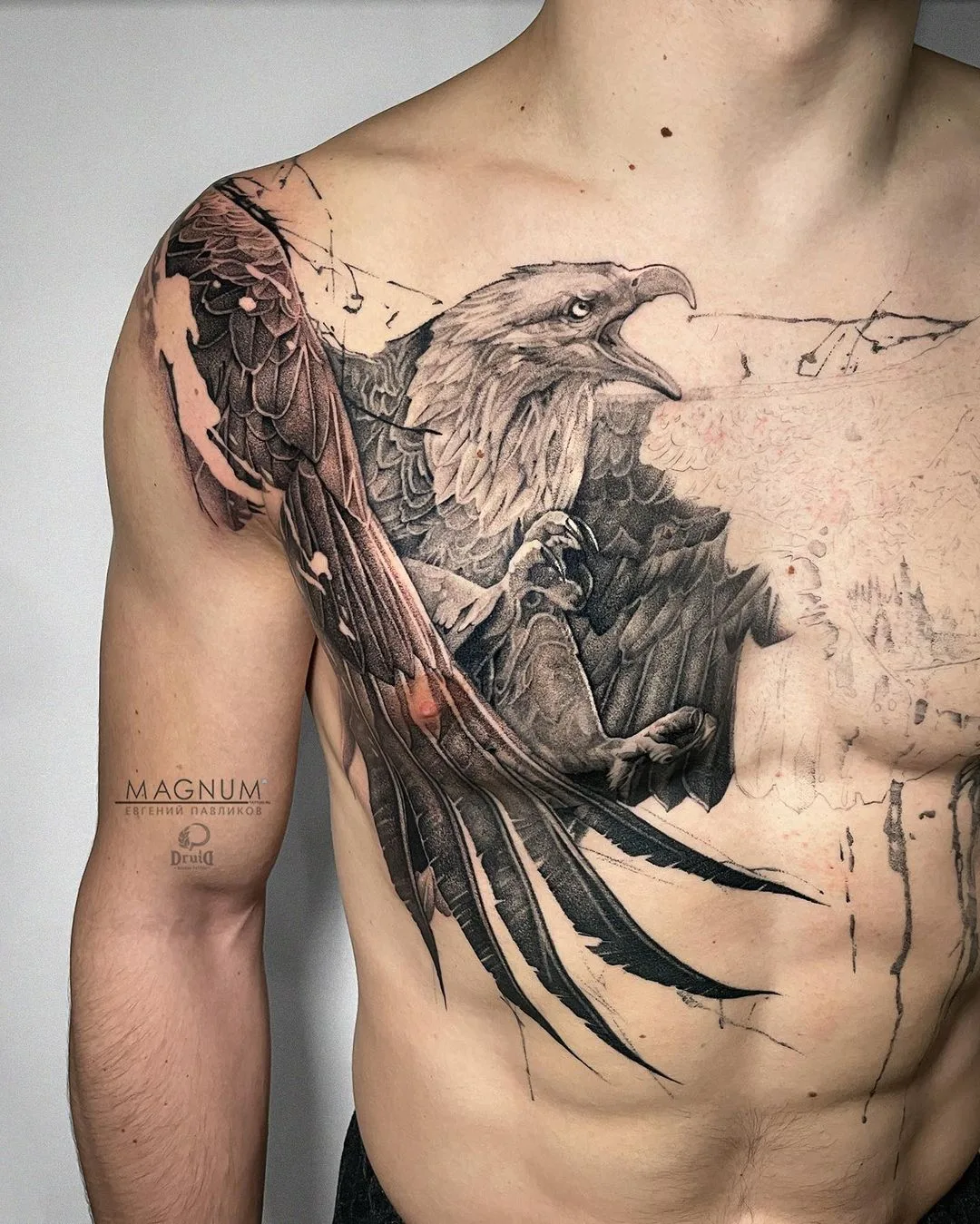
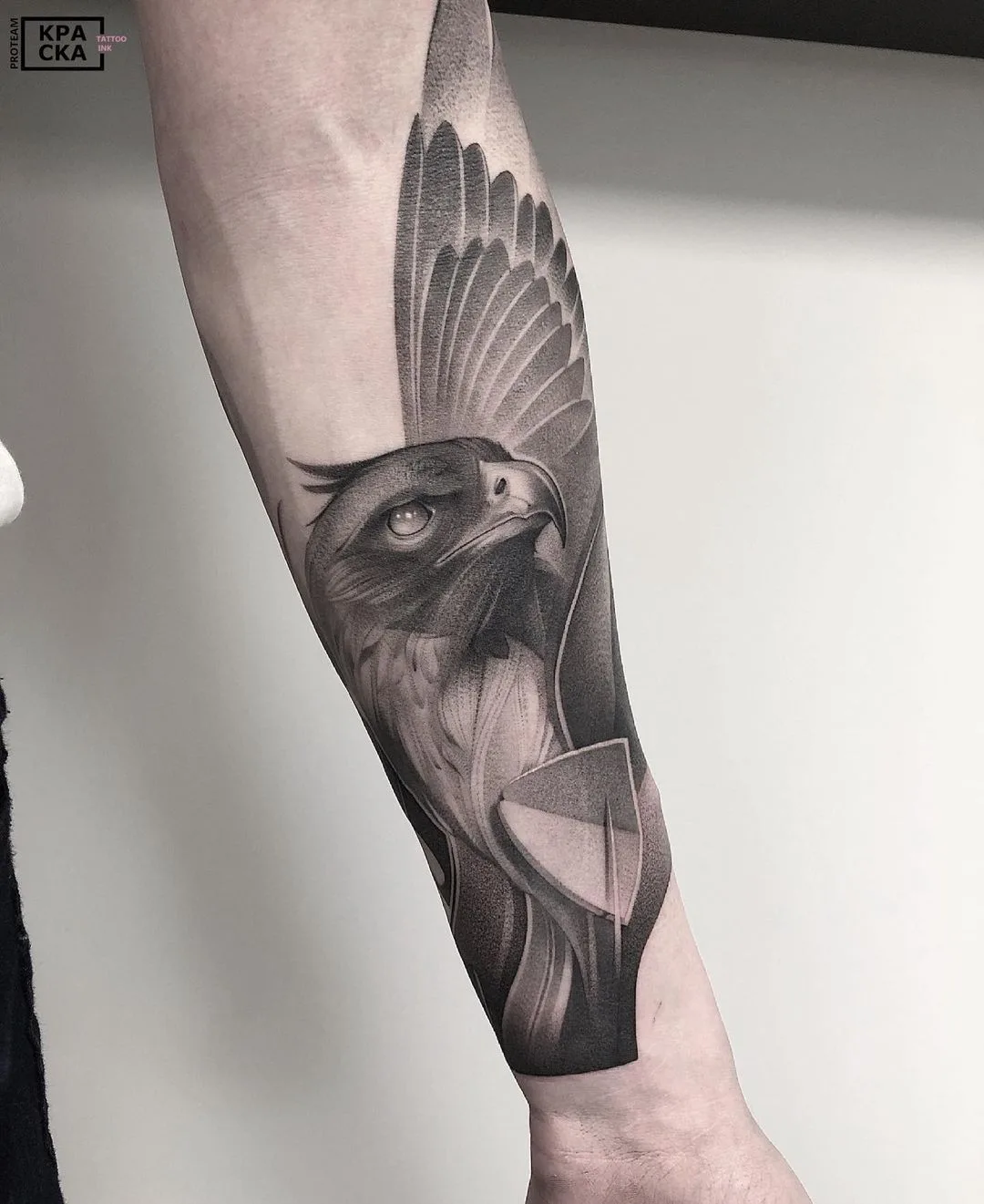
Forearm. Works for vertical compositions, an eagle diving, a single feather, or a portrait-style head study. Full spread-wing designs are harder to pull off on forearms due to the limited width, but a skilled artist can make it work with creative wrapping. Generally better for medium-sized, focused designs rather than full scenes.
Calf. An underrated option. The calf provides a good flat surface for medium-to-large eagles, and the natural muscle shape can enhance a perched or landing composition. Less visible than arm or chest placements, which some people prefer.
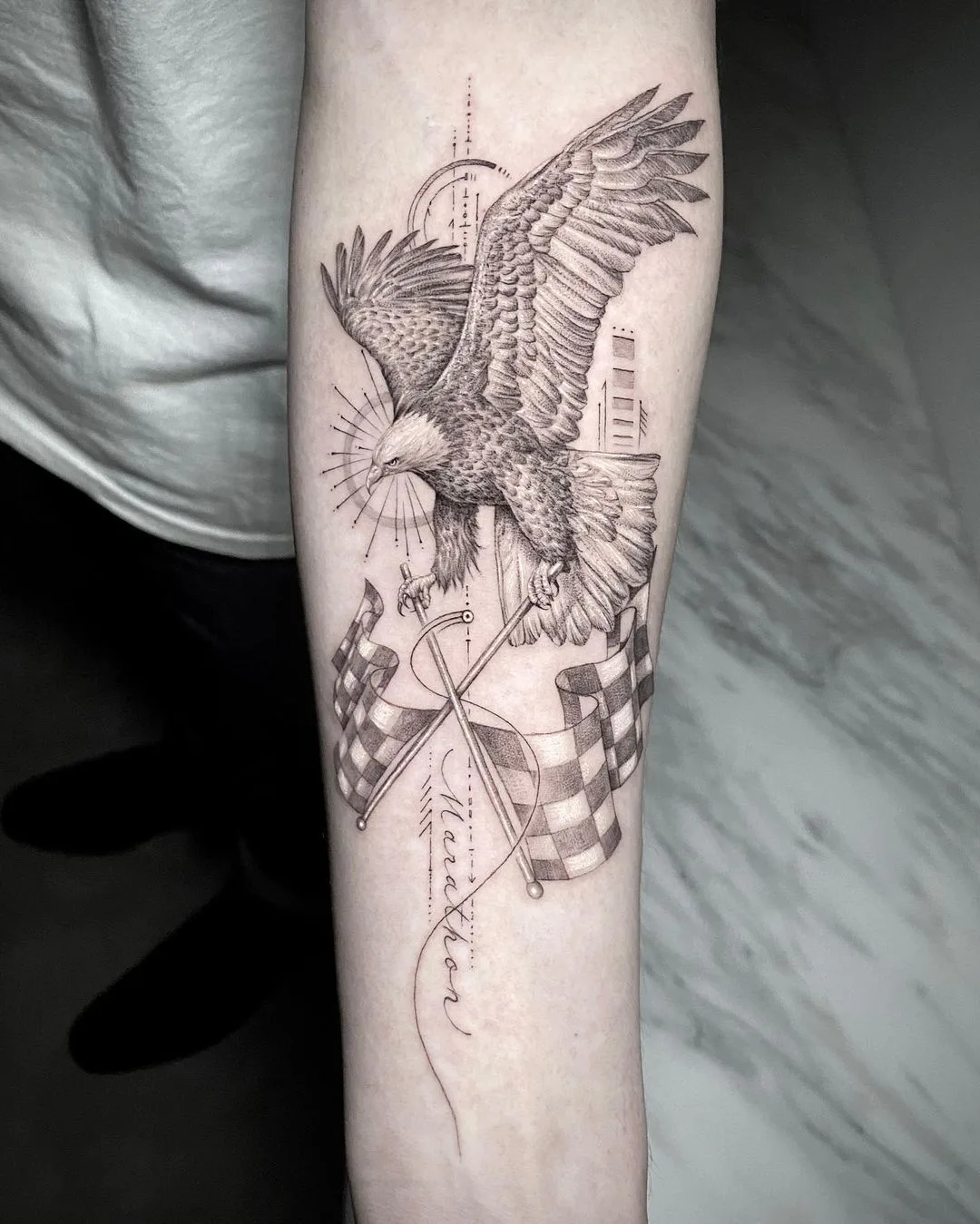
Frequently Asked Questions
What does an eagle tattoo mean in the military?
In military contexts, eagle tattoos typically represent service, patriotism, and honor. Specific branches have their own eagle symbolism, the Marine Corps eagle atop the globe and anchor, the colonel’s eagle insignia in the Army, Navy, and Marines. For veterans, an eagle tattoo often commemorates service, fallen comrades, or personal sacrifice. The specific design elements usually signal which branch or unit someone served with, though this isn’t universal.
Is it cultural appropriation to get an eagle tattoo?
An eagle in general? Probably not, eagles appear in so many cultures that no single tradition can claim exclusive ownership. However, specific eagle imagery from particular cultures does raise appropriation concerns. Native American eagle feather designs, Aztec eagle warrior imagery, or specific tribal patterns should be approached with awareness and respect. When in doubt, research the specific tradition you’re drawing from and consider whether your design borrows surface aesthetics from a living culture’s sacred imagery.
Which eagle species is most popular for tattoos?
The bald eagle dominates in North America, mostly for patriotic reasons. Golden eagles are popular worldwide and arguably more versatile since they don’t carry the specifically American association. Harpy eagles, Philippine eagles, and crowned eagles appear less frequently but offer distinctive visual profiles for people wanting something different. The species choice often signals the meaning, bald eagle for American patriotism, golden eagle for more universal power and freedom symbolism.
How much does an eagle tattoo typically cost?
Costs vary enormously depending on size, style, detail level, and artist. A small traditional eagle on the forearm might run $300-$600. A detailed realistic chest piece could be $1,500-$3,000 or more. Full back pieces by top artists can reach $5,000-$10,000+. These are rough ranges, geographic location, artist reputation, and shop rates all factor in. Get consultations from multiple artists before committing to a large piece.
Can eagle tattoos be combined with other symbols?
Absolutely, and they frequently are. American flags and shields are the obvious patriotic combination. Snakes and eagles together reference both the Mexican flag imagery and the broader predator-prey dynamic. Arrows, mountains, pine trees, and other nature elements create wilderness-themed compositions. Skulls combined with eagles can represent the duality of power and mortality. Clocks, compasses, and roses are popular complementary elements that add layers of personal meaning. The eagle’s shape, wide wingspan, detailed feathers, accommodates surrounding elements naturally.
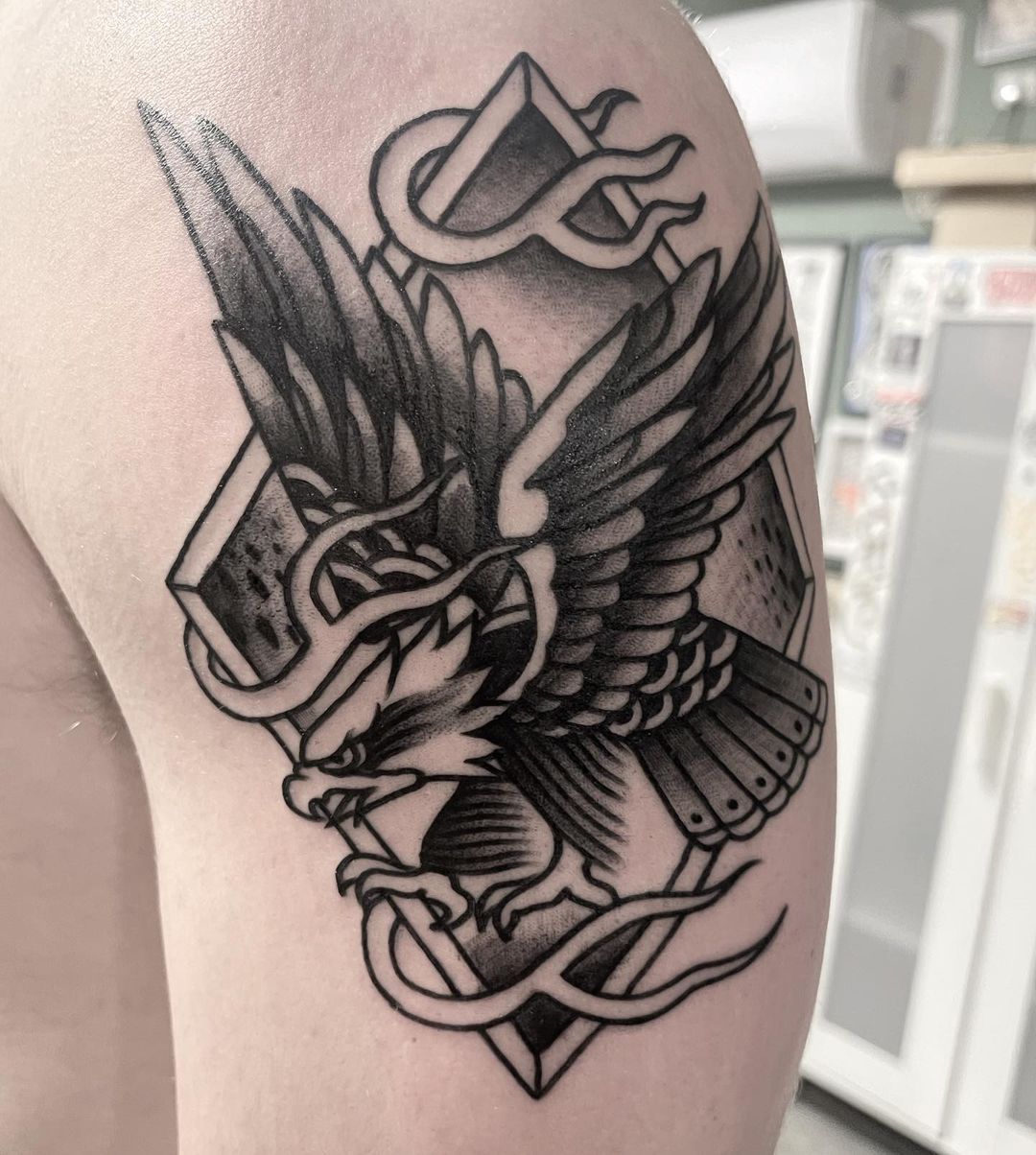
Neo-traditional black and grey eagle
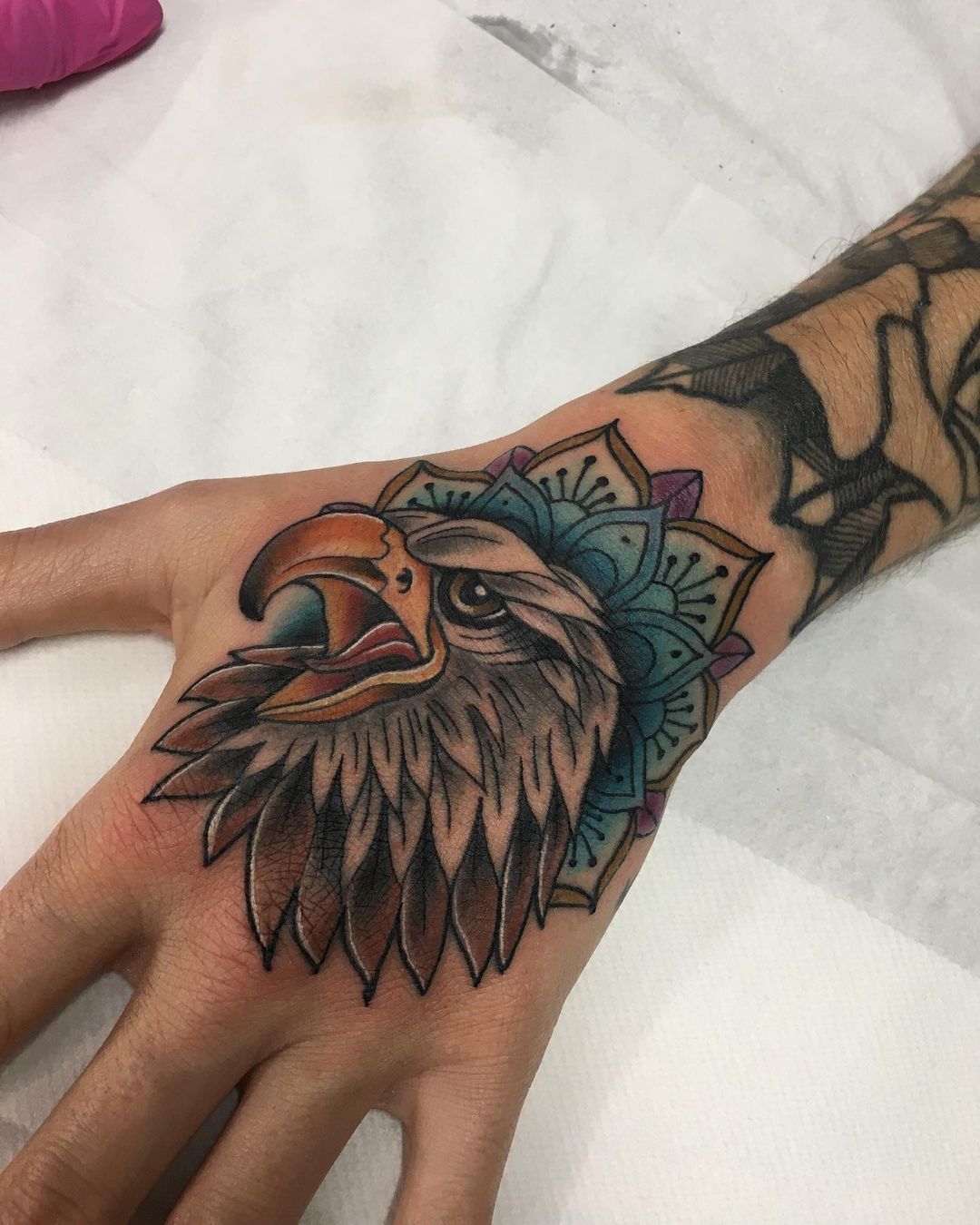
Neo-traditional eagle with mandala
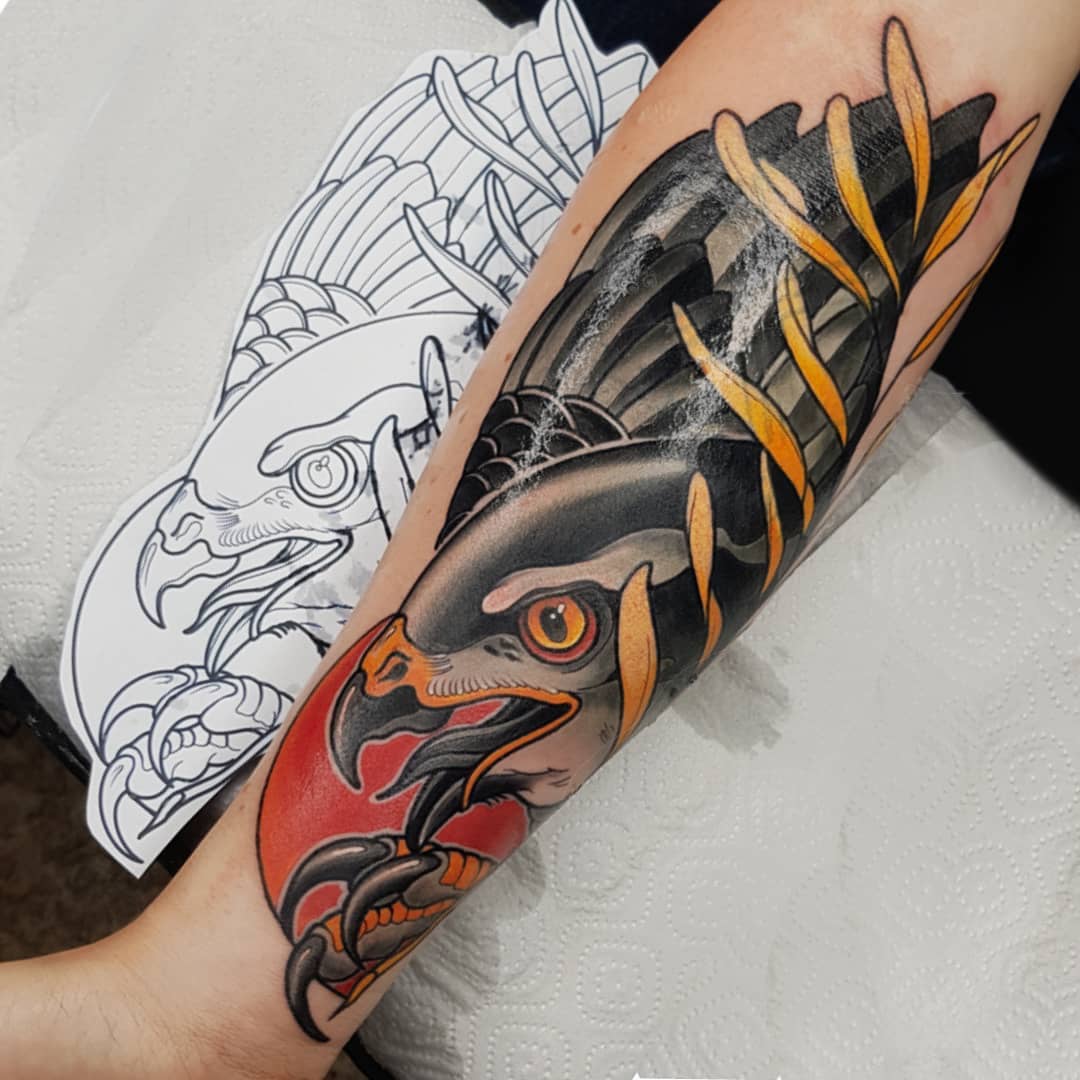
Neo-traditional eagle with sketch
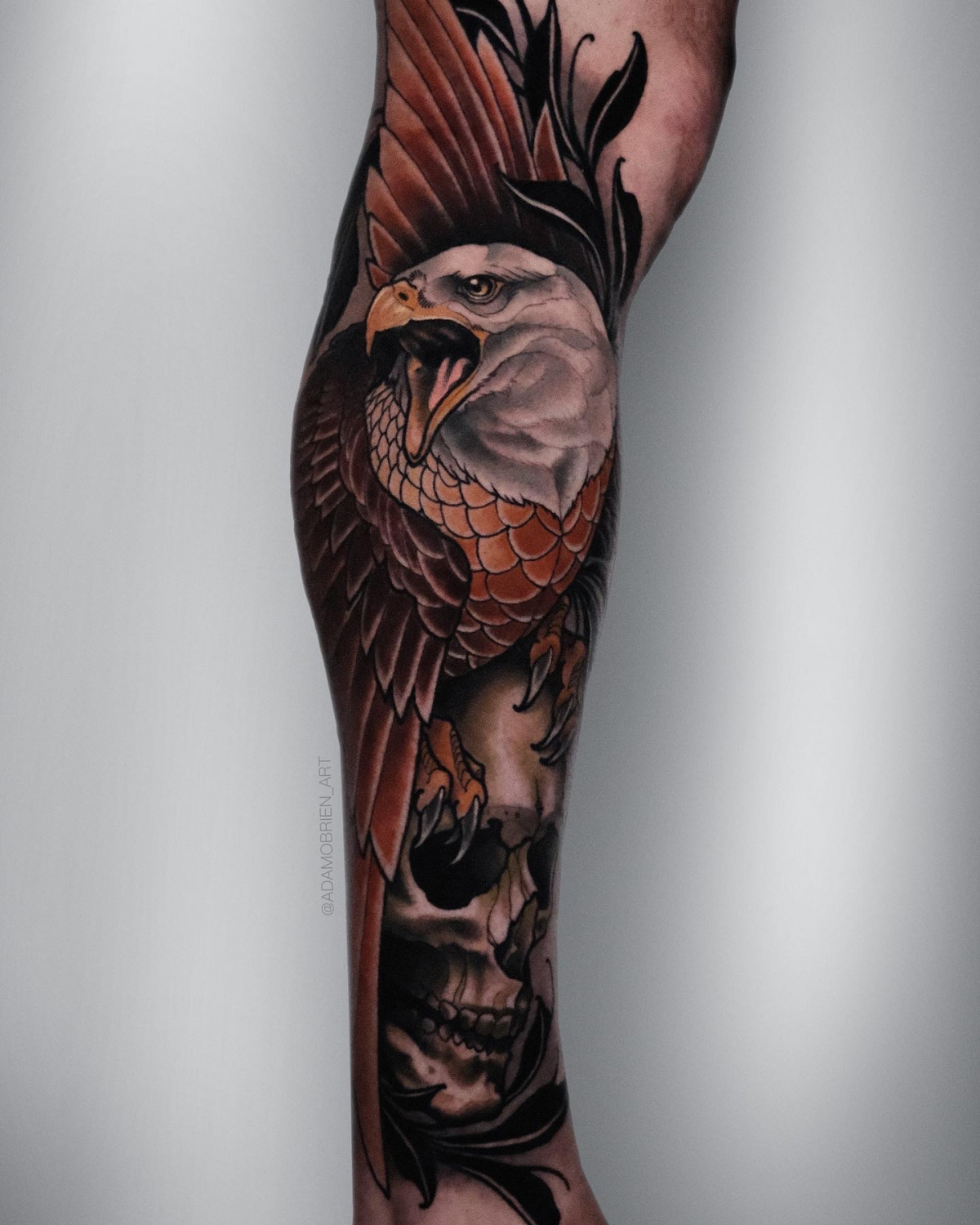
Neo-traditional eagle and skull
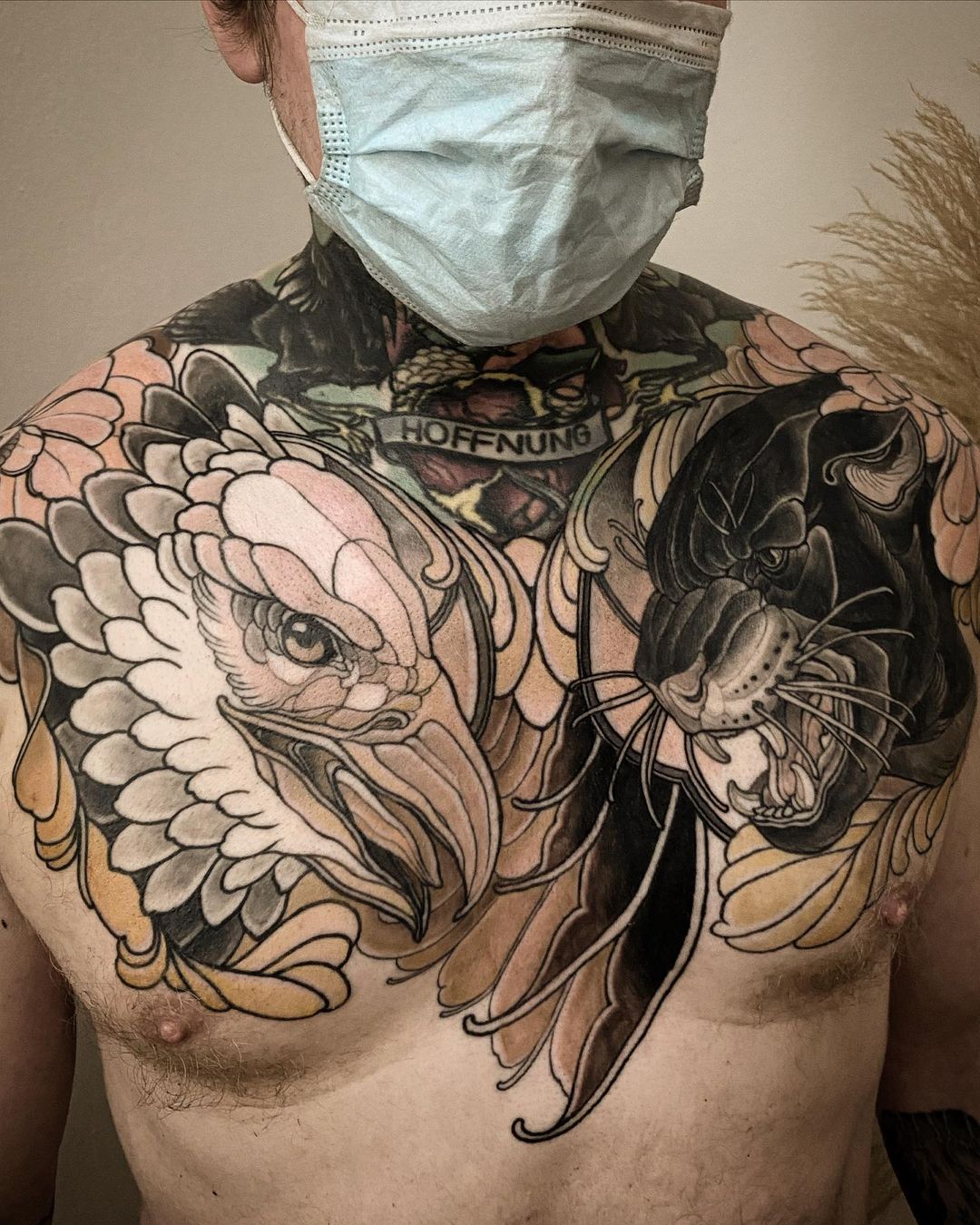
Neo-traditional eagle and panther chest piece

Watercolor eagle in circular frame
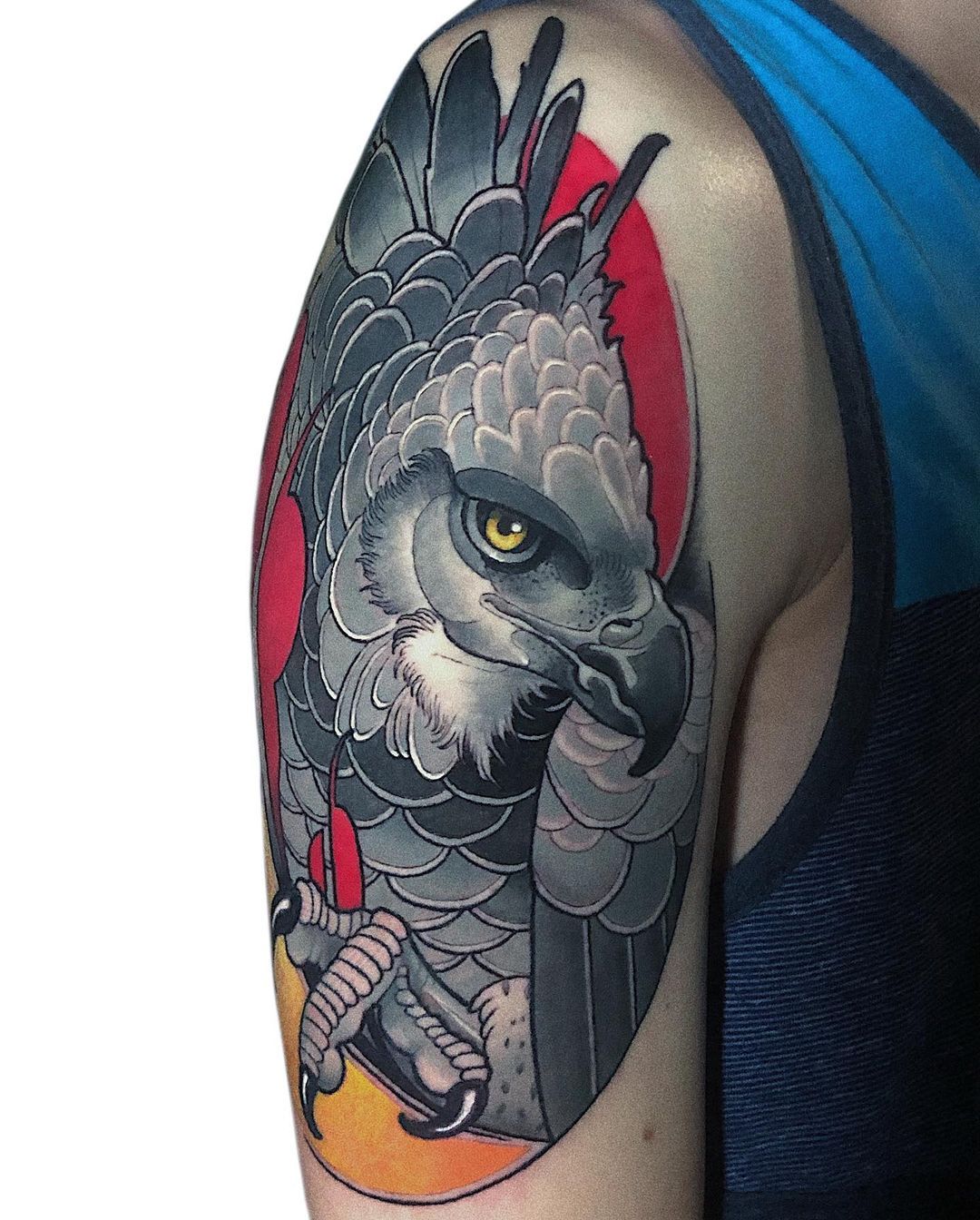
Japanese irezumi eagle

Japanese full back eagle and tiger tattoo
The eagle means freedom and power everywhere humans have watched it fly, but the specific flavor of that freedom changes dramatically depending on which sky you’re standing under.