A sparrow tattoo means coming home: loyalty to a place and to a person, and the promise of return. It is the bird that lives in the eaves rather than the one that crosses oceans, which is why sailors, believers and working-class Londoners all claimed it. Which claim you are wearing depends on how the bird is drawn, and on whether the artist drew a sparrow or the swallow that has stood in for it since the days of dockside flash.
- Most "sparrow" tattoos are drawn on a swallow: forked tail, pointed wings. If you want the round, short-tailed house sparrow that never migrates, say so and bring a photograph.
- Sailors earned one bird per 5,000 nautical miles and believed it would carry a drowned man's soul home; Sailor Jerry's flash turned that earned mark into a style choice.
- Matthew 10:29 makes the sparrow a humility symbol, the cheapest creature still counted; Bede's sparrow through the king's hall makes it a short life passing through warmth.
- Direction of flight, a banner, a cage or a skull change the meaning more than the style does: flying toward the body reads as returning, away as leaving.
- Below about four centimetres a fine-line sparrow loses its eye and beak within a few years; a bold-outline traditional bird still reads at seventy.
What a sparrow tattoo means
Start with the animal, because the tattoo trade has spent a century blurring it. A house sparrow (Passer domesticus) is a small, plump, brown-and-grey bird with a short conical beak and a short, barely notched tail. It does not migrate. The sparrow under your roof tile in April is the same bird that was there in January, and ringed house sparrows have been recorded living whole lives within a couple of kilometres.
That is the root of the meaning. A swallow leaves and returns; a sparrow simply stays. In tattooing it became the bird of fidelity to home, family and one partner, and the readings people bring to the chair follow from there: loyalty, constancy, contentment with a small life well kept. It is the least heroic bird in the catalogue, which is the point. Nobody gets a sparrow to look dangerous.
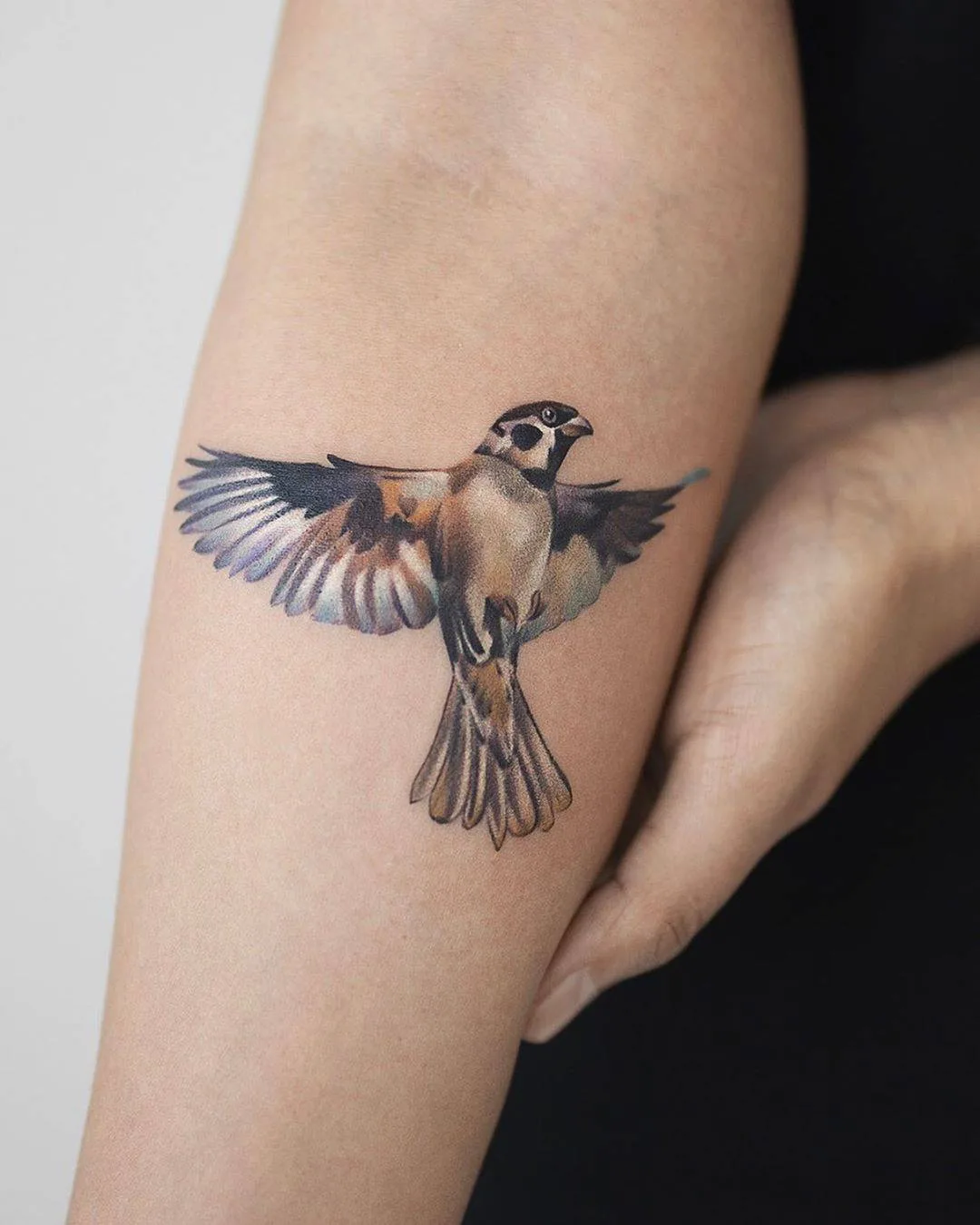
Three further readings sit on top of that base. The first is survival in ordinary conditions. Sparrows live in the cracks of cities, on spilled grain and dropped chips, and people who have got through illness, addiction or a bad decade without anyone noticing tend to find the sparrow before they find the phoenix. The second is the pair. House sparrows are broadly monogamous and re-use a nest site for years, and two sparrows facing each other have stood for a devoted couple for as long as the motif has existed. The third is smallness counted: the religious reading, below, where the creature too cheap to matter is nevertheless watched.
There is an older, less flattering thread too. Chaucer's Summoner is "as hoot he was and lecherous as a sparwe", and Catullus' poems about his lover's pet sparrow are not innocent. In 1958 Mao's Four Pests campaign killed the bird in enormous numbers across China, and crop pests multiplied in the years that followed. A few people wear the sparrow for precisely that story: a small thing whose removal broke everything. Nobody has to choose a meaning in advance. The design does it for you.
Sailor tradition: 5,000 miles and the soul carried home
Every sparrow tattoo owes its shape to the sailor's swallow, so the nautical story has to be told honestly. The bird in the tradition was a barn swallow: forked tail, long pointed wings, the bird that sailors took, when it turned up over a ship's rail, as a sign that land was near.
Out of that came the rule British and American sailors are said to have followed through the 19th and early 20th centuries: one bird on the chest at 5,000 nautical miles, a second at 10,000. A man with two had been round the Horn or across the Atlantic more than once, and a tavern keeper in Liverpool or Norfolk, Virginia could read his experience from across the room.
The second layer mattered when the weather turned. If a man drowned, the birds on his chest would rise and carry his soul out of the water and home. Swallows return every spring to the same nest, and the tattoo borrowed that habit as a guarantee that the wearer would return too, alive if possible and in spirit if not. For men signing on with a real chance of not coming back, that was insurance, not decoration.
The sparrow inherited all of it by way of a naming slip. Over time the flash bird was often called a sparrow as well as a swallow, and the distinction stopped mattering to anyone but ornithologists. Ask for a "sparrow" in most studios today and you will be shown a forked tail.
Christian symbolism: not one sparrow falls unnoticed
"Are not two sparrows sold for a penny? Yet not one of them will fall to the ground outside your Father's care. So don't be afraid; you are worth more than many sparrows." That is Matthew 10:29–31, the passage behind most sparrow tattoos worn as faith. Luke 12:6 repeats it at five sparrows for two pennies. The bird is chosen because it is the cheapest living thing on sale in a first-century market, and the cheapest thing is still counted.
The Psalms add two lines people carry. Psalm 84:3, "Even the sparrow has found a home, and the swallow a nest for herself, near your altar," is the sparrow allowed in close. Psalm 102:7, "I watch, and am as a sparrow alone upon the house top," is the sparrow as loneliness, and it turns up in memorial pieces more often.
The hymn is the version most Americans know. "His Eye Is on the Sparrow" was written in 1905 by Civilla Martin with music by Charles Gabriel, became Ethel Waters' signature song and the title of her 1951 autobiography, and a later generation learned it from Sister Act 2. The phrase in script beneath a small bird is a standard combination in Christian tattooing.
As a tattoo the Christian sparrow is a humility symbol, not a power symbol. You are not the eagle or the lion. You are the sparrow, and you were seen anyway. It pairs with a small cross, a verse reference, or nothing at all.
English folk tradition: the house bird
The oldest English sparrow story is in Bede, who describes the council at which King Edwin of Northumbria decided, in 627, whether to accept Christianity. One of Edwin's thegns compared a human life to a sparrow flying through the king's hall on a winter night: in through one door, a moment in the warmth and firelight, out through the other into the dark it came from. The sparrow as a brief passage through warmth has been an English image ever since, and it is the reading people choose when the bird marks a life that was short.
Everyday folklore was harder-edged. In parts of England a sparrow flying into the house was an omen of death in the family. At the same time, without contradiction, the sparrow in the eaves was the familiar presence: the bird you heard first every morning, that nested in the thatch and followed the plough. Shakespeare put the two together in Hamlet: "There's a special providence in the fall of a sparrow." Matthew's verse in an English mouth, and a line that turns up in script tattoos too.
Then there is the Cockney sparrow: the cheeky, undersized Londoner who gets by on nerve, a stock figure of music hall for over a century. The house sparrow was the London bird until it was not: its numbers in the capital fell steeply from the 1970s onward, and the RSPB red-listed the species in 2002. A sparrow on a Londoner now carries some of that, the ordinary thing that turned out to be fragile.
Sailor Jerry and Americana
Norman Keith Collins, Sailor Jerry, tattooed on Hotel Street in Honolulu's Chinatown from the 1930s until his death in 1973, working on the sailors who poured through Pearl Harbor. He turned the crude birds of dockside flash into something that held its shape: a heavy black outline, a rust-red breast, blue-green wings with one yellow highlight, and a tail that was forked because the bird on the sheet was really a swallow, whatever it was labelled.
That is the important shift. In the sailors' tradition the bird had to be earned, one per 5,000 miles. By the time Collins' flash was being copied in every port studio in the Pacific, it was a design you chose because it looked right next to the anchor and the pin-up. The meaning moved from the wearer's biography to the style.
The wider Americana line runs through the same shops. August "Cap" Coleman in Norfolk, Virginia drew swallows for the Atlantic fleet that are still being redrawn; Bert Grimm on the Pike in Long Beach kept the bird in his flash for decades. Collins' heirs Ed Hardy and Mike Malone took over the drawings after 1973, and when a rum company licensed the Sailor Jerry name in 1999 his flash went into its branding; millions who have never entered a studio now recognise the style from a bar shelf. For the wearer this cuts both ways: a Jerry-style sparrow says "American traditional" before it says anything about the person under it, unless you change the direction of flight, the banner text or the object in the beak.

Two-swallow 'True Love' tattoo by @Artlink
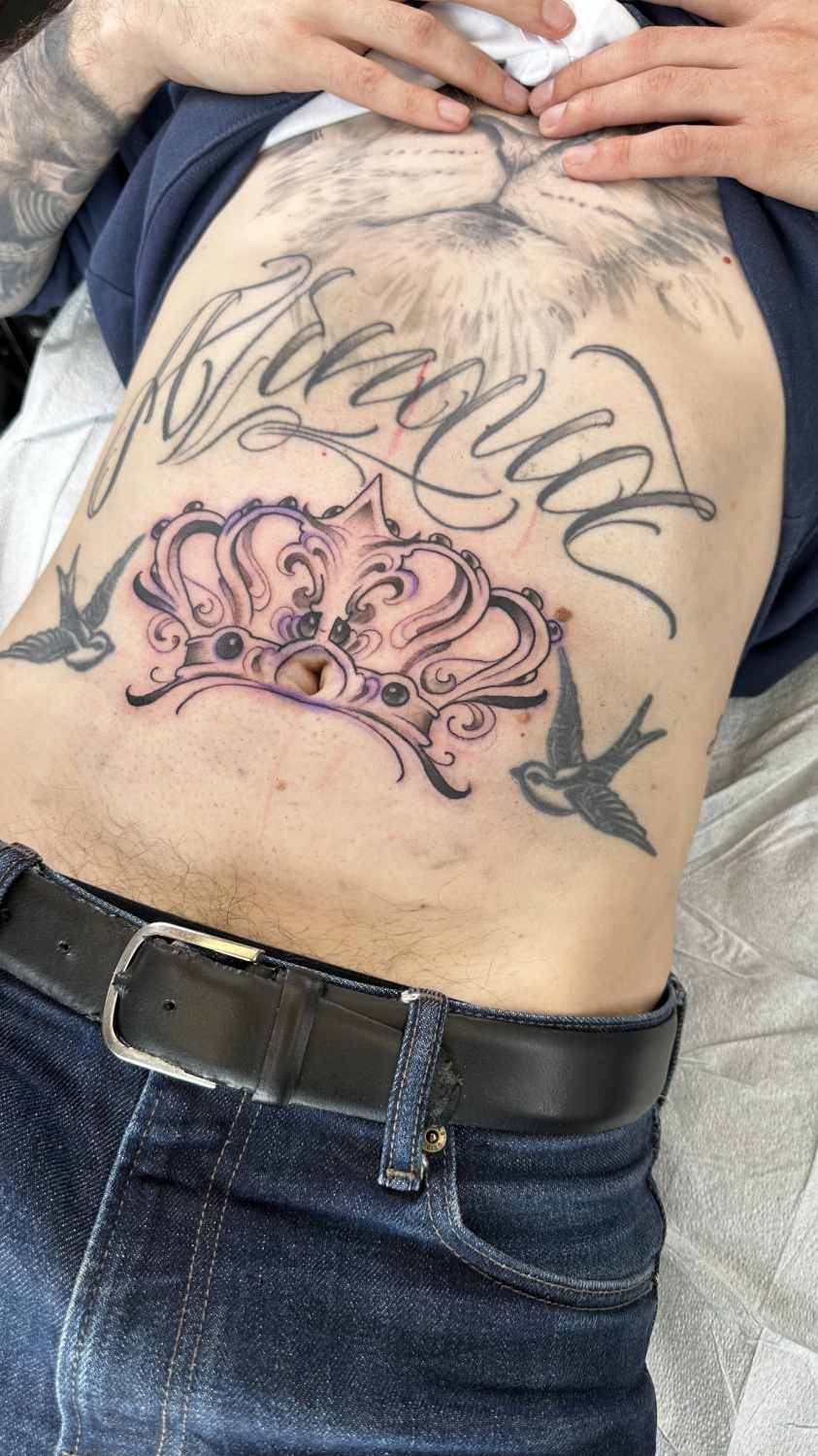
Swallows and crown stomach tattoo by @nimatattoo

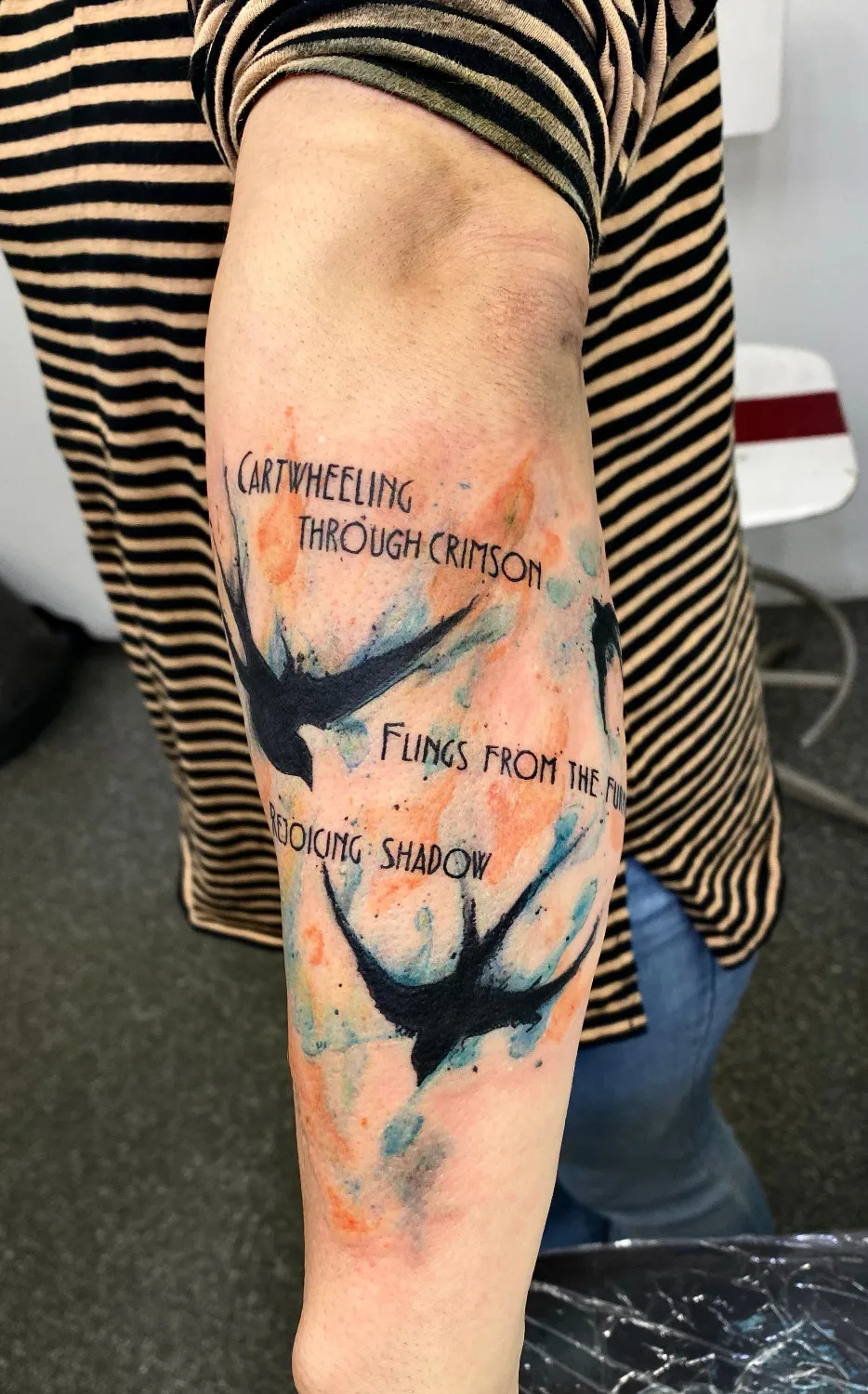
Swallows and bat on dagger tattoo by @paul_anderson_tattoos
Tattoo styles that suit the sparrow
American traditional. The native style. Bold outline, three or four flat colours, the bird in profile with wings spread, usually in flight and often in a pair. The rules are strict and that is the appeal: a sparrow drawn to the Sailor Jerry proportions is legible from across a room and still legible at seventy. If you want the historical weight, this is the only style that carries all of it.
Neo-traditional. Same skeleton, wider palette, more drawing inside the lines: feather groups rendered rather than implied, a peony or rose under the bird, a banner with a name. It suits people who want the sailor's bird without the sailor's four colours, and it holds up provided the outline stays heavy.
Fine line and minimalist. The dominant style for small sparrows over the past decade: a single-weight outline, sometimes a little stipple, the bird perched on a twig or in flight at wrist or collarbone scale. These are the pieces most often chosen as a first tattoo; read the ageing section before you commit.
Realism and black-and-grey. The house sparrow suits realism precisely because it is drab: the artist has to earn the image from feather texture and the eye, not from colour. Colour realism gives you the actual bird, and it is the one style where "sparrow" and "swallow" are not interchangeable, because the photograph decides. Black-and-grey handles the same subject with less risk to longevity.
Japanese. The sparrow (suzume) has a long life in Japanese art, almost always with bamboo: take ni suzume, bamboo and sparrow, is a standard painting subject and the crest of the Date clan of Sendai. In a Japanese sleeve the sparrow is a small, lively figure among the wind bars and leaves rather than a subject on its own; the tale of the tongue-cut sparrow, Shita-kiri Suzume, gives it a reading of kindness repaid and greed punished.
Watercolour and sketch. Colour bleeding past the line, or a bird drawn as if in pencil with construction marks left in. Both catch the quickness of the bird, and both fade unevenly.
Styles are easier to compare on skin than in prose. The bird motif page collects sparrows and swallows alongside every other bird, filterable by style and placement, and ten minutes there will tell you which register you actually respond to.
Placement and scale
The sparrow works at every size, and placement carries more history here than it does for most animals.
The chest is the sailor's placement. One bird below each collarbone, facing inward, is the original arrangement, and a pair on the upper chest reads as nautical even in fine line. It is also the natural home for the couple's version, two birds that meet in the middle. The sternum is one of the more painful sites and the collarbone only slightly better; plan a single sitting for a pair at this size.
Hands and neck are the other historic sites. Sailor Jerry-era sparrows on the backs of the hands and the side of the neck were a working man's marks, and still read that way: bold, public, unhideable. Fine-line sparrows behind the ear are the quieter modern cousin.
The forearm is the most flexible placement. A sparrow in flight sits well on the inner forearm because the body follows the line of the arm; a perched bird suits the outer forearm, where it reads right way up when your arm hangs. Wrist and ankle take the smallest versions. The ribcage takes a pair beautifully and is a poor choice for anyone who does not sit well through pain.
Scale is a separate decision from location, and the one people get wrong. A traditional sparrow with a heavy outline works down to about four centimetres. A fine-line sparrow smaller than that will lose its eye and beak within a few years and become a brown smudge with wings. A realistic sparrow needs eight centimetres or more to hold the feather texture that makes it a sparrow rather than a generic bird; below that, ask for a silhouette or a bold outline instead. Artists will say this if asked directly; fewer volunteer it, because the client has usually arrived with a thumbnail-sized screenshot.
A last note on direction. On a chest or forearm, a sparrow flying toward the body reads as returning; flying outward, as leaving. Most wearers do not decide this consciously and most artists do not ask. Decide it.
Design variations and what they change
Small changes inside a sparrow design move its meaning further than a change of style does.
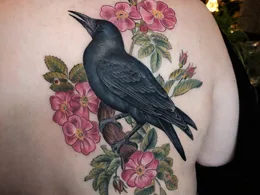
One bird or two. A single sparrow is about the wearer: home, faith, survival. A pair facing each other is about a bond, the standard couples' tattoo, one bird each, arranged so they meet when the two people stand together. A pair flying the same way reads as companions rather than a couple. A third bird, or a small flock, moves the piece toward family.
In flight or perched. Flight is the sailor's inheritance: motion, return, the soul carried. A perched sparrow, on a twig or a wire, is the house bird, settled and watching, and it suits the English and Christian readings. It is also the version that looks most like an actual sparrow, because the flight pose was standardised on a swallow's wings.
The banner. A ribbon with a name, a date or a single word is the classic Americana addition. It turns a style marker back into a personal one: the same bird with "Mum" on the banner and with a ship's name are different tattoos.
What the bird carries. A letter or ring in the beak is the messenger, the sparrow bringing something home; a twig is nest-building, a new household; a key is a private meaning the wearer usually keeps.
Nautical furniture. Anchor, nautical star, compass rose, rope. Any of these pins the sparrow to the sea tradition and makes it read as a swallow however it is drawn. Leave them off if you want the house bird.
Sparrow and skull. The bird perched on or flying past a skull is memorial: the soul-carrier in its most literal form. In traditional work the skull sits behind the bird, and the composition says survival and loss in one frame.
Cage, open or shut. A sparrow leaving an open cage is escape and recovery, one of the standard sobriety designs. A sparrow inside a shut cage is rarer and means what it looks like.
Sparrow and blossom. Cherry blossom or bamboo pulls the bird into the Japanese register; a rose or peony pulls it into neo-traditional. Either way the plant sets the season and gives a small bird a setting without adding a second subject.
Choosing an artist for a sparrow tattoo
A sparrow looks easy and is not. The bird is small, the proportions are fixed by a century of flash, and the eye and beak are the whole character. An artist who has not drawn many will give you a bird that is technically fine and somehow not a sparrow.
Three checks before you book. First, look for birds in the portfolio, and small ones: an artist whose birds are all eagles across a full back has not solved your problem. Second, ask for healed photographs of small work; fresh fine line photographs beautifully and tells you nothing about the third year. Third, decide which bird you want and say it in the first message. "Sparrow, the actual house sparrow, perched" and "sparrow, traditional, in flight" are different jobs, and the artist who is excellent at one may be indifferent to the other.
Whatever the style, the artist should work in it every week. You can filter by style, country and city in our tattoo artist directory, and the sparrow rewards that filtering because the gap between versions is wide.
The same small bird can be handled very differently. Rey Jasper in Auckland renders a sparrow in colour realism, caught mid-wingbeat on the forearm: the bird itself, not the flash version. Carl McReynolds in Little Rock puts two swallows on the ribs in fine black-and-grey, one above the other, the couples' composition stripped of colour and banners. Talley Matthew works a black-and-grey bird into a chest piece of fern and flowers, where it belongs to the plants rather than the sea. And Shitneck Jones in Portland keeps the bird inside a full traditional chest, among a snake, a panther and flowers, much as they sat on a sailor a century ago. Four approaches to one bird.

Sparrow among flowers tattoo by @semenova_tattooer

Sparrow on pomegranate tattoo by @allday_jina

Forearm sparrow tattoo by @ignis.ink
Aftercare and how a sparrow tattoo ages
Standard aftercare applies: wash gently, keep it lightly moisturised, leave the flaking alone, and keep it out of pools and direct sun until the surface has healed, two to three weeks. The deeper layers settle over a few months.
The specific risk with a sparrow is that most of them are small. Ink spreads slightly under the skin over the years, and fine lines close together merge. On a four-centimetre fine-line sparrow the eye, the beak and the wing feathers are all within a millimetre or two of each other, and by year five they may be one shape. Traditional sparrows dodge this by design: a heavy outline, colour blocks with space between them, no detail that can close up. That is why the Sailor Jerry bird still reads on men who were tattooed in the 1960s.
Colour matters as well. The red breast and the yellow highlight fade before the blue and the black, so a bird that starts warm ends cooler; a good artist saturates the red on the day knowing that. Brown realism ages evenly but softly, and a realistic sparrow that relies on feather texture rather than a strong silhouette loses the texture first.
Sunscreen on a forearm, hand or neck sparrow does more for its twenty-year life than any dedicated tattoo product. Expect one touch-up in the first year on anything fine-line.
Frequently asked questions
What does a sparrow tattoo symbolize?
Coming home, and the loyalty that implies: to a place, a partner or a family. The sailor's version adds the soul carried safely back from the sea; the Christian version, the small thing that is still counted; the English version, the ordinary bird of the eaves. Survival and freedom are common secondary readings, and a cage makes the second explicit.
Is a sparrow tattoo the same as a swallow tattoo?
In most studios, yes; in ornithology, no. The sailor's bird was a swallow: forked tail, pointed wings, a migrant that returns to the same nest. The sparrow is rounder, short-tailed and does not migrate. The trade has used the names interchangeably for a century, so say which one you mean.
What does a sparrow tattoo mean for sailors?
One bird for every 5,000 nautical miles sailed, worn on the chest as a record of experience, and a belief that the birds would carry the sailor's soul home if he drowned. Sailors read swallows over a ship as a sign that land was near; that is where the link with safe return began.
What does a sparrow tattoo mean in the Bible?
Matthew 10:29–31: two sparrows sold for a penny, and not one falls without the Father knowing. The sparrow stands for the smallest creature still watched over, and for humility. Psalm 84:3 and the hymn "His Eye Is on the Sparrow" are the other sources people quote.
What does a sparrow tattoo mean for a woman?
The same as for anyone else; there is no separate meaning by gender. Many women choose fine-line and small sparrows, at the collarbone, wrist or behind the ear, but the symbolism is identical whoever wears it.
What does the Jack Sparrow tattoo mean?
In the Pirates of the Caribbean films the character has a bird flying over water and a setting sun on his right forearm. Fans get it as a reference to the character, though it circles back to the older traditions: a bird, the sea, and a return.