Foxes occupy a strange position in the animal kingdom. Technically canines, yes, but they share almost nothing behaviorally with dogs or wolves. They hunt alone. They're most active at twilight, that uncertain hour between day and dark. They've colonized forests, deserts, arctic tundra, and the middle of London with equal ease. And across nearly every culture that has encountered them, foxes have earned a reputation for being clever. Sometimes dangerously so.
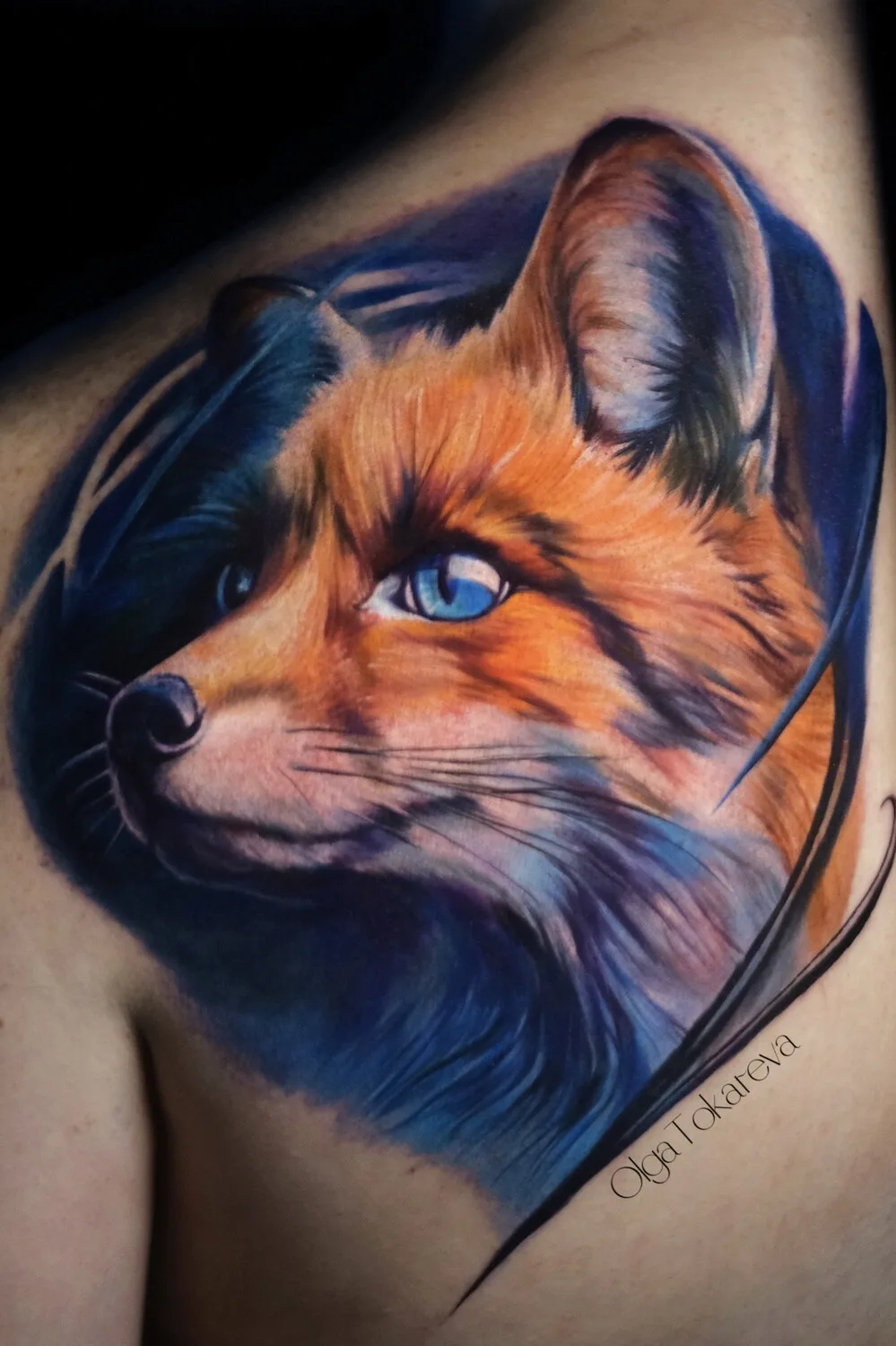
A fox tattoo says something about intelligence, sure. But it says more about the kind of intelligence, not brute-force problem solving, but observation, timing, and the willingness to find a way around the obstacle rather than through it.
Core Symbolism of the Fox
Three words come up consistently: cunning, intelligence, adaptability. But those words alone don't quite capture the full picture.
Cunning is the trait most commonly associated with foxes, and it carries a specific flavor. Fox-cunning is about reading a situation accurately and responding with precision, not deception for its own sake. Aesop knew this. So did every other storyteller who cast the fox as a character. The fox wins not by being the strongest or the fastest, but by understanding what the stronger, faster animals will do before they do it.
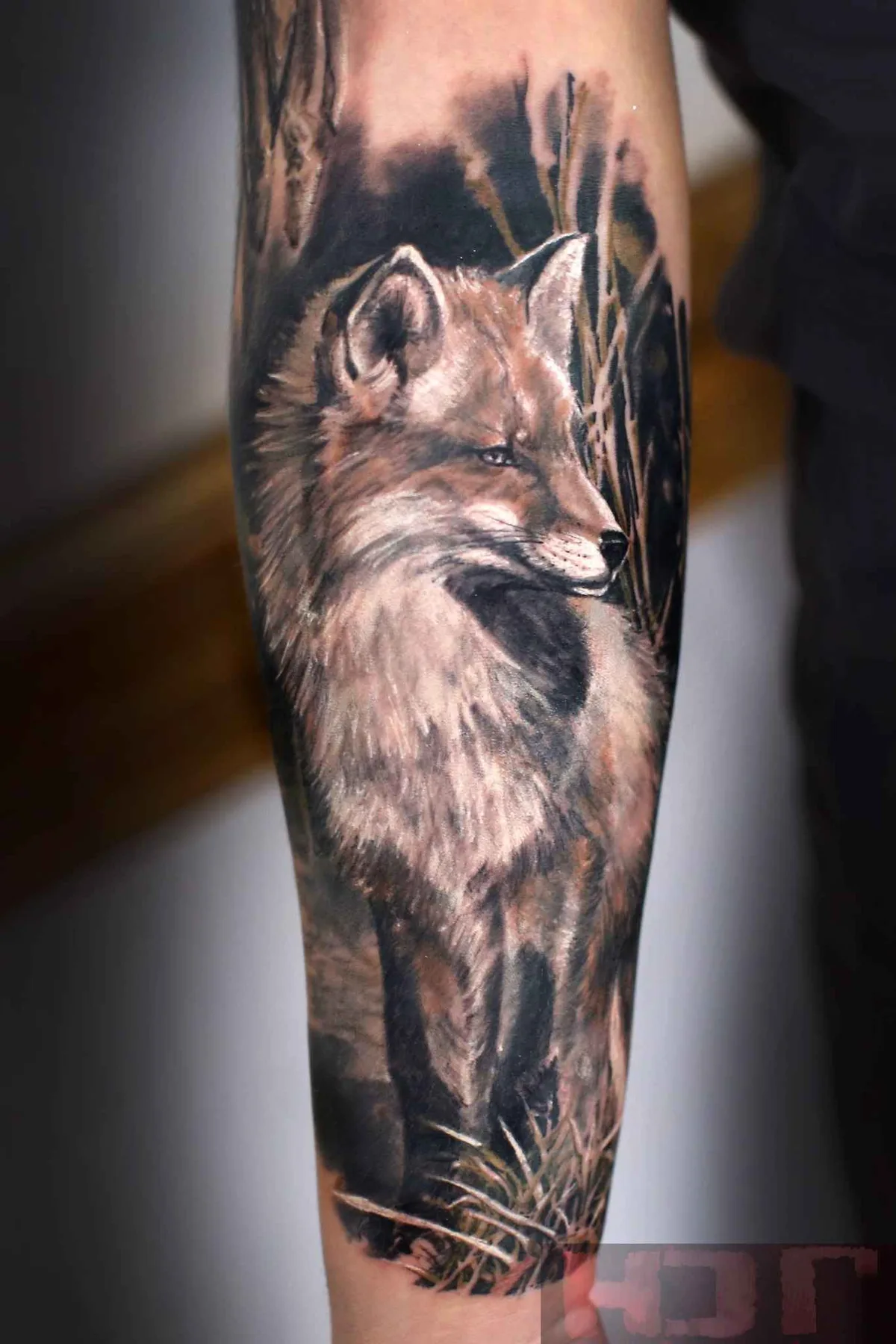
Intelligence in the fox context is practical, not academic. Foxes are remarkable problem-solvers in the wild. They cache food across dozens of locations and remember each one. They've been observed using the earth's magnetic field to hunt, aligning themselves along a north-south axis before pouncing on prey hidden under snow. That's not instinct alone. That's something closer to strategy, and it's hard to miss how unusual that is among land predators.
Adaptability might be the most underrated quality here. The red fox has the widest natural range of any land carnivore except humans, every continent except Antarctica. Urban foxes in European cities have learned to navigate traffic, time garbage collection schedules, and coexist with millions of people who never invited them in. For collectors who have moved frequently or reinvented themselves more than once, this is often the primary meaning behind a fox tattoo. The animal as a symbol of thriving in circumstances that weren't designed for you.
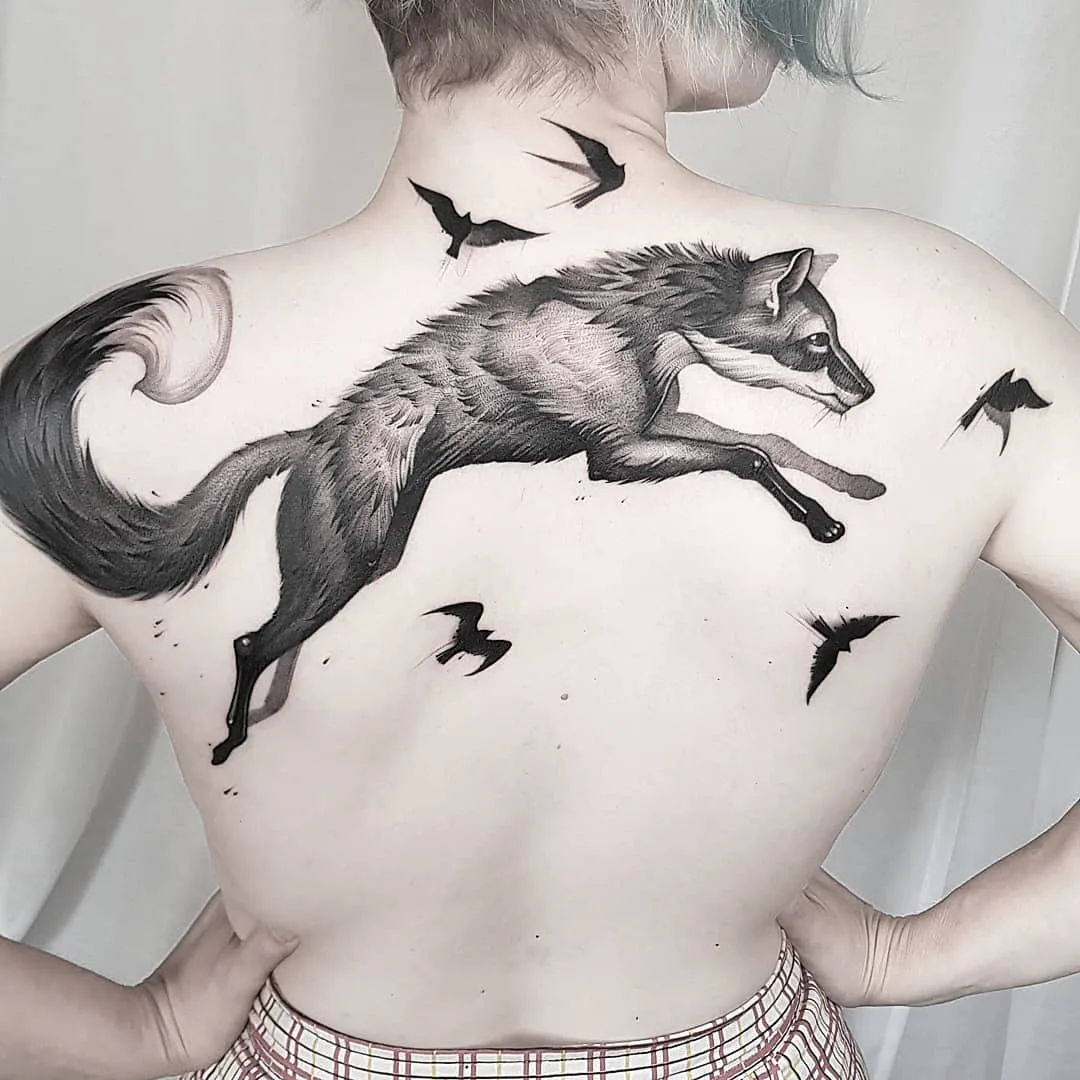
There's a fourth quality worth mentioning. Playfulness. Foxes play well into adulthood, filmed playing with found objects, ambushing each other for fun, bouncing on trampolines in suburban backyards. The image of the fox as purely calculating misses something real about the animal. They also know how to enjoy themselves.
Japanese Kitsune Mythology
Japanese fox mythology is probably the most elaborate in the world. The kitsune is a supernatural being that grows more powerful with age, sprouting additional tails as it accumulates wisdom and magical ability. A nine-tailed kitsune is essentially a minor deity. Full stop.
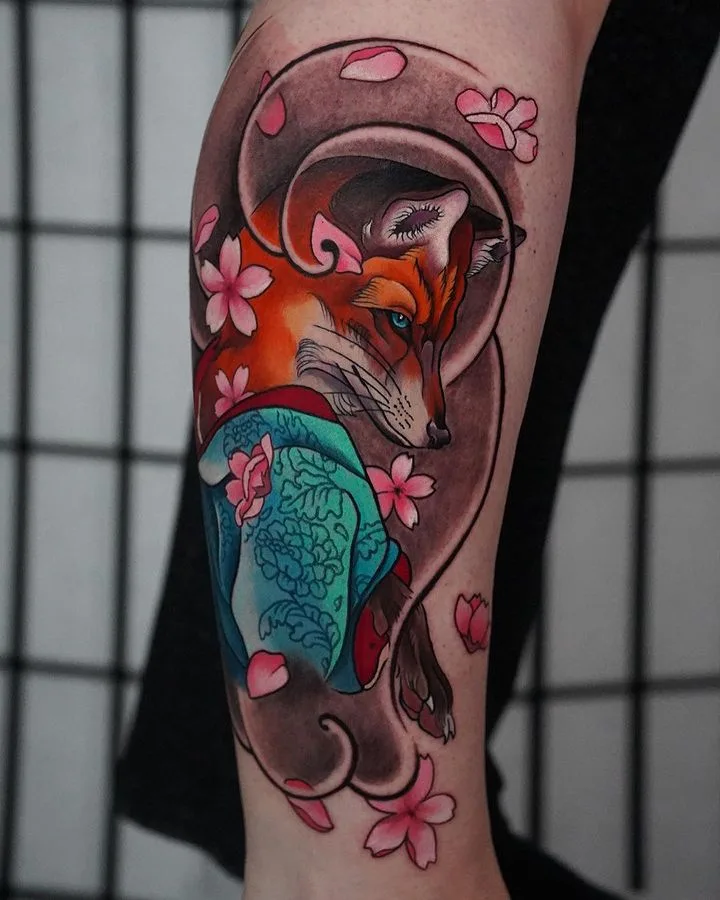
Kitsune come in two broad categories. Zenko are benevolent foxes associated with the god Inari, protectors of rice, prosperity, and fertility. Their stone statues flank Inari shrines throughout Japan, often wearing red bibs and holding keys to celestial granaries in their mouths. Then there are yako, or nogitsune, trickster foxes, mischievous and sometimes malicious, known for possessing humans, creating illusions, and generally making life complicated for anyone who crosses them. The line between zenko and yako is not always clear, which is probably the point.
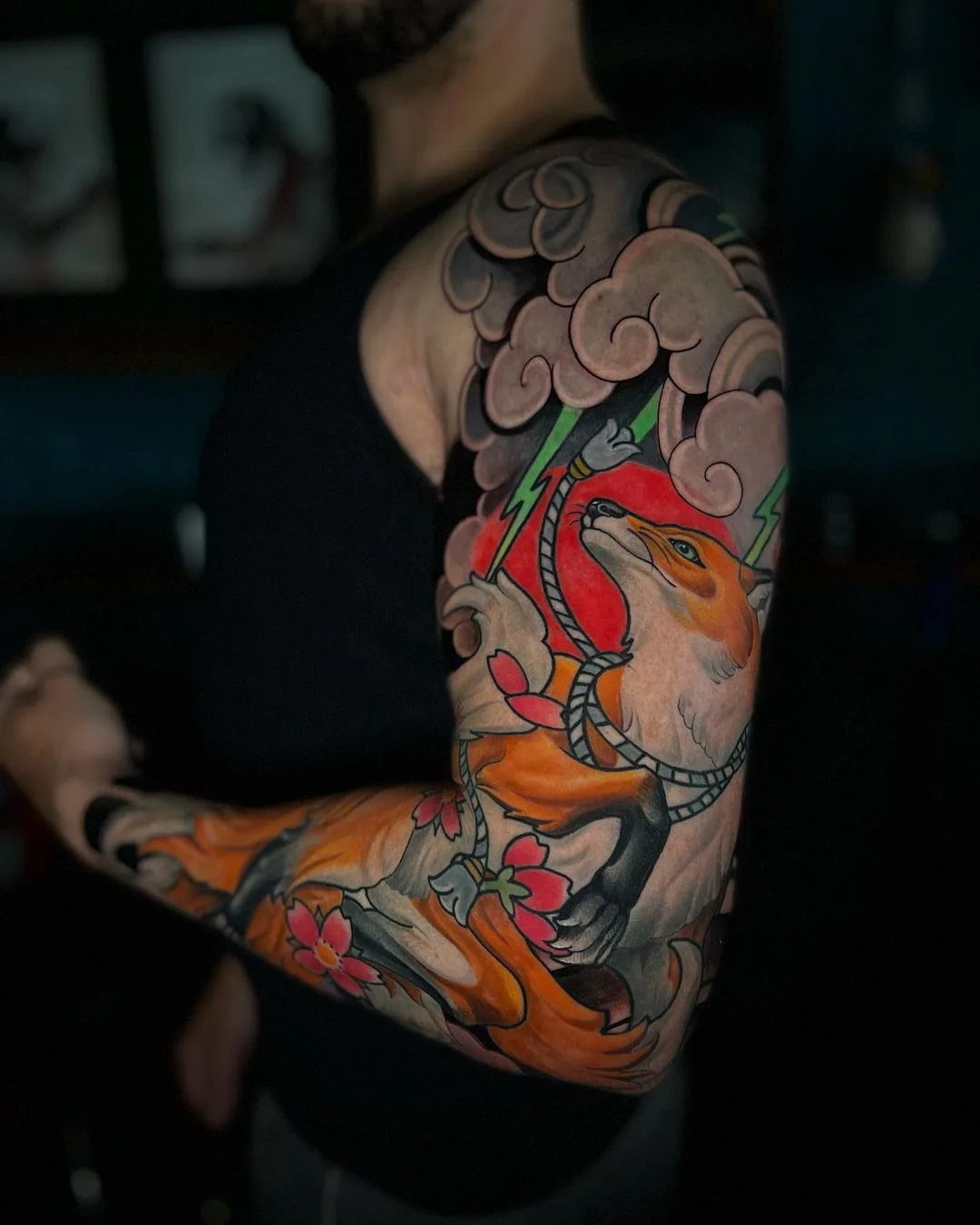
A kitsune tattoo can lean either way. The multi-tailed fox surrounded by fox fire (kitsune-bi, those floating blue flames) is a visually striking design that can represent wisdom, transformation, spiritual power, or the acceptance that intelligence and trickery are not always separate things. These tattoos are almost always executed in Japanese traditional style, bold outlines, a specific color palette, cloud and wave backgrounds, and they work best large. Half-sleeves and back panels are the natural fit. Cramming a nine-tailed kitsune into a four-inch square is a waste of the concept.
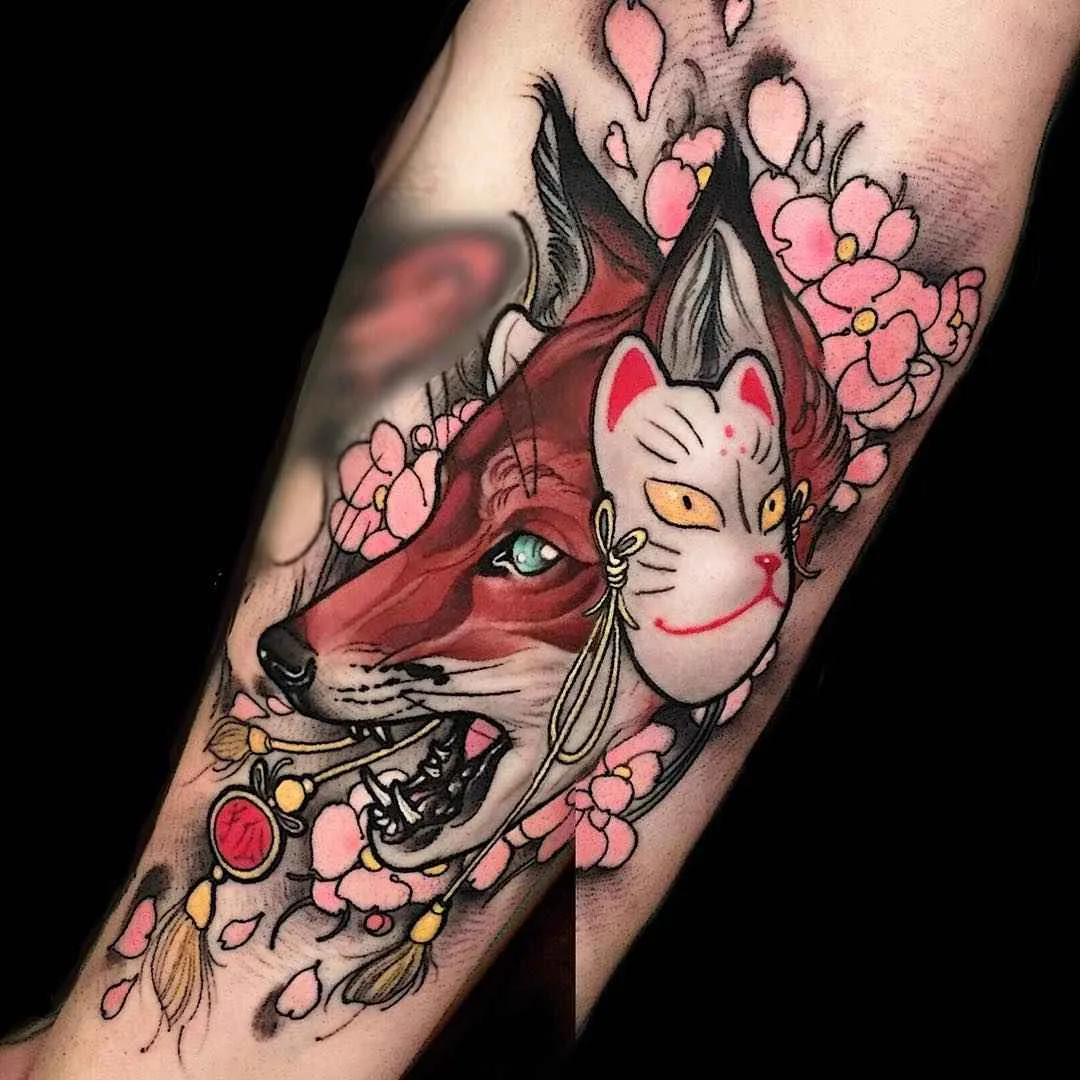
The Inari fox specifically appeals to people looking for protection and prosperity symbolism without the trickster element. These tend toward more serene compositions, a fox sitting calmly, perhaps with a jewel or key, framed by torii gates or rice stalks. Quieter, but no less intentional.
Native American Fox Stories
Fox appears in the oral traditions of many Native American nations, though the specific role varies considerably from one to the next.
In some Plains traditions, Fox is a trickster figure, similar to Coyote but usually portrayed as more subtle and less chaotic. Where Coyote creates through accident and impulse, Fox creates through careful planning. That distinction matters. Fox stories often carry lessons about the difference between cleverness used well and cleverness used selfishly, and the two outcomes look very different by the end.
For certain Northern California tribes, the silver fox was a creator figure who worked alongside Coyote to shape the world. This elevates the fox from clever animal to something approaching sacred. The silver fox brought order where Coyote brought chaos, and the world needed both. Among the Meskwaki people, the fox is a clan symbol and an ancestor, not merely a character in stories, but a foundational identity. That's a different category entirely.
A note that applies to any culturally specific symbol: using another culture's sacred imagery as a personal tattoo requires genuine thought and respect. The fox as a general symbol of cleverness is one thing. Reproducing specific tribal imagery is another, and the difference is not subtle.
Using sacred tribal imagery from Native American cultures as personal tattoo designs requires genuine respect and understanding. The fox as a general symbol of cleverness differs significantly from reproducing specific tribal sacred imagery.
Celtic and European Folklore
European fox folklore tends to center on one character: Reynard. The Reynard cycle, originating in medieval France and the Low Countries, follows a fox who outsmarts wolves, bears, lions, and human hunters through charm, strategic deception, and genuine brilliance. The stories were wildly popular for centuries and served as social satire, Reynard was the common person's hero, using wit against brute power. That framing has aged surprisingly well.
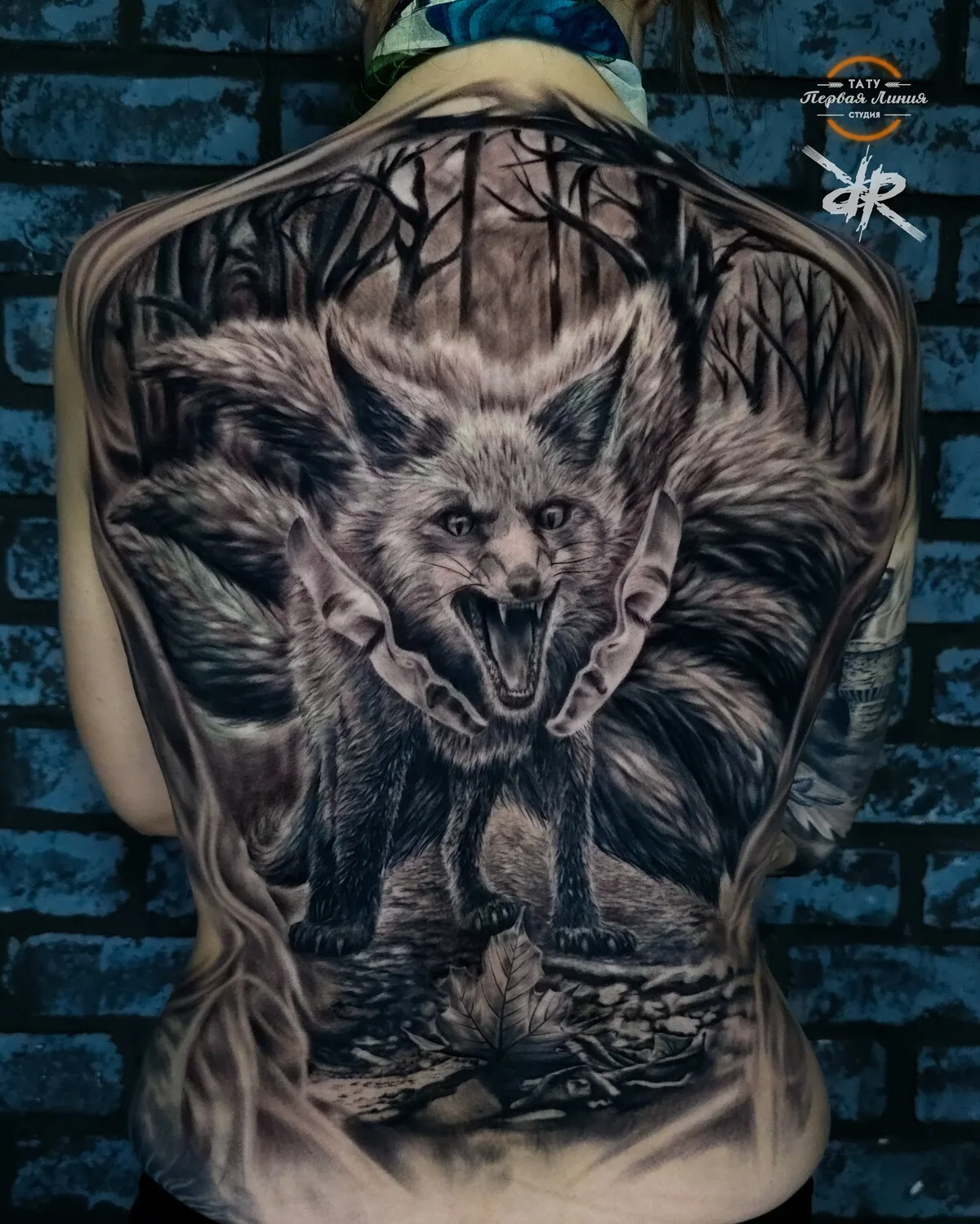
Celtic traditions viewed the fox somewhat differently. In Irish and Scottish folklore, the fox (known as the "sionnach") was associated with the ability to move between worlds. Foxes were thought to know the forests so intimately they could guide, or mislead, travelers. Druids reportedly admired the fox for its ability to blend into its surroundings and observe without being observed. Whether that's historical record or romanticized lore is a fair question, but the image stuck.
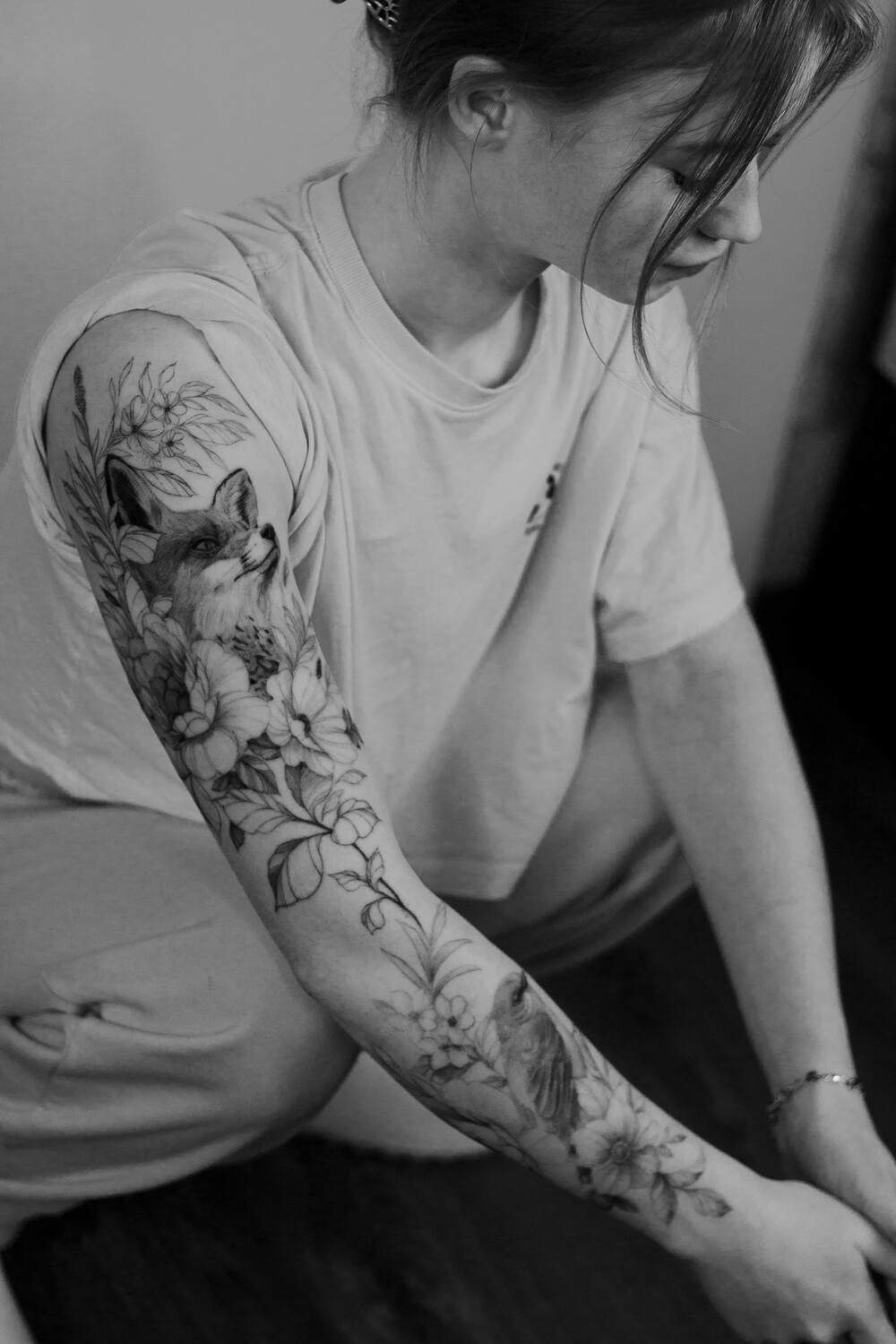
A European-folklore-inspired fox tattoo tends to be warmer and more narrative than the Japanese approach. Think of a fox in a forest setting, perhaps with Celtic knotwork borders or accompanied by symbols of wisdom like books or keys. These designs suit a storybook aesthetic, detailed, illustrative, a little romantic. They work well in fine-line black and grey or in a muted, earthy color palette.
- Fox tattoos symbolize strategic intelligence and adaptability rather than brute force
- Japanese kitsune designs work best as large pieces (half-sleeves, back panels) to showcase multiple tails and details
- Cultural context matters, Native American tribal imagery requires respectful consideration before use
- European folklore foxes suit narrative, storybook aesthetics with forest settings and Celtic elements
- Color choices significantly impact meaning: red for passion, white for wisdom, black for mystery
Nordic Connections
The fox doesn't hold center stage in Norse mythology the way wolves and ravens do, but it turns up in meaningful places. The most direct connection runs to Loki, the trickster god. Loki isn't specifically a fox deity, but the cultural bond between foxes and trickery runs deep enough that many Norse-themed tattoo designs lean on fox imagery to channel Lokian energy: shapeshifting, boundary-crossing, a fundamental refusal to be pinned down or categorized.
There's also the firefox of Finnish mythology, which sits close to Nordic tradition. According to the legend, the firefox ran across the arctic sky so fast its tail scattered sparks, and those sparks became the northern lights. The Finnish word for aurora borealis, revontulet, literally translates to "fox fires." A fox running beneath a blazing aurora, or conjuring one, makes for a stunning tattoo concept. Speed, wonder, raw natural beauty all in one image.
Popular Fox Tattoo Styles
Watercolor
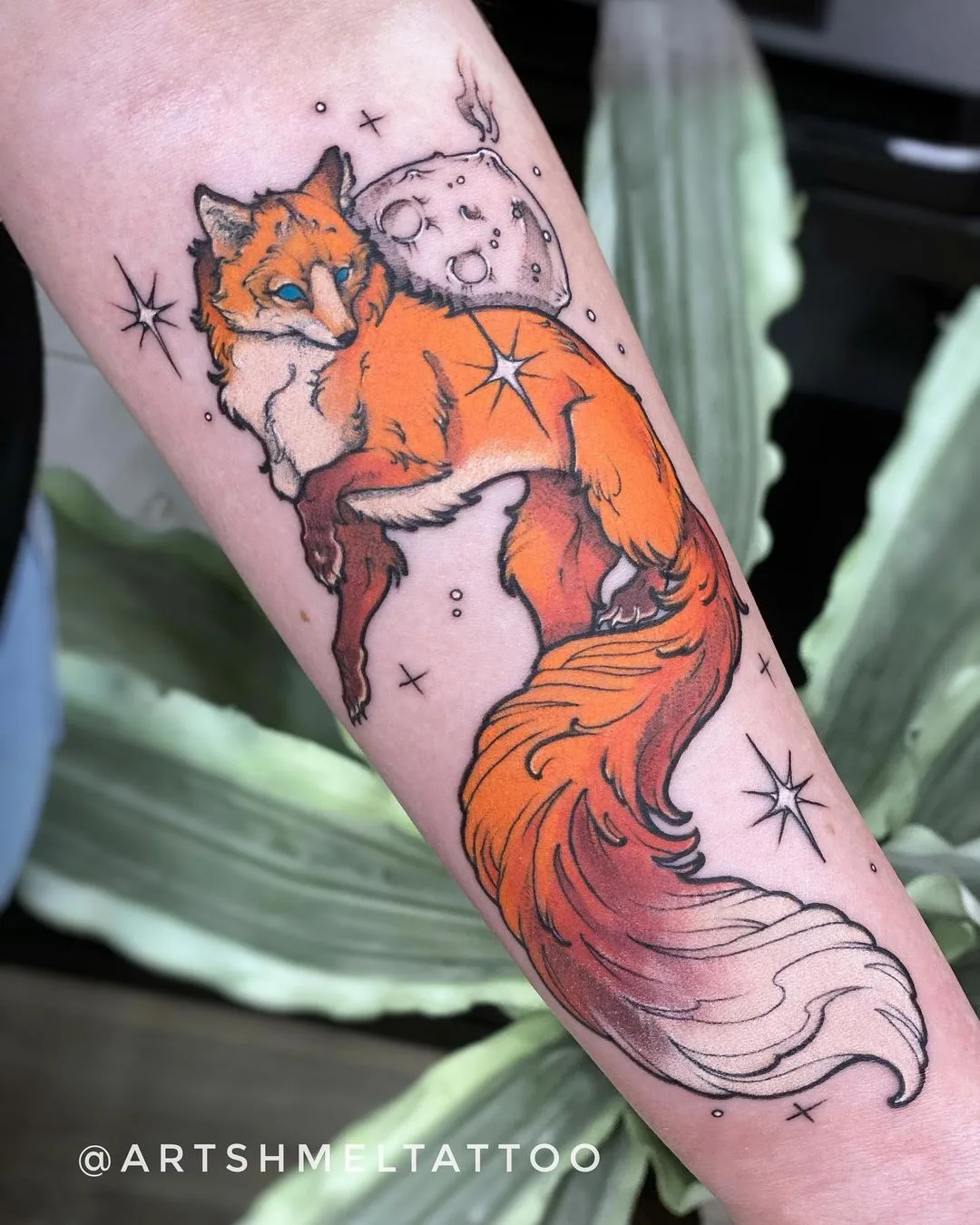
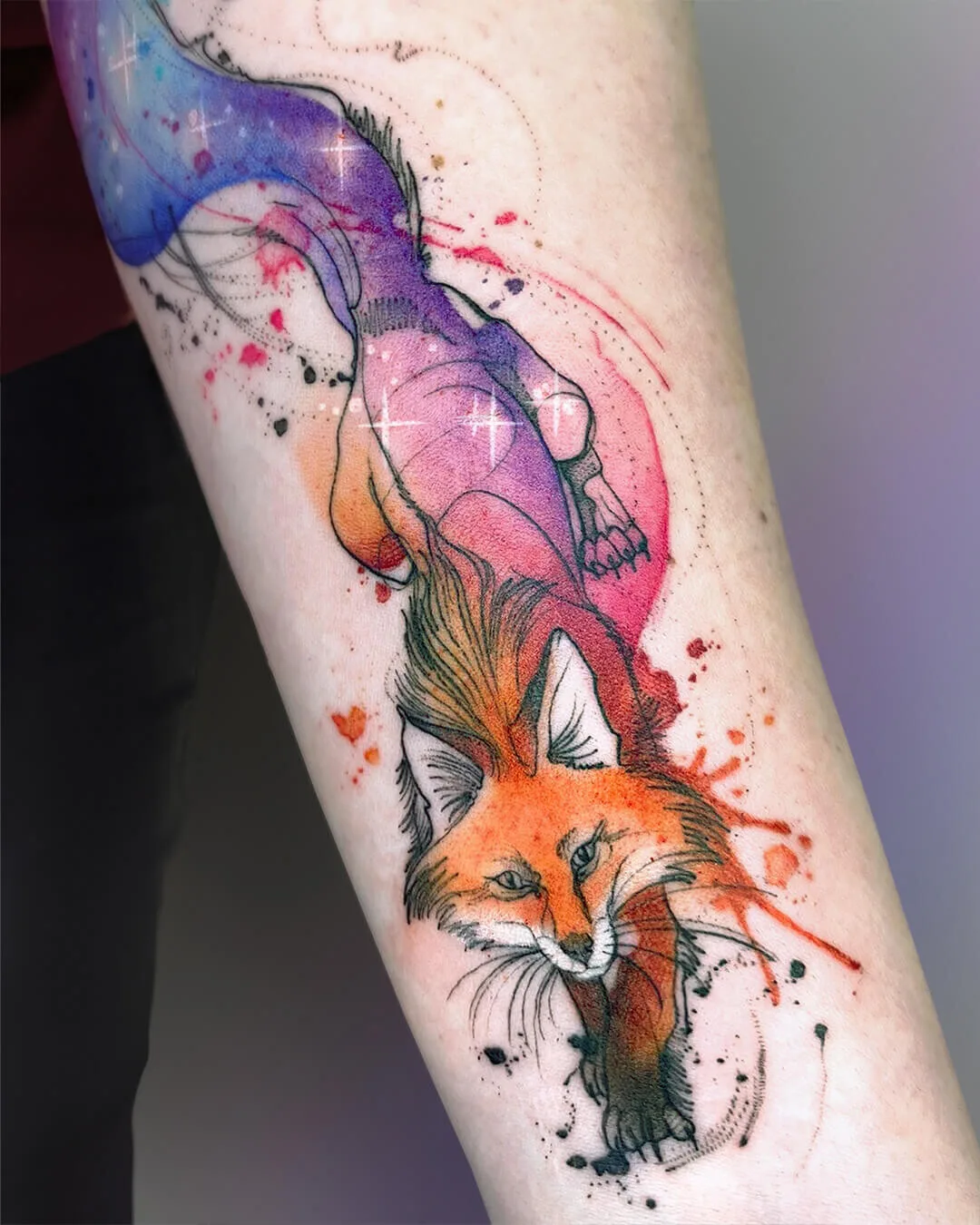
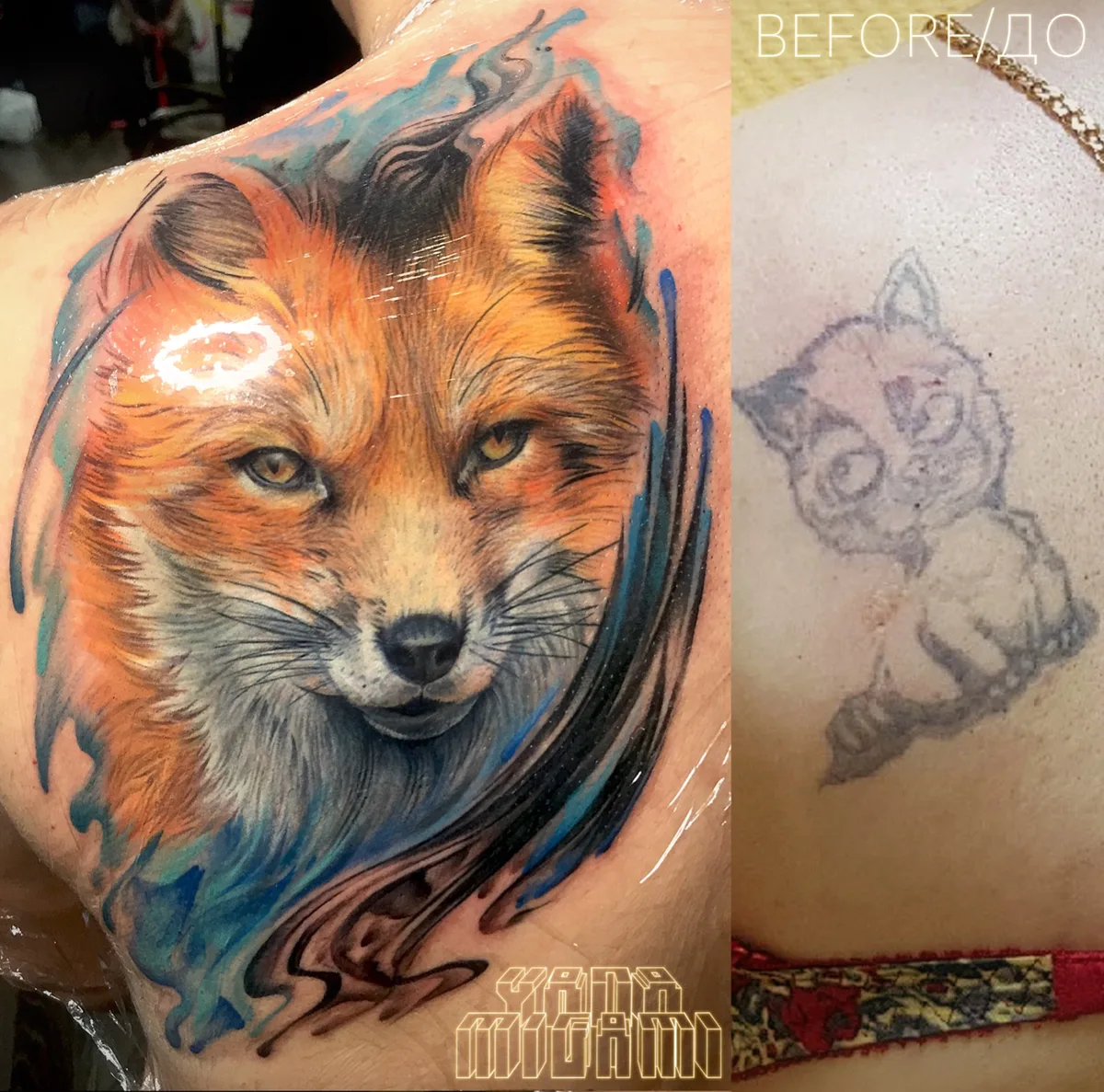
Foxes and watercolor are probably as close to a natural pairing as tattooing offers. The red fox's coloring, that particular mix of orange, white, and deep black, suits the splashy, bleeding-edge watercolor approach almost too well. These pieces are vibrant and eye-catching. They tend to read especially well on the forearm or upper arm, where there's enough surface area for the color to breathe and the composition to open up. The usual caveat still applies: watercolor fades faster than heavily outlined work, so a solid underlying structure matters for longevity.
Geometric
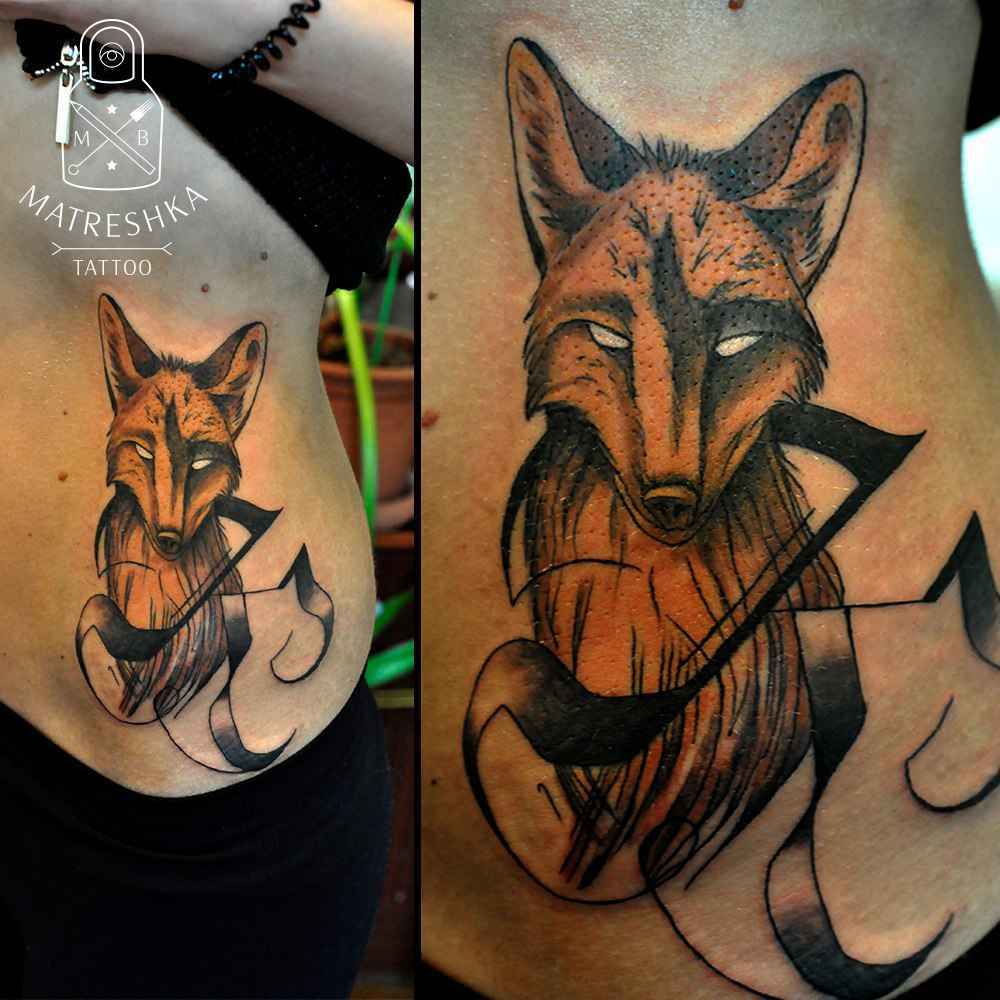
Matreshka Tattoo, geometric fox
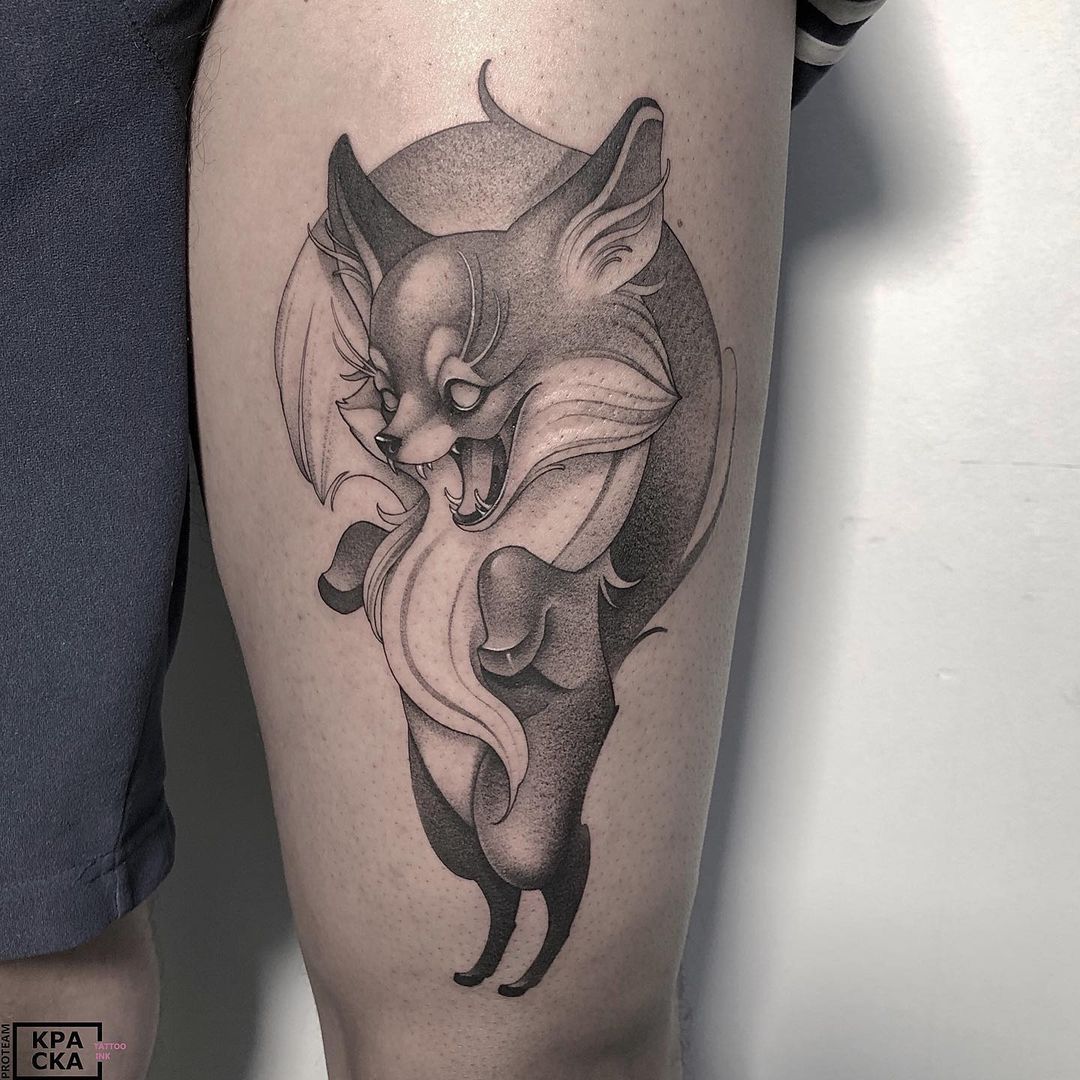
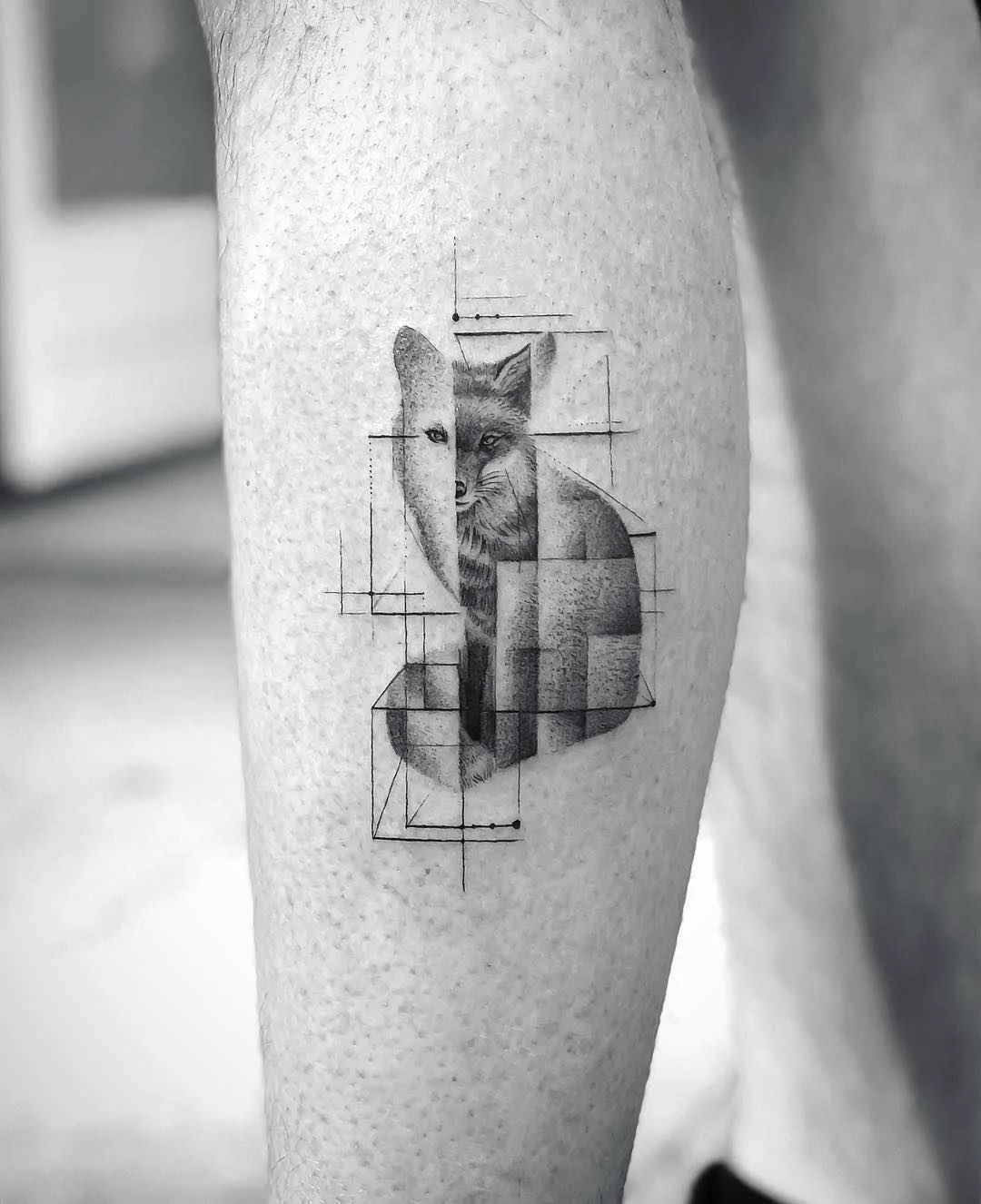
Black and gray geometric fox
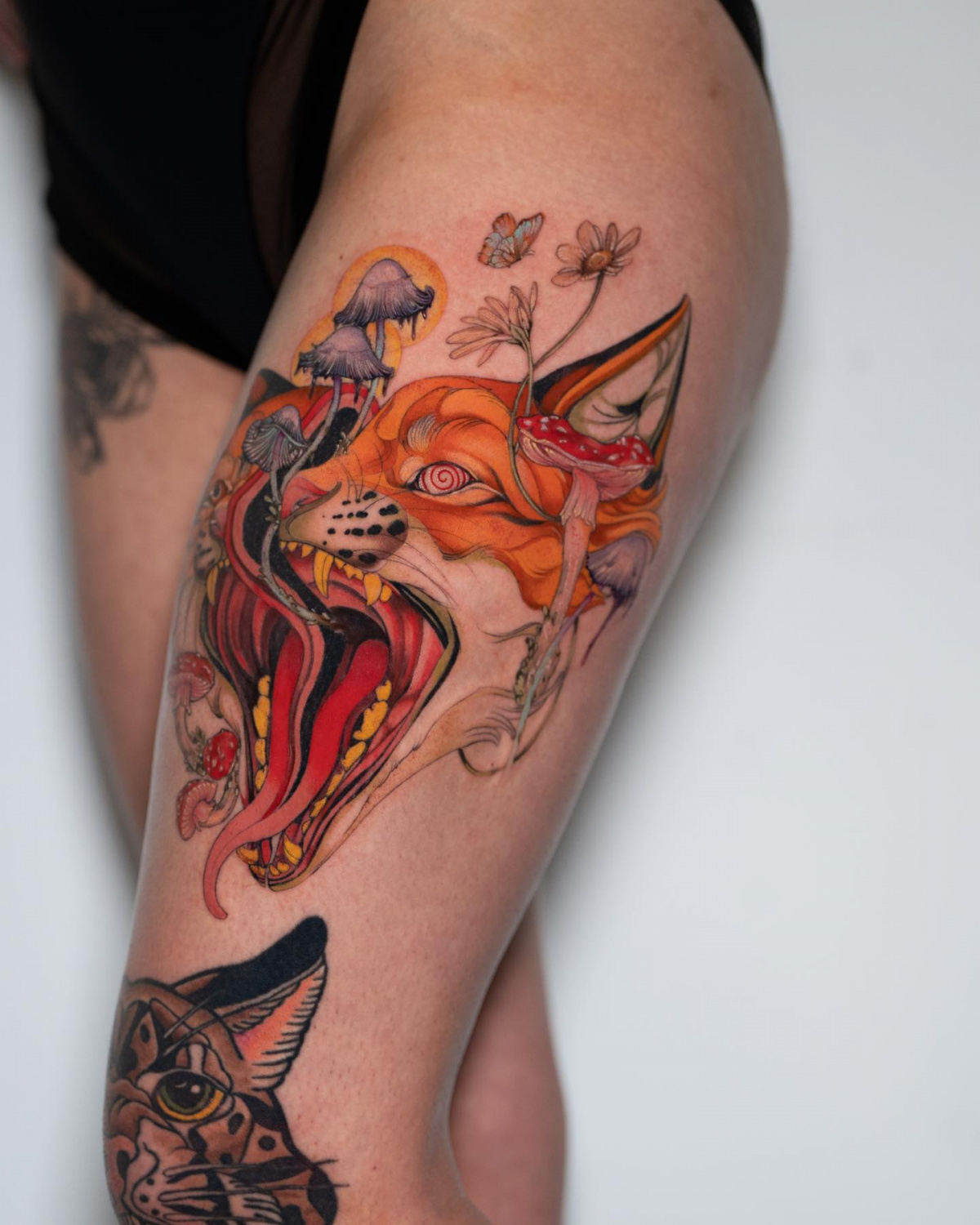
Neo-traditional fox with mushrooms and flowers
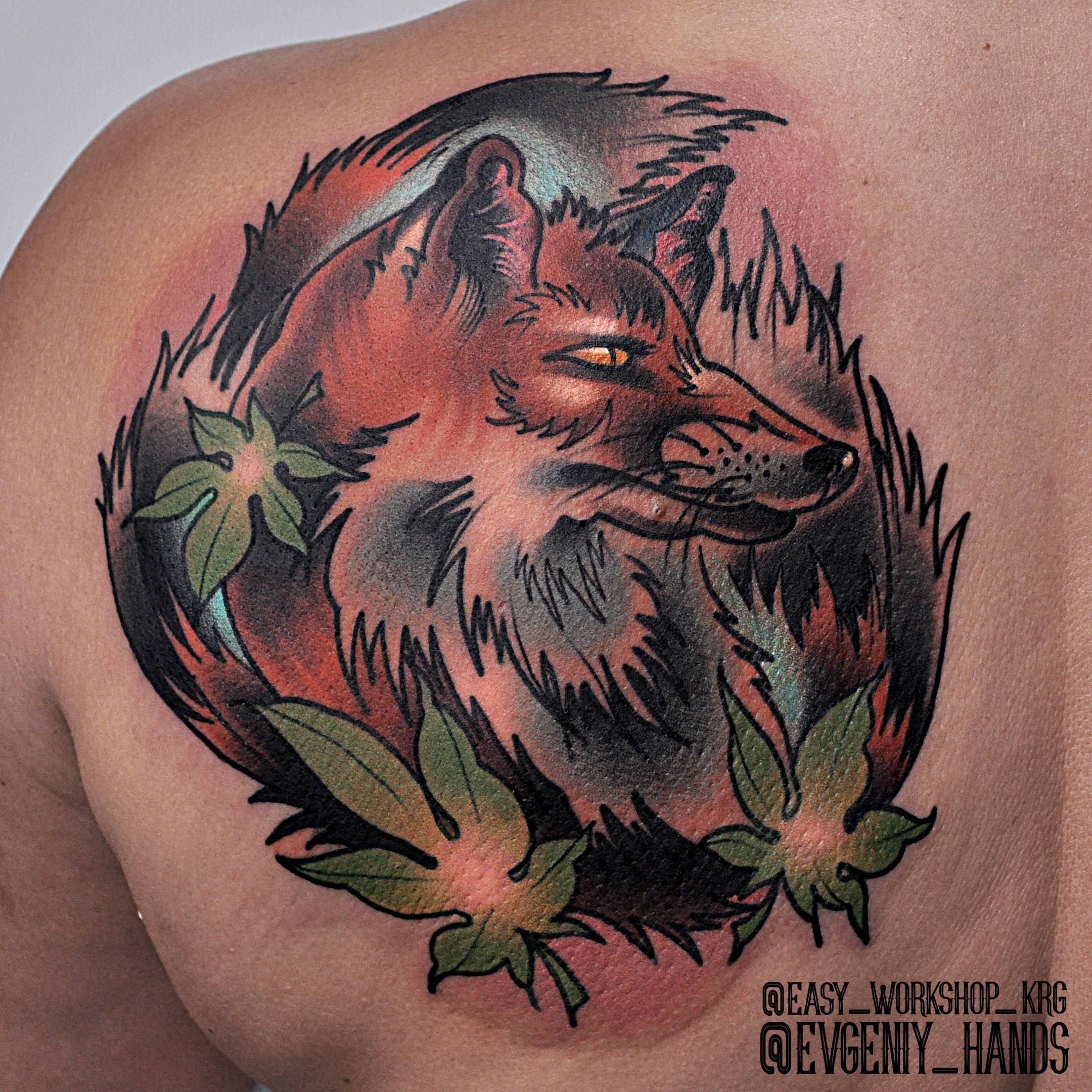
Neo-traditional fox by Easy Workshop KRC
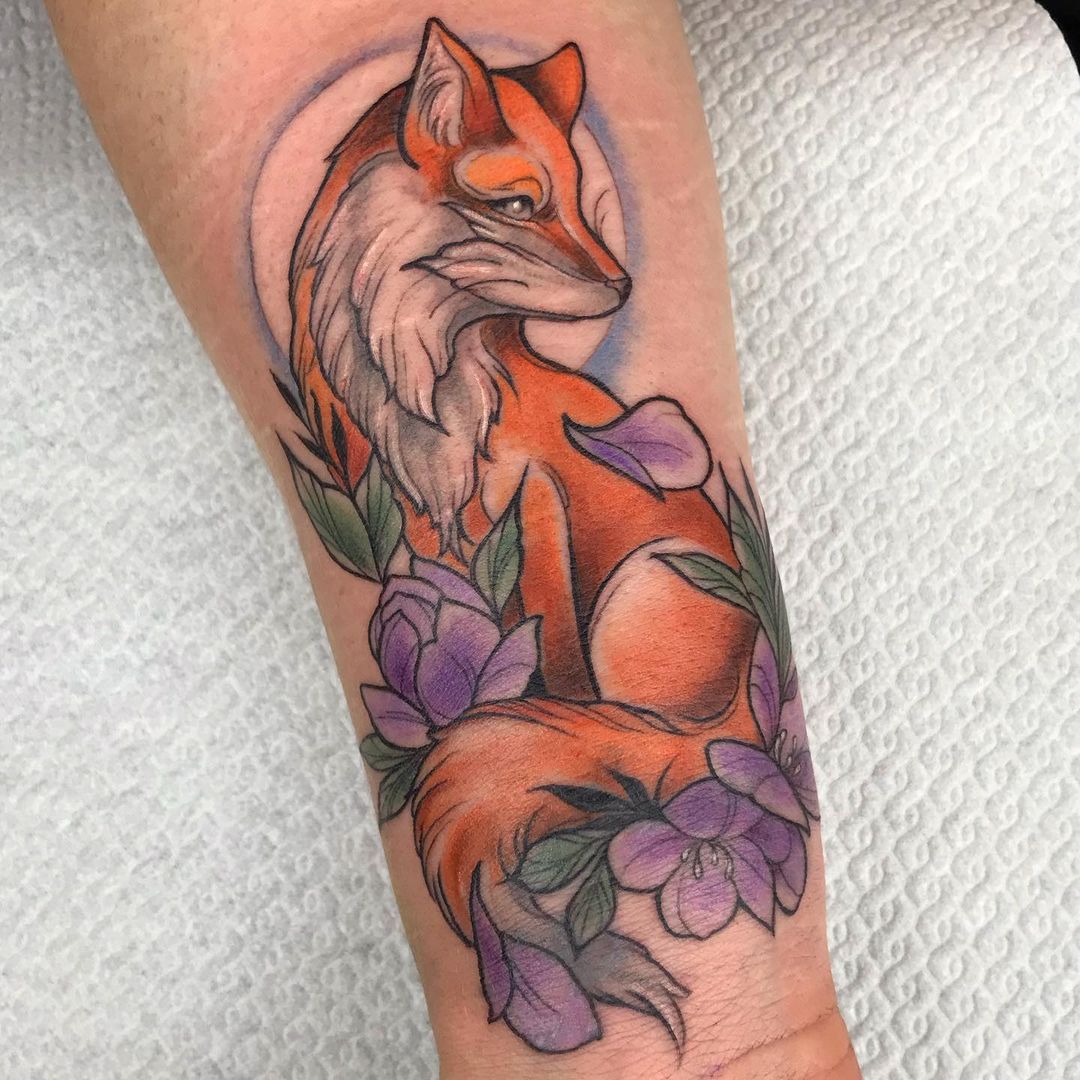
Neo-traditional fox with flowers
Geometric fox designs have been popular for years, and the reason isn't hard to see. The fox's face is naturally angular, pointed ears, narrow muzzle, a head that already reads as triangular. Those features translate into geometric shapes almost without effort. Low-poly fox designs, where the animal is rendered as a series of colored triangles like an untextured 3D model, have been trending for a long time and keep evolving rather than fading. Or rather, the core concept stays, but artists keep pushing it into new variations.
Neo-Traditional
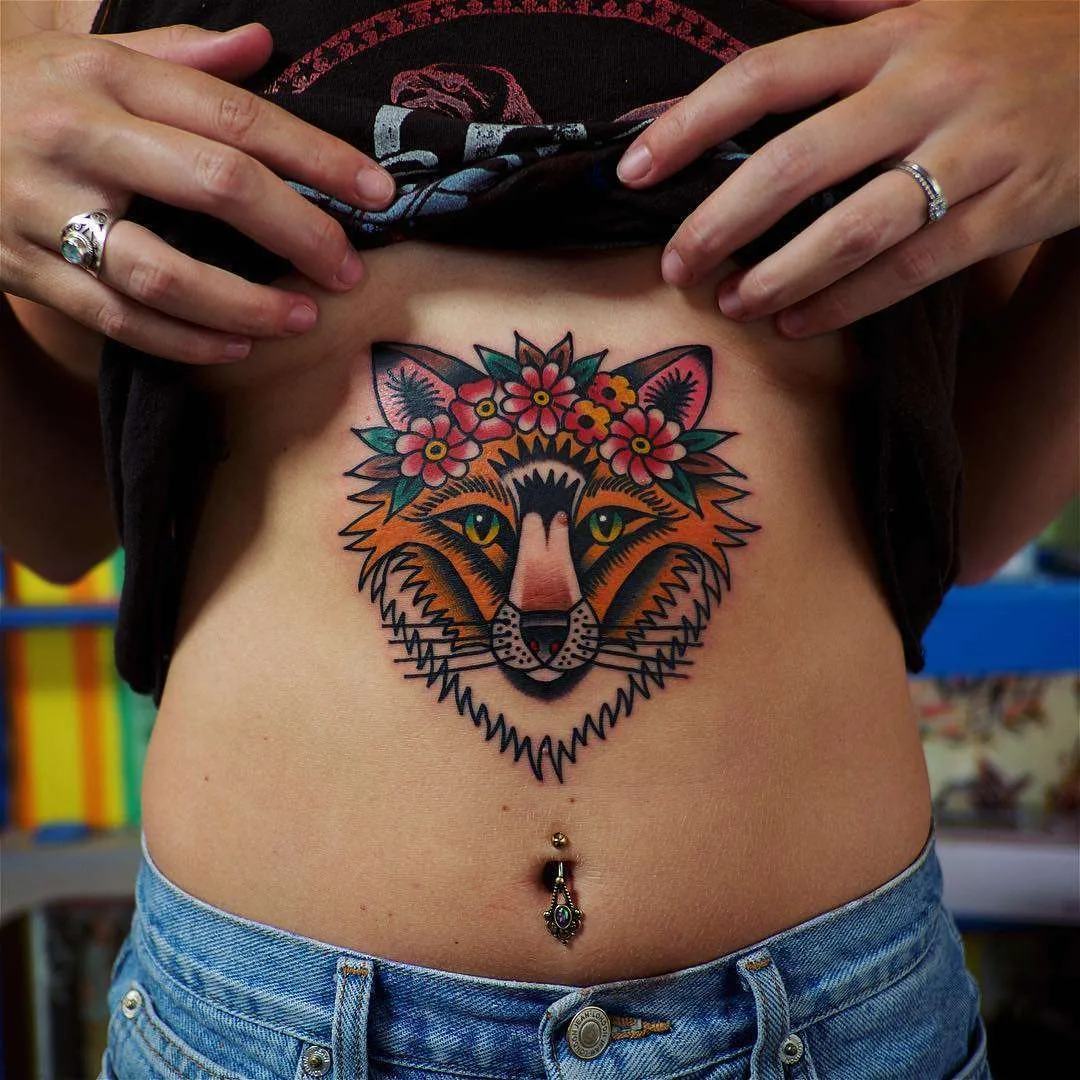
Neo-traditional fox tattoos borrow the bold outlines and flat color fields of American traditional work, then layer in more detail, shading, and a wider color range on top. A neo-traditional fox might carry the structured composition of old-school tattooing alongside realistic fur texture and a palette that goes well beyond the classic primaries. These pieces tend to age well. The strong linework gives them a foundation that holds up over time, even as some of the finer detail softens.
Japanese Traditional
For kitsune work, Japanese traditional irezumi is the gold standard. Bold black outlines, specific background elements, clouds, waves, wind bars, and a color palette that's limited but hits hard. The multi-tailed kitsune rendered in this style is one of the most dramatic subjects in tattooing, full stop. These pieces demand real estate: a sleeve, a back panel, a full thigh. The visual impact earns it.
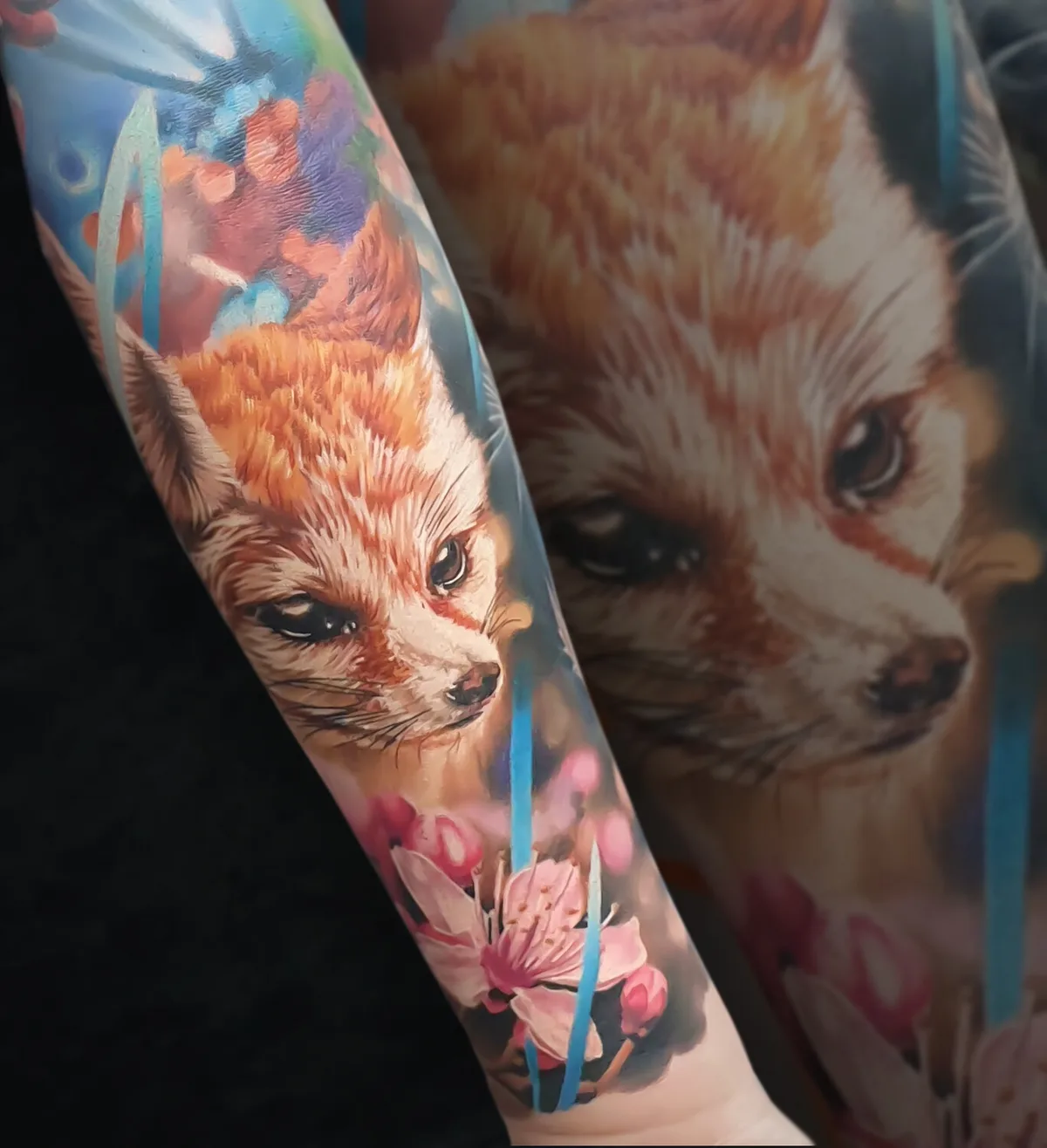
Nine-tailed kitsune designs need space to breathe. Cramming this intricate concept into a small piece wastes the visual impact, consider half-sleeves or back panels for maximum effect.
Color Meanings in Fox Tattoos
The species you choose to depict adds its own symbolic layer to the piece.
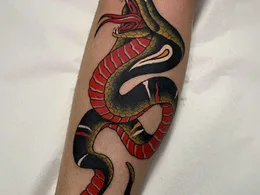
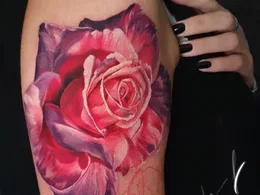
The red fox is the default, and by a wide margin. Its warm orange-red coloring carries associations with passion, energy, and the feeling of autumn. It's the most visually recognizable option and, honestly, the most symbolically loaded. Most fox tattoos feature the red fox for exactly those reasons.
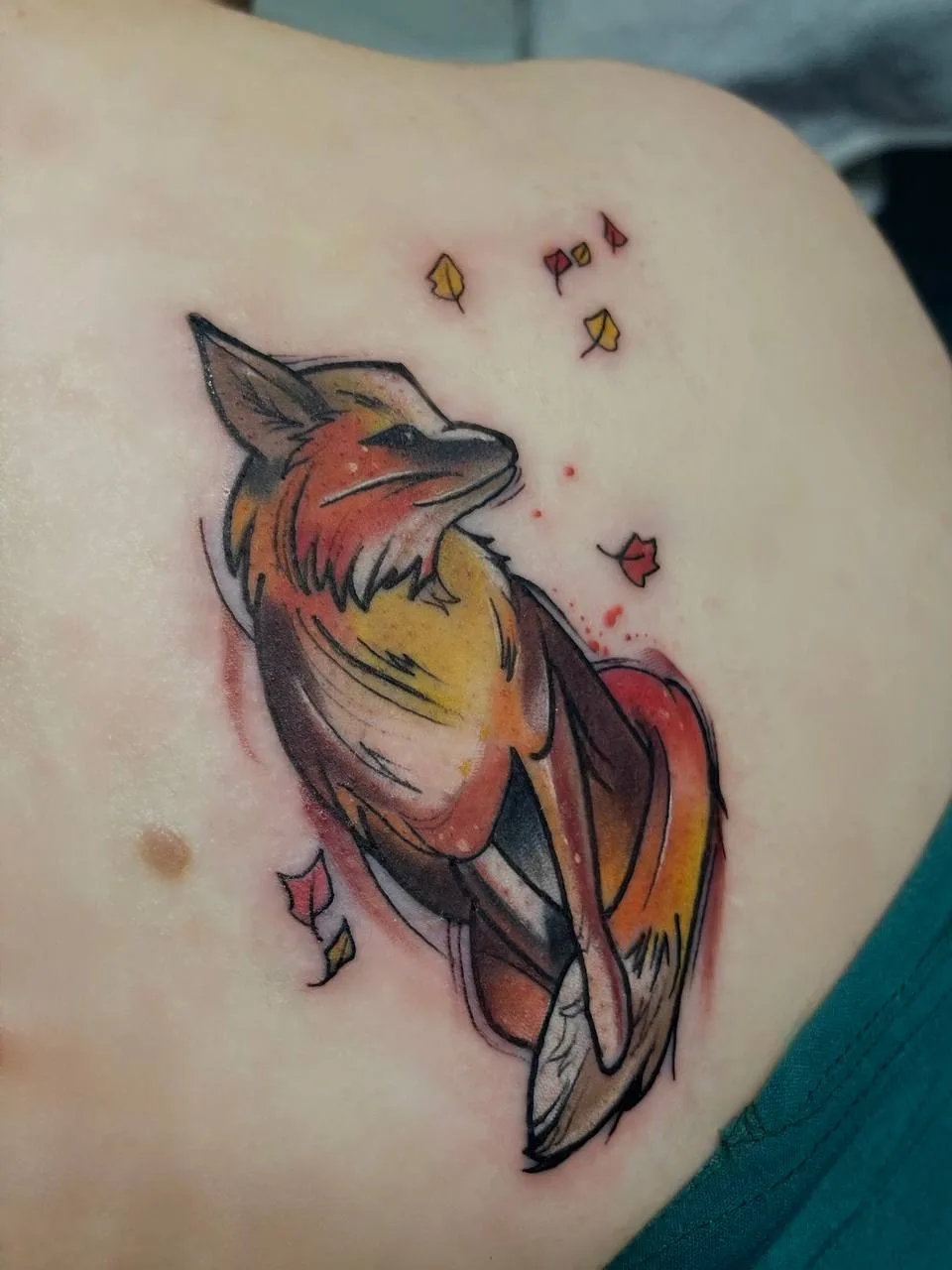
The arctic fox, white or blue-grey depending on the season, represents survival in extreme conditions, a certain emotional coolness, and maybe a quieter kind of resilience. These designs carry a different energy than red fox pieces. Collectors who go this route tend to identify more with endurance than with flash. The arctic fox's seasonal color shift, white in winter and brown in summer, adds another layer: transformation and adaptability taken about as far as they can go in the animal world.
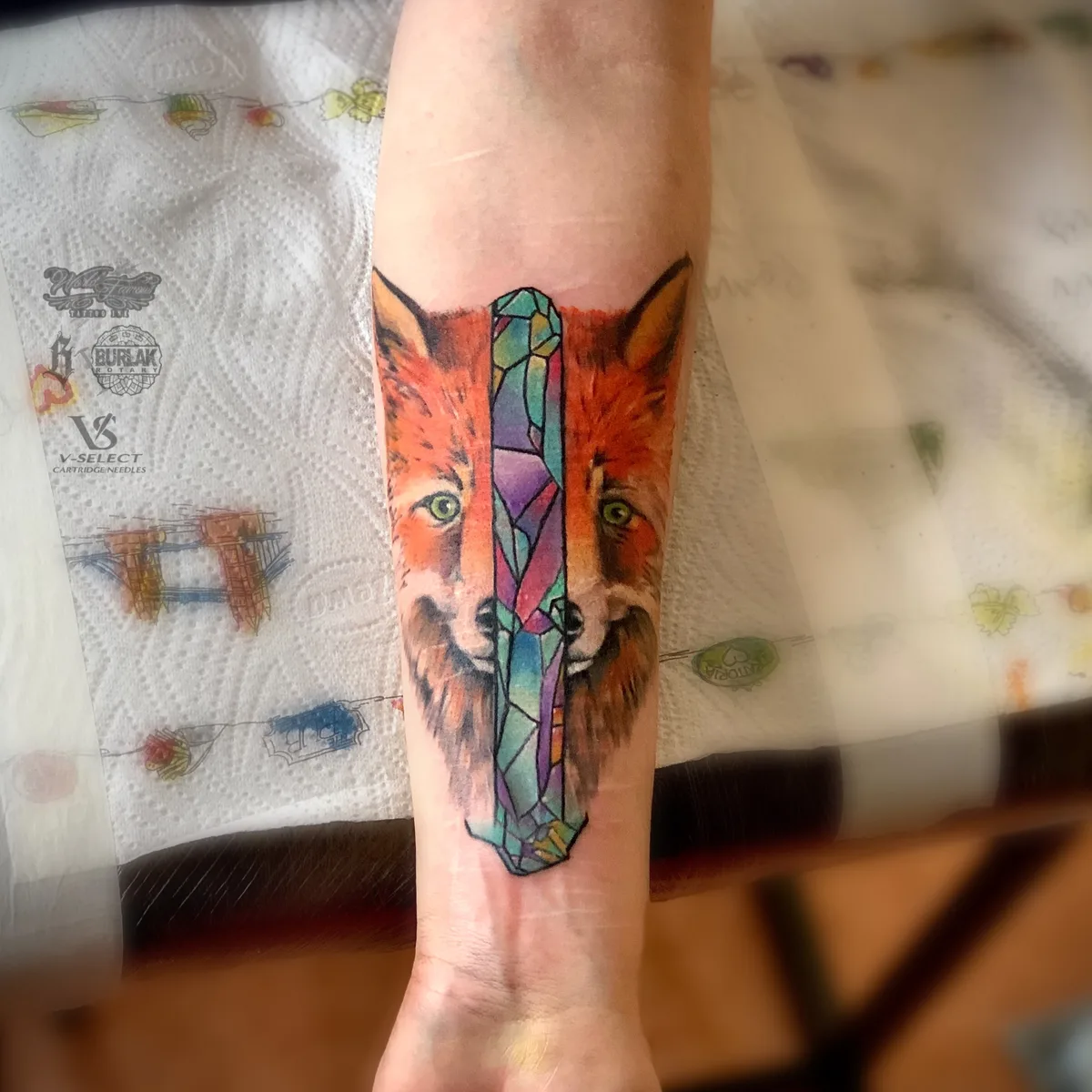
The fennec fox reads differently again. Enormous ears, tiny body, a desert survivor that thrives in one of the harshest environments on earth by evolving to hear prey moving underground and shed heat through those oversized ears. As a tattoo subject it gets chosen as much for its distinctive look as for any particular symbolism. It is also, frankly, adorable, and sometimes a tattoo is allowed to just be charming. No deeper meaning required.
Placement Guide
Fox tattoos adapt well across most body areas, though certain styles suit certain placements better than others.
The forearm remains the most popular spot for medium-sized fox designs in geometric, watercolor, or neo-traditional styles. A fox's body, long and lean, maps naturally onto the forearm's proportions. The upper arm and shoulder handle larger pieces, particularly Japanese-style kitsune with full background elements. The thigh offers a wide, relatively flat canvas for detailed work or multi-element compositions with room to spare.
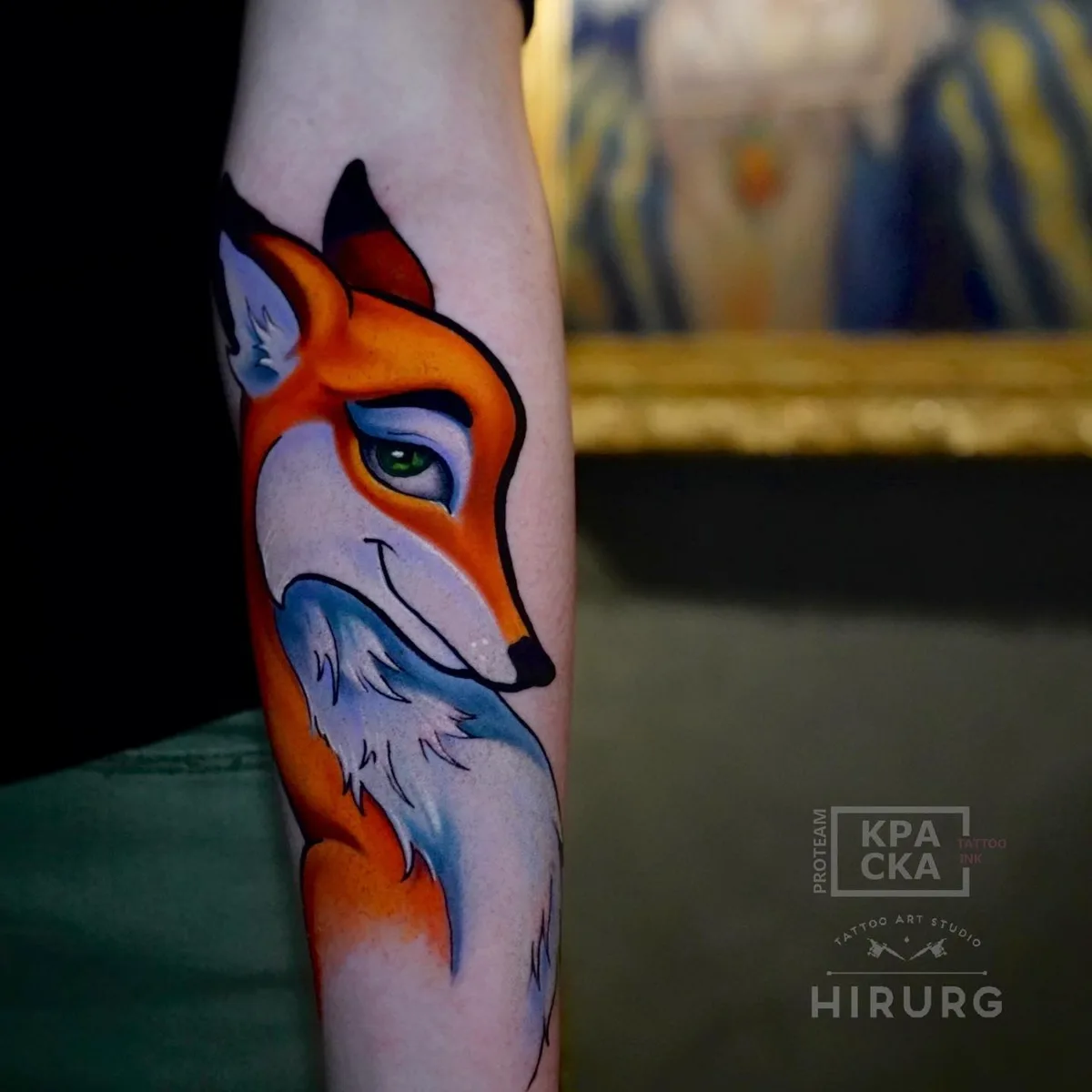
Smaller fox designs, a minimalist face, a geometric head, a tiny running silhouette, work well on the wrist, ankle, or behind the ear. The chest and sternum suit symmetrical fox compositions, though that's a more painful placement and worth thinking through carefully. The calf is underrated for fox tattoos; the muscle shape complements a sitting or curled fox in a way that feels natural rather than forced.
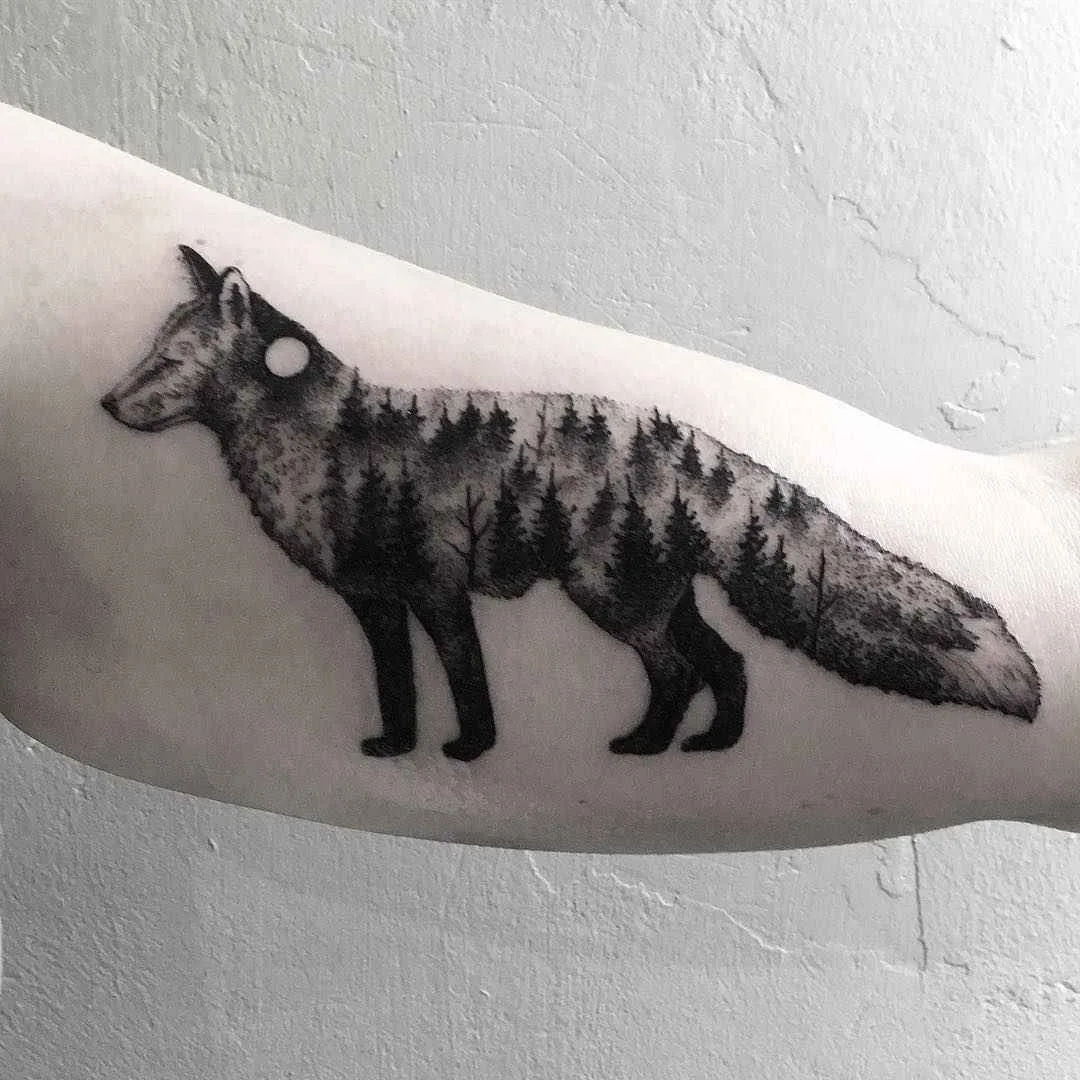
One thing worth thinking about: foxes are directional animals, and orientation matters. A fox facing forward feels confrontational. One in profile suggests motion and purpose. A fox looking back over its shoulder, a popular pose, and for good reason, implies awareness, maybe caution. Think about which direction your fox faces before the stencil goes down.
| Cultural Tradition | Fox Symbolism | Design Style | Best Placement |
|---|---|---|---|
| Japanese Kitsune | Wisdom, spiritual power, transformation | Traditional Japanese with bold outlines | Half-sleeve, back panel |
| European Folklore | Cleverness against authority, forest wisdom | Storybook illustration, Celtic elements | Forearm, thigh |
| Native American | Strategic planning, creator energy | Respectful interpretation only | Varies by design |
| Nordic/Finnish | Trickster energy, boundary-crossing | Norse-themed with runes | Upper arm, back |
Common Combinations
Foxes pair naturally with forest elements: pine trees, mushrooms, ferns, autumn leaves scattered mid-fall. These combinations ground the fox in its habitat and build a complete scene rather than leaving an isolated figure floating on skin. Floral elements work well too, roses and foxes have a nice visual tension between soft and sharp that artists tend to enjoy working with.
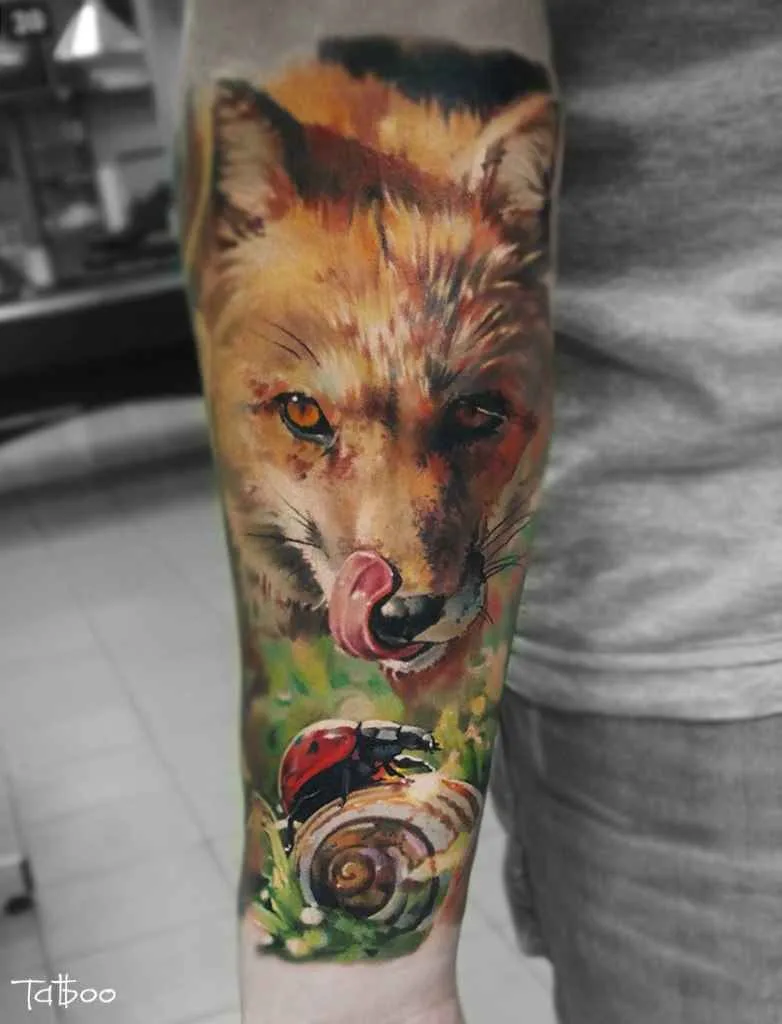
Moon imagery turns up frequently, especially crescent moons. The association between foxes and twilight makes this a natural pairing, almost inevitable. In Japanese compositions, kitsune are often surrounded by fox fire, ghostly blue flames that drift around the animal, and this element adds real supernatural weight to the design without overcrowding it.
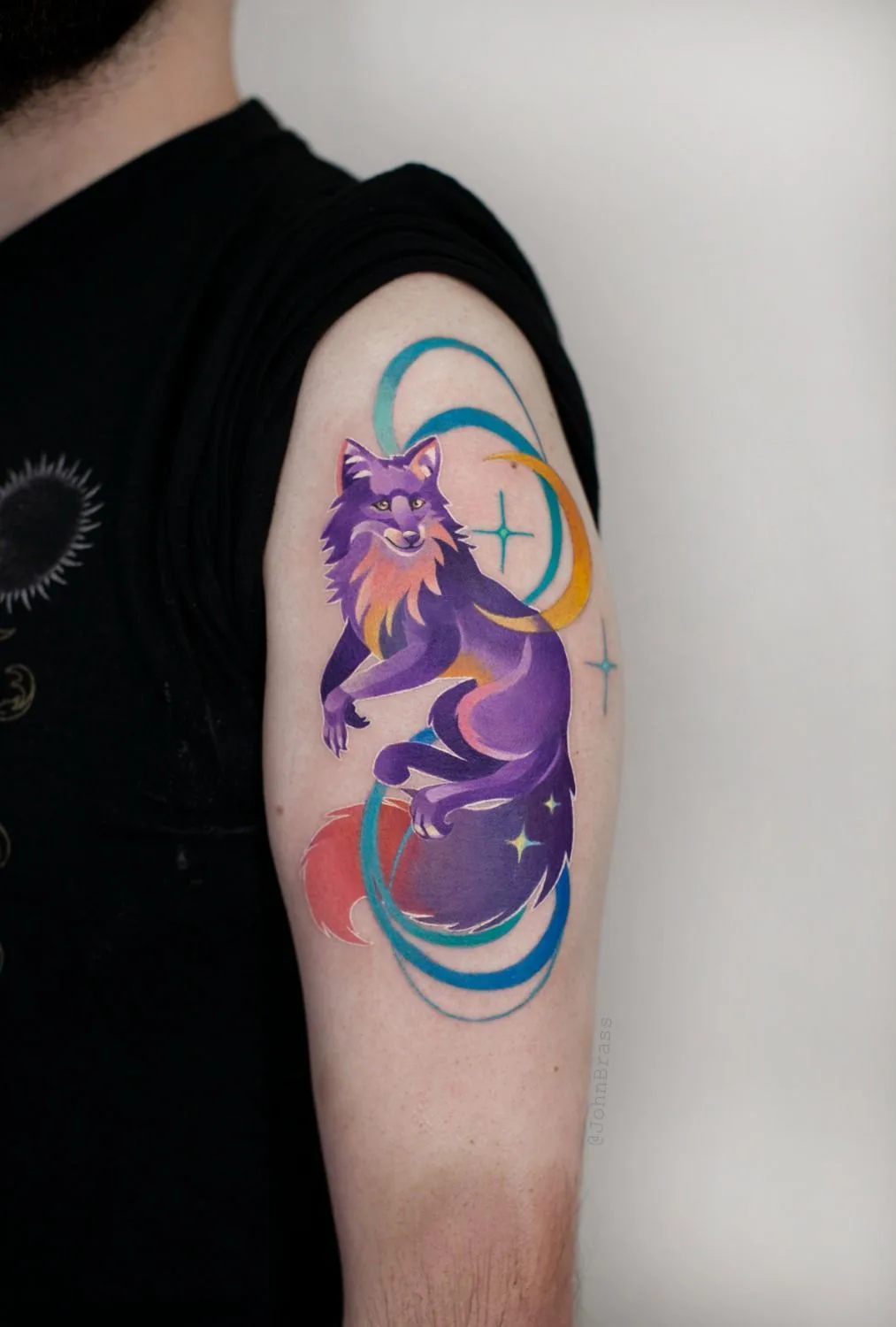
Geometric backgrounds, sacred geometry or mandala patterns in particular, give structure to more organic fox forms. The contrast between the mathematical and the natural can land hard visually. Some collectors pair foxes with other animals: a fox and a rabbit (predator and prey, or cunning set against innocence), a fox and a crow (two trickster figures from different traditions), a fox and a wolf. That last pairing carries its own quiet tension, the solitary against the social, the clever against the strong.
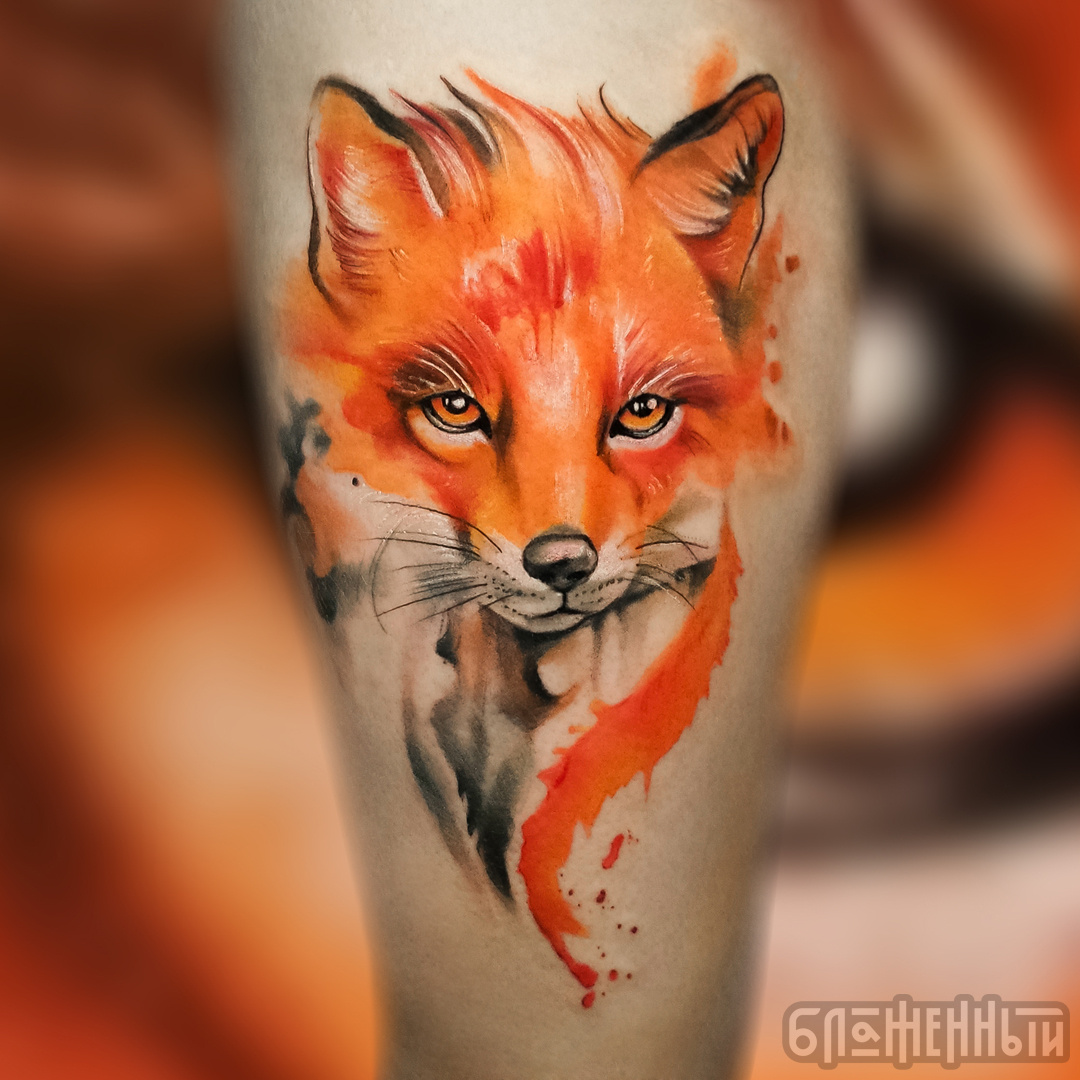
Watercolor fox realism
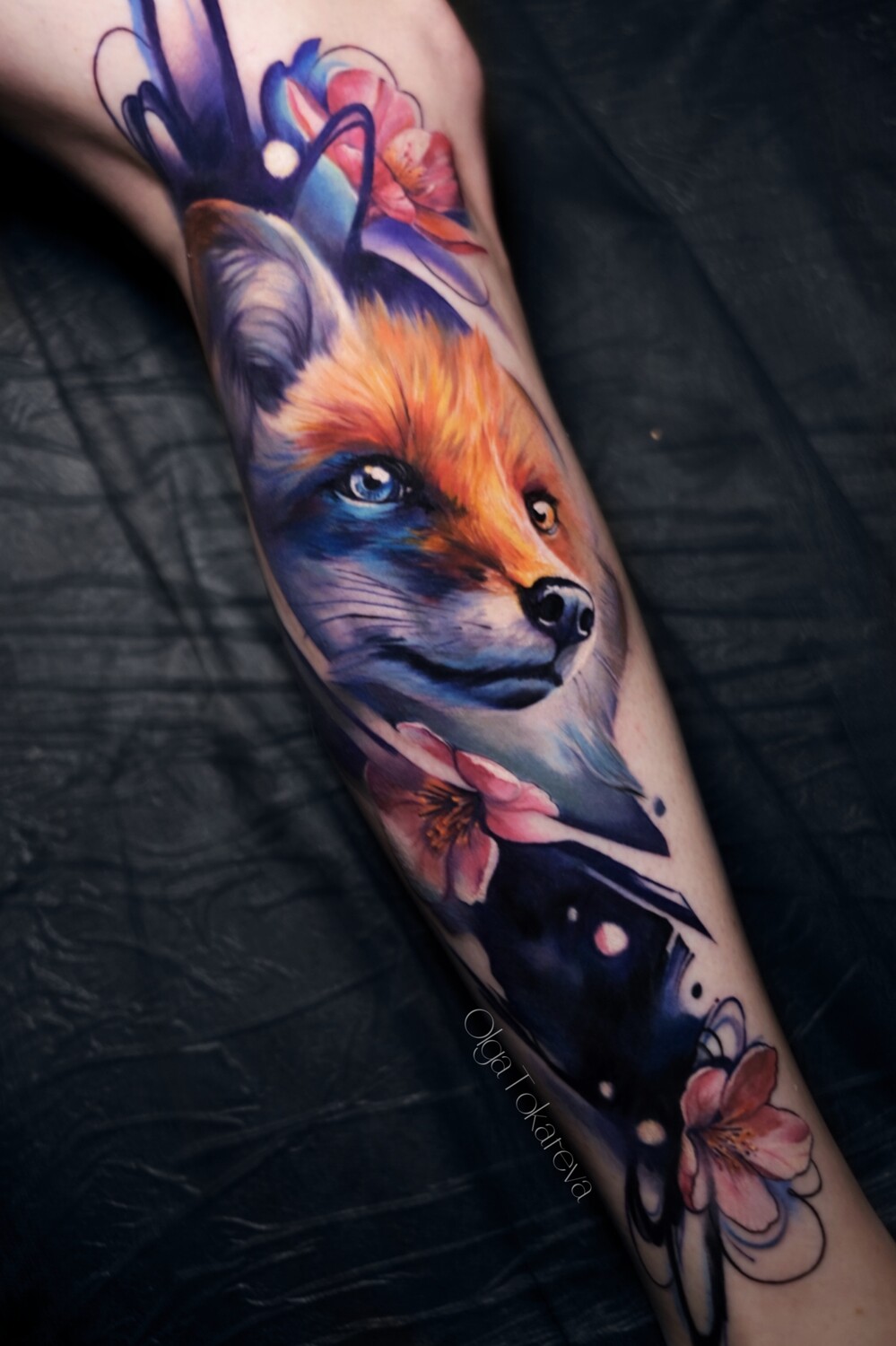
Watercolor fox portrait with florals
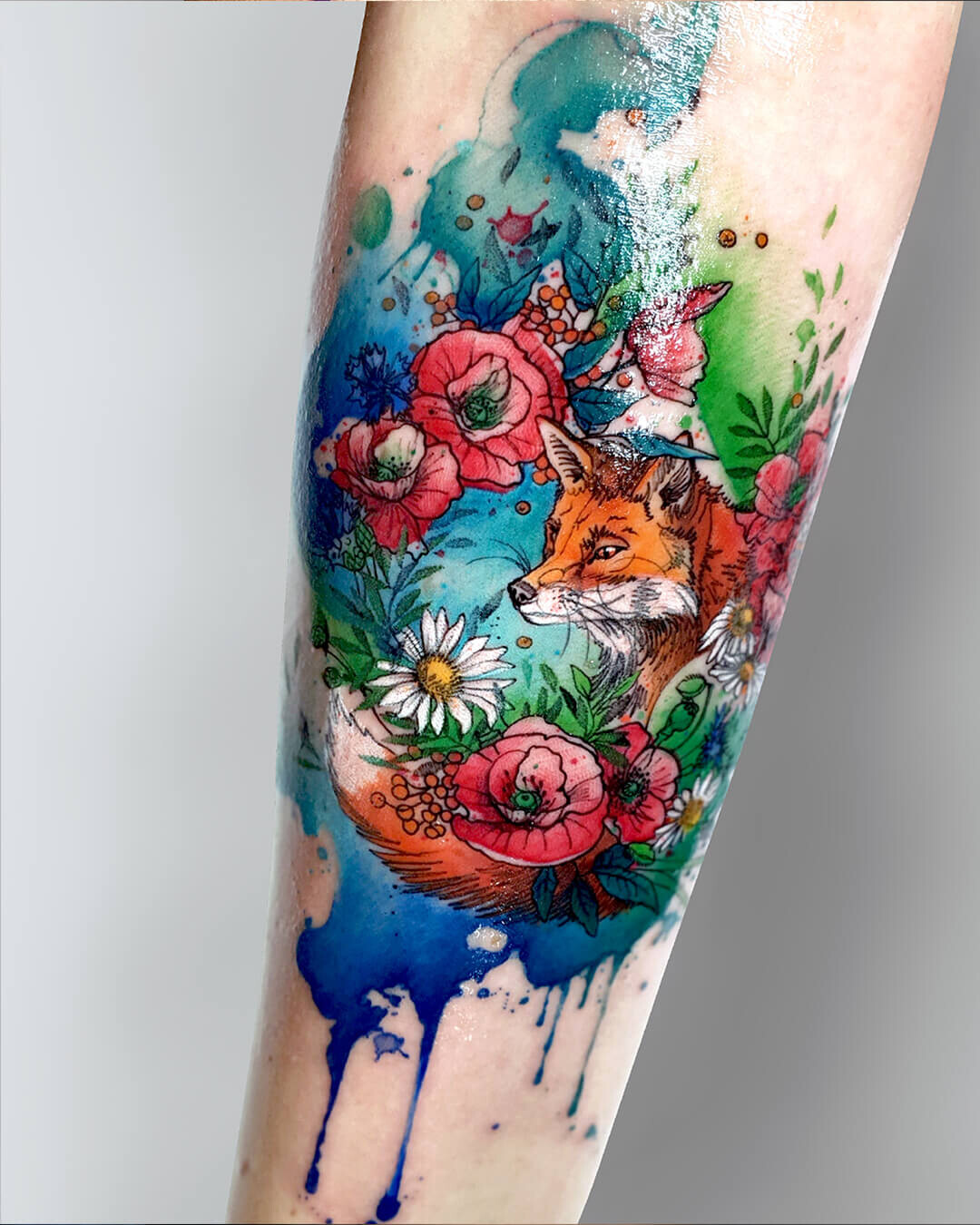
Watercolor fox with flowers
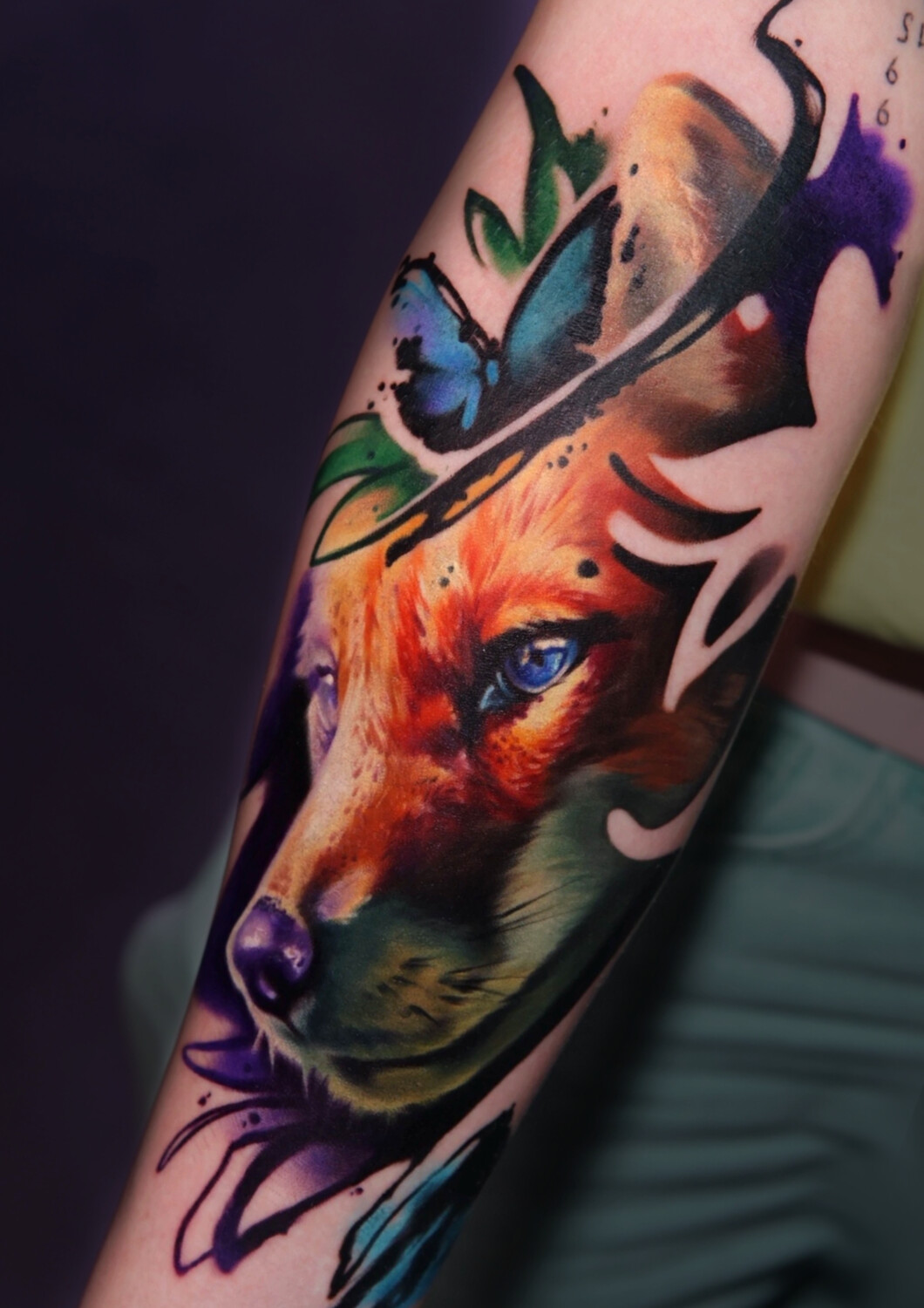
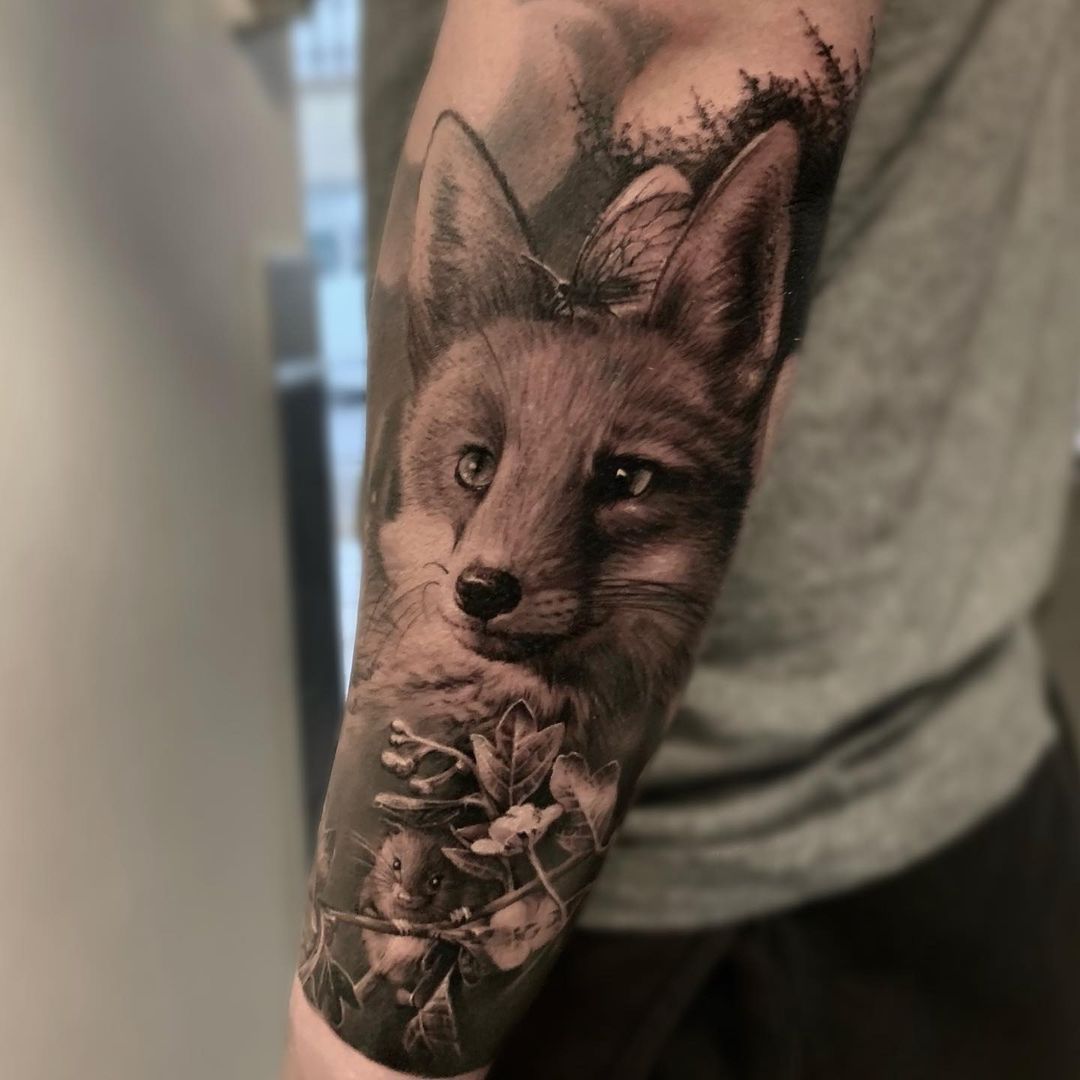
Realistic watercolor fox with butterfly
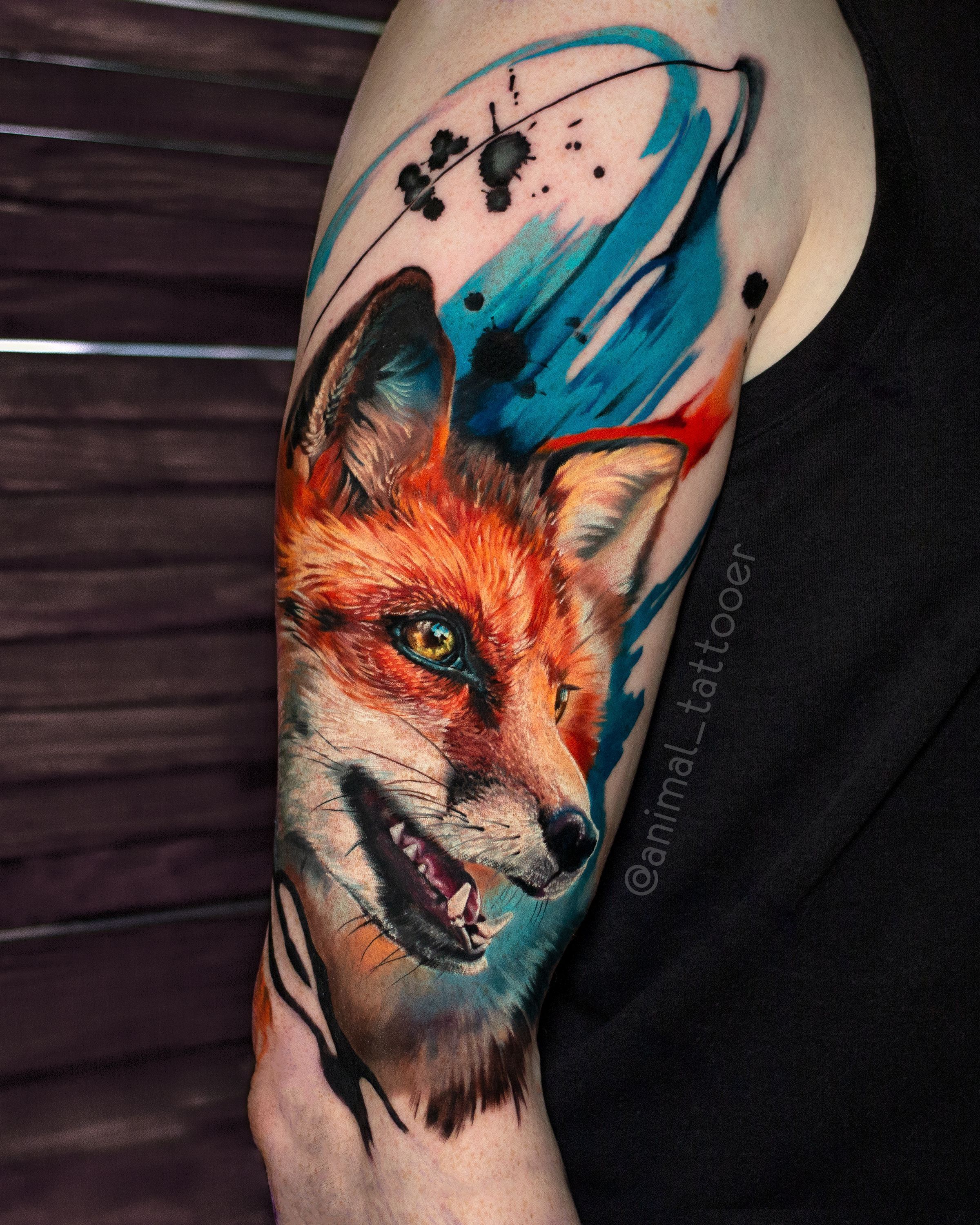
Realistic fox with watercolor, Animal_tattooer
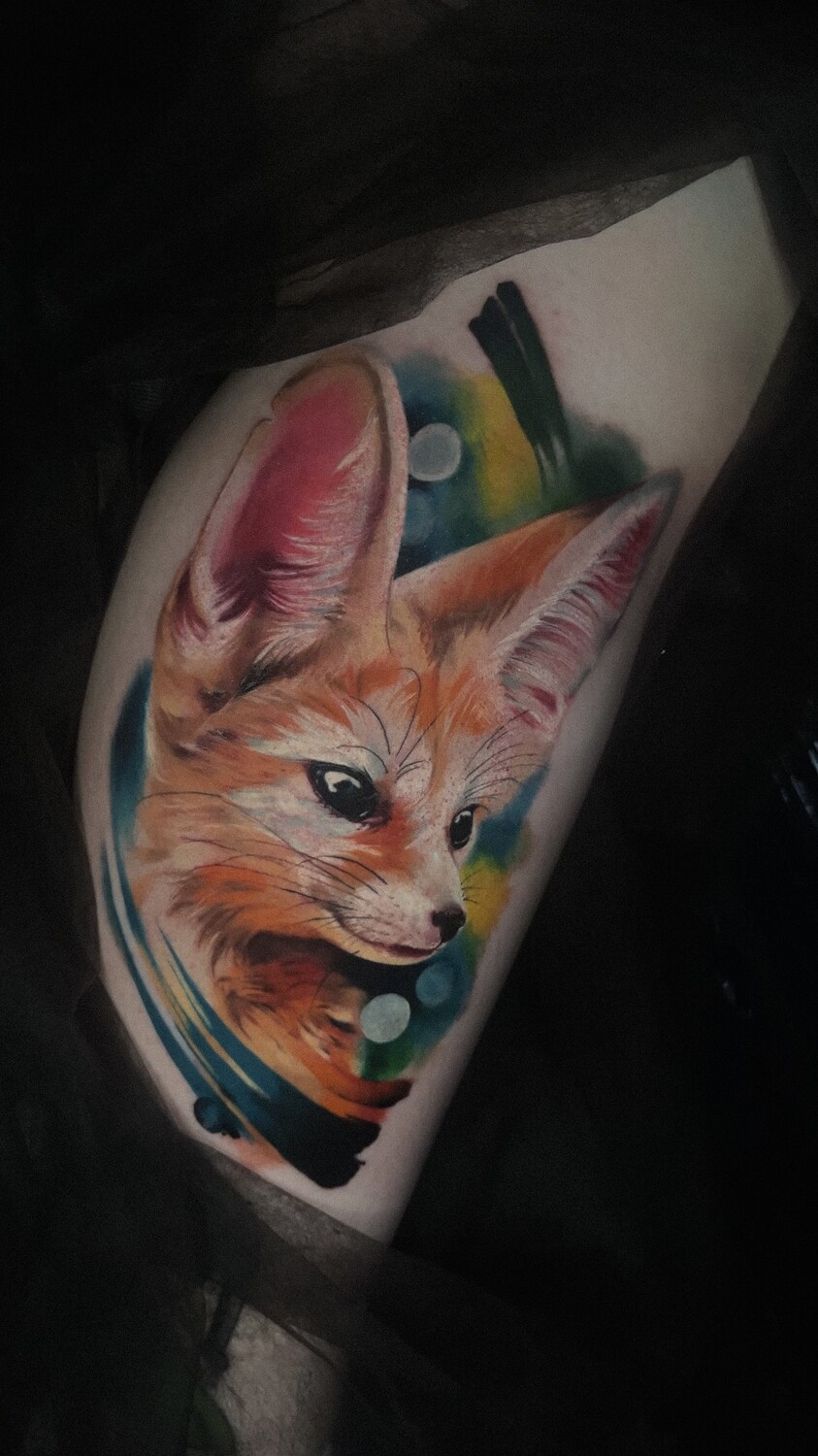
Realistic fox with watercolor background
Frequently Asked Questions
What does a fox tattoo mean for women?
Fox tattoos resonate with women for many of the same reasons cat tattoos do: they carry a kind of intelligence and beauty that has nothing to do with performance or approval-seeking. The fox is attractive without effort. Sharp without announcing it. For some women, a fox tattoo speaks to getting through a world that was not built for them by being clever rather than combative. That said, this reading is not exclusive to women. Anyone who identifies with the fox's way of moving through life can claim it.
Is a kitsune tattoo disrespectful if I am not Japanese?
The kitsune has traveled far beyond its origins, carried outward by anime, manga, and a genuine global appetite for Japanese folklore. Most Japanese tattoo artists welcome non-Japanese clients who approach the tradition with real interest. What actually matters is execution and intent. Seeking out an artist who understands the iconography, learning what the tails represent, connecting honestly with the symbolism -- that is respect. Getting something vaguely fox-shaped because it looked cool on a Pinterest board, with no sense of what the fox fire or the tail count means, is a different thing entirely. The finished piece usually shows which camp you were in.
What does the number of tails mean on a kitsune tattoo?
In Japanese mythology, a kitsune earns one additional tail for every hundred years of life, or for each significant gain in wisdom, depending on which version of the tradition you follow. A one-tailed fox is young, still accumulating experience. Five tails signals real power and age. Nine tails -- the kyubi no kitsune -- is something else altogether: a near-divine being, said to see and hear anything in the world, most often depicted in gold or white. Most kitsune tattoos land at one tail (clean, minimal) or nine (full mythological weight). Choosing something in between is uncommon, but it carries its own logic: a being mid-transformation, still on the way to whatever it is becoming.
Does a fox tattoo have any negative meanings?
It can. In several East Asian traditions, fox spirits are figures of seduction and deception -- creatures who lure humans toward harm. European folklore has its own version: the fox as thief and liar, charming but untrustworthy. However, most collectors choosing fox tattoos today are drawn to the other side of that coin: adaptability, wit, a certain feral elegance. The darker associations have largely faded from mainstream tattoo culture, and design choices do a lot of the framing. A serene, golden kitsune reads very differently from a snarling fox with hollow eyes.
How well do fox tattoos age?
Style and placement drive everything here. Japanese traditional and neo-traditional fox tattoos hold up exceptionally well over the years -- bold outlines and saturated color are just built to last. Geometric work ages cleanly too, provided the linework is precise and the spacing is right. Watercolor fox tattoos are more vulnerable, particularly the lighter washes, though a solid structural foundation underneath slows the fade considerably. Realistic fur texture needs room to breathe: at least four to five inches across, or the fine detail collapses over time. And placement matters as much as any of that. A fox tattooed on a sun-exposed forearm will fade faster than the same piece on your thigh, full stop, regardless of style or artist.
Realistic fox with butterfly and botanical details
Fox with flowers, black and gray realism

Fox with flowers, black and gray
Color-realism fox tattoo with florals
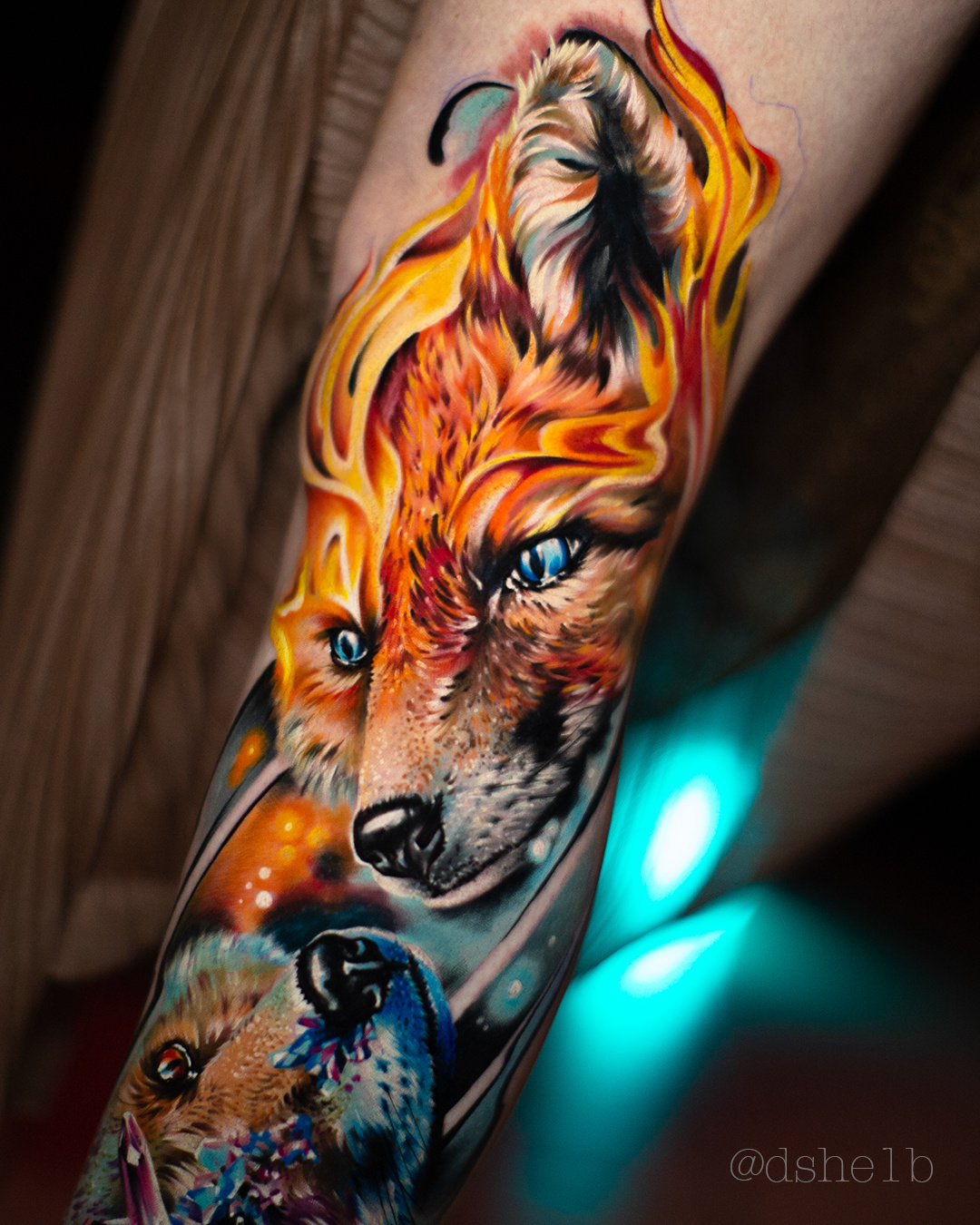
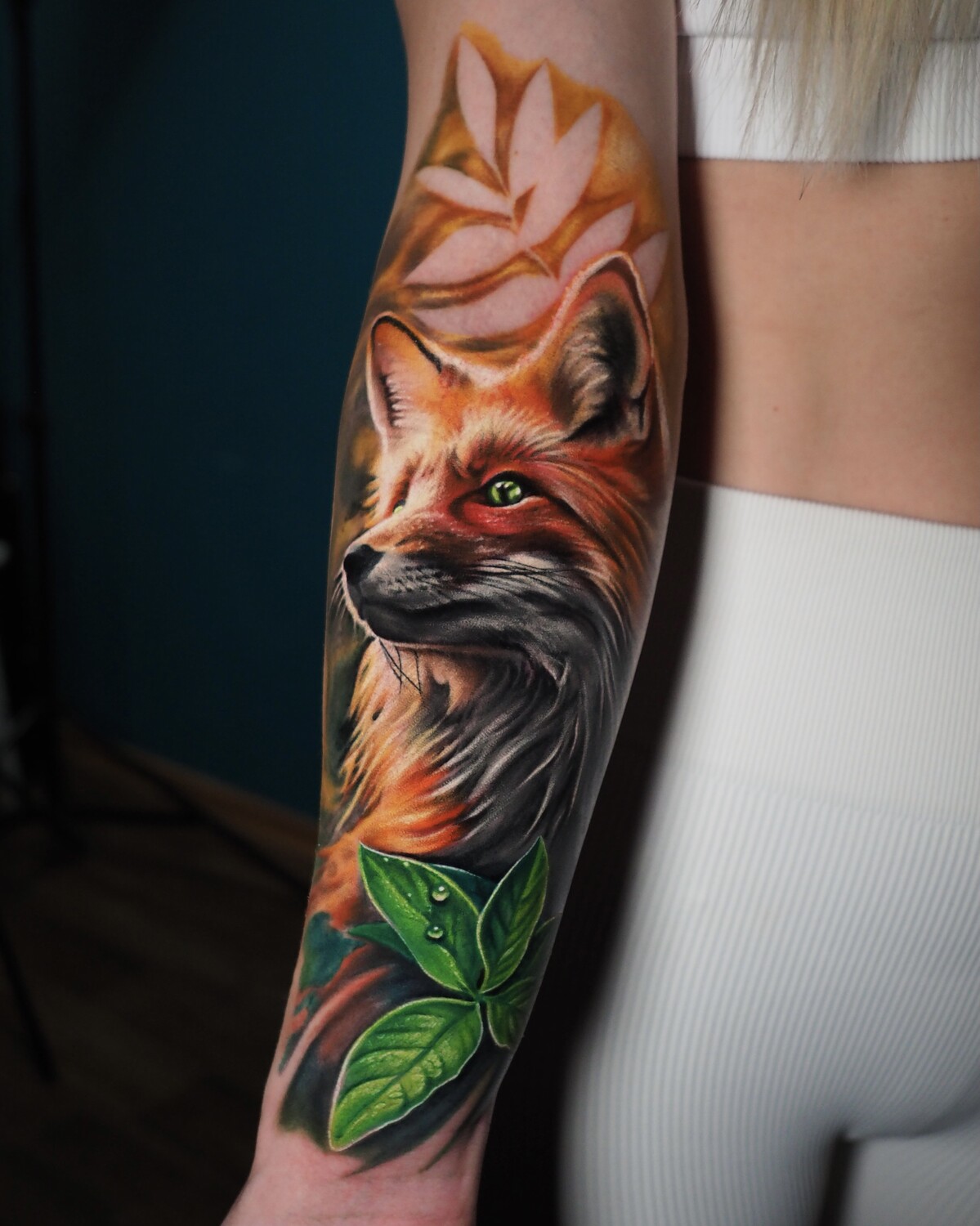
Color-realism fox with flames
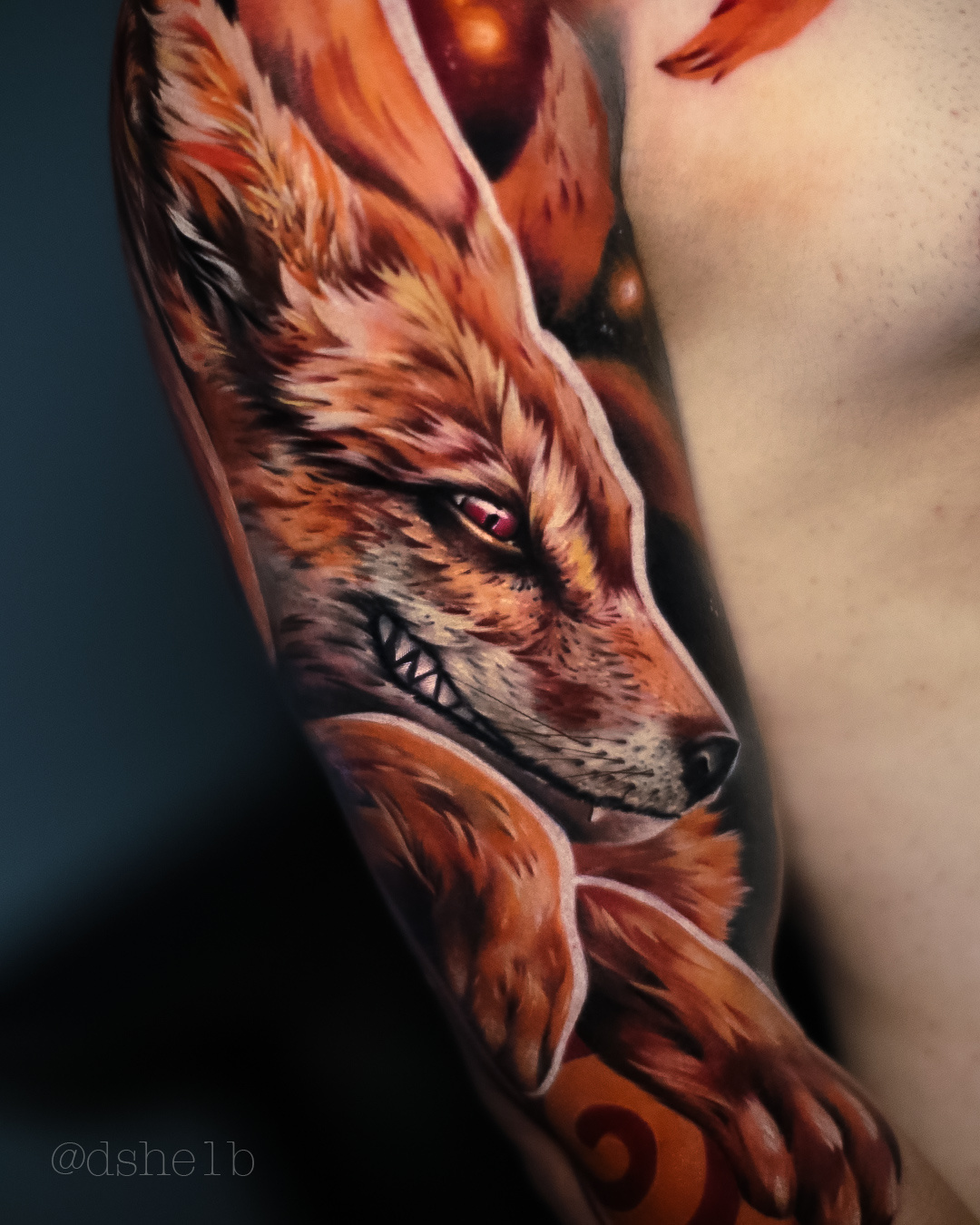
Color-realism fox portrait by @dshelb