A horse tattoo means freedom, strength and a partnership that has to be earned: the horse is the one animal humans could not have built empires, crossed continents or won wars without. Which of those readings you are wearing depends on the design: a loose mustang on a ridge and a saddled horse under a rider say different things, and the traditions behind them (Celtic, Chinese, Plains, Western, Greek) do not agree with each other either.
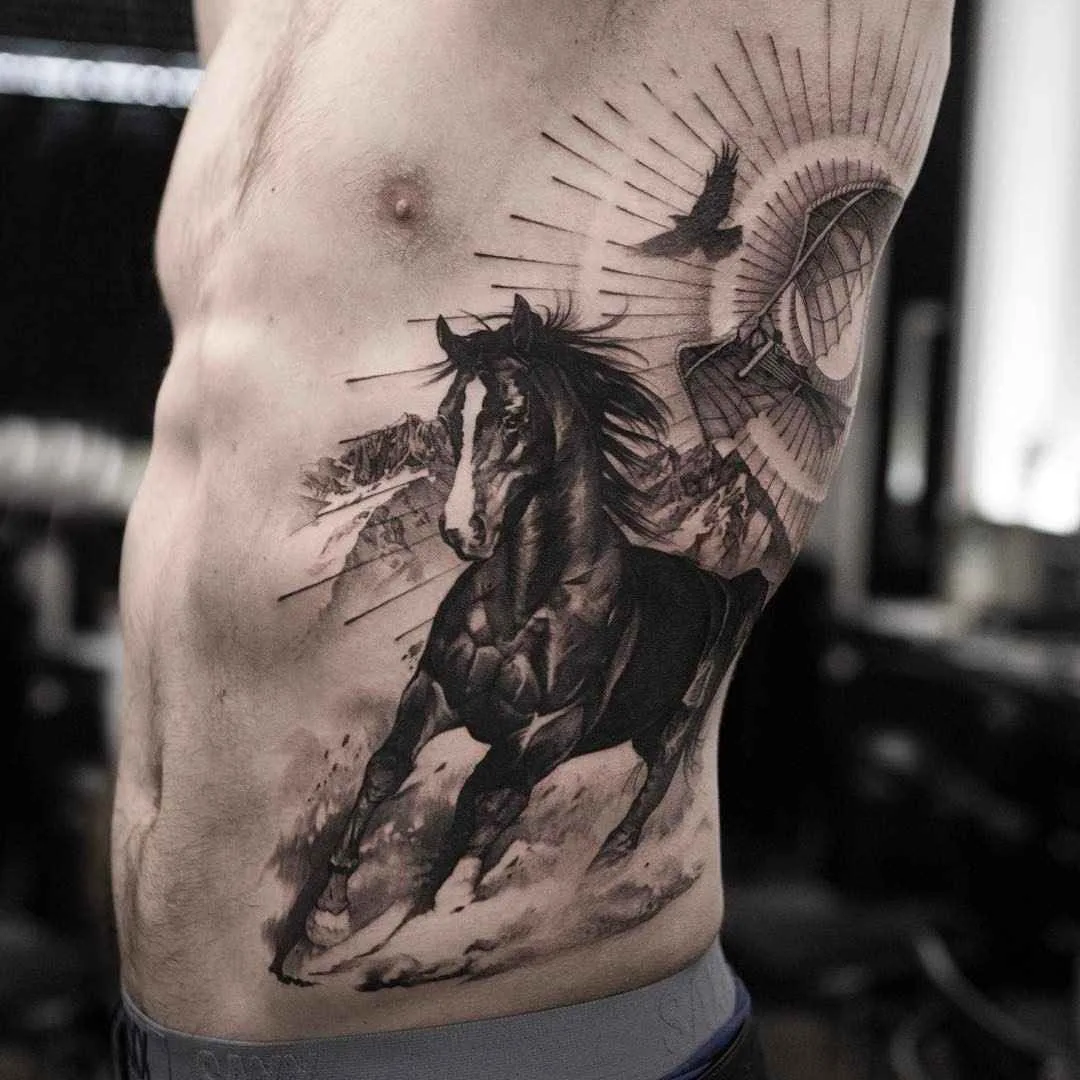
- Freedom is the reading people say first; partnership and earned status are what most clients actually mean.
- Each tradition gives the horse a different job: Celtic sovereignty, Chinese momentum, Plains wealth, Western freedom, Greek aspiration.
- A rider shifts the subject from the animal to the person who earned it.
- Four thin legs decide scale: a full figure under fifteen centimetres will not survive ageing.
- Pick an artist by healed horses in the portfolio: anatomy errors show at a glance.
What a horse tattoo means
Freedom is the obvious reading, and it is the one people say out loud. But look at what artists actually get asked for and the picture changes: horses with tack, horses with riders, horses that belonged to someone (an animal from a childhood, a grandfather's farm, a racing yard). The client who says "freedom" first usually says "partnership" third.
That is because the horse is the domesticated animal that was never fully domesticated. A horse cooperates, and the cooperation is conditional. Anyone who has worked with one knows the relationship is negotiated daily, and that five hundred kilograms can end it at any moment by deciding not to. The tattoo carries that: strength you work with rather than own.
Then there is status. For more than five thousand years, since the Botai people of northern Kazakhstan kept horses (and possibly milked and rode them) around 3500 BC, the horse has been the measure of a person's standing. Knights were chevaliers and caballeros, literally horse-men, and a mounted man was a different class of man. The association has moved to racing paddocks and show-jumping arenas, but the logic is unchanged: a horse on your skin claims something, usually that you earned it.
Endurance and work sit underneath all of that. The Pony Express of 1860–61 changed horses every ten to fifteen miles because no single animal could sustain the pace; endurance riders today cover 160 kilometres in a day on one, which is closer to what it was built for. People who have carried a heavy load for a long time recognise that reading before any mythology.
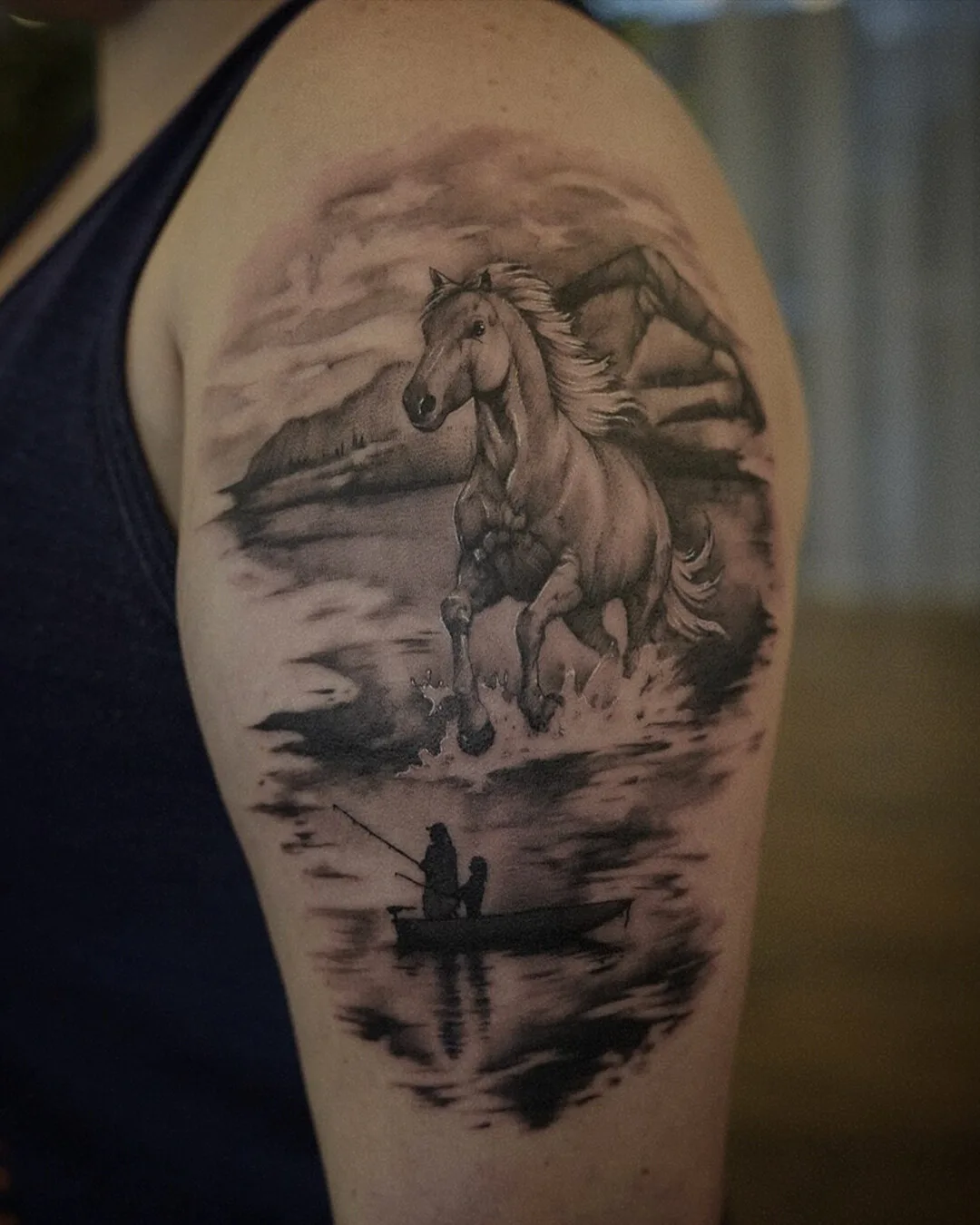
The design settles which of these you are wearing. A riderless horse in motion says freedom. A horse head in portrait says a bond with one specific animal. A horse with a rider (knight, cowboy, samurai) says mastery, and shifts the subject from the animal to the person on it. Most people know which they want before they can explain why.
Celtic mythology: Epona and Rhiannon
Epona was a Gaulish goddess of horses, and one of the few Celtic deities to reach the Roman calendar; a calendar from Italy gives her feast as 18 December. She is shown sidesaddle on a mare, or between two horses. Roman cavalrymen honoured her from Britain to the Danube, and her images were kept in stables. Her domain was plenty, and some scholars also read her as a guide between worlds, because she turns up on funerary monuments.
Rhiannon is the Welsh figure, and her story in the Mabinogi carries the sovereignty idea more sharply. She rides past Pwyll, prince of Dyfed, on a white horse at a walking pace, and no rider he sends can catch her however hard they gallop, until he simply asks her to stop. Later, falsely accused of killing her infant son, she is made to sit at the gate and carry visitors on her back like a horse. The horse goddess is won by asking rather than chasing, and her humiliation and restoration track the fortunes of the kingdom. That is the Celtic reading: the horse as the animal a ruler is judged by.
Chinese zodiac: the seventh sign
The Horse is the seventh of the twelve zodiac animals, paired with the earthly branch wu, the hours from 11 a.m. to 1 p.m., the direction south and the element fire: the yang animal at the height of the day. People born in horse years (1978, 1990, 2002, 2014, 2026) are described as energetic, quick and impatient: good at starting things, bad at being fenced in. The idiom mǎ dào chéng gōng, "success the moment the horse arrives", still goes on New Year banners.
2026 is a Fire Horse year, which comes round every sixty years and has a reputation: in Japan, where Fire Horse women were believed to be dangerous to their husbands, the birth rate fell by about a quarter in 1966. A tattoo marked as Fire Horse takes that edge on deliberately.
The visual tradition runs deep. The Han emperor Wu sent armies to Ferghana for the "heavenly horses"; Tang emperor Taizong had his six war horses carved for his tomb; and Xu Beihong's ink-wash gallopers from the 1940s move to skin almost unchanged: a few strokes and a lot of empty space.
Native American traditions: the horse as wealth and status
Horses reached the Plains through Spanish New Mexico, and the flood came after the Pueblo Revolt of 1680 put thousands of animals into Native hands. Within a few generations nations that had hunted buffalo on foot were mounted: the Comanche among the first, then Lakota, Cheyenne and Crow. The Lakota word for horse, šúŋkawakȟáŋ, is usually rendered "sacred dog": the new animal was named for the one that had carried the loads before it.
Wealth was counted in horses. A family's herd was its bank; a bride price was paid in horses; a young man who came home with horses taken from an enemy camp had earned status in the most direct way there was. Coups were recorded on the horse as well as the rider, in painted marks that, by most accounts, had set meanings: a handprint for an enemy killed at close quarters, a circle round the eye for keen sight. The Nez Perce bred the spotted Appaloosa; the Crow made horse regalia that museums now show as art.
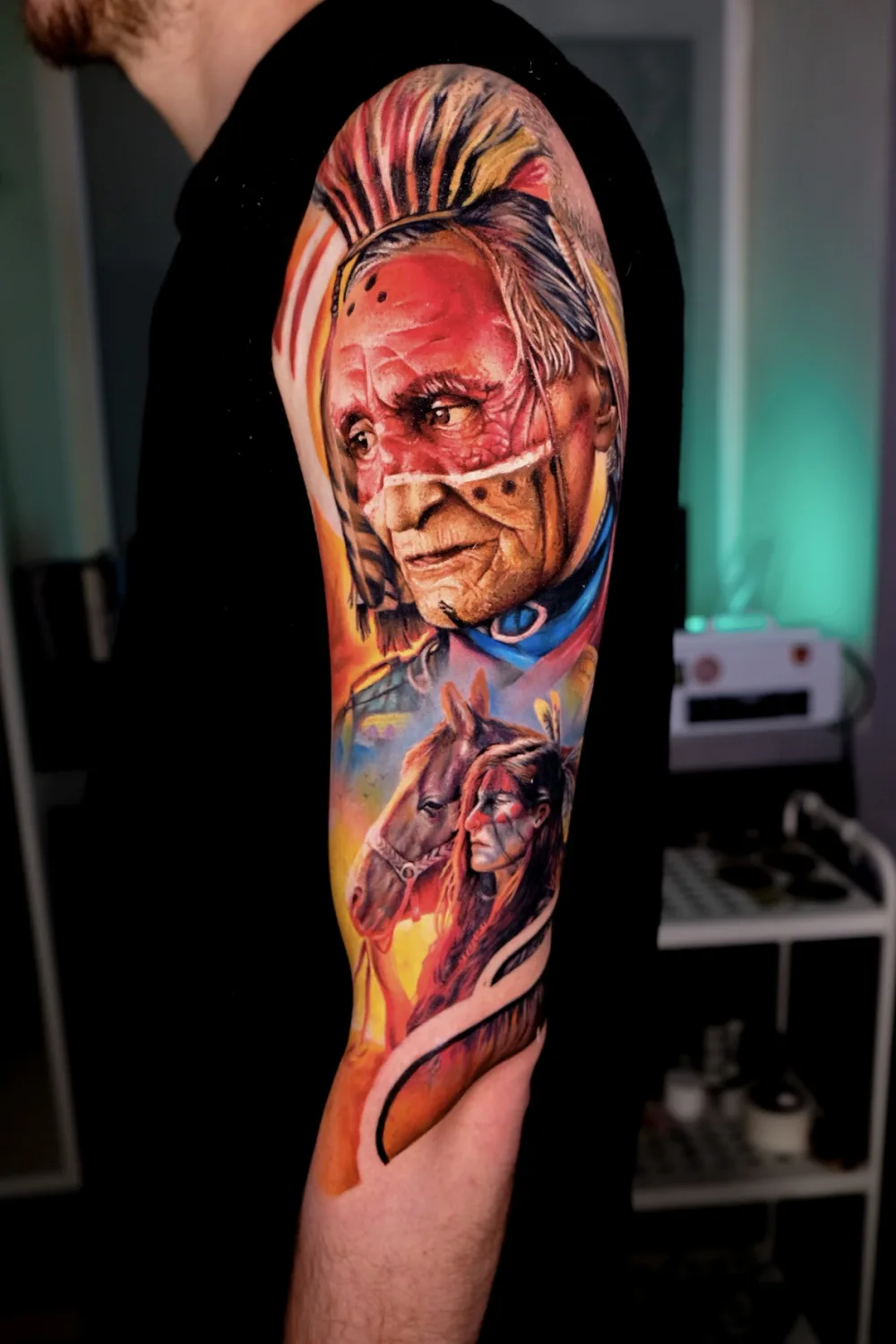
For anyone outside those nations, the workable approach is the general reading (the horse as earned wealth) while leaving painted symbols, regalia and ceremonial imagery to the communities they belong to.
American Western: the horse as freedom
The open-range cattle era lasted about twenty years, from the first big drives up the Chisholm Trail in 1867 to the winter of 1886–87 that killed the herds, and it produced most of the imagery Western clients bring in: the cowboy, the bronc, the mustang on the ridge. Frederic Remington's sculpture The Bronco Buster (1895) fixed the rearing horse and clinging rider as the pose; Wyoming put a bucking horse on its licence plates in 1936 and never took it off.
The mustang is the freedom image proper: Spanish stock gone feral, protected since the 1971 Wild Free-Roaming Horses and Burros Act after a campaign led by Velma Johnston, a Nevada secretary the press called Wild Horse Annie. A mustang tattoo says the wearer got loose from something. That is the reading most Western clients mean, and the design is usually riderless for that reason.
The cowboy's horse says something else, and it is the reading they mean second. On a drive the horse was the tool a man's life depended on, closer to a colleague than a pet. A horse-and-rider Western piece is about that partnership, and about competence: a person who can handle what they are sitting on.
Greek mythology: Pegasus and the centaurs
Pegasus is born from the neck of Medusa when Perseus beheads her: a winged horse out of a monster's blood. He strikes Mount Helicon with a hoof and opens the Hippocrene, the spring of the Muses, which makes him a poet's animal as well as a hero's. Bellerophon tames him with Athena's golden bridle, kills the Chimera from his back, then tries to fly to Olympus itself; Zeus sends a gadfly, Pegasus throws him and goes on alone to carry the thunderbolts. The winged horse is aspiration, and the rider who forgets the horse is not his falls.
The centaurs are the opposite figure: a human who cannot get out from under the horse. Most of them are drunk and violent: at the wedding of Pirithous they try to carry off the bride, a brawl carved across the Parthenon metopes. Chiron is the exception: tutor to Achilles and Asclepius, wounded by one of Heracles' arrows and in such pain that he gives up his immortality. A centaur tattoo picks one: the instinct, or the discipline that masters it.
In some versions of the contest for Athens, Poseidon made the first horse by striking the ground with his trident: the horse as elemental force.
Tattoo styles that suit the horse
Realism and black and grey. The most requested approach, and the one where the horse is unforgiving: everyone has seen a horse, and a hock bent the wrong way reads as wrong even to people who cannot say why. Good horse realism gets the skull right first (the long face, the nostril, the eye set on the side of the head) and lets the coat do the rest; a horse in a landscape is the standard large format and holds a rib or thigh well.
Neo-traditional. Bold outlines, a wider palette, and room for a mane that flows into flowers or ornament. The horse's profile, the arched neck and the curve of the jaw, suits the decorative logic of the style better than almost any other animal, which is why neo-traditional horses on thighs have become a genre of their own. They age well because the line carries the image.
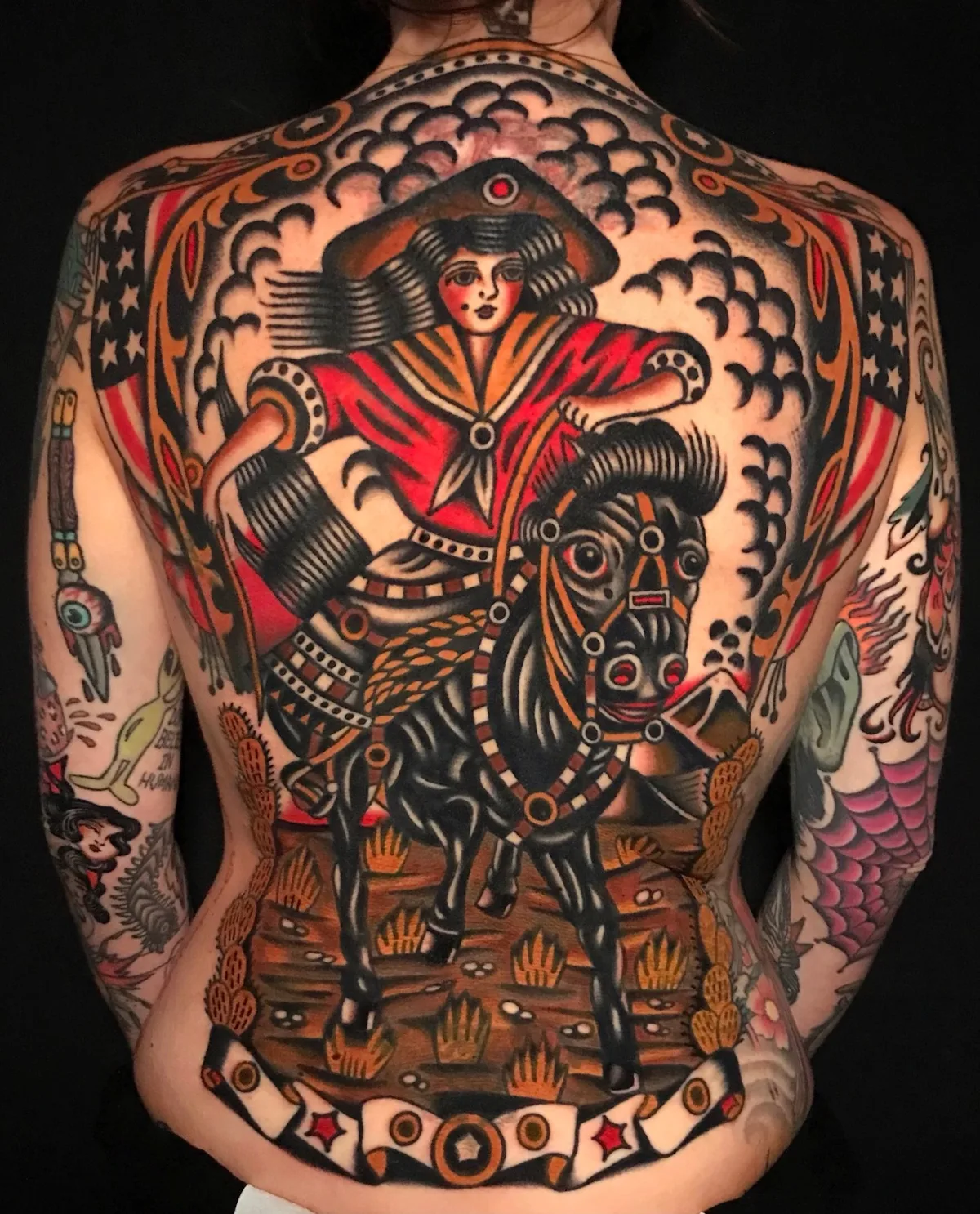
Traditional and old school. The cowboy on a bronc, the horse head with a rose or a horseshoe, the Western scene laid out flat with a banner: this is where the American reading lives, and the style's graphic simplicity suits a subject with a strong silhouette.
Blackwork and engraving. Solid black, or hatched like a woodcut, a horse and rider in this register looks like a print pulled from an old book: a knight, a Dürer horseman. It is the natural style for the darker readings: the black horse, the skeleton horse, the four horsemen.
Japanese. The horse appears in Japanese art carrying samurai into battle (Takeda Shingen's cavalry, the mounted archers of yabusame), and the style's composition rules, with wind, water and cloud filling the background, turn a horse into a scene rather than a portrait. A samurai on horseback across the ribs is a full project, but the format holds a large area better than realism.

Knight with flag blackwork tattoo by @heaventattooer

Jousting knights engraving tattoo by @marcocmatarese
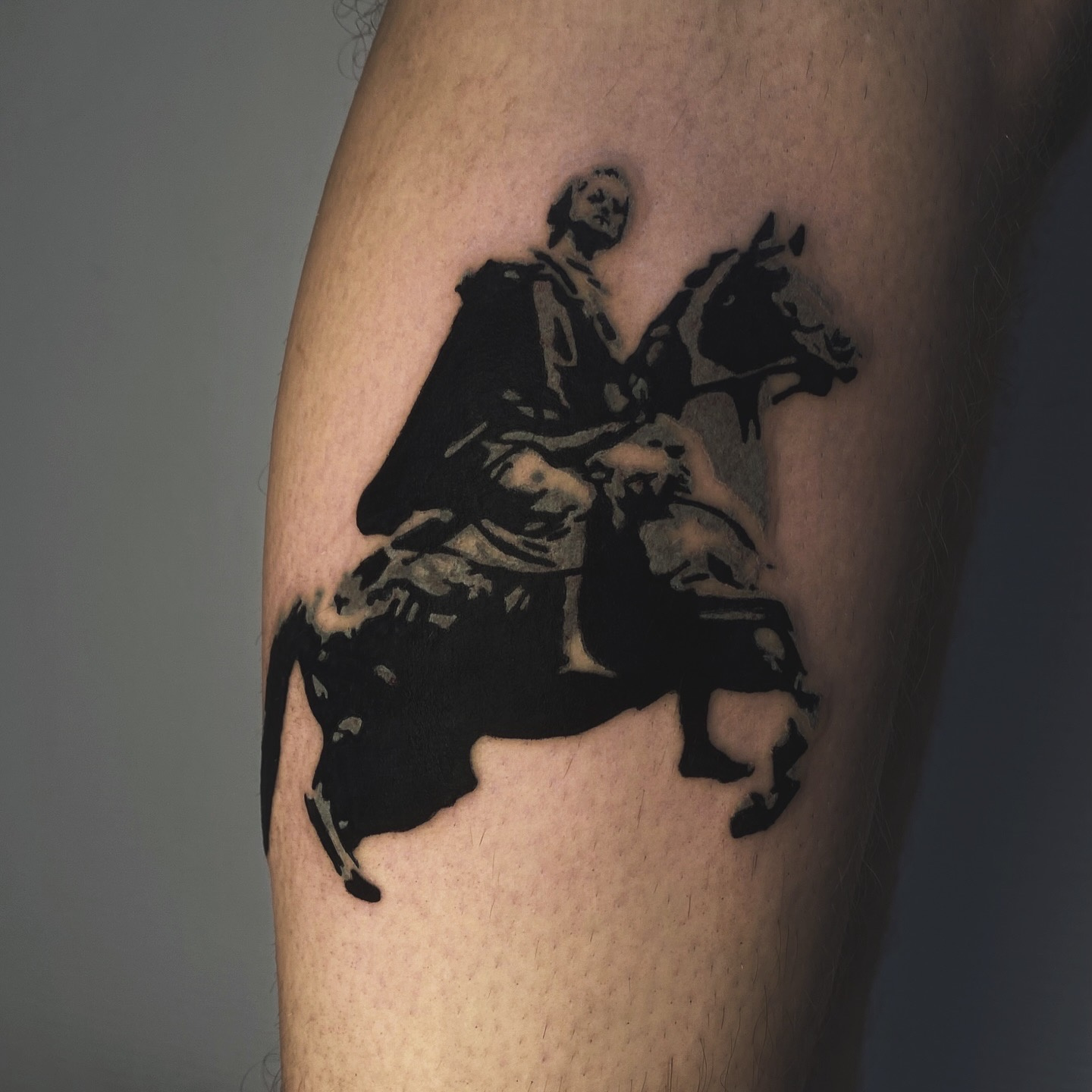
Rider on horseback blackwork tattoo by @Voytz_ttt

Rider blackwork engraving tattoo by @nathan_kostechko

Skeleton rider and city tattoo by @ivan.zagusta
Watercolour, geometric and fineline. Watercolour suits the horse's motion but needs a line structure under it to last. Geometric work that breaks a horse into planes still works when the geometry follows the anatomy rather than being scattered for effect. Fineline horses are the small-scale option, and the legs vanish first.
To see how differently the same animal is handled across these registers, the horse motif page collects the work by style and placement: riders and riderless, portrait and full figure, side by side.
Placement and scale
The horse is a horizontal animal with four thin legs, and that shape decides placement more than taste does: it needs length, and it needs enough room for the legs to stay separate.
The thigh has become the default for large horse pieces, and it is the placement you see most: a broad, flat, nearly vertical canvas that takes a horse in profile at a size where the legs and the eye both survive. It is also where people put a tattoo they want for themselves rather than for the room.
The side and ribs suit a horse in a landscape: a galloping figure with mountains behind it, or a mounted samurai. The area is long and curves with the body, and a horse in motion reads well along it. It is one of the more painful places to sit, and such pieces are nearly always multi-session.
The forearm takes a horse head, a rider in engraving style, or a small full figure at the limit of what the width allows. A galloping horse wrapping the forearm loses its legs round the back, so most forearm horses are heads or standing figures.
The upper arm and shoulder buy room for context and extend into a sleeve later. The chest suits a knight on horseback or a traditional horse-and-rose laid across the pectoral, and the sternum gives a rearing horse its vertical. The back is where the ambitious pieces go: a skeleton horse, a skull with a horse, a cowboy scene across the whole surface. A back piece is measured in months.

Rearing horse forearm tattoo by @ag_blackwork

Samurai on horse tattoo by @oliverthortattoo

Minimalist linework horse tattoo by @_dr_woo_

Full back horse tattoo by @mihailpolina

Roman chariot sleeve tattoo by @sasha.prudnikov.tattoo
Scale is a separate decision from location, and for the horse it is the more important one. A full-figure horse under about fifteen centimetres long cannot keep four legs distinct once the lines spread; a head under about eight cannot keep the eye and nostril open. Below those sizes the honest options are a silhouette, a horseshoe, or a linework head with the detail deliberately left out. An artist will say this if asked directly.
Design variations and what they change
Rearing. Front legs up, weight on the hocks: the pose of equestrian statues. It reads as power under pressure, the moment before something breaks or is brought under control, and it fits a vertical space, which is why it dominates chests and calves.
Galloping. All four feet off the ground (a fact Eadweard Muybridge had to photograph in 1878 to prove), the running horse says freedom, urgency, forward motion. Left to right is progress; right to left is return.
Standing, and the head portrait. A calm horse or a close portrait of the head is almost always about a specific animal. Memorial pieces for a horse that has died are common commissions, and they carry what the general symbolism does not: a particular blaze, a particular ear.
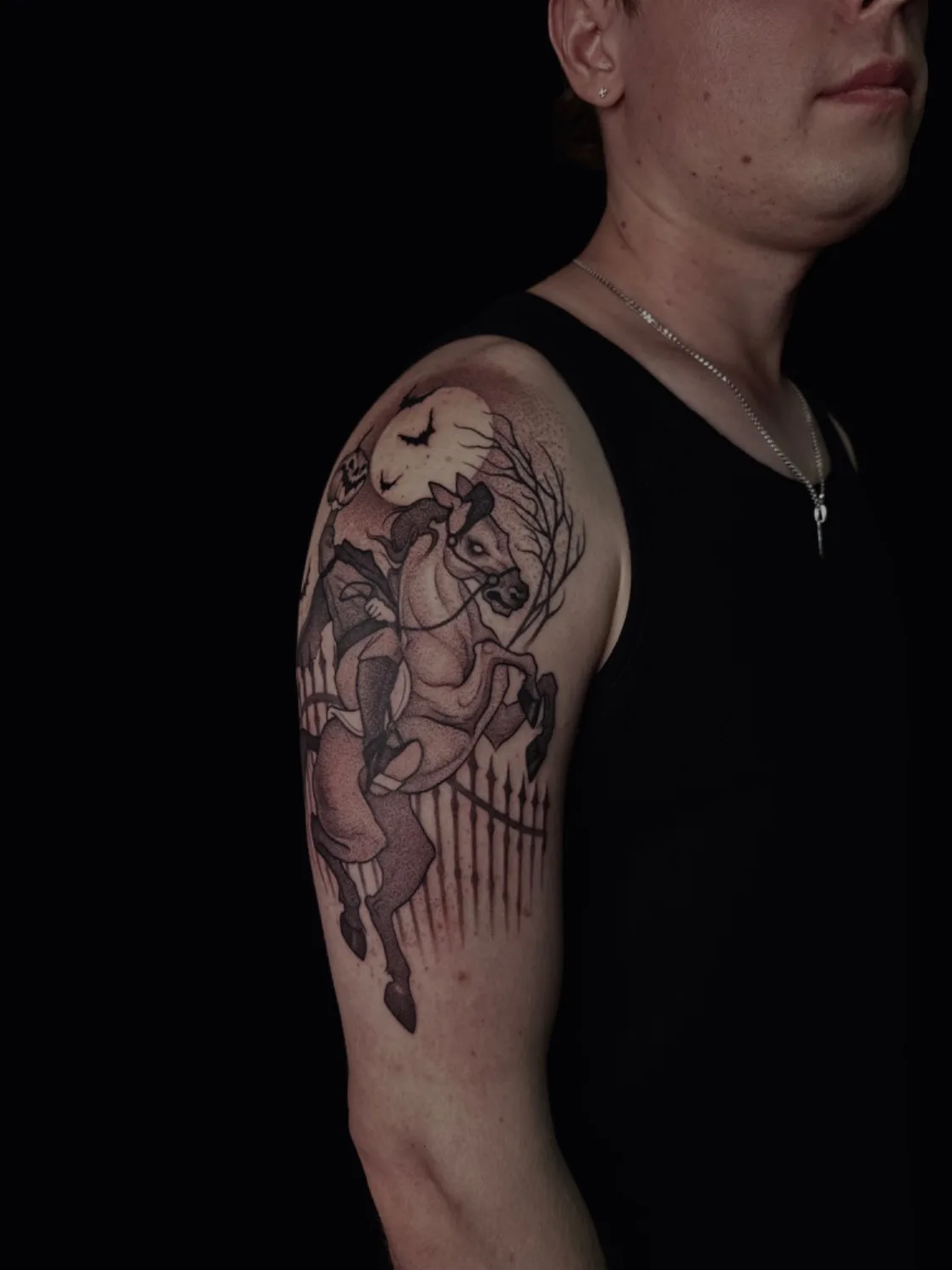
Horse and rider. Adding a person changes the subject. A knight makes it about vows and service; a cowboy about competence and the West; a samurai about discipline; a headless horseman or a skeletal rider turns the horse into a vehicle for death. In all of them the horse becomes the thing the rider has earned, which is the reading most horse-and-rider clients are after.
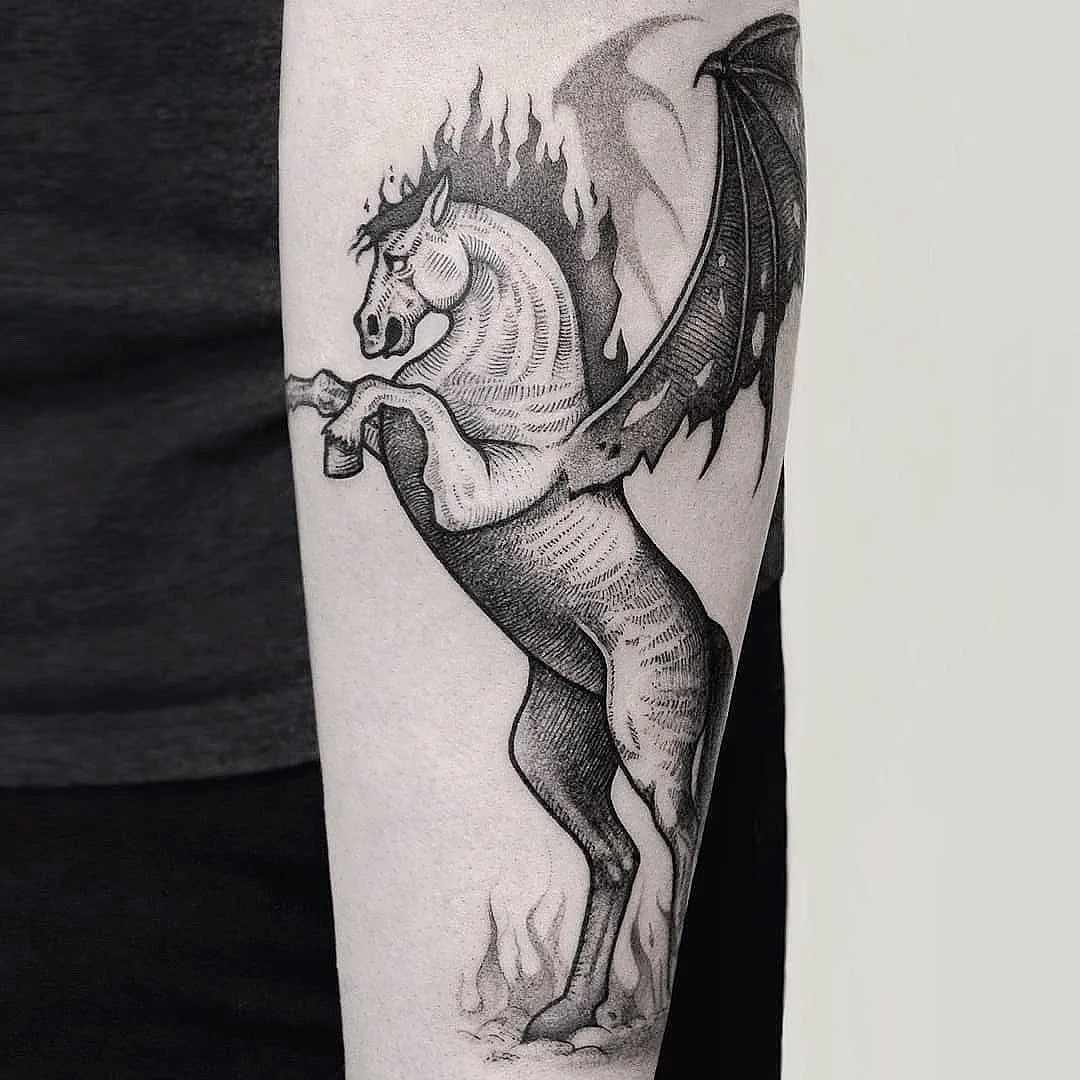
Winged. Pegasus, or a generic winged horse: aspiration, the writer's and the survivor's animal. The wings should look as if they could lift the body; small decorative wings turn it into a carousel horse.
Skull and skeleton. A horse skull is an unusually beautiful object, long and hollow with the teeth on show, and a skeleton horse in full stride is one of the strongest images blackwork has. Both point at mortality, the end of a way of life, or the pale horse of Revelation.
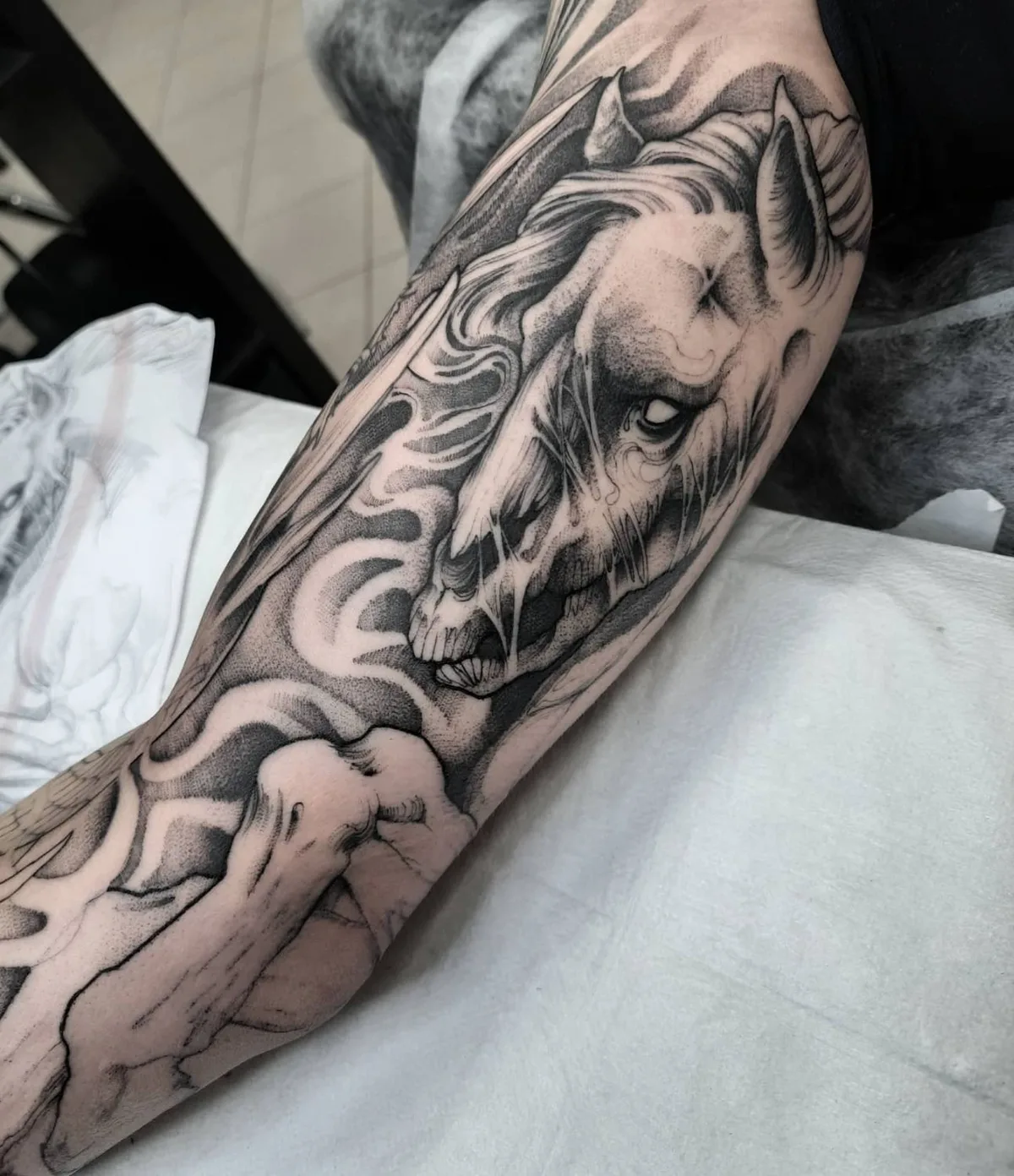
The colour of the horse. Black horses carry the night and the supernatural: the kelpie, the Wild Hunt. White horses carry purity and, in Revelation, conquest. A chestnut or bay is usually somebody's real horse.
Flowers, horseshoes and ornament. Neo-traditional territory: a mane flowing into peonies or roses turns the animal into a decorative object rather than a portrait. A horseshoe on its own is a luck charm and a different piece: points up to hold the luck in, points down to pour it over you.
Choosing an artist for a horse tattoo
The horse is one of the animals tattoo artists most often draw badly. The problem is anatomy: the hock is the horse's ankle, not its knee, and bends the opposite way from what people expect; the pastern angle, the set of the ears, the depth of the chest. A client who rides will spot an error in a second, and one who does not will still feel that something is off.
So the first check is horses specifically, in the portfolio, healed. Dogs, wolves and big cats do not transfer. Ask for healed photographs rather than fresh, because fresh work photographs beautifully and says nothing about how the mane and the legs settle.
Second, match the reading to the artist's register. Oscar Akermo works the horse as black-and-grey realism set into mountains along the ribs: the landscape format, where the animal is one element of a scene. Emily Rose Murray takes the neo-traditional route, a horse on the thigh with flowers worked into the composition, where line and colour carry the piece rather than shading. Nathan Kostechko renders horse and rider in blackwork with engraving hatching on the forearm, so the piece reads like a print rather than a photograph. Three different tattoos of one animal, and the choice between them settles more than size or placement will.

Horse head portrait tattoo by @roman_zao

Horse with blue flowers tattoo by @natilleray_tattoo

Neo-traditional horse with red flowers tattoo by @kike.esteras

Neo-traditional horse with rose tattoo by @martyearly

Watercolor horse with flowers tattoo by @misspank
Third, bring the right reference. Photographs of real horses (the specific horse, if there is one) are worth more than screenshots of other tattoos. Say which tradition you mean, if you mean one; a Celtic, a Plains and a Western horse are not composed the same way.
If you want to compare artists by style, country and city before contacting anyone, the tattoo artist directory filters on all three.
Aftercare and how a horse tattoo ages
Healing is standard: keep it clean, keep it lightly moisturised, leave the scabs alone, and keep it out of pools, sea and direct sun: two to three weeks for the surface, a few months underneath. Riders have one extra problem: a fresh thigh or calf piece under a saddle and boots, in the sweat and dust of a yard, is not what a healing wound wants. Plan the session around a break from the stable.
Beyond healing, the horse has two specific ageing risks. The first is the legs: they are the thinnest part of any full-figure design, and as lines spread over ten or fifteen years they close up first. A horse drawn with the legs at the limit of the size ends up standing in grass. The second is the mane and tail: fine, flowing lines that look superb fresh and blur early unless anchored to solid shapes. A good artist builds the horse so the silhouette survives when the detail does not.
Black and grey softens evenly; colour fades unevenly, reds and yellows first, so a chestnut horse can turn grey before its rider does unless the underpainting allows for it. Sunscreen does more for its long life than any tattoo-specific product. Budget one touch-up in the first year for anything with fine linework.
Frequently asked questions
What does a running horse tattoo mean?
Freedom pursued rather than dreamed about: momentum, urgency, going somewhere. It is the most common horse pose in tattooing for that reason, and the one that needs the most room, because the legs are extended. Left to right reads as progress, right to left as going back.
What does a black horse tattoo mean?
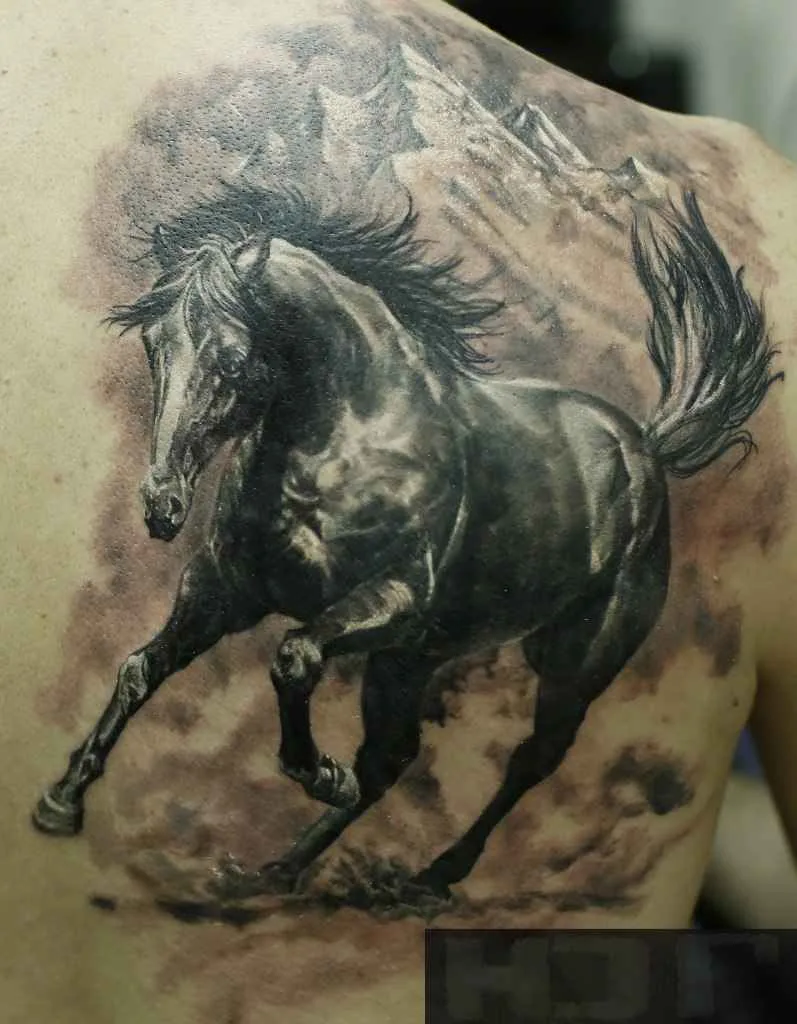
Mystery, the supernatural and death in most European folklore: the kelpie, the Wild Hunt, the black horse of Revelation carrying famine. On skin it suits blackwork. Many black horse tattoos are simply portraits of a black horse the wearer knew.
What does a horse skull tattoo mean?
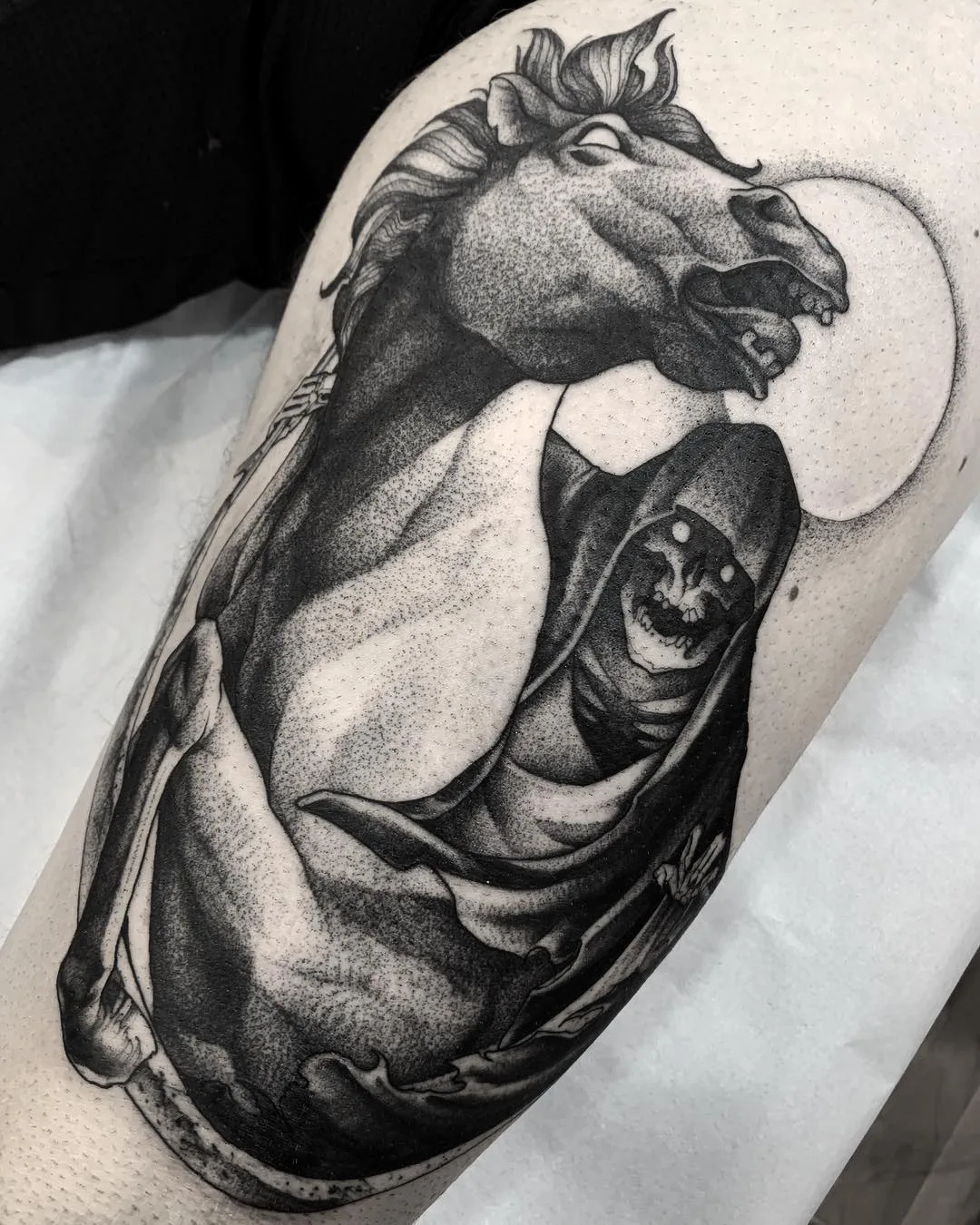
Mortality with a horse's freedom folded into it: the end of a way of life, respect for the cycle, sometimes protection, since horse skulls were buried under thresholds to guard a boundary. Visually it is one of the best skulls in tattooing.
What does a horseshoe tattoo mean?
Luck, in a small piece that can go anywhere: wrist, ankle, behind the ear. The argument about which way up it goes has never been settled: points up so the luck stays in the bowl, or points down so it pours over you. Paired with a horse head or a rose it becomes a traditional-style staple.
What does a rearing horse tattoo mean?
Power held at the edge of control: the horse rising against the rider, or against nothing at all. It is the pose of equestrian statues, and it fits vertical spaces like the chest and calf.
Are horse tattoos only for people who ride?
No. Riders and owners get them as memorials and portraits of specific animals, but the larger share are about the symbolism (freedom, earned strength, partnership) and are worn by people who have never sat on a horse. Equestrians will notice if the anatomy is wrong, so get it right either way.