There's a particular kind of tattoo client who comes in asking for a koi fish and already has the whole thing figured out. The direction it swims, the color, the water around it, all decided before they've sat down. And usually, about half of what they believe about koi symbolism is wrong. Not their fault. The internet is full of confident-sounding explanations about koi fish tattoos that are, to put it charitably, incomplete. Some of them are just made up.
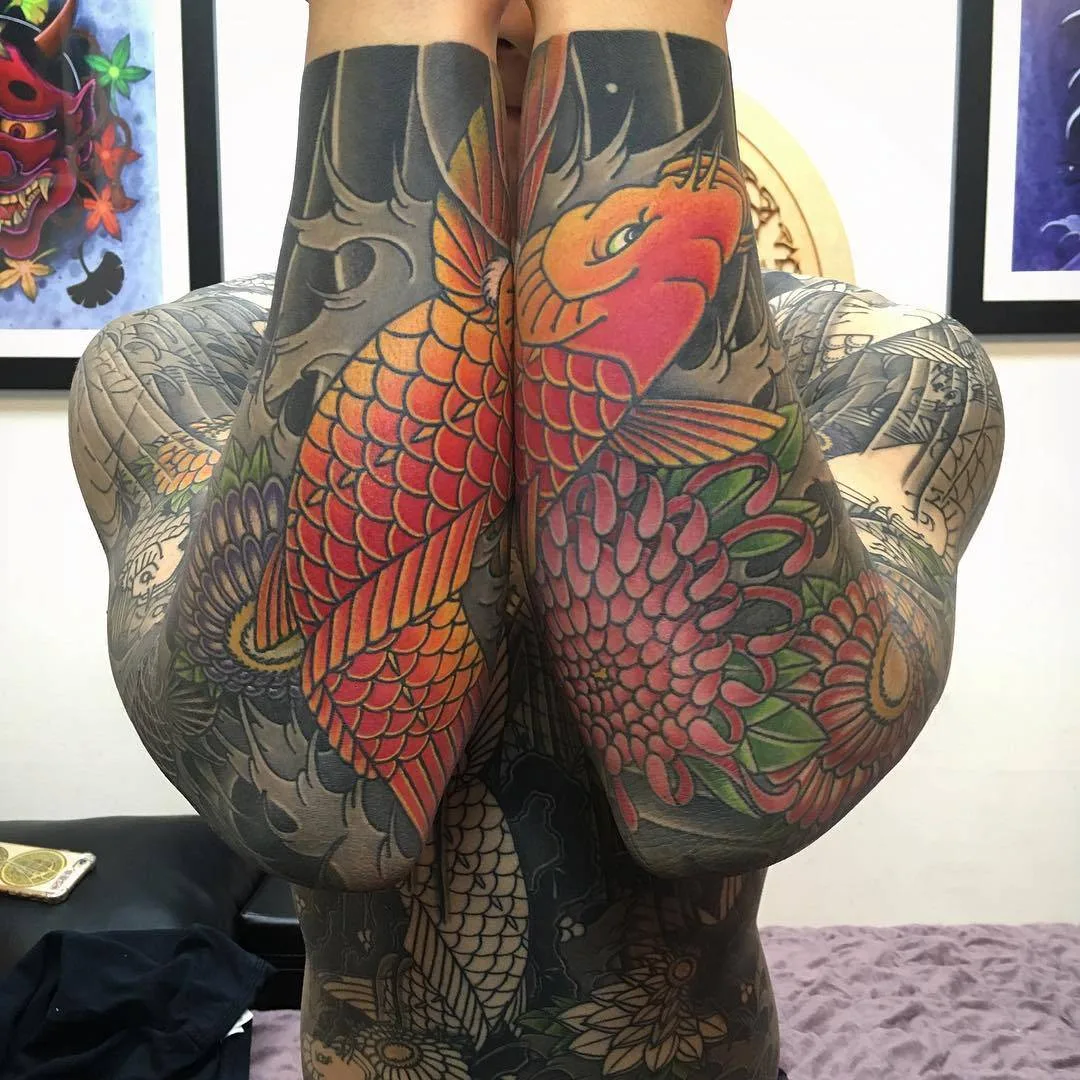
But that's actually part of what makes the koi so interesting as a tattoo subject. It sits at this intersection of genuine ancient mythology, modern reinterpretation, and pure aesthetic appeal. There's a real story here. Several, actually.
The Dragon Gate Legend
If you're going to understand koi tattoos, you have to start with the Dragon Gate. It's the structural spine of almost everything the koi represents, and it's a genuinely great myth, the kind that sticks with you long after you first hear it.
The legend goes like this. On the Yellow River in China, there's a waterfall called the Dragon Gate, or Longmen. Every year, thousands of koi swim upstream to reach it. The current is brutal. Most fish turn back. But the ones that make it to the top, the ones that actually leap the waterfall, are transformed into dragons. Literally transformed, scales shifting, body lengthening, a fish becoming something else entirely.
The myth probably dates back to the Han Dynasty, maybe earlier. It became a foundational metaphor in Chinese culture for passing imperial examinations, overcoming impossible odds, achieving something that changes your fundamental nature. The phrase "jumping over the Dragon Gate" is still used in modern Chinese to describe a breakthrough accomplishment, a promotion, an immigration, getting into a top university. The specifics change, but the structure holds.
For tattoos, this matters because the koi isn't just a pretty fish. It's a fish in the middle of becoming something else. That's why so many koi tattoo designs show the fish mid-leap, surrounded by churning water, sometimes with dragon features already emerging at the tail or head. The transformation is the point. And if you're getting a koi tattoo to mark a period of personal change, recovery, a career shift, surviving something that should have broken you, you're tapping into a story that has been doing exactly that work for over two thousand years.
What the Colors Mean
Color selection in koi tattoos isn't arbitrary. Well, sometimes it is, people pick colors they like, and that's completely fine. But there's a system behind it, rooted in both Japanese koi breeding traditions and broader East Asian symbolism.
Gold or yellow koi represent prosperity and wealth. This is the most straightforward one. Gold is the color of money, of success. In Japanese culture, a golden koi specifically suggests good fortune in business or career. It's probably the most popular choice for people who connect their koi tattoo to professional ambitions. There's nothing subtle about it, which is maybe the whole appeal.
Red koi carry associations with love, passion, and intense energy. In some interpretations, a red koi specifically represents a mother figure or maternal love, though that reading seems to come more from modern tattoo culture than from traditional mythology. Red is also the color of bravery in Japanese symbolism, so there's overlap with courage and determination. Red koi work for almost any meaning you want to attach to them, really. The color is versatile that way.
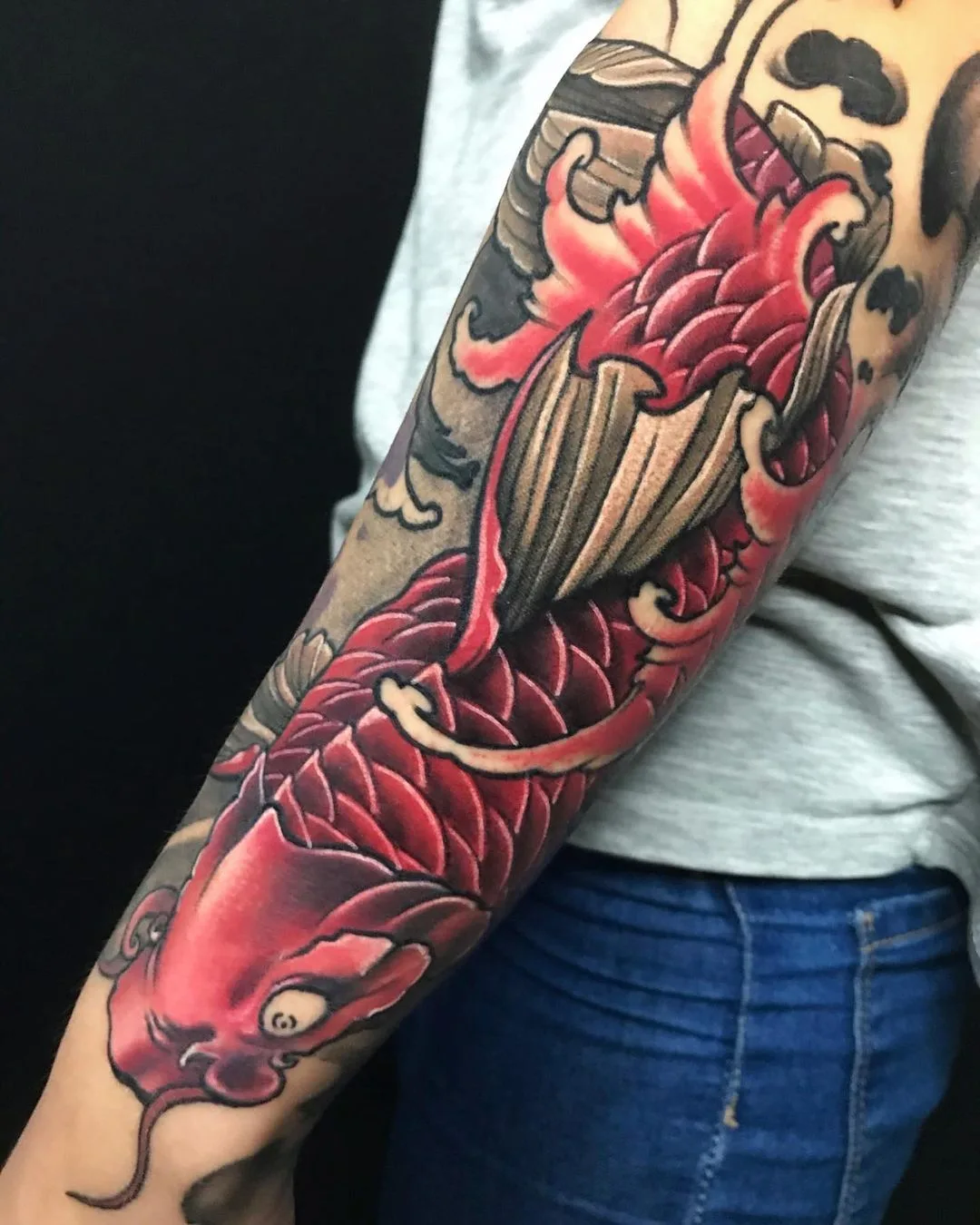
Black koi are perhaps the most powerful symbolically. A black koi represents adversity that has been overcome, specifically, the kind of hardship that fundamentally changes you. It connects directly back to the Dragon Gate legend. The fish that fought the hardest current, that refused to turn back when everything said it should. If the golden koi is about where you're going, the black koi is about what you've already survived. There's a weight to black koi tattoos that the other colors don't quite carry.
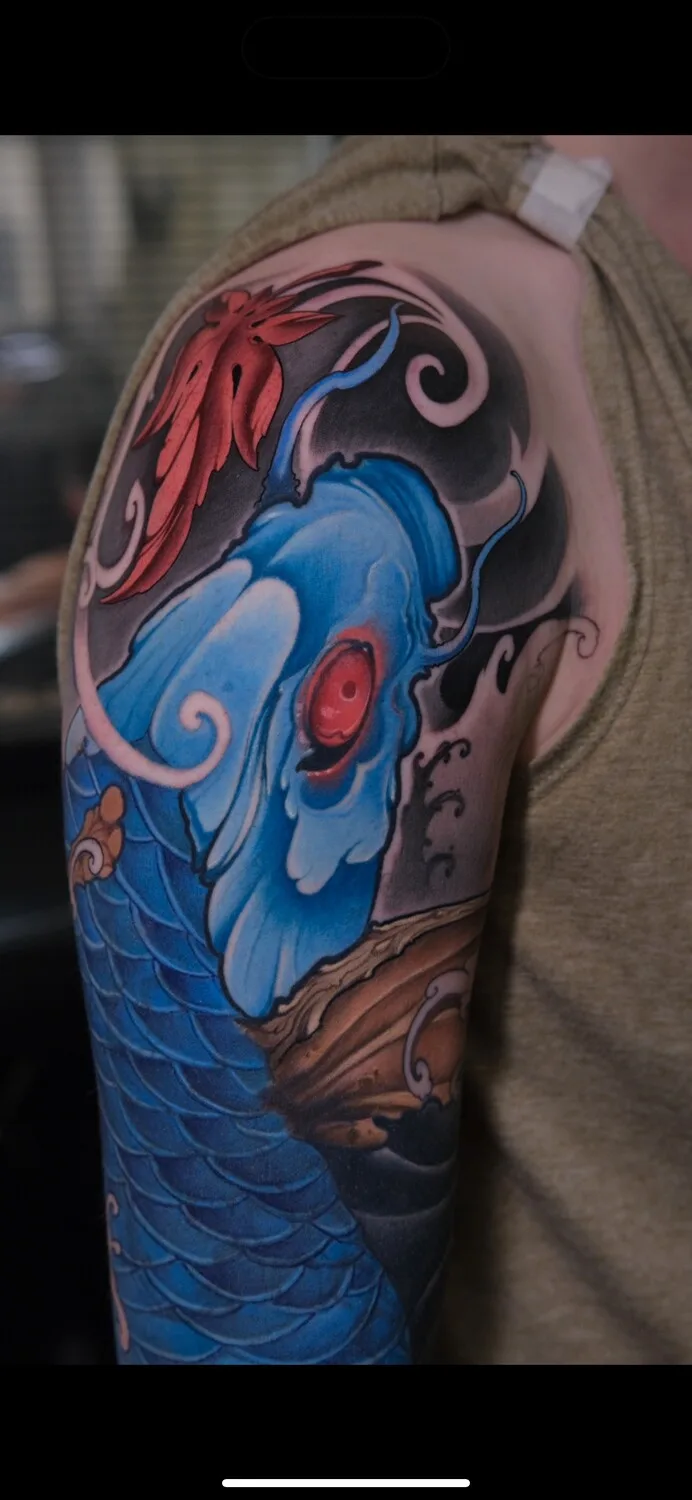
Blue koi are traditionally associated with masculinity and virility, though that's a reading that feels increasingly dated. More broadly, blue koi suggest tranquility, calm strength, and reproductive fertility. In Japanese koi breeding, blue varieties like Asagi and Shusui are highly prized for their subtle beauty. The masculinity association has meant that blue koi tattoos historically skewed toward male clients, but that's shifting now, as it should. A color doesn't belong to a gender.
There are other colors too. White koi suggest career advancement. Orange suggests social success and good relationships. Combinations, red and white, black and white, carry their own specific meanings, often tied to Kohaku and Kumonryu varieties in actual koi keeping. But the four above are the core ones you'll encounter in tattoo symbolism.
Swimming Direction: Correcting the Myths
Here's where I need to push back on something you've probably read elsewhere. There's a widely circulated claim in tattoo culture that goes roughly like this: a koi swimming upstream means you're currently struggling, while a koi swimming downstream means you've already overcome your challenges. Or the reverse. Or that downstream means you've given up. The explanations contradict each other depending on the source, which should probably tell you something about their reliability.
The truth is less tidy, and more interesting.
In traditional Japanese tattooing, the direction a koi swims is primarily an aesthetic and compositional choice, not a rigid symbolic code. A koi swimming upstream, head pointed upward on the body, does connect naturally to the Dragon Gate myth. The fish fighting the current, striving upward. That association is real. But a downstream koi carries no inherent meaning of failure or surrender. That interpretation seems to have been invented wholesale by Western tattoo blogs sometime in the early 2000s, and it spread because it sounds plausible. It isn't rooted in any Japanese or Chinese tradition I've been able to find.
A downstream koi can represent having already completed the journey. The struggle is over. You made it through. Or it can simply mean the tattoo artist determined the design would flow better with the natural lines of the body in that direction. Sleeves, for instance, often have koi swimming downward along the forearm because the visual movement follows the arm's taper. That's composition, not symbolism.
So if someone tells you your downstream koi means you've "given up," you can comfortably ignore them. They're repeating internet folklore. Both directions are valid, both carry meaning if you want them to, and neither is inherently negative.
Japanese vs. Chinese Traditions
The koi myth originates in China, but its fullest expression in tattoo art came through Japan. The two traditions treat the koi somewhat differently, and that gap matters more than most people realize.
In China, the koi's primary association is with the Dragon Gate, achievement, examination success, upward mobility. An aspirational symbol, full stop. Chinese koi imagery tends to emphasize the moment of transformation, the leap itself. You'll see koi depicted alongside dragons or partially transforming into dragons, because the destination matters as much as the journey. The carp-to-dragon transformation has been a staple of Chinese art for centuries, appearing on imperial ceramics and temple carvings alike.
Japan imported the koi along with Buddhism and Chinese cultural traditions, probably around the 5th or 6th century, though pinning down exact dates for this kind of cultural transmission is always a bit sketchy. What Japan did with the koi was genuinely interesting. It kept the perseverance symbolism but added its own layers on top. The koi became associated with Boys' Day (now Children's Day, May 5th), when families fly koinobori, windsock-shaped koi streamers, one for each child. The fish became a vessel for parental hopes: strength, resilience, success.
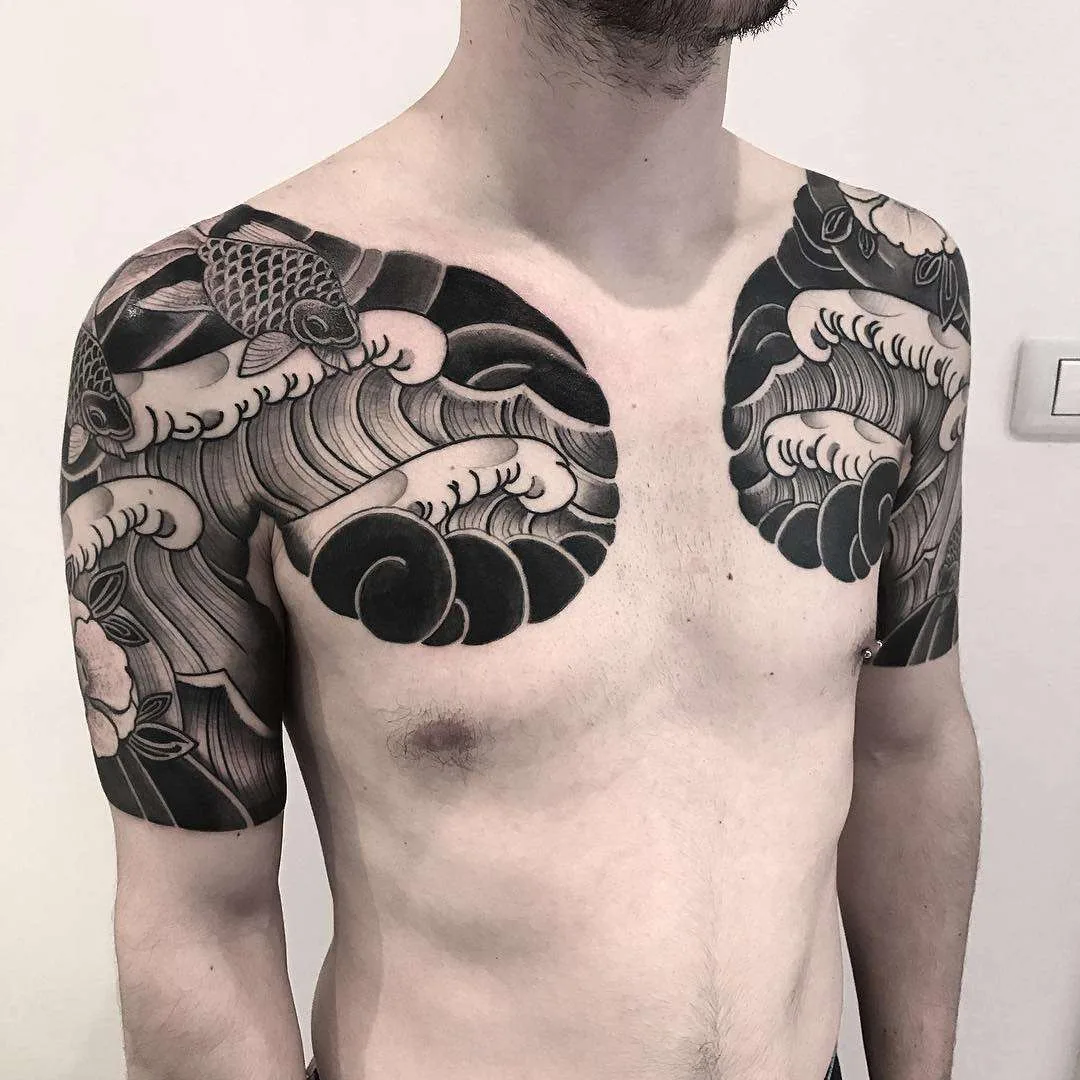
In irezumi, traditional Japanese tattooing, the koi occupies a specific place in the visual vocabulary. Typically shown in water, often paired with waves, maple leaves, or cherry blossoms to indicate season. The water matters. In irezumi, it represents the environment the koi moves through: life itself, with all its currents and turbulence. The koi's relationship to the water is the story being told, not just a backdrop.
You don't need to be Japanese or Chinese to get a koi tattoo. These symbols have been shared and adapted across cultures for a long time, and the tattoo world has always been a space where imagery travels. But knowing the origins deepens the tattoo, even if nobody else sees that depth but you.
Styles Worth Considering
The style you choose for a koi tattoo shapes the entire feeling of the piece. And there are more options than most people expect going in.
Irezumi (traditional Japanese). This is the original home of the koi in tattoo art. Bold outlines, specific color conventions, waves rendered in that distinctive Japanese style with white caps and curling forms. Irezumi koi are built for larger compositions, bodysuits, half-sleeves, full backs. They don't exist in isolation. The water, the background elements, the placement on the body, everything is intentional and interconnected. If authenticity is what you're after, this is the route. Though authenticity isn't always the goal, and that's fine too.
Watercolor. This style has surged in popularity over the last decade, and koi are among the subjects it serves best. Splashes of color bleeding outward from the fish, no hard boundaries, the whole thing looking like it was painted directly onto skin. The effect can be genuinely stunning. However, watercolor tattoos have real longevity concerns, those soft gradients fade faster than solid fills and bold lines. A skilled artist will build in enough underlying structure to age well, but ask about this directly before committing.
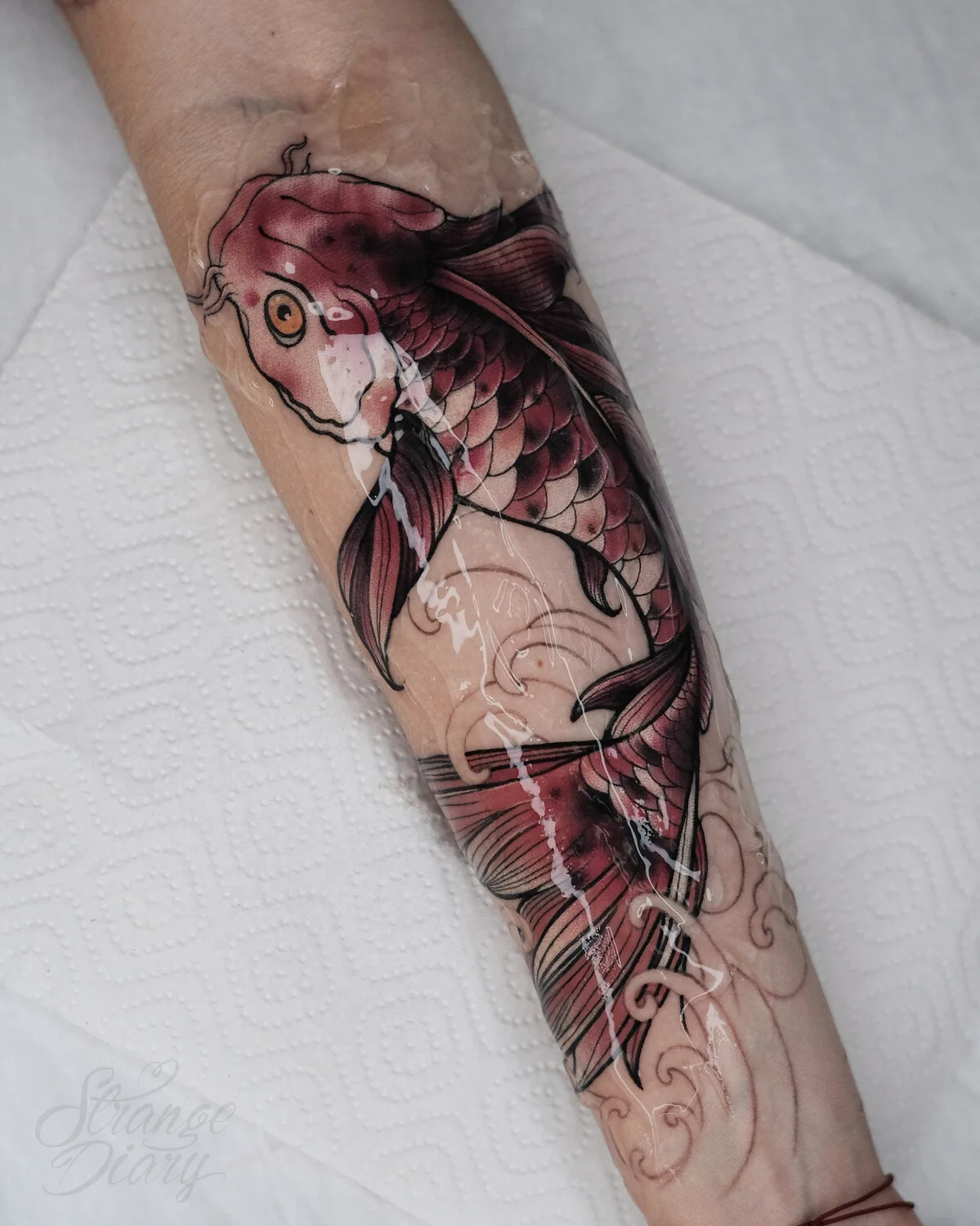
Realism. A photorealistic koi captures every scale, every fin ray, every shift in color across the body. Technically demanding. When it works, the result is breathtaking; when it doesn't, the piece can read flat, almost clinical. The difference usually comes down to water treatment and implied movement. Static water kills a realistic koi design. You want the sense that the fish is actually pushing through something.
Neo-traditional. Takes the bold outlines of traditional work and layers in more complex color palettes and shading. Neo-traditional koi feel contemporary while still carrying that graphic punch. A solid middle ground for collectors who want structure and boldness without committing to the full irezumi aesthetic, and they age remarkably well, which is worth thinking about when you're making a permanent decision.
Placement and Scale

Full-sleeve irezumi with koi, dragon and waves

Japanese irezumi koi fish sleeve
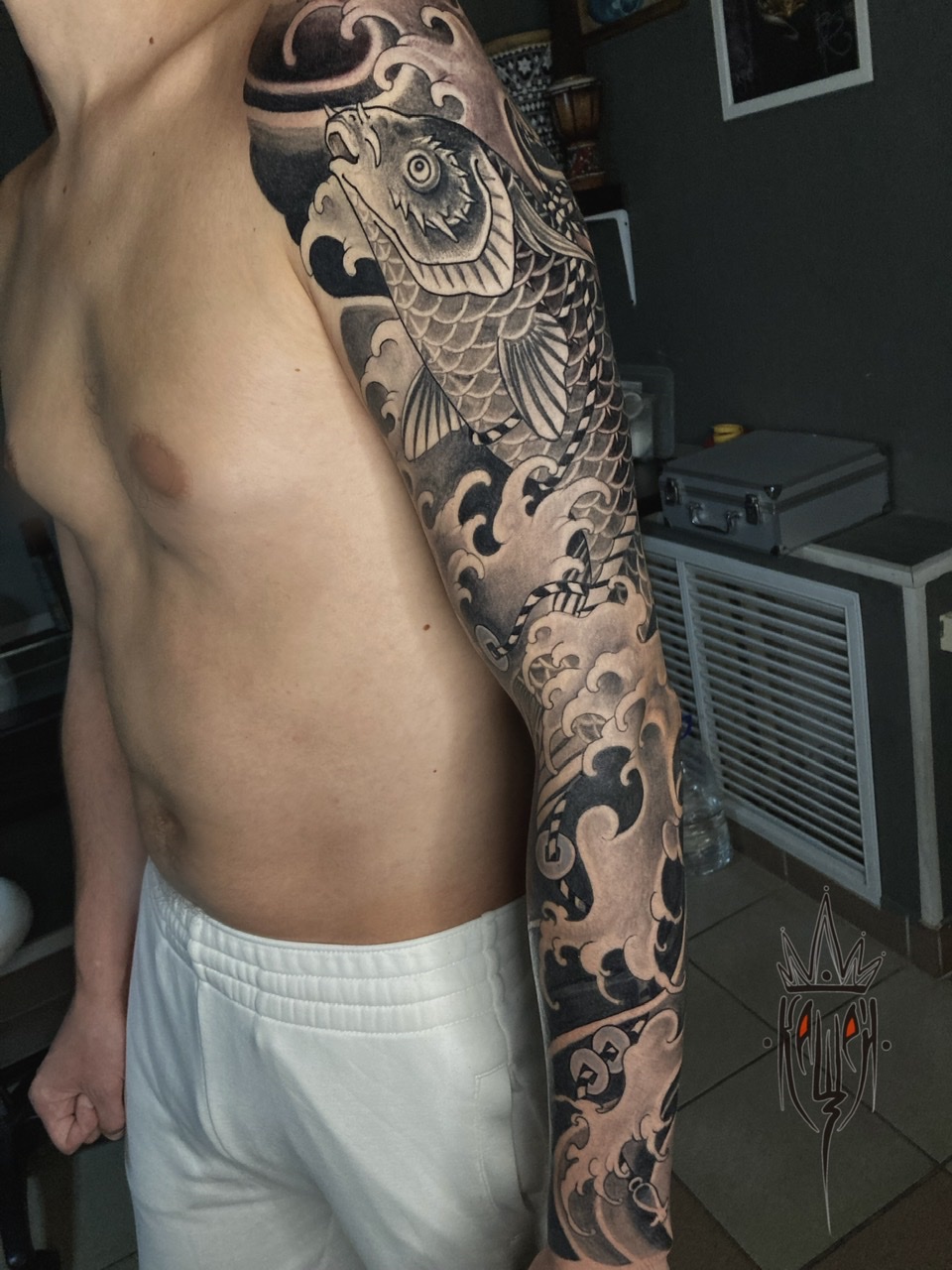
Full-sleeve Japanese koi fish tattoo
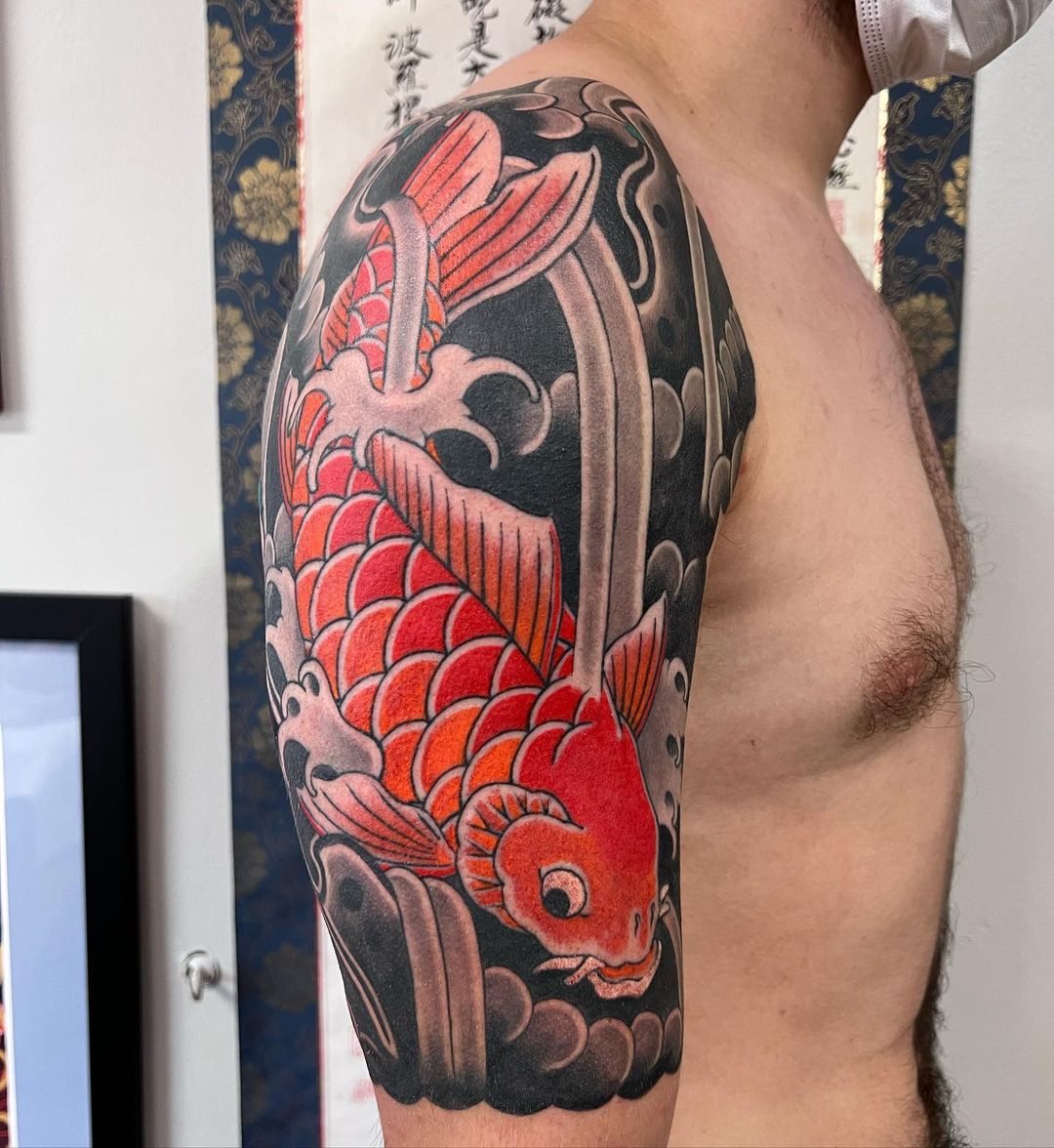
Japanese koi in red and black
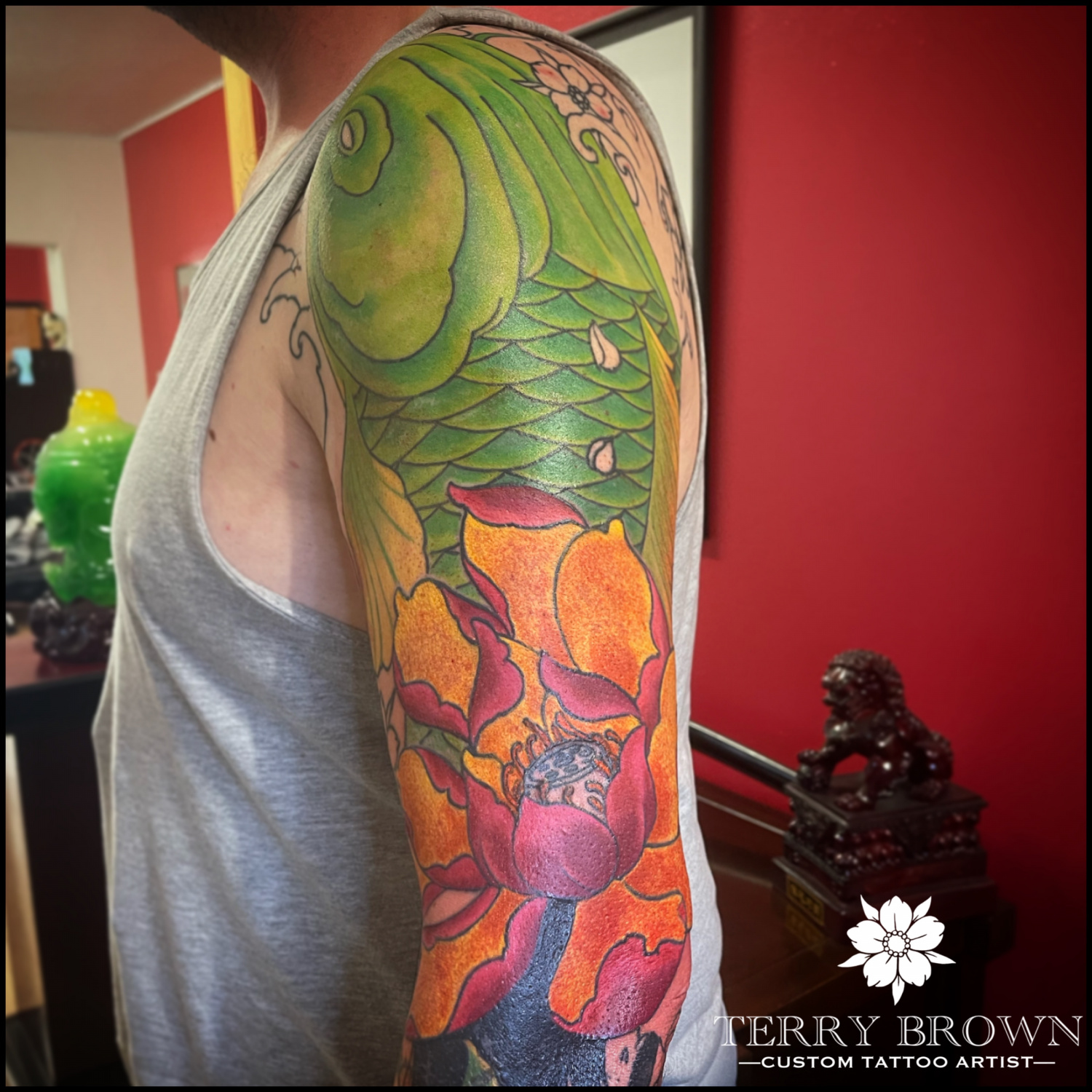
Terry Brown: koi and lotus, Japanese watercolor
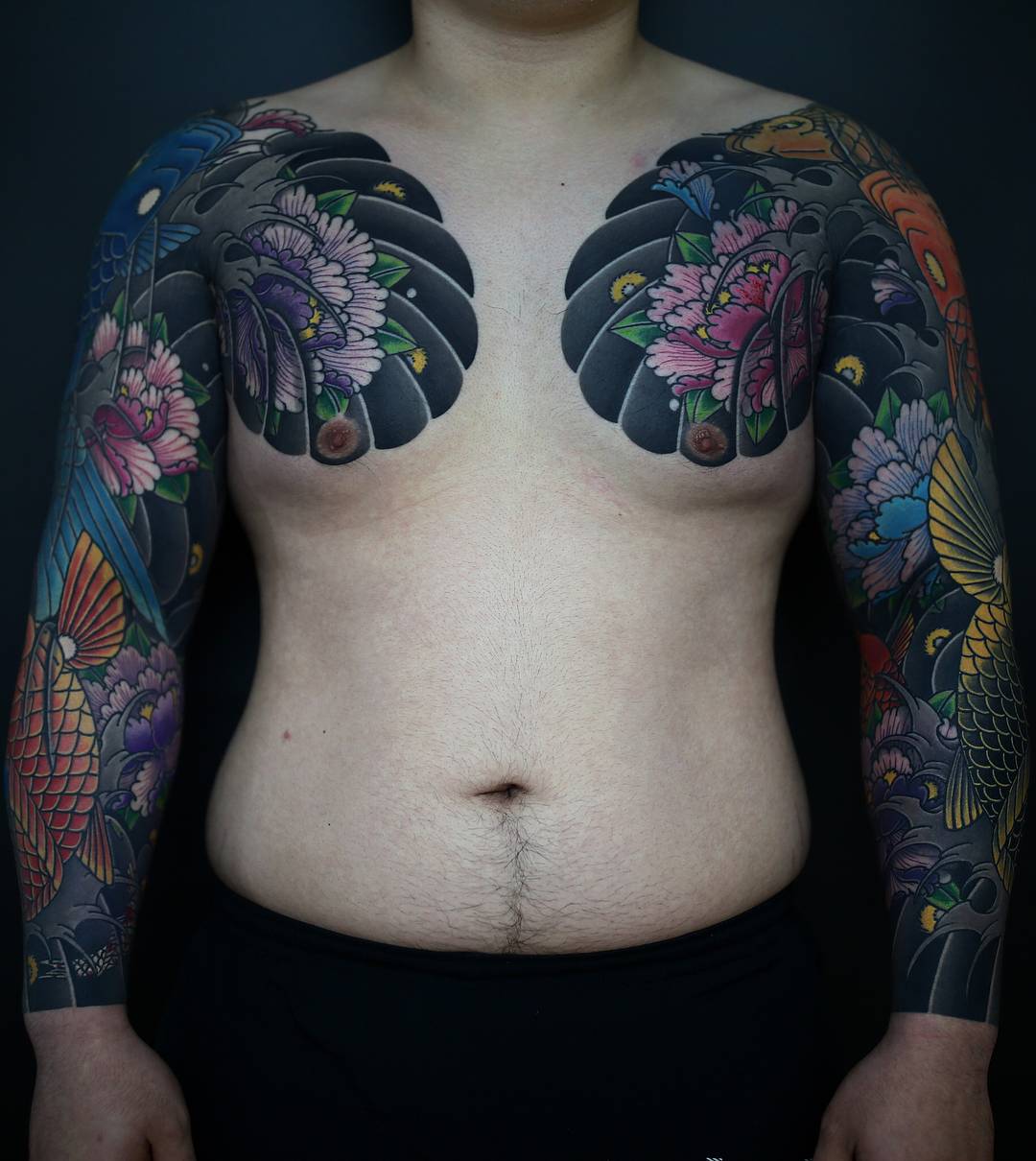
Japanese koi and floral full-body tattoo
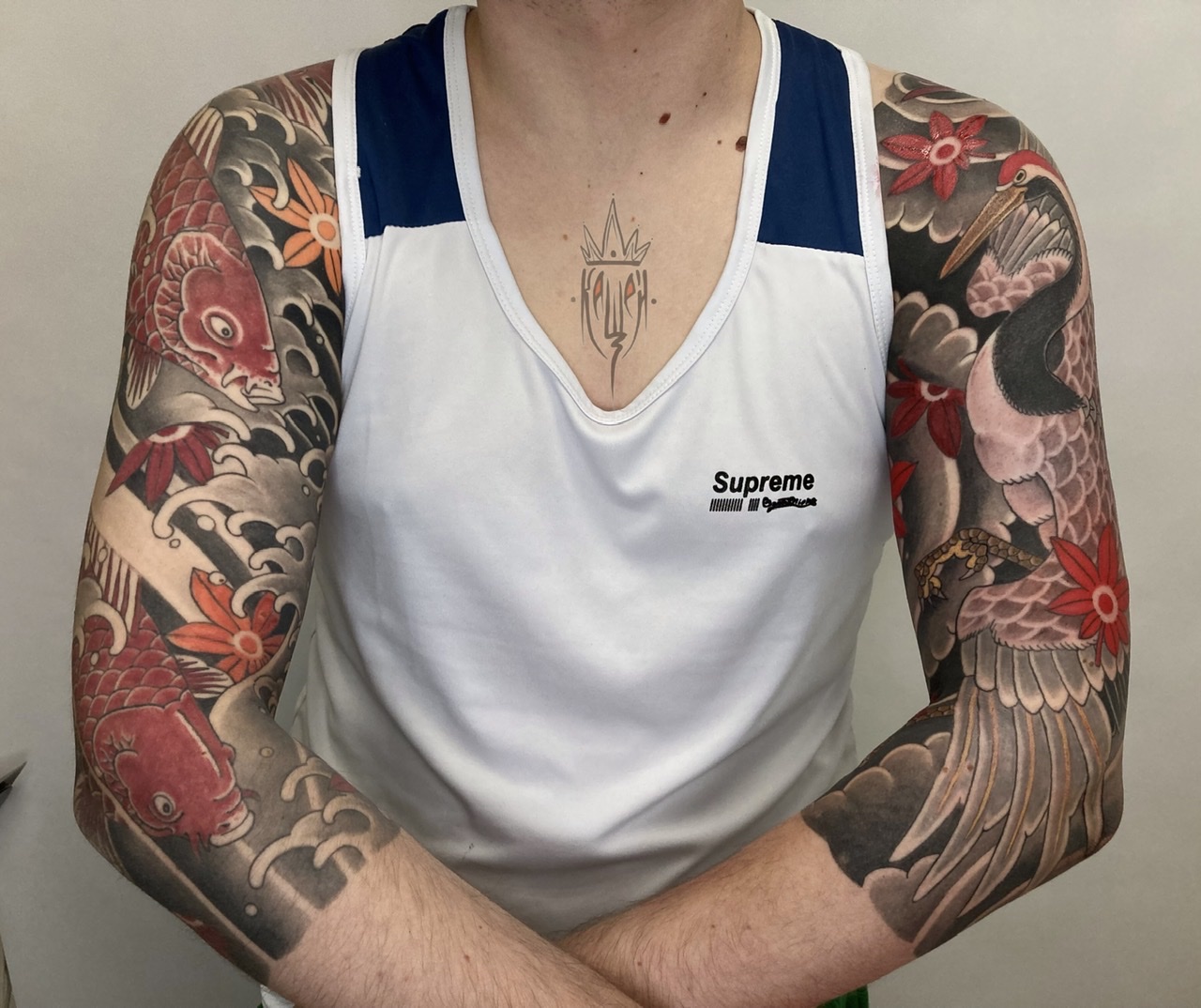
Full-sleeve Japanese koi and crane tattoo
Koi tattoos need room to breathe. That's probably the most practical thing to understand about placement. A koi crammed into a small area loses the sense of movement that makes the design work in the first place. The water, the flow, the implied current, all of it requires space to read correctly.
Full back pieces are the traditional home of the koi in Japanese tattooing. A koi spanning the entire back, surrounded by waves, with cherry blossoms or maple leaves drifting through, this is irezumi at its most ambitious. The back offers a flat, broad canvas that lets the composition breathe and develop fully. It's also a serious commitment: time, money, pain. Multiple sessions, sometimes spread across months or even years. But the result, when it comes together, can be genuinely magnificent.
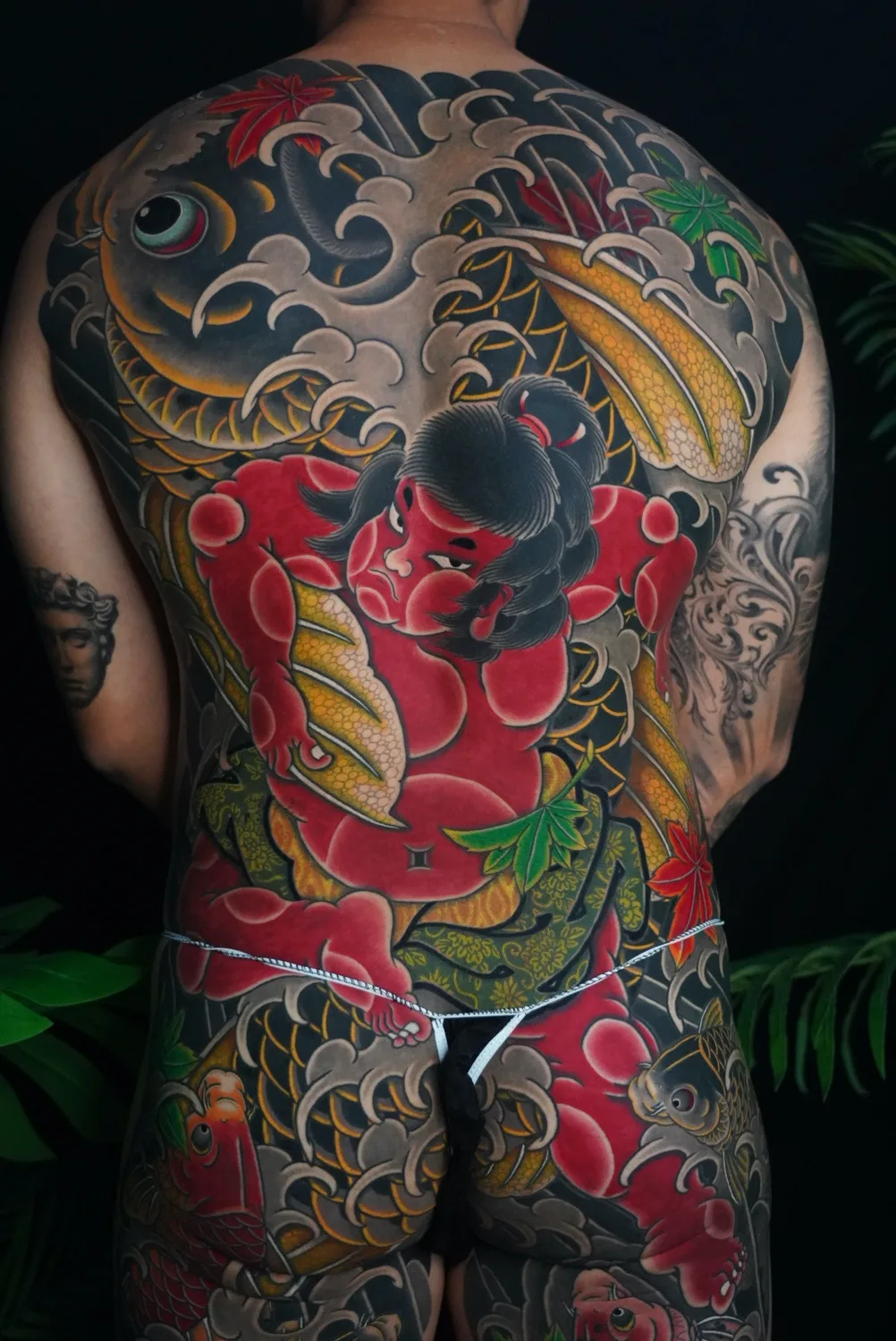
Sleeve work is probably the most popular placement in Western tattoo culture. A koi wrapping around the upper arm, or running the full length of a sleeve, creates natural movement as the body turns. The fish seems to swim. That effect is deliberate, and it's one of the real reasons koi translate so well to sleeve compositions. Half-sleeves can work too, though the design needs tighter planning to avoid feeling abruptly cut off at the elbow.
Thigh pieces have surged in popularity, especially for larger and more detailed koi work. The thigh offers a broad, relatively flat surface, comparable to the back in canvas quality, but far easier to conceal. Good option for someone who wants a substantial piece that stays private. Pain levels vary considerably; the inner thigh is notably more intense than the outer, so worth discussing placement specifics with your artist before committing.
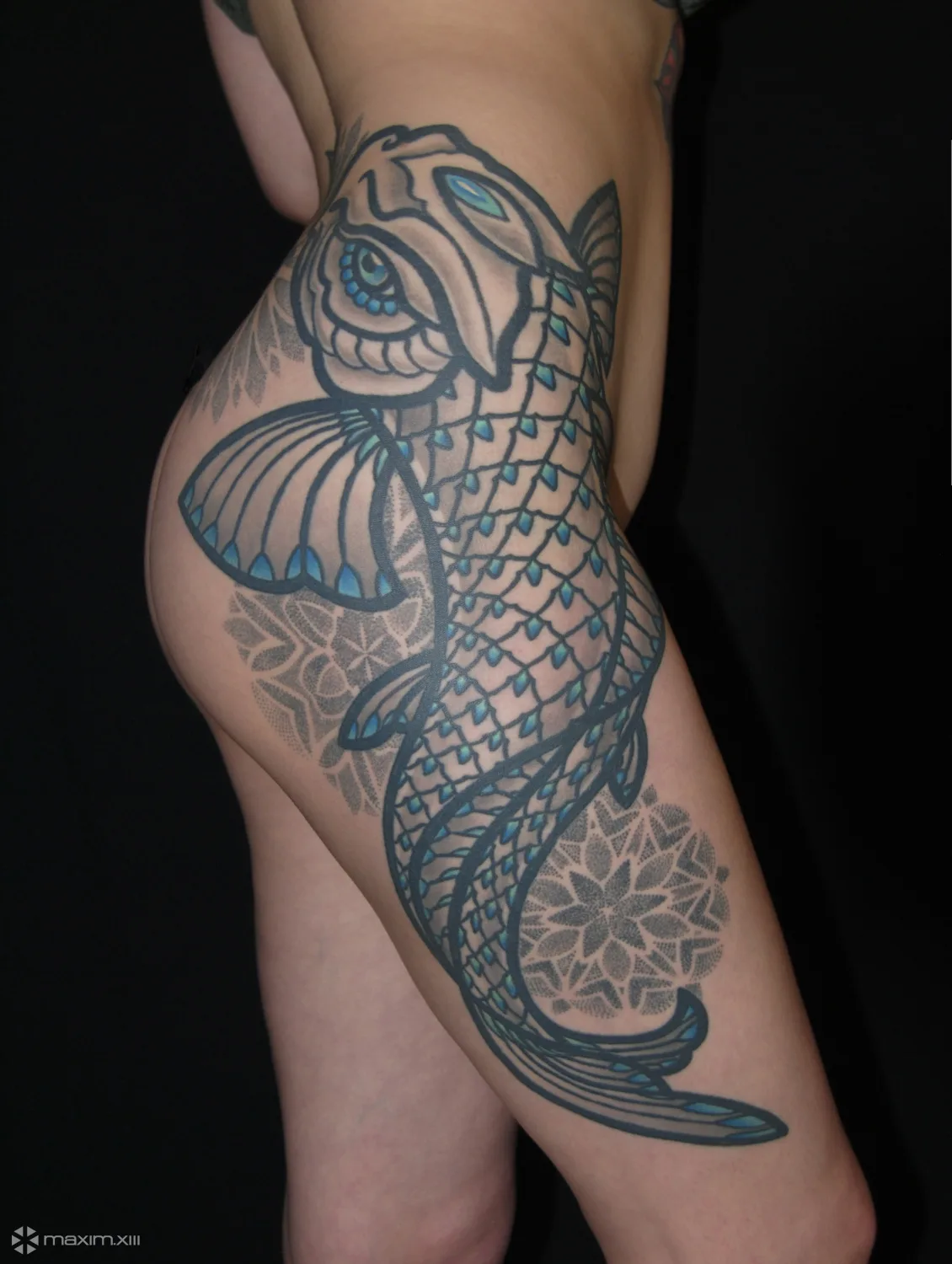
Smaller placements, wrist, ankle, behind the ear, can work for simplified or stylized koi, but you sacrifice a lot of what makes the image compelling. A tiny koi stripped of water and context is just a fish. Seems reductive, but it's true.
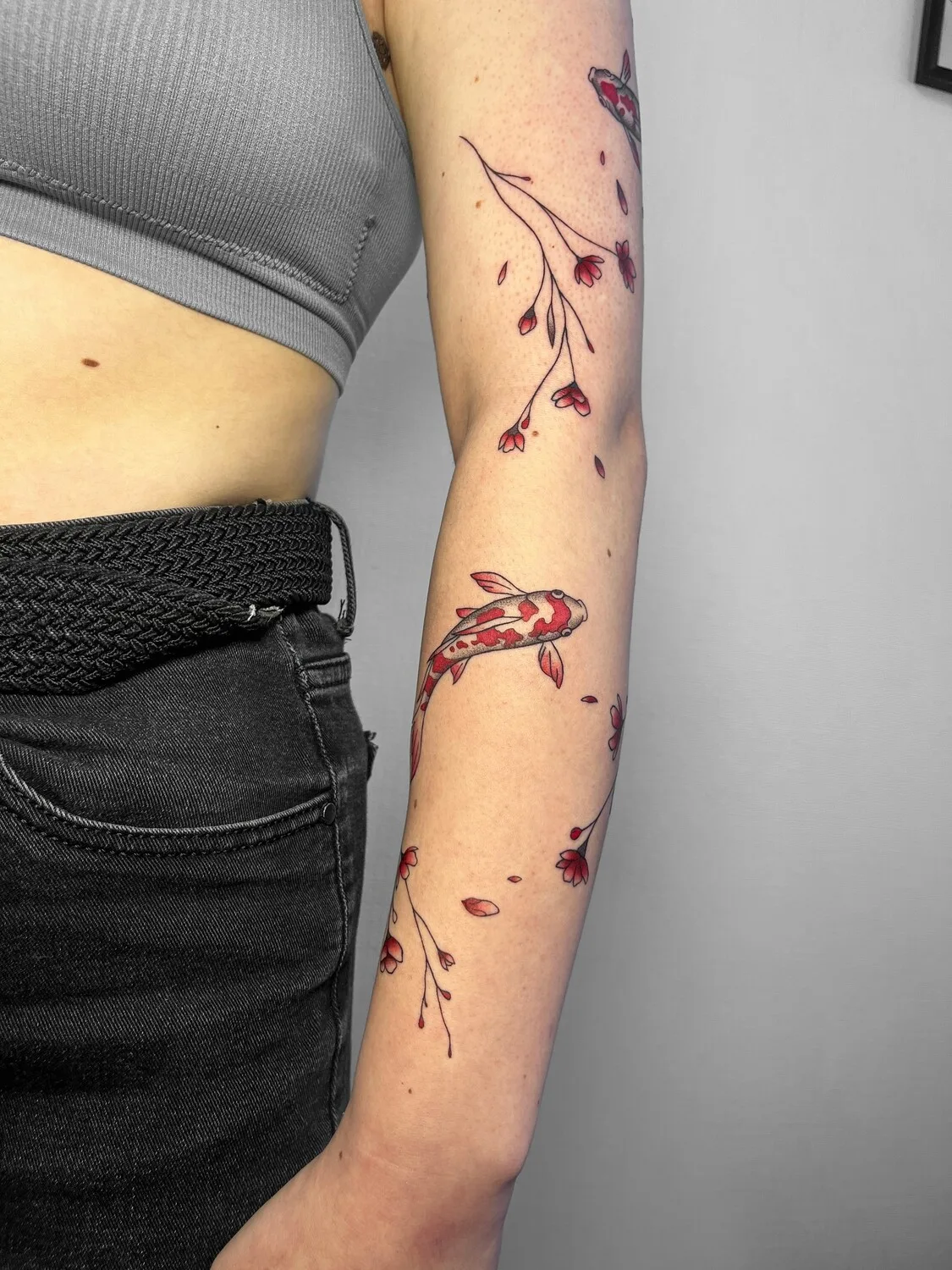
Combinations That Work
Koi rarely swim alone in tattoo compositions. The fish belongs in an environment, and the elements you build around it shape the meaning considerably.
Koi and lotus. Probably the most natural pairing in the tradition. The lotus grows in muddy water and produces a pristine flower, a Buddhist symbol of spiritual emergence from suffering. Paired with a koi fighting upstream through that same difficult water, you get a doubled message of perseverance and transformation. Both symbols are saying the same thing from different angles. The repetition strengthens the meaning rather than diluting it, which is unusual, most symbol combinations create something new, but this one amplifies what's already there.
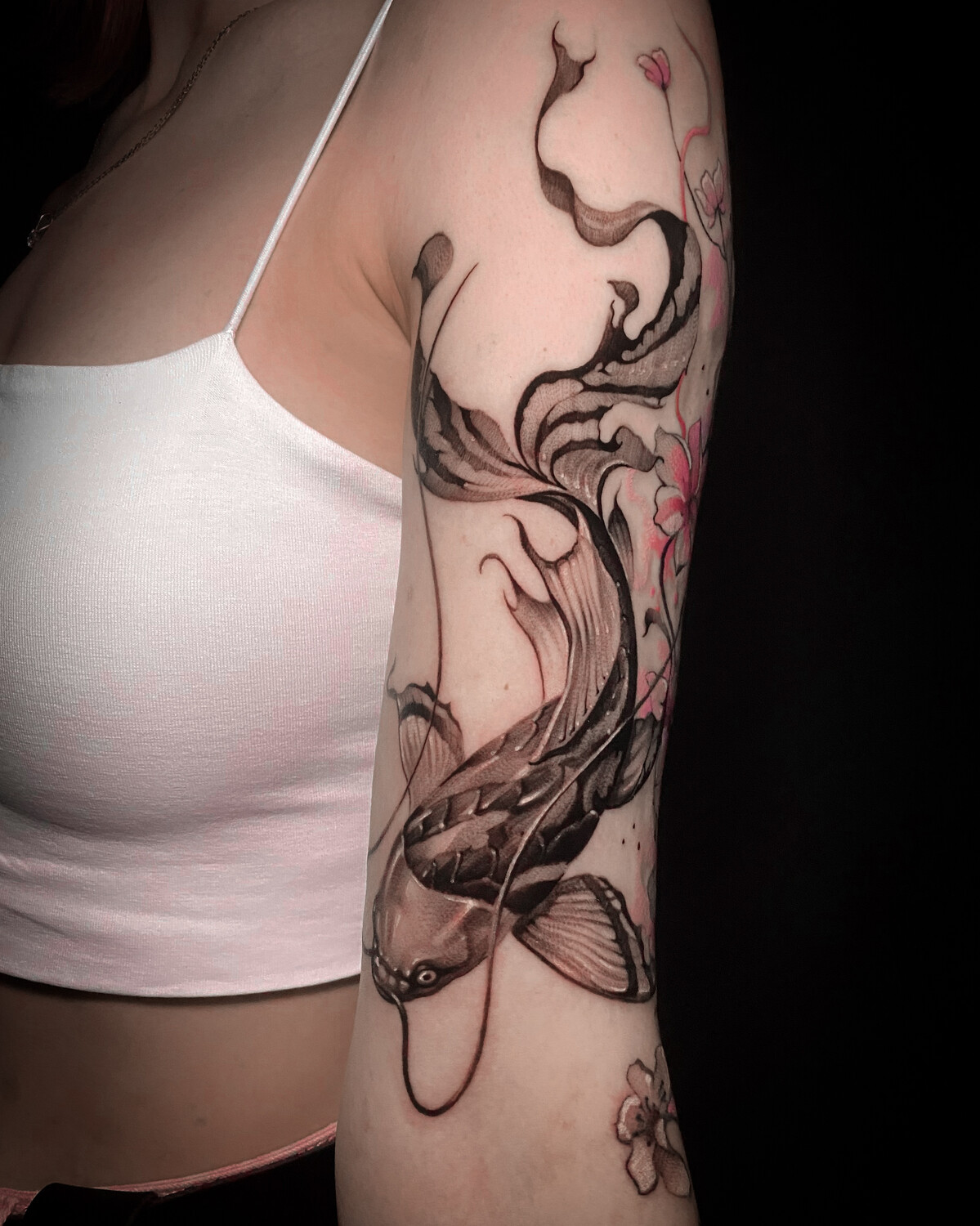
Koi with watercolour and florals
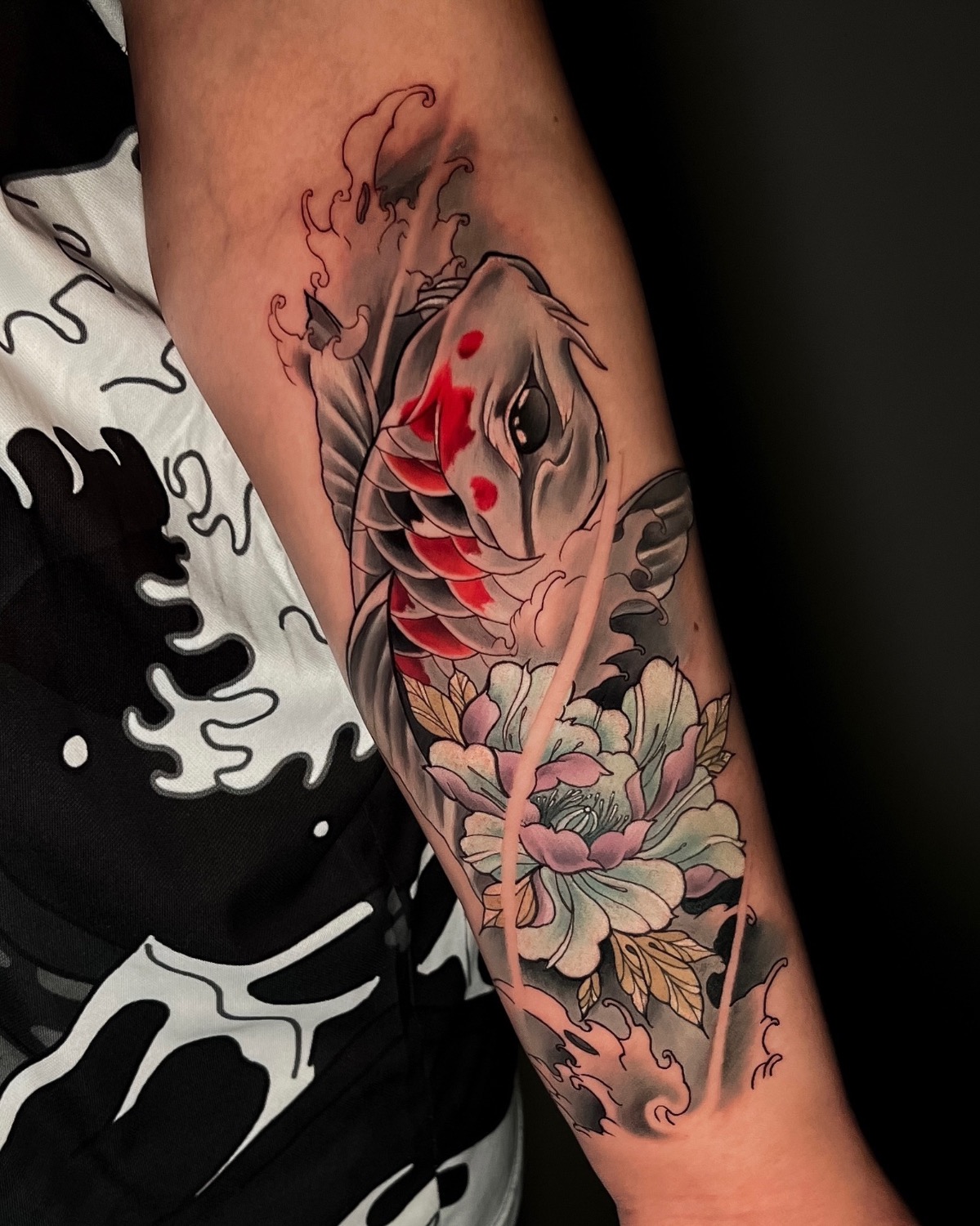
Koi and peony in watercolour
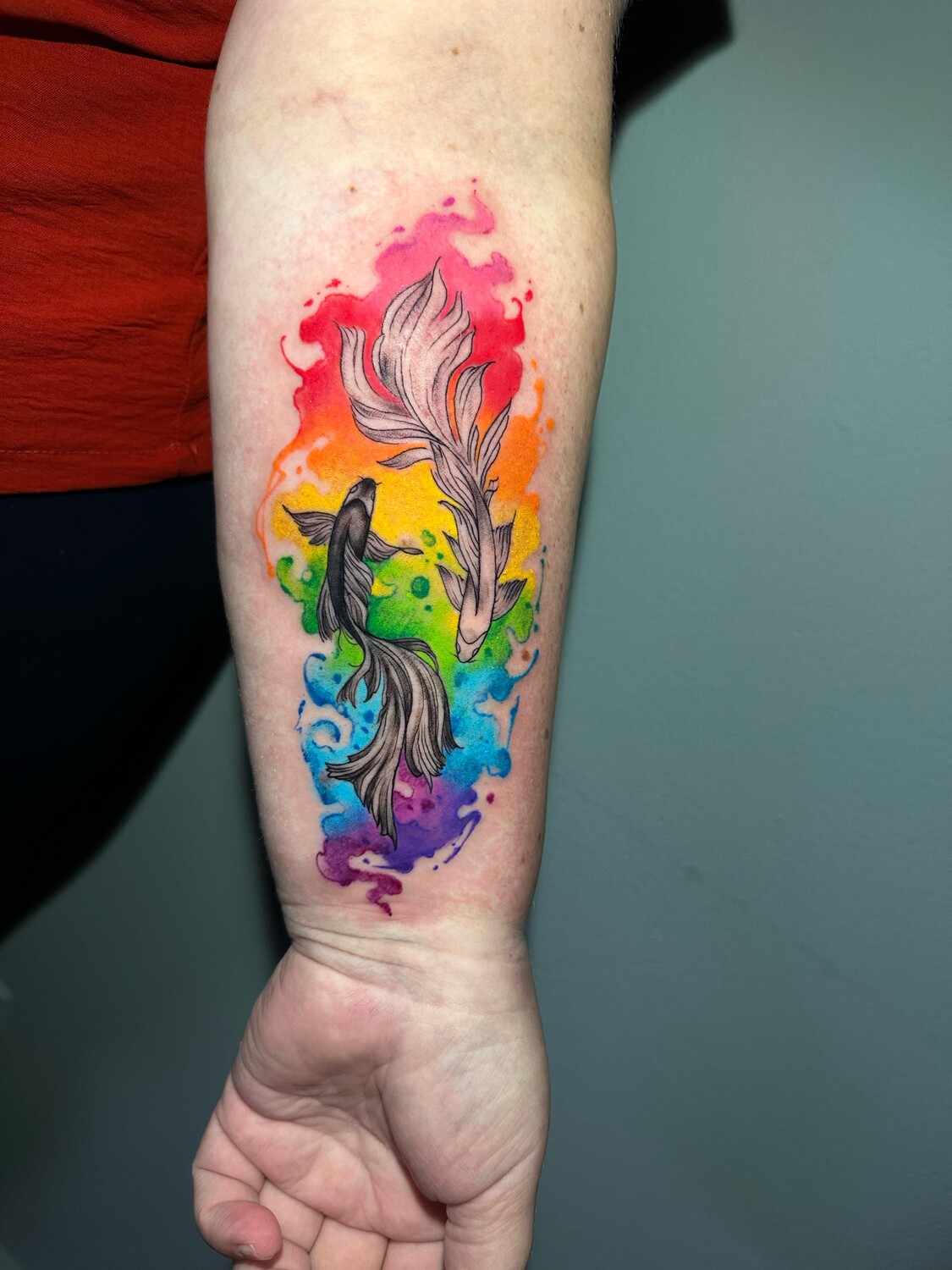
Two koi fish with watercolour background
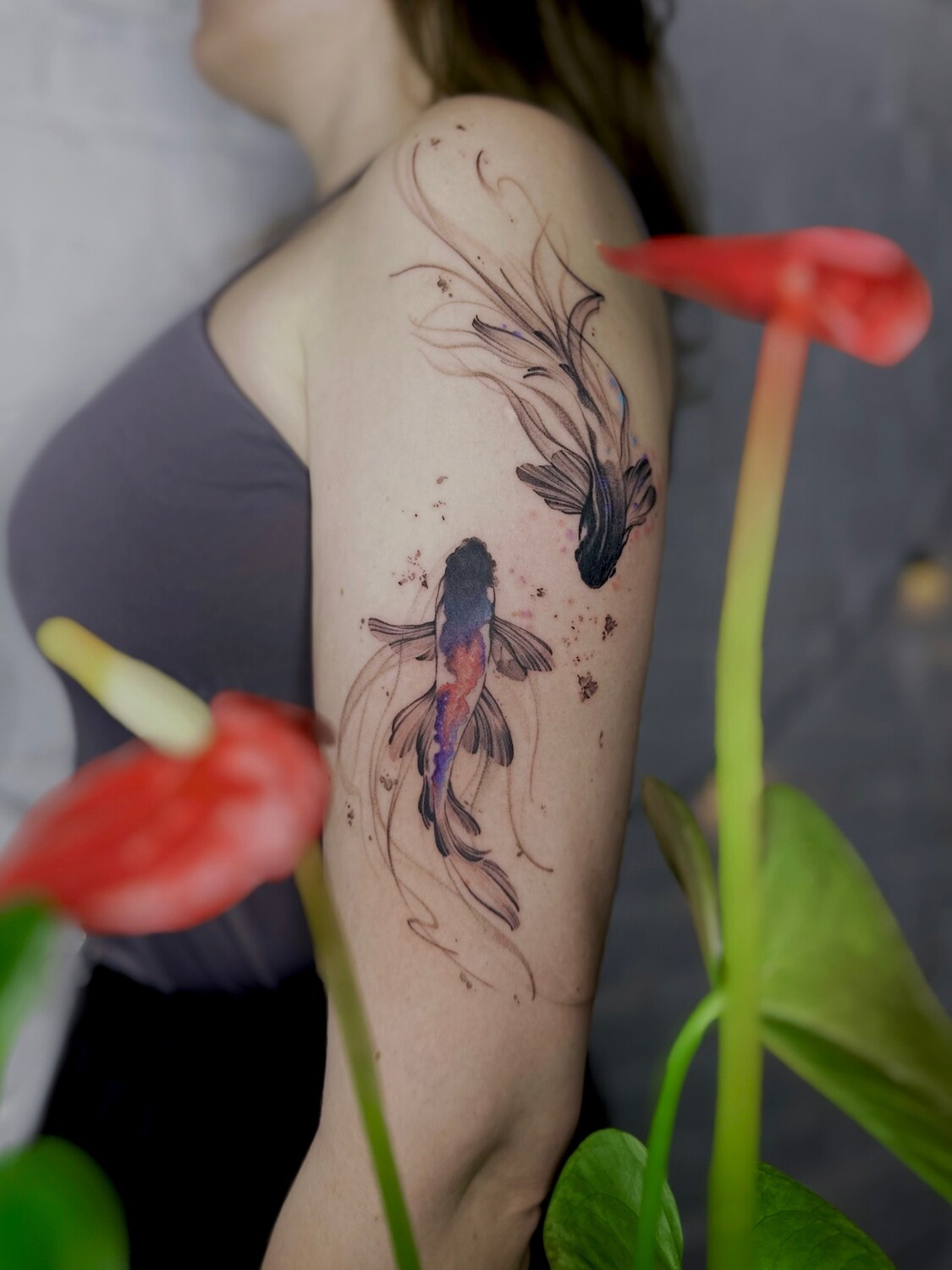
Watercolour koi fish tattoo

Red koi with watercolour and gold butterfly accents
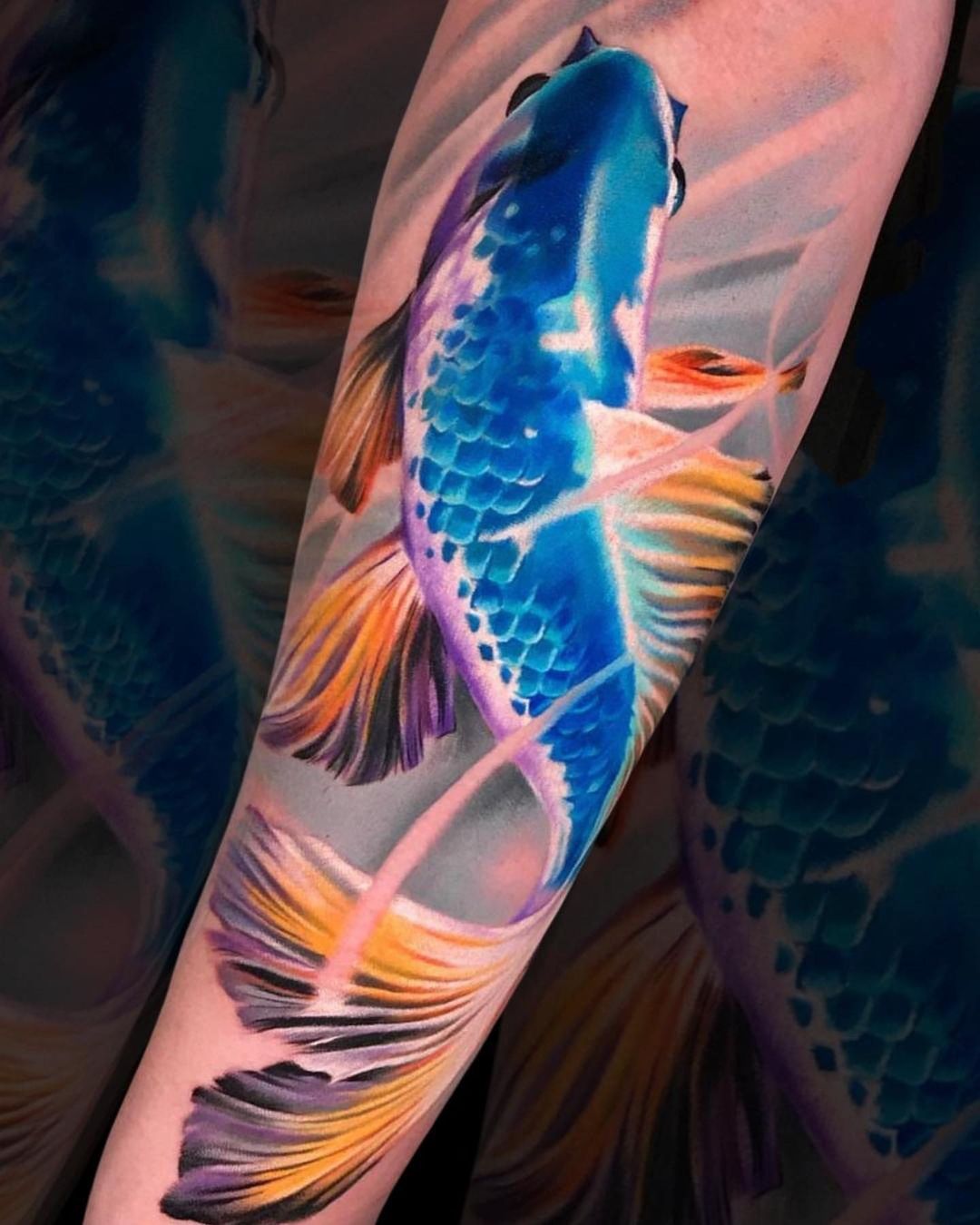
Realistic watercolour koi
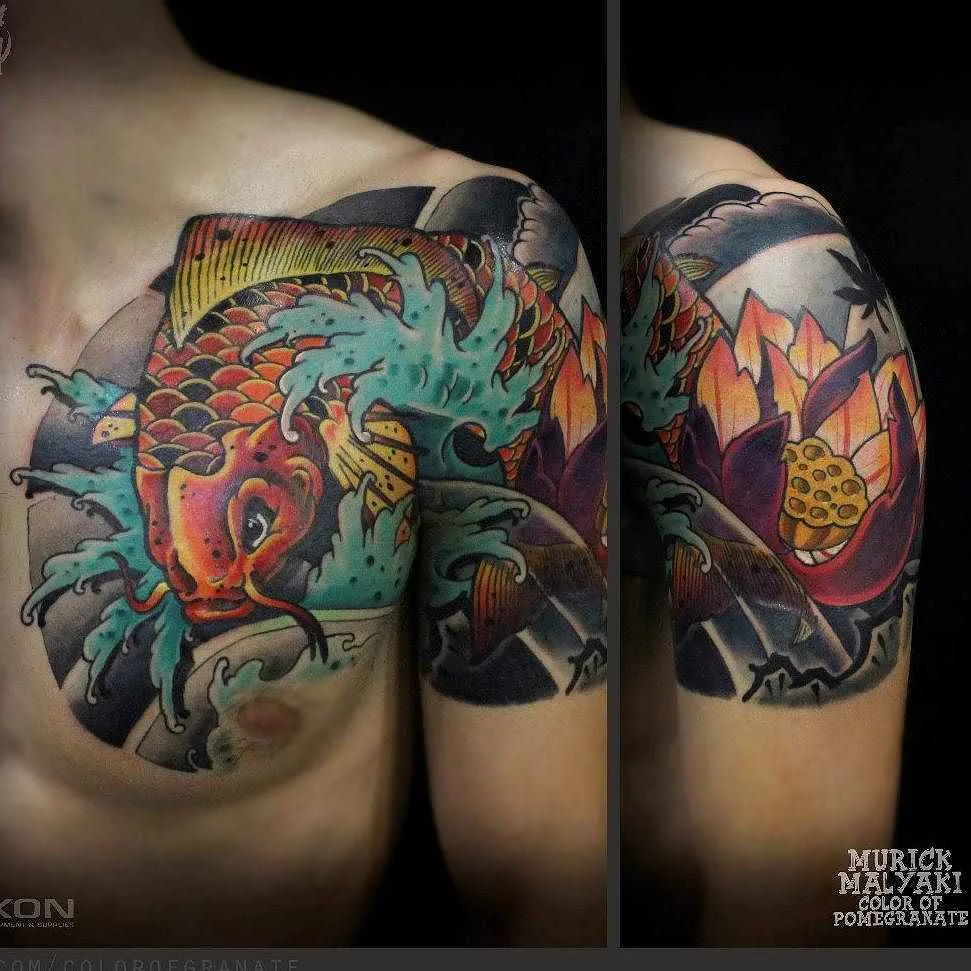
Koi and waves. Almost every traditional koi tattoo includes water, but some designs make the waves themselves a focal element. Japanese wave patterns, inspired by Hokusai and other ukiyo-e artists, carry their own symbolism: life's constant changes, raw power, the overwhelming force of nature. A koi swimming through massive waves suggests perseverance against something genuinely formidable. The scale of the challenge matters to the reading of the image.
Koi and cherry blossom. Cherry blossoms, sakura, represent the transience of life in Japanese culture. They bloom briefly, beautifully, and then they're gone. Combined with a koi, which carries connotations of endurance and survival, you get an interesting tension. Beauty that fades set against strength that endures. Or rather, the combination might be saying both things are true at once, life is brief and fragile, and also worth fighting through. That's not a contradiction. It's just how things are.
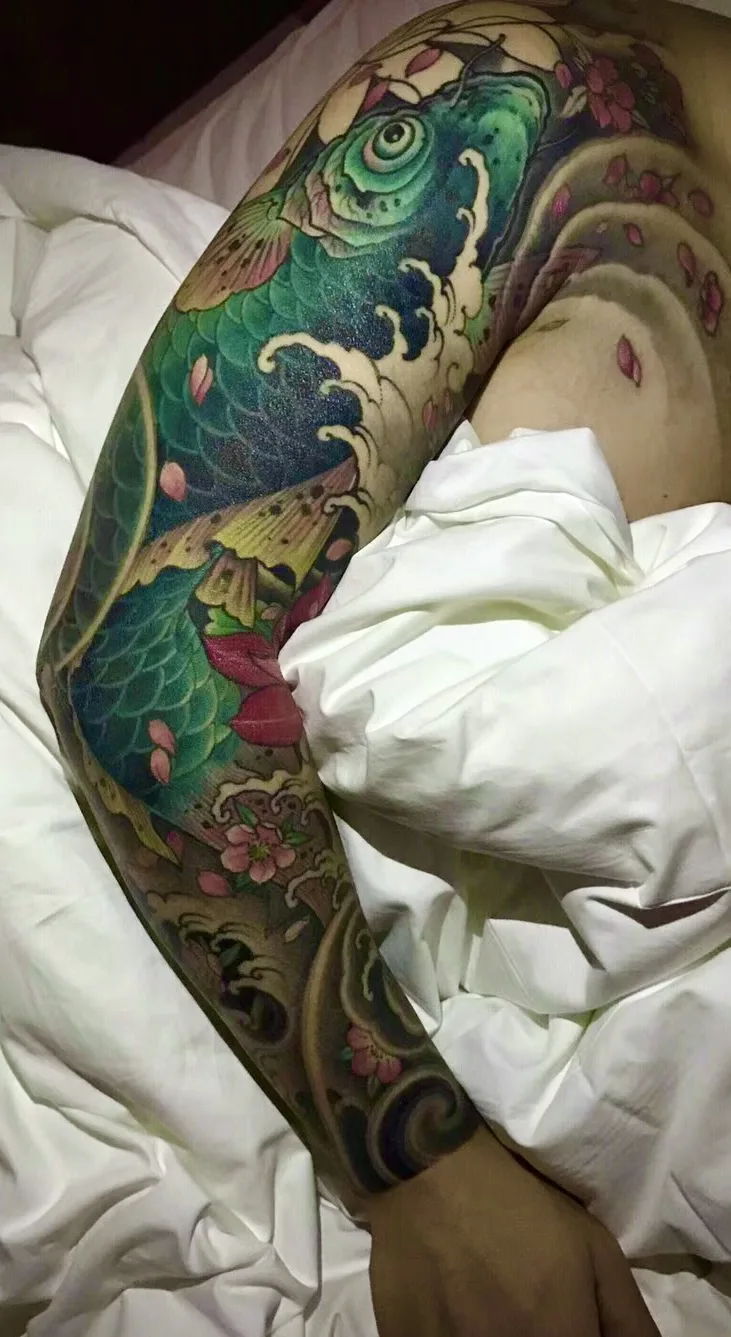
Koi and dragon. This directly illustrates the Dragon Gate myth: the moment of transformation, caught mid-change. Some designs show a koi at the bottom transitioning into a dragon at the top. Others place the two creatures facing each other, past and future self in conversation. It's a dramatic composition that needs scale to land properly. A forearm probably isn't enough space to do it justice.
Frequently Asked Questions
Does the number of koi in a tattoo matter?
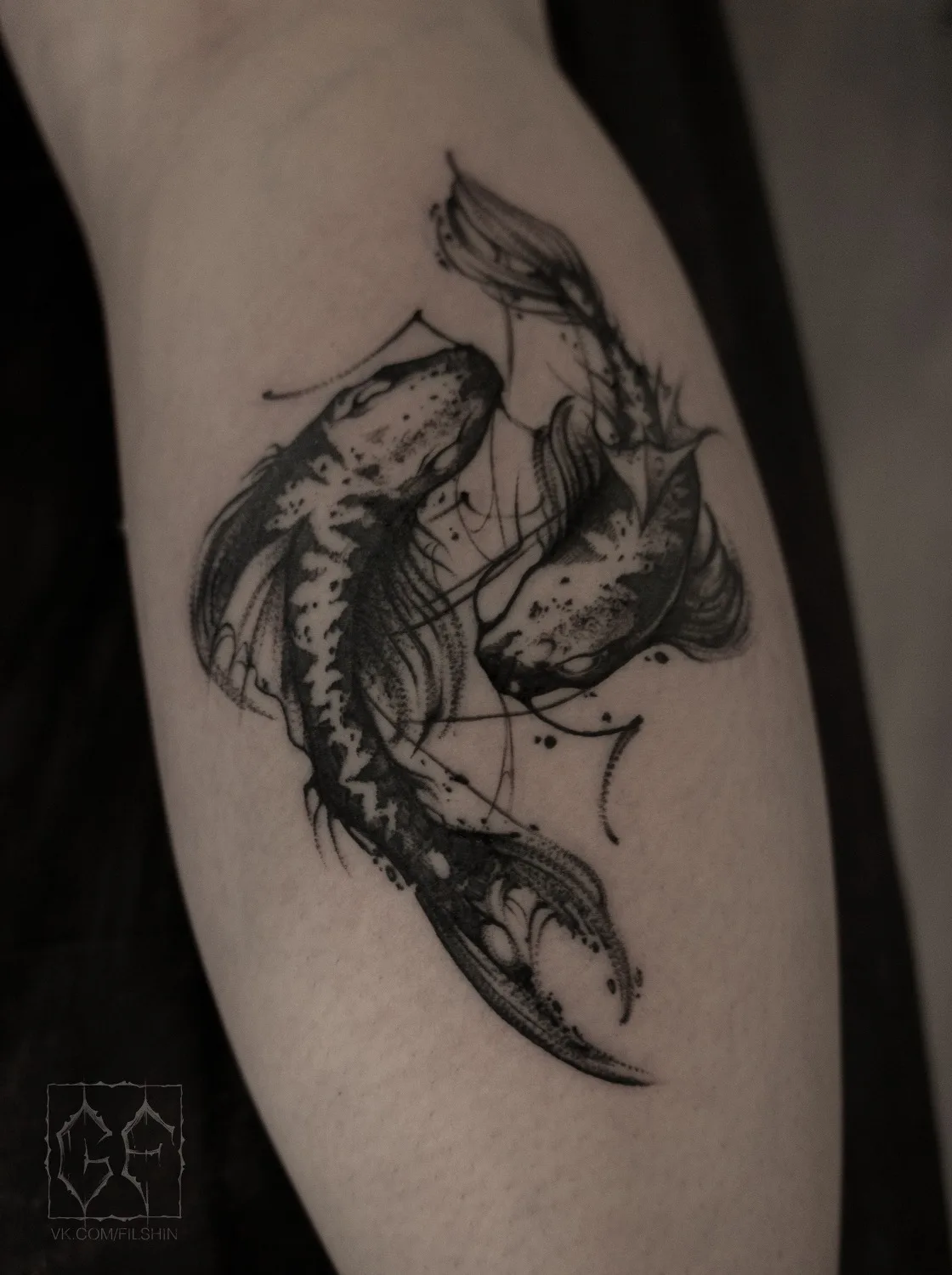
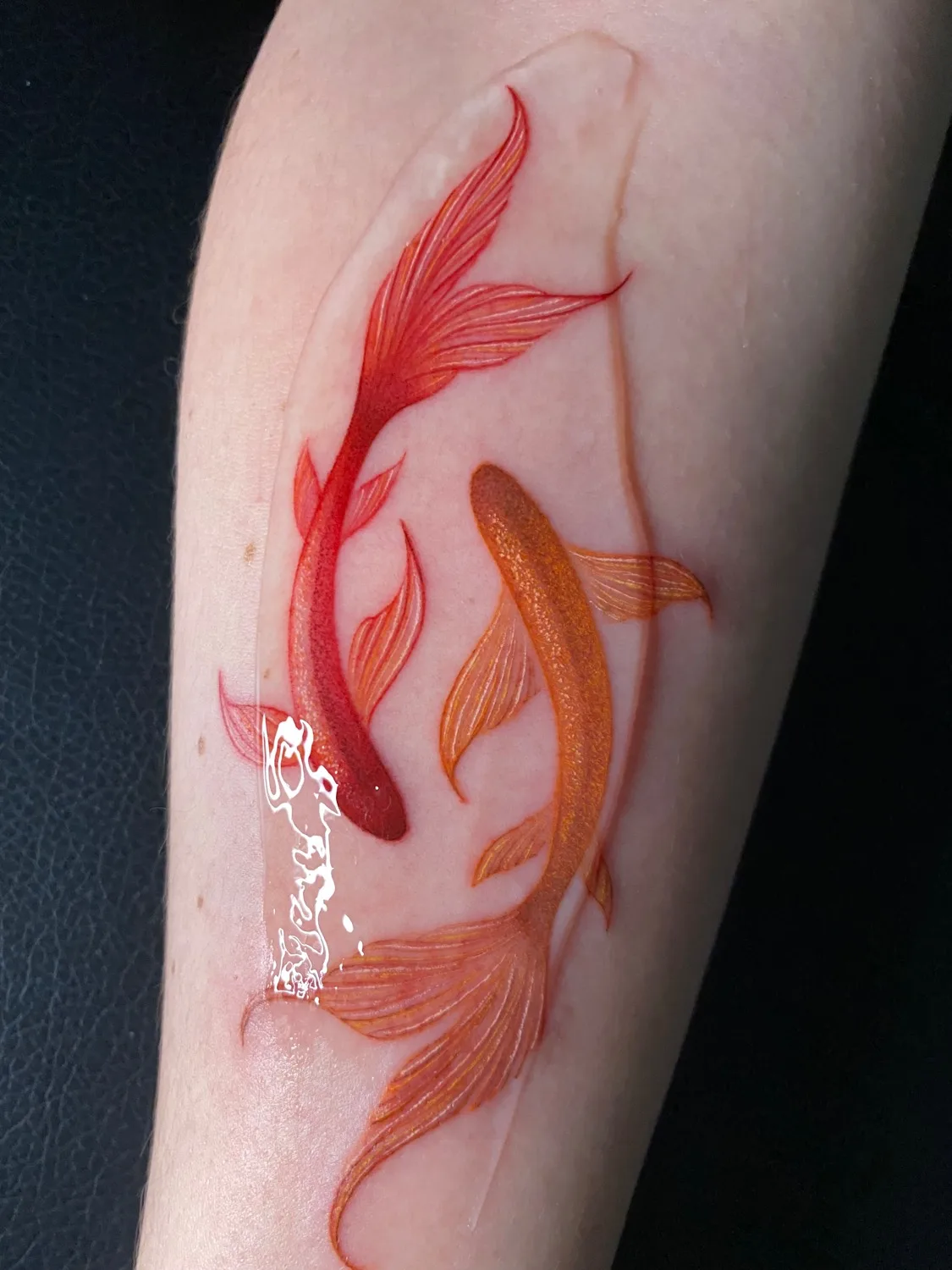
In some interpretations, yes. A single koi emphasizes personal struggle and independence. Two koi, often shown swimming in opposite directions, yin-yang style, represent balance, partnership, or duality. In feng shui traditions, specific numbers carry meaning: nine koi for long-lasting prosperity, for instance. Honestly, though, most people choose the number based on composition and visual balance rather than numerological significance. Either approach is valid.
Is a koi tattoo cultural appropriation?
This is a question worth taking seriously, even though the answer isn't simple. Koi imagery has been part of global tattoo culture for decades, and both Japanese and Chinese tattoo traditions have long histories of being practiced across cultural boundaries. What matters more than heritage is respect, understanding the symbolism, choosing an artist who treats the tradition with care, and not reducing a complex cultural symbol to a fashion accessory. Most irezumi practitioners I've spoken with welcome thoughtful engagement from any background. The thoughtfulness is what counts.
How long does a koi tattoo take?
Depends entirely on size and style. A small, simplified koi might take two to three hours. A full back piece in traditional Japanese style could require 40 to 60 hours spread across many sessions. Detailed realism falls somewhere in between. Your artist will give you an estimate during consultation, and it's almost always longer than you expect. Plan for that.
Will a koi tattoo fade or blur over time?
All tattoos change with time. Koi work in traditional styles, bold outlines, solid color fills, holds up exceptionally well over decades. Watercolor and fine-line koi will need touch-ups sooner, perhaps after five to eight years. Sun exposure is the biggest enemy. If your koi sits on a frequently exposed area, sunscreen becomes non-negotiable. Seems like basic advice. Most people don't follow it.
Can a koi tattoo be combined with non-Asian imagery?
Absolutely. Contemporary tattoo art blends cultural visual languages all the time, and koi have shown up alongside geometric patterns, European floral work, and abstract backgrounds with real success. The key is finding an artist who can make those disparate elements feel cohesive rather than just stacked on top of each other. Purists may prefer keeping the koi within its traditional visual context, and honestly, that instinct is worth respecting. Neither approach is wrong. It depends on what story you want your skin to tell.
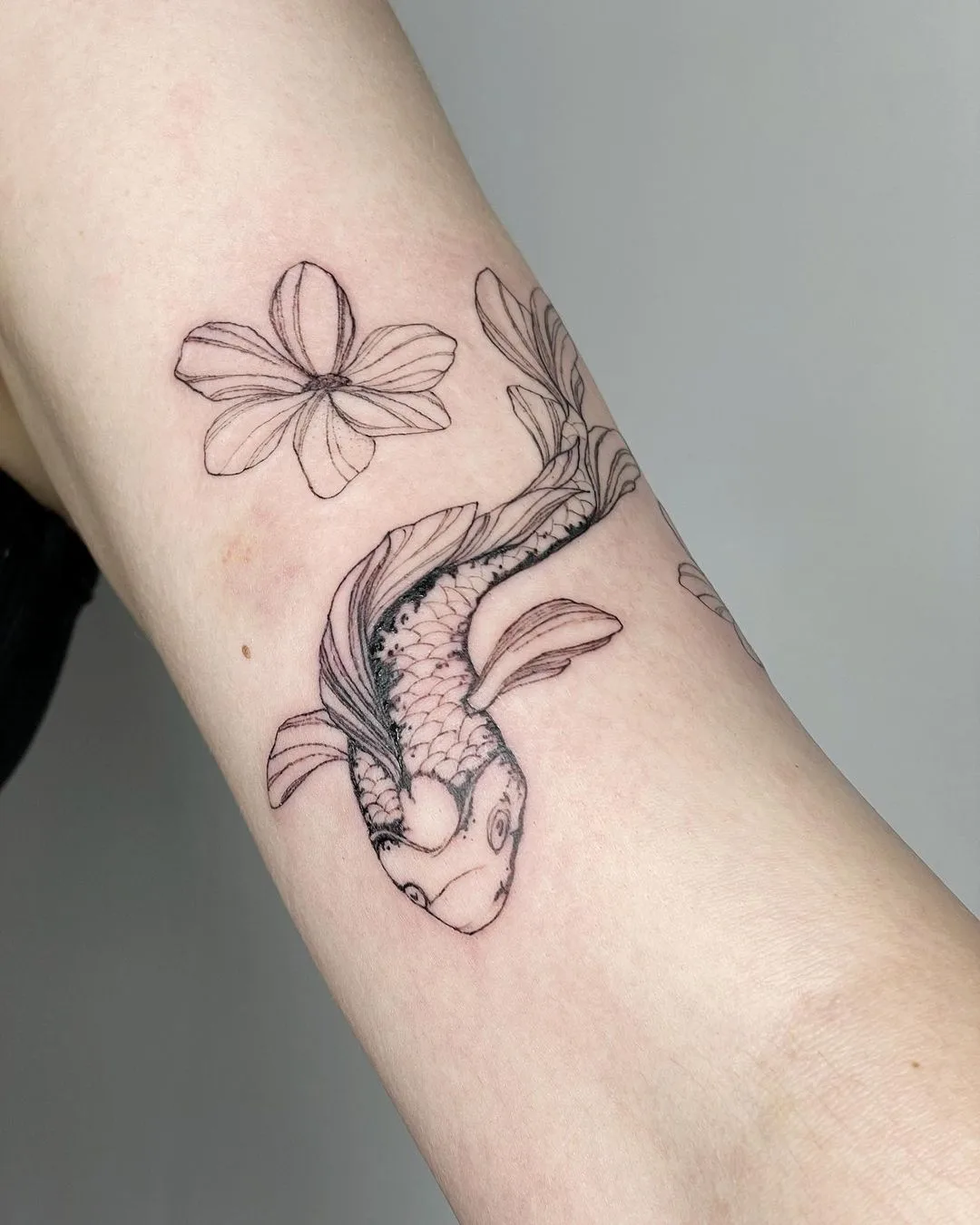
At its core, a koi fish tattoo is about one idea: that struggling forward through something genuinely hard can change you into something you weren't before, and that the struggle itself is what makes the transformation real.
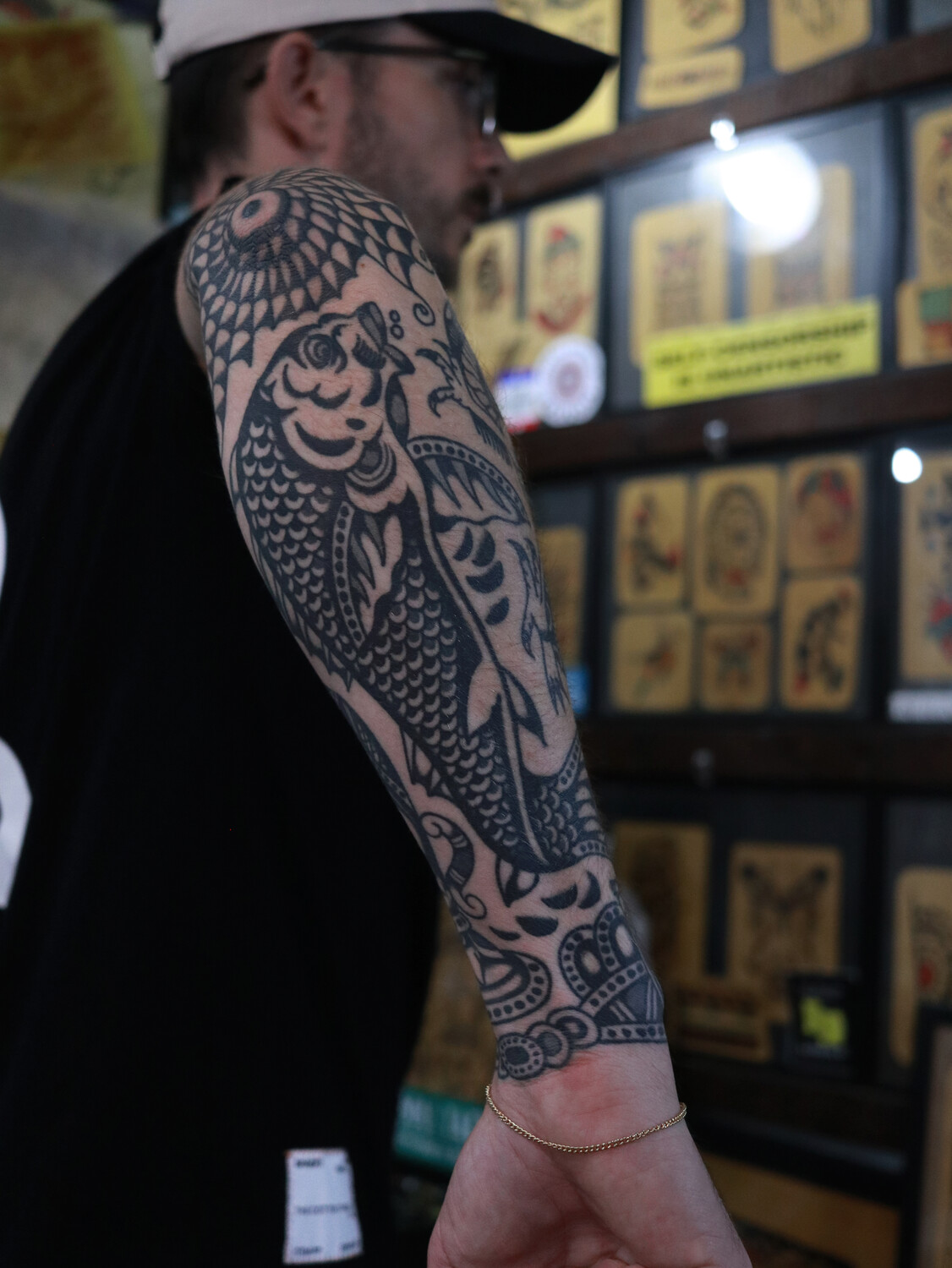
Full-sleeve blackwork koi fish tattoo
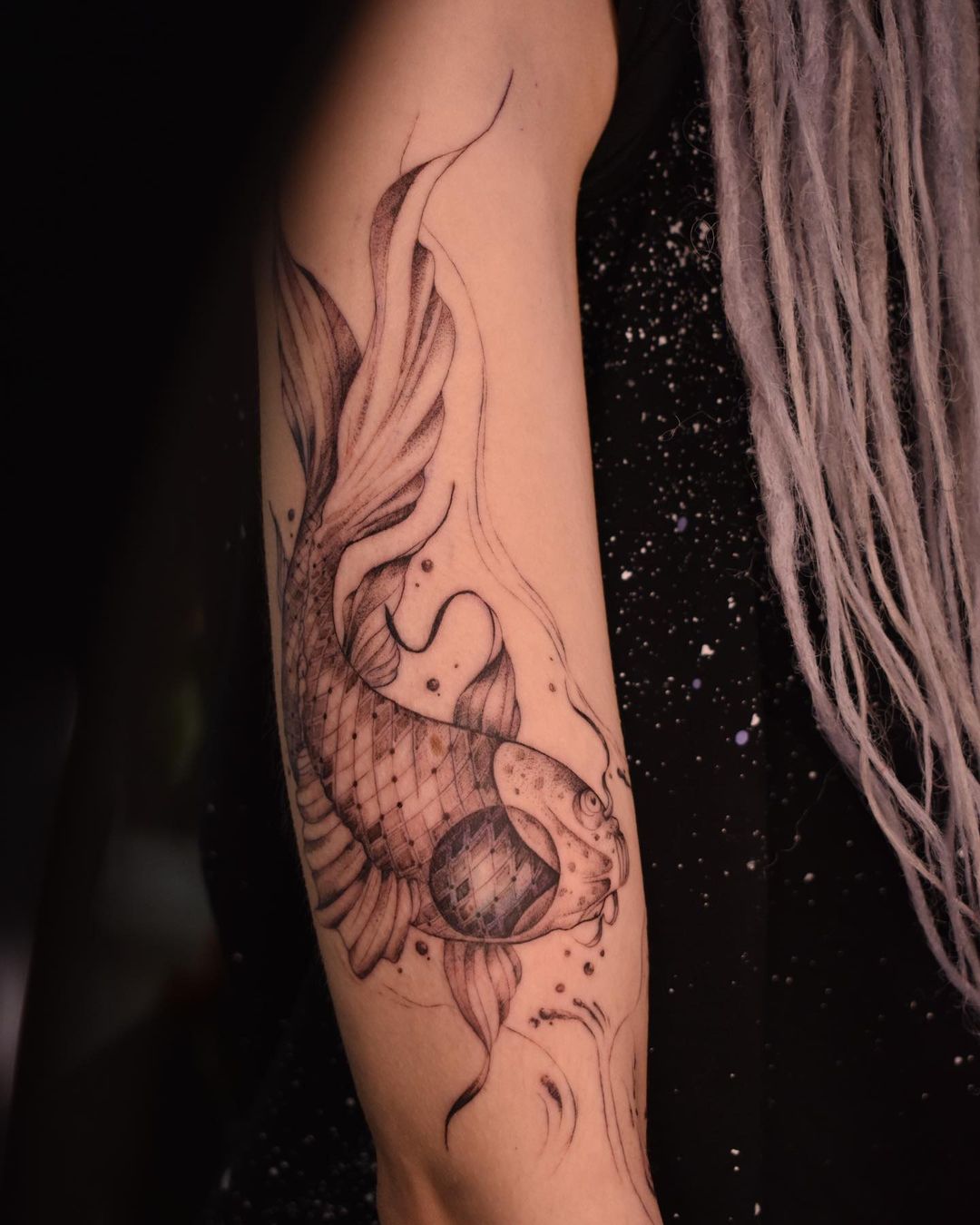
Black-grey koi with fine linework and dotwork
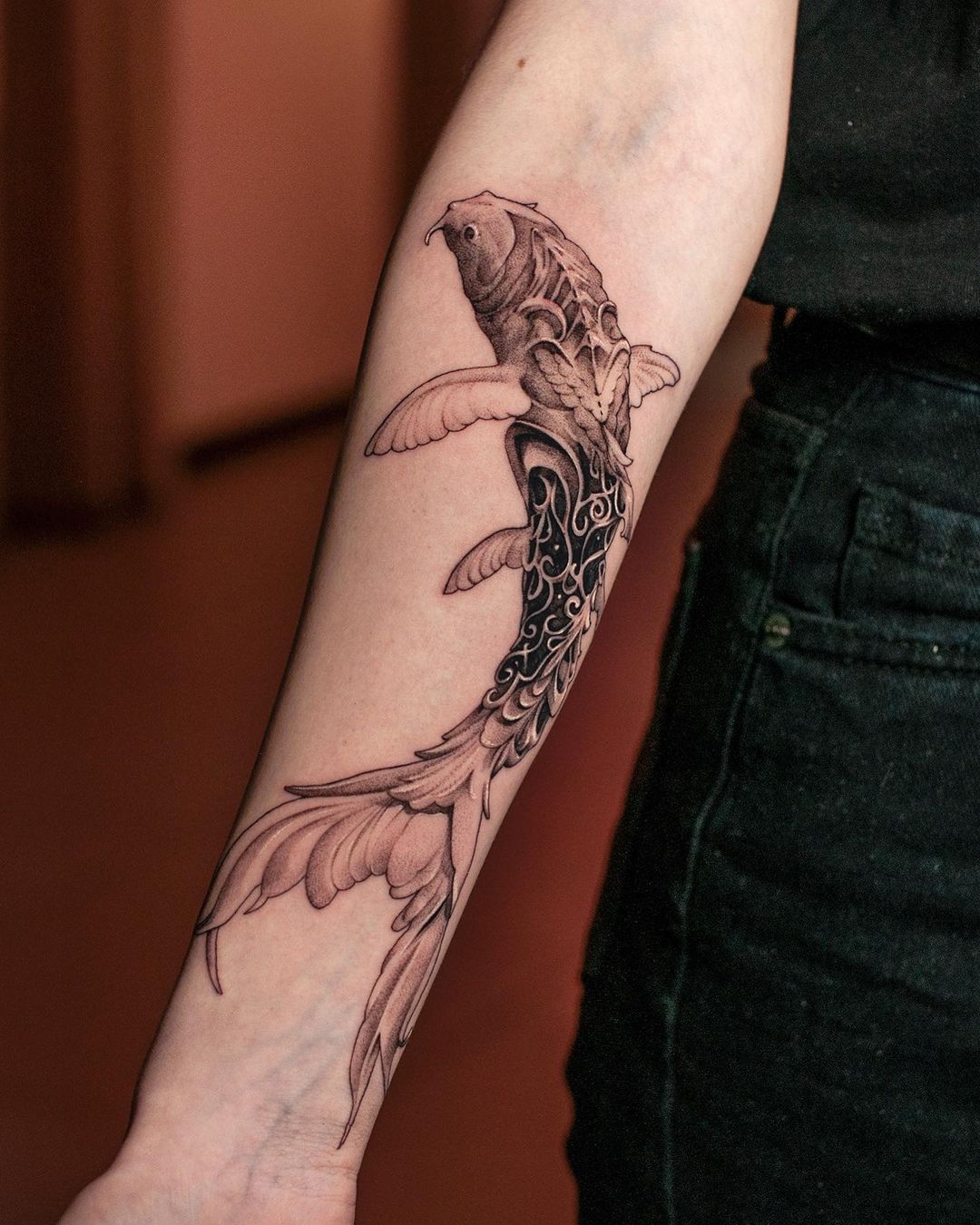
Koi with geometric ornamental patterns, black and grey
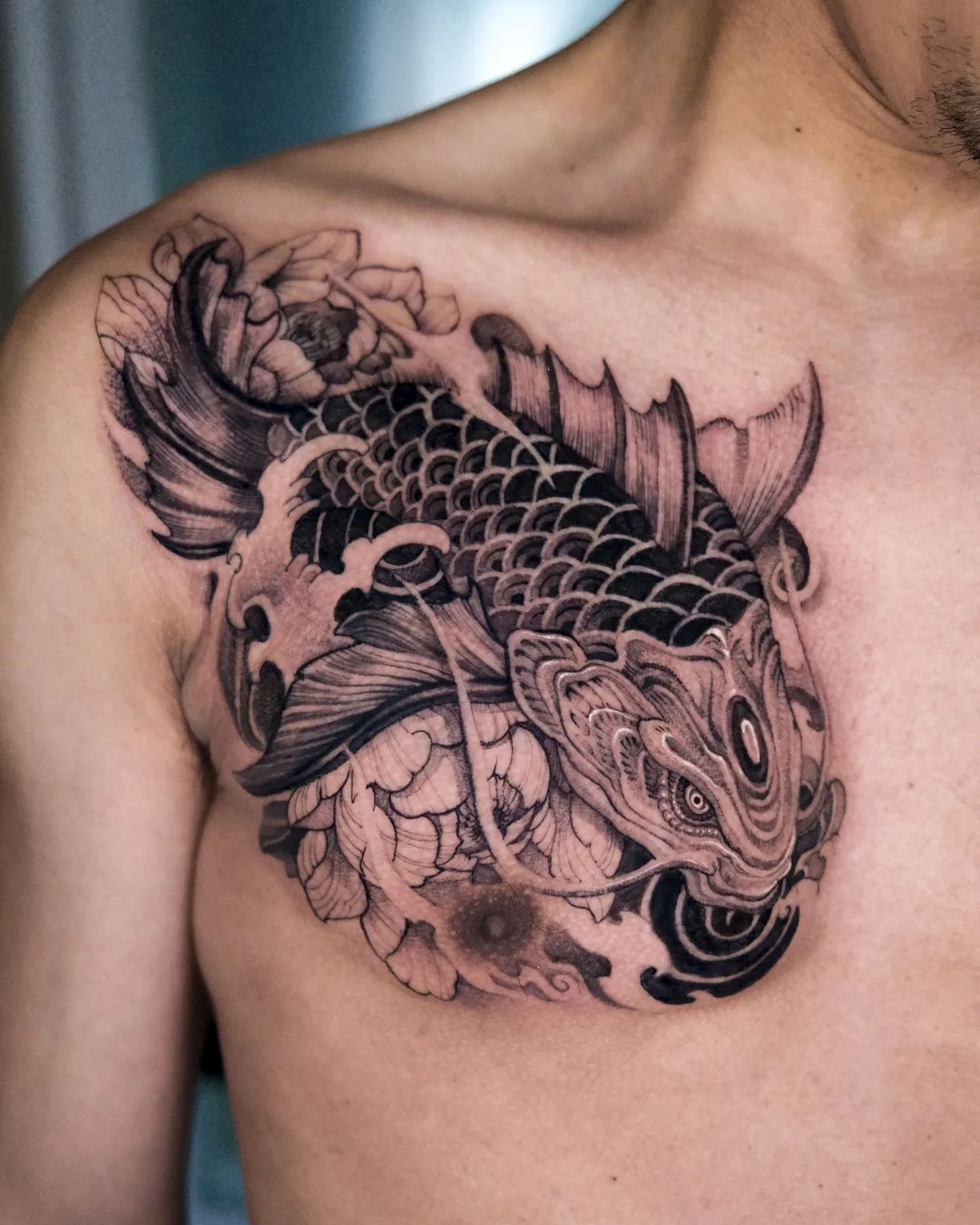
Black-and-grey Japanese koi chest tattoo

Japanese black-and-grey koi fish tattoo
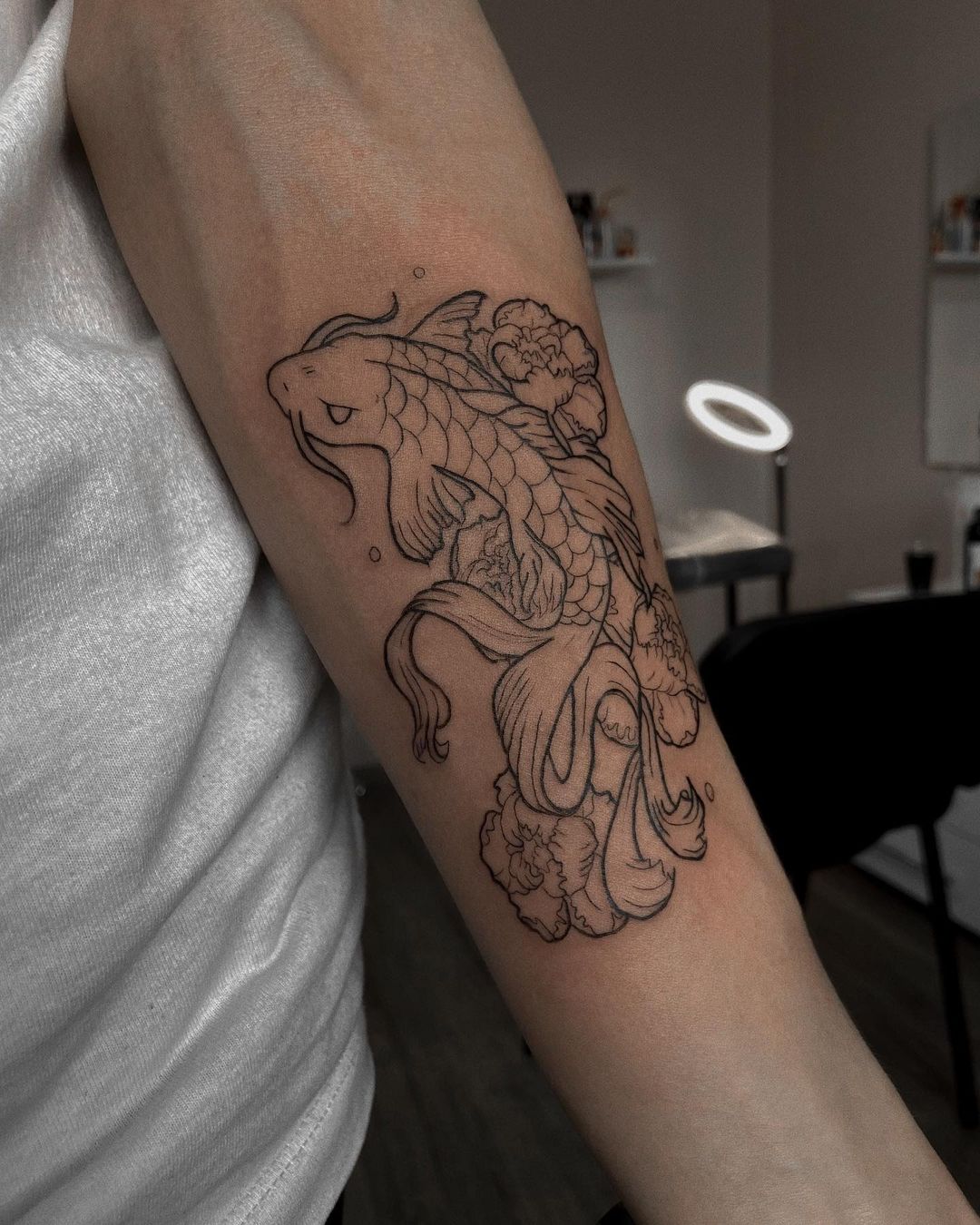
Black linework koi with florals
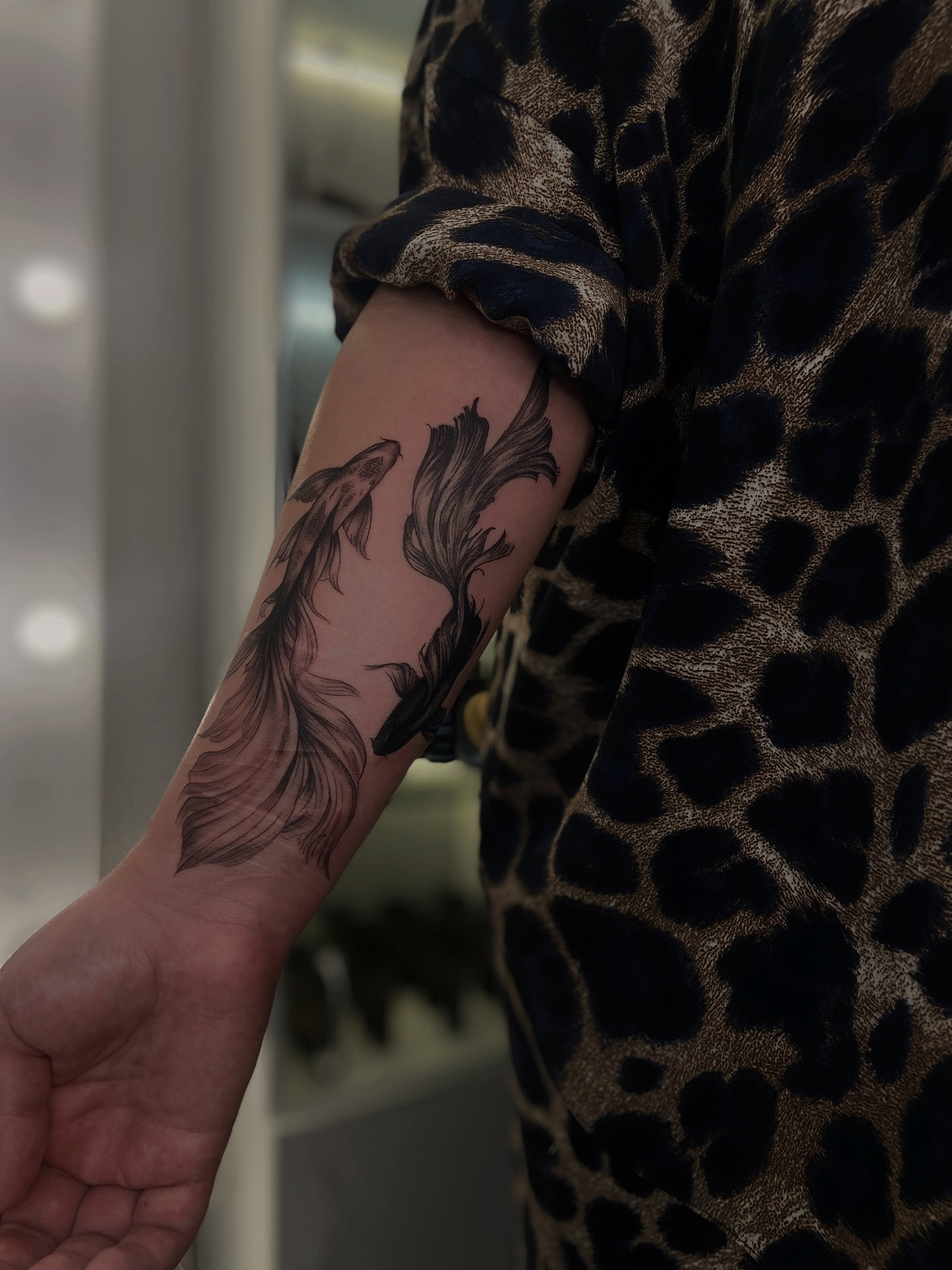
Black-grey koi fish forearm tattoo