A shark tattoo means protection before it means danger: in the Pacific cultures that first put the animal on skin, the shark was an ancestor, a guardian and a guide for canoes, not a predator. The Western reading of fearlessness and apex-predator drive is real too, but it is the younger of the two, and it arrived with a film.
- In Hawaiʻi the shark was an ʻaumakua, a family ancestor returned as a guardian; Kamohoaliʻi, Pele's brother, guided canoes home.
- The Polynesian shark-tooth row (niho mano) means protection, but Samoan peʻa and malu record a person's genealogy: copying one is appropriation, commissioning a Pacific artist is not.
- In Māori culture the mako tooth pendant marked rank and is taonga; kirituhi is the honest route for non-Māori wearers.
- The open-jawed predator arrived with Jaws in 1975; surf culture and shark conservation have since turned the animal back into something to defend.
- Closed mouth reads as guardian, open jaws as predator; species and direction of travel change the meaning as much as the style does.
What a shark tattoo means
Sharks have been in the oceans for around 450 million years. They are older than trees and have come through several mass extinctions. When someone chooses a shark, part of what they are choosing is that stubborn continuity: the thing that keeps going after everything around it has been wiped out. People who have rebuilt a life after a loss tend to find that reading first.
The second reading is quiet authority. A shark does not display, threaten or bluff. It sits at the top of its food chain and behaves accordingly. As a tattoo that translates into confidence without noise, which is why the motif is popular with people who would rather be underestimated than loud.
Forward motion is the third. Several species (the great white and the mako among them) breathe by swimming, and if they stop for long they suffocate. That is not true of all sharks, but the metaphor has outlived the biology: keep moving or die. People who have had to carry on through a bad stretch without the option of stopping recognise it.
Then there is the reading the animal never asked for: menace. Sharks kill fewer than ten people a year worldwide in most years, and humans kill sharks by the tens of millions, yet the cultural weight of terror is still there. Some wearers lean into it deliberately, because they identify with being misjudged or want the tattoo to unsettle. The gap between reputation and reality is itself part of the meaning.
Underneath all of these is the oldest layer. In Hawaiʻi the shark was a family guardian; in Samoa, Tahiti and the Marquesas its teeth were a protective pattern with rules attached; in Aotearoa a single mako tooth marked rank. Those traditions do not agree with the Jaws reading, and a well-made shark tattoo usually picks a side. The sections below take the traditions one at a time, then get practical.
Hawaiian tradition: ʻaumākua and Kamohoaliʻi
In Hawaiian belief an ʻaumakua is an ancestral guardian: a family member who has died and returned in another form to watch over the living. Owls, lizards, eels and sharks all served, and the shark was among the most respected. A family with a shark guardian recognised a particular animal by its markings, fed it near their fishing grounds, spoke to it, and would not eat shark meat. A shark that drove fish into a net or pushed a swamped canoe toward shore was a relative doing its job.
The shark of highest standing was Kamohoaliʻi, elder brother of the volcano goddess Pele. When Pele's family sailed from Kahiki to the Hawaiian islands, Kamohoaliʻi guided the canoe. Lost navigators who poured ʻawa into the sea were said to see him surface and lead them home. His sacred cliff sits on the rim of Kīlauea, and the story runs that the volcano's smoke never blows across it.
Not every shark was kin. The niuhi, the large man-eaters (tiger sharks and great whites), were feared, linked with sorcery, and hunted by chiefs as a test of nerve. A chief's wife was said to eat niuhi flesh during pregnancy so the child would be born fearless. The same animal carried both meanings depending on which shark, and which family.
For a tattoo, the Hawaiian reading is the one that turns the shark into a protector: a specific ancestor rather than a generic force.
Polynesian tradition: the shark-tooth row in tatau
The English word tattoo comes from the Polynesian tatau, and the shark tooth is one of the oldest units in that vocabulary. In Polynesian tattoo vocabulary the row of triangles is often called niho mano, shark teeth, and it reads as protection, guidance and ferocity in defence of what is yours. Modern readings tie it to the warrior who would fight and the navigator asking the sea for safe passage; run along an arm band, it frames everything inside it.
The pattern had owners. In Samoa the male peʻa (waist to knee) and the female malu were given by a tufuga tā tatau, a master from lineages such as the Suluʻape family, using hand tools, in front of family, over days or weeks of real pain. What the marks recorded was service to family and village, and who you were descended from. Marquesan patutiki carried genealogy in the same way. A pattern was a record, and the record was specific to a person.
That is where the line runs. Commissioning a Pacific artist to compose a piece for you, in their tradition, using the shared vocabulary of niho mano and wave and spearhead, is how these traditions have always been carried and is generally welcomed. Copying a peʻa or a malu from a photograph, or lifting a pattern off a stranger's arm because it looked good, is appropriation in the plain sense: you are wearing someone's genealogy as a costume. If a Samoan can read your leg and it tells them a story that is not yours, the design has failed, however well it was drawn.
Māori tradition: the mako tooth as taonga
In Aotearoa the shark appears on the body not mainly as a pattern but as an object. A single tooth of the mako shark, drilled and hung from the ear as a pendant, was worn by people of rank. The teeth were prized and passed down for generations; they sit in museum collections today as heirlooms with known lines of descent. A mako tooth in the ear said you had standing, and that someone before you had it too.
That places the tooth among taonga, the treasures a people holds in trust: land, language, carving, tā moko. The Treaty of Waitangi guaranteed Māori possession of their taonga in 1840, which is why the word carries legal as well as cultural weight in New Zealand today.
The shark enters Māori pattern too. Mangōpare, the hammerhead, is one of the standard kōwhaiwhai designs painted on meeting-house rafters, and it stands for strength and determination that does not let go. A proverb makes the same point: kia mate ururoa, kei mate wheke. Die like a shark, fighting, not like an octopus that goes limp when it is caught.
For a non-Māori wearer the honest route exists and has a name. Kirituhi is Māori-style work designed for people without Māori descent; it borrows the visual language while making no claim to whakapapa. Tā moko proper records lineage and belongs to the person and their people. An artist who works in the tradition will tell you which one you are asking for.
The modern reading: surf culture and conservation
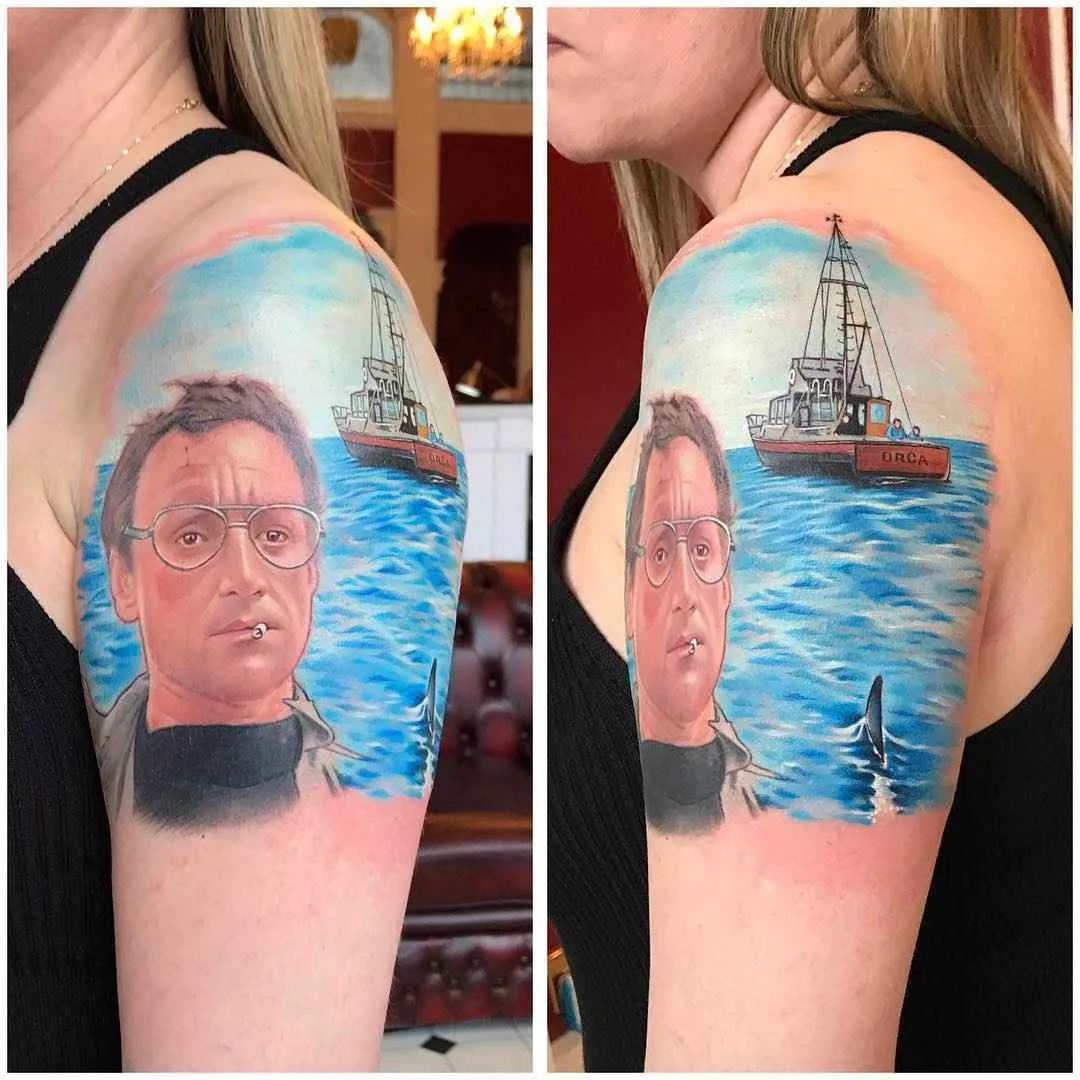
Jaws came out in 1975 and rewrote the shark for the whole Western world in one summer. Peter Benchley, who wrote the novel, spent his last decades campaigning for shark protection and said he would not write the book again knowing what he later learned. The film gave tattooing the open-jawed great white; the author's regret gave it the counter-reading.
Surfers hold both at once. They share the water with the animal, and the best-known encounters are part of the culture's folklore: Bethany Hamilton losing her arm to a tiger shark at Kauai in 2003 and returning to competition within a year; Mick Fanning punching a great white off his board during a live-broadcast final at Jeffreys Bay in 2015. A surfer's shark tattoo is rarely about fear. It is about knowing what is under you and paddling out anyway.
Conservation has changed the motif more than anything since the film. Around a hundred million sharks are killed each year, most for fins, and a run of documentaries, from Rob Stewart's Sharkwater in 2006 onward, made the predator into something that needed defending. The whale shark, a plankton-eating giant, and the hammerhead, with several species now endangered, became the conservation sharks in tattooing. On those pieces the meaning flips completely: not "I am dangerous" but "this animal is not the danger."
Tattoo styles that suit the shark
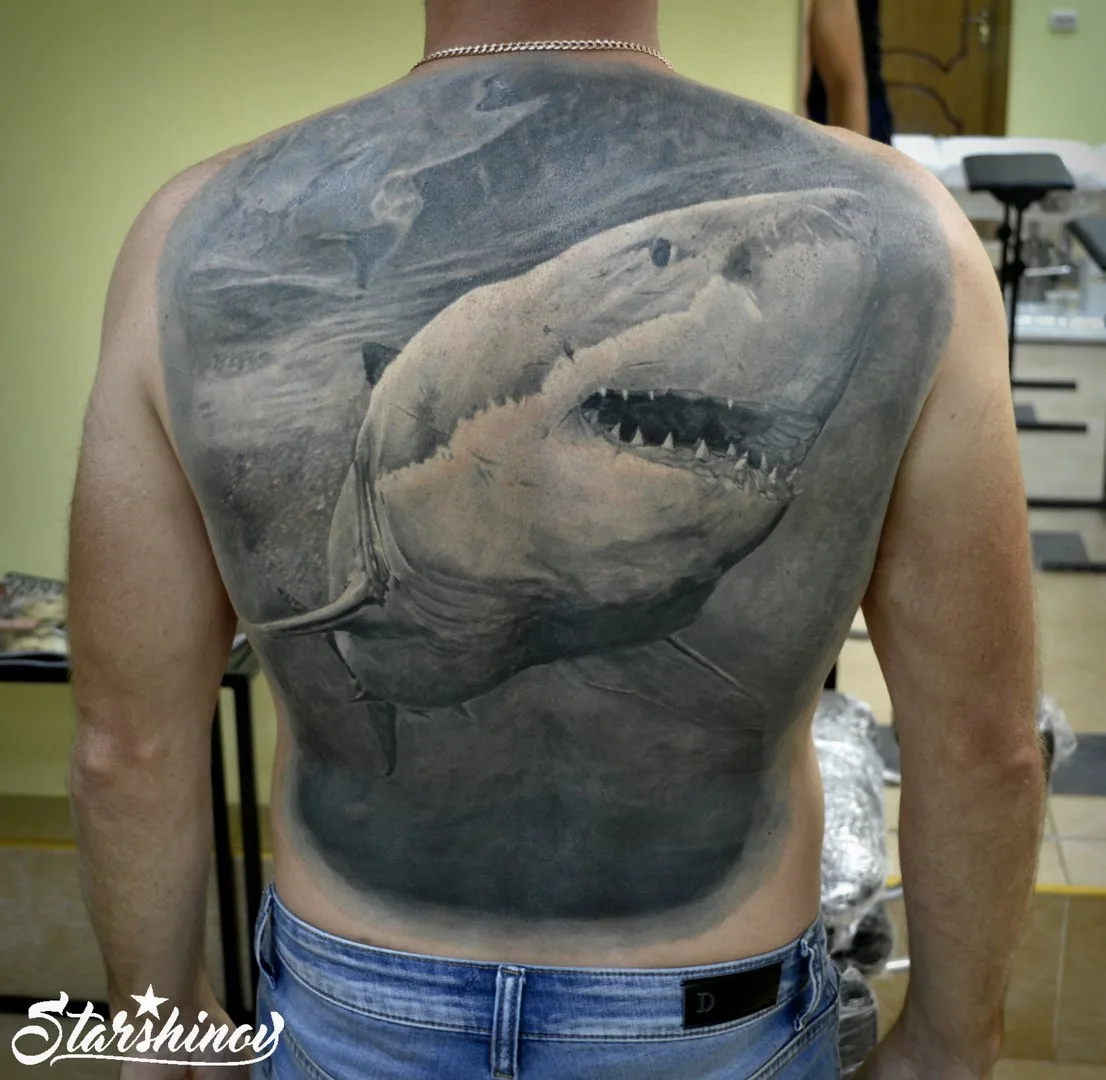
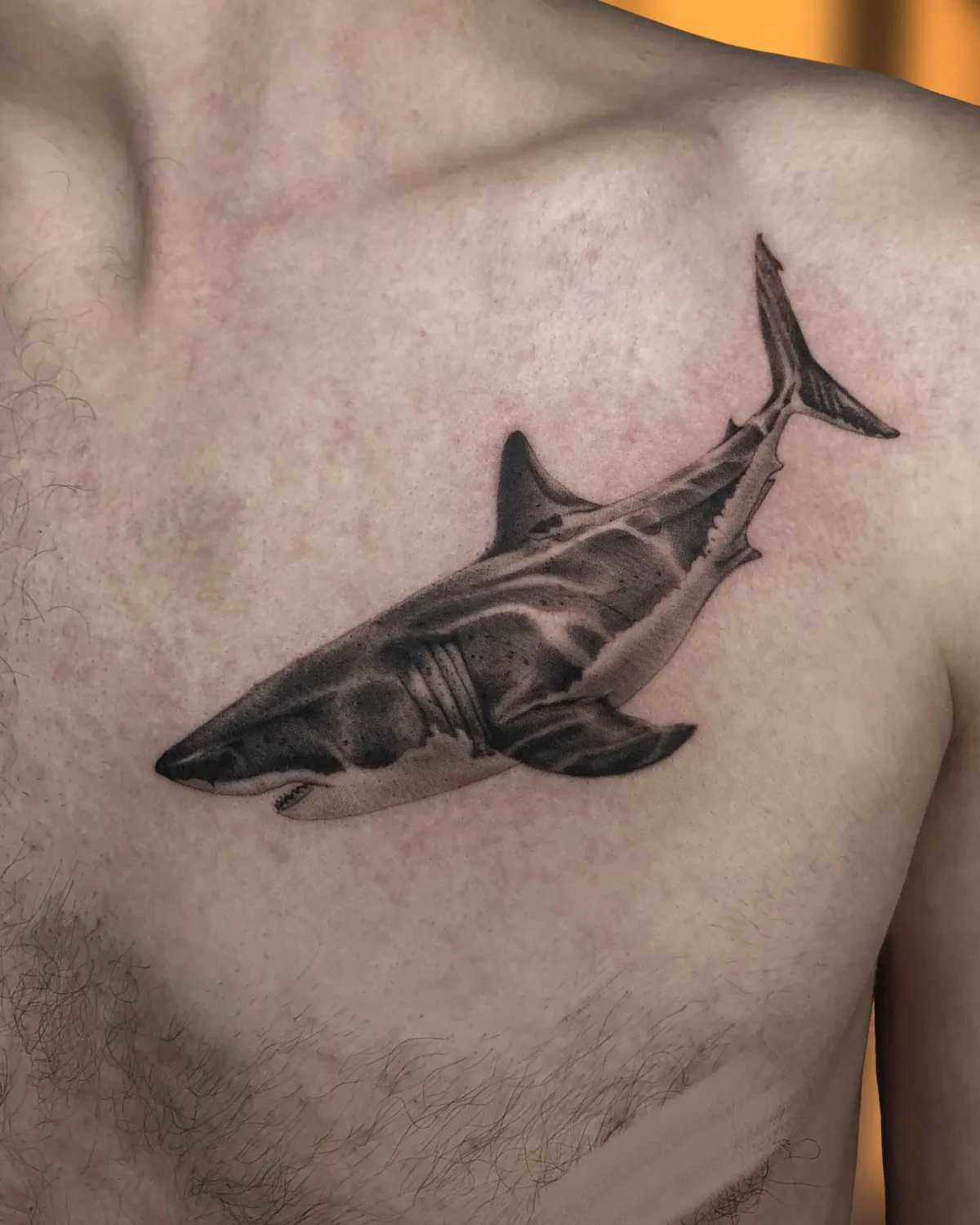
Realism and black and grey. The most requested approach, and the shark rewards it because its body is a study in countershading: dark on top, pale underneath, and a soft gradient along the flank that a good black-and-grey artist can carry for a full forearm. The details that sell a realistic shark are the gill slits, the eye, and the skin breaking the water. The details that sink one are teeth drawn from memory: dentition is species-specific, and a great white with a tiger shark's serrations looks wrong even to people who cannot say why.
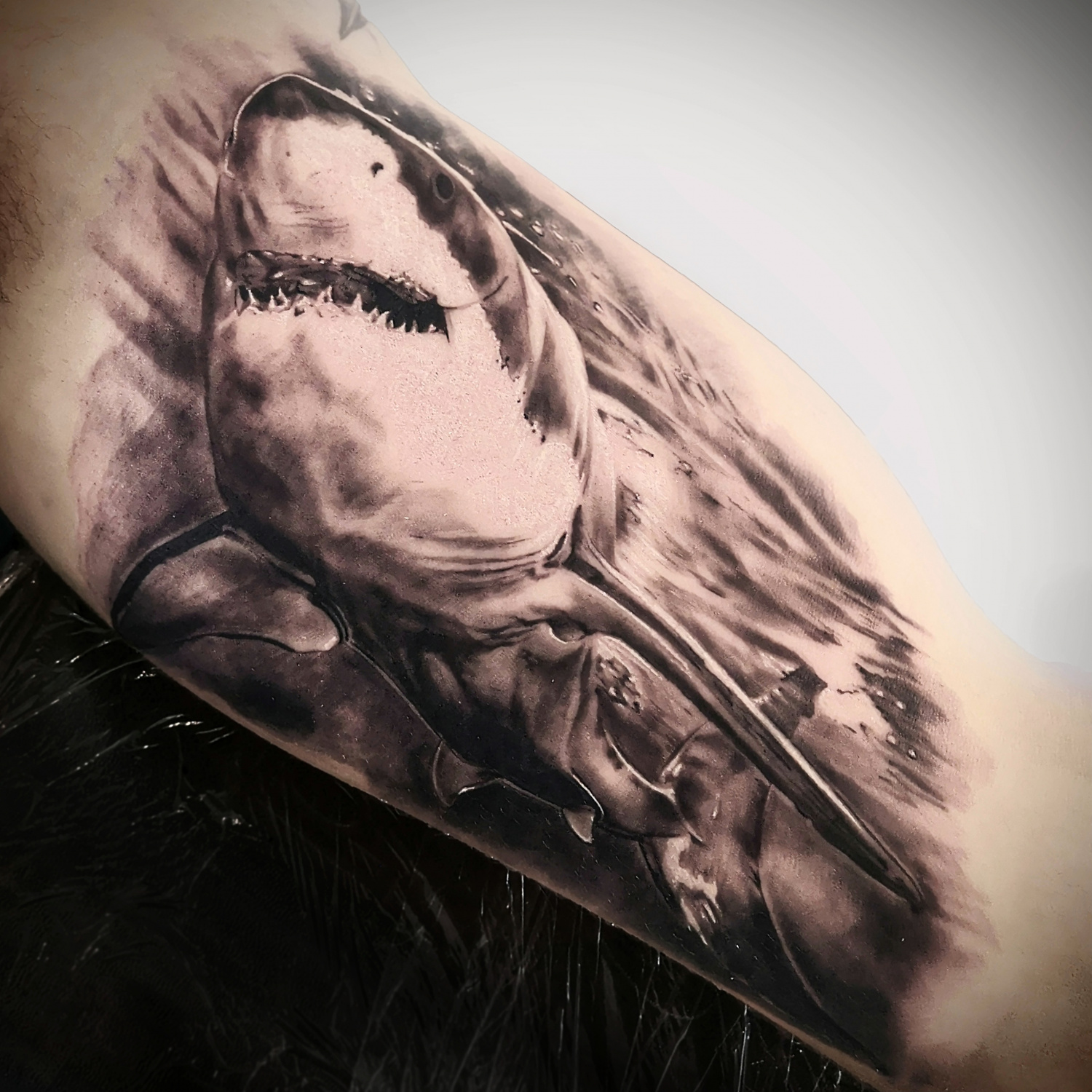
Black and grey shark tattoo underwater by @dark_eve_black

Forearm shark tattoo in black and grey by @vendlertattoo
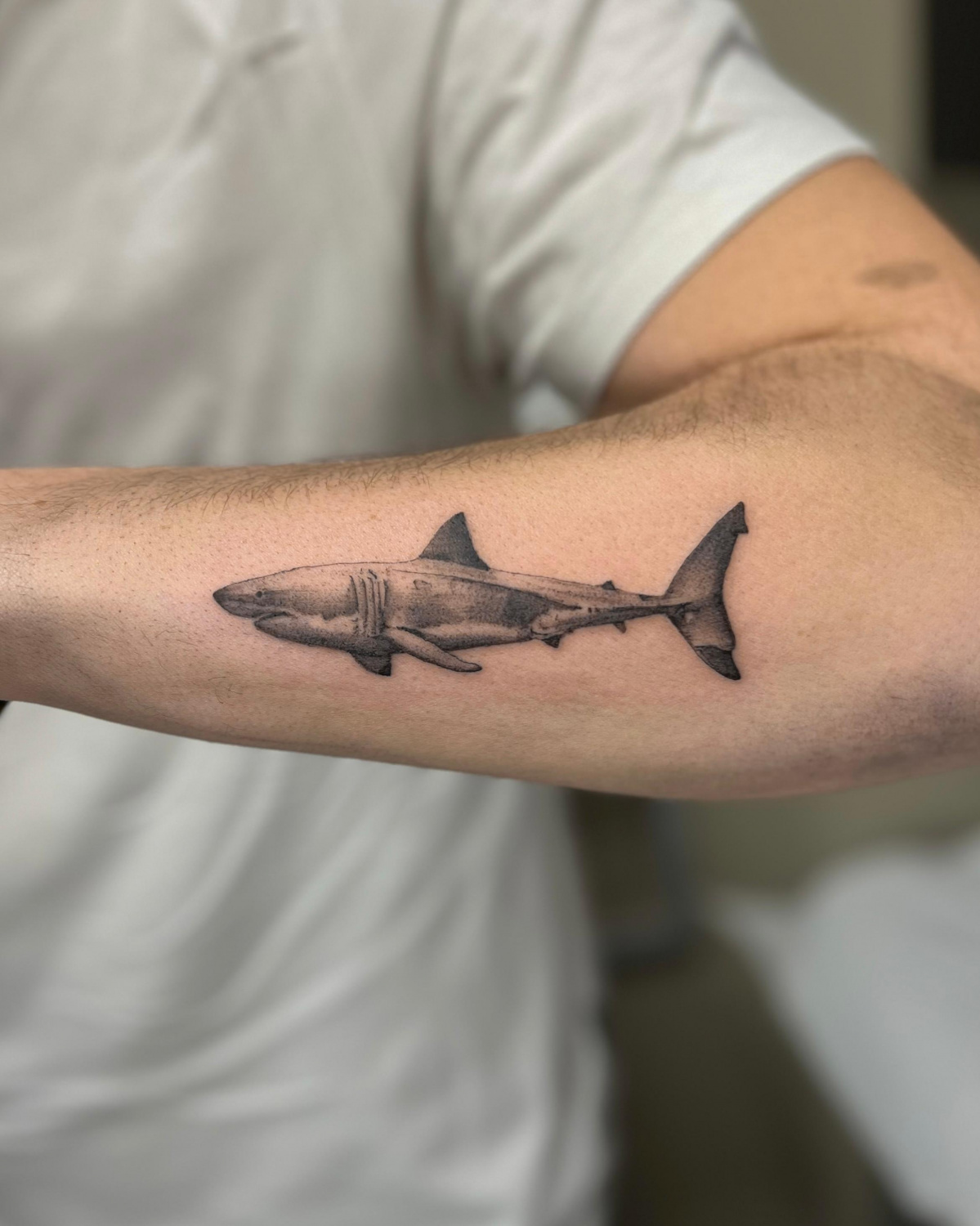
Grey shark tattoo on the forearm by @laumestre

Realistic forearm shark tattoo by @monsieur.slow

Shadow-effect shark tattoo by @sin_tattoooo

Black and grey shark tattoo on the arm by @poppinowillinkya
American traditional. Sharks turn up on old sailor flash alongside anchors, swallows and ships, and the usual reading is blunt: a sailor who wore one was telling the sea he was not afraid of it. Bold outline, a limited palette of blue-grey, red and black, exaggerated proportions and a wedge of white teeth. This is the style that ages best, and it ties the animal to maritime Western culture rather than the Pacific.
Polynesian. The shark rendered as pattern rather than portrait: rows of niho mano, wave and spearhead motifs, sometimes the animal's silhouette built entirely from those elements. Solid black, large areas, meant for shoulder, upper arm, calf or thigh. Read the section above on where borrowing crosses into appropriation before booking this one.
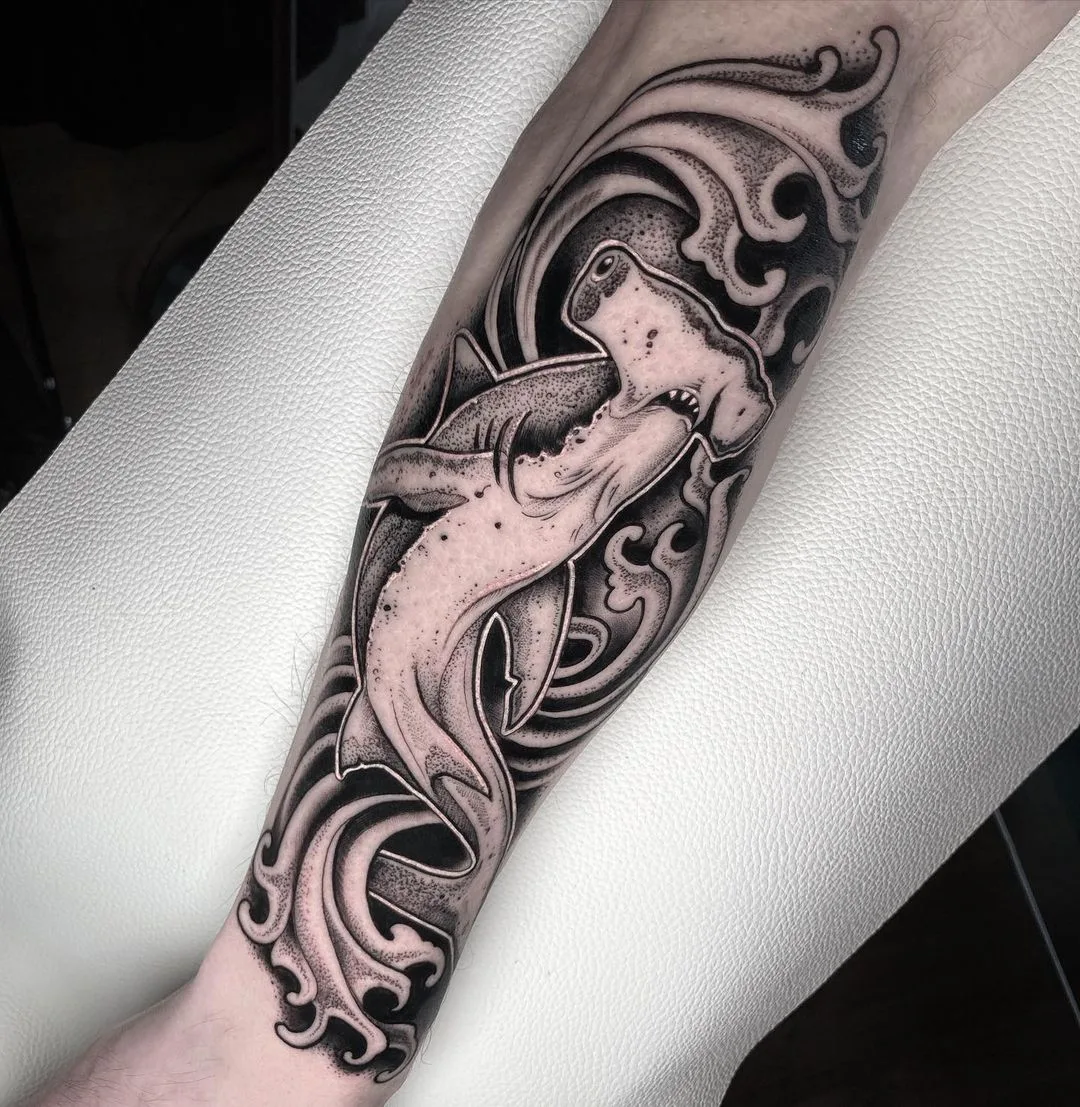
Blackwork and dotwork. A solid black shark has gravity that colour versions lack. Stripping colour pushes the shape forward, and dense black against bare skin does the highlighting. Dotwork suits the animal's gradient: a stippled flank fading to clean skin reads as water without drawing any.
Neo-traditional. Traditional line discipline with a wider palette and more drawing. The shark here is usually part of a composition, wrapped in waves or framed by a rising sun, and it holds a calf or an upper arm better than a lone portrait does.
Geometric and fineline. The animal broken into facets or reduced to a single clean outline. These scale down further than anything else on the list and hold up over time because there is no fine gradient to blur. They also carry the symbolism without the literal predator.
Japanese. Sharks are rare in classical irezumi, which prefers koi and dragons, but modern Japanese-style artists fold them into ocean scenes with wind bars, spray and rocks. The shark becomes one element in a moving composition, which is why the style holds a back or a full sleeve better than any other. To see how these styles compare on real skin, the shark motif page gathers the work by style and placement.

Neo-traditional shark tattoo with banner by @strange_diary
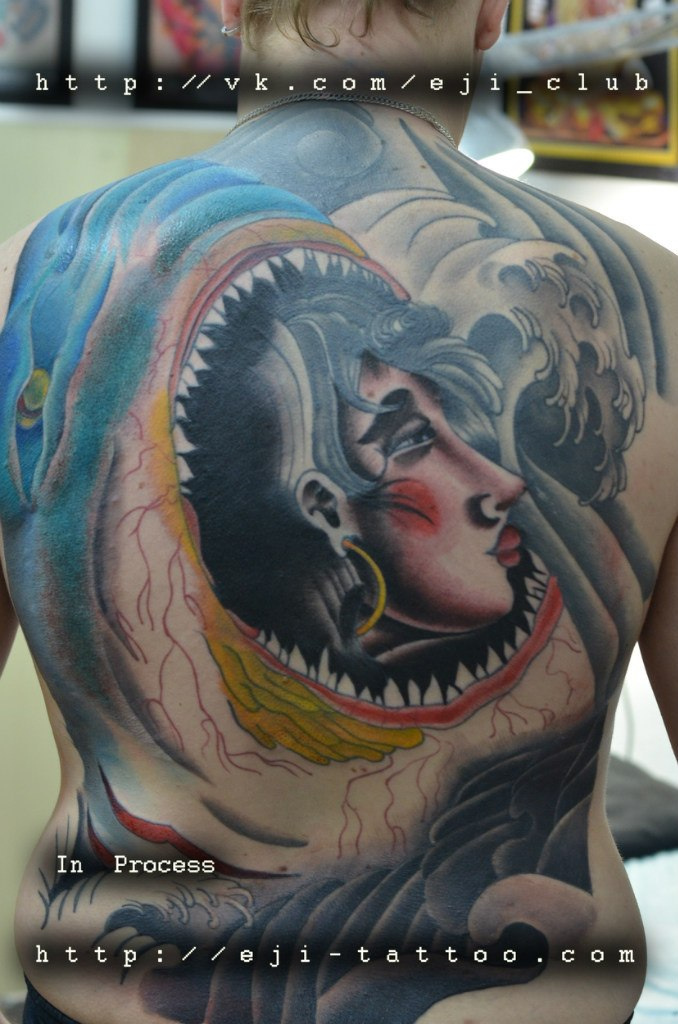
Woman's face in shark jaws tattoo by @Ejitattoo

Traditional shark tattoo with LOVE banner by @TrueHardcore_tattooer

Neo-traditional sleeve tattoo by @ducky_valley_

Neo-traditional shark tattoo in vivid colour by @juliancolumbia

Dotwork shark tattoo on bicep by @back.ttt

Dotwork-style black and grey shark tattoo by @Jaris_ink
Placement and scale
The shark is a long animal, and that decides most placement questions before style does. The forearm and the calf are the two default placements, because the fish follows the muscle and the tail can wrap toward the inner side. A shark that spirals from the outer forearm to the inner gives a sense of travel that a flat placement cannot.
The upper arm and shoulder buy context. A shark here can have water around it, a diver beneath it, a ship above, and the deltoid's curve suits a turning body. This placement also extends into a full sleeve later without redrawing what you already have.
The ribs and side torso fit the shape better than anywhere: the animal follows the curve of the ribcage as if swimming past. It is also one of the more painful sessions on the body, and the skin there moves, so fine detail suffers. The thigh has been gaining on all of these for larger work: big canvas, moderate pain, full control over who sees it.
A back piece gives the animal an environment. A shark rising through a wreck, or two sharks circling, is a multi-session project in any style. Chest placements work at medium size, centred on the sternum or set on one pectoral, and a shark over the heart tends to be the guardian reading rather than the predator.
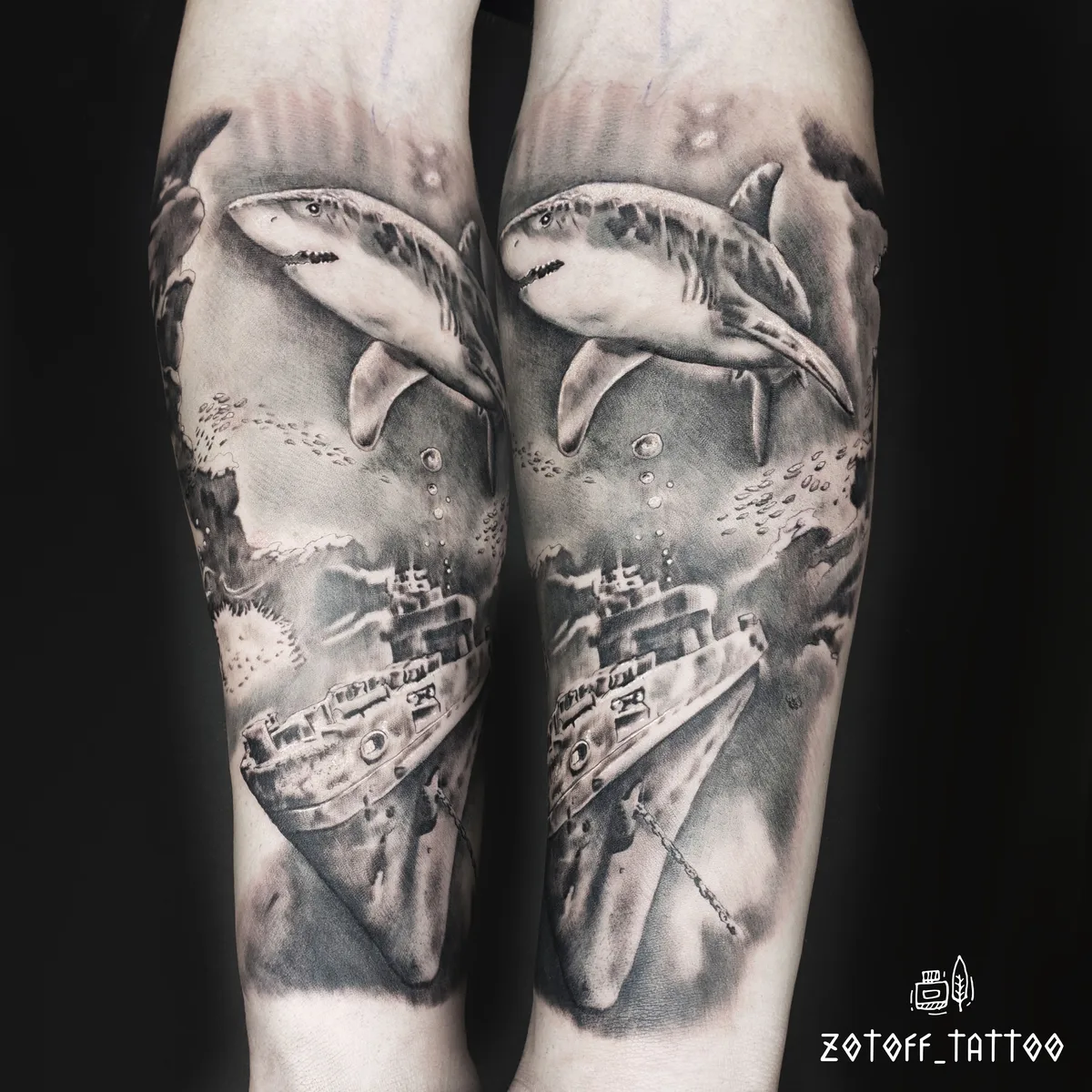
Scale needs its own decision. A realistic shark under roughly ten centimetres cannot hold its gradient: the countershading that makes the animal read as three-dimensional closes up into a dark shape within a few years. Below that size the honest options are a silhouette, a linework outline, a geometric treatment or a traditional design. The wrist, ankle and palm all take small sharks, but a palm tattoo fades hard and usually needs redoing.
Direction matters too. A shark swimming up toward the shoulder reads as ascent and pursuit; one swimming down toward the hand reads as hunting. Most artists will draw it whichever way you ask; fewer will point out that you are choosing a meaning when you choose the direction.
Design variations and what they change
Small choices inside a shark design move the meaning further than switching styles does.
Open jaws or closed mouth. The single biggest decision. A shark shown mid-strike, teeth out, is the film's shark: confrontation, threat, appetite. A shark in profile with the mouth closed, moving through water, is the Hawaiian shark: watchful and unbothered. Most people picture the first and end up happier with the second once they see it on their own arm every day.
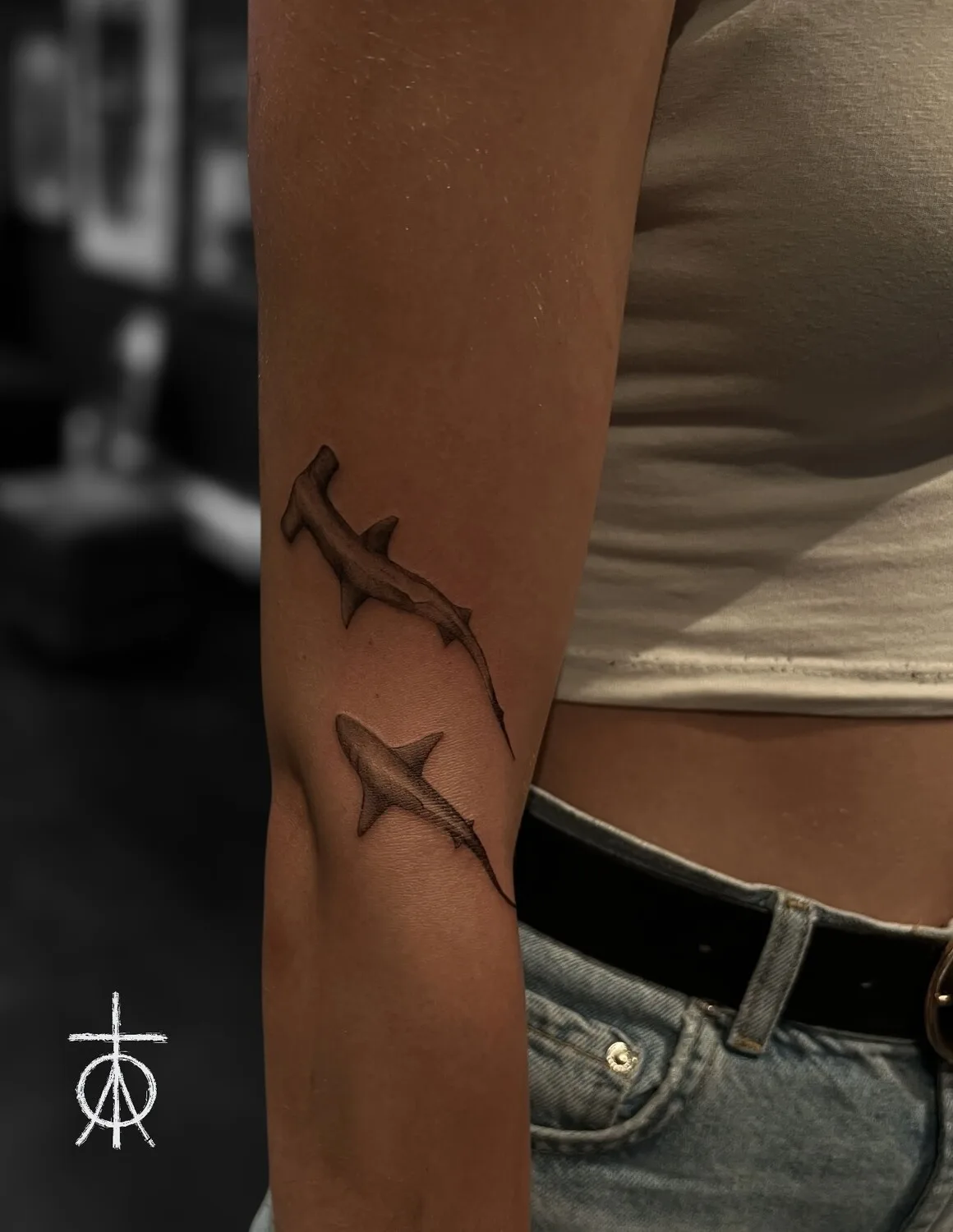
Species. A great white is unambiguous power and menace. A hammerhead reads as seeing what others miss (the head gives it an unusually wide field of view) and, in Māori pattern, as tenacity. A tiger shark stands for indiscriminate appetite, the animal that eats anything. A whale shark, spotted and enormous and harmless, is about wonder rather than aggression, and it is the species conservation-minded wearers choose. A mako is speed.
The shark-tooth row. A band of niho mano triangles around the arm or calf, with or without the animal, is the oldest shark tattoo there is. It reads as protection, and, to anyone who knows the source, as Polynesian, so the appropriation question applies to the band as much as to a full piece.
A single tooth. One shark tooth, drawn as an object rather than a pattern, points to the Māori pendant tradition: rank, inheritance, something passed down. Small, durable, and protective without any teeth bared.
Nautical company. A shark with an anchor, a ship, a compass or a diver's helmet places the animal in the sailor lineage and makes the piece about the sea as workplace and adversary. A shark with a diver turns the composition into an encounter, and the scale of the two figures decides whether it reads as threat or coexistence.
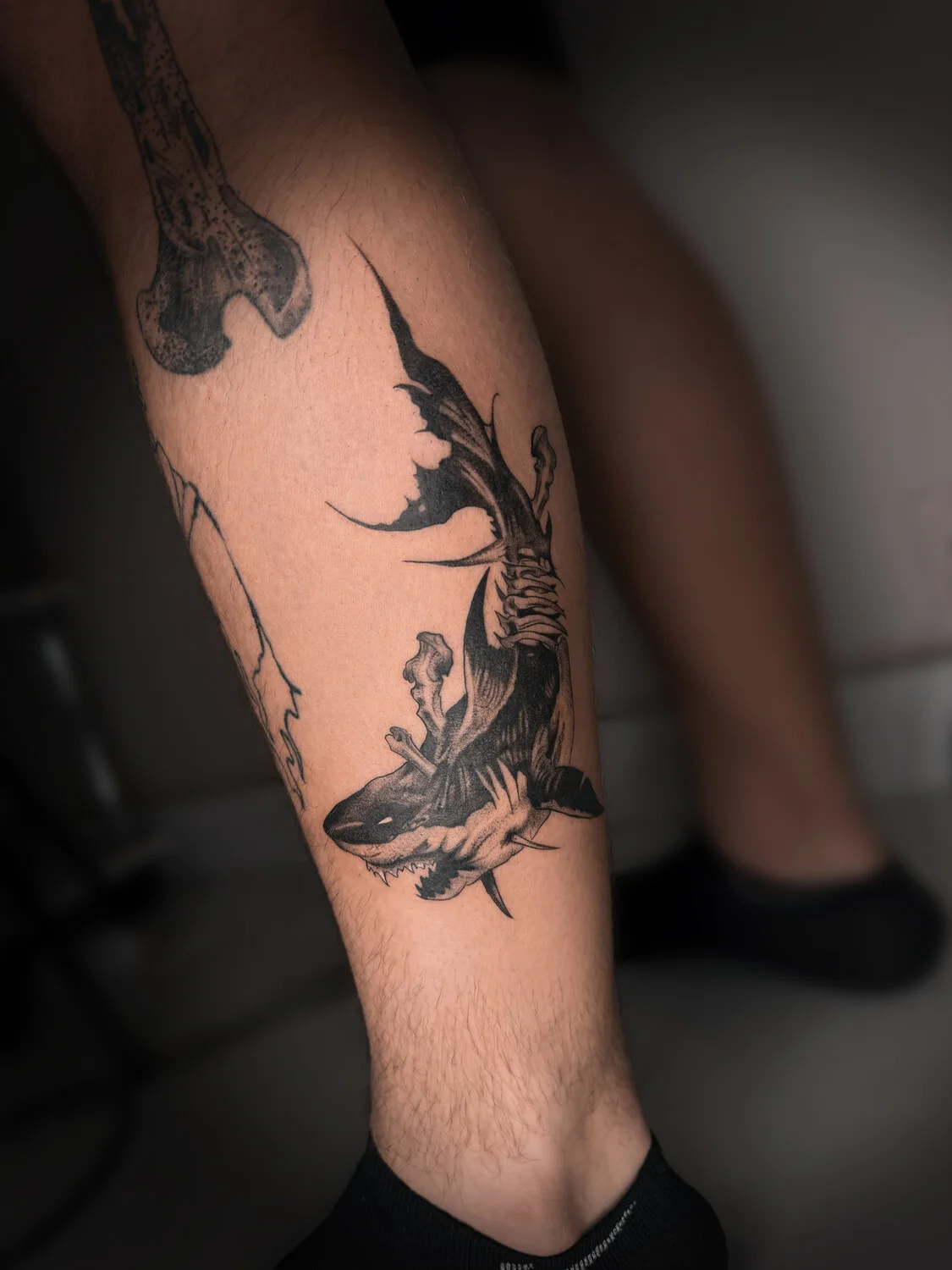
Skeleton and x-ray treatments. A shark reduced to jaw and cartilage, or drawn with its skeleton visible, is memento mori: the ocean's predator as a reminder that everything is prey to time. It also ages well, since there is no gradient to blur.
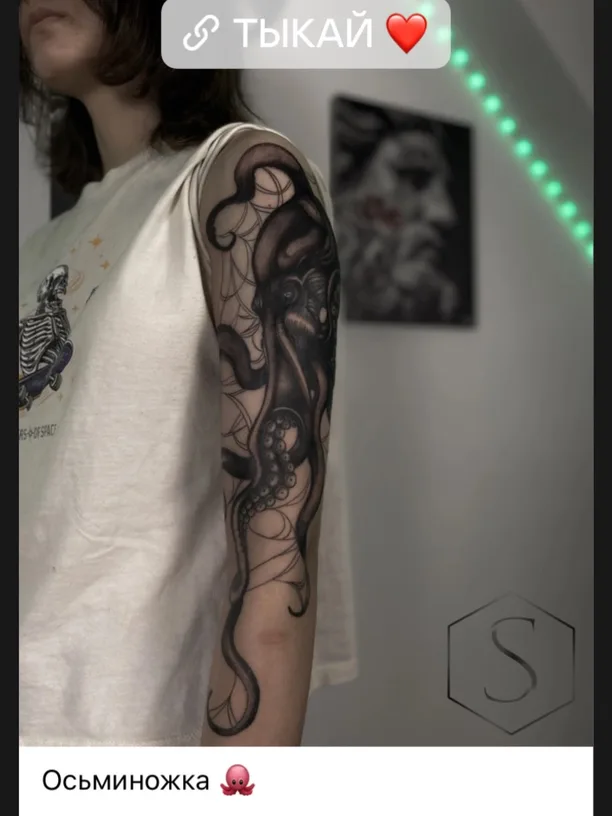
Shark with other animals. Shark and octopus is the classic pairing, and in Fijian tradition the shark god Dakuwaqa fought an octopus and lost, which is why the waters around Kadavu were said to be safe. Multi-animal compositions need an upper arm at minimum, and the shark stops being the centre of the piece once a second animal earns equal space, so decide that hierarchy at the sketch stage.
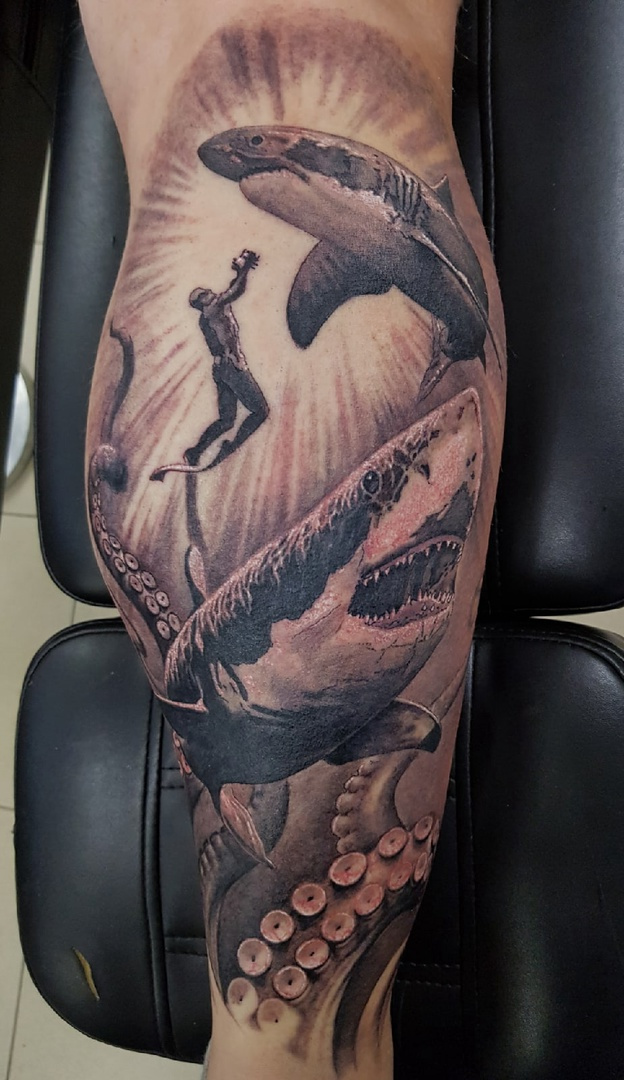
Diver, sharks and octopus tattoo by @chikai72
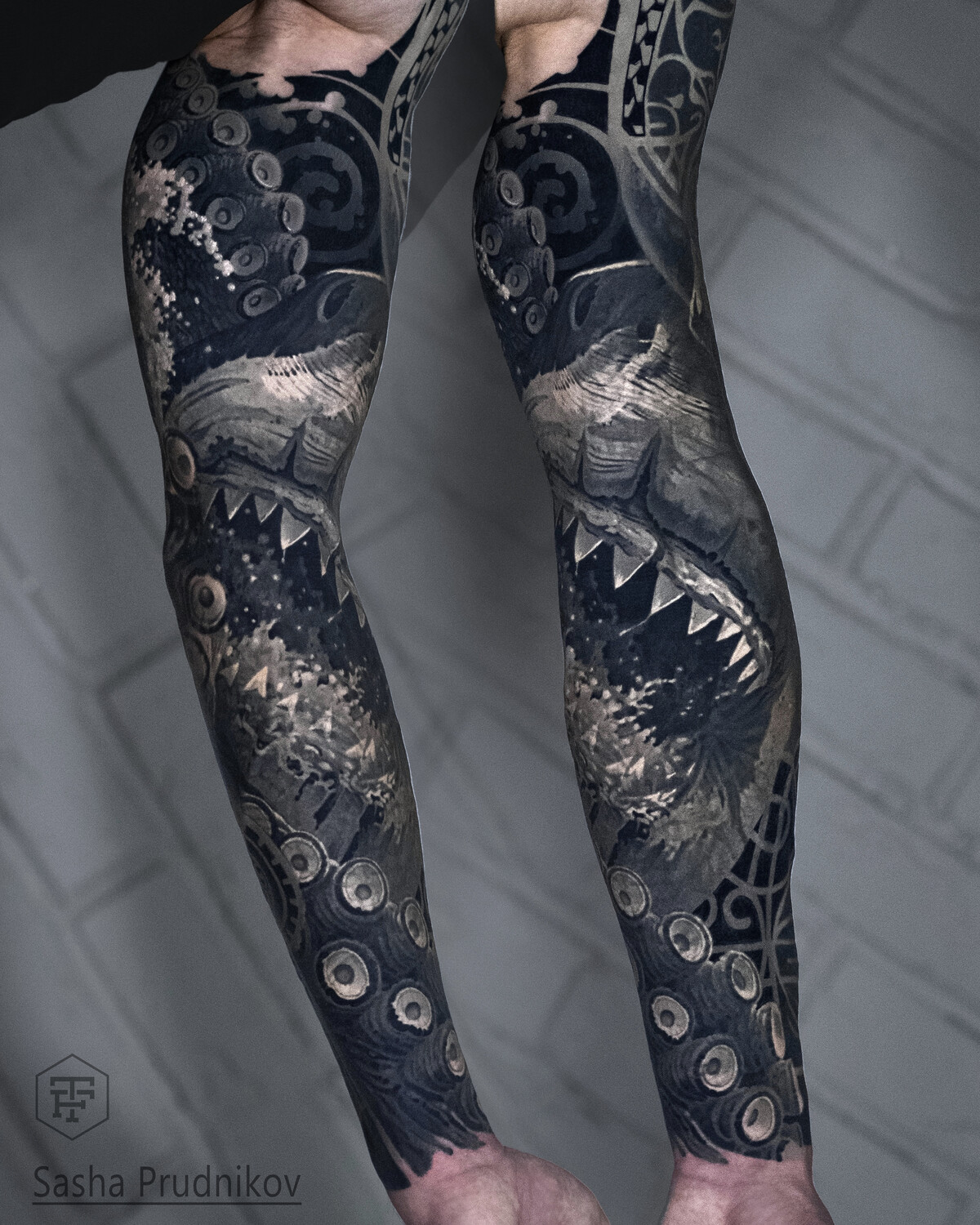
Shark and octopus tattoo on both arms by @sasha.prudnikov.tattoo

Shark and octopus colour tattoo by @gaborheizlertattoos

Shark and octopus tattoo in waves by @StasDobryk

Shark near ruins tattoo in framed scene by @lucky_luchino

Sharks and shipwreck tattoo underwater by @inkbysaga
Choosing an artist for a shark tattoo
The shark exposes two weaknesses in an artist: anatomy and water. A shark drawn from memory comes out as a generic fish with teeth, and unconvincing water turns into grey smudges around it. Ask to see sharks specifically in a portfolio, and ask to see them healed rather than fresh, because the flank gradient is exactly what settles differently after a year.
Match the tradition to the artist. If the piece leans on Polynesian pattern or Māori form, an artist inside that tradition will get right the details a generalist invents, and will tell you whether what you are asking for is yours to wear. If the piece is realism, look for an artist who has solved marine animals before. You can filter by style, country and city in the tattoo artist directory.
It helps to see how differently the same animal is handled. Garrett Hudson draws the shark in a neo-traditional register, wrapped in waves under a rising sun on a calf, so the animal is part of a composition rather than a floating portrait. Balazs Bercsenyi builds it in black and grey with a diver in the frame, which turns a forearm piece into an encounter with a scale relationship to think about. Merry Morgan goes the other way entirely: a blackwork shark paired with a lightbulb, solid black and linework, the animal used as an idea rather than a creature. Three approaches to one motif, and the choice between them decides more than size or placement will.
Bring reference of the right kind: photographs of the species you want give an artist the animal to solve; screenshots of other people's tattoos give them a solution to copy. Say which reading you want, guardian or predator, because it changes the mouth, the angle and the company the shark keeps.
Aftercare and how a shark tattoo ages
Standard aftercare applies: keep it clean, moisturise without smothering, leave the scabs alone, and stay out of direct sun until it has healed: two to three weeks for the surface, a few months for the deeper layers.
The shark adds one rule that matters to exactly the people most likely to wear it: no salt water. Surfers and divers need to stay out of the ocean for three to four weeks, and a session booked at the start of a swell will be regretted. Pools are out for the same period.
Beyond that, the animal has a specific ageing risk. The gradient along the flank, the soft transition from dark back to pale belly, is the part that blurs first, and a realistic shark that depends entirely on that gradient will read as a grey shape in five to ten years. The fix is structural: a clear silhouette, real contrast with the surroundings, and detail that supports the form rather than carrying it. Traditional and Polynesian work, which never relied on the gradient, ages best of all.
Colour fades unevenly, so a blue-grey shark with a red wound or a warm sun behind it will lose the warm tones first unless the artist has planned for it. Sunscreen on an exposed forearm or calf does more for a piece's twenty-year life than any product sold for tattoos. Expect one touch-up in the first year for fine linework.
Frequently asked questions
What does a shark tattoo mean?
Protection, survival and quiet authority in its oldest readings; fearlessness and apex-predator drive in the modern Western one. In Hawaiian tradition the shark is an ancestral guardian, in Polynesian tatau its teeth are a protective pattern, in Māori culture the mako tooth marks rank. The mouth decides which reading a tattoo carries: closed is the guardian, open is the predator.
What does a shark tattoo mean in Polynesian culture?
The shark-tooth row, niho mano, means protection, guidance and strength in defence of family, and it appears in Marquesan, Tahitian and Samoan work. In Hawaiʻi the shark can be an ʻaumakua, a family guardian. The patterns carried genealogy and were given, not chosen, which is why copying a Samoan peʻa or malu is appropriation and commissioning a Pacific artist is not.
Is it disrespectful to get a Polynesian shark tattoo?
It depends on what you copy and who draws it. A piece composed for you by an artist working in the tradition is the way these designs have always travelled. Reproducing a peʻa, a malu or someone else's specific pattern is wearing another person's lineage. Māori artists have a separate category, kirituhi, for Māori-style work made for non-Māori wearers.
What does a shark tooth tattoo mean?
A single tooth points to the Māori pendant tradition: standing, inheritance, something handed down. A row of triangular teeth is the Polynesian niho mano and means protection. Both are small, both age well, and both say guardianship without showing a predator.
What does a hammerhead shark tattoo mean?
Seeing what others miss, because of the animal's unusually wide field of view, and, in Māori kōwhaiwhai pattern where it is called mangōpare, strength and determination that does not let go. Several hammerhead species are endangered, so it is also a conservation shark, alongside the whale shark.
What did a shark tattoo mean for sailors?
That the wearer was not afraid of the sea or of dying in it. Sharks turn up on traditional flash alongside anchors, swallows and ships, and a traditional shark still reads as the maritime, Western lineage of the motif rather than the Pacific one.