An octopus tattoo means intelligence and adaptability: a mind that solves problems sideways, a body that changes colour, texture and shape to fit the situation, and an arm that grows back when it is lost. Which reading you are wearing depends on the design and the tradition behind it: the animal is a god in Hawaii, an erotic joke in Edo-period Japan, a sailor's nightmare in Norway and an ancient decorative motif in the Aegean.
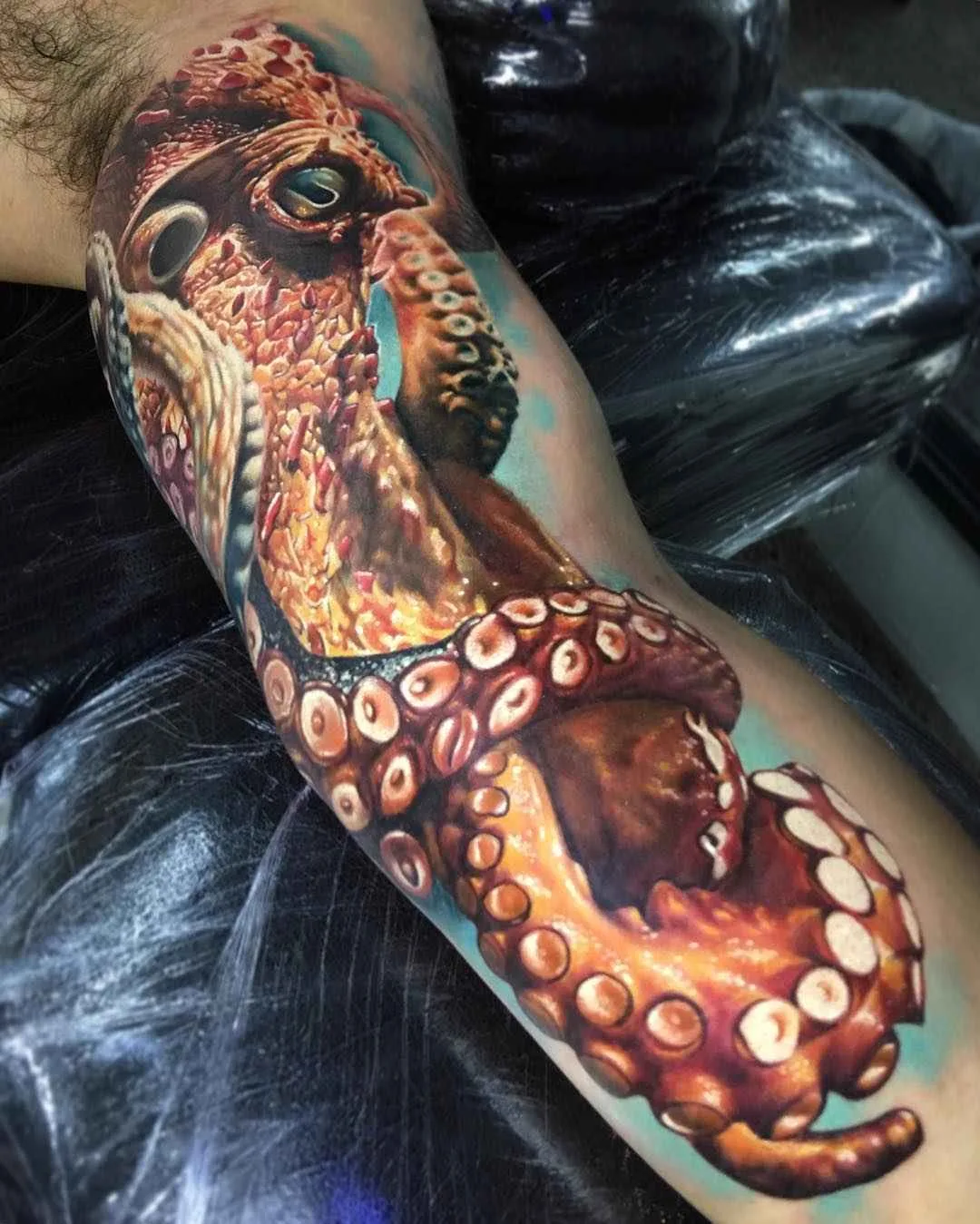
- The octopus stands for intelligence, adaptability and regeneration, and each meaning comes straight from its biology: a distributed nervous system, instant camouflage and arms that grow back.
- Four traditions give it different weight: Kanaloa's body form in Hawaii, Hokusai's Edo-period prints, the Norwegian kraken, and Minoan pottery from around 1500 BC, among the oldest octopus art known.
- Japanese, blackwork and realism suit it best; the arms are built to wrap a shoulder, thigh or forearm, and anything under about ten centimetres loses the suckers.
- Suckers are the detail that ages first: plan them larger than feels natural, keep a strong outline, and ask any artist for healed octopus work rather than fresh photos.
What an octopus tattoo means
Start with the brain. Octopuses have the largest brain-to-body ratio of any invertebrate and roughly 500 million neurons, about two-thirds of them in the arms rather than the head. Each arm can taste, touch and make simple decisions on its own; the central brain sets the goal and the limbs work out the route. When someone gets an octopus tattoo, intelligence is almost always part of what they are saying about themselves: problem-solving, lateral thinking, the ability to figure things out when the obvious path is blocked.
Adaptability is the most cited meaning, and the biology earns it. An octopus can change colour, texture and the outline of its body in under a second. It squeezes through any opening larger than its beak. Veined octopuses off Indonesia have been filmed carrying coconut halves across the sea floor to build shelters: tool use in an animal with no skeleton. If your life has required constant reinvention, the octopus fits.
Regeneration adds the layer that brings people in after a hard year. An octopus can lose an arm to a predator and regrow it completely, nerves and suckers included, within a few months. That makes the animal a natural symbol for recovery and starting over, and it is a common reason people choose it: people who came through illness or injury and want an animal that grew back rather than one that never got hurt.
Then there is the mystery. Octopuses are solitary and nocturnal, and their lineage split from ours more than 500 million years ago. That is a mind that arrived at curiosity, play and memory by a completely different route, the closest thing on Earth to an alien intelligence. An octopus tattoo carries that sense of hidden depth.
The complexity is part of the meaning. Eight arms. Three hearts. Blue, copper-based blood. Most species live only a year or two, and the female guards her eggs without eating until she dies, usually days after they hatch: a creature that learns fast because it does not have long. The octopus resists simplification, and so does its tattoo. It is an animal for people who contain multitudes.
Japanese tradition: the octopus in Edo-period art
Japan has one of the longest artistic relationships with the octopus of any culture that tattoos it. The word tako runs through Edo-period visual culture (woodblock prints, netsuke carvings, festival banners) long before Western tattooing borrowed the image.
The most famous octopus artwork in Japanese history is Hokusai's "The Dream of the Fisherman's Wife," a print from 1814 in his shunga book Kinoe no Komatsu. It shows a woman entangled with two octopuses, a large one and a small one, in an explicitly sexual scene. It is strange, funny and technically brilliant, and it tied the octopus to desire and the unconscious in a way Western readers have argued about ever since. Hokusai also drew the animal straight, as an anatomical study, in the Hokusai Manga sketchbooks.
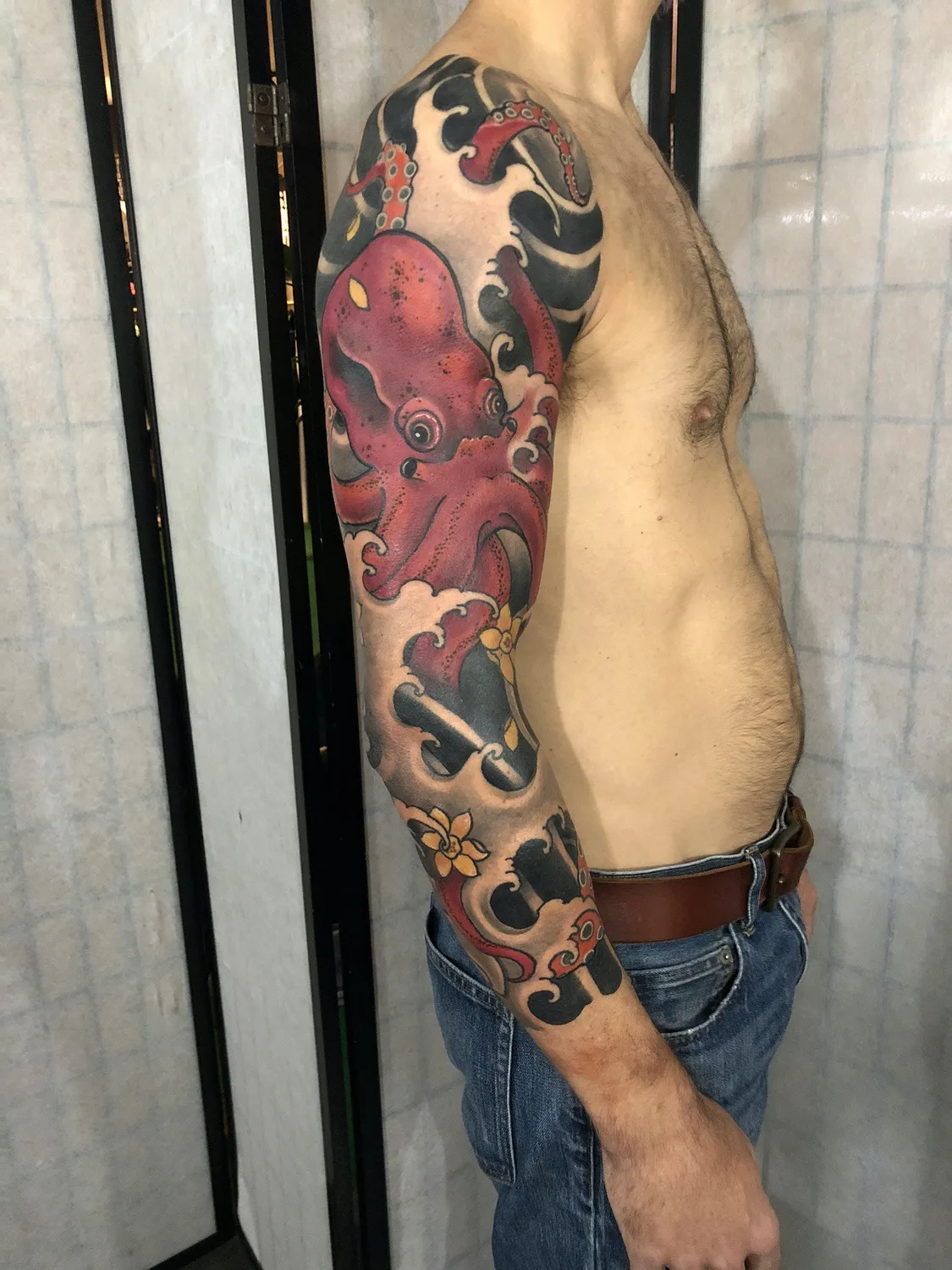
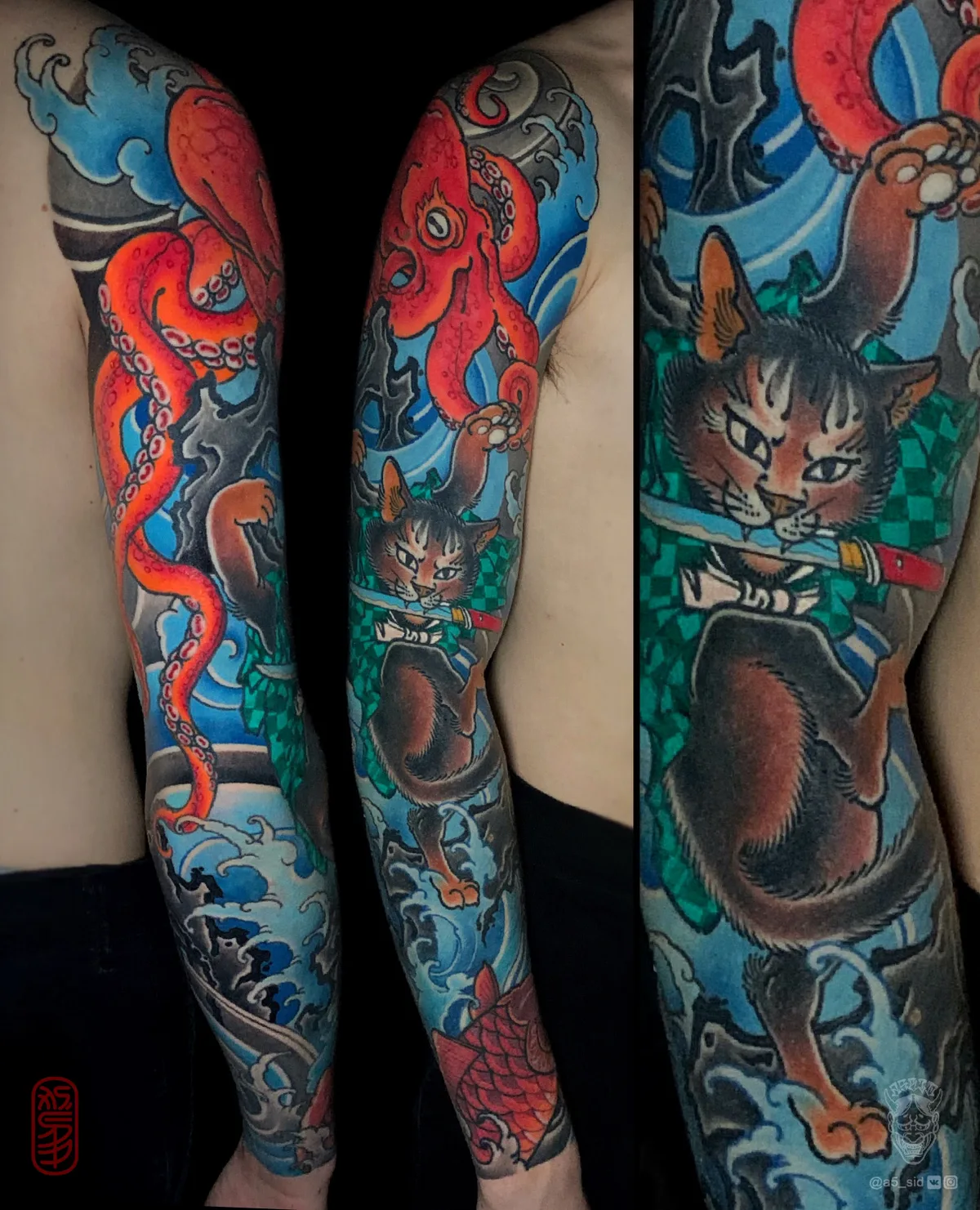
That is the tradition irezumi inherits. In a Japanese sleeve or back piece the octopus is rarely alone: it belongs to a moving ocean scene alongside carp, waves and wind bars, and its arms serve as compositional lines that carry the eye across the body. The colouring follows the print tradition (deep reds, blacks, a teal for the water) and the pieces are large, because the subject was designed to be.
Folk belief added a stranger figure in the far north. The akkorokamui of Ainu tradition in Hokkaido is a giant red octopus spirit of Funka Bay, big enough to swallow boats and yet associated with healing. A benevolent monster is one reason the Japanese octopus reads as a presence rather than a threat.
Polynesian tradition: Kanaloa and the ocean's reach
In Hawaiian tradition the octopus, heʻe, is the body form of Kanaloa, god of the ocean, of deep water and of long voyages. Kanaloa is paired with Kāne, god of fresh water; in chants the two travel the islands together, one opening springs and the other commanding the sea. To wear the octopus in that context is to wear the god's reach: arms that extend to every part of the ocean at once. One Hawaiian telling goes further and makes the octopus the sole survivor of a previous world, older than the islands themselves: a primordial weight that a shark or a turtle does not carry.
The wider Pacific has its own octopus. In Tahitian cosmology the great octopus Tumu-raʻi-fenua held the sky pressed against the earth until its arms were cut and the two separated. In Māori tradition the navigator Kupe chased the giant octopus Te Wheke-a-Muturangi from Hawaiki across the ocean and killed it in Cook Strait; the chase is how he found Aotearoa.
Polynesian tattoo patterns fold the animal into larger compositions, where the arms become the interlocking bands of Pacific work. Everyday life adds its own layer: islanders have fished for octopus for thousands of years, and the animal is both food and trickster: clever, evasive, capable of outsmarting the fisherman, which in some traditions makes it stand for escaping danger through wit rather than force.
European maritime lore: the kraken
Sailors feared the kraken long before anyone knew what a giant squid looked like. Norwegian accounts described a creature so large it was mistaken for an island: crews would anchor on its back, light a fire, and watch the ground go under. Erik Pontoppidan, the bishop of Bergen, gave the beast scientific dignity in his Natural History of Norway in 1752, reporting that it was a mile and a half across and could pull a warship to the bottom, and noting that fishermen caught more fish above it.
Then the animal turned up. In 1857 the Danish zoologist Japetus Steenstrup described a real giant squid from a beak and named the genus Architeuthis. Four years later the French warship Alecton fought one off Tenerife and came away with a piece of tail and a story Jules Verne borrowed for the Nautilus scene in Twenty Thousand Leagues Under the Sea.
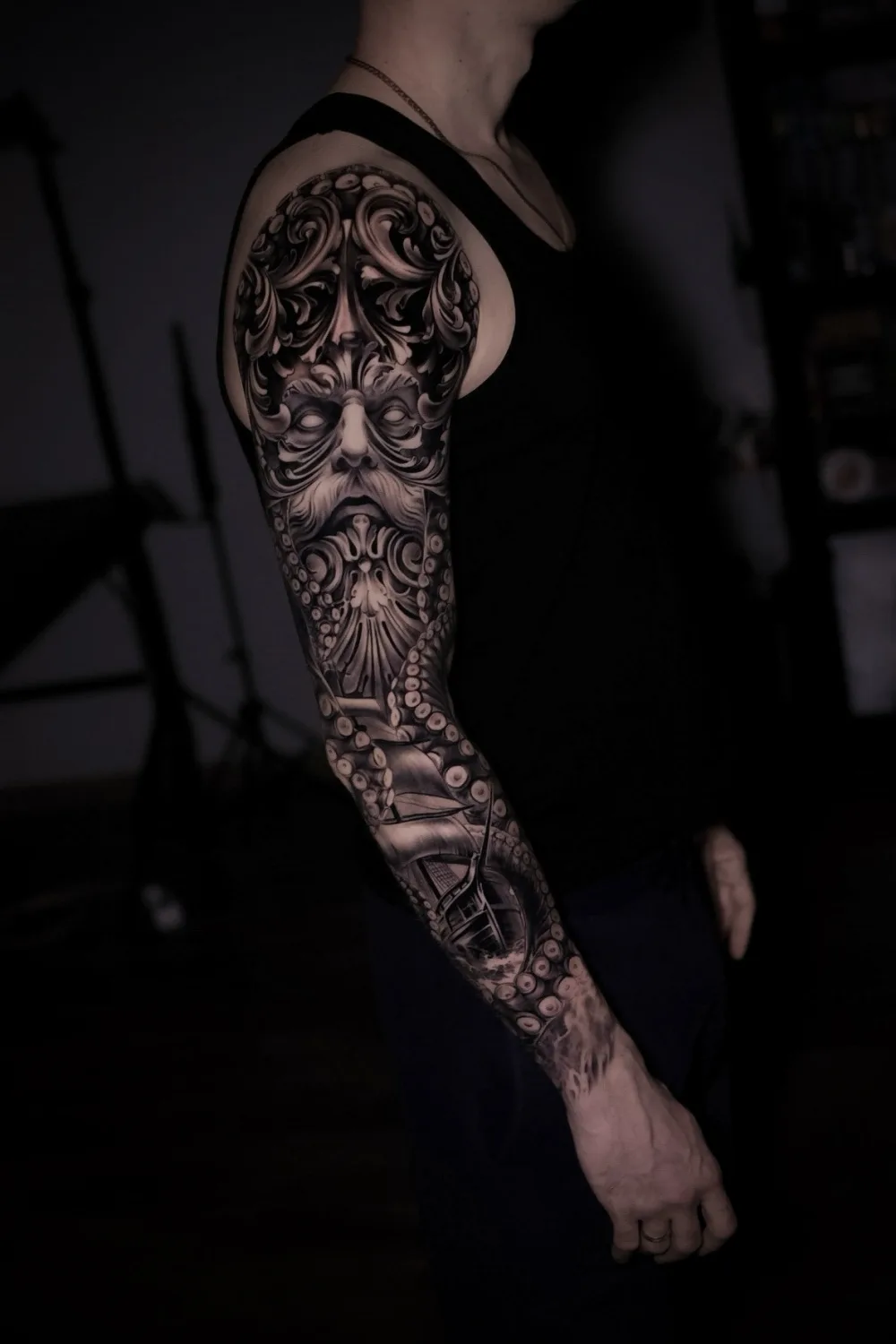
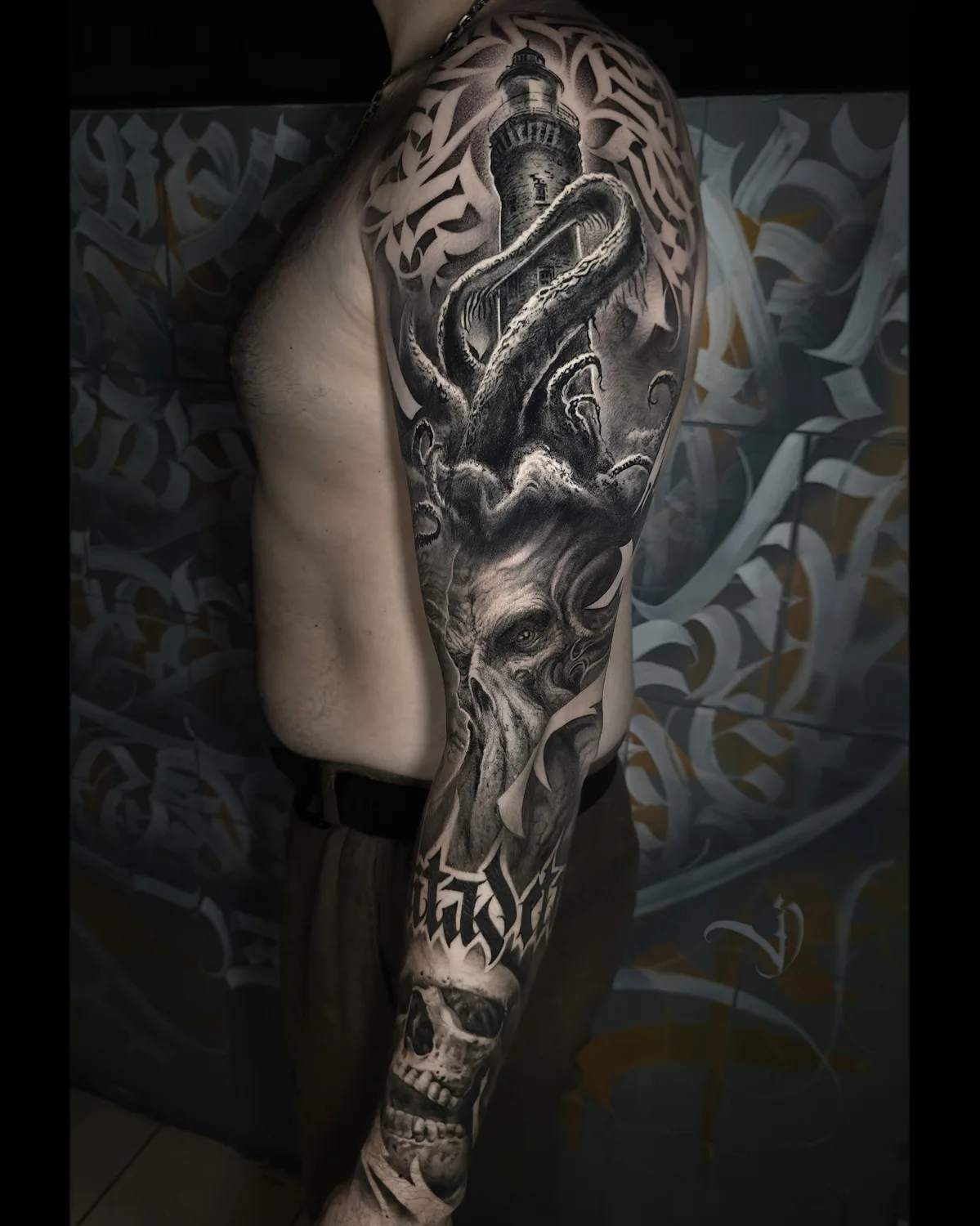
Modern kraken tattoos blend octopus and squid anatomy freely, because accuracy was never the point. The point is scale. A creature wrapping its arms around a ship works on several levels at once: human ambition against natural force, the arrogance of thinking the ocean can be mastered, or simply a dramatic image on a shoulder blade.
What has changed is the tone. The kraken has moved from terror toward respect, and for many wearers, identification: misunderstood, powerful, mostly wanting to be left alone. Divers who meet real octopuses describe them as shy and curious. Some tattoos play with that gap on purpose.
Minoan pottery: the earliest octopus art
Some of the oldest octopus art anyone has found comes from Bronze Age Crete. Around 1500 BC, Minoan potters of the so-called Marine Style painted octopuses across the full surface of jars and flasks, arms spiralling around the vessel so that there was no front and no back; the design only makes sense when you turn the pot in your hands. One celebrated piece is an octopus vessel from Palaikastro, now in the Heraklion Archaeological Museum: a single wide-eyed animal, arms curling out to the handles, seaweed and shells filling the gaps.
Nobody left a written explanation of what the octopus meant to the Minoans. The reasonable reading is the obvious one: a palace civilisation that lived from the sea decorated its finest tableware with the sea's most graphic inhabitant, and chose it because its shape solved a design problem. Eight flexible arms can wrap a curved surface the way no fish can. The Mycenaeans inherited the motif and stiffened it over three centuries until the animal became pure ornament.
That 3,500-year-old composition is why the octopus works on a shoulder today. The Palaikastro potter's problem (one animal covering a rounded object so that it reads from every angle) is exactly the problem an artist faces on a deltoid, a calf or a thigh. The Minoan solution still holds: head on the highest point, arms following the curve, the sea filling the negative space.
Tattoo styles that suit the octopus
Japanese. The natural home, for the reasons above. The arms integrate with the waves, clouds and wind bars that define irezumi backgrounds, and the print-tradition palette of deep red, black and teal gives the animal an intensity other approaches struggle to reach. These are half-sleeve pieces at minimum, and the outline carries the image, which is why they age better than most of what follows.
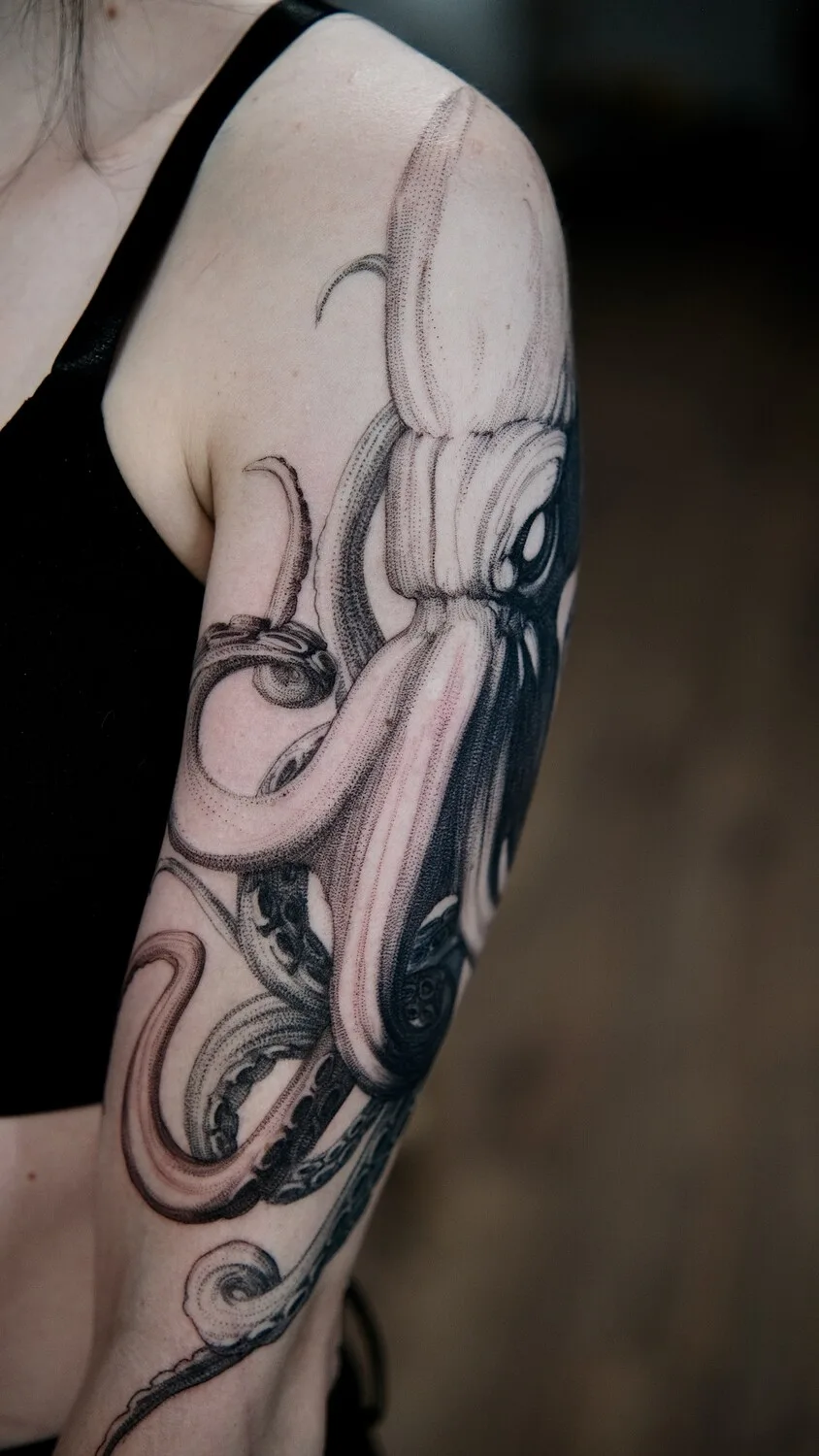
Realism. Technically the hardest and spectacular when it works. Everything depends on texture: the suckers need to look three-dimensional, the skin wet and half translucent, the eye (a horizontal pupil in a gold iris) unsettlingly aware. Black-and-grey realism is the safer buy; colour realism can be extraordinary if the artist understands underwater light, and muddy if they do not.
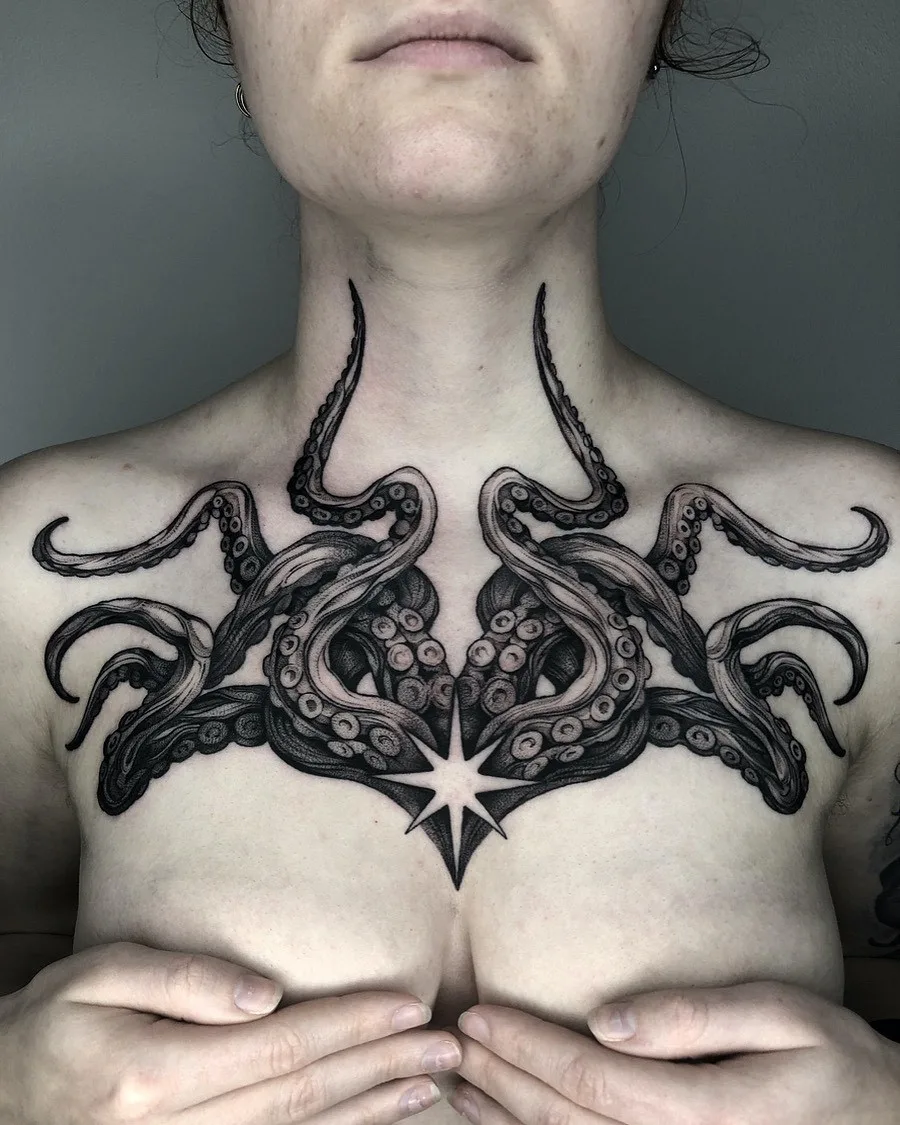
Blackwork and engraving. Solid black strips the animal to silhouette and pattern. The sucker rows become a graphic rhythm, the arms become calligraphy, and the contrast between dense black and bare skin does the highlighting for you. Etching-style linework, the look of a nineteenth-century natural history plate, sits especially well on the octopus, because that is how most Europeans first saw the animal.
Traditional and neo-traditional. Bold outline, saturated colour, a slightly iconic quality. Old-school flash has carried the octopus since the sailor era, often wrapped around an anchor or a diver's helmet. Neo-traditional keeps the line discipline and widens the palette, and it accommodates humour in a way realism cannot: the octopus with a top hat, a teacup in every arm.
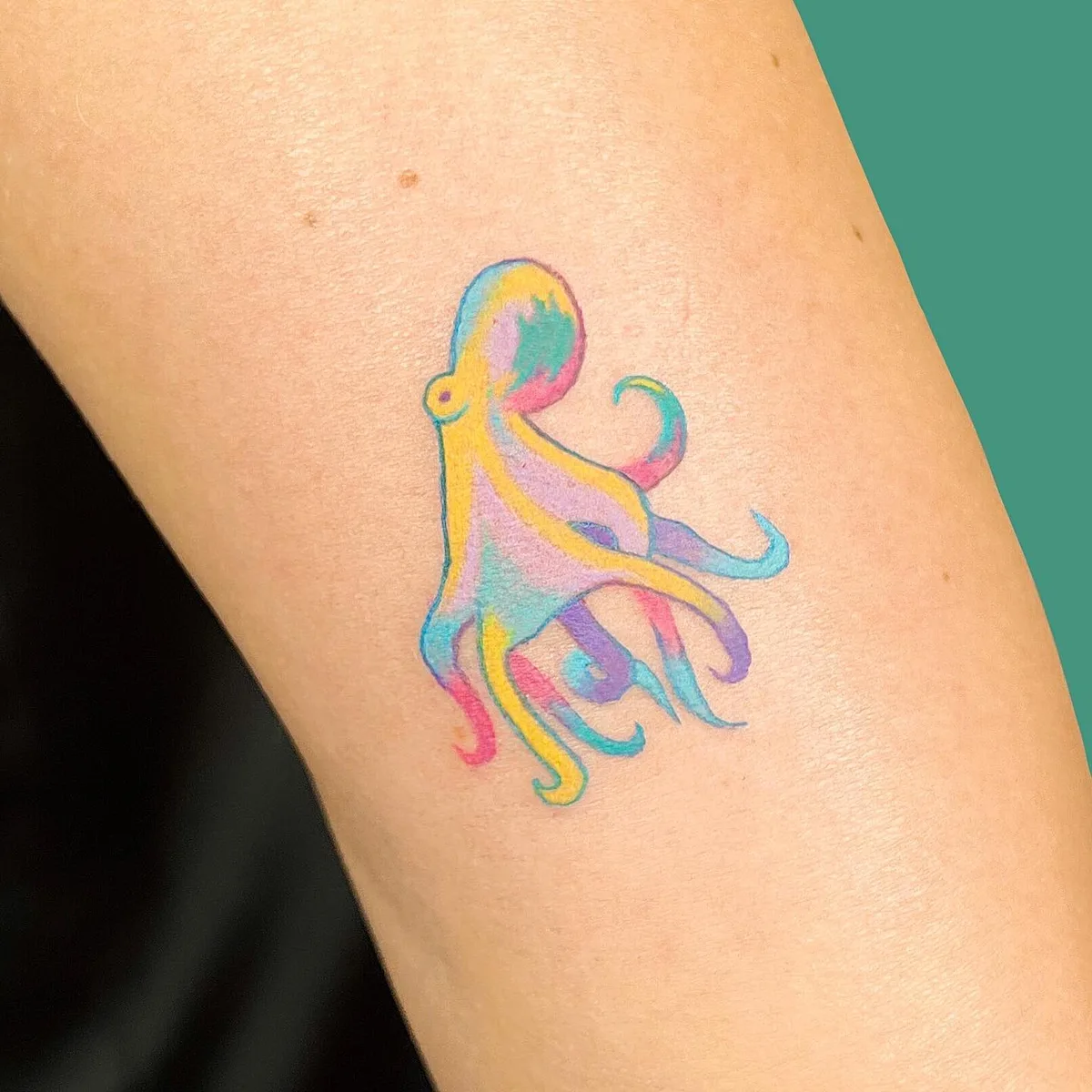
Watercolour. One of the few subjects where the style is thematically justified rather than fashionable, because colour change is what the animal does. Purple and orange bleeding into blue around a loose octopus form reads as alive. The trade is longevity: without a line base the edges soften faster, so agree touch-up expectations before the first session.
Dotwork and geometric. A mandala octopus, with the arms forming a radial pattern around the head, turns marine biology into sacred geometry. It suits the intelligence reading (a mind arranged as a pattern) and has become a common choice for sternum and upper-back placements where symmetry matters more than movement.
To see how far the same animal travels between these approaches, the octopus motif page collects finished work by style and placement: a Japanese wave sleeve next to an engraving-style calf piece next to a photoreal forearm portrait.

Dotwork octopus arm tattoo by @Likalesova

Blackwork octopus tattoo with intricate linework by @epoxid

Dotwork octopus tattoo across the chest and shoulder by @dro

Linework hand tattoo by @jeskattattoo

Geometric octopus tattoo by @mironenko.tattoo
Placement and scale
The octopus is one of the few tattoo subjects that genuinely collaborates with anatomy. Arms can wrap a forearm, spiral down a leg, reach over a shoulder or spread across the ribs in ways that use the body's contours rather than fighting them. Where you put it is less a location decision than a composition decision.
The shoulder and upper arm are the most common answer. The head sits on the shoulder cap, where its roundness echoes the deltoid, and the arms flow down the upper arm in several directions, into a half sleeve now, a full sleeve later.
A full back gives the animal room to sprawl. Eight arms across the shoulder blades create more visual movement than almost any other single subject, and artists often let one or two reach over the shoulders or around the ribs so the piece reads from the front as well. These are multi-session projects, and Japanese work in particular treats the back as one canvas.
The thigh has been gaining on both for detailed work: a broad, relatively flat surface for the head, a cylinder for the arms to wrap, moderate pain, and full control over who sees it. The calf does the same in a smaller format and suits a vertical composition: head at the top of the muscle, arms trailing toward the ankle. The forearm is the compromise most people land on: enough length for two or three arms to wrap, the head on the widest part, and the option to show or cover it.
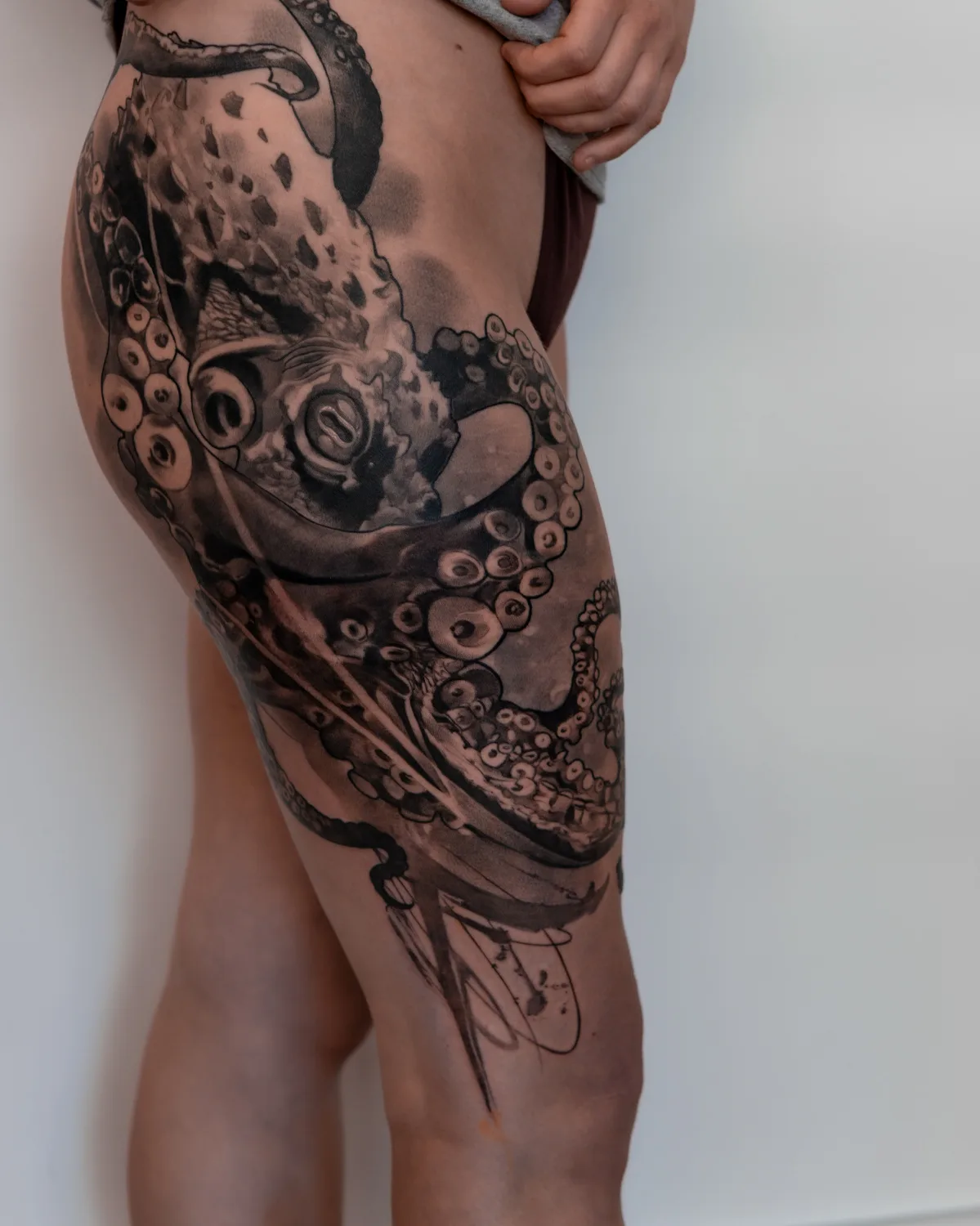
Scale deserves its own decision. An octopus under about ten centimetres cannot hold sucker detail: the small circles close up as the ink spreads and the arms become undifferentiated lines within a few years. Below that size the honest options are a clean silhouette, a single arm rather than the whole animal, or a traditional design with heavy outlines. Whatever the location, decide early how much skin the piece may take later: an octopus drawn for a forearm rarely extends into a sleeve without being redrawn.
Design variations and what they change
Small choices inside an octopus design move the meaning further than switching style does.
Colour. Blue emphasises the ocean and reads as calm and contemplative; the blue-ringed octopus, one of the most venomous animals in the world, adds a beautiful-but-deadly edge. Red and orange carry more aggression and point to the giant Pacific octopus, the largest species; red is also the colour of the print tradition, so it pulls the piece toward Japan. Black and grey removes the animal from its habitat and turns it into a psychological symbol: intelligence, complexity, the many-armed self.
Octopus and ship. The kraken composition. Arms around a hull, a mast snapping, the sea in turmoil. It reads as force against ambition, or as the wearer against whatever tried to sink them, and it needs a lot of skin: an upper arm at minimum, a back to do it justice.

Skull and octopus tattoo by @deni_aktemirov

Skull-faced octopus tattoo by @Shum_art_tattoo

Biomechanical octopus tattoo by @renortattoo

Woman and octopus tattoo by @slawek_pawlik

Orange and blue octopus tattoo by @jmc.tattoo

New school octopus tattoo by @amylynn.colson
Octopus and anchor, diver or helmet. The sailor-era pairing. The anchor adds stability to an animal that has none, which is why old flash liked the combination: something fixed inside something fluid. A diver's helmet in the arms puts a human in the frame without showing a face.
Octopus and skull. Pushes the design toward the dark-traditional register: mortality wrapped in something alive. Arms threading through the eye sockets are a common device, and the composition holds up in blackwork better than in colour.
Mandala and geometric frames. A radial arrangement of the arms makes the piece about order rather than movement, and suits placements where the body is symmetrical: sternum, upper back, the top of the thigh. The intelligence reading comes through strongly here, at the cost of the animal looking alive.
Single arm. One arm curling out of a sleeve, around a wrist or along the collarbone, rather than the whole creature. It says the same thing more quietly, keeps sucker detail large enough to survive, and works at sizes where a full octopus would turn to mush.
Eyes. The one detail that changes the piece most. A visible, focused eye reads as intelligence watching you; the same animal with the eye turned away or hidden behind an arm reads as mystery. Cartoon eyes turn the whole thing into neo-traditional humour. Decide this deliberately.
Choosing an artist for an octopus tattoo
The octopus exposes a specific weakness: suckers. A row of small circles that has to stay evenly spaced while it wraps around a curved arm and shrinks with perspective is a discipline test, and an artist who has not solved it produces a tube with polka dots. Ask to see octopuses in a portfolio, not sea creatures in general; fish and jellyfish are easier. And ask for healed photographs: fresh work tells you nothing about whether the sucker detail has held.
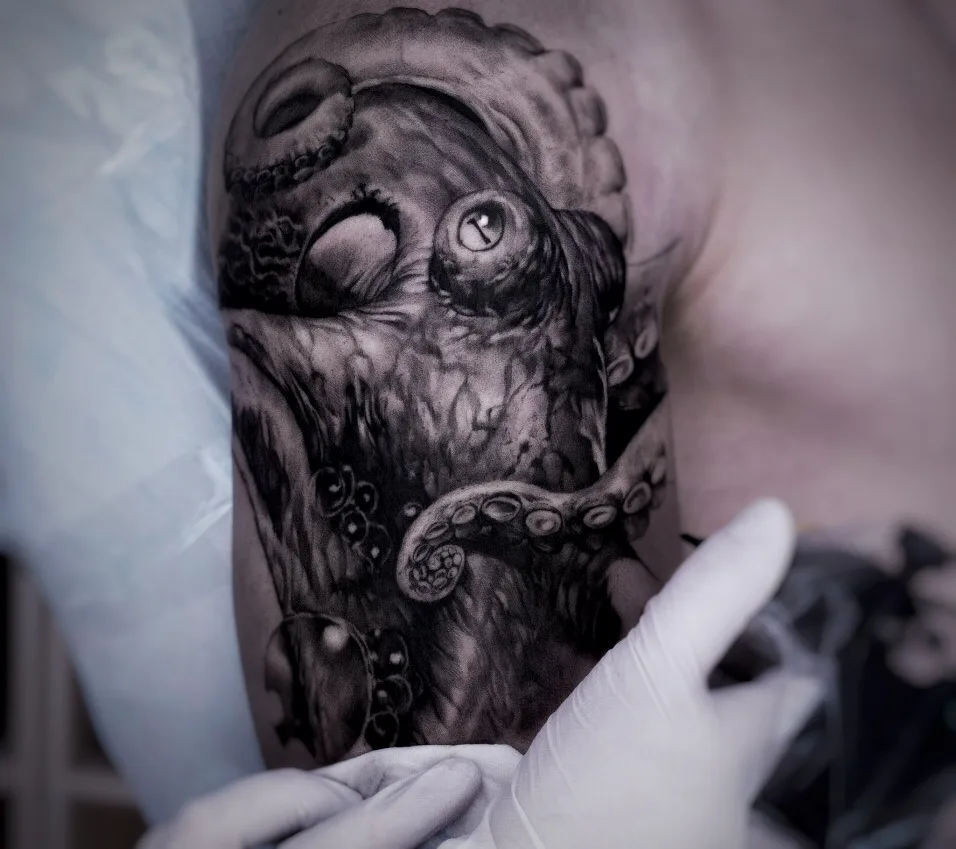
Match the tradition to the artist. If you want the Edo-period reading, an artist who works inside Japanese composition will get the water, the wind bars and the palette right where a generalist invents them. If you want a photoreal animal, a portrait specialist is not automatically the right choice, because wet skin and underwater light are their own technical problem. If you want the kraken, look for someone who has drawn ships before, because the rigging is where those pieces fail. You can filter by style, country and city in our tattoo artist directory.
It helps to look at how differently the same animal is handled. Yushi sets the octopus inside a Japanese wave sleeve, where the arms and the water share one rhythm and the animal reads as part of a scene; Nick Noonan works it as a tight realistic forearm portrait, all wet texture and one attentive eye; Henbo Henning reduces it to blackwork on a calf, the sucker rows turned into graphic pattern; and Vic James pairs it with a diver in a traditional flash register that would have made sense to a sailor in 1930. Four approaches to one motif, and the choice between them decides more than size or placement will.
Aftercare and how an octopus tattoo ages
Standard aftercare applies: keep it clean, keep it moisturised without smothering it, leave the scabs alone, and stay out of pools, the sea and direct sun until it has healed. Two to three weeks for the surface, a few months for the deeper layers. The sea part matters more than usual here: many octopus tattoos belong to divers who are impatient to get back in.
Beyond that, the octopus has one specific ageing risk, and it is the suckers. Small circles are the first thing time closes up: ink spreads a little each year, and a row of neat rings becomes a row of dots and then a soft edge. A design that depends entirely on that detail will lose it in five to ten years. The fix is structural: larger suckers than feel natural at the sketch stage, a clear silhouette for each arm, and enough contrast between arm and background that the piece stays legible after the fine work softens.
Colour and black-and-grey age differently. Black and grey softens evenly and stays readable. Colour fades unevenly: reds and oranges go first, so a red Japanese octopus needs a strong black outline to hold its shape after a decade, and a watercolour octopus with no line base is a piece with a shorter life and a touch-up budget attached. Sunscreen on an exposed forearm or calf does more for its twenty-year life than any dedicated product.
Frequently asked questions
What does an octopus tattoo mean for a woman?
The octopus has no strongly gendered symbolism, so it means roughly the same things regardless of who wears it. Some women choose it for the eight-arms metaphor, holding career, family and creative work at once. The female octopus's death guarding her eggs also carries weight for some wearers.
What does a kraken tattoo mean?
Power on a scale nobody can control. The kraken is the octopus taken to myth: a force that sinks ships and rises from the deep, and in most modern readings a stand-in for the wearer's own capacity to overwhelm, or for something they survived.
Is an octopus tattoo associated with anything negative?
Historically, yes. From the 1870s onward the octopus was the standard propaganda image for a grasping power: Fred Rose's 1877 map of Europe drew Russia as one, and the device was reused against empires, corporations and, in its ugliest form, ethnic groups. Tattooing has almost entirely shed the association, but an octopus wrapped around a globe can still be read through that lens.
What does an octopus tattoo mean in Japanese culture?
The tako is a fixture of Edo-period art rather than a single symbol. Through Hokusai it is tied to desire and the strange; through irezumi it is part of the moving ocean, alongside carp and waves; in the far north the Ainu akkorokamui is a giant octopus spirit of healing.
How painful is an octopus tattoo?
It depends on placement. On the outer upper arm or thigh it is moderate at most. The same design wrapping onto the inner arm, ribs or elbow ditch becomes considerably harder, and large pieces cross both easy and difficult zones by design.
What pairs well with an octopus tattoo?
Ships, anchors and lighthouses are the classic nautical companions. Coral, fish and sea turtles build an ecosystem composition. Skulls and daggers push toward the darker traditional register. Flowers, especially lotus and peony, set ocean against garden.