A raven tattoo means memory and foresight: the bird that flies out, sees everything, and comes back to report. Death is in there too, but as a rumour picked up on the way, not the point of the trip. Which reading you are wearing depends on the tradition you draw from: Odin's ravens, the Morrígan's, Raven of the Pacific Northwest, or the one Edgar Allan Poe put on a bust above a door in 1845.
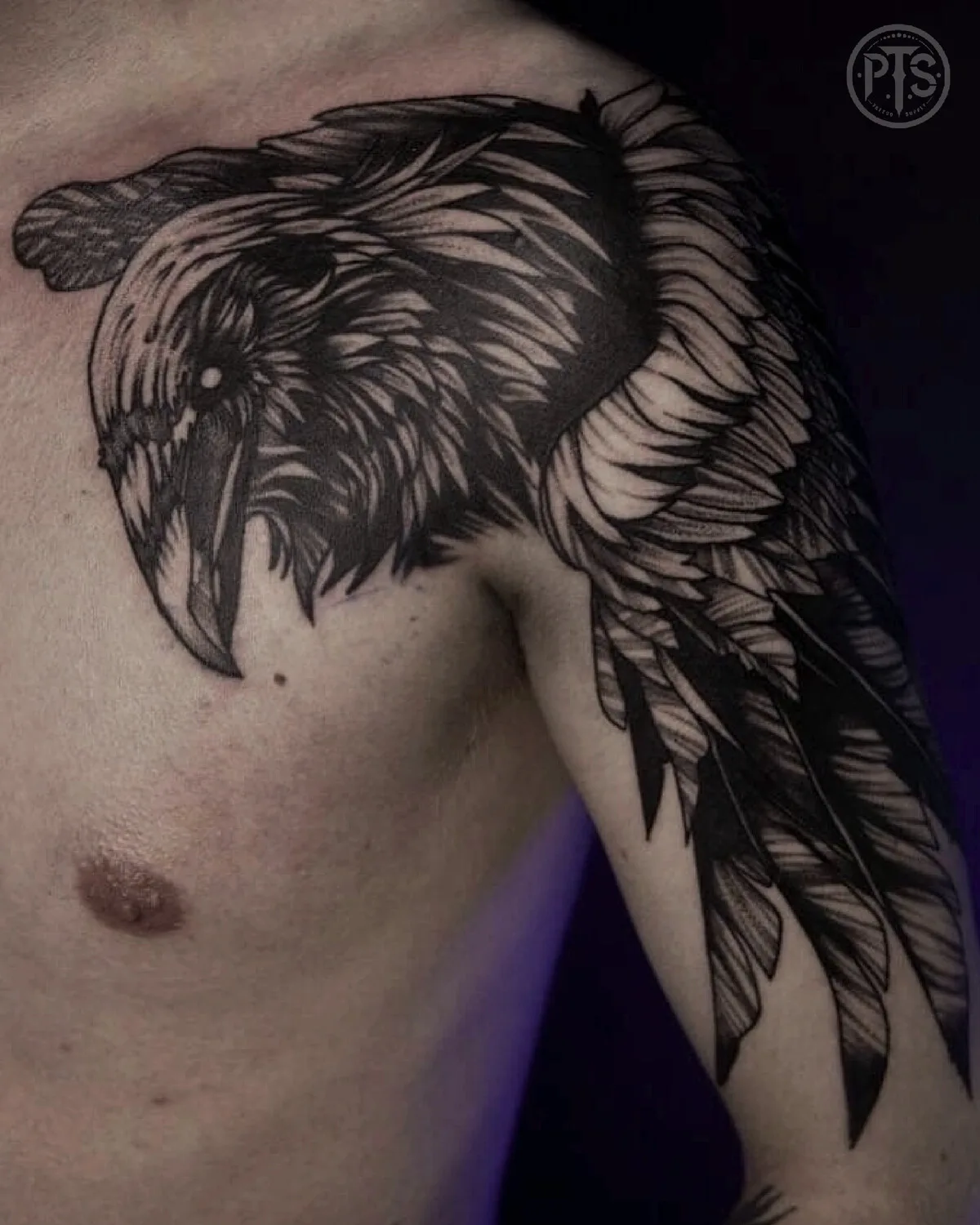
- The raven's core meaning is memory and foresight; the death reading is a later layer, from battlefields and from Poe.
- Two ravens mean Odin's Huginn and Muninn, and his fear of losing memory more than thought.
- In Irish myth the raven is the Morrígan herself, a war goddess in bird form; in Haida and Tlingit accounts Raven stole the sun and made the world.
- Formline belongs to the Pacific Northwest nations: take the story, not the crest.
- The raven tests an artist's black. Keep the bird above eight centimetres and build it on strong shapes, not fine feather detail.
What a raven tattoo means
Start with the animal, because the myths grew out of it. The common raven, Corvus corax, is the largest songbird on earth, with a wingspan well over a metre, a beak built for tearing, and a brain on a different budget from the rest of the bird world. Ravens pair for life, cache food and remember where, recognise individual human faces for years, and in 2017 a study at Lund University in Sweden showed ravens choosing a tool they would not need until the next day and holding on to it. Planning, not reflex.
People who lived alongside ravens noticed. A bird that watches, remembers and reports is a bird that knows things, and knowing things shades easily into knowing what has not happened yet. That is where the prophetic raven comes from, not from the graveyard. The graveyard is a separate strand: ravens eat carrion, and for most of European history a flock over a valley meant a battle had been fought there; Norse poets called warriors feeders of ravens. Death attached to the bird the way smoke attaches to a coat. The intelligence and the memory were already there.
The older stories agree. The raven is the first bird Noah sends from the ark, and it does not come back; it goes to and fro over the waters on its own errand. In Ovid, Apollo's raven was white until it brought bad news about the god's lover Coronis and was scorched black for it. Not death: a bird that goes where people cannot and knows what they do not.
So in tattooing the raven splits into two readings. One raven is a witness: thought, memory, the part of you that goes out and comes back with the truth. The other is a warning, the bird that arrives before something ends. Most people know which they want before they can say why.
One thing this article leaves alone: the crow. People swap the two constantly, but the crow's symbolism is social where the raven's is solitary and oracular, and it deserves its own article. For now: a raven is roughly twice the size, with a heavy beak, a shaggy throat and a wedge-shaped tail. If your artist draws a fan-shaped tail, you have a crow.
Norse mythology: Huginn and Muninn
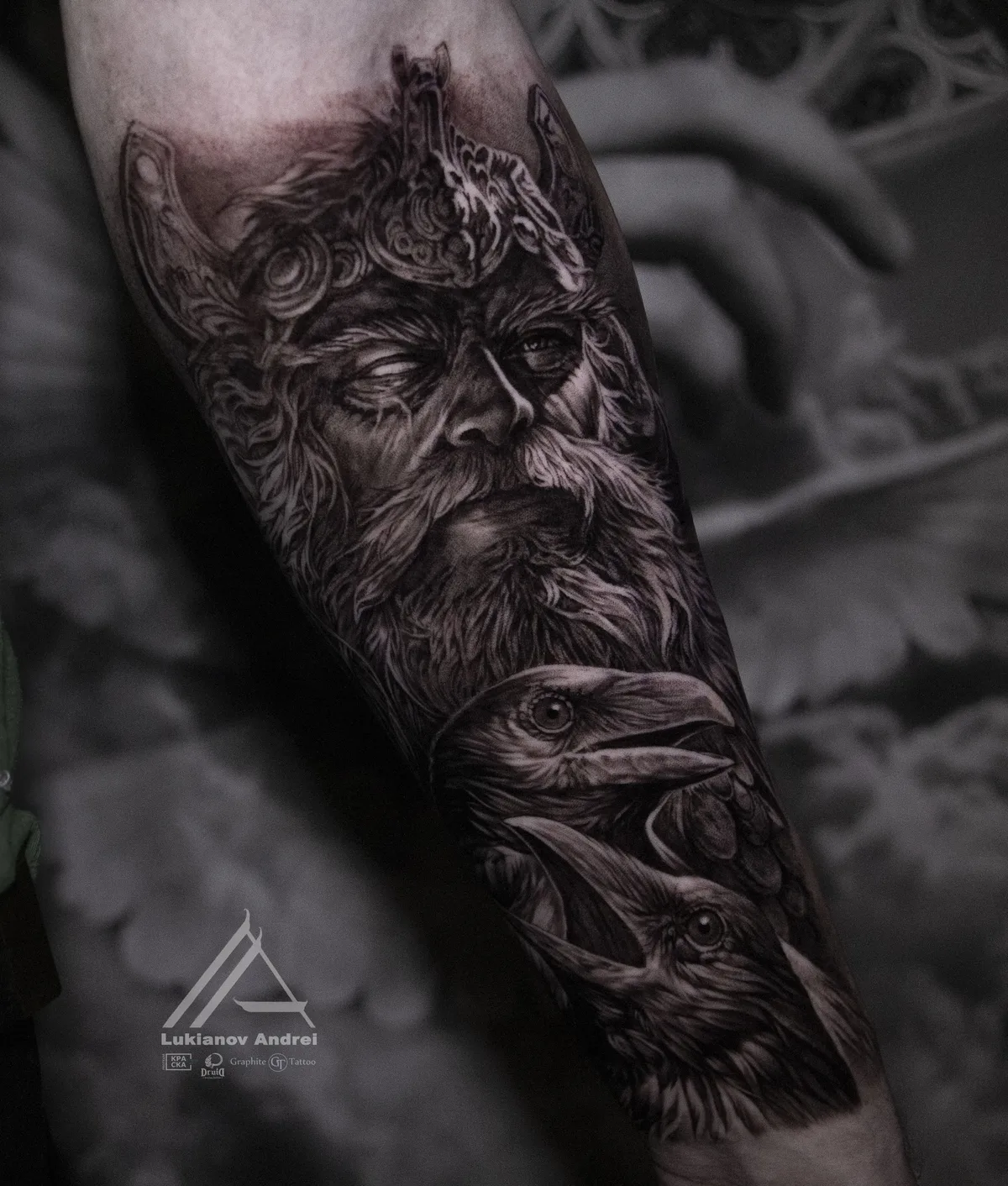
Two ravens on one tattoo almost always mean Odin. In Snorri Sturluson's Prose Edda the god keeps two birds that sit on his shoulders and tell him everything they have seen: Huginn, whose name means thought, and Muninn, whose name means memory or mind. At dawn he sends them out over the world; by breakfast they are back. Snorri says this is why Odin is called Hrafnaguð, the raven-god.
The line that gives the tattoo its weight is older than Snorri. In the Eddic poem Grímnismál, Odin says: Huginn and Muninn fly every day over the wide earth; I fear for Huginn, that he may not return; yet more I fear for Muninn. A god who has already given an eye for wisdom and hung nine nights on a tree for the runes is afraid of one thing, and it is not losing the ability to think. It is losing what he remembers.
That is the reading most people who choose Huginn and Muninn are reaching for, whether they have read the poem or not: the two ravens as the two halves of a mind, and memory as the half you cannot afford to lose. For someone watching a parent lose their memory, the design says something precise. It is also why a single raven from a Norse source reads differently from a pair: one bird alone can read as the one that did not come back.
Celtic mythology: the Morrígan on the battlefield
In Irish tradition the raven is not a god's messenger. It is the god. The Morrígan (the name is usually read as great queen or phantom queen) is a goddess of war, sovereignty and prophecy who appears sometimes as one figure and sometimes as three sisters, one of whom is Badb Catha, the battle-crow. When she takes bird form she does not send a raven; she becomes one, and the birds over a battlefield are her presence, not her pets.
The Táin Bó Cúailnge, the cattle raid at the centre of the Ulster Cycle, has her all through it. She offers herself to the hero Cú Chulainn, is refused, and turns against him. In the later tale of his death, mortally wounded in his last battle, Cú Chulainn ties himself to a standing stone so he can die on his feet; his enemies dare not approach until a bird lands on his shoulder. The stone is still there, at Knockbridge in County Louth, and the bird is usually read as the Morrígan. Everyone in the story knows what it means when she lands.
The Irish raven, then, is prophecy in its hardest form: the future arriving, and a figure who chooses how. As a tattoo it is heavier than the Norse pair. Knotwork in the feathers, a triple spiral for the three sisters, the bird on a standing stone: those details tell anyone who knows the material which raven you mean.
Native American traditions: Raven who stole the light
On the Pacific Northwest coast the raven is neither omen nor messenger. He made the world, and he did it by stealing. In Tlingit and Haida accounts a chief at the head of the Nass River keeps the sun, the moon and the stars locked in boxes. Raven (Yéil in Tlingit, Yáahl in Haida) turns himself into a hemlock needle, is swallowed by the chief's daughter, is born as her son, and cries until his grandfather opens the boxes one at a time. He lets out the stars, then the moon, then flies up through the smoke hole with the sun in his beak; in some tellings the smoke turns his white feathers black on the way out.
He is a trickster, greedy and vain and often ridiculous, and the only reason there is light, fresh water and salmon. In Haida tradition he also coaxes the first people out of a clamshell at Rose Spit, the scene in Bill Reid's carving Raven and the First Men. Raven is a crest figure: Haida society is divided into Raven and Eagle sides, and the crest belongs to families by inheritance, not by admiration.
That last point decides the tattoo question. Formline, the flowing black shape with its ovoids, U-forms and red and blue-green secondaries that people recognise from poles and bentwood boxes, is the visual language of the Haida, Tlingit, Tsimshian and their neighbours. The term was coined by an outsider, the art historian Bill Holm, in 1965; the system is theirs, and artists from those nations are reviving crest tattooing on their own terms. For anyone outside those communities the honest path is to take the story and leave the formline to the people it belongs to.
Poe and the Victorian raven
The English-speaking world's raven means grief because of one poem. The Raven appeared in the New York Evening Mirror on 29 January 1845 and made Poe famous within weeks, though he was paid about nine dollars for it. A man alone at midnight, mourning a woman called Lenore, hears a tapping; a raven walks in, perches on a bust of Pallas above the chamber door, and answers every question with the same word. Will he see Lenore again? Nevermore. Will the pain lift? Nevermore. The poem ends with the bird still there.
Poe did not invent the talking raven. Charles Dickens had one, a real one named Grip, who appears as a character in Barnaby Rudge in 1841. Poe reviewed the novel and complained that Dickens had not made the bird prophetic enough. Grip died that year and was stuffed; he now sits in a glass case in the Free Library of Philadelphia. The Raven is, among other things, Poe finishing Dickens's job.
The Victorians took it from there (the story that Charles II decreed the Tower of London must always keep ravens cannot be traced before the 1880s), and the raven fitted a century that made an art of grief. As a tattoo, the Poe raven is the one with the word Nevermore under it, or a bust, or a closed book. It means loss you have stopped arguing with. It is the most direct of the four readings and the one most likely to look like everyone else's: a reason to think about typography, not a reason to avoid it.
Tattoo styles that suit the raven
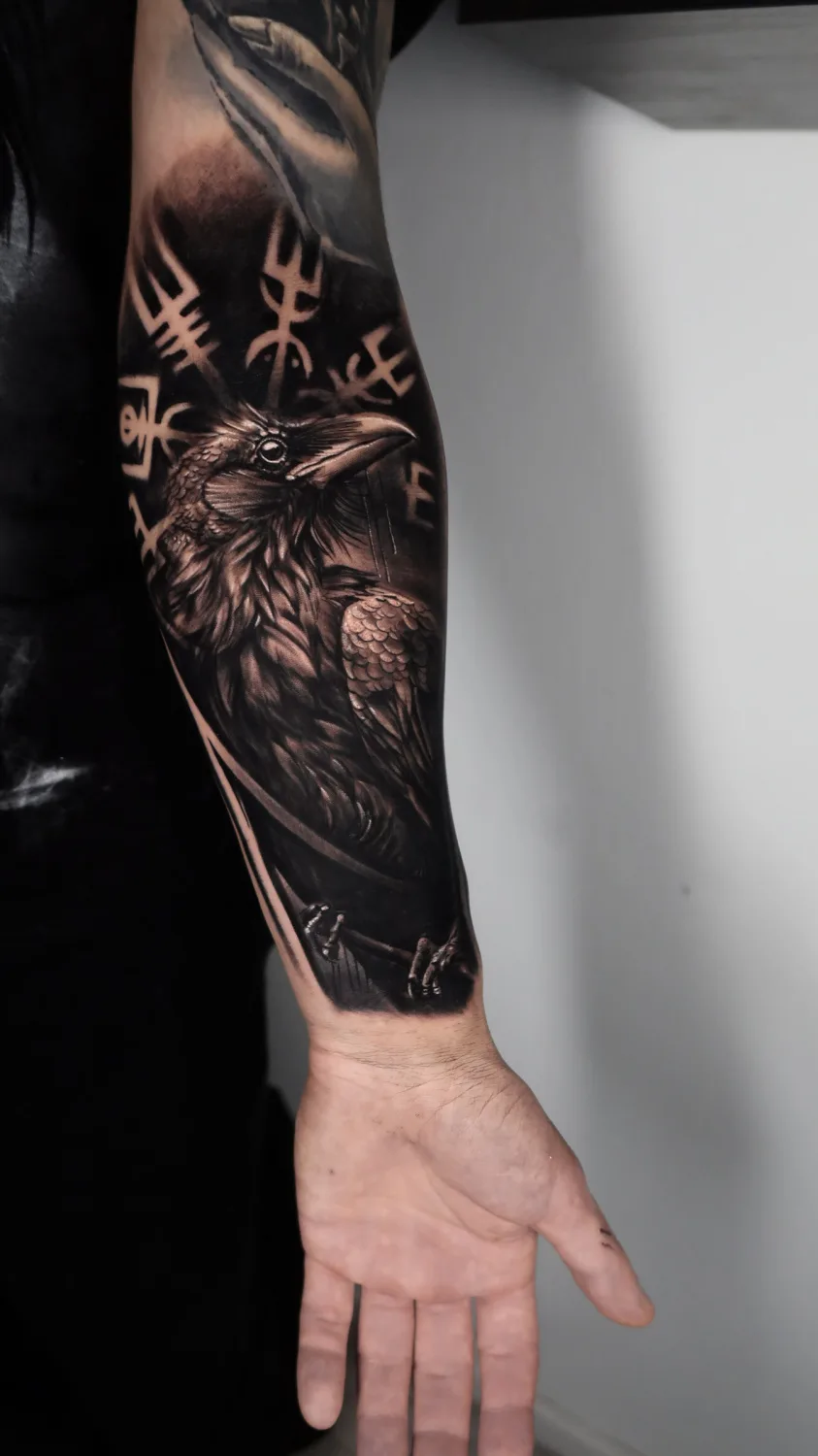
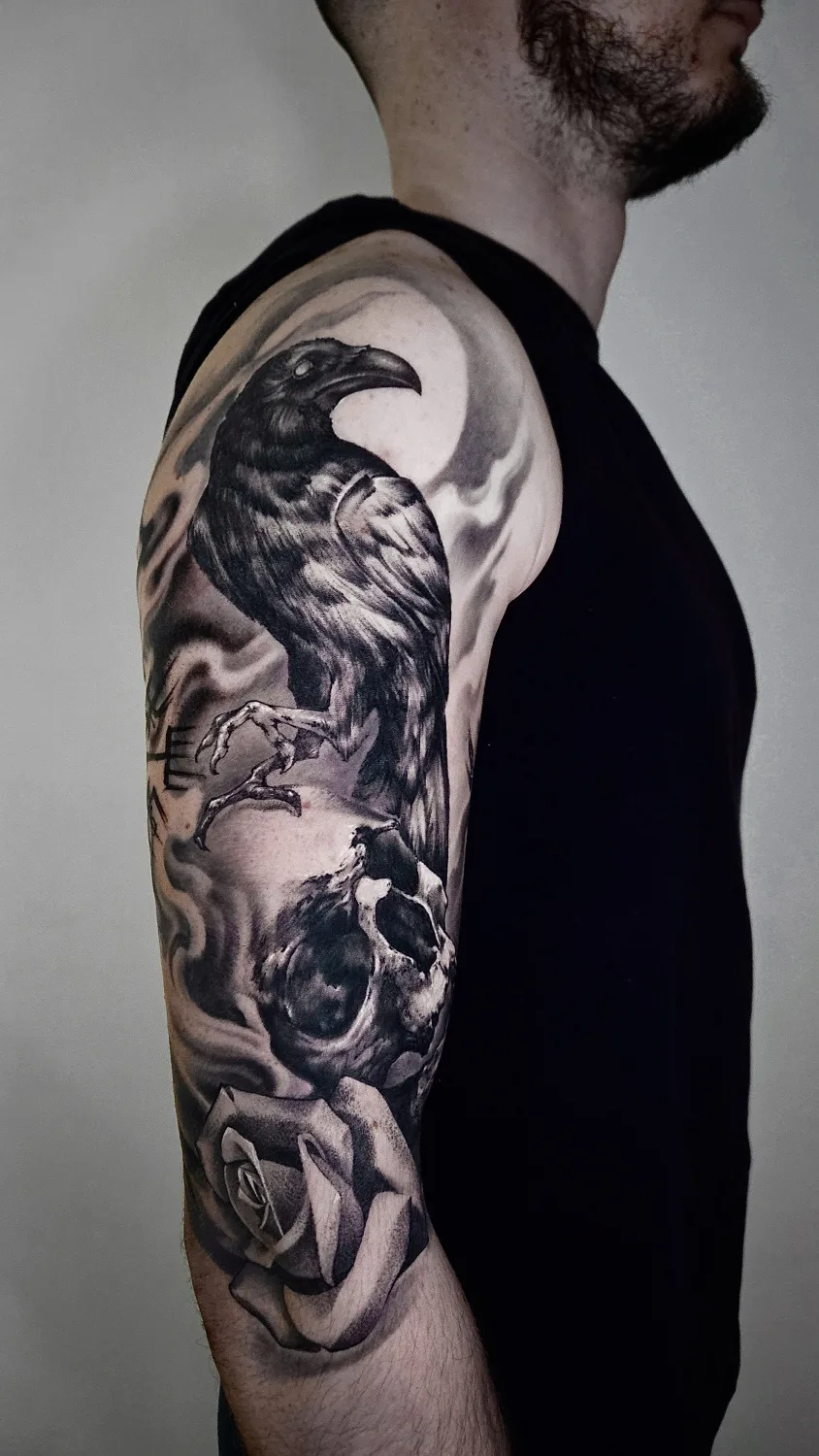
Blackwork. The obvious match and still the strongest. A raven in solid black with the feather structure carved out in negative space looks like the animal; a black bird is a black shape before it is anything else. The technical demand is saturation: heavy black has to heal even, and a patchy raven reads as a mistake from across the room. Blackwork also takes Norse and Celtic ornament well, since knotwork and runes were black line to begin with.
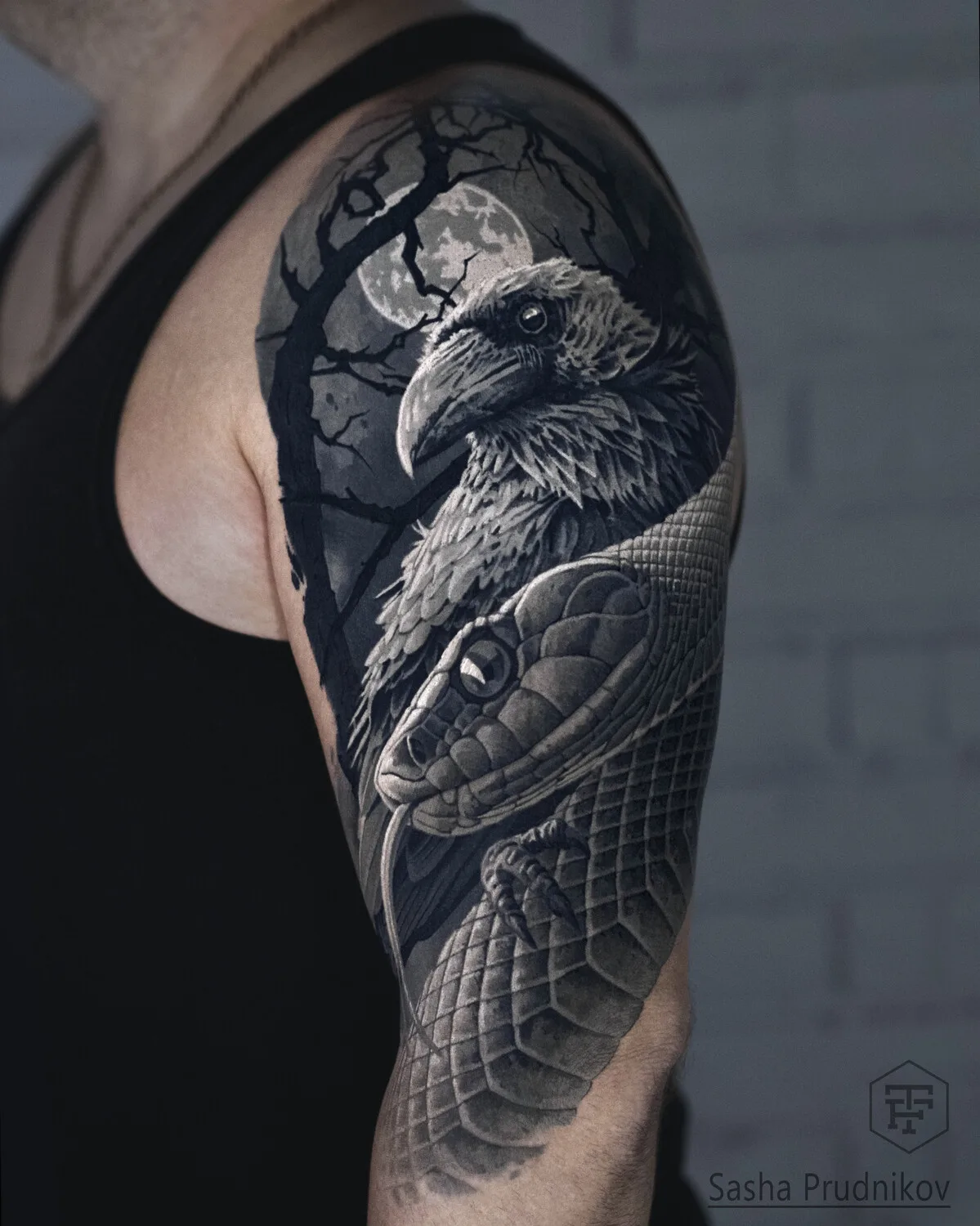
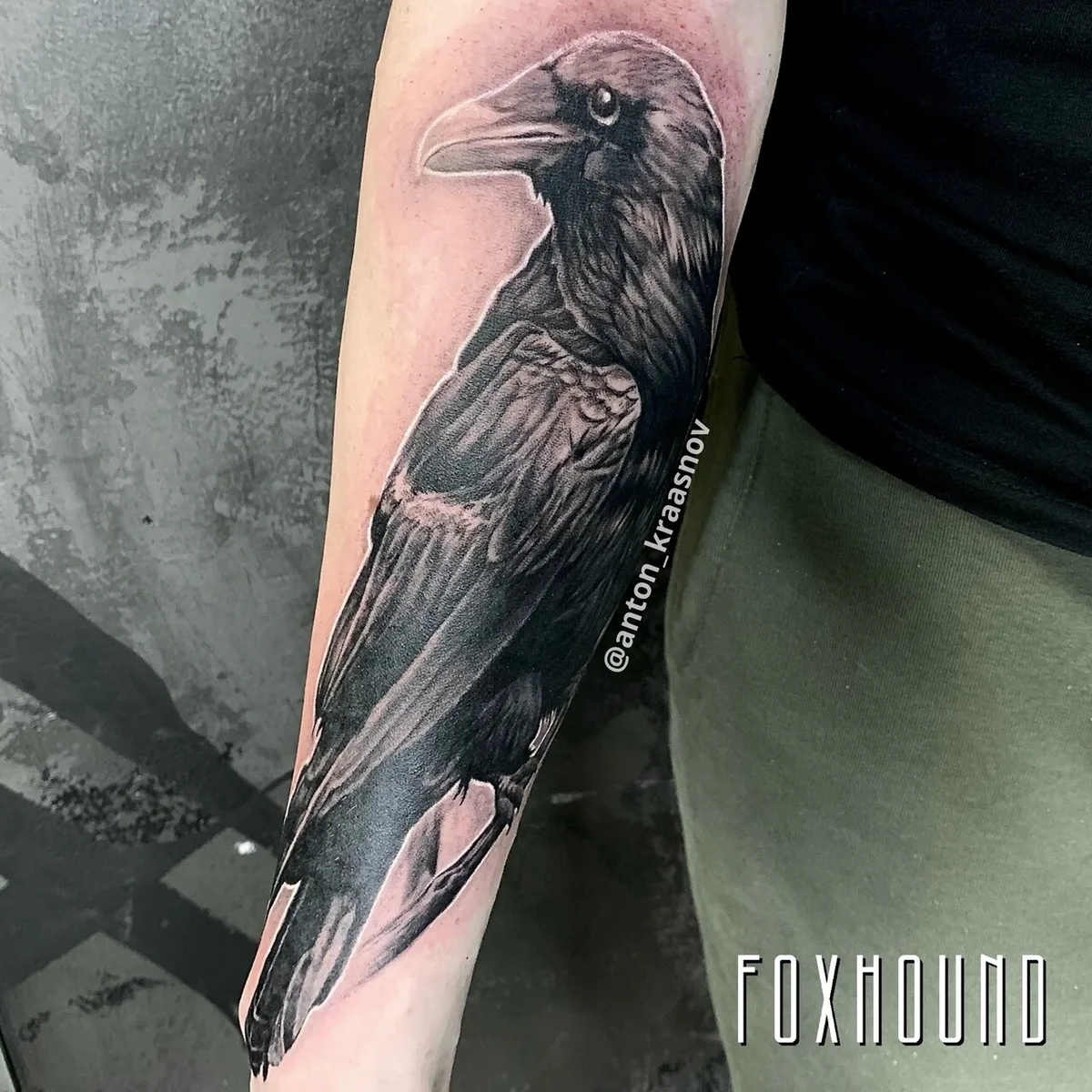
Black-and-grey realism. The raven's difficulty is the sheen. Its feathers are not flat black; they throw blue and violet in light, and a realist has to suggest that with grey and skin tone alone. The birds that work are built on the big shapes (head, throat feathers, primaries) with fine barbing kept to a few places where it will survive; the birds that fail try to draw every feather. Realism is the style for a portrait raven, an eye that looks at you.
Illustrative and linework. A raven in confident line, with hatching or dotwork for volume, sits between blackwork and realism and ages better than either at small sizes. It is the natural fit for the storytelling variations below, a raven with a key or a raven on a bare branch, because line can carry a scene where solid black would swallow it.
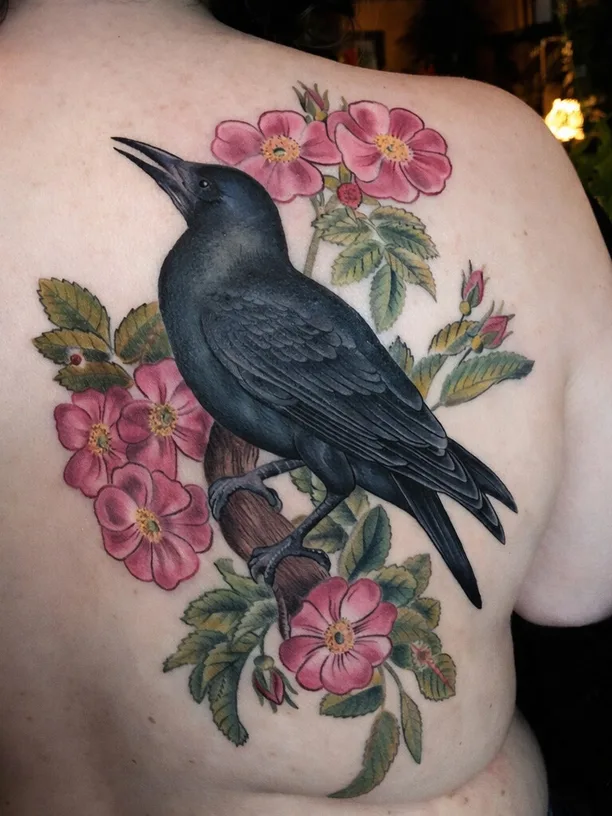
Neo-traditional. Bold outline, a limited saturated palette, some ornament. The neo-traditional raven is graphic rather than natural, usually with a rose, a moon or a branch to anchor it, and it is the best choice if you want colour, because it treats the black bird as a shape and lets the colour live around it. Traditional flash has its own raven, in profile with wings up and often a heart or a skull in its claws, and it will look the same in thirty years.
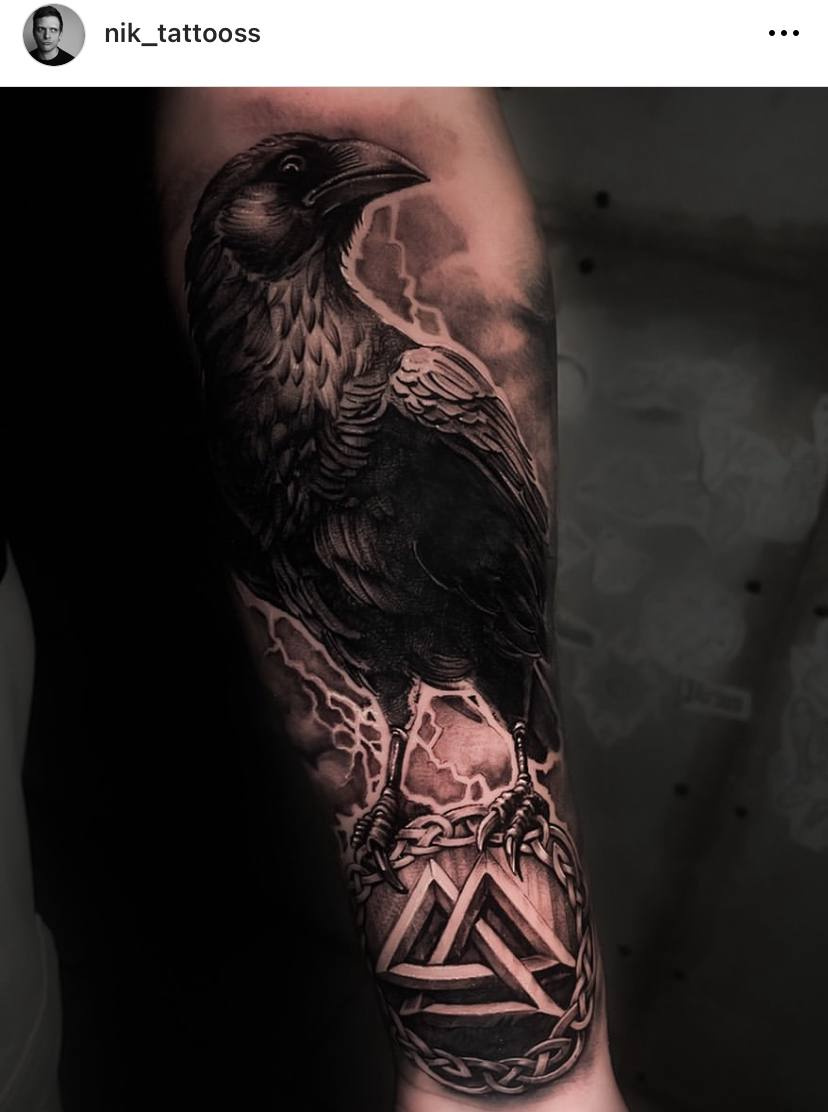
Nordic and Celtic ornament. Huginn and Muninn drawn in the interlaced animal style of the Urnes stave church, or a raven built from triquetra knots, reads as heritage before it reads as a bird. It needs an artist who has studied the ornament, since invented knotwork looks invented.
To see how those styles look side by side on real skin (blackwork sleeves, black-and-grey back pieces, neo-traditional colour), the raven motif page collects the work by style and placement.
Placement and scale
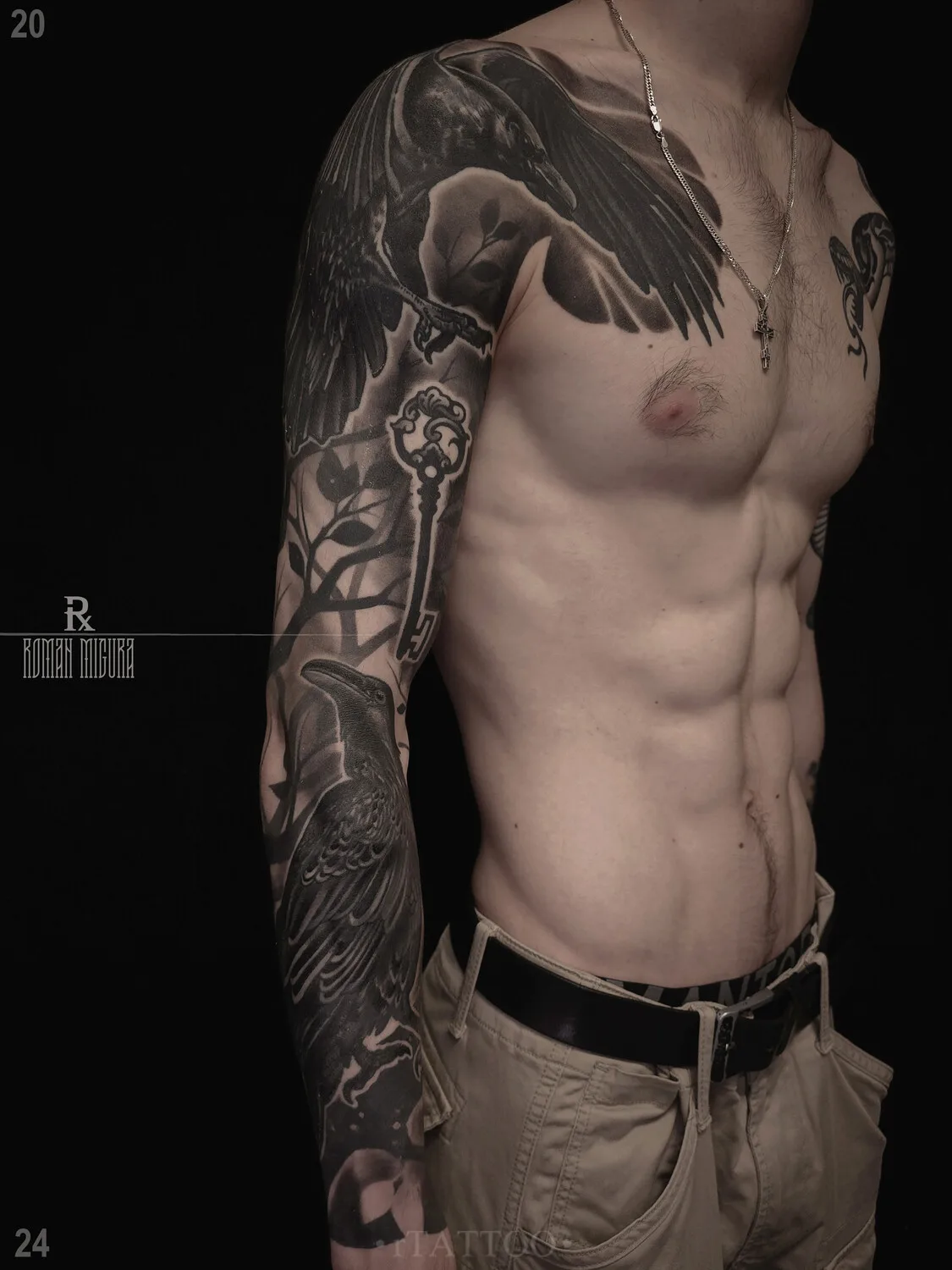
The forearm is where most raven tattoos end up. A bird in profile, wings folded, runs the length of the inner forearm as if drawn for it; a raven in flight wraps the outer forearm so the far wing disappears round the edge and the whole thing reads as a bird passing through. Moderate pain, easy to show or cover, and the placement most people pick for a first piece of any size.
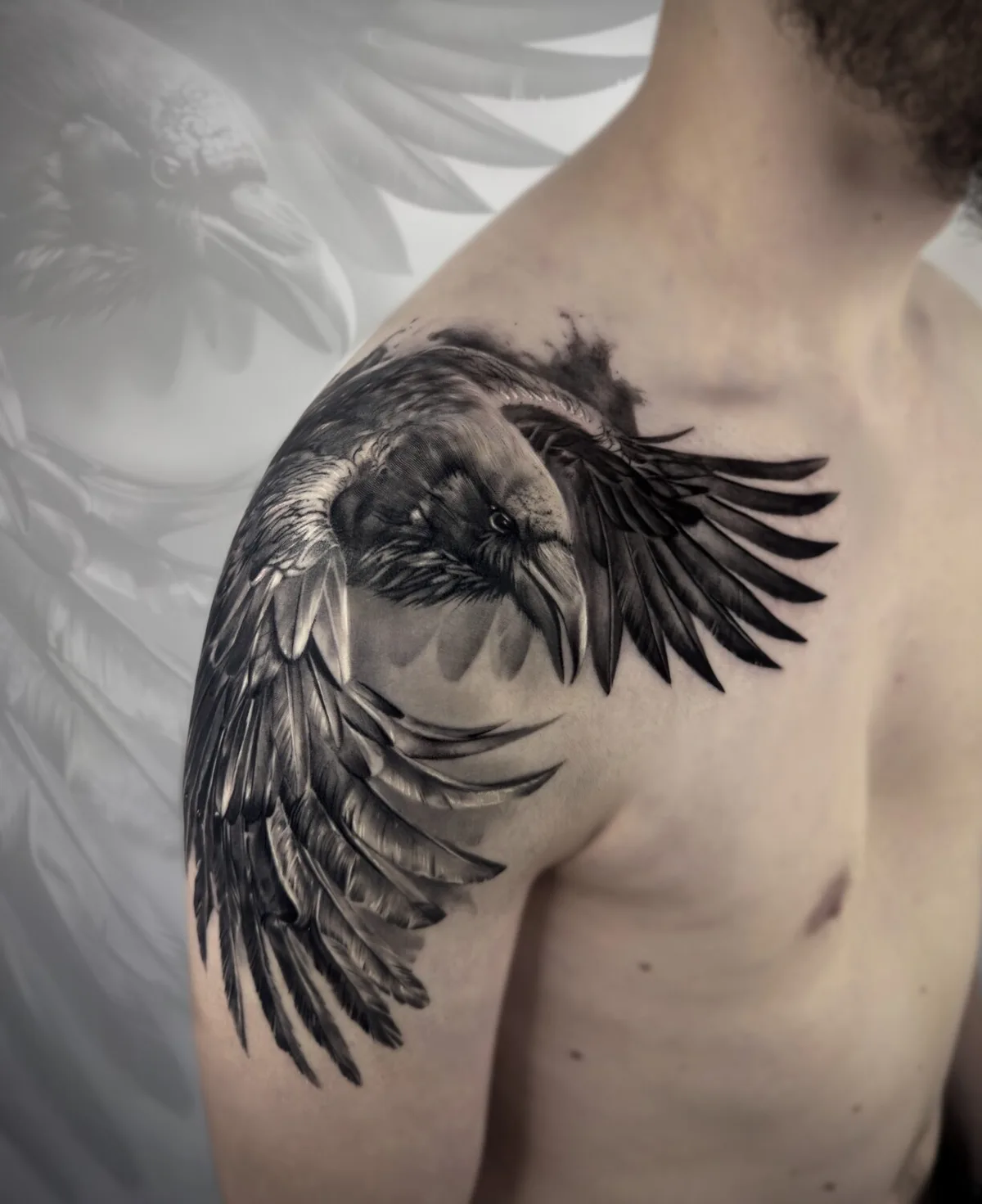
The shoulders and upper back give open wings the room they need. Spread across the shoulder blades, the wings follow the muscles and the bird looks like it is landing on you. This is the placement for the Morrígan and for anything with a standing stone under the bird, and it is where Huginn and Muninn sit best as a pair: one on each shoulder, which is where the Edda puts them.
The chest is personal and painful in the same measure. A single raven over the heart with its head turned reads as a guardian or a memorial. Two ravens meeting at the sternum, wings out to the collarbones, is the strongest symmetrical composition the motif has and one of the more painful to sit through. The full back is for the scene: a raven over a forest, a bird large enough to have a face. Thigh and calf are the quieter alternatives, with real space, less pain and complete control over who sees it, and they suit a perched bird, since the vertical of the leg does the branch's job.
Scale needs its own decision. Below roughly eight centimetres a raven cannot hold feather detail; the barbs merge as the ink settles and you are left with a dark oval with a beak. At that size the honest options are a clean silhouette, a single-line raven, or a traditional profile with a heavy outline. Between ten and twenty centimetres you can have a real bird with structure; above that, the sheen, the eye and the scene. Artists say this if asked and rarely say it first.

Full back Viking warrior tattoo by @sicko_black
Raven on Viking symbol tattoo by @Shum_art_tattoo
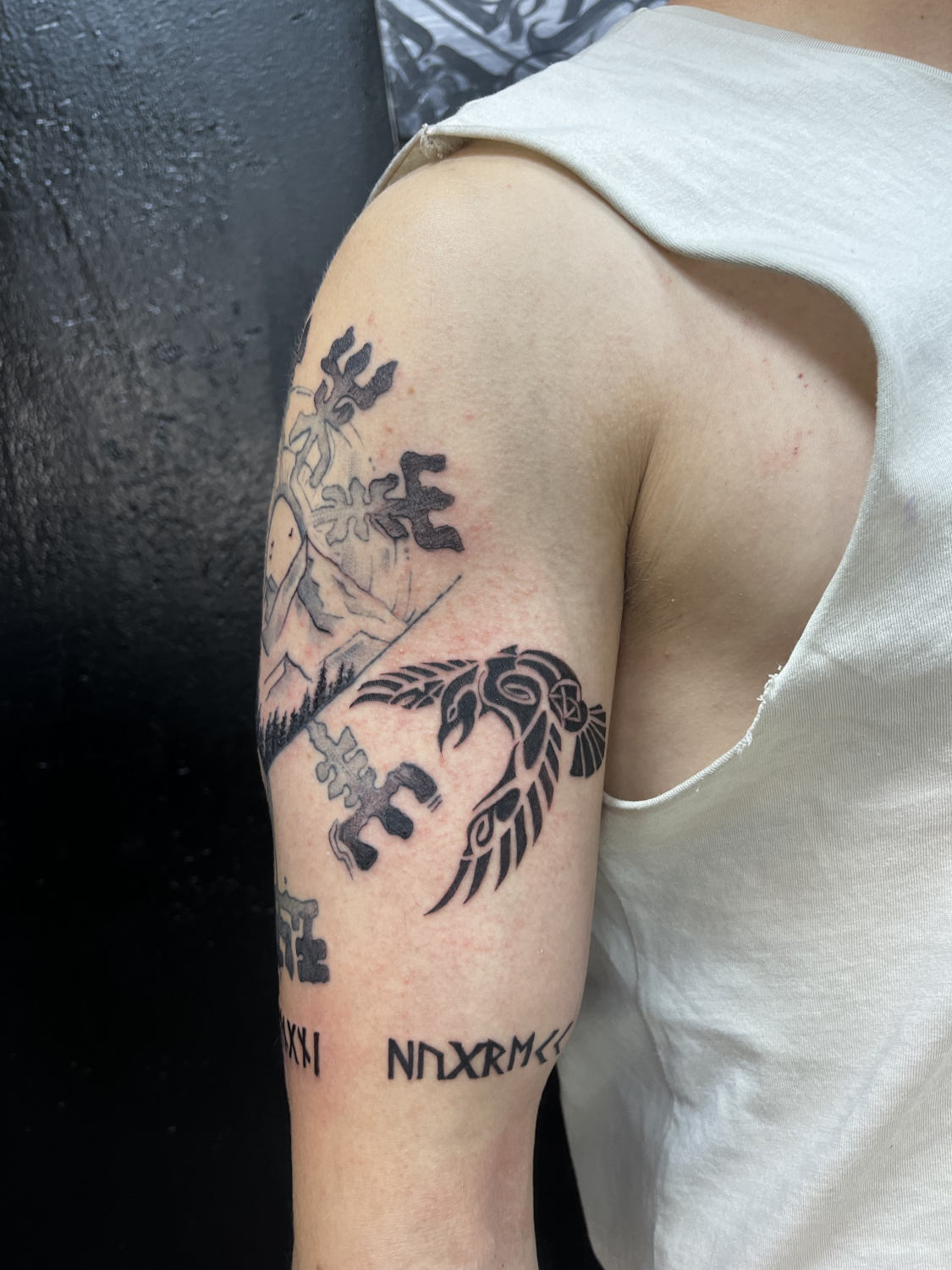
Raven with runes and mountains tattoo by @tempesttats
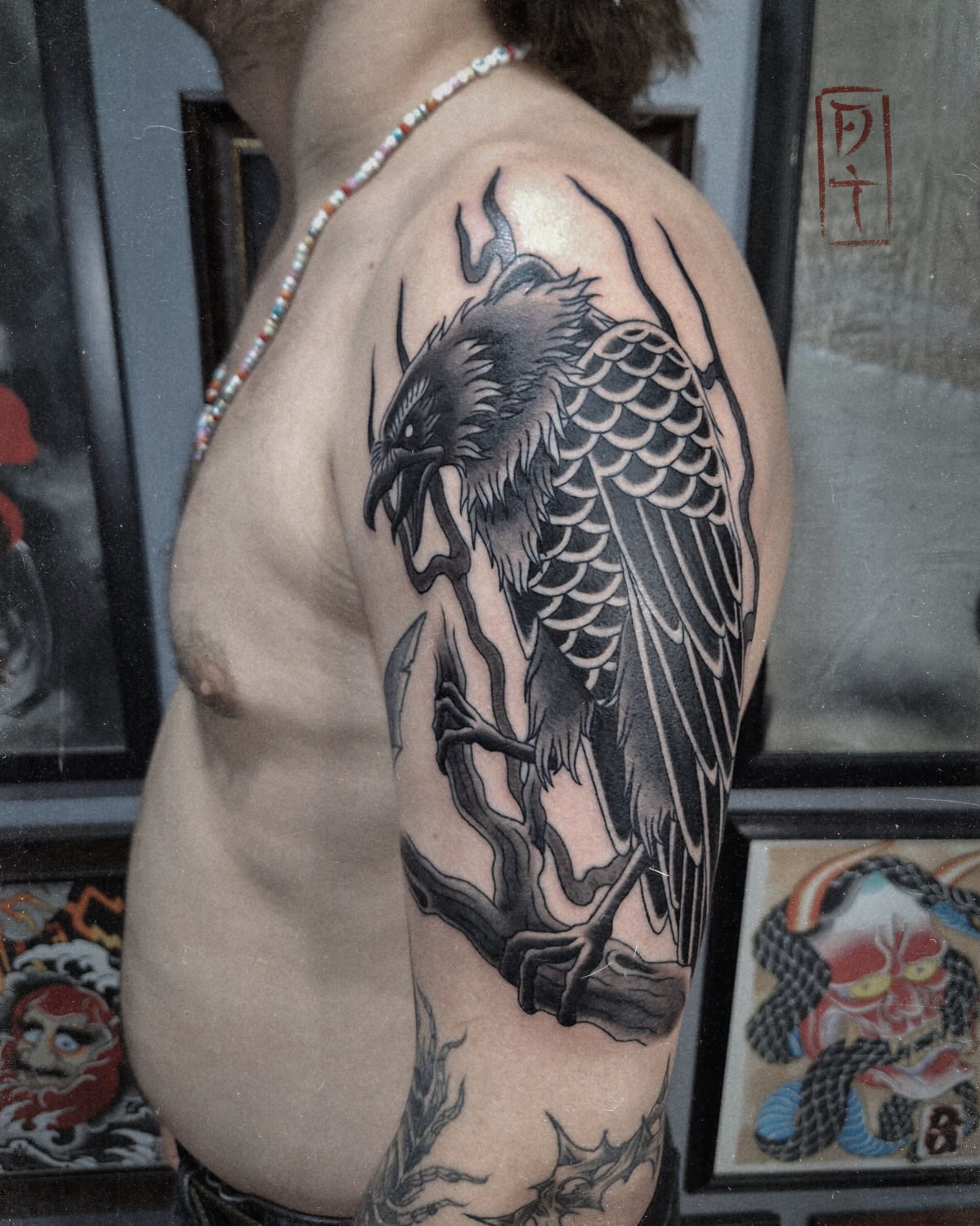
Japanese-style raven tattoo by @romadoberman

Ravens over mountains tattoo by @Jollycyb
Design variations and what they change
Small changes move the raven's meaning further than a change of style does, because the bird is a fixed shape and everything else is commentary.
One raven or two. Two ravens are Odin's, and the pair reads as thought and memory whatever else is in the design. A single raven is open (witness, warning, Poe's bird, the Morrígan) and takes its meaning from what surrounds it. Three ravens, less common, point to the triple Morrígan.
Perched, flying or landing. A perched raven watches; it is the bird that knows. A raven in flight is the messenger, going or coming back. A landing raven, wings braked and feet out, is the Cú Chulainn moment, the arrival, and the most dramatic pose the motif has.
The eye. In a black-and-grey piece the single highlight in the eye is where every viewer looks first. An eye that meets the viewer's is confrontation; an eye looking out of the frame is vigilance. No visible eye, whether a silhouette or the head turned away, reads as absence, and it is the choice people make for memorials.
The raven and the key. An old pairing that means a secret kept or a way through. Ravens in folklore are the birds that know where things are hidden, so a raven holding a key says the wearer holds knowledge, or is waiting to be let in. The raven and the skull is the memento mori version, and the one that tips the bird fully into the death reading; if you want your raven to mean memory rather than mortality, this is the pairing to leave out.
Runes, knotwork and script. Runes under a raven pin it to Odin; Ansuz, the rune most often linked to Odin, is the usual choice, in Elder Futhark to match the age of the myth. Knotwork pins it to the Morrígan. A single word in serif type pins it to Poe. Any of these locks the reading, so decide first whether you want it locked.
The raven dissolving. A bird breaking into feathers, smoke or sketch lines says transition rather than presence: the thing that is leaving, or the self being replaced. It suits the memory reading and hides a technical advantage: less solid black to heal, less fine detail to blur.
Choosing an artist for a raven tattoo
A raven is a test of an artist's black. Solid areas that heal patchy, outlines that wobble along a wing edge, feathers that all point the same way: every one of those shows more on a black bird than on any other subject, because there is no colour to distract from it.
Three checks before you book. First, ask for healed photographs of black-heavy work; fresh black is always perfect, and the question is what it looks like at six months. Second, look for birds in the portfolio and look at the primaries: an artist who understands how flight feathers layer will draw a raven that could fly, and one who does not will draw a leaf shape with a beak. Third, match the tradition to the artist: Urnes-style Huginn and Muninn need someone who has drawn Norse ornament before; a realist bird needs a realist.
Bring photographs of real ravens rather than other people's tattoos (the animal to solve, not someone else's answer), and see how differently the same bird gets handled. Loren Fetterman, working in black-and-grey realism in the north of England, folds the raven into a Viking sleeve with a longship: one figure in a Norse scene rather than a portrait. Anatole in New York gives a single raven the whole back, bird and bare trees in realist black and grey, so the placement becomes the landscape. Tina Marabito takes the opposite route: a neo-traditional raven on a branch, colour around a black shape, sized for an upper arm. Three approaches to one motif, and the choice between them decides more than the size will.
You can filter by style, country and city in our tattoo artist directory; a portfolio with several healed black birds in it is the shortlist.

Viking sleeve with ships tattoo by @lorenf

Elder portrait with ravens tattoo by @Nazarov

Bearded elder and ravens tattoo by @Nazarov

Viking god and compass tattoo by @Diegoconci

Viking warrior with runes tattoo by @Elizabethproink
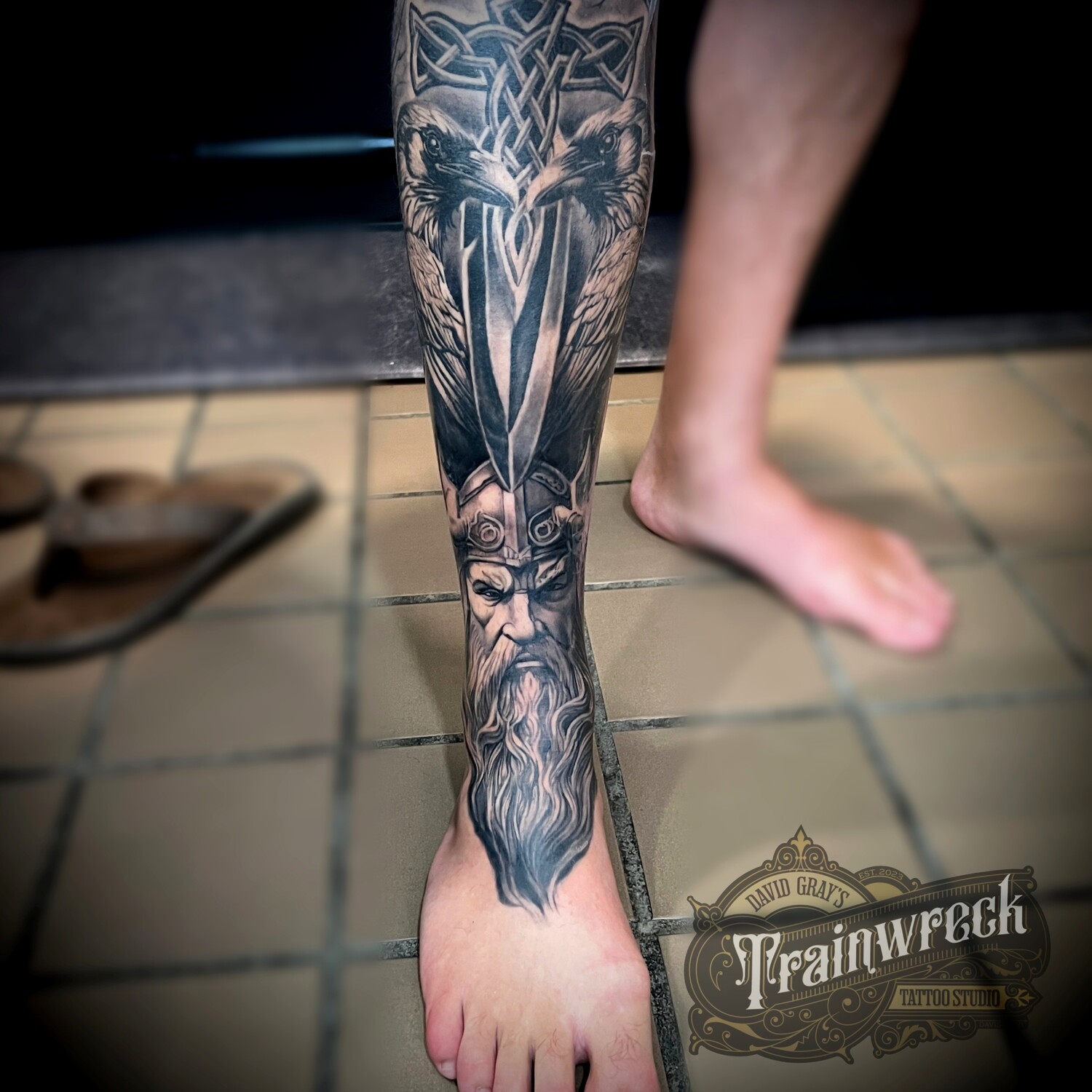
Viking warrior and sword tattoo by @trainwrecktattoostudio
Aftercare and how a raven tattoo ages
The basic protocol is the same as for any tattoo: keep it clean and lightly moisturised, leave the flaking alone, no swimming and no direct sun until the surface has closed: two to three weeks for the skin, a few months for the ink to settle.
Ravens add one thing. Heavy black takes more passes to saturate than shaded work, so a large blackwork raven will be more swollen and shed a thicker layer as it heals. That is normal. Picking at it is not: a scab lifted early from a solid black area takes ink with it, and the patch it leaves is exactly the flaw a black bird cannot hide. Expect a touch-up pass on any large solid area and treat it as part of the piece.
Over years the raven ages well by tattoo standards, because it is mostly black, and black is the pigment that stays. What goes first is the fine work, the individual barbs and the thin highlights on the beak, so a raven built on strong shapes with detail on top will still be a raven at twenty years, while one built entirely from detail will be a dark blur with a hint of wings. Sunscreen on an exposed forearm raven does more for its long life than any dedicated product, and it matters most for black-and-grey, since the grey tones go first.
Frequently asked questions
What does a raven tattoo symbolize?
Memory, foresight and intelligence first: the bird that goes out, sees, and comes back to report, as Odin's ravens do. Death and grief second, through battlefields and through Poe. In Pacific Northwest traditions the raven is a creator and trickster; in Irish myth it is a war goddess in bird form. Which meaning a tattoo carries depends on what is drawn with the bird.
Is a raven tattoo bad luck?
No. The unlucky raven is a European folk reading based on ravens gathering where animals had died, and it coexists with the Norse raven of wisdom and the Northwest coast Raven who gave people the sun. Most people choosing the bird today are choosing the intelligence and the memory, not the omen.
What is the difference between a raven and a crow tattoo?
Anatomically, a raven is about twice the size, with a heavier beak, shaggy throat feathers and a wedge-shaped tail, where a crow's tail is fan-shaped. Symbolically the raven is solitary and oracular (memory, prophecy, Odin) while the crow is social and communal. The crow's own meanings deserve a separate article.
What does a Huginn and Muninn tattoo mean?
Thought and memory, the two ravens Odin sends out each morning. Grímnismál adds the detail that gives the design its weight: Odin fears losing Huginn, and fears losing Muninn more. A pair of ravens says the two halves of a mind, and that memory is the half worth guarding.
What does a raven tattoo mean for a woman?
The same as for anyone; the bird has no gendered reading. If there is a difference in what people choose, it is that the Morrígan, the Irish goddess who takes raven form on the battlefield, is often picked deliberately as a female figure of prophecy and sovereignty; knotwork or a triple spiral usually points to her.