There are countless software platforms designed to help people run a business. DUBHCORE was never supposed to be one of them. It was born inside a real, working tattoo studio, conceived and designed by a tattoo artist who was simply trying to solve problems he knew all too well.
Appointments, messages, client requests coming in through different channels, consent forms and documentation, deposits, calendars, artists, clients: small tasks that seem manageable on their own, but together can take up hours that could otherwise be spent drawing, tattooing, or simply running the studio better.
The problem wasn't that management software didn't exist. The problem was that most of it hadn't been designed around the way a tattoo studio actually works. So instead of adapting the studio to the software, he started building the software around the studio.
Little by little, that idea became DUBHCORE. Born in a studio, for a studio.
It was never meant to become a business
There was no business plan behind DUBHCORE. No startup in the making, no particular ambition to enter the software industry, and certainly no intention of building a public persona around its creator.
In the beginning, DUBHCORE was supposed to stay exactly where it had been born: inside the studio. A tool built to solve its creator's own practical needs and, at most, something to share with a few tattoo artist friends dealing with the same problems.
Then other artists started seeing it, and one question kept coming up:
“Why don't you make this available to the rest of us?”
What had started as an almost entirely personal solution slowly began to change shape. Not because its creator suddenly decided he wanted to sell software, but because friends and colleagues convinced him that something capable of making life easier for one studio might be able to do the same for many others.
Eventually, they convinced him. That was when DUBHCORE stopped being just a private tool and began its journey towards becoming a product.
But the original goal never changed: less time managing chaos, more time tattooing.
A project shaped by the people who actually do this work
The original idea and design behind DUBHCORE came directly from the experience of a tattoo artist, but it would be wrong to tell its story as the work of one person locked away in a room.
DUBHCORE has also grown thanks to friends, colleagues and professionals from within the industry who chose to give the project their time, experience and attention. They shared the everyday needs of their studios, contributed to the planning, tried the workflows, tested what was being developed and pointed out what worked — and, more importantly, what didn't.
Many decisions came from one extremely simple question:
“OK, but how would we actually use this in the studio?”
During development, that question often proved more important than any technical specification.
The principle has always been the same: don't start with how software thinks a tattoo studio should work. Look at how a tattoo studio actually works, and build around that reality.
That's why DUBHCORE doesn't want to be simply another piece of software for the industry. It wants to be a product born from within the industry.
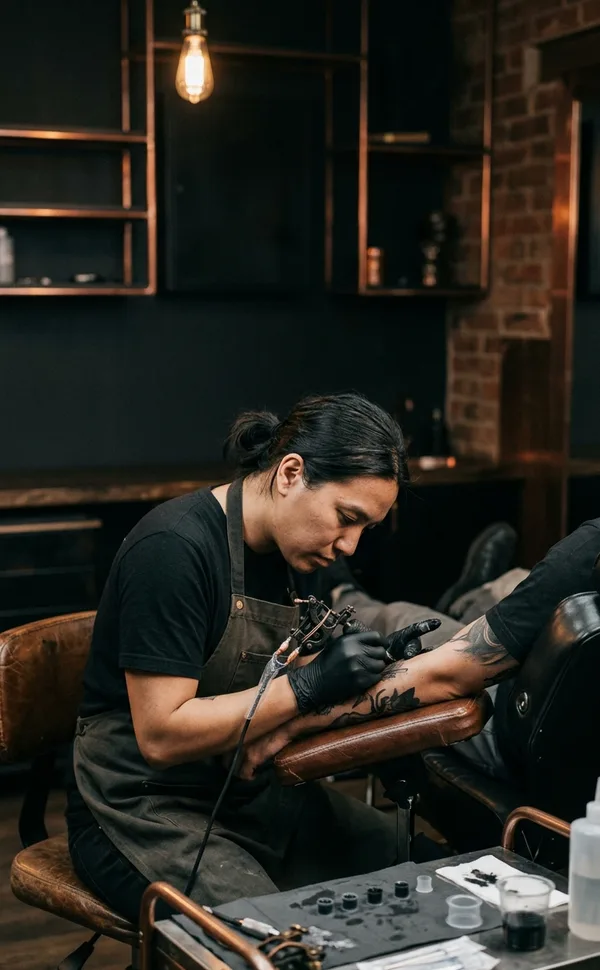
The founder who stays in the shadows
There is another choice behind DUBHCORE — one that is probably less common today. Its creator has chosen not to be the face of DUBHCORE.
This isn't a marketing stunt designed to create mystery before some future reveal. There is no face waiting to be unveiled: staying in the shadows is a conscious choice.
DUBHCORE was conceived by someone who knew tattooing before social media became an almost inseparable part of it. A world where a tattoo artist's reputation was built primarily through the work that left the studio, through technique, word of mouth and the respect earned over years among clients and fellow artists.
That world has inevitably changed. Today, tattooing exists alongside algorithms, follower counts, constant content creation, personal exposure and an increasing pressure for the artist to become a brand in their own right.
It's a direction DUBHCORE's creator simply doesn't identify with. So he consciously chose to move the other way.
He doesn't want DUBHCORE to turn him into an influencer. He doesn't want to use his face to sell the platform, and he has no interest in building a personal brand around the project.
Most importantly, he doesn't believe knowing his identity should make DUBHCORE any better or worse.
The question he would rather tattoo artists ask is much simpler:
Does it actually make my work easier?
If the answer is yes, DUBHCORE has done its job. If the answer is no, knowing the name or face of the person who designed it won't change anything.
In an industry where being constantly visible seems to matter more and more, DUBHCORE has consciously chosen a different path. A philosophy perfectly captured in one sentence:
“The founder stays in the shadows. The work and the product speak instead.”
Why DUBHCORE?
Even the name tells you something about its creator, without putting him at the centre of the story.
DUBH is a Gaelic word meaning black, dark. It's a natural reference to black ink and tattooing, but it also comes from its creator's deep connection with Ireland and Scotland.
CORE, meanwhile, represents the nucleus — the operational heart of the studio: the place where artists, clients, appointments, requests, documentation and everyday work all come together.
Those two ideas became DUBHCORE. A name for something designed to sit quietly at the centre of the studio and help everything around it work better.
One environment, built around the studio
Over time, DUBHCORE has grown far beyond the private tool it was originally supposed to be. The idea is to bring into one environment all the things that, in the everyday life of a studio, often end up scattered across messages, calendars, paperwork and different apps.
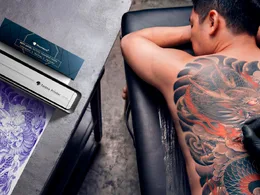
The journey can begin with the client's initial request: the studio can manage it, bring it into its workflow and organise it within the calendar. The studio and client can communicate, while documents, consent forms and signatures follow the process through to an organised client record. All within the same environment.


DUBHCORE also wasn't designed exclusively for the individual tattoo artist. Its development takes into account the reality of studios with multiple artists, different roles and multiple locations, as well as the different workflows involved in tattooing, piercing and PMU.


Even seemingly small details have been approached from the reality of everyday studio life: preventing scheduling conflicts, quickly seeing when required documentation is missing, keeping everything related to a session organised and making the relationship between client and studio easier to manage.
They may not be particularly spectacular details. But they're exactly the kind of details that cost people time every day.
The goal isn't to replace human interaction with technology. It's to remove some of the noise surrounding it.
Technology should make itself as invisible as possible
As DUBHCORE developed, it gained more and more functionality, but constantly adding features was never the real objective. The objective is to remove friction.
Management software can have a hundred different tools, but if it forces a tattoo artist to completely change the way they work, it has probably missed the point.
Technology should stay in the background. Artists should have to think about their management software as little as possible and simply find it there when they need it, helping organise what happens before, during and after the work itself.
That's also why the conversation with the people who actually work in the industry won't end when DUBHCORE launches.
DUBHCORE doesn't claim to know how every studio should work. It wants to keep listening to tattoo artists, piercers, PMU professionals and studios, understand how they actually work and allow that conversation to continue shaping the platform as it evolves.
Because the principle remains the same one that started everything: the studio first, the software second.
From Idea to Ink.
DUBHCORE is now preparing for its public launch.
And there is something unusual about watching a product come to market that, in the beginning, was never even supposed to be sold. What was meant to be a tool for one studio is about to be placed in the hands of other tattoo artists, piercers, PMU professionals and studios.
Where DUBHCORE goes from here remains to be seen. But whether it eventually becomes a large platform or remains a tool used by a smaller community isn't what its creator considers the true measure of success.
That measure is much simpler.
If, at the end of the day, a tattoo artist has spent less time chasing messages, organising paperwork, piecing together scattered information and dealing with administrative chaos — and has had more time to draw, tattoo, or simply focus on their studio — then DUBHCORE will have achieved what it was created to do.
DUBHCORE doesn't want to change tattooing. It wants to give tattoo artists more time to do it.
And you probably won't see its creator celebrating the result in front of a camera. He'll be somewhere else.
Probably tattooing.
DUBHCORE
FROM IDEA TO INK.