A cat tattoo means independence and guardianship at once: an animal that protects the household without ever belonging to it. Which reading you wear depends on the cat you choose, because the cat that Egyptians mourned with shaved eyebrows had become, two thousand years later, the black cat read out in European courtrooms as evidence of a pact with the devil. That inversion is the whole story of the motif.
- The cat carries two readings at once, independence and guardianship, and the design decides which one you wear: a seated Egyptian silhouette is the guardian, a cat walking away is the loner.
- The black cat is the motif's spine: sacred and mourned in Egypt, lucky in Japan and Britain, then turned into courtroom evidence by Vox in Rama (1233) and the witch trials. A black cat tattoo carries both halves whether you intend it or not.
- Each tradition has a specific figure worth naming in the brief: Bastet of Bubastis, the maneki-neko of Gōtoku-ji, the bakeneko, and Freyja's chariot cats (which the Eddas never name).
- Realistic cat portraits live or die on the eyes and need palm size at minimum; Egyptian, traditional and ornamental treatments age better because the shape carries the piece.
- Ask for healed cats in a portfolio, match the tradition to the artist, and bring photographs of the real animal rather than screenshots of other tattoos.
What a cat tattoo means
Start with the animal. The cat is often described as the domestic animal that arrived on its own terms. The oldest evidence is a grave on Cyprus, at Shillourokambos, roughly 9,500 years old, where a person was buried with a cat close by. Cats are not native to Cyprus, so people must have carried them over by boat; the partnership itself began on the mainland, where grain stores drew mice, and mice drew cats. That is the foundation of the independence reading: a cat stays because it chooses to, and anyone who has lived with one knows the difference between loyalty and consent.
The second reading is guardianship, and it is just as old. A cat that hunts the mice in the granary protects the food, and a house that keeps the food survives the winter. Egypt built a goddess on that fact. Long before the cat was a pet it was a working guardian, and a tattoo of a seated, watchful cat still carries that: something small that keeps the household safe without being asked.
The third reading runs underneath both: the cat as the animal of the threshold. Cats are crepuscular, most active at dawn and dusk. Their eyes throw light back in the dark because of a reflective layer behind the retina, which is why a cat in a doorway at night looks like it is watching from another world. Almost every culture that lived with cats ended up placing them somewhere between the household and the supernatural. Sometimes that made them sacred; sometimes, suspects.
In tattooing, those readings sort into recognisable types. A seated cat in profile, upright and still, is the Egyptian guardian. A cat mid-stretch or walking away is independence and self-possession. A black cat with a moon is the threshold animal, and it is the most loaded of the three, because it carries the blessing and the curse at the same time. A portrait of a specific cat is grief or love for one particular animal and usually nothing more.
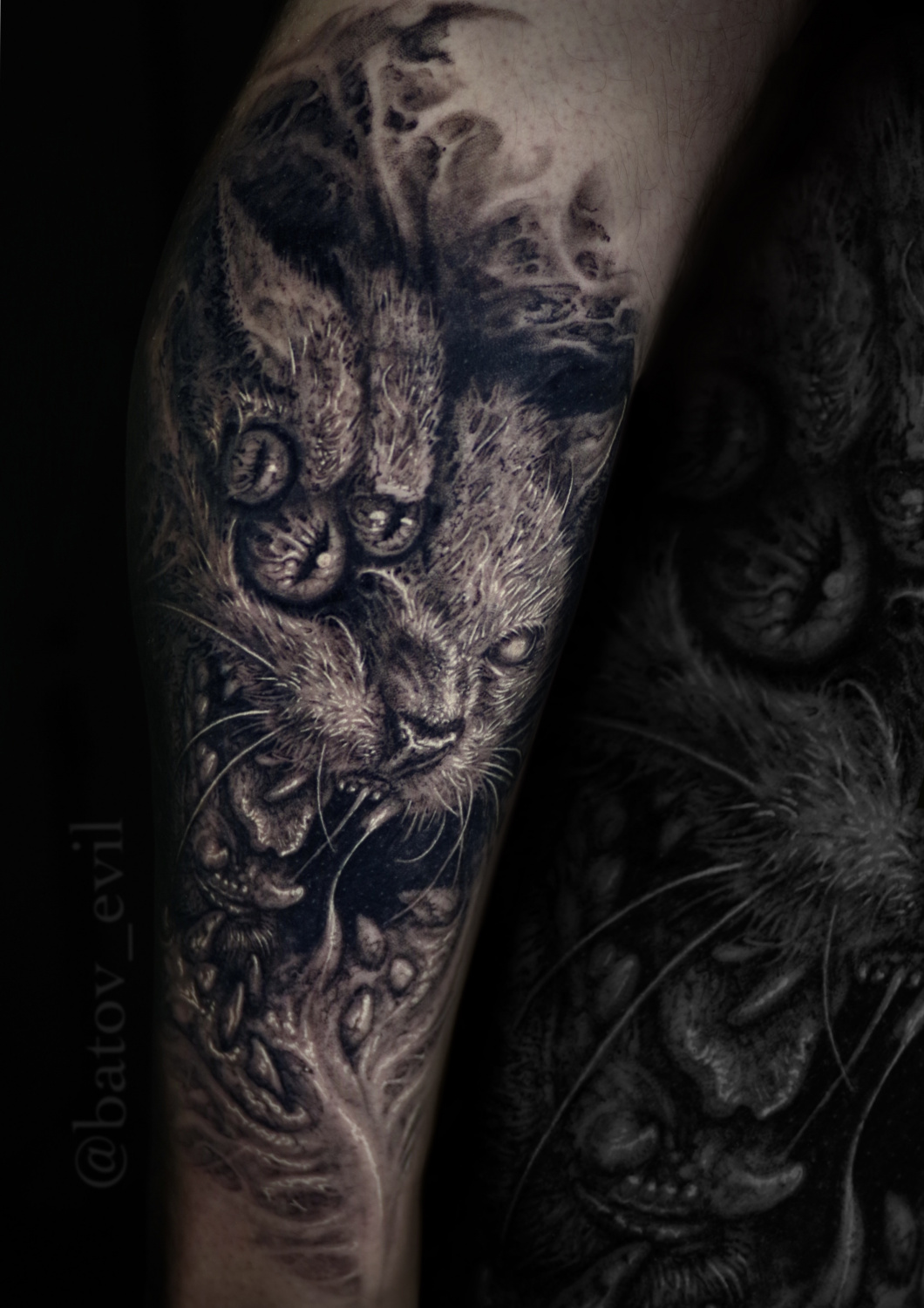
Snarling cat tattoo in dark black and grey by @Batovtattoo

Realistic snarling cat tattoo with fiery elements by @vishar

Black and grey cat tattoo with floral elements by @Veresktt

Black and grey cat tattoo with large eyes amid flowers by @jole

Realistic cat tattoo with blue eyes and flowers by @tattoosigal

Realistic cat face tattoo with florals by @mazalovatattoo
Egyptian tradition: Bastet and the cat that was mourned
Bastet began as a lioness. In the Old Kingdom she was a war goddess and a protector of the king, close kin to Sekhmet. Over the centuries her image softened into a domestic cat, and by the first millennium BC she had become the goddess of the home, of women in childbirth and of the household itself. Her city was Bubastis in the eastern Nile delta, and her festival there was, according to Herodotus, the largest in Egypt, with more wine drunk in those days than in the rest of the year.
The bronze cats in museums are votive offerings to her. The best known, the Gayer-Anderson cat in the British Museum, wears gold earrings, a gold nose ring and a silver pectoral, and it is the model for countless upright cat silhouettes tattooed today. Cats were mummified by the hundred thousand and buried at Bubastis and at Beni Hasan, where a cemetery uncovered in 1888 held so many that the mummies were shipped to England and sold as fertiliser.
Two details show how seriously the animal was taken. Herodotus records that when a household cat died a natural death, everyone in the house shaved their eyebrows in mourning. And Diodorus Siculus describes a Roman in Alexandria, around 60 BC, who killed a cat by accident and was lynched by the crowd. An Egyptian cat tattoo carries that weight: protection, the sanctity of the home, and an animal whose death was an occasion for public grief.
Japanese tradition: maneki-neko and bakeneko
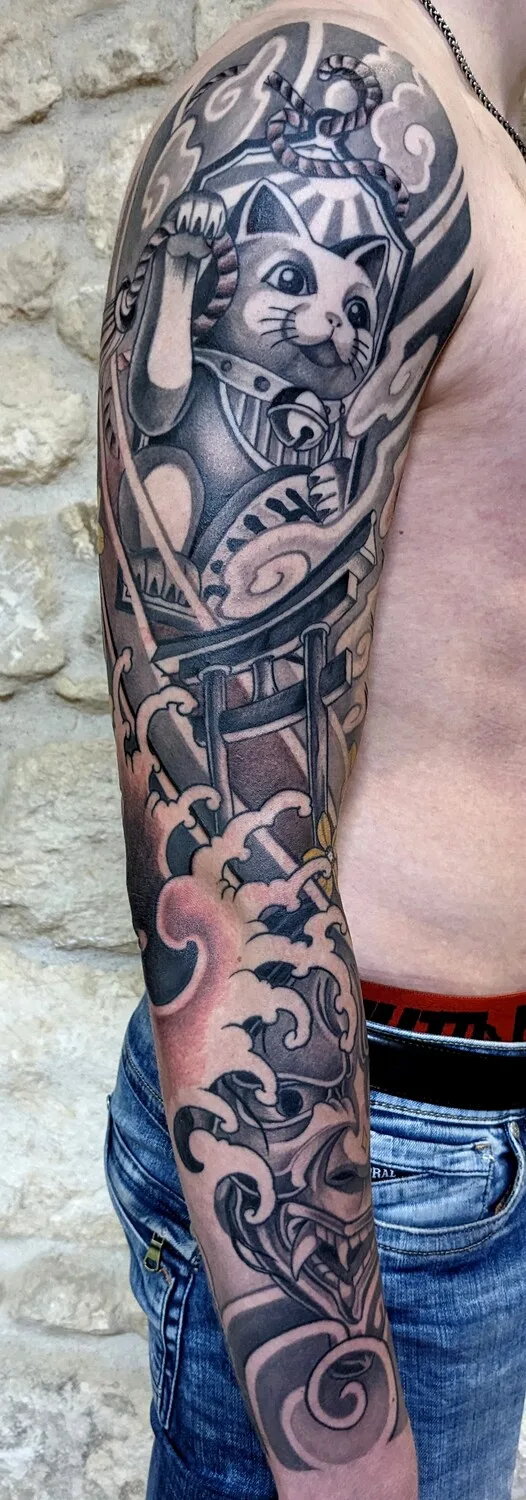
Japan holds two cats that face in opposite directions, and both are tattooed.
The maneki-neko is the beckoning cat in every shop window. The most repeated origin story belongs to Gōtoku-ji temple in Setagaya, Tokyo. A feudal lord, usually named as Ii Naotaka of Hikone, was passing the temple during a storm when the priest's cat raised a paw and seemed to call him in. He followed it, and lightning struck the spot where he had been standing. He became the temple's patron, and today its grounds are packed with thousands of white cat figures. For a tattoo: the left paw raised is said to draw people and custom, the right to draw money; a white cat is good fortune, a gold one is wealth, a black one turns away illness and evil, and the calico is the luckiest of all. A maneki-neko tattoo says that luck is something you invite in, not something that happens to you.
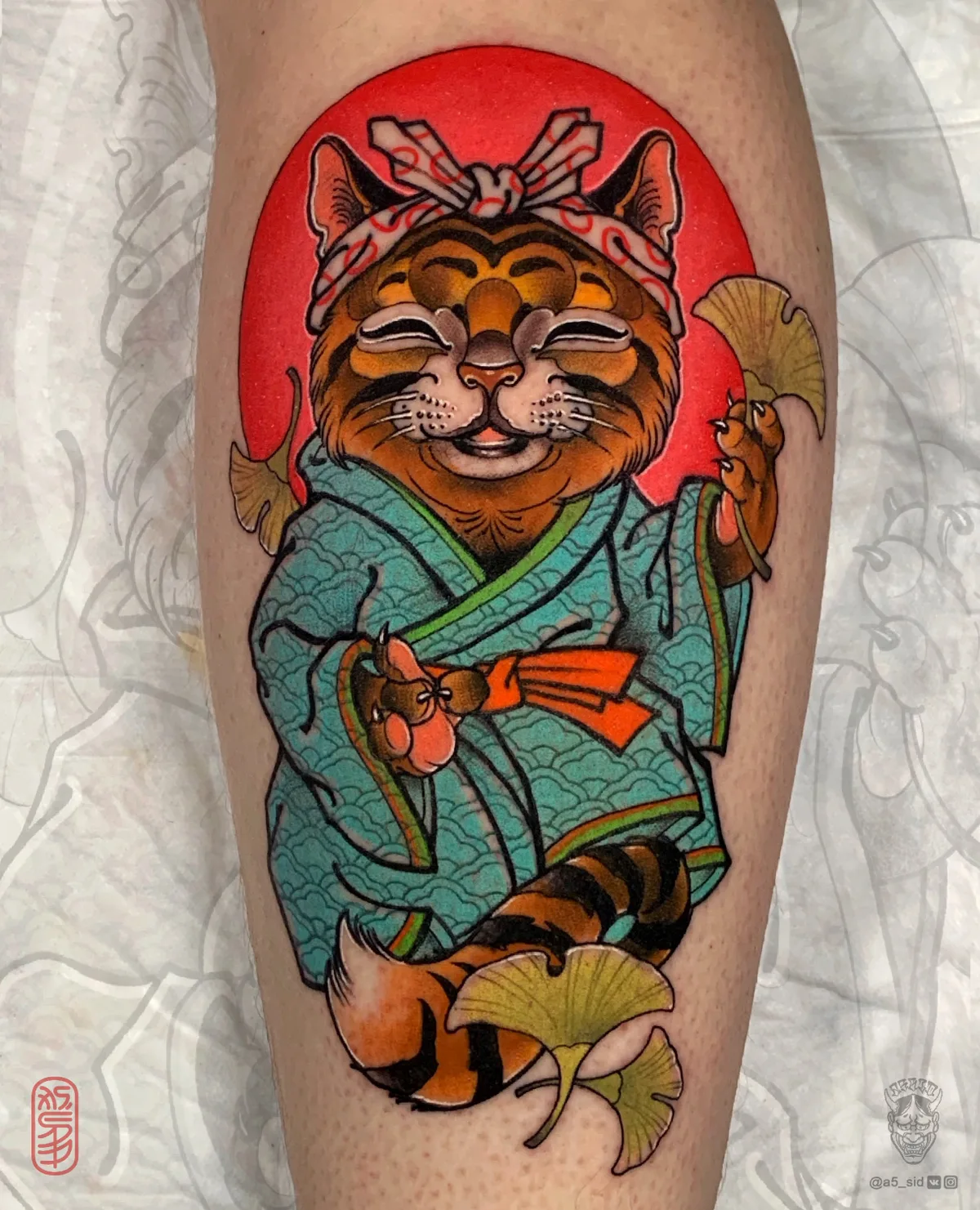
The bakeneko is the cat that does not beckon. In Edo-period belief a cat that lived too long or grew too large could change: it would walk on its hind legs, speak, lick the fish oil from lamps, and take the shape of the person it had replaced. The nekomata went a step further, its tail splitting in two, and folklore holds that fear of it is why short tails were once preferred in Japanese cats. The most famous story is the cat disturbance of the Nabeshima clan in Saga, in which a bakeneko avenges its dead owner's family by taking the form of the lord's concubine and tormenting him night after night. A bakeneko tattoo reads as the cat that remembers.
Norse mythology: Freyja's cats
Snorri Sturluson's Prose Edda gives it in one line: when Freyja travels, she drives a chariot drawn by two cats. No horses, no wolves, no boar like her brother Freyr. Cats.
Freyja is the goddess of love and desire, and the mistress of seiðr, the magic of seeing and shaping fate, which she taught to Odin himself. She is also a goddess of war. Half of those who die in battle go to her hall, Fólkvangr, and only the other half to Odin's Valhalla. Love and death, desire and killing, and the animals that pull her are the ones that cannot be commanded. The Eddas never name them; the names you will find online (Bygul and Trjegul) are a modern invention, not from any Norse source, so leave them off the design.
There is a second Norse cat worth knowing. When Thor visits the hall of the giant Útgarða-Loki, he is challenged to lift a grey cat off the floor and manages to raise only one paw. The cat is later revealed to be the Midgard Serpent in disguise, so large it encircles the world. A cat the strongest of the gods cannot lift is a joke with an edge, and an unusual Norse tattoo without the runes-and-knotwork cliché. A Freyja cat piece reads as love that carries weapons: beauty with a will of its own, and a companion animal chosen precisely because it does not obey.
Medieval Europe: the black cat and the trials
Here the animal that Egypt mourned becomes evidence.
The turn can be dated. In 1233 Pope Gregory IX issued the bull Vox in Rama, describing the rites of a heretical sect in the Rhineland. In the pope's account the initiates kiss a black cat, and the devil appears among them as a figure half man and half cat. It is one of the earliest texts in which the Church put the black cat and the devil together. Two and a half centuries later the Malleus Maleficarum, the witch-hunters' manual of 1486, repeated the claim that witches could take the form of cats, and by the sixteenth century the animal had a legal role.
The English trials show how it worked. At Chelmsford in 1566, Elizabeth Francis confessed that her grandmother had given her a white spotted cat called Sathan, which she fed with bread, milk and drops of her own blood. The cat was the familiar: the physical link between the accused and the devil, and its presence in a house was treated as proof. In the Flemish city of Ypres the Kattenstoet festival grew out of the practice of throwing live cats from the belfry of the Cloth Hall, a custom that lasted until 1817; it is now a parade with plush cats.
This is the inversion that gives the black cat its charge. The same animal was a household guardian in Egypt and a corpse on the cobbles in Ypres. A black cat tattoo carries both halves whether the wearer intends it or not, and the best designs choose a side deliberately: reclaim it, or lean into the witch's companion and own the accusation.
Tattoo styles that suit the cat
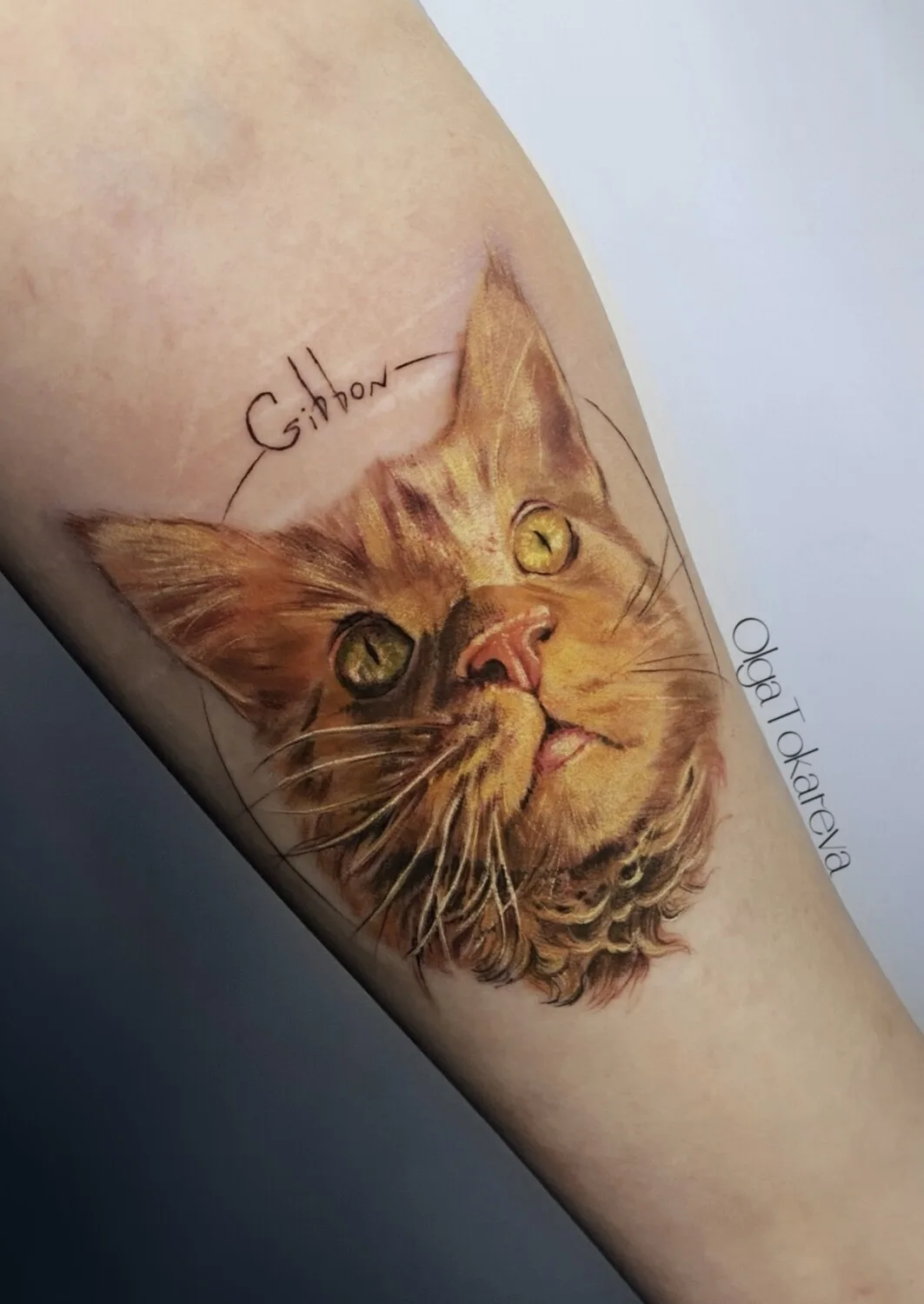
Realism. Almost always a portrait of a specific cat, and often a memorial. The technical problem is the same as with any fur animal: direction before shading, and eyes that carry the piece. Cat eyes are the hardest part, because the vertical pupil and the reflective quality have to be suggested rather than drawn, and a pupil placed a millimetre off turns a beloved animal into a stranger. Black-and-grey realism ages more predictably than colour here.
Egyptian. The upright seated silhouette from the bronzes, in black with gold accents, sometimes with a wedjat eye or an ankh. The style is formal and symmetrical by nature, which is why it sits so well on the sternum, the spine or the centre of the back, and why it survives decades: the shape is the piece, and the shape does not blur.
Japanese. The natural home for maneki-neko and bakeneko. Japanese composition puts the cat inside a scene, with waves, peonies, coins or a lantern, and treats the outline as the structure that holds the colour, which is why it carries a large area and ages well. A bakeneko with a split tail and a lamp means something specific to anyone who knows the story and looks striking to anyone who does not.
Traditional and neo-traditional. Bold outlines, flat saturated colour, the cat as an icon rather than an individual. American traditional has its own cat tradition in the crawling black panther, and a domestic cat drawn with the same rules borrows its longevity. Neo-traditional widens the palette and adds botanical framing, which is where most of the current thigh pieces live.
Blackwork and ornamental. Solid black cats, or cat faces built out of filigree, dotwork and mandala geometry. Stripping the fur out and replacing it with pattern solves the ageing problem before it starts, and it suits the threshold reading: a cat made of ornament looks like something between an animal and a symbol.
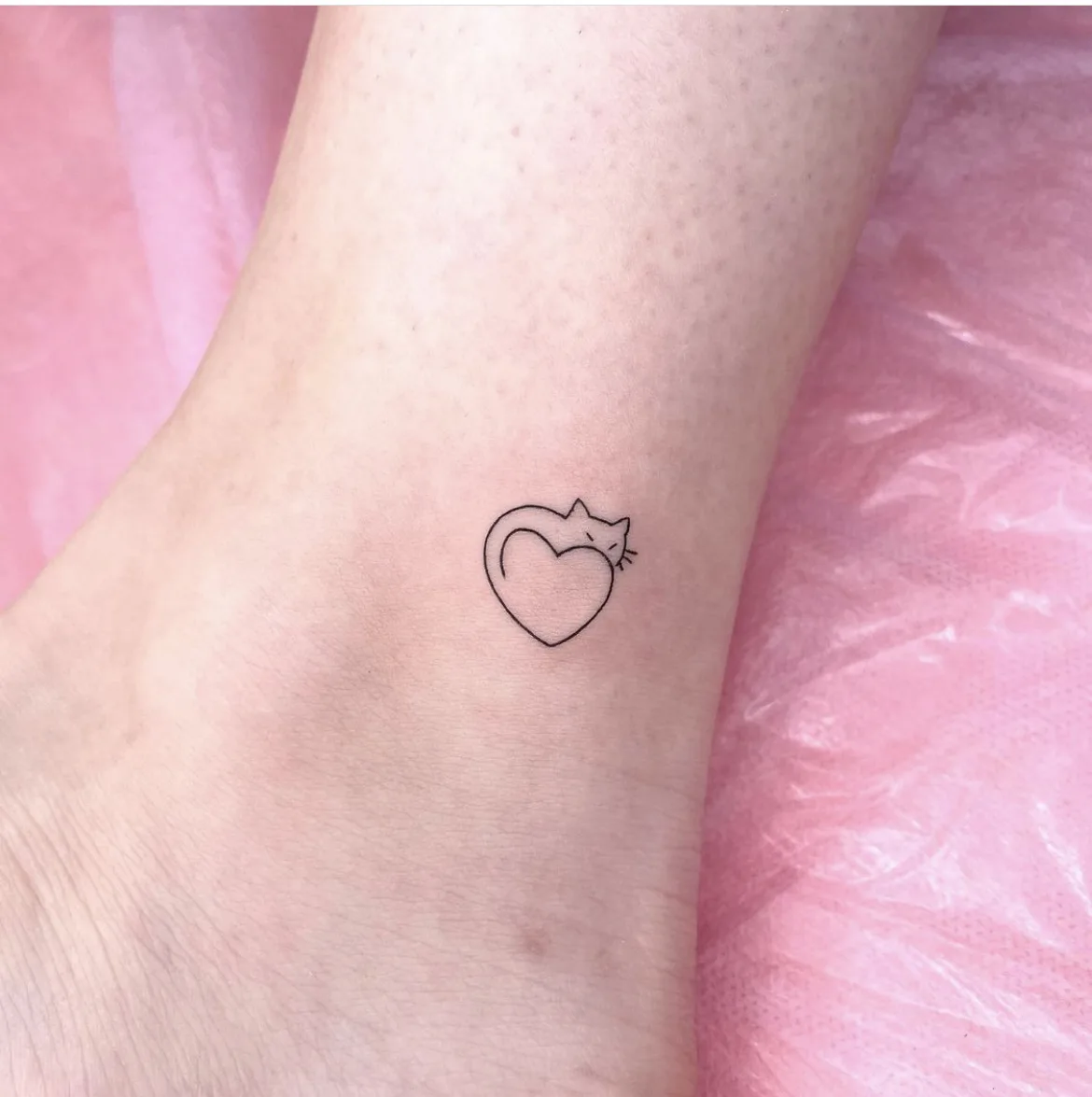
Minimalist and fine line. A single continuous line, two triangles for ears and a curve for the tail. The risk is only that very thin lines soften over years; keep the design simple enough that softening does not matter. To see how these styles actually read on skin, side by side and across dozens of artists, the cat motif page collects the work by style and placement.

Blackwork cat tattoo with Cyrillic text by @velaster_tattoo

Linework cat tattoo in blue and green by @e.hyang.tattoo

Cat peeking from a box tattoo by @ilya_brezinski

Cat tattoo with handwritten phrase by @bowsertattoos

Flash sheet tattoo with cats and classic motifs by @ytarapatainboxru
Placement and scale
Cats are unusually flexible to place because the animal itself comes in so many shapes: curled, stretched, seated, mid-leap, or simply a face. The placement should follow the pose rather than the other way round.
The forearm is the default for a portrait and for the Egyptian silhouette. It offers usable canvas, moderate pain, and the choice of showing or covering it, and an upright seated cat runs naturally along the length of the arm. A memorial portrait on the inner forearm is close to standard now.
The thigh has become the place for large illustrative and neo-traditional cats: enough room for a full maneki-neko with its coins and cushion, or a cat among flowers, with complete control over who sees it. The ribs and the side suit a stretching cat or a cat face built into ornament, because the design can follow the curve of the body and the placement rewards a piece meant to be seen rarely and deliberately. The shoulder blade takes a sleeping, curled cat as if it were made for it.
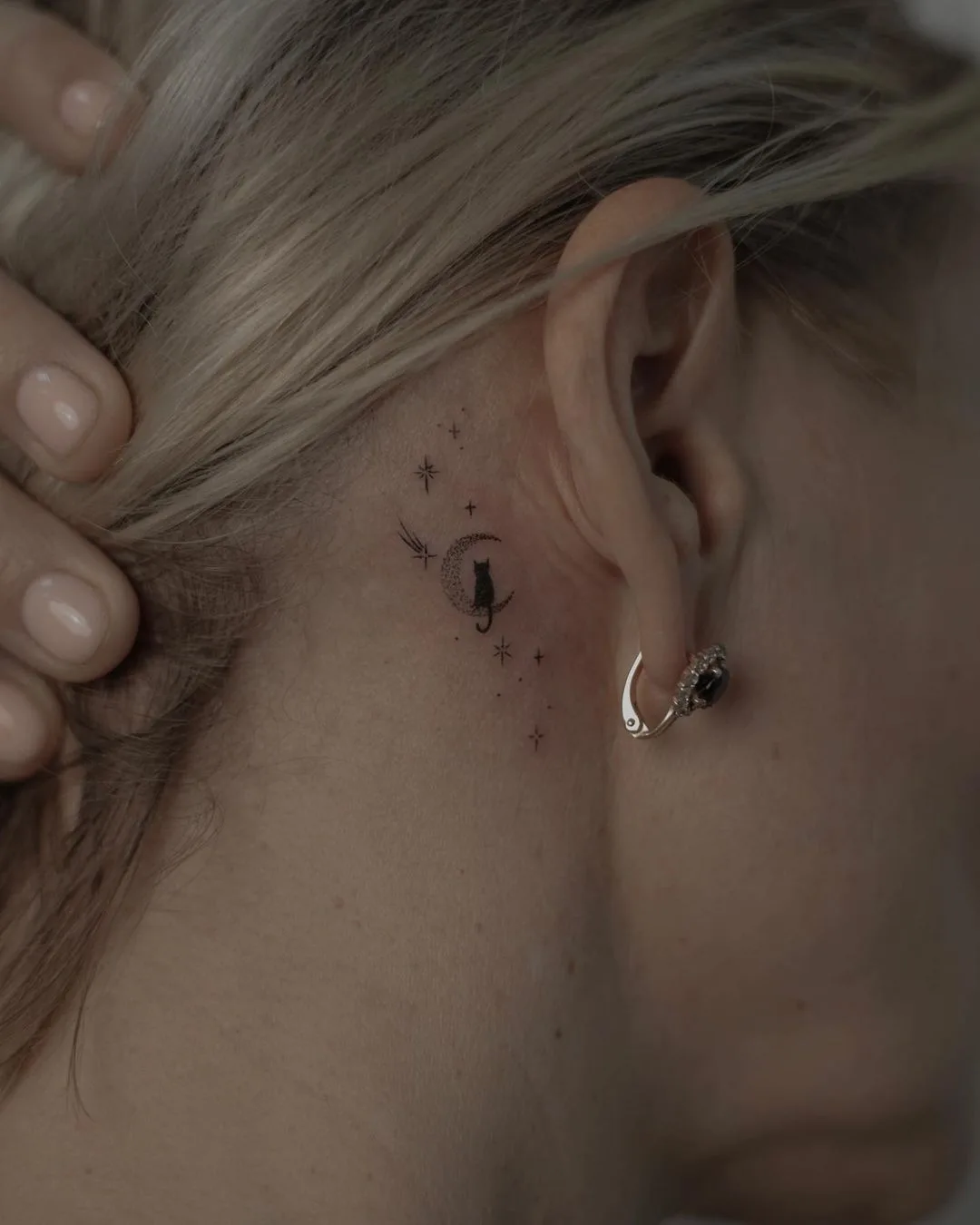
Small placements have their own logic. The ankle is the classic spot for a small sitting cat. Behind the ear and the inner finger take a tiny face, and the finger in particular suits the animal: hidden most of the time, shown when you choose. The catch is that these spots wear hard. Fingers lose ink faster than almost anywhere on the body, so keep anything there to a few clean lines and expect a touch-up.
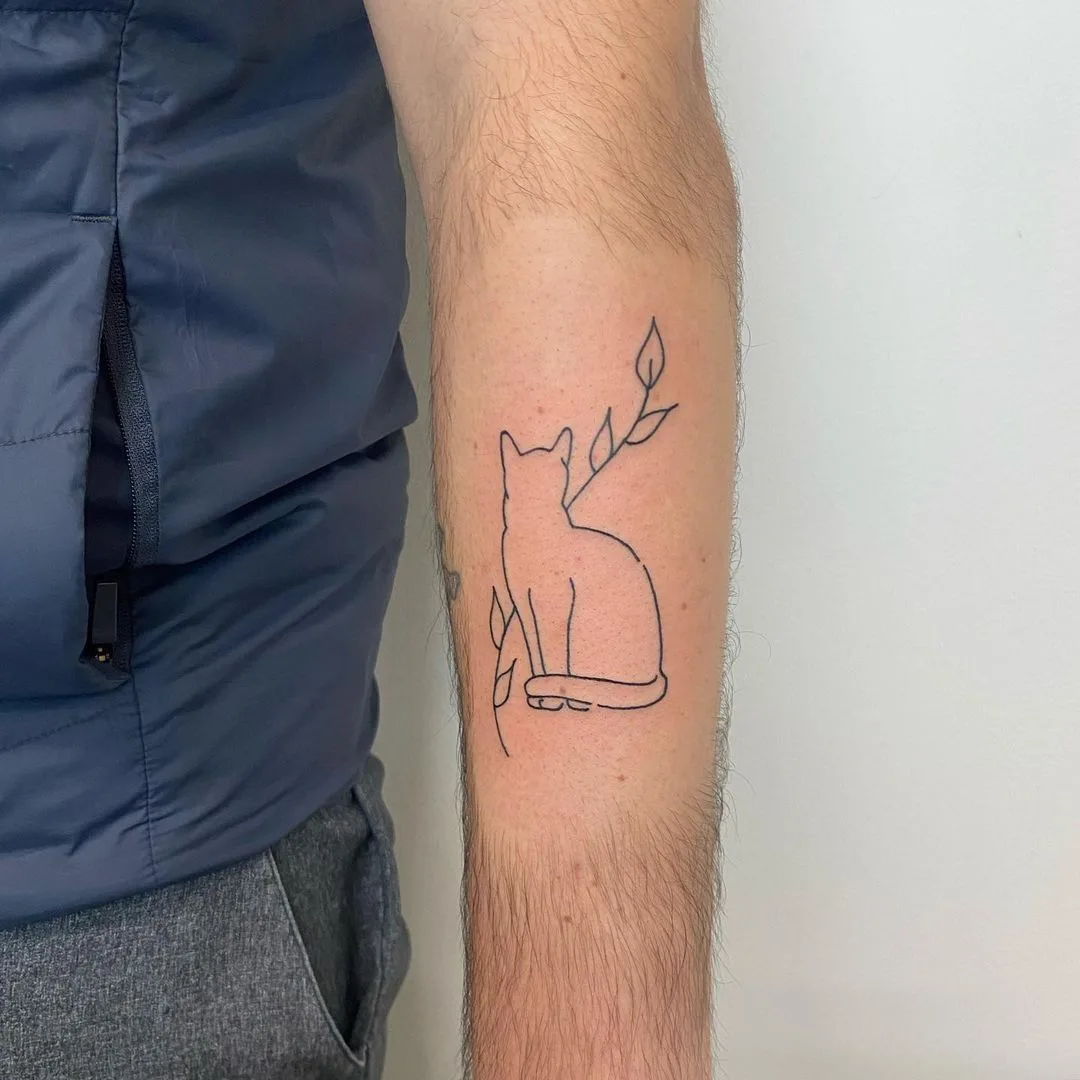
Scale is a separate decision from location. A realistic cat face under about eight centimetres cannot hold fur texture; there is not enough room for the contrast to survive healing, and it will close into a dark shape within a few years. Below that size the honest options are a silhouette, a linework cat, or a traditional design with heavy outlines. A full Egyptian or Japanese composition wants the upper arm at minimum, and a bakeneko scene with waves and a lantern is a thigh or a back piece.
Design variations and what they change
Small choices inside a cat design move the meaning further than switching styles does.
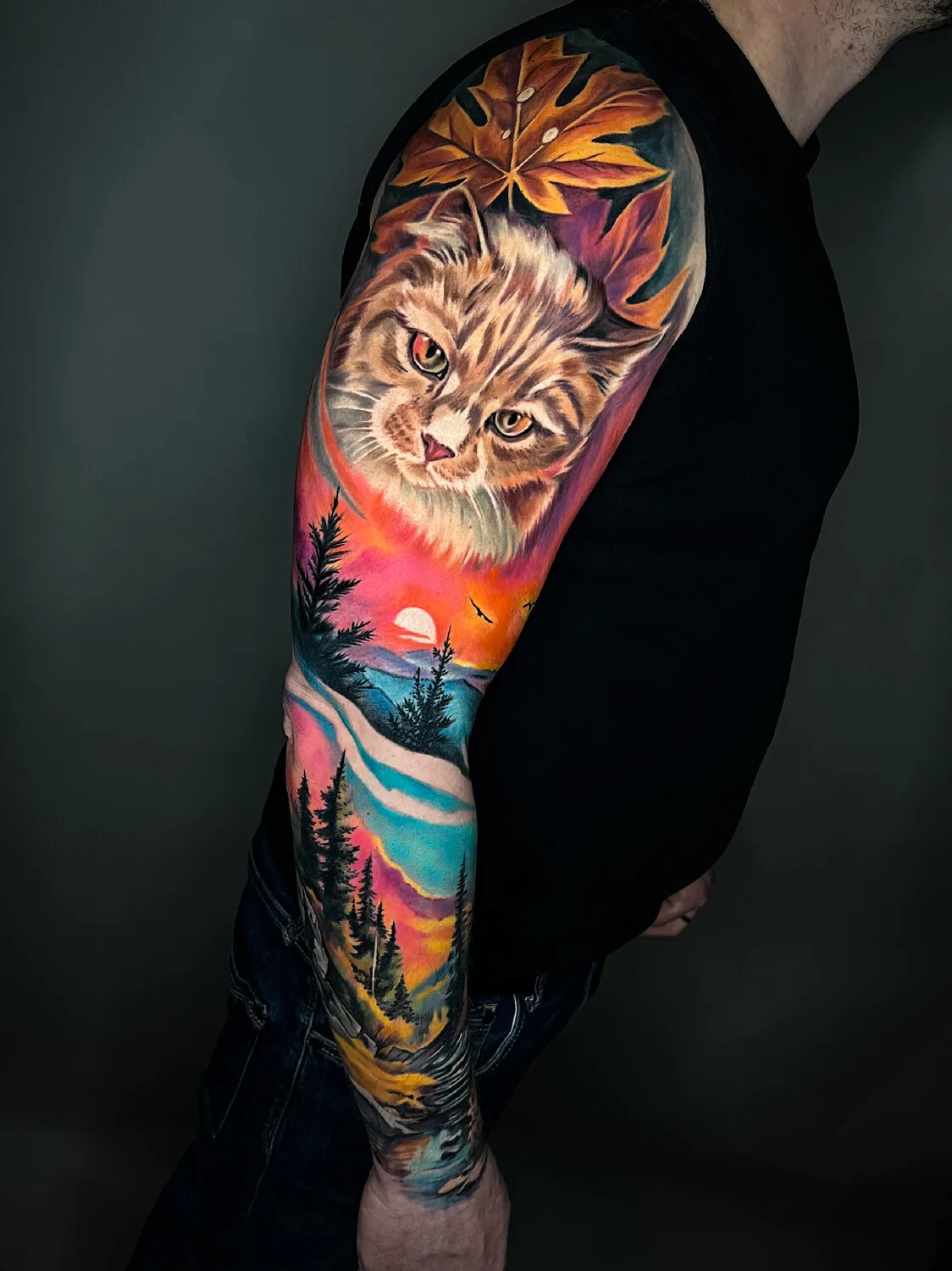
Colour of the cat. This is the biggest lever. A black cat drags in the whole medieval history above; it reads as witchcraft, luck or its opposite. A white cat reads as purity and, in the Japanese register, as good fortune. A calico is the luckiest maneki-neko. A ginger or tabby cat almost always means one specific animal, and the reading stops there.
Cat and moon. The most common pairing in the motif, and the one most likely to look generic. A crescent turns any cat into the threshold animal; a full moon pushes it toward the witch's companion. It works when the moon has a job in the composition, as a frame or a phase sequence, rather than sitting behind the head by default.
Eyes. Open eyes looking at the viewer are confrontation, and a cat's stare is expected. Half-closed eyes read as contentment and trust. A cat with its eyes closed, curled up, is nearly always a memorial. Glowing eyes, or a cat covered in eyes, push the design into the uncanny, and several artists in the dark traditional register have built whole pieces on exactly that.
Pose. Seated upright is the Egyptian guardian and the most formal pose available. A stretch is ease and self-possession. A cat walking away is independence in its purest form; a cat walking toward the viewer is an invitation. A cat with its back arched is a threat display, and reads that way unless that is the point.
Objects and companions. A raised paw makes it a maneki-neko whatever else is in the picture. A top hat or a suit turns the cat into a character with human manners. A cat with a skull or a raven is the witch's companion. Two cats are partnership or duality, and one black with one white is the yin-yang reading made literal.
Your own cat inside a mythology. The most personal variation and one of the most creative: your tabby in the Gayer-Anderson pose, your black cat as Freyja's chariot animal, your ginger cat as a maneki-neko with a raised paw. It works when the artist has clear photographs of the real animal and a clear reference for the tradition, and fails when either is vague.
Choosing an artist for a cat tattoo
The cat punishes generalists in a specific way: the face is small, the features are close together, and a portrait that is slightly wrong is wrong in a way the owner will see every day.
Three checks are worth doing before you book. First, ask for healed photographs of cats specifically; fresh work photographs beautifully and tells you nothing about how the contrast settles. Second, match the tradition to the artist. If you want a bakeneko, look for someone who works in Japanese composition; if you want the Egyptian silhouette, look for clean geometric black; if you want a memorial portrait, look for black-and-grey realism with animals in it. Third, bring the right reference: photographs of the real cat and a picture of the tradition, not screenshots of somebody else's tattoo.
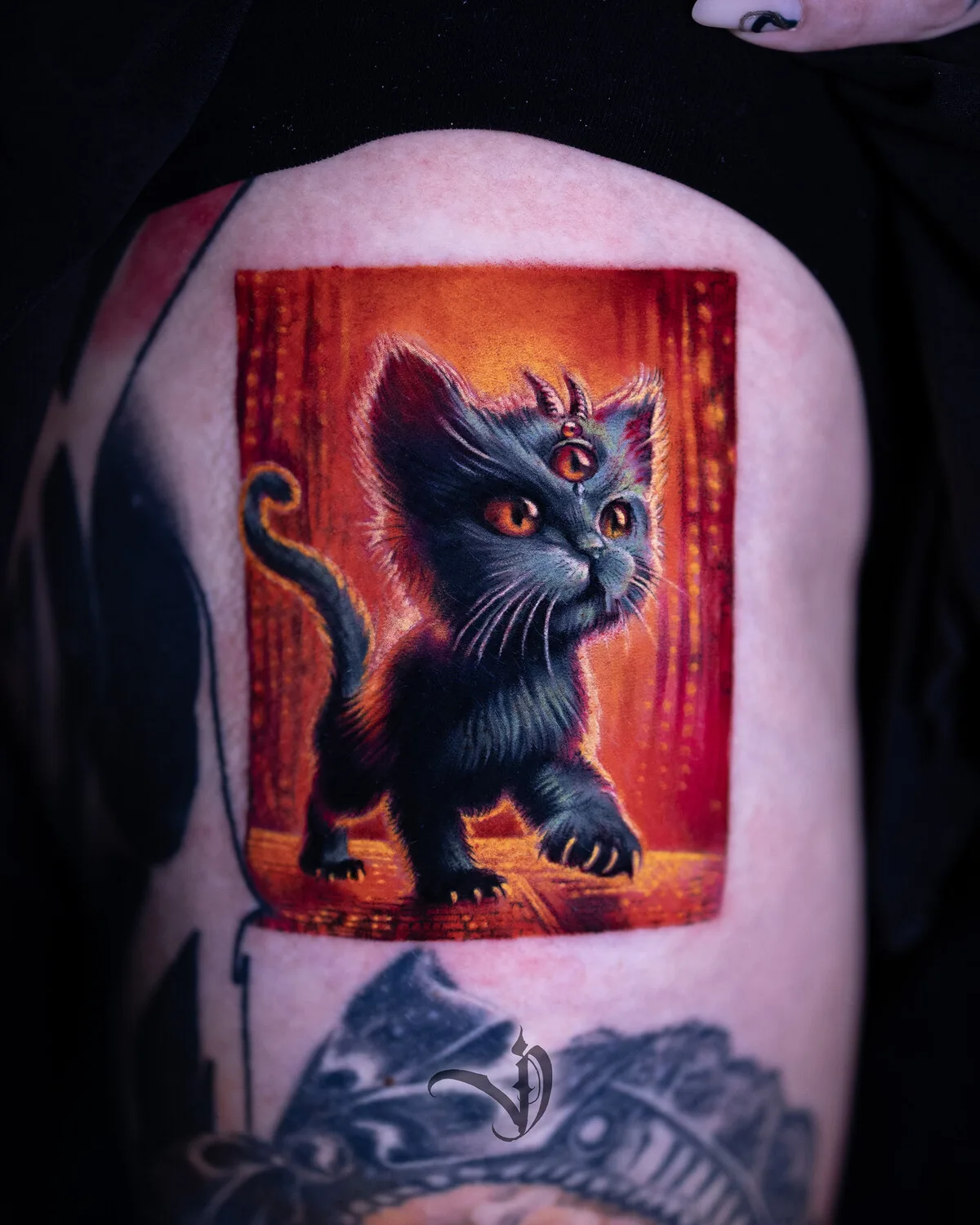
It also helps to look at how differently the same animal is handled. Zlata Kolomoyskaya works the cat as a soft black-and-grey portrait, a small seated kitten on the forearm where the fur is suggested with fine stipple and the eyes carry everything. Chris Bint goes the other way entirely: a cat face on the ribs built from filigree, dotwork and mandala geometry, so the animal reads as ornament with two eyes looking out of it. Mario Teide takes the black cat into dark traditional territory, a pile of cats covered in eyes under a crescent moon, bold outline and flat colour on the thigh.
Style, country and city all narrow the search, and you can filter by each in our tattoo artist directory. Whoever you choose, say plainly at the consultation which cat you mean: the guardian, the loner, the lucky one or the witch's companion. The answer changes the drawing, not just the decoration.
Aftercare and how a cat tattoo ages
Standard aftercare applies: keep it clean, keep it moisturised without smothering it, leave the scabs alone, and stay out of pools and direct sun until it has healed.
Beyond that, cats have one specific ageing risk, and it is the face. The features that make a cat recognisable as itself, the nose leather, the whisker spots, the exact shape of the eyes, are small and close together, and small close detail is what blurs first. A realistic portrait that depends on that detail will soften into a generic cat in five to ten years unless it was built on strong underlying contrast and a clear silhouette. The Egyptian, traditional and ornamental treatments dodge the problem, because the shape carries the piece and the shape does not move.

Black and grey cat face tattoo by @abdyushev_tattoo

Grey cat portrait tattoo by @Dislike

Cat portrait tattoo in black and grey by @niqo.tattoo

Fresh black and grey cat tattoo by @biyanova_tattoo_spb

Small realistic cat face tattoo by @biyanova_tattoo_spb
Colour ages differently from black and grey. A gold accent on an Egyptian cat, a red cushion under a maneki-neko or a yellow moon behind a black cat will fade before the black does, so a piece that relies on colour for its meaning wants that colour inside solid outlined shapes rather than washes. Sunscreen on an exposed forearm does more for a cat portrait's twenty-year life than any product sold for tattoos. Expect one touch-up in the first year for anything with fine linework or a finger placement.
Frequently asked questions
What does a black cat tattoo mean?
Both things at once. In ancient Egypt cats were sacred, and in Japan, Scotland and among sailors a black cat is protection and good luck; in the medieval Church and the witch trials it was the devil's animal and evidence against the accused. The tattoo carries that inversion whether you intend it or not, so decide which side you are wearing: reclaimed luck, or the witch's companion.
Is a cat tattoo bad luck?
Only if you rank a few centuries of European superstition above the rest of human history. The bad-luck reading applies to black cats in a narrow Western window, and even there much of Britain calls a black cat crossing your path good fortune.
What does a cat tattoo mean for a woman?
The association with femininity runs through Bastet, who protected women and the home, and through Freyja, whose chariot the cats pulled. The qualities the motif carries, independence, grace, and the capacity to be gentle and fierce at once, are not gendered by nature; men get cat tattoos for exactly the same reasons.
What does a maneki-neko tattoo mean?
Invited luck. The beckoning cat of Gōtoku-ji temple calls custom and money in; the raised paw decides which (left for people, right for money), and the colour refines it: white for general fortune, gold for wealth, black to turn away harm, calico for the luckiest of all.
What does a two-cat tattoo represent?
Partnership, duality or balance. One black and one white cat is the yin-yang reading made literal; two cats whose tails form a heart is as direct as romantic symbolism gets; two portraits side by side usually mean two real animals.
Should I get a realistic or a stylised cat tattoo?
If the tattoo is for one specific cat, realism, because you want that face and those markings. If the tattoo is for what cats mean, a stylised treatment (Egyptian, Japanese, traditional, ornamental) gives more freedom and ages better.