Botanical tattooing may look soft, natural, and effortless at first glance. But behind delicate lines, leaves, and flowers lies precise work with the shape of the body, the movement of the composition, and the individual features of each client.
In this author article, California-based fine line botanical tattoo artist Eva Ronnova shares why freehand has become the foundation of her approach to large-scale floral projects, how drawing directly on the skin helps move away from template-based solutions, and why botanical tattooing requires not only technique, but also a deep understanding of anatomy, form, and the living structure of plants.
My name is Eva Ronnova, and I am a fine line botanical tattoo artist based in California, with over five years of professional tattooing experience.
I specialize in large-scale floral compositions and freehand tattoo design, combining botanical forms with the anatomy of the human body. Over time, freehand has evolved from an occasional tool in my workflow into the foundation of my entire approach to tattooing.
In this article, I want to share how I discovered freehand design, why it became such an important part of my work, and how it allows me to create truly custom tattoos for every client.
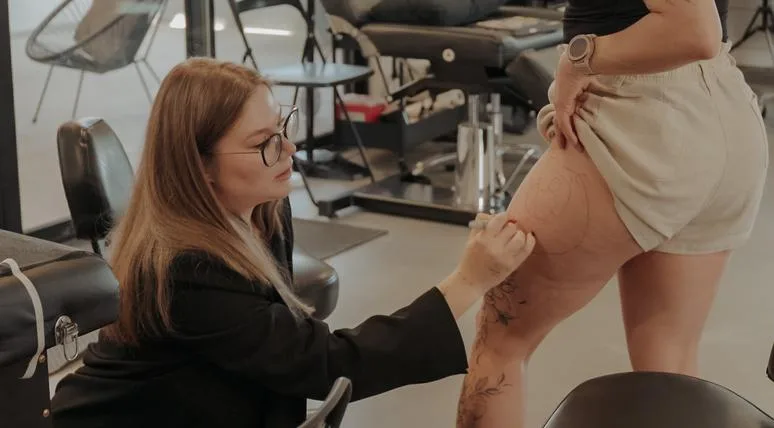
When people think about freehand tattooing, they often see it as a special skill or an advanced technique. For me, it is a natural result of drawing practice and a deep understanding of design principles.
I did not start using freehand because I wanted to stand out from other artists. My first attempts happened out of necessity.
During my first year of tattooing, I was working on a botanical bracelet design. As many tattoo artists know, wrap-around projects can be difficult because a design that looks balanced on a flat screen often behaves very differently once it is transferred onto a three-dimensional form. I spent a long time trying to adjust the stencil and make the composition flow naturally around the arm. Eventually, I became frustrated and decided to draw the leaves directly onto the skin.
The result immediately looked better than the stencil version.
At the time, I considered it a lucky accident. Looking back, I understand why it happened. By that point, I had already drawn leaves hundreds of times. I understood their structure, how they emerge from stems, how they overlap, and how they create movement within a composition. My hand was not inventing something new. It was applying knowledge that had already been built through years of drawing.


Several years later, another situation reinforced this realization. I had prepared a large floral project for a client who had traveled several hours to my studio. On the day of the appointment, my stencil printer stopped working. Faced with the choice of cancelling the session or trusting my own abilities, I decided to draw the composition directly onto the body.
The project involved large peonies, which at the time felt much more intimidating than a few leaves. However, once I started drawing, I noticed something interesting: the process was not more difficult than working with a stencil. In many ways, it was easier.


I had already drawn peonies hundreds of times — on paper, on my iPad, and in previous tattoo designs. The knowledge was already there. The freehand process simply allowed me to use it directly on the body.
What surprised me even more was the amount of time it saved.
Many artists spend a significant part of the appointment resizing stencils, printing multiple versions, repositioning them, making corrections, and repeating the process until the composition finally fits the body. Freehand allows me to design specifically for the individual person rather than adapting a pre-existing design to them. I can customize the composition and make adjustments immediately.
This is especially important in botanical tattooing.
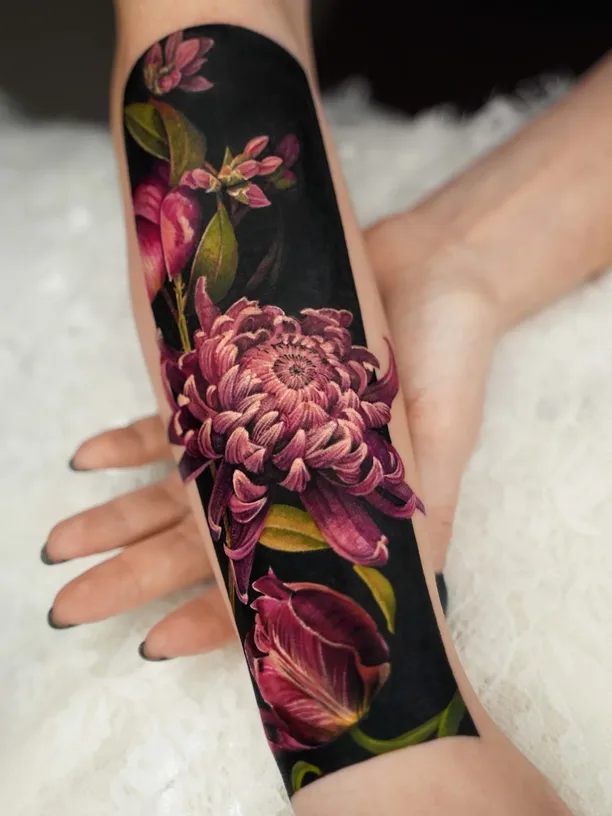
Flowers are organic structures. They have direction, movement, hierarchy, and growth patterns. The human body also has its own structure, rhythm, and natural flow. When a composition is created directly on the body, it becomes possible to bring these two systems together in a way that feels natural.
For me, the goal has never been simply to place flowers on the skin. The goal is to create a relationship between botanical anatomy and human anatomy.
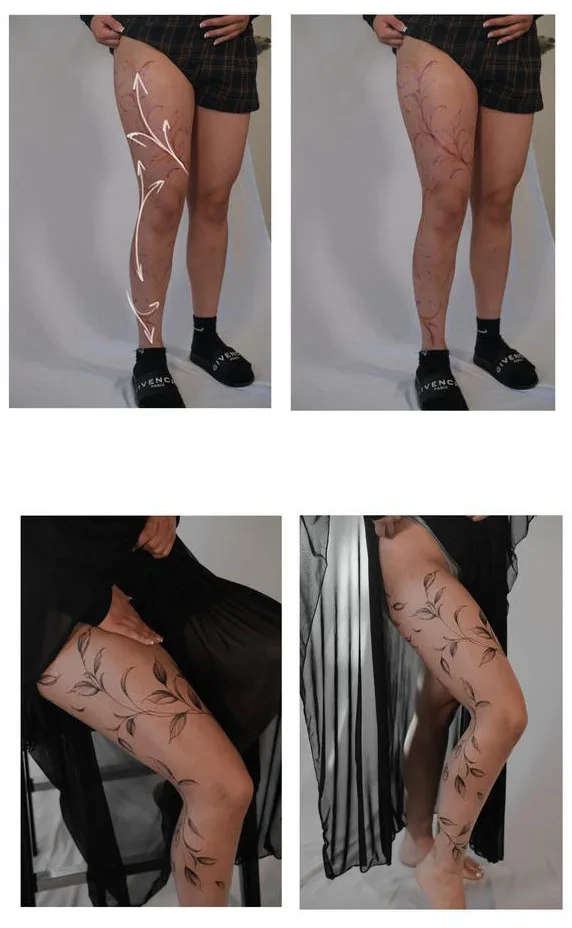
This is why I believe drawing skills are essential for freehand tattooing. Without an understanding of construction, proportion, perspective, and form, freehand becomes guesswork. The ability to draw directly on the body is not something that appears suddenly. It develops through continuous observation, study, and repetition.
Today, every large-scale project I create begins with freehand design. Not because I dislike technology or believe stencils are inherently wrong, but because freehand gives me the flexibility to respond to the individual client in front of me.
Every freehand project becomes a collaboration between the artist, the design, and the client. Because the drawing is created directly on the body, adjustments can be made in real time, allowing the client to take part in the creative process. For me, this is one of the greatest strengths of freehand tattooing: the final design exists only for that person and cannot be fully replicated on anyone else.
For that reason, I do not see freehand only as a technique. I see it as a design philosophy built on drawing, observation, and the understanding that no two bodies should receive exactly the same composition.