Pavel Gusarov started tattooing in 2010, assembled his first machine from a record player's motor, and immediately began working on his own arm. Since then, he has gone through neo-traditional, Japanese style, and ornamental, until in 2020 he settled on black graphics and Scythian aesthetics. He now works in St. Petersburg, Moscow, and Berlin.
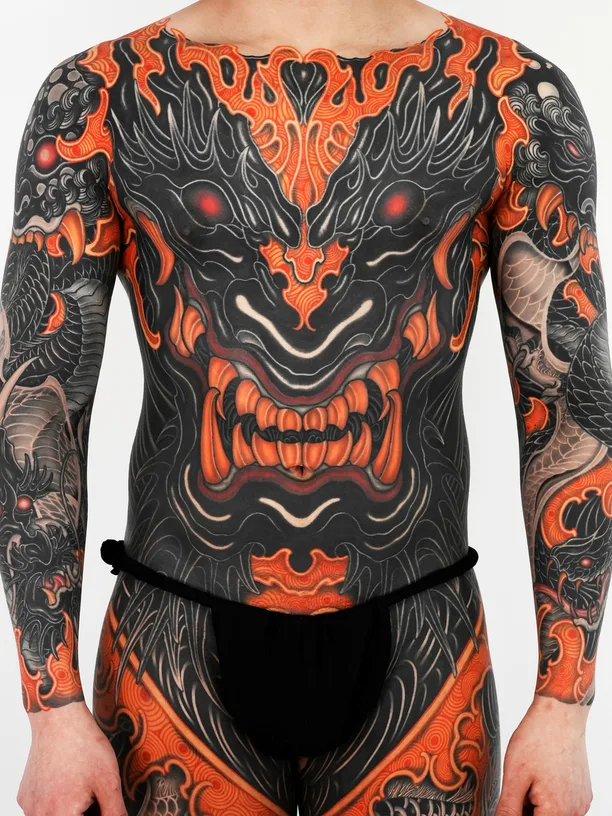
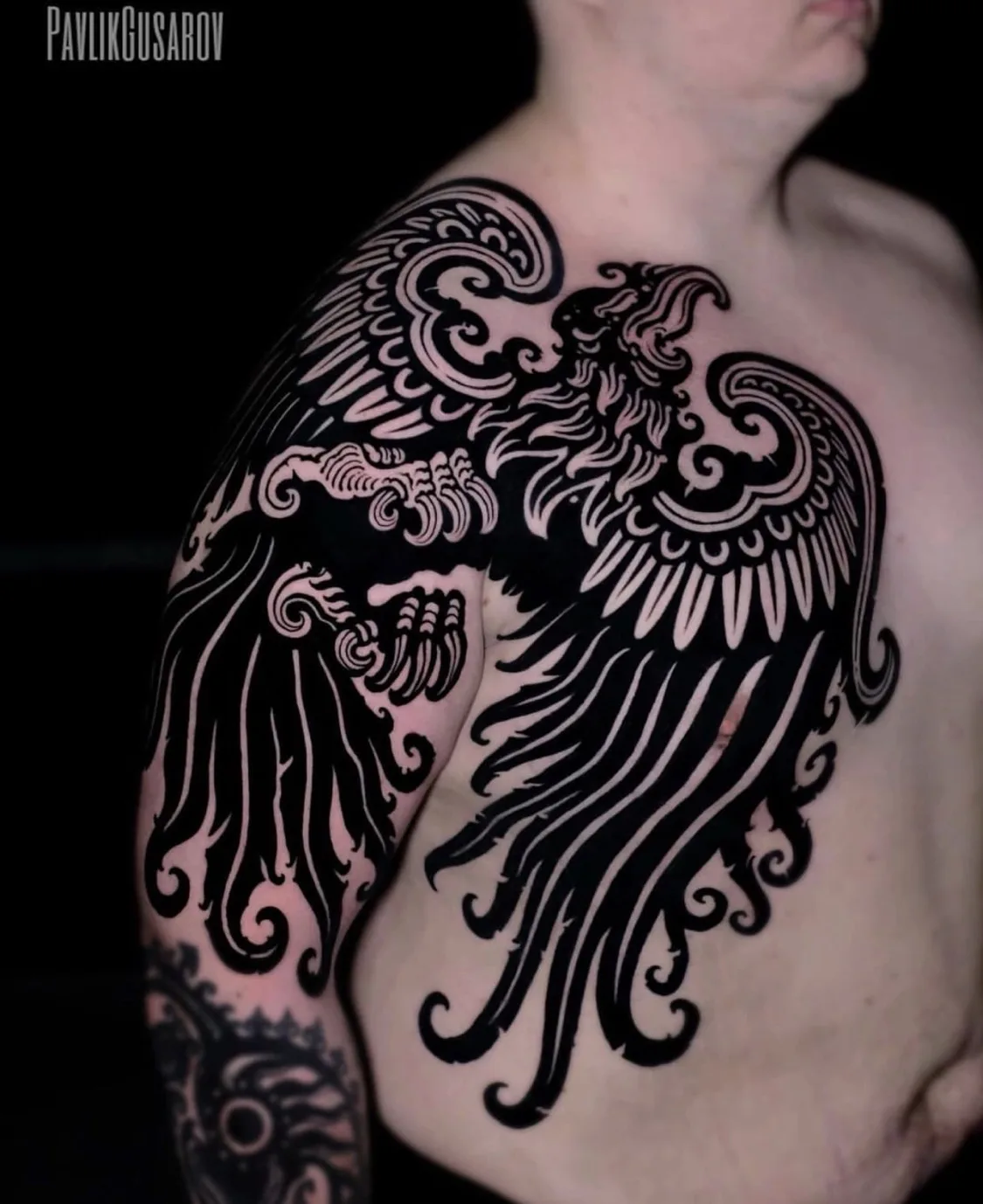
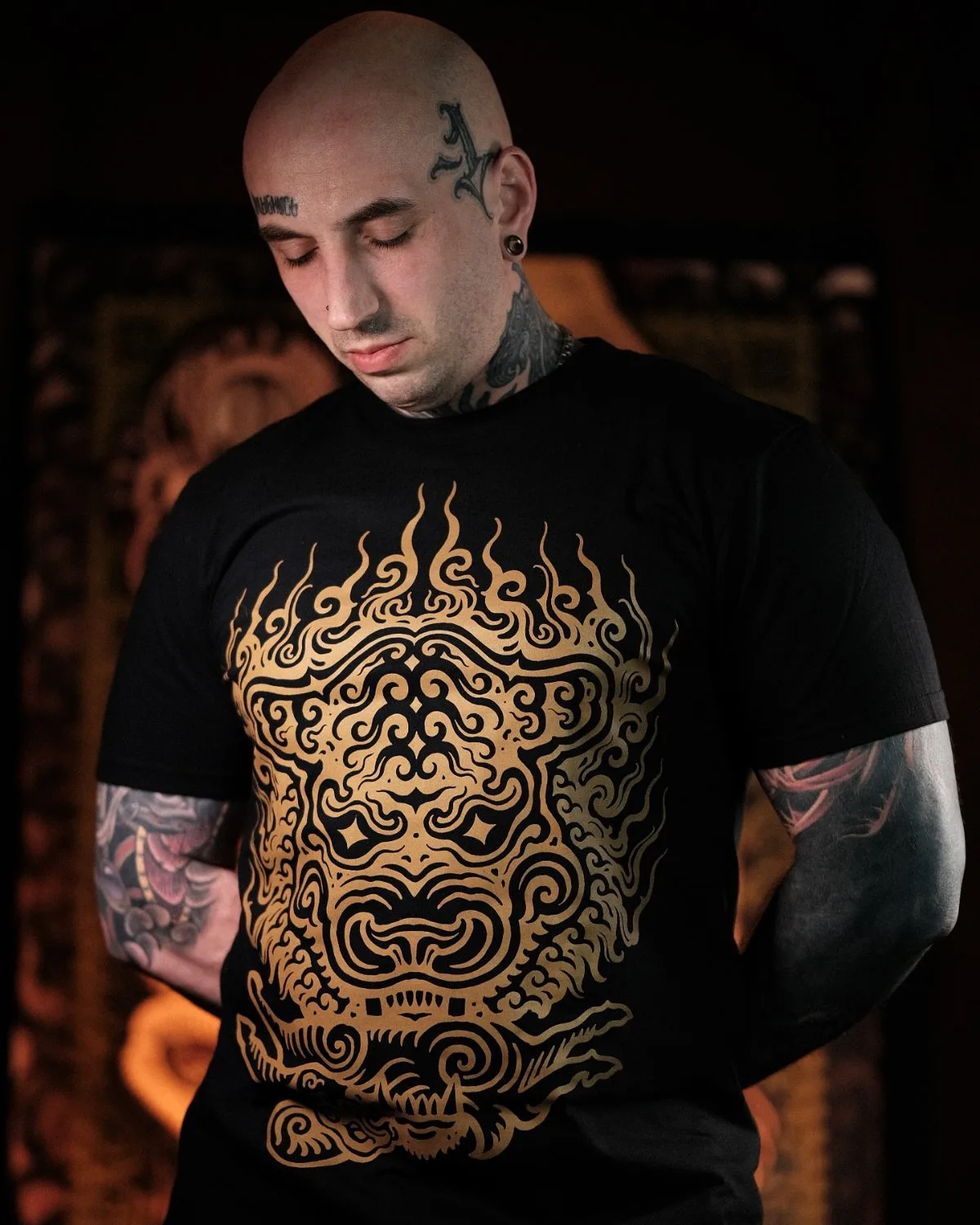
His works are recognizable at first glance: dense black, sharp contrast, animals, tigers, panthers, boars, frozen in the tense dynamics reminiscent of those seen on gold plates from burial mounds. Form is primary here. The body is not a canvas, but part of the composition.
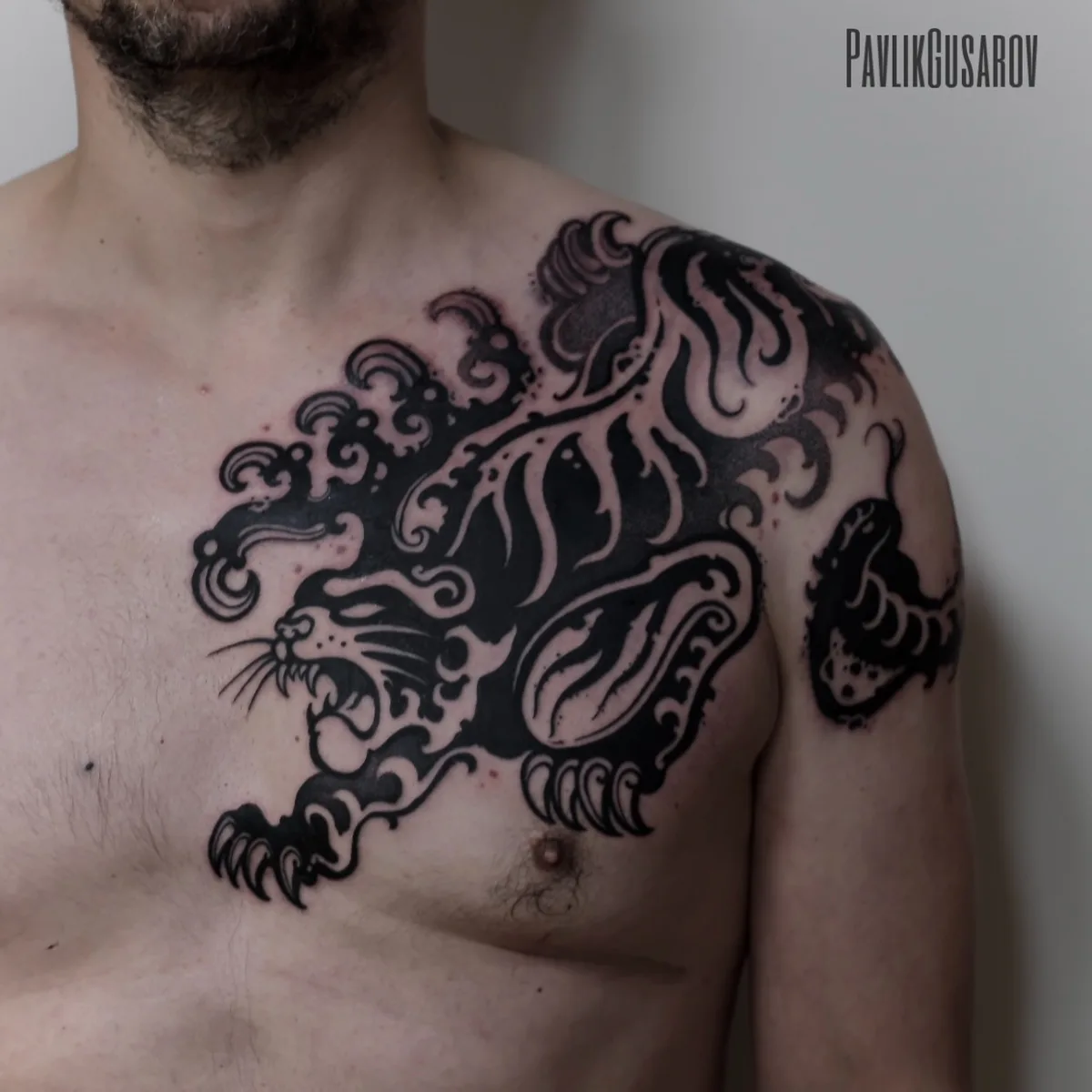
In this interview, Pavel talks about how his artistic language is structured, where the Scythian beast comes from in modern tattooing, how dialogue with the client is built, and why emptiness in a tattoo works on par with form.
Pavel, tell us, how did your journey in the tattoo industry begin in 2010?
I came to tattooing not out of fashion or romance. It was more of an instinct, a desire to leave a mark, to work with the body as a living carrier of meaning.
I knew nothing about tattoos and had no one to ask, so I assembled a machine myself from a record player's motor using an old self-study book and tattooed my left arm up to the elbow.
I learned the craft through practice, observation, and experimentation. Back then, tattooing was less of a "product" and more of a craft, and that immediately resonated with me.
You worked in neo-traditional, Japanese style, ornamental. What prompted you to abandon complex forms in favor of a concise and exclusively black style?
Excess. At some point, I realized that complexity for complexity's sake no longer interested me. Color, decorativeness, overload, all of it distracted from the essence.
“If the form works in black, without artificial support, then there is life in it.”
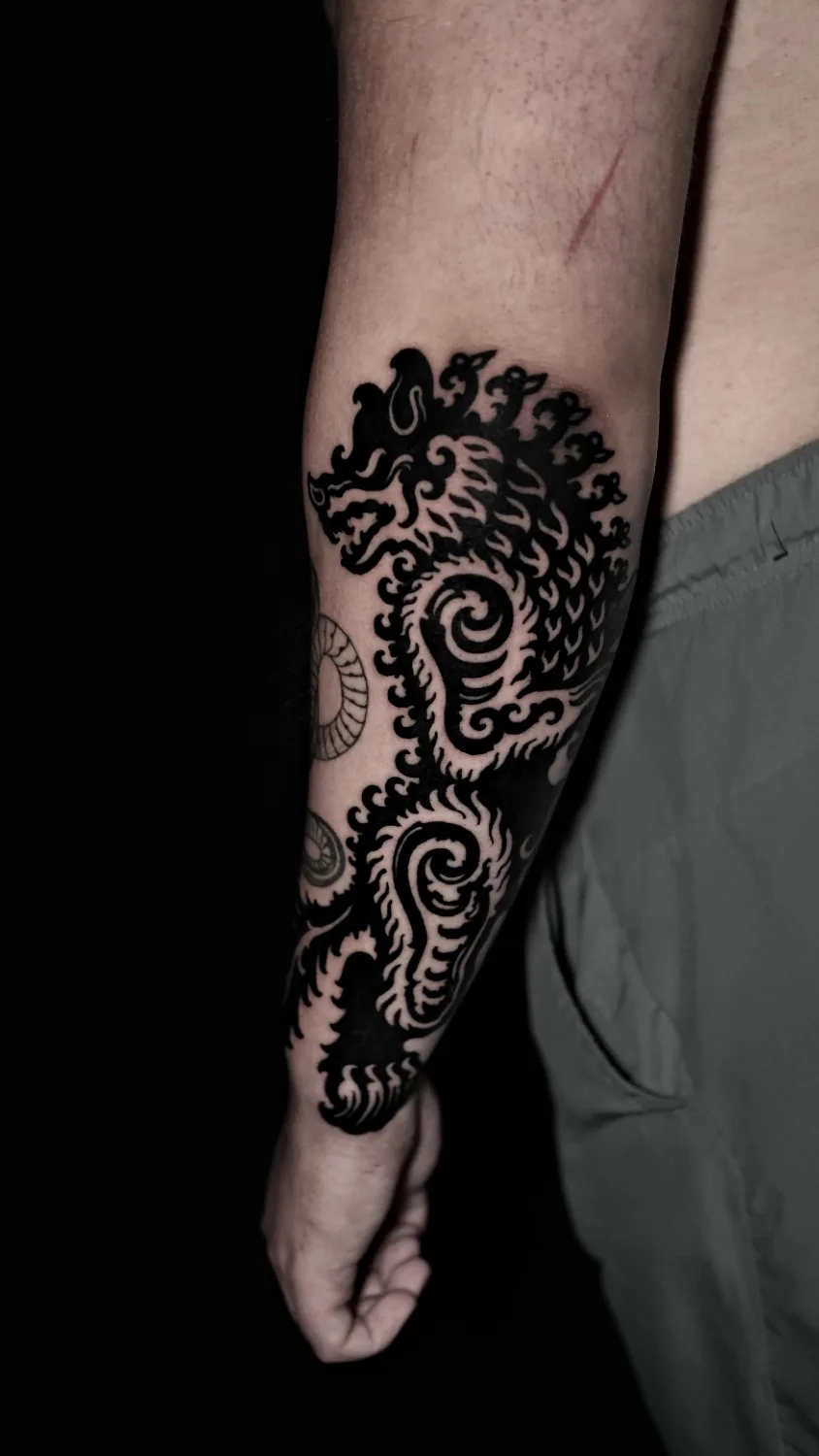
I wanted clarity. Black color and simplification of form, that's an honest conversation. If the form works in black, without artificial support, then there is life in it. It's both graphics and illustration.
Since 2020, you've been developing the "Scythian animal style." Why this particular style? What about it resonated with you, visually or philosophically?
Because it's not invented. It's born from the earth, from war, from death and faith. There's no attempt to please, only strength and rhythm.
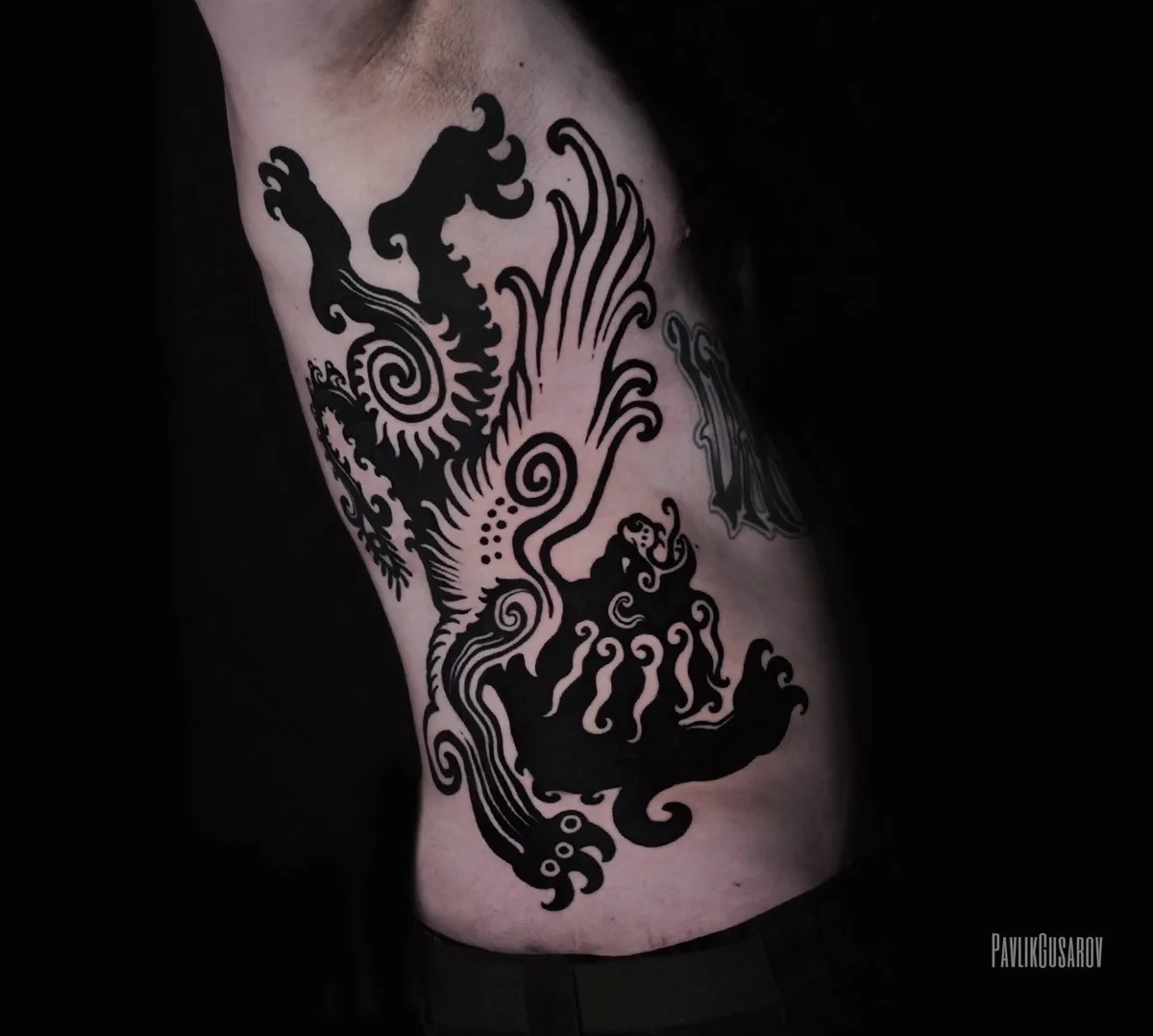
Visually, it's harsh, sharp, honest. Philosophically, it's about the cycle, about predator and prey, about balance. In 2020, I myself was undergoing an internal restructuring, and this language resonated with my state.
Tell us more about what "Scythian animal style" means to you. How deeply have you delved into it, is it only aesthetics, or is there also a cultural and historical layer?
I worked a lot with archaeology, the form of artifacts, texts, and the internal logic of stylized forms. But my task is not to reconstruct the past. I'm interested not in museum accuracy, but in the spirit of this language.
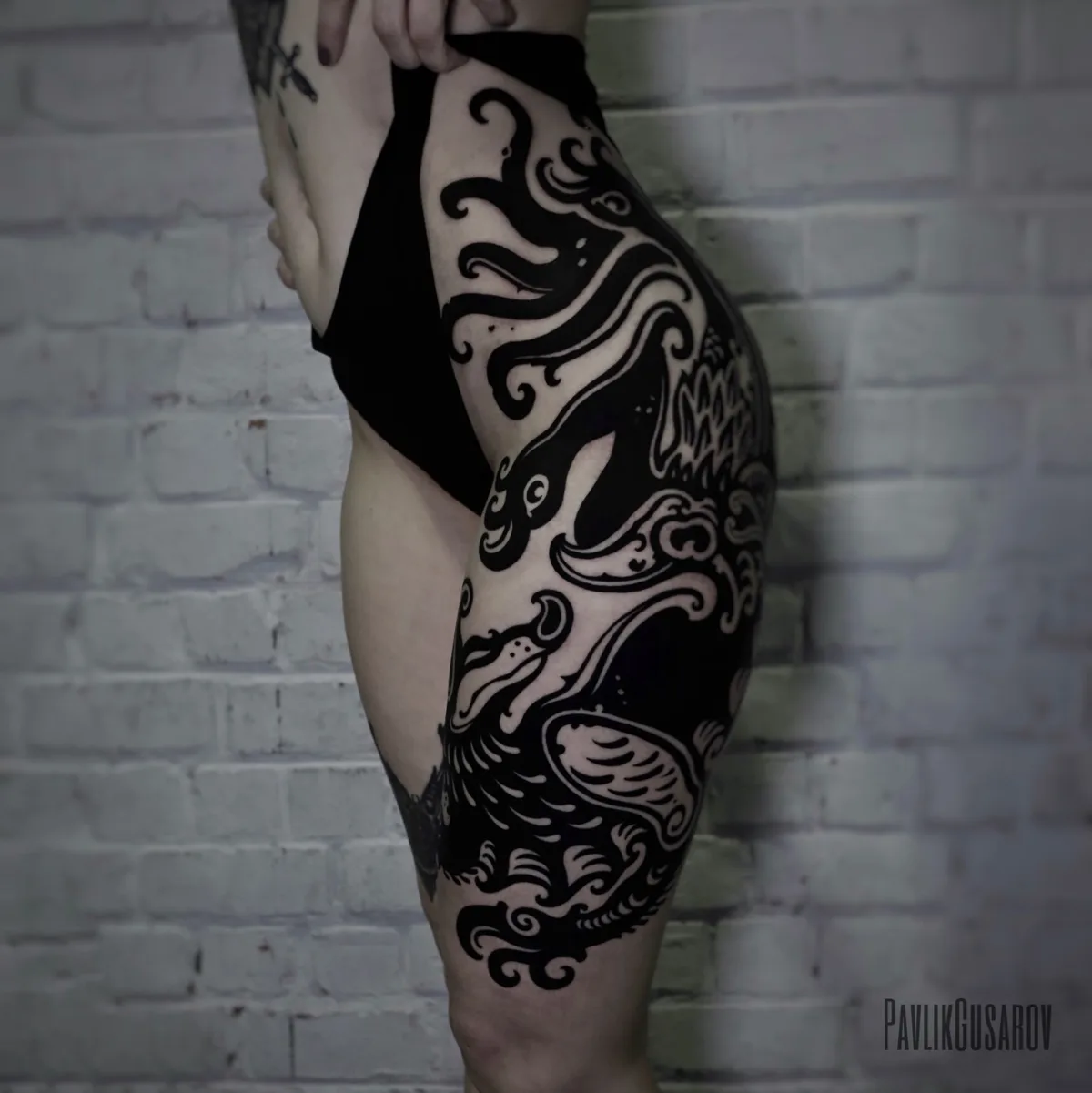
This is a dialogue with an ancient form, transferred to a modern body. Aesthetics here are just an entry point, behind which there is always meaning.
You have many animals in your portfolio: tigers, panthers, boars. Why have they become the basis of your language? What do you convey through them?
Because an animal is utterly honest. There is no moralizing in it, only essence and function. These are archetypes of strength, rage, survival, solitude. Through the image of an animal, I speak not about a person's appearance, but about their inner state. It's not about "beautiful" or "cute," it's about a personal totem.
You adapt Scythian aesthetics to modern mythologies, dragons, imaginary creatures. How do you find a balance between archetype and modernity?
I don't copy, I translate. The archetype remains, the form changes. Modern myths, dragons, imaginary creatures are the same ancient fears and forces, just in a new guise. Balance is found through respect for the source and the courage to be non-canonical.
You work with contrast and simplification of form. What techniques and materials help you achieve the desired quality and "depth"?
At the core of my work are clear lines, dense black, and well-built contrast. I deliberately choose simple, reliable tools and avoid visual tricks: for me, it's important that the tattoo holds up due to its form, not due to effects.
“Emptiness here works on par with form; it provides breathing room, intensifies tension, and allows the image to 'live' on the body, rather than just lie on it.”
The depth in my works is built not through gradients and illusory volume, but through rhythm, pauses, and a precise balance between masses of black and negative space. Emptiness here works on par with form; it provides breathing room, intensifies tension, and allows the image to "live" on the body, rather than just lie on it.
You once said that the tattoo's form is primary, and the body serves as its canvas. How do you compose designs so that they "live" with the client's anatomy?
I don't perceive the body as a flat canvas. It's alive and volumetric, with its own logic and character. When working, I consider how the form interacts with the body, how it integrates and comes alive.
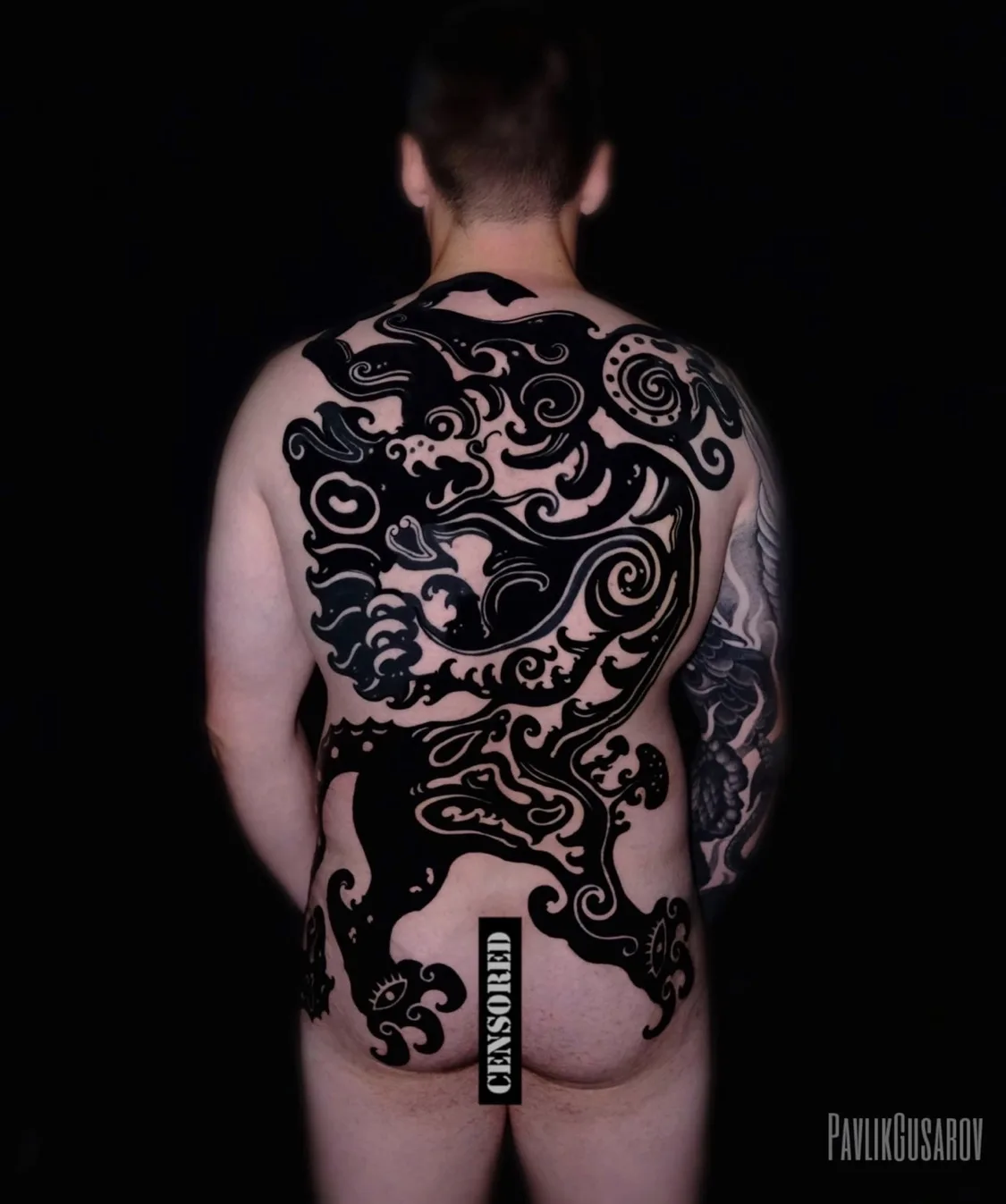
The composition should not lie on top of the skin; it should become a part of it. It's important for the tattoo to live with the person, to change its character over time, but not lose its power. A strong form matures with the body and becomes an extension of it.
Where do you draw inspiration for the placement and rhythm of your designs? Is it more archaeology, ethnography, or visual intuition?
Archaeology provides the structure and logic of forms, ethnography provides the cultural context, and intuition determines the final look. Without it, everything is dead.
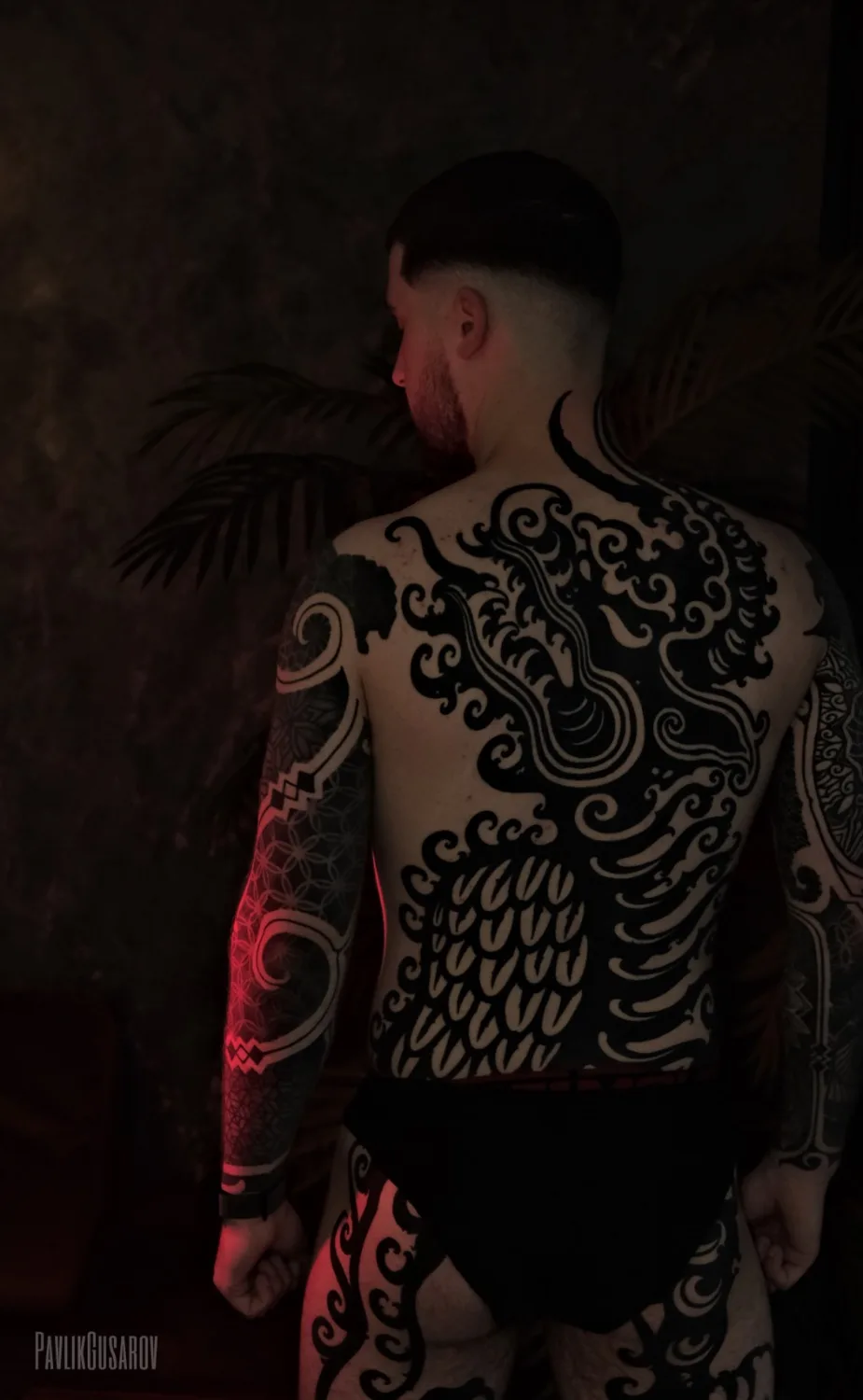
In addition, I study Tibetan iconography. I'm inspired by the characters, their dynamics, and details there. So, if you see some fiery swirl or an element from Tibetan mythology on my Scythian beast, it's not by chance; I draw ideas from there too.
How do you structure your process, from idea to final design? And how much do you take the client's wishes into account?
I always listen, but I don't always agree. The client comes with a request, and I come with my own language. If we find common ground, a strong work is born.
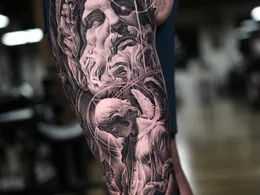
When the client's input is appropriate, it is always beneficial.
Sometimes it's necessary to adjust the request, explain the approach, find a common rhythm, and it is in this that a dialogue is born that makes the tattoo real.
How long does your average session last? And how many such sessions are needed, for example, for a forearm tattoo?
On average, my session lasts about six hours. During this time, I manage to do a fairly large amount of work, and the client doesn't get too tired.
The animal style is associated with pagan symbols and an ancient worldview. How do you explain the deep meaning of the images to clients?
I try to explain simply, without mystification or unnecessary mystery. I don't impose beliefs or dictate how a person should perceive a symbol. My task is to show what this image means, where it came from, and what meaning is embedded in it. The decision then rests with the individual: they choose how this symbol will resonate with them, what story or feeling they will associate with it.
Have there been cases where someone came simply "for something beautiful," and you offered an image with philosophical undertones, and it changed their attitude towards tattoos?
Yes, that happens regularly. Often people come without a clear understanding of what they truly want. They see a beautiful picture and think that's enough. But when an image truly resonates, you feel it immediately. At that moment, their attitude towards the tattoo changes: it stops being just a picture on the body and becomes a part of the person, their inner state and history. Many of my clients have written that they "grew into" their tattoo years later.
What is more important to you: visual expressiveness or the psychological response of the person who will wear the tattoo?
Visuals and response are inseparable. If a tattoo doesn't evoke a response, even the most beautiful form is empty. But without a strong form, this response quickly loses its power and doesn't linger on the body.
It's not a matter of choice, it's a connection: form creates a language through which a person perceives an image and its depth. Only when form and response work together does a tattoo begin to "work" for a person.
You work in St. Petersburg, Moscow, and Berlin. How do different cities and clients influence your approach and perception of tattoos?
My approach is always the same: I aim to create a tattoo based on the client's ideas that I would personally want to wear. The only difference among clients is the language barrier.
You participate and judge at tattoo conventions. What key changes have you seen in the industry in recent years?
Currently, there's a lot of noise and little substance in the industry. Everything has become faster, more superficial, with an abundance of images and visual traffic, but less true meaning. Because of this, supply significantly exceeds demand: there are more artists than people willing to understand the work and approach. However, good artists are only more valuable because of this; their work and artistic language stand out from everything else. I think that over time, the situation will settle, the market will adapt, and the value of true craftsmanship will become obvious again.
Among thousands of tattoo artists, only a few work in the Scythian aesthetic. Why do you think this direction is still almost untouched by anyone?
Scythian aesthetics require not only skill but also responsibility, inner strength, and an understanding of form. It's not a style for likes or trendy fads; it's difficult to work in, and not everyone is ready for such depth. That's why the direction remains almost untouched, and that's what makes it unique.
What advice would you give to people looking for their artist? What, in your opinion, should they look for: style, experience, philosophy?
It's very important not just to contact the artist in writing, but to meet them in person, live, and talk in their studio. To see how everything is arranged there, how the tattooing process goes. A tattoo is also an energy exchange, and it's important that it takes place in comfortable conditions. Often, good artists work in cool, comfortable studios. If you're invited to get a tattoo somewhere in a basement, I probably wouldn't go.
It's very important that you connect with the person on an energetic level. You'll agree, having a session in a comfortable studio with a good tattoo artist and conversationalist is much more pleasant than shivering from the cold with some unknown person in a basement. Of course, the tattoo itself will be completed in both places, but how it will be remembered in your life depends only on where and with whom you get it.